


Jeremiah 49:29
- אָהֳלֵיהֶם'o·ho·lei·Hemtheir tentsH168N-mpc ¦ 3mpNoun Plural Masculine Constructאָהֳלֵיtentsהֶםtheir
- וְצֹאנָםve·tzo·Namand their flock[s]H6629Conj-w ¦ N-csc ¦ 3mpNoun Singular common gender Constructוְandצֹאנָflock[s]םtheir
- יִקָּחוּyi·Ka·chupeople will take awayH3947V-Qal-Imperf-3mpVerb Qal Imperfect 3rd Plural Masculine
- יְרִיעוֹתֵיהֶםye·ri·'o·tei·Hemtheir tent curtainsH3407N-fpc ¦ 3mpNoun Plural Feminine Constructיְרִיעוֹתֵיtent curtainsהֶםtheir
- וְכָלve·kholand allH3605Conj-w ¦ N-mscNoun Singular Masculine Constructוְandכָלall
- כְּלֵיהֶםke·lei·Hemtheir equipment<s>H3627N-mpc ¦ 3mpNoun Plural Masculine Constructכְּלֵיequipment<s>הֶםtheir
- וּגְמַלֵּיהֶםu·ge·ma·lei·Hemand their camelsH1581Conj-w ¦ N-mpc ¦ 3mpNoun Plural Masculine Constructוּandגְמַלֵּיcamelsהֶםtheir
- יִשְׂאוּyis·'Uthey will carry offH5375V-Qal-Imperf-3mpVerb Qal Imperfect 3rd Plural Masculine
- לָהֶםla·Hemfor <the> themselvesPrep-l ¦ 3mpSuffix Personal 3rd Plural Masculineלָfor <the>הֶםthemselves
- וְקָרְאוּve·ka·re·'Uand people will call outH7121Conj-w ¦ V-Qal-ConsecPerf-3cpVerb Qal Consecutive Perfect 3rd Plural common genderוְandקָרְאוּpeople will call out
- עֲלֵיהֶם'a·lei·Hemto themH5921Prep ¦ 3mpPreposition Definiteעֲלֵיtoהֶםthem
- מָגוֹרma·GorterrorH4032N-msNoun Singular Masculine Absolute
- מִסָּבִיבmi·sa·Viv[is] from round aboutH5439Prep-m ¦ N-csNoun Singular common gender Absoluteמִ[is] fromסָּבִיבround about
English is a literal word-by-word gloss of the Hebrew, not the KJV's wording. Why?
This is the original text the KJV's translators worked from — each Hebrew word with its own literal English meaning in this verse, prepared by scholars at Tyndale House, Cambridge. The KJV translates whole sentences, not word by word, so its wording differs: one Hebrew word can become several English words, and the KJV may choose “the LORD” where the gloss reads “Yahweh”. Both are faithful — they answer different questions. For the KJV's own rendering, switch to the KJV text.
Details
See on the biblical-era map
Study this verse
Public-domain commentary
Matthew Henry
From his Commentary on the Whole Bible. Henry comments on passages, not single verses — this entry covers Jeremiah 49:28–33. His two-level outline is real structure in the source text, so it is rendered as structure.
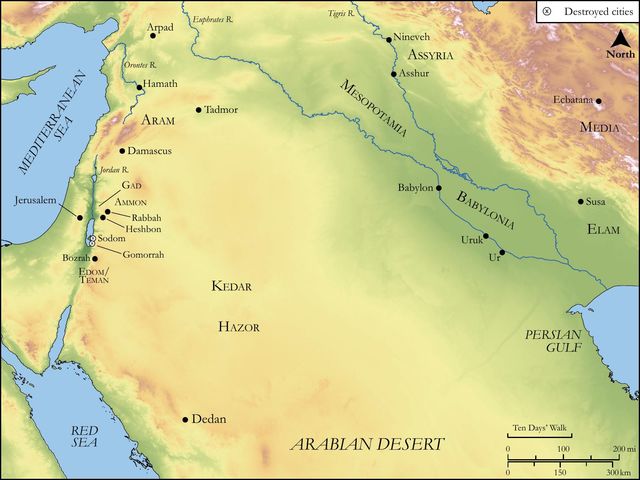
These verses foretell the desolation that Nebuchadnezzar and his forces should make among the people of Kedar (who descended from Kedar the son of Ishmael, and inhabited a part of Arabia the Stony), and of the kingdoms, the petty principalities, of Hazor, that joined to them, who perhaps were originally Canaanites, of the kingdom of Hazor, in the north of Canaan, which had Jabin for its king, but, being driven thence, settled in the deserts of Arabia and associated themselves with the Kedarenes. Concerning this people we may here observe,
I.What was their present state and posture? They dwelt in tents and had no walls, but curtains (Jer 49:20), no fortified cities; they had neither gates nor bars, Jer 49:31. They were shepherds, and had no treasures, but stock upon land, no money, but flocks and camels. They had no soldiers among them, for they were in no fear of invaders, no merchants, for they dwelt alone, Jer 49:31. Those of other nations neither came among them nor traded with them; but they lived within themselves, content with the products and pleasures of their own country. This was their manner of living, very different from that of the nations that were round about them. And,
1.They were very rich; though they had not trade, no treasures, yet they are here said to be a wealthy nation (Jer 49:31), because they had a sufficiency to answer all the occasions of human life and they were content with it. Note, Those are truly rich who have enough to supply their necessities, and know when they have enough. We need not go to the treasures of kings and provinces, or to the cash of merchants, to look for wealthy people; they may be found among shepherds that dwell in tents.
2.They were very easy: They dwelt without care. Their wealth was such as nobody envied them, or, if any did, they might come peaceably and enjoy the like; and therefore they feared nobody. Note, Those that live innocently and honestly may live very securely, though they have neither gates nor bars.
II.The design of the king of Babylon against them and the descent he make upon them:
He has taken counsel against you and has conceived a purpose against you, Jer 49:30. That proud man resolves it shall never be said that he, who had conquered so many strong cities, will leave those unconquered that dwell in tents. It was strange that that eagle should stoop to catch these flies, that so great a prince should play at such small game; but all is fish that comes to the ambitious covetous man's net. Note, It will not always secure men from suffering wrong to be able to say that they have done no wrong; not to have given offence will not be a defence against such men as Nebuchadnezzar. Yet, how unrighteous soever he was in doing it, God was righteous in directing it. These people had lived inoffensively among their neighbours, as many do, who yet, like them, are guilty before God; and it was to punish them for their offences against him that God said (Jer 49:28): Arise, go up to Kedar, and spoil the men of the east. They will do it to gratify their own covetousness and ambition, but God orders it for the correcting of an unthankful people, and for warning to a careless world to expect trouble when they seem to be most safe. God says to the Chaldeans (Jer 49:31): "Arise, get up to the wealthy nation that dwells without care; go and give them an alarm, that none may imagine their mountain stands so strong that it cannot be moved."
III.The great amazement that this put them into, and the great desolation hereby made among them:
They shall cry unto them; those on the borders shall send the alarm into all parts of the country, which shall be put into the utmost confusion by it; they shall cry, "Fear is on every side - We are surrounded by the enemy." the very terror of which shall drive them all to their feet and they shall none of them have any heart to make resistance. The enemy shall proclaim fear upon them, or against them, on every side. They need not strike a stroke; they shall shout them out of their tents, Jer 49:29. Upon the first alarm, they shall flee, get far off, and dwell deep (Jer 49:30), as the Edomites, Jer 49:8. And it will be found that this fear on every side is not groundless, for their calamity shall be brought from all sides thereof, Jer 49:32. No marvel there are fears on every side when there are foes on every side. The issue will be,
1.What they have will be a prey to the Chaldeans; they shall take to themselves their curtains and vessels; though they are but plain and coarse, and they have better of their own, yet they shall take them for spite, and spoil for spoiling sake. They shall carry away their tents and their flocks, Jer 49:29. Their camels shall be a booty to those that came for nothing else, Jer 49:32.
2.It is not said that any of them shall be slain, for they attempt not to make any resistance and their tents and flocks are accepted as a ransom for their lives; but they shall be dislodged and dispersed; though now they dwell in the utmost corners, out of the way, and therefore they think out of the reach, of danger (by this character those people were distinguished, Jer 9:26, Jer 9:25, Jer 9:23), yet they shall be scattered thence into all winds, into all parts of the world. Note, Privacy and obscurity are not always a protection and security. Many that affect to be strangers to the world may yet by unthought-of providences be forced into it; and those that live most retired may have the same lot with those that thrust themselves forth and lie most exposed.
3.Their country shall lie uninhabited; for, lying remote and out of all high roads, and having neither cities nor lands inviting to strangers, none shall care to succeed them, so that Hazor shall be a desolation for ever, Jer 49:33. If busy men be displaced, many strive to get into their placed, because they lived great; but here are easy quiet men displaced, and no man cared to abide where they did, because they lived meanly.
Continue studying Jeremiah 49:29 across the web’s major study libraries — every link below opens this exact verse, chapter, or book on the destination site.
Read & Compare
 BibleGatewayThis verse in more than 200 translations and 70 languages.
 Bible.comThe YouVersion reader — hundreds of translations, reading plans, and highlights.
 ESV.orgCrossway's official English Standard Version reader.
 NET BibleThe NET translation with 60,000+ translators' notes on every rendering decision.
 STEP BibleTyndale House's free study tool — original text, vocabulary, and scholarly resources.
 BibliaLogos Bible Software's free web reader.
 USCCBThe New American Bible (Revised Edition) with the U.S. bishops' study notes.
Commentaries
 BibleHub CommentariesDozens of classic commentaries on this verse, gathered on one page.
 StudyLightMore than 100 commentary sets — the largest collection on the web.
 BibleRefPlain-English commentary on what this verse means, verse by verse.
 Enduring WordDavid Guzik's free commentary on this chapter, widely used by Bible teachers.
 Bible Study ToolsVerse commentary alongside Greek and Hebrew study aids.
Original Language & Research
- BibleHub InterlinearThe verse word by word — original language, transliteration, and English.
- BibleHub LexiconEvery word's original-language definition and Strong's entry.
 Blue Letter BibleDeep-study tools — Strong's numbers, concordance, and word studies.
 SefariaThe Hebrew text with Rashi and centuries of Jewish commentary.
Sermons, Hymns & Audio


TrulyRandomVerse is not affiliated with these sites and doesn’t control their content. They’re linked because they’re genuinely useful.
Summary
Jeremiah 49:29 powerfully prophesies the complete and devastating judgment upon the nomadic tribes of Kedar and Hazor, depicting a scene of total plunder where their most essential possessions—tents, flocks, curtains, vessels, and camels—are seized by invaders. This comprehensive dispossession leaves them utterly destitute and culminates in a chilling declaration of overwhelming and inescapable terror, illustrating the profound psychological and existential impact of divine judgment executed through the Babylonian forces.
Context
ShowHideLiterary Context
Jeremiah 49:29 is an integral part of a series of oracles against foreign nations found in Jeremiah 46-51. Specifically, it falls within the prophecy directed at Kedar and Hazor, introduced in Jeremiah 49:28. The preceding verses establish that Nebuchadnezzar, king of Babylon, is the divinely appointed instrument for this judgment, acting as God's agent. The immediate literary progression moves from the divine command to attack to a detailed enumeration of the plunder and the resulting terror, emphasizing the thoroughness and severity of the impending destruction. This oracle serves not only as a warning to these specific tribes but also as a broader theological statement affirming God's absolute sovereignty over all nations, underscoring that none are exempt from His righteous judgment.
Historical & Cultural Context
Kedar and Hazor were significant nomadic Arab confederations inhabiting the vast desert regions to the east and south of Judah. Kedar, in particular, was renowned for its immense wealth in livestock, especially sheep and camels, and its characteristic tent-dwelling lifestyle, which defined their transient existence. Their "curtains" (yᵉrîyʻâh) refer to the often richly woven and valuable tent coverings, central to their mobile homes. "Vessels" (kᵉlîy) would encompass all their portable implements, tools, and personal effects. This prophecy unfolds during a period when the Neo-Babylonian Empire, under Nebuchadnezzar, was the dominant regional power, systematically extending its dominion and subjugating surrounding territories. For a nomadic people, the seizure of their tents, flocks, and camels represented the complete obliteration of their economic foundation, their means of survival, and their very identity, forcing them into utter destitution and displacement.
Key Themes
ShowHideThis verse powerfully contributes to several overarching themes within Jeremiah's prophetic message. Firstly, it vividly illustrates the theme of Divine Judgment on Nations, demonstrating that God's authority and justice extend far beyond Israel to encompass all peoples, holding them accountable for their pride, idolatry, or opposition to His divine purposes, as seen in the broader collection of oracles against nations in Jeremiah 49. Secondly, it underscores the Fleeting Nature of Earthly Possessions and Security. For Kedar and Hazor, their material wealth and nomadic lifestyle constituted their primary security, yet these are utterly stripped away, serving as a stark reminder of the transient nature of all material riches when confronted by divine decree. Finally, the chilling declaration of "fear on every side" highlights the theme of Inescapable Terror and Desolation that accompanies God's judgment, a concept deeply resonant with Jeremiah's own personal suffering and lament as "Magor-missabib" (terror on every side), a phrase he uses to describe his own persecution in Jeremiah 20:10.
Exposition and Analysis
ShowHideKey Word Analysis
ShowHideThis primitive root signifies "to take" in its broadest sense, encompassing actions such as accepting, bringing, buying, carrying away, seizing, or receiving. In the context of Jeremiah 49:29, its usage emphasizes a forceful and complete appropriation, highlighting the act of plunder and the total dispossession inflicted by the invaders. The repetition of verbs of taking (lâqach and nâsâʼ) throughout the verse reinforces the thoroughness of this confiscation.
Derived from a root meaning "to fear," this noun denotes a fright or terror, which can be either objective (something that causes fear) or subjective (the experience of fear itself). Here, it encapsulates the overwhelming, paralyzing dread that grips the inhabitants as their entire world is dismantled. It describes a profound emotional and psychological state of utter helplessness and despair.
This term, often used adverbially, means "around," "circuit," or "on every side." When combined with "fear" (mâgôwr), it forms the powerful and well-known idiom "Magor-missabib." This idiom vividly conveys a terror that is pervasive, inescapable, and emanating from all directions, leaving no avenue for escape, relief, or sanctuary.
Verse Breakdown
ShowHide"Their tents and their flocks shall they take away"
This opening clause immediately identifies the primary targets of the plunder: the very essence of nomadic wealth and existence. "Tents" (H168, 'ôhel) represent their homes, shelter, and the foundation of their mobile society, while "flocks" (H6629, tsôʼn) signify their livelihood, food source, and primary form of wealth and trade. The verb "take away" (H3947, lâqach) indicates a forceful, violent removal, setting the stage for complete and utter dispossession.
"they shall take to themselves their curtains, and all their vessels, and their camels;"
This clause expands upon the extent of the plunder, detailing more specific and valuable possessions. "Curtains" (H3407, yᵉrîyʻâh) refer to the woven coverings of their tents, which were often intricately made, valuable, and integral to their mobile homes. "Vessels" (H3627, kᵉlîy) encompass all their portable implements, tools, and utensils, essential for daily life and trade. "Camels" (H1581, gâmâl) were crucial for transport, trade, and even military strength in a desert environment, representing significant capital and mobility. The phrase "take to themselves" (H5375, nâsâʼ) reinforces the idea of appropriation and seizure by the invading forces.
"and they shall cry unto them, Fear [is] on every side."
This final clause shifts from the material plunder to its profound psychological and emotional impact. The "cry" (H7121, qârâʼ) suggests a desperate, perhaps pleading or wailing, outcry from the dispossessed. The declaration "Fear [is] on every side" (H4032, mâgôwr H5439, çâbîyb) is a chilling summary of their inescapable predicament. It conveys not merely that they are afraid, but that terror itself has enveloped them from every direction, leaving no sanctuary, no hope, and no possibility of escape from their dire situation.
Literary Devices
ShowHideJeremiah 49:29 masterfully employs several potent literary devices to convey its message of utter desolation and pervasive terror. The most prominent is Enumeration or Catalogue, as the verse meticulously lists the items to be plundered: "tents," "flocks," "curtains," "vessels," and "camels." This detailed listing emphasizes the thoroughness and totality of the confiscation, leaving nothing of value behind. There is also a strong sense of Imagery, painting a vivid and distressing picture of a nomadic camp being stripped bare, with the subsequent "cry" evoking the sound of their profound despair and helplessness. The concluding phrase "Fear [is] on every side" is a powerful Idiom (Hebrew: Magor-missabib), creating an atmosphere of pervasive, inescapable dread that envelops the victims. This idiom also functions as a profound Allusion or Intertextuality, echoing Jeremiah's own personal lament in Jeremiah 20:10, where he describes himself as "Magor-missabib" due to the constant threats and opposition he faced. By applying this same deeply personal phrase to Kedar and Hazor, the prophet underscores the depth of their impending doom, mirroring his own profound suffering and emphasizing the universal nature of such terror when facing divine judgment.
Theological and Thematic Connections
ShowHideJeremiah 49:29 stands as a powerful testament to God's universal sovereignty and the inevitable consequences of rebellion, pride, or opposition to His divine will, even for nations seemingly outside the direct covenant with Israel. It vividly illustrates that no people, no power, and no earthly security is beyond the reach of divine judgment. The complete stripping away of Kedar and Hazor's material wealth highlights the transient nature of all earthly security and possessions, serving as a profound reminder that true and lasting security is found not in what we accumulate or possess, but solely in our relationship with the unchanging and sovereign God. The pervasive "fear on every side" underscores the profound terror and existential dread that accompanies separation from God's favor and protection, contrasting sharply with the peace and security offered to those who trust implicitly in Him.
Reflection and Application
ShowHideJeremiah 49:29 offers a stark and enduring reminder of the impermanence of all earthly security and the ultimate accountability of all nations and individuals before a holy God. In a contemporary world where we often instinctively place our trust in financial stability, material possessions, national strength, or technological advancements, this verse challenges us to profoundly re-evaluate where our true and ultimate security truly lies. The swift and complete loss experienced by Kedar and Hazor serves as a powerful cautionary tale against relying on anything other than the unchanging character, unwavering promises, and sovereign power of God. It compels us to deeply consider whether our hearts are genuinely invested in eternal realities or merely in fleeting temporal comforts. Furthermore, the pervasive "fear on every side" described in this ancient prophecy can resonate deeply with modern anxieties and the pervasive uncertainties of our own age, prompting us to earnestly seek the profound peace that transcends all understanding, a peace that is only found in a steadfast relationship with God amidst life's inevitable uncertainties and challenges.
Questions for Reflection
ShowHideFAQ
ShowHideWho were Kedar and Hazor, and why were they singled out for judgment?
ShowHideKedar and Hazor were prominent nomadic Arab tribes located in the desert regions stretching east and south of Judah. They were known for their considerable wealth, primarily derived from their extensive livestock (especially sheep and camels), and their distinctive tent-dwelling, transient lifestyle. While the specific reasons for God's judgment against them are not explicitly detailed in Jeremiah 49:29, the broader context of Jeremiah's prophecies against foreign nations (e.g., Jeremiah 49:1-27) indicates that nations were typically judged for their pride, idolatry, violence, or their opposition to God's divine purposes, often in relation to their treatment of Israel or their general wickedness. God's judgment here serves as a powerful demonstration of His universal sovereignty over all peoples, underscoring that none are exempt from His righteous decrees.
What is the significance of the phrase "Fear [is] on every side"?
ShowHideThe phrase "Fear [is] on every side" is a direct translation of the potent Hebrew idiom Magor-missabib (מָגוֹר מִסָּבִיב). Its significance lies in conveying a terror that is not merely present but is pervasive, inescapable, and emanating from all directions, leaving absolutely no place of refuge, sanctuary, or relief. This specific phrase is famously and intimately associated with the prophet Jeremiah himself, who laments being called "Magor-missabib" by his persecutors and mockers in Jeremiah 20:10 due to the constant threats, opposition, and profound emotional distress he faced in his prophetic ministry. Its powerful application to Kedar and Hazor in this verse underscores the depth and totality of the psychological and existential impact of their impending doom, mirroring the prophet's own profound suffering and emphasizing the universal nature of such terror when confronted by divine judgment.
Christ-Centered Fulfillment
ShowHideWhile Jeremiah 49:29 vividly describes a judgment of physical desolation and pervasive terror upon a nomadic people, its Christ-centered fulfillment points us to the ultimate security and profound peace found exclusively in Jesus Christ, who delivers us from the most profound "fear on every side"—the fear of death, divine judgment, and eternal separation from God. The complete stripping away of all earthly possessions for Kedar and Hazor powerfully foreshadows the foundational truth that true and lasting security is never found in fleeting material wealth, which "moth and rust doth corrupt" (Matthew 6:19), but rather in Christ, who offers an eternal, incorruptible inheritance that can never be taken away (1 Peter 1:4). Jesus, the Lamb of God, voluntarily bore the full weight of God's righteous judgment for humanity's sin, enduring the very terror and desolation that humanity justly deserved, thereby providing a perfect and eternal refuge from the spiritual "fear on every side" that plagues those outside of Him (Romans 8:1-2). Through His sacrificial death and glorious resurrection, believers are graciously given "a spirit not of fear but of power and love and self-control" (2 Timothy 1:7), finding their true and eternal dwelling place not in temporary tents, but in the unshakeable and everlasting kingdom of God established by Christ (Hebrews 12:28).