


Jeremiah 46:5
Bible text: King James Version (1769 Blayney text) · Public domain
Bible text: King James Version with Strong's numbers · Public domain
Bible text: Berean Standard Bible · Public domain
Bible text: American Standard Version (1901) · Public domain
Bible text: World English Bible, Messianic edition · Public domain
Bible text: Geneva Bible (1599) · Public domain
Bible text: Young's Literal Translation · Public domain
- מַדּוּעַma·Du·a'why?H4069InterrogParticle Interrogative
- רָאִיתִיra·'I·tihave I seenH7200V-Qal-Perf-1csVerb Qal Perfect 1st Singular common gender
- הֵמָּהHe·mahtheyH1992Pro-3mpPronoun Personal 3rd Plural Masculine
- חַתִּיםcha·Tim[will be] terrifiedH2844Adj-mpAdjective Plural Masculine Absolute
- נְסֹגִיםne·so·Gim[they will be] turned backH5472V-Niphal-Prtcpl-mpVerb Niphal Participle Plural Masculine Absolute
- אָחוֹר'a·chOrbackwardsH268N-msNoun Singular Masculine Absolute
- וְגִבּוֹרֵיהֶםve·gi·bo·rei·Hemand their warriorsH1368Conj-w ¦ N-mpc ¦ 3mpNoun Plural Masculine Constructוְandגִבּוֹרֵיwarriorsהֶםtheir
- יֻכַּתּוּyu·Ka·tuthey will be crushedH3807V-Hophal-Imperf-3mpVerb Hophal Imperfect 3rd Plural Masculine
- וּמָנוֹסu·ma·Nosand flightH4498Conj-w ¦ N-msNoun Singular Masculine Absoluteוּandמָנוֹסflight
- נָסוּNa·suthey will fleeH5127V-Qal-Perf-3cpVerb Qal Perfect 3rd Plural common gender
- וְלֹאve·Lo'and notH3808Conj-w ¦ NegParticle Negativeוְandלֹאnot
- הִפְנוּhif·Nuthey will turn backH6437V-Hiphil-Perf-3cpVerb Hiphil Perfect 3rd Plural common gender
- מָגוֹרma·GorterrorH4032N-msNoun Singular Masculine Absolute
- מִסָּבִיבmi·sa·Viv[will be] from round aboutH5439Prep-m ¦ N-csNoun Singular common gender Absoluteמִ[will be] fromסָּבִיבround about
- נְאֻםne·'um[the] utterance ofH5002N-mscNoun Singular Masculine Construct
- יְהוָהYah·wehYahwehH3068N-properNoun Proper Title
English is a literal word-by-word gloss of the Hebrew, not the KJV's wording. Why?
This is the original text the KJV's translators worked from — each Hebrew word with its own literal English meaning in this verse, prepared by scholars at Tyndale House, Cambridge. The KJV translates whole sentences, not word by word, so its wording differs: one Hebrew word can become several English words, and the KJV may choose “the LORD” where the gloss reads “Yahweh”. Both are faithful — they answer different questions. For the KJV's own rendering, switch to the KJV text.
Details
See on the biblical-era map
Study this verse
Public-domain commentary
Matthew Henry
From his Commentary on the Whole Bible. Henry comments on passages, not single verses — this entry covers Jeremiah 46:1–12.
The first verse is the title of that part of this book, which relates to the neighbouring nations, and follows here. It is the word of the Lord which came to Jeremiah against the Gentiles; for God is King and Judge of nations, knows and will call to an account those who know him not nor take any notice of him. Both Isaiah and Ezekiel prophesied against these nations that Jeremiah here has a separate saying to, and with reference to the same events. In the Old Testament we have the word of the Lord against the Gentiles; in the New Testament we have the word of the Lord for the Gentiles, that those who were afar off are made nigh.
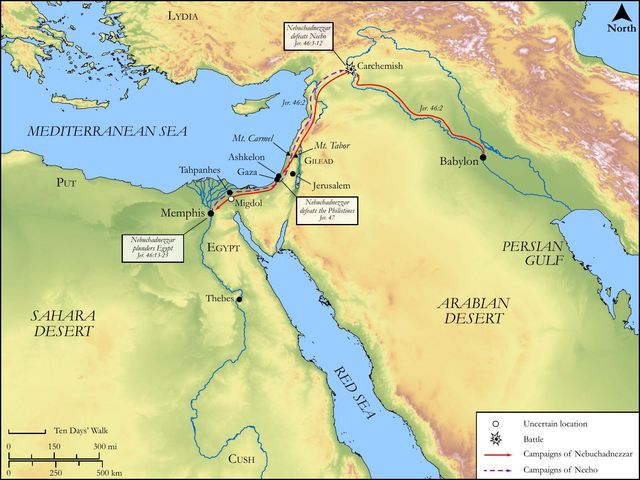
He begins with Egypt, because they were of old Israel's oppressors and of late their deceivers, when they put confidence in them. In these verses he foretells the overthrow of the army of Pharaoh-necho, by Nebuchadnezzar, in the fourth year of Jehoiakim, which was so complete a victory to the king of Babylon that thereby he recovered from the river of Egypt to the river Euphrates, all that pertained to the king of Egypt, and so weakened him that he came not again any more out of his land (as we find, Kg2 24:7), and so made him pay dearly for his expedition against the king of Assyria four years before, in which he slew Josiah, Kg2 23:29. This is the event that is here foretold in lofty expressions of triumph over Egypt thus foiled, which Jeremiah would speak of with a particular pleasure, because the death of Josiah, which he had lamented, was now avenged on Pharaoh-necho. Now here,
I.The Egyptians are upbraided with the mighty preparations they made for this expedition, in which the prophet calls to them to do their utmost, for so they would: "Come then, order the buckler, let the weapons of war be got ready," Jer 46:3. Egypt was famous for horses - let them be harnessed and the cavalry well mounted: Get up, you horsemen, and stand forth, etc., Jer 46:4. See what preparations the children of men make, with abundance of care and trouble and at a vast expense, to kill one another, as if they did not die fast enough of themselves. He compares their marching out upon this expedition to the rising of their river Nile (Jer 46:7, Jer 46:8): Egypt now rises up like a flood, scorning to keep within its own banks and threatening to overflow all the neighbouring lands. It is a very formidable army that the Egyptians bring into the field upon this occasion. The prophet summons them (Jer 46:9): Come up, you horses; rage, you chariots. He challenges them to bring all their confederate troops together, the Ethiopians, that descended from the same stock with the Egyptians (Gen 10:6), and were their neighbours and allies, the Libyans and Lydians, both seated in Africa, to the west of Egypt, and from them the Egyptians fetched their auxiliary forces. Let them strengthen themselves with all the art and interest they have, yet it shall be all in vain; they shall be shamefully defeated notwithstanding, for God will fight against them, and against him there is no wisdom nor counsel, Pro 21:30, Pro 21:31. It concerns those that go forth to war not only to order the buckler, and harness the horses, but to repent of their sins, and pray to God for his presence with them, and that they may have it to keep themselves from every wicked thing.
II.They are upbraided with the great expectations they had from this expedition, which were quite contrary to what God intended in bringing them together. They knew their own thoughts, and God knew them, and sat in heaven and laughed at them,; but they knew not the thoughts of the Lord, for he gathers them as sheaves into the floor, Mic 4:11, Mic 4:12. Egypt saith (Jer 46:8): I will go up; I will cover the earth, and none shall hinder me; I will destroy the city, whatever city it is that stands in my way. Like Pharaoh of old, I will pursue, I will overtake. The Egyptians say that they shall have a day of it, but God saith that it shall be his day: The is the day of the Lord God of hosts (Jer 46:10), the day in which he will be exalted in the overthrow of the Egyptians. They meant one thing, but God meant another; they designed it for the advancement of their dignity and the enlargement of their dominion, but God designed it for the great abasement and weakening of their kingdom. It is a day of vengeance for Josiah's death; it is a day of sacrifice to divine justice, to which multitudes of the sinners of Egypt shall fall as victims. Note, When men think to magnify themselves by pushing on unrighteous enterprises, let them expect that God will glorify himself by blasting them and cutting them off.
III.They are upbraided with their cowardice and inglorious flight when they come to an engagement (Jer 46:5, Jer 46:6):
"Wherefore have I seen them, notwithstanding all these mighty and vast preparations and all these expressions of bravery and resolution, when the Chaldean army faces them, dismayed, turned back, quite disheartened, and no spirit left in them." 1. They make a shameful retreat. Even their mighty ones, who, one would think, should have stood their ground, flee a flight, flee by consent, make the best of their way, flee in confusion and with the utmost precipitation; they have neither time nor heart to look back, but fear is round about them, for they apprehend it so. And yet, 2. They cannot make their escape. They have the shame of flying, and yet not the satisfaction of saving themselves by flight; they might as well have stood their ground and died upon the spot; for even the swift shall not flee away. The lightness of their heels shall fail them when it comes to the trial, as well as the stoutness of their hearts; the mighty shall not escape, nay, they are beaten down and broken to pieces. They shall stumble in their flight, and fall towards the north, towards their enemy's country; for such confusion were they in when they took to their feet that instead of making homeward, as men usually do in that case, they made forward. Note, The race is not to the swift nor the battle to the strong. Valiant men are not always victorious.
IV.They are upbraided with their utter inability ever to recover this blow, which should be fatal to their nation, Jer 46:11, Jer 46:12.
The damsel, the daughter of Egypt, that lived in great pomp and state, is sorely wounded by this defeat. Let her now seek for balm in Gilead and physicians there; let her use all the medicines her wise men can prescribe for the healing of this hurt, and the repairing of the loss sustained by this defeat; but all in vain; no cure shall be to them; they shall never be able to bring such a powerful army as this into the field again. "The nations that rang of thy glory and strength have now heard of thy shame, how shamefully thou wast routed and how thou are weakened by it." It needs not be spread by the triumphs of the conquerors, the shrieks and outcries of the conquered will proclaim it: Thy cry hath filled the country about. For, when they fled several ways, one mighty man stumbled upon another and dashed against another, such confusion were they in, so that both together became a pray to the pursuers, an easy prey. A thousand such dreadful accidents there should be, which should fill the country with the cry of those that were overcome. Let not the mighty man therefore glory in his might, for the time may come when it will stand him in no stead.
Continue studying Jeremiah 46:5 across the web’s major study libraries — every link below opens this exact verse, chapter, or book on the destination site.
Read & Compare
 BibleGatewayThis verse in more than 200 translations and 70 languages.
 Bible.comThe YouVersion reader — hundreds of translations, reading plans, and highlights.
 ESV.orgCrossway's official English Standard Version reader.
 NET BibleThe NET translation with 60,000+ translators' notes on every rendering decision.
 STEP BibleTyndale House's free study tool — original text, vocabulary, and scholarly resources.
 BibliaLogos Bible Software's free web reader.
 USCCBThe New American Bible (Revised Edition) with the U.S. bishops' study notes.
Commentaries
 BibleHub CommentariesDozens of classic commentaries on this verse, gathered on one page.
 StudyLightMore than 100 commentary sets — the largest collection on the web.
 BibleRefPlain-English commentary on what this verse means, verse by verse.
 Enduring WordDavid Guzik's free commentary on this chapter, widely used by Bible teachers.
 Bible Study ToolsVerse commentary alongside Greek and Hebrew study aids.
Original Language & Research
- BibleHub InterlinearThe verse word by word — original language, transliteration, and English.
- BibleHub LexiconEvery word's original-language definition and Strong's entry.
 Blue Letter BibleDeep-study tools — Strong's numbers, concordance, and word studies.
 SefariaThe Hebrew text with Rashi and centuries of Jewish commentary.
Sermons, Hymns & Audio


TrulyRandomVerse is not affiliated with these sites and doesn’t control their content. They’re linked because they’re genuinely useful.
Summary
Jeremiah 46:5 powerfully captures the ignominious and chaotic rout of the Egyptian army at the pivotal Battle of Carchemish. Through a rhetorical question, the Lord Himself highlights His direct observation and orchestration of their sudden dismay and headlong retreat, underscoring that their military collapse was not a mere misfortune but a divinely ordained judgment. The verse vividly portrays the futility of human strength and pride when confronted by God's sovereign will, revealing that even Egypt's formidable "mighty ones" were utterly overwhelmed by a pervasive, divinely-instilled fear that compelled their desperate, unthinking flight.
Context
ShowHideLiterary Context
Jeremiah 46:5 is strategically placed within Jeremiah's broader collection of oracles against foreign nations, specifically initiating the detailed prophecy concerning Egypt found in Jeremiah 46:1-26. The preceding verses (Jeremiah 46:2-4) set the scene by describing Egypt's grand preparations for battle, meticulously detailing their military readiness. However, verse 5 abruptly shifts focus, employing a rhetorical question from the Lord ("Wherefore have I seen them dismayed...?"), which immediately reveals the shocking reality of their defeat. This divine inquiry positions the military catastrophe not as a random event, but as a divinely observed and orchestrated judgment. This section serves a crucial theological purpose within the book of Jeremiah, demonstrating God's absolute sovereignty over all earthly powers and His ability to use nations—whether as instruments or objects—to fulfill His prophetic word and execute His righteous judgments, a theme consistently echoed throughout the book, as seen in His pronouncements against Judah and other surrounding peoples in Jeremiah 25.
Historical & Cultural Context
The historical backdrop for Jeremiah 46:5 is the decisive Battle of Carchemish, fought in 605 BC. This confrontation pitted the resurgent Neo-Babylonian Empire, led by the formidable Nebuchadnezzar, against the Egyptian forces under Pharaoh Necho II, who had previously asserted Egyptian influence in the Levant and defeated Judah at Megiddo. Carchemish, a strategically vital city on the Euphrates River, controlled crucial trade routes and access points between Mesopotamia and Egypt. Egypt, a long-standing regional superpower, boasted a formidable military, renowned for its chariots, archers, and disciplined infantry. Their catastrophic defeat at Carchemish marked a profound geopolitical turning point, signaling the definitive end of Egyptian imperial dominance over the nations west of the Euphrates and ushering in the undisputed ascendancy of Babylon as the preeminent regional power. For the Egyptians, this defeat was not merely a military loss but a deep humiliation, shattering their national pride and military reputation, thereby confirming Jeremiah's earlier prophecies of their impending downfall (compare Jeremiah 46:13-26).
Key Themes
ShowHideThis verse powerfully contributes to several foundational theological and narrative themes prevalent throughout the book of Jeremiah and the broader biblical narrative. Firstly, it emphatically underscores Divine Sovereignty, illustrating that God is the ultimate orchestrator of human history, possessing the power to raise up and cast down nations according to His immutable will. The utter defeat of a seemingly invincible army like Egypt's serves as irrefutable proof that no human power or strategic might can ultimately withstand God's sovereign decree. Secondly, the passage highlights the Futility of Human Strength and Pride. Despite their formidable military might, strategic preparations, and historical prowess, Egypt's "mighty ones" are utterly routed and flee in disarray, emphasizing the vanity and ultimate emptiness of trusting in chariots, horses, or human ingenuity rather than placing one's unwavering trust in the Lord (compare Psalm 20:7). Finally, the verse powerfully illustrates the theme of Inescapable Judgment. The pervasive "fear" that grips the Egyptian army is explicitly attributed to the Lord, indicating that their panic was not an accidental consequence of battle but a divinely instilled psychological weapon, ensuring their complete discomfiture and the fulfillment of the prophetic word. This divine instigation of terror is a recurring hallmark of God's judgment and intervention in battles throughout biblical history (e.g., Joshua 10:10).
Exposition and Analysis
ShowHideKey Word Analysis
ShowHideThis word, derived from a root meaning "to shatter" or "to be broken," conveys a profound sense of being crushed, terrified, or utterly broken in spirit. It describes a state far beyond simple fear, indicating a complete loss of courage, morale, and the will to resist. The Egyptian army was not merely afraid but psychologically shattered, leading directly to their desperate and disorderly flight.
This term refers to powerful warriors, champions, or elite soldiers, often implying exceptional strength and valor. In this context, its use highlights the profound irony and humiliation of Egypt's most formidable fighting men being utterly defeated and compelled to flee. It underscores the theological truth that even the pinnacle of human might and military prowess is rendered powerless and ineffective before the sovereign judgment of God.
This noun denotes a fright, terror, or dread, which can be either objective (something that causes fear) or subjective (the internal feeling of fear). When combined with the subsequent phrase "round about" (H5439, çâbîyb), it forms the powerful expression "terror on every side" or "fear from every direction." This signifies an inescapable and pervasive dread that completely enveloped the Egyptian forces, paralyzing their ability to fight, strategize, or execute an orderly retreat, ensuring their complete discomfiture.
Verse Breakdown
ShowHide"Wherefore have I seen them dismayed [and] turned away back?"
This opening clause is a rhetorical question posed directly by the Lord Himself, emphasizing His personal observation and active involvement in the Egyptian army's collapse. It implies a sense of divine astonishment at the sudden, inexplicable panic and disorderly retreat of a once-proud and formidable military force. The phrase "turned away back" vividly depicts a complete and ignominious rout, a full-scale reversal from their initial advance.
"and their mighty ones are beaten down, and are fled apace, and look not back:"
This clause graphically details the utter disarray and destruction of Egypt's elite warriors. "Beaten down" suggests a crushing, decisive defeat, not merely a strategic withdrawal. "Fled apace" (from H4498, mânôwç, meaning "a retreat" or "a fleeing") implies a desperate, headlong flight, while "look not back" powerfully paints a picture of complete, unthinking panic, where survival is the only thought, with no regard for military discipline, comrades, or dignity.
"[for] fear [was] round about, saith the LORD."
This concluding declaration provides the divine explanation for the Egyptian army's catastrophic rout. The pervasive terror that enveloped them was not a natural consequence of battle or superior enemy tactics but a supernatural instillation by the Lord Himself. The phrase "fear was round about" (Hebrew, mâgôwr çâbîyb) signifies an inescapable, all-encompassing dread that broke their spirit and led to their unthinking flight, confirming God's absolute control over the hearts and minds of men and nations, even their most formidable warriors.
Literary Devices
ShowHideJeremiah 46:5 employs several potent literary devices to convey its message of divine judgment and the futility of human might. The verse opens with a Rhetorical Question ("Wherefore have I seen them dismayed...?"), which serves to immediately draw the reader's attention to the shocking spectacle of Egypt's defeat and to underscore the Lord's direct observation and implied agency in the event. This is followed by intensely Vivid Imagery and a rapid succession of Action Verbs ("dismayed," "turned away back," "beaten down," "fled apace," "look not back"). These verbs create a dynamic, chaotic, and almost frenetic scene, effectively painting a picture of a once-proud army reduced to a terrified, disorganized mob. The phrase "fled apace, and look not back" utilizes Hyperbole to emphasize the absolute nature of their rout, suggesting a panic so profound that all military discipline, strategic thinking, and self-preservation were abandoned in favor of sheer escape. Finally, the statement "fear [was] round about, saith the LORD" employs a form of Personification where "fear" is presented as an almost tangible, encircling force that actively paralyzes the army. The concluding phrase, "saith the LORD," functions as a Divine Declaration, stamping the entire prophecy with undeniable authority and attributing the ultimate cause of Egypt's catastrophic downfall directly to God's sovereign will and judgment.
Theological and Thematic Connections
ShowHideJeremiah 46:5 stands as a profound testament to God's absolute sovereignty over the affairs of nations and the ultimate futility of human power when it presumes to oppose or ignore His will. It reveals that the rise and fall of empires are not merely products of geopolitical forces, military might, or human ingenuity, but are meticulously orchestrated by the Almighty according to His immutable divine purposes. The swift and decisive defeat of Egypt's formidable army, despite its historical prowess and strategic preparations, serves as a stark reminder that no human institution, no matter how strong, proud, or seemingly invincible, can ultimately stand against the decree of the Lord. This truth should profoundly humble humanity, redirecting our trust from temporary earthly securities and fleeting human strength to the eternal, unshakeable power and wisdom of God. The divine instillation of fear demonstrates God's ability to dismantle even the most organized and powerful forces through psychological means, proving that true strength lies not in numbers, weaponry, or human resolve, but in alignment with the divine will.
Reflection and Application
ShowHideJeremiah 46:5 offers profound and enduring lessons for contemporary believers, serving as a powerful reminder that all human power, military might, national pride, and even personal capabilities are ultimately fleeting, temporal, and subject to God's supreme authority. In a world often characterized by political instability, economic uncertainty, and the rise and fall of global powers, this verse profoundly encourages us to place our ultimate trust and security not in earthly institutions, political systems, or even our own perceived strengths and abilities, but solely in the sovereign God who holds the destiny of nations and individuals in His hands. It calls for a posture of deep humility, recognizing that true security, lasting peace, and genuine strength come only from Him. When faced with overwhelming personal challenges, societal anxieties, or global crises, this passage reminds us that the Lord can, and often does, instill fear and confusion in the hearts of adversaries, ensuring His purposes are fulfilled. Therefore, our ultimate reliance should always be on Him, rather than succumbing to fear, despair, or misplaced confidence in human solutions.
Questions for Reflection
ShowHideFAQ
ShowHideWhat was the significance of the Battle of Carchemish for Judah and Egypt?
ShowHideThe Battle of Carchemish in 605 BC was a pivotal moment in the days of Jeremiah. It marked the definitive end of Egypt's imperial dominance and the complete collapse of the remnants of the Assyrian Empire, paving the way for the unchallenged rise of the Neo-Babylonian Empire under Nebuchadnezzar. This dramatic shift in power had profound implications for Judah, which subsequently fell under Babylonian control, leading directly to the Babylonian exile as prophesied by Jeremiah (compare Jeremiah 25:9-11).
Why does God "instill fear" in armies, as described in this verse?
ShowHideGod instills fear in armies as a potent means of divine judgment and to unequivocally demonstrate His absolute sovereignty over all human endeavors. In Jeremiah 46:5, the "fear [was] round about" the Egyptian army, causing their complete and disorderly rout. This is not merely a psychological tactic but a supernatural intervention that supernaturally breaks the morale and fighting spirit of even the strongest forces. It serves to show that no human power, no matter how formidable, can stand against God's will and that He can use any means, including internal panic and confusion, to achieve His purposes and execute His judgments (compare Exodus 23:27).
How does this verse relate to God's justice and mercy?
ShowHideWhile Jeremiah 46:5 primarily highlights God's justice and judgment against a proud and often oppressive nation, it implicitly underscores His mercy towards His own covenant people. By dismantling the power of nations that oppressed or threatened Israel, God demonstrated His unwavering faithfulness to His covenant promises and His protective care for His chosen people. This act of judgment on Egypt was part of a larger, overarching divine plan that would eventually lead to the discipline of Judah, but also its ultimate restoration. God's justice is always perfectly balanced and righteous, even when its manifestation is severe, ultimately serving His redemptive purposes for humanity and His glory (compare Jeremiah 29:10-14).
Christ-Centered Fulfillment
ShowHideJeremiah 46:5, with its vivid depiction of a mighty army collapsing under divinely instilled fear and the profound futility of human strength, finds its ultimate Christ-centered fulfillment in the person and redemptive work of Jesus Christ. The very sovereignty of God, which meticulously orchestrated the fall of Egypt and the rise of Babylon, is perfectly embodied in Christ, to whom all authority in heaven and on earth has been given (compare Matthew 28:18). The "fear" that enveloped Egypt foreshadows the ultimate terror that will grip those who stand in rebellion against the Lamb of God on the day of final judgment, yet conversely, it powerfully highlights the profound peace, security, and refuge found by those who, by faith, take shelter in Him (compare Revelation 6:15-17). The "mighty ones" of Egypt, beaten down and fleeing in disarray, powerfully illustrate the absolute futility of relying on any human power, wisdom, military strength, or self-righteousness for salvation or ultimate security. Instead, all true power, victory, and salvation reside solely in Christ, who, through His crucifixion and resurrection, "disarmed the spiritual rulers and authorities" and "made a public spectacle of them, triumphing over them by the cross" (compare Colossians 2:15). His decisive victory over sin, death, and the powers of darkness is the ultimate demonstration of God's sovereignty, ensuring that no earthly or spiritual foe can ultimately stand against His eternal kingdom. In Jesus, God's justice is perfectly executed, and His redemptive plan for humanity is fully realized, offering refuge from the very "fear" that consumes those outside of His grace (compare John 16:33).