


Deuteronomy 2:25
- הַיּוֹםhai·Yomthe dayH3117Art ¦ N-msNoun Singular Masculine Absoluteהַtheיּוֹםday
- הַזֶּהha·Zeh<the> thisH2088Art ¦ PrtParticle Demonstrativeהַ<the>זֶּהthis
- אָחֵל'a·ChelI will beginH2490V-Hiphil-Imperf-1csVerb Hiphil Imperfect 1st Singular common gender
- תֵּתtetto putH5414V-Qal-InfVerb Qal Infinitive Construct
- פַּחְדְּךָpach·de·Khayour dreadH6343N-msc ¦ 2msNoun Singular Masculine Constructפַּחְדְּdreadךָyour
- וְיִרְאָתְךָve·yir·'A·te·khaand your fearH3374Conj-w ¦ N-fsc ¦ 2msNoun Singular Feminine Constructוְandיִרְאָתְfearךָyour
- עַל'alonH5921PrepPreposition
- פְּנֵיpe·Nei[the] face ofH6440N-mpcNoun Plural Masculine Construct
- הָעַמִּיםha·'a·Mimthe peoplesH5971Art ¦ N-mpNoun Plural Masculine Absoluteהָtheעַמִּיםpeoples
- תַּחַתTa·chatunderH8478N-mscNoun Singular Masculine Construct
- כָּלkolallH3605N-mscNoun Singular Masculine Construct
- הַשָּׁמָיִםha·sha·Ma·yimthe heavensH8064Art ¦ N-mpNoun Plural Masculine Absoluteהַtheשָּׁמָיִםheavens
- אֲשֶׁר'a·SherwhoH834RelParticle Relative
- יִשְׁמְעוּןyish·me·'Unthey will hear !H8085V-Qal-Imperf-3mp ¦ SfxVerb Qal Imperfect 3rd Plural Masculineיִשְׁמְעוּthey will hearן!
- שִׁמְעֲךָshim·'a·Khayour reportH8088N-msc ¦ 2msNoun Singular Masculine Constructשִׁמְעֲreportךָyour
- וְרָגְזוּve·ra·ge·Zuand they will trembleH7264Conj-w ¦ V-Qal-ConsecPerf-3cpVerb Qal Consecutive Perfect 3rd Plural common genderוְandרָגְזוּthey will tremble
- וְחָלוּve·cha·Luand they will be in anguishH2342Conj-w ¦ V-Qal-ConsecPerf-3cpVerb Qal Consecutive Perfect 3rd Plural common genderוְandחָלוּthey will be in anguish
- מִפָּנֶיךָmi·pa·Nei·kha<from> because of youH6440Prep-m ¦ N-mpc ¦ 2msNoun Plural Masculine Constructמִ<from>פָּנֶיbecause ofךָyou
English is a literal word-by-word gloss of the Hebrew, not the KJV's wording. Why?
This is the original text the KJV's translators worked from — each Hebrew word with its own literal English meaning in this verse, prepared by scholars at Tyndale House, Cambridge. The KJV translates whole sentences, not word by word, so its wording differs: one Hebrew word can become several English words, and the KJV may choose “the LORD” where the gloss reads “Yahweh”. Both are faithful — they answer different questions. For the KJV's own rendering, switch to the KJV text.
Details
See on the biblical-era map
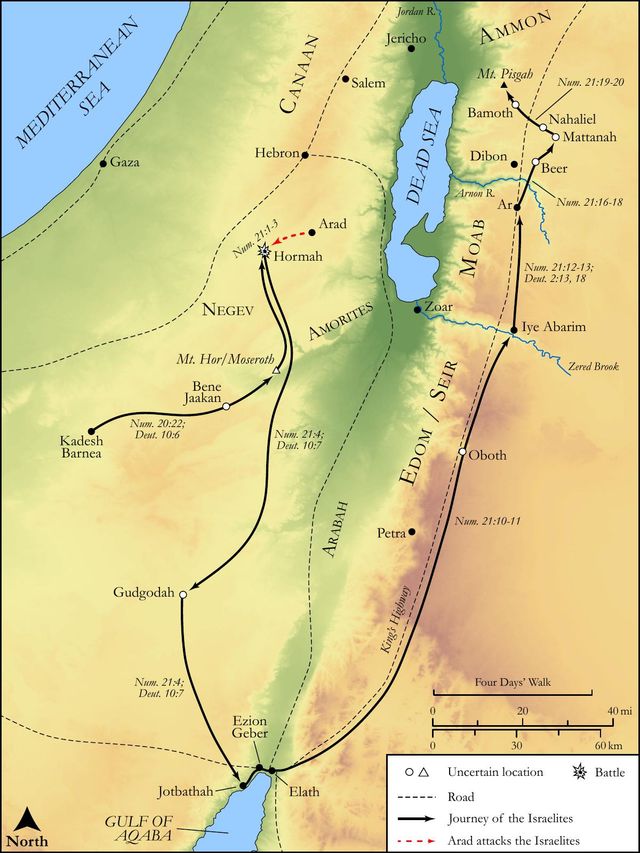
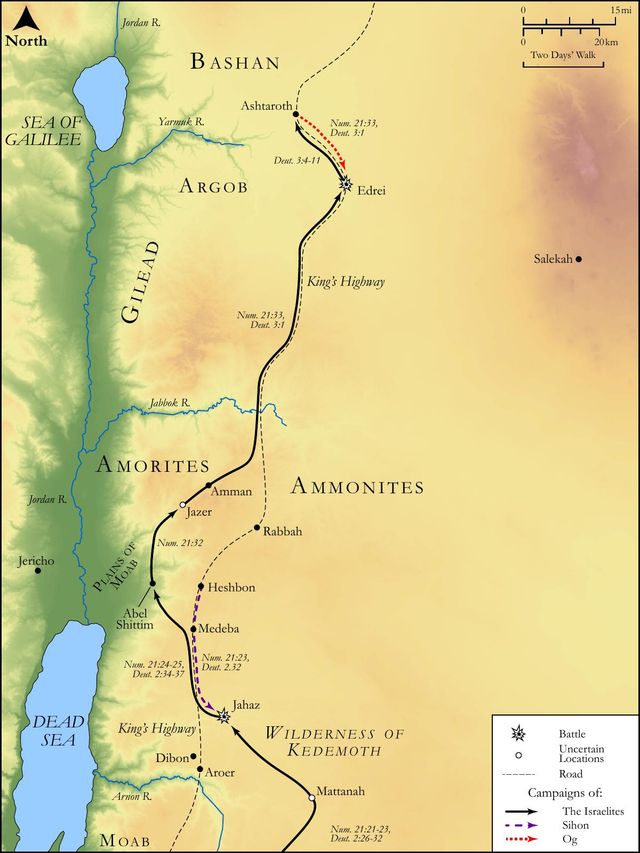
Study this verse
Public-domain commentary
Matthew Henry
From his Commentary on the Whole Bible. Henry comments on passages, not single verses — this entry covers Deuteronomy 2:24–37. His two-level outline is real structure in the source text, so it is rendered as structure.
God having tried the self-denial of his people in forbidding them to meddle with the Moabites and Ammonites, and they having quietly passed by those rich countries, and, though superior in number, not made any attack upon them, here he recompenses them for their obedience by giving them possession of the country of Sihon king of the Amorites. If we forbear what God forbids, we shall receive what he promises, and shall be no losers at last by our obedience, though it may seem for the present to be to our loss. Wrong not others, and God shall right thee.
I.God gives them commission to seize upon the country of Sihon king of Heshbon, Deu 2:24, Deu 2:25.
This was then God's way of disposing of kingdoms, but such particular grants are not now either to be expected or pretended. In this commission observe,
1.Though God assured them that the land should be their own, yet they must bestir themselves, and contend in battle with the enemy. What God gives we must endeavour to get.
2.God promises that when they fight he will fight for them. Do you begin to possess it, and I will begin to put the dread of you upon them. God would dispirit the enemy and so destroy them, would magnify Israel and so terrify all those against whom they were commissioned. See Exo 15:14.
II.Moses sends to Sihon a message of peace, and only begs a passage through his land, with a promise to give his country no disturbance, but the advantage of trading for ready money with so great a body, Deu 2:26-29. Moses herein did neither disobey God, who bade him contend with Sihon, nor dissemble with Sihon; but doubtless it was by divine direction that he did it, that Sihon might be left inexcusable, though God hardened his heart. This may illustrate the method of God's dealing with those to whom he gives his gospel, but does not give grace to believe it.
III.Sihon began the war (Deu 2:32), God having made his heart obstinate, and hidden from his eyes the thing that belonged to his peace (Deu 2:30), that he might deliver him into the hand of Israel. Those that meddle with the people of God meddle to their own hurt; and God sometimes ruins his enemies by their own resolves. See Mic 4:11-13; Rev 16:14.
IV.Israel was victorious.
1.They put all the Amorites to the sword, men, women, and children (Deu 2:33, Deu 2:34); this they did as the executioners of God's wrath; now the measure of the Amorites' iniquity was full (Gen 15:16), and the longer it was in the filling the sorer was the reckoning at last. This was one of the devoted nations. They died, not as Israel's enemies, but as sacrifices to divine justice, in the offering of which sacrifices Israel was employed, as a kingdom of priests. The case being therefore extraordinary, it ought not to be drawn into a precedent for military executions, which make no distinction and give no quarter: those will have judgment without mercy that show no mercy.
2.They took possession of all they had; their cities (Deu 2:34), their goods (Deu 2:35), and their land, Deu 2:36. The wealth of the sinner is laid up for the just. What a new world did Israel now come into! Most of them were born, and had lived all their days, in a vast howling wilderness, where they knew not what either fields or cities were, had no houses to dwell in, and neither sowed nor reaped; and now of a sudden to become masters of a country so well built, so well husbanded, this made them amends for their long waiting, and yet it was but the earnest of a great deal more. Much more joyful will the change be which holy souls will experience when they remove out of the wilderness of this world to the better country, that is, the heavenly, to the city that has foundations.
Continue studying Deuteronomy 2:25 across the web’s major study libraries — every link below opens this exact verse, chapter, or book on the destination site.
Read & Compare
 BibleGatewayThis verse in more than 200 translations and 70 languages.
 Bible.comThe YouVersion reader — hundreds of translations, reading plans, and highlights.
 ESV.orgCrossway's official English Standard Version reader.
 NET BibleThe NET translation with 60,000+ translators' notes on every rendering decision.
 STEP BibleTyndale House's free study tool — original text, vocabulary, and scholarly resources.
 BibliaLogos Bible Software's free web reader.
 USCCBThe New American Bible (Revised Edition) with the U.S. bishops' study notes.
Commentaries
 BibleHub CommentariesDozens of classic commentaries on this verse, gathered on one page.
 StudyLightMore than 100 commentary sets — the largest collection on the web.
 BibleRefPlain-English commentary on what this verse means, verse by verse.
 Enduring WordDavid Guzik's free commentary on this chapter, widely used by Bible teachers.
 Bible Study ToolsVerse commentary alongside Greek and Hebrew study aids.
Original Language & Research
- BibleHub InterlinearThe verse word by word — original language, transliteration, and English.
- BibleHub LexiconEvery word's original-language definition and Strong's entry.
 Blue Letter BibleDeep-study tools — Strong's numbers, concordance, and word studies.
 SefariaThe Hebrew text with Rashi and centuries of Jewish commentary.
Sermons, Hymns & Audio


TrulyRandomVerse is not affiliated with these sites and doesn’t control their content. They’re linked because they’re genuinely useful.
Summary
Deuteronomy 2:25 marks a profound declaration of divine intervention, where God assures Israel that He will supernaturally instill a pervasive dread and fear into the surrounding nations. This divine act is not merely a psychological tactic but a sovereign demonstration of God's power, designed to pave the way for Israel's entry into the Promised Land and to fulfill His ancient covenant promises, thereby bolstering the confidence of His people as they prepare for the imminent conquest.
Context
ShowHideLiterary Context
This declaration from God, recounted by Moses, serves as a pivotal turning point in Israel's wilderness journey. Immediately preceding this verse, the narrative details God's specific instructions to Israel regarding their peaceful passage through the territories of their kin – Edom, Moab, and Ammon – emphasizing that these lands were not for Israel to conquer or possess, as seen in passages like Deuteronomy 2:4-5. Deuteronomy 2:25 abruptly shifts the divine directive from peaceful bypass to active preparation for conquest. It sets the stage for the confrontation with King Sihon of Heshbon, which begins in Deuteronomy 2:26, signaling the commencement of the Transjordanian conquests that precede the full entry into Canaan. This verse underscores God's active orchestration of events, ensuring Israel's success as they transition from wandering to inheritance.
Historical & Cultural Context
At this juncture, Israel stands on the eastern bank of the Jordan River, poised to enter the land promised to their ancestors after forty years of wilderness wandering. The peoples mentioned, though not explicitly named in this verse, include the Amorites, Moabites, and Ammonites, who occupied strategic territories in the Transjordan region. In the ancient Near East, the reputation of a nation's deity and its military prowess often preceded its armies. However, here, the "dread" and "fear" are not merely a natural reaction to Israel's large numbers or past victories (like the Exodus), but a divinely implanted, supernatural terror. This reflects a common ancient Near Eastern motif of a patron deity fighting for its people, but uniquely, Yahweh's action is portrayed as universally impactful ("under the whole heaven"), demonstrating His unparalleled sovereignty over all nations and their leaders, setting Him apart from regional deities.
Key Themes
ShowHideDeuteronomy 2:25 powerfully illustrates several core themes. Firstly, Divine Sovereignty and Providence are paramount, as God explicitly states, "This day will I begin to put the dread of thee and the fear of thee upon the nations." This highlights His absolute control over human hearts and national destinies, actively orchestrating the circumstances for Israel's success, a theme echoed in Exodus 14:14. Secondly, it underscores God's Covenant Faithfulness, demonstrating His unwavering commitment to fulfill the ancient promises made to Abraham regarding the land, as seen in Genesis 15:18. The divinely induced fear serves as a strategic weapon in this Holy War, where Yahweh Himself acts as the Divine Warrior for His people, ensuring their path to inheritance. Finally, the verse showcases God's use of Psychological Warfare, where the mere "report" of Israel, backed by God's power, is sufficient to demoralize and weaken the resolve of formidable adversaries, paving the way for Israel's advance into the land of promise.
Exposition and Analysis
ShowHideKey Word Analysis
ShowHideThis term (H6343) denotes a sudden, overwhelming terror or panic, properly referring to the object feared, but by implication, the feeling itself. In this context, it describes a divinely induced, paralyzing fright that will seize the nations, rendering them vulnerable and incapable of effective resistance against Israel.
While yirʼâh (H3374) can encompass awe or reverence, here, in conjunction with pachad, it emphatically refers to an intense, terrifying dread. The pairing of these two terms ("dread of thee and the fear of thee") creates a powerful hendiadys, emphasizing the comprehensive, pervasive, and inescapable nature of the terror God intends to inflict upon Israel's enemies.
This word (H2342) is a primitive root meaning to twist or whirl, specifically to writhe in pain (especially of parturition) or fear. Figuratively, it conveys deep emotional and psychological consternation, a state of being overwhelmed and distressed. In this verse, it describes the profound internal turmoil and helplessness that will afflict the nations, leading to a sense of despair in the face of the impending threat.
Verse Breakdown
ShowHide"This day will I begin to put the dread of thee and the fear of thee upon the nations"
This opening clause emphasizes God's direct, immediate, and sovereign initiative. It is not Israel's military might or strategic prowess, but God's supernatural action that inaugurates the conquest of the Transjordanian territories. The deliberate use of both "dread" (pachad) and "fear" (yirʼâh) highlights the intense, pervasive, and paralyzing terror that will be supernaturally instilled, signaling the commencement of a new, divinely orchestrated phase in Israel's journey toward their inheritance.
"[that are] under the whole heaven, who shall hear report of thee"
This phrase underscores the universal scope of God's reputation and power, which will precede Israel's advance. The "report" implies that the news of God's mighty acts on behalf of Israel (e.g., the Exodus, the wilderness journey, the defeat of powerful kings) will spread far and wide, serving as the catalyst for the divinely implanted fear. This demonstrates that God's renown and the impact of His actions transcend mere geographical boundaries, reaching all peoples.
"and shall tremble, and be in anguish because of thee."
This final clause describes the tangible and visceral reactions of the nations to this divinely orchestrated fear. "Tremble" indicates a physical shaking or quaking, a loss of composure and stability. "Anguish" (chûwl) points to deep emotional and psychological distress, a writhing in pain or fear. These responses are a direct consequence of God's active intervention, designed to demoralize the adversaries, break their will to fight, and clear the path for Israel's inheritance with minimal resistance.
Literary Devices
ShowHideDeuteronomy 2:25 employs several potent literary devices to convey its message of divine power and assurance. The use of Parallelism is evident in the pairing of "dread of thee and the fear of thee," which serves to intensify the description of the supernatural terror God will inflict. Similarly, "shall tremble, and be in anguish" further emphasizes the profound and debilitating effect of this fear, creating a sense of comprehensive psychological and physical incapacitation. The phrase "under the whole heaven" functions as Hyperbole, underscoring the widespread and universal impact of God's reputation and the fear He instills, even if the immediate context is regional. The declaration "This day will I begin" is an example of Divine Fiat, highlighting God's authoritative command and immediate action in history. The entire verse also functions as a powerful Prophecy and Assurance, providing comfort and confidence to Israel by revealing God's pre-emptive divine intervention on their behalf, guaranteeing their success.
Theological and Thematic Connections
ShowHideDeuteronomy 2:25 profoundly illustrates God's active and sovereign involvement in the affairs of nations and His unwavering faithfulness to His covenant promises. This verse reveals a God who does not merely observe but actively intervenes, preparing the way for His people's inheritance not solely through their military might, but through His own supernatural power. The instilling of fear in the hearts of enemies is a recurring theme in the Old Testament, showcasing God as the ultimate warrior who fights for His people, ensuring His purposes prevail. It underscores the truth that true victory belongs to the Lord, and His reputation precedes and empowers His chosen instruments. This divine strategy minimizes the need for Israel's direct combat in certain instances, highlighting God's providential care and His desire to demonstrate His glory to all peoples.
Reflection and Application
ShowHideDeuteronomy 2:25 offers profound encouragement and a vital perspective for believers today. It reminds us that our God is not passive but actively involved in our lives and circumstances, often working behind the scenes in ways we cannot perceive. Just as He went before Israel, instilling dread in their adversaries, so too does He fight our spiritual battles, clear our paths, and overcome obstacles that seem insurmountable. This verse calls us to cultivate a deep trust in God's sovereign power and His unfailing promises, rather than relying on our own strength or strategies. When faced with daunting challenges—whether spiritual attacks, personal struggles, or societal pressures—we can find confidence in the assurance that the Lord is actively engaged on our behalf. Our obedience and faithfulness to Him can, like Israel's "report," serve as a powerful testimony to His power, causing others to take notice of His work in and through us and drawing them to Him.
Questions for Reflection
ShowHideFAQ
ShowHideWhy does God use fear as a weapon against nations?
ShowHideGod uses fear as a strategic weapon to demonstrate His absolute sovereignty, fulfill His covenant promises to Israel, and minimize the need for direct, bloody conflict for His people. By supernaturally instilling "dread" and "fear" (as declared in Deuteronomy 2:25), God shows that He is the ultimate power, capable of manipulating even the psychological state of nations. This serves to break the will of Israel's enemies, making their conquest less arduous and clearly attributing the victory to divine intervention rather than Israel's military might. It also serves as a testimony to His power, ensuring His reputation spreads "under the whole heaven," preparing the way for His people to inherit the land promised to them (e.g., Genesis 15:18).
Does this mean God will always make our enemies afraid today?
ShowHideWhile God's character as a divine warrior who fights for His people remains constant, the specific manifestation of instilling physical fear in adversaries, as seen in Deuteronomy 2:25), was uniquely tied to Israel's historical conquest of the Promised Land under the Old Covenant. For believers today, God's active support in our "battles" primarily manifests in spiritual warfare (e.g., Ephesians 6:12), providing wisdom, strength, peace, and ultimate victory over sin, death, and the devil through Christ. While God can certainly influence circumstances and hearts, the promise for New Covenant believers is not necessarily that physical adversaries will tremble, but that God will equip us for spiritual triumph and work all things for our good and His glory (e.g., Romans 8:28).
Christ-Centered Fulfillment
ShowHideDeuteronomy 2:25, with its declaration of God's pre-emptive action to instill dread and fear in the nations, finds its ultimate and most profound fulfillment in the person and work of Jesus Christ. While Israel's physical conquest of Canaan foreshadowed a greater spiritual reality, Christ's mission was to conquer not land, but the spiritual enemies of humanity: sin, death, and the devil. The "report" of Israel's God-backed advance in the Old Testament prefigures the worldwide "report" of the Gospel, which proclaims Christ's decisive victory on the cross. Through His death and resurrection, Jesus disarmed the principalities and powers, making a public spectacle of them, triumphing over them (as seen in Colossians 2:15). This ultimate conquest instilled a spiritual "dread and fear" in the realm of darkness, shattering Satan's dominion and liberating those held captive (as described in Hebrews 2:14-15). Just as God cleared the way for Israel to inherit the land, Christ, the true Joshua, clears the way for all who believe in Him to inherit eternal life and the heavenly kingdom, not through physical warfare, but through His redemptive sacrifice (see John 3:16 and 1 Peter 1:3-4). The fear instilled by God in Deuteronomy points to the awe and reverence due to Christ, who has overcome the world and secured a victory far greater than any earthly conquest, establishing His kingdom that will never be destroyed (Daniel 2:44).