


Deuteronomy 2:34
Bible text: King James Version (1769 Blayney text) · Public domain
Bible text: Berean Standard Bible · Public domain
Bible text: American Standard Version (1901) · Public domain
Bible text: World English Bible, Messianic edition · Public domain
Bible text: Geneva Bible (1599) · Public domain
Bible text: Young's Literal Translation · Public domain
- וַנִּלְכֹּדva·nil·Kodand we capturedH3920Conj-w ¦ V-Qal-ConsecImperf-1cpVerb Qal Consecutive Imperfect 1st Plural common genderוַandנִּלְכֹּדwe captured
- אֶת'et<obj.>H853DirObjMParticle Object Indicator
- כָּלkolallH3605N-mscNoun Singular Masculine Construct
- עָרָיו'a·Ravhis citiesH5892N-mpc ¦ 3msNoun Plural Masculine Constructעָרָיcitiesוhis
- בָּעֵתba·'Etat the timeH6256Prep-b ¦ N-csNoun Singular common gender Absoluteבָּat theעֵתtime
- הַהִואha·Hiv'<the> thatH1931Art ¦ Pro-3fsPronoun Personal 3rd Singular Feminineהַ<the>הִואthat
- וַנַּחֲרֵםva·na·cha·Remand we totally destroyedH2763Conj-w ¦ V-Hiphil-ConsecImperf-1cpVerb Hiphil Consecutive Imperfect 1st Plural common genderוַandנַּחֲרֵםwe totally destroyed
- אֶת'et<obj.>H853DirObjMParticle Object Indicator
- כָּלkoleveryH3605N-mscNoun Singular Masculine Construct
- עִיר'ircity ofH5892N-fscNoun Singular Feminine Construct
- מְתִםme·TimmenH4962N-mpNoun Plural Masculine Absolute
- וְהַנָּשִׁיםve·ha·na·Shimand the womenH802Conj-w ¦ Art ¦ N-mpNoun Plural Masculine Absoluteוְandהַtheנָּשִׁיםwomen
- וְהַטָּףve·ha·Tafand the little one[s]H2945Conj-w ¦ Art ¦ N-msNoun Singular Masculine Absoluteוְandהַtheטָּףlittle one[s]
- לֹאlo'notH3808NegParticle Negative
- הִשְׁאַרְנוּhish·'Ar·nuwe sparedH7604V-Hiphil-Perf-1cpVerb Hiphil Perfect 1st Plural common gender
- שָׂרִידsa·Rida survivorH8300N-msNoun Singular Masculine Absolute
English is a literal word-by-word gloss of the Hebrew, not the KJV's wording. Why?
This is the original text the KJV's translators worked from — each Hebrew word with its own literal English meaning in this verse, prepared by scholars at Tyndale House, Cambridge. The KJV translates whole sentences, not word by word, so its wording differs: one Hebrew word can become several English words, and the KJV may choose “the LORD” where the gloss reads “Yahweh”. Both are faithful — they answer different questions. For the KJV's own rendering, switch to the KJV text.
Details
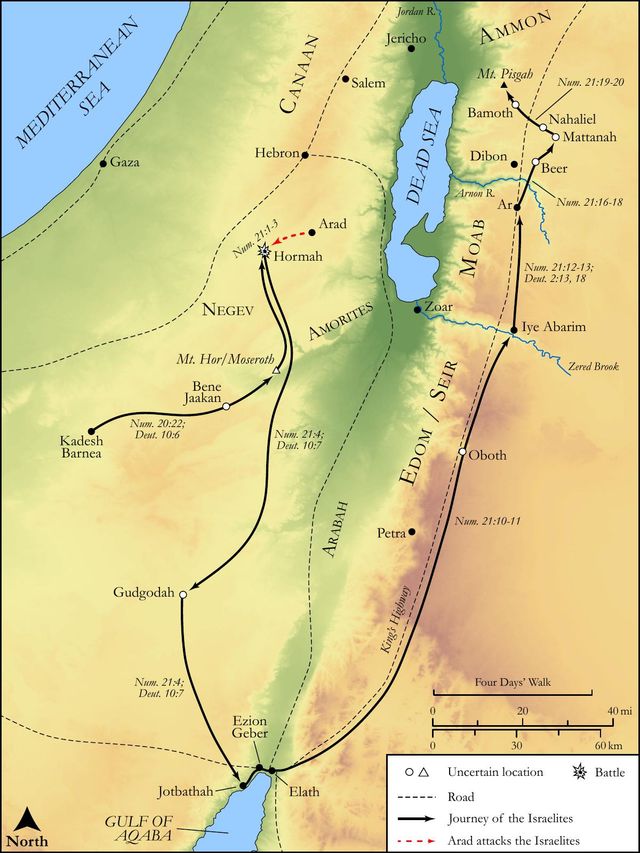
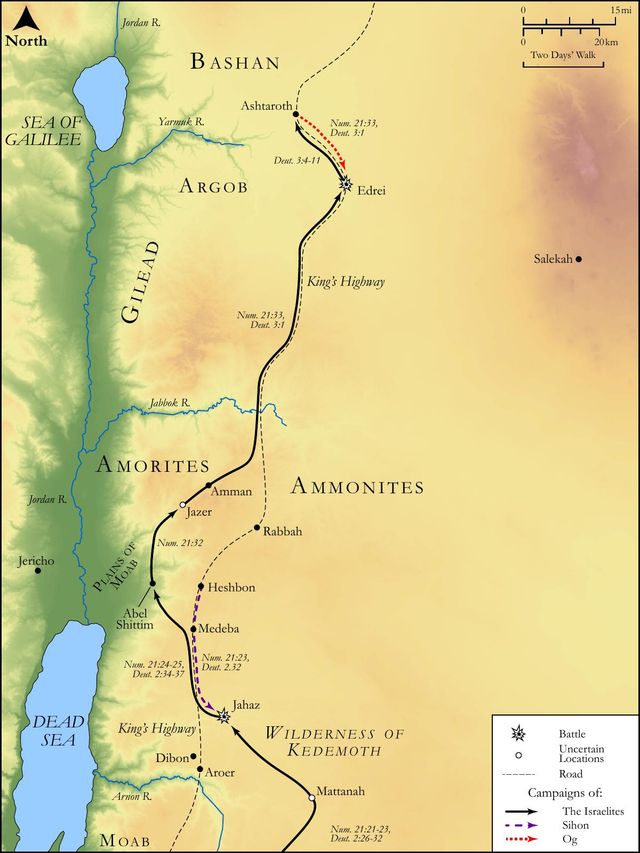
See on the biblical-era maps
Study this verse
Public-domain commentary
Matthew Henry
From his Commentary on the Whole Bible. Henry comments on passages, not single verses — this entry covers Deuteronomy 2:24–37. His two-level outline is real structure in the source text, so it is rendered as structure.
God having tried the self-denial of his people in forbidding them to meddle with the Moabites and Ammonites, and they having quietly passed by those rich countries, and, though superior in number, not made any attack upon them, here he recompenses them for their obedience by giving them possession of the country of Sihon king of the Amorites. If we forbear what God forbids, we shall receive what he promises, and shall be no losers at last by our obedience, though it may seem for the present to be to our loss. Wrong not others, and God shall right thee.
I.God gives them commission to seize upon the country of Sihon king of Heshbon, Deu 2:24, Deu 2:25.
This was then God's way of disposing of kingdoms, but such particular grants are not now either to be expected or pretended. In this commission observe,
1.Though God assured them that the land should be their own, yet they must bestir themselves, and contend in battle with the enemy. What God gives we must endeavour to get.
2.God promises that when they fight he will fight for them. Do you begin to possess it, and I will begin to put the dread of you upon them. God would dispirit the enemy and so destroy them, would magnify Israel and so terrify all those against whom they were commissioned. See Exo 15:14.
II.Moses sends to Sihon a message of peace, and only begs a passage through his land, with a promise to give his country no disturbance, but the advantage of trading for ready money with so great a body, Deu 2:26-29. Moses herein did neither disobey God, who bade him contend with Sihon, nor dissemble with Sihon; but doubtless it was by divine direction that he did it, that Sihon might be left inexcusable, though God hardened his heart. This may illustrate the method of God's dealing with those to whom he gives his gospel, but does not give grace to believe it.
III.Sihon began the war (Deu 2:32), God having made his heart obstinate, and hidden from his eyes the thing that belonged to his peace (Deu 2:30), that he might deliver him into the hand of Israel. Those that meddle with the people of God meddle to their own hurt; and God sometimes ruins his enemies by their own resolves. See Mic 4:11-13; Rev 16:14.
IV.Israel was victorious.
1.They put all the Amorites to the sword, men, women, and children (Deu 2:33, Deu 2:34); this they did as the executioners of God's wrath; now the measure of the Amorites' iniquity was full (Gen 15:16), and the longer it was in the filling the sorer was the reckoning at last. This was one of the devoted nations. They died, not as Israel's enemies, but as sacrifices to divine justice, in the offering of which sacrifices Israel was employed, as a kingdom of priests. The case being therefore extraordinary, it ought not to be drawn into a precedent for military executions, which make no distinction and give no quarter: those will have judgment without mercy that show no mercy.
2.They took possession of all they had; their cities (Deu 2:34), their goods (Deu 2:35), and their land, Deu 2:36. The wealth of the sinner is laid up for the just. What a new world did Israel now come into! Most of them were born, and had lived all their days, in a vast howling wilderness, where they knew not what either fields or cities were, had no houses to dwell in, and neither sowed nor reaped; and now of a sudden to become masters of a country so well built, so well husbanded, this made them amends for their long waiting, and yet it was but the earnest of a great deal more. Much more joyful will the change be which holy souls will experience when they remove out of the wilderness of this world to the better country, that is, the heavenly, to the city that has foundations.
Continue studying Deuteronomy 2:34 across the web’s major study libraries — every link below opens this exact verse, chapter, or book on the destination site.
Read & Compare
 BibleGatewayThis verse in more than 200 translations and 70 languages.
 Bible.comThe YouVersion reader — hundreds of translations, reading plans, and highlights.
 ESV.orgCrossway's official English Standard Version reader.
 NET BibleThe NET translation with 60,000+ translators' notes on every rendering decision.
 STEP BibleTyndale House's free study tool — original text, vocabulary, and scholarly resources.
 BibliaLogos Bible Software's free web reader.
 USCCBThe New American Bible (Revised Edition) with the U.S. bishops' study notes.
Commentaries
 BibleHub CommentariesDozens of classic commentaries on this verse, gathered on one page.
 StudyLightMore than 100 commentary sets — the largest collection on the web.
 BibleRefPlain-English commentary on what this verse means, verse by verse.
 Enduring WordDavid Guzik's free commentary on this chapter, widely used by Bible teachers.
 Bible Study ToolsVerse commentary alongside Greek and Hebrew study aids.
Original Language & Research
- BibleHub InterlinearThe verse word by word — original language, transliteration, and English.
- BibleHub LexiconEvery word's original-language definition and Strong's entry.
 Blue Letter BibleDeep-study tools — Strong's numbers, concordance, and word studies.
 SefariaThe Hebrew text with Rashi and centuries of Jewish commentary.
Sermons, Hymns & Audio


TrulyRandomVerse is not affiliated with these sites and doesn’t control their content. They’re linked because they’re genuinely useful.
Summary
Deuteronomy 2:34 encapsulates a pivotal moment in Israel's wilderness journey, recounting their decisive victory over King Sihon of Heshbon. This verse details the comprehensive conquest of Sihon's cities and the complete destruction of their inhabitants—men, women, and children—an act understood as herem, a divinely commanded devotion to destruction. Moses' recounting emphasizes this event as both a severe judgment against the Amorites' profound wickedness and a powerful demonstration of God's unwavering power and faithfulness in delivering the Promised Land to His covenant people.
Context
ShowHideLiterary Context
This verse is deeply embedded within Moses' retrospective account of Israel's forty-year wilderness wanderings, specifically detailing their initial encounters and conquests east of the Jordan River. Following a period of peaceful passage through the territories of Edom and Moab, Israel sought similar transit through the Amorite kingdom of King Sihon. Moses explicitly states their intention to adhere to a strict non-interference policy and to pay for all provisions, as outlined in Moses' request to Sihon. However, Sihon defiantly refused passage. As Deuteronomy 2:30 reveals, this refusal was divinely orchestrated: "the Lord your God hardened his spirit and made his heart obstinate, that he might give him into your hand, as he is this day." This divine intervention sets the stage for the ensuing battle and the subsequent herem action, emphasizing that the victory was not merely a military triumph but a direct fulfillment of God's sovereign plan to dispossess the wicked inhabitants and prepare the land for Israel's inheritance. The narrative then immediately transitions to the conquest of Og, King of Bashan, underscoring a consistent pattern of divinely enabled victories as Israel approaches the Promised Land.
Historical & Cultural Context
The Amorites were a prominent people, with various tribal groups inhabiting regions including Transjordan. King Sihon ruled from Heshbon, a strategically important city. The practice described in this verse, "utterly destroyed" (Hebrew: ḥāram), refers to a specific form of holy war or "devotion to destruction" commanded by God. This was not a general license for warfare or an act of wanton cruelty, but a unique, divinely mandated judgment against particular nations—especially those in Canaan—whose iniquity had reached its full measure, as God foretold in Genesis 15:16. The purpose of herem was multifaceted: it served as divine judgment against extreme idolatry, child sacrifice, and pervasive moral depravity; it prevented Israel from being corrupted by these pagan practices; and it underscored God's absolute sovereignty and holiness. This practice was distinct from the common warfare of the nations, which often involved enslavement, tribute, or assimilation, as herem explicitly forbade Israel from taking plunder or incorporating the defeated population, ensuring a radical separation for the purity of God's covenant people.
Key Themes
ShowHideThe conquest of Sihon's territory and the herem action in Deuteronomy 2:34 contribute significantly to several overarching themes in Deuteronomy and the broader Pentateuch. Firstly, it powerfully illustrates Divine Judgment and Holiness. God's absolute holiness demands a radical separation from profound evil, and the herem was a severe, yet just, response to generations of Amorite wickedness. Secondly, it highlights Obedience and Fulfillment of Promise. Israel's actions were a direct response to God's command, demonstrating their obedience and leading to the successful acquisition of territory. This victory served as a tangible sign of God's active role in fulfilling His covenant promises to Abraham and his descendants regarding the land, as seen in commands like Deuteronomy 7:2 and the broader laws of warfare in Deuteronomy 20:16-18. Thirdly, the passage underscores God's Sovereignty and Providence, revealing that even Sihon's refusal to grant passage was part of God's overarching plan to deliver him into Israel's hand. This foundational victory east of the Jordan provided crucial momentum and confidence for Israel as they prepared to enter the Promised Land to the west.
Exposition and Analysis
ShowHideKey Word Analysis
ShowHideThis primitive root means "to catch (in a net, trap or pit); generally, to capture or occupy." In this context, it signifies the military capture and occupation of Sihon's cities. It implies a decisive and complete taking of control, not merely a transient raid. The use of this word emphasizes the successful acquisition of territory as a direct outcome of the battle, highlighting God's faithfulness in delivering the land to Israel.
This crucial term means "to seclude; specifically (by a ban) to devote to religious uses (especially destruction)." When applied to warfare, as here, it signifies that the people and their possessions are irrevocably "devoted" to God for complete annihilation. This was not for Israel's personal gain or pleasure, but an act of divine judgment and consecration, ensuring the purging of severe wickedness and idolatry from the land, thereby protecting Israel from corruption. It implies a radical, uncompromising devotion to God's will.
This word refers to "a family (mostly used collectively in the singular); (little) children (ones), families." Its inclusion here emphasizes the thoroughness of the herem command, extending the judgment to all members of the population, regardless of age. While jarring to modern sensibilities, this detail underscores the radical nature of the divine judgment against the pervasive and deeply rooted wickedness of these specific Amorite inhabitants, preventing any future resurgence of their corrupting influence on Israel.
Verse Breakdown
ShowHide"And we took all his cities at that time,"
This clause establishes the immediate and comprehensive outcome of the battle with King Sihon. The "we" refers to the Israelites under Moses' leadership, highlighting their collective participation in executing God's will. "All his cities" emphasizes the totality of the conquest, signifying a complete victory over Sihon's entire dominion, not just a single stronghold. This territorial acquisition was a vital and divinely enabled step in Israel's journey towards possessing the land promised by God.
"and utterly destroyed the men, and the women, and the little ones, of every city,"
This is the core of the herem command as executed in this context. The phrase "utterly destroyed" (from ḥāram) signifies the complete annihilation of the population, including all age groups—men, women, and children. The explicit mention of "women, and the little ones" is profoundly challenging for modern readers but underscores the radical nature of the divine judgment against the pervasive and deeply ingrained wickedness of these specific Amorite inhabitants. This extreme measure was intended to prevent the spiritual and moral corruption of Israel through intermarriage, idolatry, and the adoption of abhorrent pagan practices like child sacrifice, which were characteristic of the Canaanite cultures and an abomination to God.
"we left none to remain:"
This final clause powerfully reinforces the absolute thoroughness and uncompromising nature of the herem. It serves as a stark reiteration of the command's complete execution, emphasizing that no survivors were left who could potentially re-establish the pagan culture or corrupt Israel. This complete eradication was a direct act of obedience to God's specific command for this unique historical period and context, demonstrating Israel's commitment to God's holiness and their separation from evil.
Literary Devices
ShowHideThe verse employs several powerful literary devices to convey its message and underscore the significance of the event. Repetition is prominently featured in the emphasis on totality: "all his cities" is echoed by "of every city," culminating in the definitive statement "we left none to remain." This rhetorical device amplifies the comprehensive nature of the conquest and the herem command, leaving no doubt about the thoroughness of the action. The stark, declarative statement functions as a Narrative Report, recounting a pivotal historical event with unvarnished directness, characteristic of Moses' recounting of Israel's journey. The phrase "we left none to remain" also carries an element of Hyperbole, a common feature in ancient military reports, used to convey the decisive and overwhelming nature of the victory, even if a few individuals might have escaped the immediate onslaught. More profoundly, the entire account is framed by Divine Command and Fulfillment, where God's hardening of Sihon's heart and the subsequent herem are presented as the direct execution of His sovereign will and judgment. This transforms a mere military engagement into a profound theological statement about God's justice, His holiness, and His unwavering commitment to His covenant people.
Theological and Thematic Connections
ShowHideThe conquest and herem in Deuteronomy 2:34 present a profound theological challenge, yet they are central to understanding God's character and His dealings with humanity in specific historical contexts. This passage reveals God as absolutely holy, just, and sovereign, capable of executing severe judgment against nations whose wickedness and rebellion against His moral order have reached their zenith. The herem was not an act of arbitrary cruelty but a unique, divinely ordained measure to protect the nascent nation of Israel from the pervasive moral and spiritual corruption of the Canaanite peoples, thereby preserving the purity of the covenant line through which the Messiah would eventually come. It underscores that God's patience with sin has limits, and His justice will ultimately prevail. While difficult, this account serves as a stark reminder of the gravity of sin and the seriousness of God's judgment, particularly against practices like idolatry, child sacrifice, and sexual perversion that deeply offended His holiness.
Reflection and Application
ShowHideDeuteronomy 2:34, with its depiction of total destruction, is undeniably one of the most challenging passages in the Old Testament for modern readers. It compels us to grapple with the nature of divine justice and the unique historical context of God's commands to Israel. While the specific command of herem warfare is not a universal mandate for believers today, the underlying principles of God's holiness, His intolerance for profound evil, and the necessity of radical separation from corrupting influences remain eternally relevant. For the believer, this passage calls for a spiritual herem—a decisive and uncompromising "utter destruction" of sin, idolatry, and anything that competes for God's rightful place in our lives. We are called to put to death the "old self" with its sinful desires, as exhorted in Colossians 3:5, and to wage spiritual warfare against the schemes of the enemy, leaving "none to remain" that would lead us away from Christ and His kingdom. This requires vigilance, repentance, and a radical commitment to purity and obedience, recognizing that compromise with sin can lead to spiritual corruption and separation from God. Just as Israel was commanded to clear the land for God's holy presence, we are called to purify our hearts as temples of the Holy Spirit.
Questions for Reflection
ShowHideFAQ
ShowHideWas the destruction described in Deuteronomy 2:34 an act of genocide?
ShowHideThe term "genocide" refers to the deliberate and systematic extermination of a national, ethnic, racial, or religious group. While the outcome in Deuteronomy 2:34 (the complete destruction of the Amorite population in Sihon's cities) appears similar to genocide in its thoroughness, the biblical account presents it as a unique, divinely commanded act of judgment against specific nations whose wickedness and moral depravity (including practices like child sacrifice, idolatry, and sexual perversion) had reached a critical point, as God explicitly stated in Genesis 15:16 and detailed in Leviticus 18:24-30. This was not motivated by ethnic hatred or territorial expansion for its own sake, but by God's holiness and His need to protect His covenant people, Israel, from spiritual corruption. The herem was a specific, limited command for a particular time and place, distinct from human-initiated genocide, which is always condemned in Scripture as an act of evil and a violation of God's image in humanity.
Christ-Centered Fulfillment
ShowHideWhile Deuteronomy 2:34 describes a physical act of judgment and destruction, its ultimate Christ-centered fulfillment lies in the spiritual realm, revealing God's absolute intolerance for sin and His radical provision for cleansing and new creation. Just as the herem in the Old Testament purged the land of profound evil to prepare it for God's people, Christ's work on the cross utterly "destroyed" the power of sin and death, disarming the spiritual forces of evil and triumphing over them, as described in Colossians 2:15. He is the ultimate Lamb of God who takes away the sin of the world, bearing the full judgment against human wickedness so that all who believe might be spared from eternal destruction. Furthermore, Christ's return will usher in the final, comprehensive judgment against all evil, where sin and its effects will be "utterly destroyed" from creation. In this consummation, a new heaven and new earth, "in which righteousness dwells," will be established for His redeemed people, as promised in 2 Peter 3:13 and vividly depicted in Revelation 19-21. Thus, the radical separation from evil seen in Deuteronomy 2:34 foreshadows the even more radical and complete spiritual victory and purification accomplished by Christ, both in the individual believer's life through sanctification and in the glorious consummation of His eternal kingdom.