


Deuteronomy 2:30
- וְלֹאve·Lo'and notH3808Conj-w ¦ NegParticle Negativeוְandלֹאnot
- אָבָה'a·Vahhe was willingH14V-Qal-Perf-3msVerb Qal Perfect 3rd Singular Masculine
- סִיחֹןsi·ChonSihonH5511N-proper-mNoun Proper Masculine
- מֶלֶךְMe·lekh[the] king ofH4428N-mscNoun Singular Masculine Construct
- חֶשְׁבּוֹןchesh·BonHeshbonH2809N-properNoun Proper Location
- הַעֲבִרֵנוּha·'a·vi·Re·nuto let pass usH5674V-Hiphil-Inf ¦ 1cpVerb Hiphil Infinitive Constructהַעֲבִרֵto let passנוּus
- בּוֹboin himPrep-b ¦ 3msSuffix Personal 3rd Singular Masculineבּinוֹhim
- כִּיkiforH3588PrtParticle Conditional
- הִקְשָׁהhik·Shahhe had made stubbornH7185V-Hiphil-Perf-3msVerb Hiphil Perfect 3rd Singular Masculine
- יְהוָהYah·wehYahwehH3068N-properNoun Proper Title
- אֱלֹהֶיךָ'e·lo·Hei·khayour GodH430N-mpc ¦ 2msNoun Plural Masculine ConstructאֱלֹהֶיGodךָyour
- אֶת'et<obj.>H853DirObjMParticle Object Indicator
- רוּחוֹru·Chohis spiritH7307N-fsc ¦ 3msNoun Singular Feminine Constructרוּחspiritוֹhis
- וְאִמֵּץve·'i·Metzand he had made obstinateH553Conj-w ¦ V-Piel-ConsecPerf-3msVerb Piel Consecutive Perfect 3rd Singular Masculineוְandאִמֵּץhe had made obstinate
- אֶת'et<obj.>H853DirObjMParticle Object Indicator
- לְבָבוֹle·va·Vohis heartH3824N-msc ¦ 3msNoun Singular Masculine Constructלְבָבheartוֹhis
- לְמַעַןle·Ma·'anso asH4616PrtParticle Conditional
- תִּתּוֹti·Toto give himH5414V-Qal-Inf ¦ 3msVerb Qal Infinitive Constructתִּתּto giveוֹhim
- בְיָדְךָve·ya·de·Khain your handH3027Prep-b ¦ N-csc ¦ 2msNoun Singular common gender Constructבְinיָדְhandךָyour
- כַּיּוֹםkai·Yomas the dayH3117Prep-k ¦ N-msNoun Singular Masculine Absoluteכַּas theיּוֹםday
- הַזֶּהha·Zeh<the> thisH2088Art ¦ PrtParticle Demonstrativeהַ<the>זֶּהthis
English is a literal word-by-word gloss of the Hebrew, not the KJV's wording. Why?
This is the original text the KJV's translators worked from — each Hebrew word with its own literal English meaning in this verse, prepared by scholars at Tyndale House, Cambridge. The KJV translates whole sentences, not word by word, so its wording differs: one Hebrew word can become several English words, and the KJV may choose “the LORD” where the gloss reads “Yahweh”. Both are faithful — they answer different questions. For the KJV's own rendering, switch to the KJV text.
Details
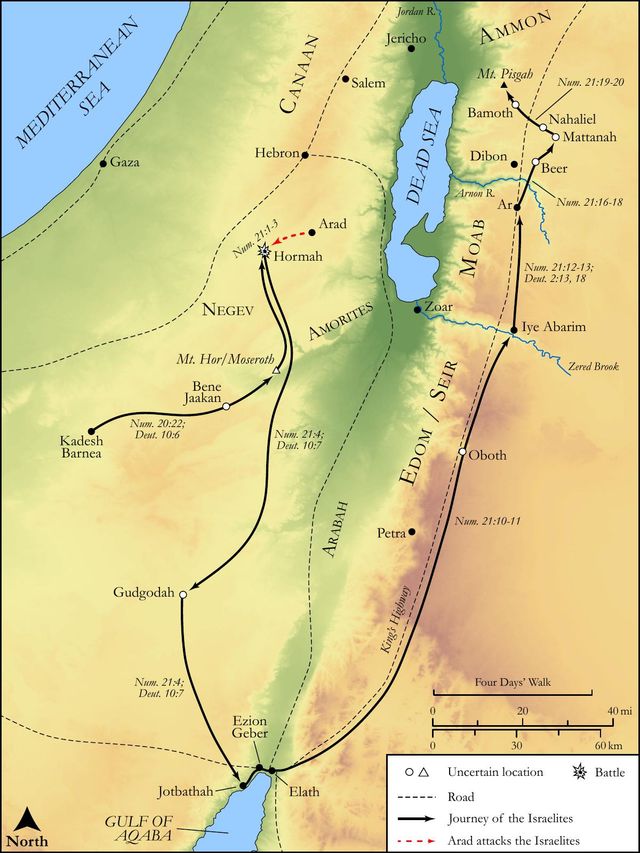
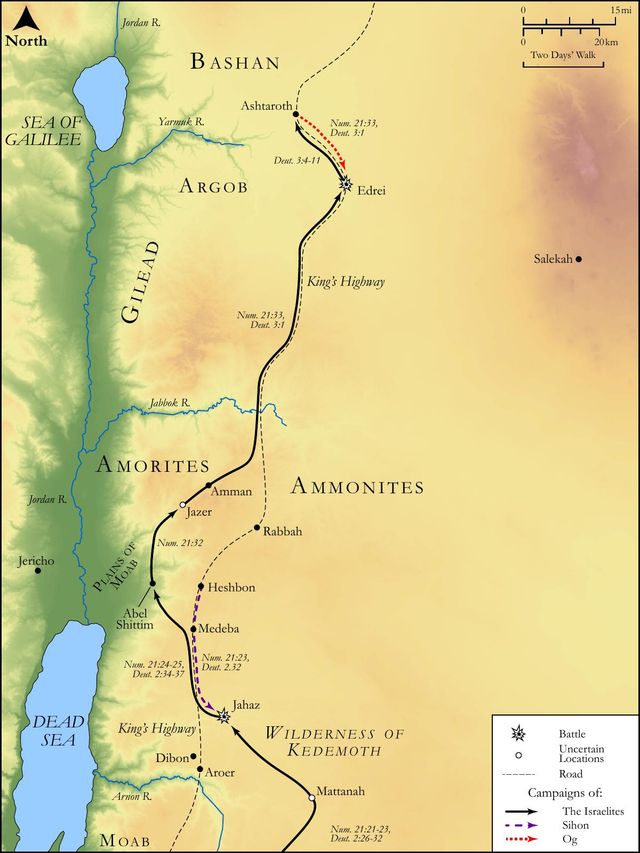
See on the biblical-era map
Study this verse
Public-domain commentary
Matthew Henry
From his Commentary on the Whole Bible. Henry comments on passages, not single verses — this entry covers Deuteronomy 2:24–37. His two-level outline is real structure in the source text, so it is rendered as structure.
God having tried the self-denial of his people in forbidding them to meddle with the Moabites and Ammonites, and they having quietly passed by those rich countries, and, though superior in number, not made any attack upon them, here he recompenses them for their obedience by giving them possession of the country of Sihon king of the Amorites. If we forbear what God forbids, we shall receive what he promises, and shall be no losers at last by our obedience, though it may seem for the present to be to our loss. Wrong not others, and God shall right thee.
I.God gives them commission to seize upon the country of Sihon king of Heshbon, Deu 2:24, Deu 2:25.
This was then God's way of disposing of kingdoms, but such particular grants are not now either to be expected or pretended. In this commission observe,
1.Though God assured them that the land should be their own, yet they must bestir themselves, and contend in battle with the enemy. What God gives we must endeavour to get.
2.God promises that when they fight he will fight for them. Do you begin to possess it, and I will begin to put the dread of you upon them. God would dispirit the enemy and so destroy them, would magnify Israel and so terrify all those against whom they were commissioned. See Exo 15:14.
II.Moses sends to Sihon a message of peace, and only begs a passage through his land, with a promise to give his country no disturbance, but the advantage of trading for ready money with so great a body, Deu 2:26-29. Moses herein did neither disobey God, who bade him contend with Sihon, nor dissemble with Sihon; but doubtless it was by divine direction that he did it, that Sihon might be left inexcusable, though God hardened his heart. This may illustrate the method of God's dealing with those to whom he gives his gospel, but does not give grace to believe it.
III.Sihon began the war (Deu 2:32), God having made his heart obstinate, and hidden from his eyes the thing that belonged to his peace (Deu 2:30), that he might deliver him into the hand of Israel. Those that meddle with the people of God meddle to their own hurt; and God sometimes ruins his enemies by their own resolves. See Mic 4:11-13; Rev 16:14.
IV.Israel was victorious.
1.They put all the Amorites to the sword, men, women, and children (Deu 2:33, Deu 2:34); this they did as the executioners of God's wrath; now the measure of the Amorites' iniquity was full (Gen 15:16), and the longer it was in the filling the sorer was the reckoning at last. This was one of the devoted nations. They died, not as Israel's enemies, but as sacrifices to divine justice, in the offering of which sacrifices Israel was employed, as a kingdom of priests. The case being therefore extraordinary, it ought not to be drawn into a precedent for military executions, which make no distinction and give no quarter: those will have judgment without mercy that show no mercy.
2.They took possession of all they had; their cities (Deu 2:34), their goods (Deu 2:35), and their land, Deu 2:36. The wealth of the sinner is laid up for the just. What a new world did Israel now come into! Most of them were born, and had lived all their days, in a vast howling wilderness, where they knew not what either fields or cities were, had no houses to dwell in, and neither sowed nor reaped; and now of a sudden to become masters of a country so well built, so well husbanded, this made them amends for their long waiting, and yet it was but the earnest of a great deal more. Much more joyful will the change be which holy souls will experience when they remove out of the wilderness of this world to the better country, that is, the heavenly, to the city that has foundations.
Historical interpretation
Historical reception
1 surviving comment on this verse from the historical church.
Hardened: That is, in punishment of his past sins he left him to his own stubborn and perverse disposition, which drew him to his ruin. See the note on Ex. 7. 3.
Continue studying Deuteronomy 2:30 across the web’s major study libraries — every link below opens this exact verse, chapter, or book on the destination site.
Read & Compare
 BibleGatewayThis verse in more than 200 translations and 70 languages.
 Bible.comThe YouVersion reader — hundreds of translations, reading plans, and highlights.
 ESV.orgCrossway's official English Standard Version reader.
 NET BibleThe NET translation with 60,000+ translators' notes on every rendering decision.
 STEP BibleTyndale House's free study tool — original text, vocabulary, and scholarly resources.
 BibliaLogos Bible Software's free web reader.
 USCCBThe New American Bible (Revised Edition) with the U.S. bishops' study notes.
Commentaries
 BibleHub CommentariesDozens of classic commentaries on this verse, gathered on one page.
 StudyLightMore than 100 commentary sets — the largest collection on the web.
 BibleRefPlain-English commentary on what this verse means, verse by verse.
 Enduring WordDavid Guzik's free commentary on this chapter, widely used by Bible teachers.
 Bible Study ToolsVerse commentary alongside Greek and Hebrew study aids.
Original Language & Research
- BibleHub InterlinearThe verse word by word — original language, transliteration, and English.
- BibleHub LexiconEvery word's original-language definition and Strong's entry.
 Blue Letter BibleDeep-study tools — Strong's numbers, concordance, and word studies.
 SefariaThe Hebrew text with Rashi and centuries of Jewish commentary.
Sermons, Hymns & Audio


TrulyRandomVerse is not affiliated with these sites and doesn’t control their content. They’re linked because they’re genuinely useful.
Summary
Deuteronomy 2:30 captures a pivotal moment in Israel's wilderness journey, revealing God's sovereign hand in the affairs of nations. It recounts King Sihon of Heshbon's refusal to grant Israel peaceful passage through his territory, a refusal explicitly attributed to the LORD's divine hardening of Sihon's spirit and heart. This divine intervention was not arbitrary but a deliberate act designed to facilitate Sihon's defeat and deliver his land into Israel's possession, thereby fulfilling God's covenant promises and clearing the path for Israel's advance towards the Promised Land.
Context
ShowHideLiterary Context
Deuteronomy 2:30 is embedded within Moses' retrospective account to the new generation of Israelites, delivered on the plains of Moab before their entry into Canaan. Chapters 1-3 provide a historical prologue, recounting key events from their departure from Horeb to their arrival at the Jordan. Specifically, this verse follows Moses' detailed instructions to the Israelites to respect the territories of Edom, Moab, and Ammon, who were distant relatives, and to purchase provisions rather than seize them. Moses recounts sending messengers with an offer of peaceful passage to King Sihon in Deuteronomy 2:26-29. Sihon's rejection of this offer, as detailed in verse 30, directly precipitates the battle and subsequent conquest of his Amorite kingdom, a critical step in Israel's acquisition of territory east of the Jordan, as further elaborated in Deuteronomy 3. This narrative serves to remind the new generation of God's faithful guidance and active involvement in their history, underscoring His active role in their journey.
Historical & Cultural Context
The events described in Deuteronomy 2:30 occurred near the end of Israel's forty-year wilderness wandering, as they approached the Transjordan region. Heshbon was the capital of the Amorite kingdom ruled by King Sihon, strategically located on a major trade route, the King's Highway. The Amorites were a powerful Semitic people who had established kingdoms in the region. Their refusal of passage was not uncommon for the time, as kingdoms often guarded their borders fiercely, viewing any large migrating group as a potential threat. However, the unique aspect here is the divine explanation for Sihon's obstinacy. God's hardening of hearts is a recurring theme in biblical narratives, often signifying a divine judgment or a means to bring about a predetermined outcome, as seen with Pharaoh in the book of Exodus. This act demonstrated God's sovereignty over pagan kings and served as a direct fulfillment of His promise to give Israel the land.
Key Themes
ShowHideDeuteronomy 2:30 powerfully illustrates several overarching themes central to the book of Deuteronomy. First and foremost is Divine Sovereignty and Providence. The verse explicitly states that God "hardened his spirit, and made his heart obstinate," underscoring that human decisions, even those of powerful kings, are ultimately subject to God's overarching plan. This highlights God's active control over history and His ability to orchestrate events for His purposes, ensuring that His will prevails. Secondly, it showcases Divine Judgment and Deliverance. Sihon's resistance, divinely influenced, served as the catalyst for his defeat, signifying God's judgment upon the Amorites and His deliverance of Israel. This act cleared the way for Israel's advancement towards their promised inheritance, as God had sworn to Abraham, Isaac, and Jacob (e.g., Genesis 15:18-21). Finally, the verse reinforces God's Faithfulness to Israel's Covenant. By delivering Sihon into their hands, God reaffirmed His unwavering commitment to bring His people into the land He had promised, demonstrating His power to overcome all obstacles for the sake of His chosen nation and to fulfill every aspect of His covenant.
Exposition and Analysis
ShowHideKey Word Analysis
ShowHideThis verb, from a root meaning "to be dense," signifies making something tough, severe, or difficult. When applied to the spirit, as here, it implies making it stubborn, stiff-necked, or unyielding. In this context, it describes God's direct, active influence in rendering Sihon's disposition rigid and unyielding to Israel's request for peaceful passage. It indicates a divine action that makes Sihon's spirit resistant to any compromise or inclination towards peace.
This verb means "to be alert," and by extension, "to be strong, firm, or resolute." When used in a negative sense, particularly concerning the heart, it denotes stubbornness, defiance, or an unchangeable resolve. Combined with "hardened," it paints a vivid picture of a king whose will was supernaturally fortified against any inclination towards peace, ensuring a confrontation that would lead to his predetermined downfall. It speaks to a resolute and unyielding will.
This common primitive root means "to give," but is used with a wide latitude of application, including "to put, set, allow, appoint, or deliver." Here, it carries the sense of God handing over Sihon and his kingdom into Israel's power and possession. It emphasizes that the victory was not merely a result of Israel's military might but a direct act of divine provision and transfer of authority, fulfilling God's promise to grant them possession of the land.
Verse Breakdown
ShowHide"But Sihon king of Heshbon would not let us pass by him:"
This clause presents the immediate human reality and the apparent obstacle to Israel's divinely ordained journey. It highlights Sihon's direct and unequivocal refusal of Israel's peaceful overture for passage, setting the stage for the profound divine explanation that immediately follows. This human decision, seemingly independent, is revealed to be part of a larger divine plan.
"for the LORD thy God hardened his spirit, and made his heart obstinate,"
This is the theological core of the verse, providing the divine rationale for Sihon's unyielding refusal. It unequivocally attributes Sihon's stubborn stance not solely to his independent will, but to the direct, active intervention of Yahweh. God's hardening of Sihon's "spirit" (his inner disposition, will, and courage) and making his "heart" (his core being, intellect, and emotions) "obstinate" means that Sihon's decision was divinely orchestrated to serve a higher purpose. This demonstrates God's absolute sovereignty over human leaders and their choices, even those of pagan kings.
"that he might deliver him into thy hand, as [appeareth] this day."
This final clause reveals the ultimate, redemptive purpose behind God's action: the delivery of Sihon and his kingdom into Israel's power. The phrase "into thy hand" is a common idiomatic expression signifying gaining control, victory, or possession over an enemy. "As [appeareth] this day" refers to the present reality for the Israelites, who had already conquered Sihon's territory, serving as a tangible, undeniable confirmation of God's faithfulness and the fulfillment of His plan. This outcome was not accidental but the intended, sovereignly determined result of God's hardening.
Literary Devices
ShowHideDeuteronomy 2:30 employs several powerful literary devices that underscore its theological message. The most prominent is Divine Causation, where the LORD is explicitly stated as the direct agent behind Sihon's actions, shifting the focus from human will to divine decree. This is reinforced by a form of Anthropomorphism, as God is described as hardening Sihon's "spirit" and "heart," using human attributes to describe divine action on the inner disposition of a person, emphasizing God's intimate involvement. There is also a strong sense of Irony: Sihon's attempt to thwart Israel's passage, driven by his divinely influenced stubbornness, paradoxically becomes the very means by which God delivers him into Israel's hands. His resistance, intended to preserve his kingdom, instead ensures its destruction and Israel's possession of the land. Furthermore, the phrase "as [appeareth] this day" functions as a Proleptic Statement or an Anachronism, as Moses is speaking of a past event whose outcome is already known and visibly present to his audience, serving as a powerful confirmation of God's word and faithfulness.
Theological and Thematic Connections
ShowHideDeuteronomy 2:30 offers profound theological insights into the nature of God and His interaction with humanity. It underscores the absolute sovereignty of God, demonstrating His ability to influence and direct the wills of even pagan kings to accomplish His divine purposes. This concept challenges a purely human-centric view of history, asserting that behind the visible political and military maneuvers lies the invisible hand of a sovereign God, orchestrating events for His glory and the fulfillment of His covenant promises. It reveals that God's judgment can manifest through the very resistance of those who oppose His will, turning their defiance into the means of their downfall and the advancement of His kingdom. This passage also highlights God's unwavering faithfulness to His people, ensuring that obstacles, even those divinely ordained, ultimately serve to clear the path for their inheritance and demonstrate His power to deliver.
Reflection and Application
ShowHideDeuteronomy 2:30 presents a challenging yet comforting truth about God's sovereignty. In a world that often feels chaotic or driven by human ambition, this verse reminds us that God remains firmly in control, actively working behind the scenes. When we face seemingly insurmountable obstacles or encounter resistance to what we believe is God's will, this passage encourages us to look beyond the immediate circumstances. It teaches us that God can use even the stubbornness of others, or the difficulties in our path, as instruments to bring about His perfect plan. This perspective fosters a deeper trust in His providence, knowing that His purposes will prevail, and He will clear the way for His people. It calls us to discern His hand in all situations, even when His methods are mysterious, and to rest in the assurance that He is faithful to His promises, always working for the good of those who love Him and are called according to His purpose, ultimately leading them to their promised inheritance.
Questions for Reflection
ShowHideFAQ
ShowHideDoes God truly harden people's hearts, or is it a metaphor for their own choices?
ShowHideDeuteronomy 2:30, like other passages (e.g., Exodus 4:21 regarding Pharaoh), explicitly states that God hardened Sihon's spirit and made his heart obstinate. While human beings are always responsible for their choices, the biblical text presents God as actively involved in the process, often in response to existing human rebellion or as a means to bring about His divine judgment and redemptive plan. It's not a metaphor but a theological statement about God's ultimate sovereignty over human will, demonstrating His ability to direct even the wicked for His purposes, without negating their culpability. This complex interplay between divine sovereignty and human responsibility is a deep theological truth, underscoring that God's will is supreme and His purposes will be accomplished.
Why would God harden someone's heart only to destroy them?
ShowHideGod's hardening of Sihon's heart was not arbitrary but served a specific purpose within His larger redemptive plan for Israel. Sihon's Amorite kingdom was part of the land God had promised to Abraham's descendants (e.g., Genesis 15:16). The hardening of Sihon's heart ensured a confrontation that led to his defeat, allowing Israel to take possession of the land as God had ordained. This act simultaneously served as a just judgment on the Amorites, whose "iniquity was not yet complete" in Abraham's day but had reached its full measure by the time of the Exodus, and as a demonstration of God's faithfulness to His covenant with Israel. It was a means to clear the way for His people and fulfill His promises, showcasing His justice and His unwavering commitment to His covenant people.
Christ-Centered Fulfillment
ShowHideDeuteronomy 2:30, with its portrayal of God's sovereign hardening and subsequent delivery of an enemy into the hands of His people, finds its ultimate and most profound fulfillment in the person and work of Jesus Christ. Just as God hardened Sihon's heart to clear the path for Israel's physical inheritance, so too did God, in His divine wisdom, allow for the hardening of hearts among certain Jewish leaders and the Gentile world to bring about the crucifixion of His Son. This seemingly tragic event was, in fact, the predetermined means of salvation for all humanity, as Peter proclaims in Acts 2:23. The cross, though appearing as a defeat for God's purposes, was the ultimate "delivery" – the delivery of sin's power, the delivery of Satan's dominion, and the delivery of humanity from eternal death. Through Christ's sacrifice, God "delivered" us from the domain of darkness and transferred us to the kingdom of His beloved Son, as beautifully articulated in Colossians 1:13-14. The stubbornness of human hearts, which led to the crucifixion, was paradoxically part of God's pre-ordained plan to "deliver" His people from a far greater enemy than Sihon: sin and death. Thus, the pattern of divine hardening leading to ultimate deliverance, seen in Deuteronomy, points forward to the supreme act of redemption accomplished through the Lamb of God, who takes away the sin of the world.