


Joshua 11:20
- כִּיkiforH3588PrtParticle Conditional
- מֵאֵתme·'Etfrom withH854Prep-m ¦ DirObjMParticle Object Indicatorמֵfromאֵתwith
- יְהוָהYah·wehYahwehH3068N-properNoun Proper Title
- הָיְתָהha·ye·Tahit wasH1961V-Qal-Perf-3fsVerb Qal Perfect 3rd Singular Feminine
- לְחַזֵּקle·cha·Zekto strengthenH2388Prep-l ¦ V-Piel-InfVerb Piel Infinitive Constructלְtoחַזֵּקstrengthen
- אֶת'et<obj.>H853DirObjMParticle Object Indicator
- לִבָּםli·Bamtheir heartH3820N-msc ¦ 3mpNoun Singular Masculine Constructלִבָּheartםtheir
- לִקְרַאתlik·Ratto meetH7122Prep-l ¦ V-Qal-InfVerb Qal Infinitive Constructלִtoקְרַאתmeet
- הַמִּלְחָמָהha·mil·cha·Mahthe battleH4421Art ¦ N-fsNoun Singular Feminine Absoluteהַtheמִּלְחָמָהbattle
- אֶת'etwithH854PrepPreposition
- יִשְׂרָאֵלYis·ra·'ElIsraelH3478N-properNoun Proper Location
- לְמַעַןle·Ma·'anso asH4616PrtParticle Conditional
- הַחֲרִימָםha·cha·ri·Mamto totally destroy themH2763V-Hiphil-Inf ¦ 3mpVerb Hiphil Infinitive Constructהַחֲרִימָto totally destroyםthem
- לְבִלְתִּיle·vil·Tito notH1115Prep-l ¦ N-csNoun Singular common gender Absoluteלְtoבִלְתִּיnot
- הֱיוֹתhe·yotto belongH1961V-Qal-InfVerb Qal Infinitive Construct
- לָהֶםla·Hemto <the> themPrep-l ¦ 3mpSuffix Personal 3rd Plural Masculineלָto <the>הֶםthem
- תְּחִנָּהte·chi·NahfavorH8467N-fsNoun Singular Feminine Absolute
- כִּיkiforH3588PrtParticle Conditional
- לְמַעַןle·Ma·'anso asH4616PrtParticle Conditional
- הַשְׁמִידָםhash·mi·Damto destroy themH8045V-Hiphil-Inf ¦ 3mpVerb Hiphil Infinitive Constructהַשְׁמִידָto destroyםthem
- כַּאֲשֶׁרka·'a·Sherjust asH834Prep-k ¦ RelParticle Relativeכַּjustאֲשֶׁרas
- צִוָּהtzi·Vahhe had commandedH6680V-Piel-Perf-3msVerb Piel Perfect 3rd Singular Masculine
- יְהוָהYah·wehYahwehH3068N-properNoun Proper Title
- אֶת'et<obj.>H853DirObjMParticle Object Indicator
- מֹשֶׁהmo·ShehMosesH4872N-proper-mNoun Proper Masculine
English is a literal word-by-word gloss of the Hebrew, not the KJV's wording. Why?
This is the original text the KJV's translators worked from — each Hebrew word with its own literal English meaning in this verse, prepared by scholars at Tyndale House, Cambridge. The KJV translates whole sentences, not word by word, so its wording differs: one Hebrew word can become several English words, and the KJV may choose “the LORD” where the gloss reads “Yahweh”. Both are faithful — they answer different questions. For the KJV's own rendering, switch to the KJV text.
Details
See on the biblical-era map
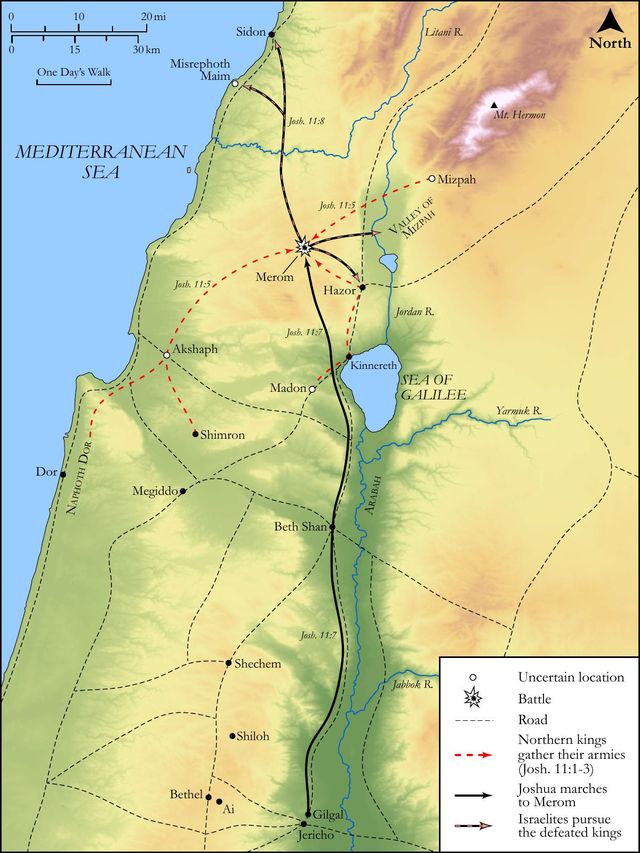
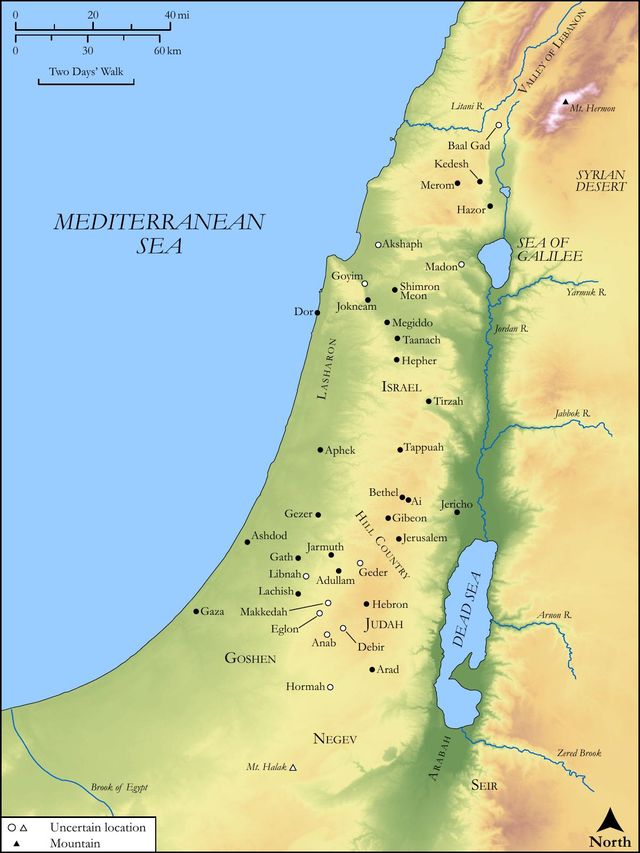
Study this verse
Public-domain commentary
Matthew Henry
From his Commentary on the Whole Bible. Henry comments on passages, not single verses — this entry covers Joshua 11:15–23. His two-level outline is real structure in the source text, so it is rendered as structure.
We have here the conclusion of this whole matter.
I.A short account is here given of what was done in four things:
- 1. The obstinacy of the Canaanites in their opposition to the Israelites. It was strange that though it appeared so manifestly that God fought for Israel, and in every engagement the Canaanites had the worst of it, yet they stood it out to the last; not one city made peace with Israel, but the Gibeonites only, who understood the things that belonged to their peace better than their neighbours, Jos 11:19. It is intimated that other cities might have made as good terms for themselves, without ragged clothes and clouted shoes, if they would have humbled themselves, but they never so much as desired conditions of peace. We here are told whence this unaccountable infatuation came: It was of the Lord to harden their hearts, Jos 11:20. As Pharaoh's heart was hardened by his own pride and wilfulness first, and afterwards by the righteous judgment of God, to his destruction, so were the hearts of these Canaanites. To punish them for all their other follies, God left them to this, to make those their enemies whom they might have made their friends. This was it that ruined them: they came against Israel in battle, and gave the first blow, and therefore might have no favour shown them. Those know not what they do who give the provocation to divine justice, or the authorized instruments of it. Are we stronger than God? Observe here, That hardness of heart is the ruin of sinners. Those that are stupid and secure, and heedless of divine warnings, are already marked for destruction. What hope is there of those concerning whom God has said, Go, make their hearts fat? 2. The constancy of the Israelites in prosecuting this war (Jos 11:18): Joshua made war a long time; some reckon it five years, others seven, that were spent in subduing this land: so long God would train up Israel to war, and give them repeated instances of his power and goodness in every new victory that he gave them. 3. The conquest of the Anakim at last, Jos 11:21, Jos 11:22. Either this was done as they met with them where they were dispersed, as some think, or rather it should seem the Anakim had retired to their fastnesses, and so were hunted out and cut off at last, after all the rest of Israel's enemies. The mountains of Judah and Israel were the habitations of those mountains of men; but not their height, nor the strength of their caves, nor the difficulty of the passes to them, could secure, no, not these mighty men, from the sword of Joshua. The cutting off of the sons of Anak is particularly mentioned because these had been such a terror to the spies forty years before, and their bulk and strength had been thought an insuperable difficulty in the way of the reducing of Canaan, Num 13:28, Num 13:33. Even that opposition which seemed invincible was got over. Never let the sons of Anak be a terror to the Israel of God, for even their day will come to fall. Giants are dwarfs to Omnipotence; yet this struggle with the Anakim was reserved for the latter end of the war, when the Israelites had become more expert in the arts of war, and had had more experience of the power and goodness of God. Note, God sometimes reserves the sharpest trials of his people by affliction and temptation for the latter end of their days. Therefore let not him that girds on the harness boast as he that puts it off. Death, that tremendous son of Anak, is the last enemy that is to be encountered; but it is to be destroyed, Co1 15:26. Thanks be to God, who will give us the victory. 4. The end and issue of this long war. The Canaanites were rooted out, not perfectly (as we shall find after in the book of Judges), but in a good measure; they were not able to make any head either, (1.) So as to keep the Israelites out of possession of the land: Joshua took all that land, Jos 11:16, Jos 11:17. And we may suppose the people dispersed themselves and their families into the countries they had conquered, at least those that lay nearest to the head-quarters at Gilgal, until an orderly distribution should be made by lot, that every man might know his own. Or, (2.) So as to keep them in action, or give them any molestation (Jos 11:23): The land rested from war. It ended not in a peace with the Canaanites (that was forbidden), but in a peace from them. There is a rest, a rest from war, remaining for the people of God, into which they shall enter when their warfare is accomplished.
II.That which was now done is here compared with that which had been said to Moses.
God's word and his works, if viewed and considered together, will mutually illustrate each other. It is here observed in the close,
1.That all the precepts God had given to Moses relating to the conquest of Canaan were obeyed on the people's part, at least while Joshua lived. See how solemnly this is remarked (Jos 11:15): As the Lord commanded Moses his servant, by whose hand the law was given, so did Moses command Joshua, for Moses was faithful, as a law-giver, to him that appointed him; he did his part, and then he died: but were the commands of Moses observed when he was in his grave? Yes, they were: So did Joshua, who was, in his place, as faithful as Moses in his. He left nothing undone (Heb. he removed nothing) of all that the Lord commanded Moses. Those that leave their duty undone do what they can to remove or make void the command of God, by which they are bound to do it; but Joshua, by performing the precept, confirmed it, as the expression is, Deu 27:26. Joshua was himself a great commander, and yet nothing was more his praise than his obedience. Those that rule others at their will must themselves be ruled by the divine will; then their power is indeed their honour, and not otherwise. The pious obedience for which Joshua is here commended respects especially the command to destroy the Canaanites, and to break down their altars and burn their images, Deu 7:2-5; Exo 23:24; Exo 34:13. Joshua, in his zeal for the Lord of hosts, spared neither the idols nor the idolaters. Saul's disobedience, or rather his partial obedience, to the command of God, for the utter destruction of the Amalekites, cost him his kingdom. It should seem Joshua himself gives this account of his most careful and punctual observance of his orders in the execution of his commission, that in all respects he had done as Moses commanded him; and then it intimates that he had more pleasure and satisfaction in reflecting upon his obedience to the commands of God in all this war, and valued himself more upon that, than upon all the gains and triumphs with which he was enriched and advanced.
2.That all the promises God had given to Moses relating to this conquest were accomplished on his part, Jos 11:23. Joshua took the whole land, conquered it, and took possession of it, according to all that the Lord said unto Moses. God had promised to drive out the nations before them (Exo 33:2; Exo 34:11), and to bring them down, Deu 9:3. And now it was done. There failed not one word of the promise. Our successes and enjoyments are then doubly sweet and comfortable to us when we see them flowing to us from the promise (this is according to what the Lord said), as our obedience is then acceptable to God when it has an eye to the precept. And, if we make conscience of our duty, we need not question the performance of the promise.
Historical interpretation
Fifteen Centuries of Reception
4 surviving comments on this verse. Each one is dated, so this reads as a timeline rather than a list.
Select a marker to jump to its quote. Markers stagger vertically where authors wrote within a few decades of each other.
For as long as the hostile powers that work sin in us do not come and incite us to sin or provoke us to fight, they cannot be killed or exterminated. For that reason, therefore, God is said in like manner to permit, even to excite, opposing powers to go out into battle against us so that we may seize the victory and they may pursue destruction.
“There was no city which the Lord did not deliver to the children of Israel, except perhaps those who lived in Gibeon. Israel violently overthrew all of them because the Lord hardened their hearts that they would fight Israel and be killed and not be shown mercy and die, just as the Lord had commanded Moses.” If it happened by the will of the Lord that Israel not receive or accept peace, then let us say with the apostle, “Why, therefore, does he object? For who can resist the will of the Lord?”
It is said that “their heart was strengthened through the Lord,” that is, that their heart was hardened, just as in the case of Pharaoh. There can be no doubt that this is justly done by a divine and lofty judgment, when God abandons someone and the enemy takes possession of him; the same applies in this case as in Pharaoh’s. But here something else sets in motion, as it is said that their hearts were emboldened to arise against Israel in war and therefore the Israelites would not show any mercy to them. The Israelites may very well have showed them mercy, if the Canaanites had not gone to war, since God had ordered that none of the Canaanites were to be spared and yet the Israelites had spared the Gibeonites because they had represented themselves as having come from a far-off country and had made a treaty with them. But because the Israelites showed mercy to some, albeit against the command of God, it must be understood that it was said with this intention that the Canaanites waged war in such a manner so that the Israelites would not spare them, nor would the Canaanites be able to convince the Israelites to show mercy and neglect God’s command. I cannot believe that this could have happened in any other way, even though Joshua was their leader and diligently obeyed all of God’s commands. Nonetheless, not even Joshua would have annihilated them so quickly had they not gone against him in such a dastardly fashion. Thus it could have happened that Joshua, taking care to fulfill God’s commandments, would have defeated them in a rather minimal way and they would have remained until the time when the Israelites could spare them after Joshua’s death, when the Israelites did not do God’s commandments with such care. For even while he was still alive the Israelites spared some Canaanites, although they subjugated them to their authority; some Canaanites, in fact, they never could conquer. But these things were not done while he was their leader but when as an old man he had retired from warfare and merely divided up the territories for the Israelites. He divided it with the intention that the Israelites would take possession of those lands that were emptied of the enemy and capture the rest by fighting, although he himself would no longer wage war. And the fact that they were able to conquer some of the Canaanites in a rather minimal way was owing to divine providence, as is clear in certain places in the Scriptures.
Hardened: This hardening of their hearts, was their having no thought of yielding or submitting: which was a sentence or judgment of God upon them in punishment of their enormous crimes.
Continue studying Joshua 11:20 across the web’s major study libraries — every link below opens this exact verse, chapter, or book on the destination site.
Read & Compare
 BibleGatewayThis verse in more than 200 translations and 70 languages.
 Bible.comThe YouVersion reader — hundreds of translations, reading plans, and highlights.
 ESV.orgCrossway's official English Standard Version reader.
 NET BibleThe NET translation with 60,000+ translators' notes on every rendering decision.
 STEP BibleTyndale House's free study tool — original text, vocabulary, and scholarly resources.
 BibliaLogos Bible Software's free web reader.
 USCCBThe New American Bible (Revised Edition) with the U.S. bishops' study notes.
Commentaries
 BibleHub CommentariesDozens of classic commentaries on this verse, gathered on one page.
 StudyLightMore than 100 commentary sets — the largest collection on the web.
 BibleRefPlain-English commentary on what this verse means, verse by verse.
 Enduring WordDavid Guzik's free commentary on this chapter, widely used by Bible teachers.
 Bible Study ToolsVerse commentary alongside Greek and Hebrew study aids.
Original Language & Research
- BibleHub InterlinearThe verse word by word — original language, transliteration, and English.
- BibleHub LexiconEvery word's original-language definition and Strong's entry.
 Blue Letter BibleDeep-study tools — Strong's numbers, concordance, and word studies.
 SefariaThe Hebrew text with Rashi and centuries of Jewish commentary.
Sermons, Hymns & Audio


TrulyRandomVerse is not affiliated with these sites and doesn’t control their content. They’re linked because they’re genuinely useful.
Summary
Joshua 11:20 offers a profound theological explanation for the persistent resistance of the Canaanite kings and peoples during the Israelite conquest, particularly in the northern campaign. It asserts that the LORD Himself divinely orchestrated the hardening of their hearts, compelling them to engage Israel in battle. This sovereign act served a specific, predetermined purpose: to ensure their utter destruction and preclude any possibility of peace or favor, thereby fulfilling the explicit commands of judgment previously given by God to Moses concerning the inhabitants of the land.
Context
ShowHideLiterary Context
This verse serves as a crucial theological interjection immediately following Joshua's decisive victory over the formidable northern coalition at the Waters of Merom, as detailed in Joshua 11:1-9. The preceding narrative highlights the overwhelming numerical and military superiority of the Canaanite forces, including chariots and horses, which were then utterly defeated by Israel, showcasing God's miraculous power and faithfulness. Joshua 11:10-15 then describes the subsequent capture and destruction of Hazor, the head of these northern kingdoms. Joshua 11:20 explains why these nations did not seek terms of peace, as some cities had (e.g., Gibeon in Joshua 9). It clarifies that their continued, unyielding opposition was not merely a matter of human stubbornness but a divinely orchestrated event designed to bring about God's righteous judgment and the complete fulfillment of His commands for the land's purification.
Historical & Cultural Context
The Canaanite nations inhabited a strategically vital land bridge, and their culture was deeply entrenched in polytheism, involving abhorrent practices such as child sacrifice (Leviticus 18:21), cultic prostitution (Deuteronomy 23:17-18), and widespread idolatry. These practices were considered an abomination to the LORD, rendering the land "unclean" and causing it to "vomit out its inhabitants" (Leviticus 18:24-25). God's command for herem (utter destruction) against certain Canaanite groups was a unique, divinely mandated act of judgment, not a general license for warfare. It was a judicial execution of nations whose "iniquity was not yet complete" in Abraham's time (Genesis 15:16), but had now reached its full measure. The hardening of their hearts ensured that this judgment, long foretold, would be fully executed without compromise, preventing the spiritual contamination of Israel.
Key Themes
ShowHideJoshua 11:20 powerfully underscores several central themes within the book of Joshua and the broader Old Testament narrative. Foremost is Divine Sovereignty, asserting God's absolute control over human will and historical outcomes. The verse explicitly states that "it was of the LORD to harden their hearts," demonstrating His active orchestration of events to fulfill His predetermined purposes, even through the resistance of His enemies. This leads directly to the theme of Divine Judgment, as the hardening served the explicit purpose "that he might destroy them utterly." This destruction was a righteous consequence of the Canaanites' profound wickedness and idolatry, a necessary act to purify the land for Israel. The phrase "as the LORD commanded Moses" highlights the theme of Fulfillment of Command, emphasizing God's unwavering faithfulness to His covenant promises and decrees, particularly the instructions for the conquest found in books like Deuteronomy 7:1-6. Finally, the statement "that they might have no favour" underscores the theme of No Mercy or Opportunity for Peace for these specific nations, signifying the finality and severity of God's judgment once their time for repentance had passed and their iniquity was full.
Exposition and Analysis
ShowHideKey Word Analysis
ShowHideFrom a primitive root meaning "to fasten upon; hence, to seize, be strong," and causatively, "to strengthen, make hard, harden." In this context, when God is the subject, it signifies a divine action that removes any inclination towards submission or peace. It does not imply that God implants evil, but rather that He withdraws grace or opportunities for a change of heart, thereby confirming the individual or nation in their chosen path of rebellion and resistance, leading to their inevitable judgment. It is a divine act that allows existing obstinacy to solidify into an unyielding stance.
This primitive root means "to seclude; specifically (by a ban) to devote to religious uses (especially destruction); to make accursed, consecrate, (utterly) destroy, devote, forfeit." It refers to the concept of herem, a unique form of holy war or consecrated destruction. Peoples or objects placed under herem were "devoted" to God, meaning they were to be completely removed from human use and either destroyed or dedicated to the sanctuary. In the context of the Canaanites, it was a divinely commanded act of judgment and purification, ensuring that their deep-seated idolatry and wickedness would not corrupt Israel. This was not mere military annihilation but a theological act of consecration and righteous judgment against egregious sin.
Verse Breakdown
ShowHide"For it was of the LORD to harden their hearts"
This opening clause immediately establishes divine initiative and sovereignty as the ultimate cause of the Canaanites' unyielding resistance. It asserts that their refusal to seek peace or surrender was not merely human stubbornness but a direct, purposeful act of God. This theological explanation removes any notion of chance or human autonomy as the primary driver of these events, pointing instead to God's overarching plan and control.
"that they should come against Israel in battle"
This clause reveals the immediate consequence and specific purpose of the hardened hearts. By removing any inclination towards peace or negotiation, God ensured that the Canaanite nations would actively engage Israel in military conflict. This confrontation was a necessary step in the divine plan for their judgment and complete destruction, preventing any partial or incomplete conquest that would leave pockets of idolatry.
"that he might destroy them utterly"
This specifies the ultimate divine purpose behind the hardening and the ensuing battle. The complete annihilation of these nations, as prescribed by the herem command, was God's righteous judgment against their profound wickedness and idolatry. This destruction was not arbitrary but a just consequence of their accumulated sin, ensuring the purification of the land and the protection of Israel from spiritual contamination.
"[and] that they might have no favour"
This phrase emphasizes the finality and severity of God's judgment. It means there was no opportunity for mercy, peace treaties, or leniency for these particular nations. Their time for repentance had passed, and their iniquity was full, leaving no room for negotiation or compromise with Israel, signifying the complete and unmitigated nature of God's wrath.
"but that he might destroy them, as the LORD commanded Moses"
This concluding phrase reiterates the purpose of destruction and, crucially, anchors it firmly in God's pre-existing commands given through Moses. This links the events of the conquest directly to the Mosaic covenant and the specific instructions found in books like Deuteronomy 20:16-18. It underscores God's unwavering faithfulness to His word and His commitment to executing His justice exactly as He declared, highlighting the continuity of His divine plan.
Literary Devices
ShowHideJoshua 11:20 employs several significant literary devices to convey its powerful theological message. The most prominent is Purpose Clause, indicated by the repeated use of "that" (לְמַעַן lema'an in Hebrew) to articulate the divine intention behind the hardening of hearts: "that they should come against Israel in battle, that he might destroy them utterly, [and] that they might have no favour, but that he might destroy them." This repetition emphasizes the deliberate and teleological nature of God's actions, revealing a clear, predetermined outcome. Repetition of the phrase "destroy them" further reinforces the absolute and comprehensive nature of the judgment. The verse also functions as a form of Theological Explanation or Divine Commentary, interrupting the narrative flow of the conquest to provide the underlying divine rationale for the events, shifting the focus from human agency to divine sovereignty. Finally, the explicit reference to "as the LORD commanded Moses" serves as an Allusion or Intertextual Reference, connecting the immediate historical events to the broader covenantal history and the foundational laws given at Sinai, thereby highlighting God's consistent character and the fulfillment of His ancient decrees.
Theological and Thematic Connections
ShowHideJoshua 11:20 presents a profound theological truth about God's absolute sovereignty, even over the wills and decisions of nations. It challenges a simplistic view of human autonomy by asserting that God can and does orchestrate circumstances, including the hardening of hearts, to accomplish His divine purposes of judgment and redemption. This does not absolve human responsibility for sin, but rather demonstrates that God can allow or even cause existing rebellion to solidify, preventing a path of peace that would thwart His righteous judgment. The verse is a stark reminder of God's holiness and justice, revealing that He is not merely a passive observer but an active participant in history, ensuring that His word is fulfilled and that unrepentant wickedness ultimately faces His righteous wrath. It compels us to grapple with the mystery of divine election and reprobation, ultimately resting in the wisdom and justice of a God whose ways are higher than our ways.
Reflection and Application
ShowHideJoshua 11:20 confronts us with the awe-inspiring and sometimes unsettling reality of God's absolute sovereignty and His righteous judgment. In a world that often seeks to minimize sin or question divine justice, this verse stands as a stark reminder of God's holiness and His intolerance for deep-seated wickedness. It compels us to recognize that God is actively involved in the affairs of humanity, orchestrating events to fulfill His ultimate purposes, even when those purposes involve severe judgment. While the specific context of herem is unique to the conquest of Canaan, the underlying principles of God's control, the seriousness of sin, and the certainty of divine judgment remain eternally relevant. This passage should cultivate in us a profound reverence for God's power and justice, prompting us to examine our own hearts and ensure we are not hardened against His truth. It encourages us to trust in His perfect wisdom, even when His ways are beyond our full comprehension, and to seek His favor while it is still available, for a time of judgment will surely come for all.
Questions for Reflection
ShowHideFAQ
ShowHideDoes God force people to sin or harden their hearts against their will?
ShowHideThe biblical concept of God hardening hearts, as seen in Joshua 11:20 and with Pharaoh in Exodus, does not typically imply that God implants evil or forces someone to act against their inherent desires. Rather, it often means God removes any restraining grace, opportunities for repentance, or the softening influence of His Spirit, thereby allowing a person's pre-existing rebellion, stubbornness, or sin to fully manifest and solidify. In the case of the Canaanites, their hearts were already deeply steeped in wickedness and idolatry (Leviticus 18:24-25). God's hardening was an act that confirmed them in their chosen path of resistance, ensuring that His righteous judgment would be fully executed without compromise, as He had commanded. It highlights God's sovereign control over even the disposition of human wills to accomplish His just purposes.
Is God unjust for commanding such destruction and hardening hearts to achieve it?
ShowHideFrom a biblical perspective, God is perfectly just and holy, and His actions are always righteous, even when they involve severe judgment. The command for herem (utter destruction) against the Canaanites was not arbitrary cruelty but a unique, divinely mandated judgment against nations whose practices were an abomination to God (e.g., child sacrifice, cultic prostitution, widespread idolatry). Their "iniquity was full" (Genesis 15:16), and they had been given centuries to repent. God's hardening of their hearts ensured that His long-foretold and righteous judgment would be carried out completely, preventing the spiritual corruption of His chosen people, Israel. This act underscores God's absolute sovereignty and His commitment to justice, demonstrating that He will not tolerate unrepentant wickedness indefinitely. It serves as a historical precedent for the certainty of God's ultimate judgment against all sin.
Christ-Centered Fulfillment
ShowHideJoshua 11:20, with its stark portrayal of divine judgment and the hardening of hearts, finds its ultimate Christ-centered fulfillment in several profound ways. The judgment meted out upon the Canaanites, a people whose hearts were hardened against God, foreshadows the universal judgment against all humanity whose hearts remain hardened in sin against their Creator. Yet, in Christ, we see the ultimate answer to this dire predicament. While the Canaanites received "no favour" and faced utter destruction, Jesus Christ is the one through whom God offers ultimate favor and mercy to a world deserving of judgment. He became the ultimate "devoted one" or herem (Galatians 3:13), bearing the curse and the wrath of God for sin on the cross, so that those who believe might receive forgiveness and eternal life. Through His sacrifice, the hardened heart of stone is replaced with a heart of flesh (Ezekiel 36:26), softened by the Holy Spirit to respond in faith and repentance, rather than being hardened unto destruction. Thus, the terrifying justice of God displayed in Joshua 11:20 ultimately points to the glorious grace of God revealed in John 1:29 and offers the only path to escape the final, eternal judgment.