


Exodus 4:21
- וַיֹּאמֶרvai·Yo·merand he saidH559Conj-w ¦ V-Qal-ConsecImperf-3msVerb Qal Consecutive Imperfect 3rd Singular Masculineוַandיֹּאמֶרhe said
- יְהוָהYah·wehYahwehH3068N-properNoun Proper Title
- אֶל'eltoH413PrepPreposition
- מֹשֶׁהmo·ShehMosesH4872N-proper-mNoun Proper Masculine
- בְּלֶכְתְּךָbe·lekh·te·Khawhen going youH1980Prep-b ¦ V-Qal-Inf ¦ 2msVerb Qal Infinitive Constructבְּwhenלֶכְתְּgoingךָyou
- לָשׁוּבla·Shuvto returnH7725Prep-l ¦ V-Qal-InfVerb Qal Infinitive Constructלָtoשׁוּבreturn
- מִצְרַיְמָהmitz·Ray·mahEgypt towardsH4714N-proper ¦ SfxNoun Proper LocationמִצְרַיְמָEgyptהtowards
- רְאֵהre·'EhseeH7200V-Qal-Imp-2msVerb Qal Imperative 2nd Singular Masculine
- כָּלkolallH3605N-mscNoun Singular Masculine Construct
- הַמֹּפְתִיםha·mo·fe·Timthe wondersH4159Art ¦ N-mpNoun Plural Masculine Absoluteהַtheמֹּפְתִיםwonders
- אֲשֶׁר'a·SherwhichH834RelParticle Relative
- שַׂמְתִּיSam·tiI have putH7760V-Qal-Perf-1csVerb Qal Perfect 1st Singular common gender
- בְיָדֶךָve·ya·De·khain your handH3027Prep-b ¦ N-csc ¦ 2msNoun Singular common gender Constructבְinיָדֶhandךָyour
- וַעֲשִׂיתָםva·'a·si·Tamand you will do themH6213Conj-w ¦ V-Qal-ConsecPerf-2ms ¦ 3mpVerb Qal Consecutive Perfect 2nd Singular Masculineוַandעֲשִׂיתָyou will doםthem
- לִפְנֵיlif·Nei<to> beforeH6440Prep-l ¦ N-mpcNoun Plural Masculine Constructלִ<to>פְנֵיbefore
- פַרְעֹהfar·'OhPharaohH6547N-msNoun Title Singular Masculine Absolute
- וַאֲנִיva·'a·Niand IH589Conj-w ¦ Pro-1csPronoun Personal 1st Singular common genderוַandאֲנִיI
- אֲחַזֵּק'a·cha·ZekI will make strongH2388V-Piel-Imperf-1csVerb Piel Imperfect 1st Singular common gender
- אֶת'et<obj.>H853DirObjMParticle Object Indicator
- לִבּוֹli·Bohis heartH3820N-msc ¦ 3msNoun Singular Masculine Constructלִבּheartוֹhis
- וְלֹאve·Lo'and notH3808Conj-w ¦ NegParticle Negativeוְandלֹאnot
- יְשַׁלַּחye·sha·Lachhe will let goH7971V-Piel-Imperf-3msVerb Piel Imperfect 3rd Singular Masculine
- אֶת'et<obj.>H853DirObjMParticle Object Indicator
- הָעָםha·'Amthe peopleH5971Art ¦ N-msNoun Singular Masculine Absoluteהָtheעָםpeople
English is a literal word-by-word gloss of the Hebrew, not the KJV's wording. Why?
This is the original text the KJV's translators worked from — each Hebrew word with its own literal English meaning in this verse, prepared by scholars at Tyndale House, Cambridge. The KJV translates whole sentences, not word by word, so its wording differs: one Hebrew word can become several English words, and the KJV may choose “the LORD” where the gloss reads “Yahweh”. Both are faithful — they answer different questions. For the KJV's own rendering, switch to the KJV text.
Details
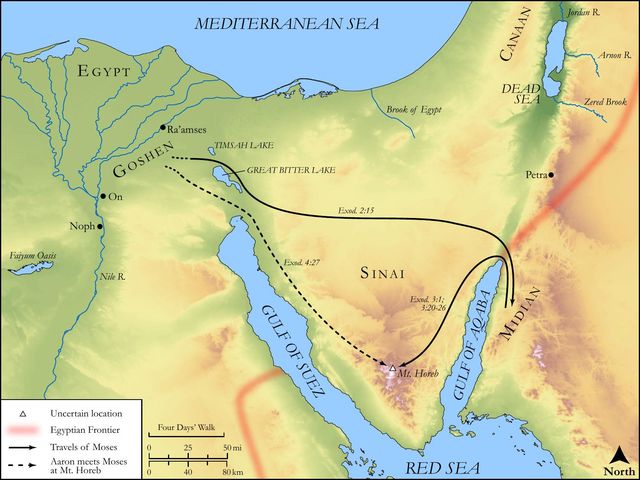
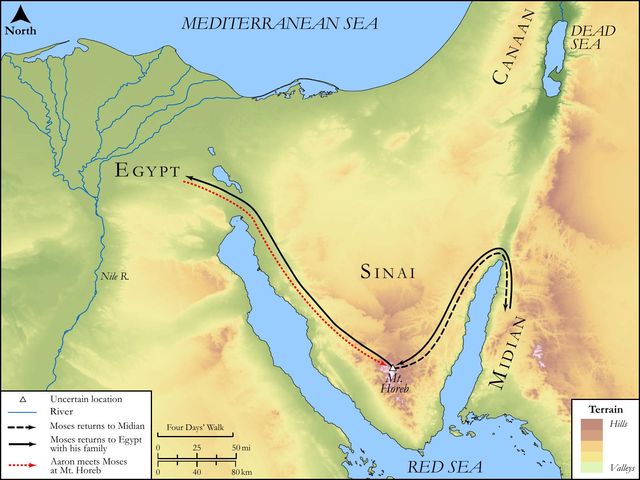
See on the biblical-era map

Study this verse
Public-domain commentary
Matthew Henry
From his Commentary on the Whole Bible. Henry comments on passages, not single verses — this entry covers Exodus 4:18–23. His three-level outline is real structure in the source text, so it is rendered as structure.
Here, I. Moses obtains leave of his father-in-law to return into Egypt, Exo 4:18. His father-in-law had been kind to him when he was a stranger, and therefore he would not be so uncivil as to leave his family, nor so unjust as to leave his service, without giving him notice. Note, The honour of being admitted into communion with God, and of being employed for him, does not exempt us from the duties of our relations and callings in this world. Moses said nothing to his father-in-law (for aught that appears) of the glorious manifestation of God to him; such favours we are to be thankful for to God, but not to boast of before men.
II.He receives from God further encouragements and directions in his work.
After God had appeared to him in the bush to settle a correspondence, it should seem, he often spoke to him, as there was occasion, with less overwhelming solemnity. And,
1.He assures Moses that the coasts were clear. Whatever new enemies he might make by his undertaking, his old enemies were all dead, all that sought his life, Exo 4:19. Perhaps some secret fear of falling into their hands was at the bottom of Moses's backwardness to go to Egypt, though he was not willing to own it, but pleaded unworthiness, insufficiency, want of elocution, etc. Note, God knows all the temptations his people lie under, and how to arm them against their secret fears, Psa 142:3.
2.He orders him to do the miracles, not only before the elders of Israel, but before Pharaoh, Exo 4:21. There were some alive perhaps in the court of Pharaoh who remembered Moses when he was the son of Pharaoh's daughter, and had many a time called him a fool for deserting the honours of that relation; but he is now sent back to court, clad with greater powers than Pharaoh's daughter could have advanced him to, so that it might appear he was no loser by his choice: this wonder-working rod did more adorn the hand of Moses than the sceptre of Egypt could have done. Note, Those that look with contempt upon worldly honours shall be recompensed with the honour that cometh from God, which is the true honour.
3.That Pharaoh's obstinacy might be no surprise nor discouragement to him, God tells him before that he would harden his heart. Pharaoh had hardened his own heart against the groans and cries of the oppressed Israelites, and shut up the bowels of his compassion from them; and now God, in a way of righteous judgment, hardens his heart against the conviction of the miracles, and the terror of the plagues. Note, Ministers must expect with many to labour in vain: we must not think it strange if we meet with those who will not be wrought upon by the strongest arguments and fairest reasonings; yet our judgment is with the Lord.
4.Words are put into his mouth with which to address Pharaoh, Exo 4:22, Exo 4:23. God had promised him (Exo 4:12), I will teach thee what thou shalt say; and here he does teach him.
(1.)He must deliver his message in the name of the great Jehovah: Thus saith the Lord; this is the first time that preface is used by any man which afterwards is used so frequently by all the prophets: whether Pharaoh will hear, or whether he will forbear, Moses must tell him, Thus saith the Lord.
(2.)He must let Pharaoh know Israel's relation to God, and God's concern for Israel. Is Israel a servant? is he a home-born slave? Jer 2:14. "No, Israel is my son, my firstborn, precious in my sight, honourable, and dear to me, not to be thus insulted and abused." (3.) He must demand a discharge for them: "Let my son go; not only my servant whom thou hast no right to detain, but my son whose liberty and honour I am very jealous for. It is my son, my son that serves me, and therefore must be spared, must be pleaded for," Mal 3:17. (4.) He must threaten Pharaoh with the death of the first-born of Egypt, in case of a refusal: I will slay thy son, even thy firstborn. As men deal with God's people, let them expect to be themselves dealt with; with the froward he will wrestle.
III.Moses addresses himself to this expedition.
When God had assured him (Exo 4:19) that the men were dead who sought his life, immediately it follows (Exo 4:20), he took his wife, and his sons, and set out for Egypt. Note, Though corruption may object much against the services God calls us to, yet grace will get the upper hand, and will be obedient to the heavenly vision.
Historical interpretation
Fifteen Centuries of Reception
4 surviving comments on this verse. Each one is dated, so this reads as a timeline rather than a list.
Select a marker to jump to its quote. Markers stagger vertically where authors wrote within a few decades of each other.
Now many have been troubled by the story of Pharaoh, in dealing with whom God says several times, “I will harden Pharaoh’s heart.” For if he is hardened by God and through being hardened sins, he is not himself responsible for the sin; and if this is so, Pharaoh has no free will. And someone will say that in the same way those who are lost have no free will and will not be lost on their own account. Also the saying in Ezekiel, “I will take away their stony hearts and will put in them hearts of flesh, that they may walk in my statutes and keep my judgments,” might lead one to suppose that it was God who gave the power to walk in the commandments and to keep the judgments, by his removing the hindrance, the stony heart, and implanting something better, the heart of flesh.
And you must not deny free will to Pharaoh just because God says in a number of places, “I have hardened Pharaoh” or “I will harden the heart of Pharaoh,” for it does not thereby follow that it was not Pharaoh himself that hardened his own heart. Furthermore, we read that this happened to Pharaoh after the plague of flies had been removed from the Egyptians, as the Scripture testifies: “And Pharaoh’s heart was hardened so that neither this time would he let the people go.” Thus it was that both God and Pharaoh caused this hardening of the heart: God, by his just judgments, Pharaoh, by his free will.
Now let no one along with pagans or Manichaeans dare to censure or blame the justice of God. It is to be believed as most certain that not the violence of God but his own repeated wickedness and indomitable pride in opposition to God’s commands caused Pharaoh to become hardened. What does that mean which God said, “I will make him obstinate,” except that when my grace is withdrawn from him his own iniquity will harden him? In order that this may be known more clearly, we propose to your charity a comparison with visible things. As often as water is contracted by excessive cold, if the heat of the sun comes upon it, it becomes melted; when the same sun departs the water again becomes hard. Similarly the charity of many men freezes because of the excessive coldness of their sins, and they become as hard as ice; however, when the warmth of divine mercy comes upon them again, they are melted.
I shall harden: Not by being the efficient cause of his sin; but by withdrawing from him, for his just punishment, the dew of grace that might have softened his heart; and so suffering him to grow harder and harder.
Continue studying Exodus 4:21 across the web’s major study libraries — every link below opens this exact verse, chapter, or book on the destination site.
Read & Compare
 BibleGatewayThis verse in more than 200 translations and 70 languages.
 Bible.comThe YouVersion reader — hundreds of translations, reading plans, and highlights.
 ESV.orgCrossway's official English Standard Version reader.
 NET BibleThe NET translation with 60,000+ translators' notes on every rendering decision.
 STEP BibleTyndale House's free study tool — original text, vocabulary, and scholarly resources.
 BibliaLogos Bible Software's free web reader.
 USCCBThe New American Bible (Revised Edition) with the U.S. bishops' study notes.
Commentaries
 BibleHub CommentariesDozens of classic commentaries on this verse, gathered on one page.
 StudyLightMore than 100 commentary sets — the largest collection on the web.
 BibleRefPlain-English commentary on what this verse means, verse by verse.
 Enduring WordDavid Guzik's free commentary on this chapter, widely used by Bible teachers.
 Bible Study ToolsVerse commentary alongside Greek and Hebrew study aids.
Original Language & Research
- BibleHub InterlinearThe verse word by word — original language, transliteration, and English.
- BibleHub LexiconEvery word's original-language definition and Strong's entry.
 Blue Letter BibleDeep-study tools — Strong's numbers, concordance, and word studies.
 SefariaThe Hebrew text with Rashi and centuries of Jewish commentary.
Sermons, Hymns & Audio


TrulyRandomVerse is not affiliated with these sites and doesn’t control their content. They’re linked because they’re genuinely useful.
Summary
Exodus 4:21 reveals a pivotal divine declaration to Moses, forewarning him that despite the powerful signs and wonders he would perform before Pharaoh, God Himself would supernaturally strengthen Pharaoh's resolve to resist. This divinely orchestrated hardening would prevent Pharaoh from immediately releasing the Israelites, thereby setting the stage for a prolonged series of judgments upon Egypt, ultimately ensuring a more profound demonstration of God's absolute power and a glorious, undeniable deliverance for His covenant people.
Context
ShowHideLiterary Context
This verse is a crucial part of Moses' initial commission at the burning bush. Following Moses' repeated objections regarding his inadequacy and the people's potential disbelief, God provides him with miraculous signs to authenticate his message and authority (Exodus 4:1-9). The immediate preceding verses detail these signs—the staff turning into a serpent and his hand becoming leprous—as divine credentials. This specific declaration in Exodus 4:21 serves as a pre-emptive warning to Moses, preparing him for the seemingly paradoxical resistance he will face despite performing undeniable miracles. It frames the entire subsequent narrative of the plagues as a divinely controlled drama, not merely a human struggle.
Historical & Cultural Context
Ancient Egypt was a polytheistic society, with Pharaoh considered a divine figure, the son of Ra, and the embodiment of national power and prosperity. The Egyptians believed their gods controlled the Nile, the sun, and all aspects of life. The concept of "heart" (Hebrew: lev) in the ancient Near East encompassed not only emotions but also intellect, will, and moral character. Pharaoh's refusal to release the Israelites was not just a political stance but a direct challenge to the authority of Yahweh, the God of Israel. The plagues, therefore, were not random acts of destruction but targeted judgments against specific Egyptian deities and their perceived domains, culminating in the humbling of Pharaoh and the demonstration of Yahweh's supremacy over all gods and powers, as promised in Exodus 9:16.
Key Themes
ShowHideExodus 4:21 introduces several foundational themes that permeate the book of Exodus. Firstly, it underscores Divine Sovereignty, demonstrating God's absolute control over human wills and historical events to accomplish His purposes. Secondly, it highlights the Authentication of God's Messenger, as the "wonders" are God's chosen means to validate Moses' authority before both Pharaoh and the Israelites. Thirdly, it sets the stage for the theme of Judgment and Deliverance, revealing that Pharaoh's resistance is not an obstacle to God's plan but an integral part of it, necessary for the full display of God's power in judging Egypt and delivering Israel. This divine strategy ultimately leads to the profound revelation of God's glory and name, as seen throughout the plague narratives, particularly in passages like Exodus 7:5 and Exodus 14:4.
Exposition and Analysis
ShowHideThe verse presents a profound theological statement regarding divine sovereignty and human will, outlining God's strategic plan for Israel's deliverance.
Key Word Analysis
ShowHideThis is the covenant name of God, frequently translated as "LORD" in English Bibles. It signifies the self-existent, eternal, and unchanging God who is faithful to His promises. In this context, the use of YHWH emphasizes that the speaker is the sovereign, covenant-keeping God of Israel, whose will cannot be thwarted, and who is about to demonstrate His unique power and authority to the world.
This term refers to a miracle, a token, or an omen. These are not mere tricks but supernatural signs designed to attest to divine presence and power, validating the messenger and the message. God explicitly states He has "put" these wonders in Moses' hand, signifying that the power originates solely from God and is merely channeled through Moses, underscoring God's ultimate agency.
While commonly translated "harden" in this context, the primary meaning of châzaq is "to strengthen," "make firm," or "make bold." It implies God will fortify Pharaoh's existing resolve or disposition to resist, enabling him to persist in his rebellion. This divine act is not about coercing an unwilling heart but confirming and empowering an already stubborn one, allowing God's greater purposes to unfold through Pharaoh's continued defiance.
Verse Breakdown
ShowHide"And the LORD said unto Moses, When thou goest to return into Egypt"
This phrase reiterates the divine commission given to Moses at the burning bush. It emphasizes that Moses' journey back to Egypt is not a personal venture but a direct obedience to God's command, initiating the unfolding of His redemptive plan.
"see that thou do all those wonders before Pharaoh, which I have put in thine hand"
This is a direct command and a reaffirmation of Moses' divine enablement. The "wonders" are the miraculous signs God has already demonstrated to Moses (e.g., the staff to serpent, the leprous hand) and others yet to come. The phrase "which I have put in thine hand" highlights that Moses is merely an instrument; the power and authority for these supernatural acts reside entirely with God, authenticating Moses as His chosen representative.
"but I will harden his heart"
This is the pivotal, prophetic declaration. God explicitly states His intention to intervene in Pharaoh's will. This divine hardening is a sovereign act that will ensure Pharaoh's continued resistance, not to prevent Israel's eventual release, but to prolong the confrontation. It sets the stage for the series of plagues, revealing God's absolute control over human rulers and His strategic plan for demonstrating His glory.
"that he shall not let the people go."
This clause reveals the immediate purpose of the hardening: to ensure Pharaoh's refusal. This refusal is necessary for God to unleash the full scope of His judgments upon Egypt, thereby demonstrating His unparalleled power over all creation and the false gods of Egypt. The ultimate goal is not to keep Israel enslaved, but to achieve their deliverance in a manner that maximizes God's glory and teaches both Egyptians and Israelites about His unique identity and might.
Literary Devices
ShowHideExodus 4:21 powerfully employs Divine Foreknowledge and Prophecy, as God explicitly declares Pharaoh's future resistance before Moses even confronts him. This establishes God's absolute control over the unfolding events and His comprehensive plan. There is a profound Paradox or Irony at play: God commands Moses to perform wonders to persuade Pharaoh, yet simultaneously states He will harden Pharaoh's heart, ensuring the persuasion fails in the short term. This highlights the deeper, revelatory purpose behind the plagues. The phrase "which I have put in thine hand" uses Anthropomorphism, attributing human-like action (putting something in a hand) to God, conveying His direct involvement and empowerment of Moses. Furthermore, the verse sets up a clear Thematic Juxtaposition between human agency (Moses performing wonders) and divine sovereignty (God hardening Pharaoh's heart), laying the groundwork for the complex interplay of human will and divine decree that characterizes the Exodus narrative.
Theological and Thematic Connections
ShowHideExodus 4:21 introduces a profound theological tension between God's absolute sovereignty and human responsibility, a theme that resonates throughout biblical theology. God's declaration, "I will harden his heart," asserts His ultimate control, even over the wills of powerful rulers, to achieve His righteous purposes. This act is not arbitrary but serves a specific divine agenda: to facilitate the full demonstration of God's justice against Egyptian oppression and His unwavering faithfulness in delivering His covenant people. The ensuing plagues are thus not merely punitive but revelatory, designed to manifest God's unparalleled power and glory to both the Egyptians and the Israelites, proving His unique identity as the one true God. This divine hardening, therefore, is an integral part of God's redemptive strategy, ensuring that His name and power are made known throughout the earth.
Reflection and Application
ShowHideExodus 4:21 offers profound insights for believers today, reminding us that God remains sovereign even in the face of seemingly insurmountable human resistance and opposition to His will. When confronted with unyielding circumstances, defiant authorities, or personal trials, we are called to trust that God can work through, and even influence, hearts and events to achieve His ultimate, righteous purposes. This passage teaches us that difficulties and prolonged struggles may sometimes be part of God's larger, strategic plan to display His power and faithfulness, much as Pharaoh's resistance was necessary for God to demonstrate His glory and deliver Israel spectacularly. Our call is to maintain faithfulness in obedience to God's commands, to perform the "wonders" (our God-given tasks and witness) He has put in our hands, even when the path ahead appears daunting or resistant. We can rest in the assurance that God has equipped us with all that is needed to fulfill His divine will, and His purposes will ultimately prevail, bringing Him the greatest glory.
Questions for Reflection
ShowHideFAQ
ShowHideDoes God's hardening of Pharaoh's heart negate Pharaoh's free will or culpability?
ShowHideNo, the biblical narrative presents a complex interplay rather than a simple negation of free will. Initially, Pharaoh repeatedly hardened his own heart (e.g., Exodus 8:15, Exodus 8:32, Exodus 9:34). God's subsequent hardening, as declared in Exodus 4:21, can be understood as confirming, strengthening, or enabling Pharaoh's already existing rebellious disposition. It allowed Pharaoh to persist in his chosen path of resistance, serving God's greater purposes without removing Pharaoh's full accountability for his choices, as evidenced by the severe judgments he incurred. This dynamic illustrates that God can use human choices, even sinful ones, to accomplish His sovereign will.
Why would God harden Pharaoh's heart if He wanted the people to go?
ShowHideGod's ultimate purpose was not simply to release Israel, but to do so in a way that would maximally display His glory and power to both Egypt and Israel, and indeed to all nations. By hardening Pharaoh's heart, God ensured that Pharaoh would resist long enough for the full series of ten plagues to unfold. This prolonged confrontation served multiple divine objectives: to demonstrate God's absolute supremacy over all the gods of Egypt, to teach both nations about His unique identity and might, and to provide a lasting testimony of His faithfulness to His covenant promises. It was a strategic act to reveal God's character and secure a more profound and memorable deliverance for His people, establishing His name throughout the earth (as stated in Exodus 9:16).
Christ-Centered Fulfillment
ShowHideThe narrative of the Exodus, initiated by God's declaration in Exodus 4:21, serves as a profound Old Testament type of Christ's redemptive work. Pharaoh, whose heart God hardened to resist, embodies the oppressive power of sin and Satan, holding humanity in spiritual bondage. Moses, commissioned by God and empowered with wonders, foreshadows Christ, the ultimate Deliverer who comes with divine authority and power from the Father. Just as God's mighty acts against Pharaoh secured physical liberation for Israel, Christ's victory over sin, death, and the devil through His crucifixion and resurrection achieves spiritual liberation for all who believe. The ultimate purpose of God's actions in Exodus—to reveal His glory, establish His covenant, and save His people—finds its supreme and perfect fulfillment in the person and work of Jesus Christ. Through Christ, God's power and love are fully displayed, not merely in a national deliverance, but in a universal salvation that frees humanity from the bondage of sin and death, offering new life and an eternal inheritance (as seen in Colossians 1:13-14 and Hebrews 2:14-15). Christ is the greater Moses, leading His people out of a greater bondage into a greater promised land.