


Joshua 11:12
- וְאֶתve·'Etand <obj.>H853Conj-w ¦ DirObjMParticle Object Indicatorוְandאֶת<obj.>
- כָּלkolallH3605N-mscNoun Singular Masculine Construct
- עָרֵי'a·Rei[the] cities ofH5892N-mpcNoun Plural Masculine Construct
- הַמְּלָכִיםha·me·la·khimthe kingsH4428Art ¦ N-mpNoun Plural Masculine Absoluteהַtheמְּלָכִיםkings
- הָאֵלֶּהHa·'e·leh<the> theseH428Art ¦ PrtParticle Demonstrativeהָ<the>אֵלֶּהthese
- וְאֶתve·'Etand <obj.>H853Conj-w ¦ DirObjMParticle Object Indicatorוְandאֶת<obj.>
- כָּלkolallH3605N-mscNoun Singular Masculine Construct
- מַלְכֵיהֶםmal·khei·Hemtheir kingsH4428N-mpc ¦ 3mpNoun Plural Masculine Constructמַלְכֵיkingsהֶםtheir
- לָכַדla·Khadhe capturedH3920V-Qal-Perf-3msVerb Qal Perfect 3rd Singular Masculine
- יְהוֹשֻׁעַye·ho·Shu·a'JoshuaH3091N-proper-mNoun Proper Masculine
- וַיַּכֵּםvai·ya·Kemand he struck themH5221Conj-w ¦ V-Hiphil-ConsecImperf-3ms ¦ 3mpVerb Hiphil Consecutive Imperfect 3rd Singular Masculineוַandיַּכֵּhe struckםthem
- לְפִיle·fito [the] mouth ofH6310Prep-l ¦ N-mscNoun Singular Masculine Constructלְtoפִי[the] mouth of
- חֶרֶבChe·rev[the] swordH2719N-fsNoun Singular Feminine Absolute
- הֶחֱרִיםhe·che·Rimhe totally destroyedH2763V-Hiphil-Perf-3msVerb Hiphil Perfect 3rd Singular Masculine
- אוֹתָם'o·Tam<obj.> themH853DirObjM ¦ 3mpParticle Object Indicatorאוֹתָ<obj.>םthem
- כַּאֲשֶׁרka·'a·Sherjust asH834Prep-k ¦ RelParticle Relativeכַּjustאֲשֶׁרas
- צִוָּהtzi·Vahhe had commandedH6680V-Piel-Perf-3msVerb Piel Perfect 3rd Singular Masculine
- מֹשֶׁהmo·ShehMosesH4872N-proper-mNoun Proper Masculine
- עֶבֶד'E·ved[the] servant ofH5650N-mscNoun Singular Masculine Construct
- יְהוָהYah·wehYahwehH3068N-properNoun Proper Title
English is a literal word-by-word gloss of the Hebrew, not the KJV's wording. Why?
This is the original text the KJV's translators worked from — each Hebrew word with its own literal English meaning in this verse, prepared by scholars at Tyndale House, Cambridge. The KJV translates whole sentences, not word by word, so its wording differs: one Hebrew word can become several English words, and the KJV may choose “the LORD” where the gloss reads “Yahweh”. Both are faithful — they answer different questions. For the KJV's own rendering, switch to the KJV text.
Details
See on the biblical-era map
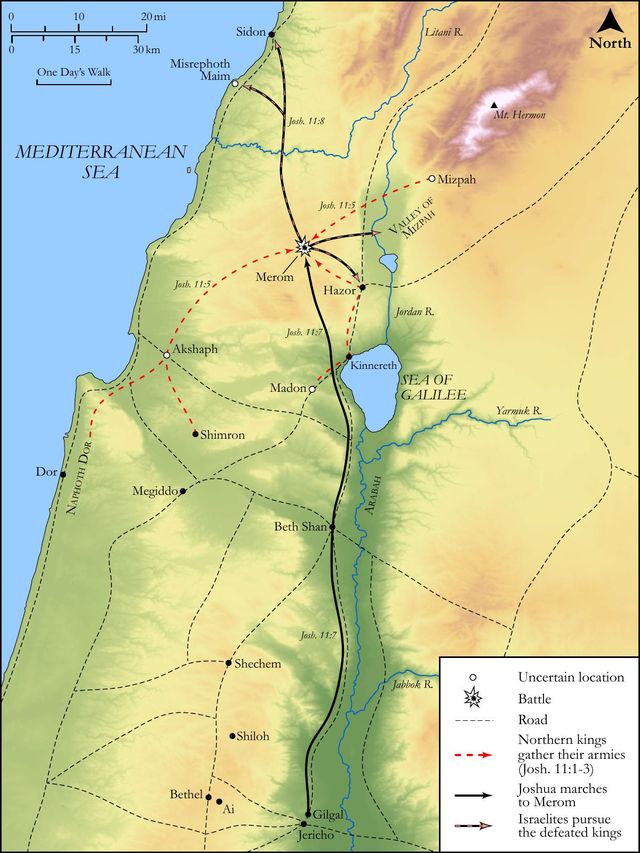
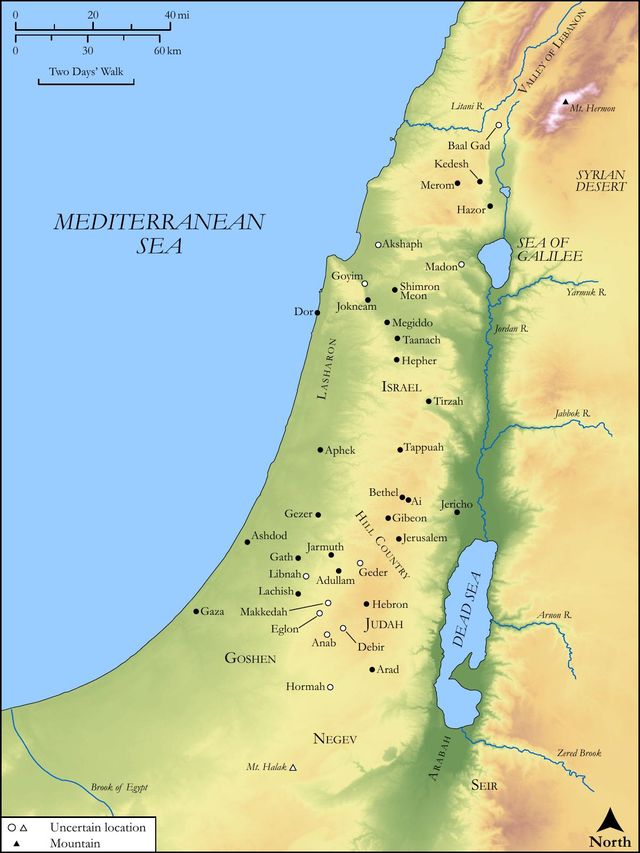
Study this verse
Public-domain commentary
Matthew Henry
From his Commentary on the Whole Bible. Henry comments on passages, not single verses — this entry covers Joshua 11:10–14.
We have here the same improvement made of this victory as was made of that in the foregoing chapter. 1. The destruction of Hazor is particularly recorded, because in it, and by the king thereof, this daring design against Israel was laid, Jos 11:10, Jos 11:11. The king of Hazor, it seems, escaped with his life out of the battle, and thought himself safe when he had got back into his own city, and Joshua had gone in pursuit of the scattered troops another way. But it proved that that which he thought would be for his welfare was his trap; in it he was taken as in an evil net; there he was slain, and his city, for his sake, burned. Yet we find that the remains of it being not well looked after by Israel the Canaanites rebuilt it, and settled there under another king of the same name, Jdg 4:2. 2. The rest of the cities of that part of the country are spoken of only in general, that Joshua got them all into his hands, but did not burn them as he did Hazor, for Israel was to dwell in great and goodly cities which they builded not (Deu 6:10) and in these among the rest. And here we find Israel rolling in blood and treasure. (1.) In the blood of their enemies; they smote all the souls (Jos 11:1), neither left they any to breathe (Jos 11:14), that there might be none to infect them with the abominations of Canaan, and none to disturb them in the possession of it. The children were cut off, lest they should afterwards lay claim to any part of this land in the right of their parents. (2.) In the wealth of their enemies. The spoil, and the cattle, they took for a prey to themselves, Jos 11:14. As they were enriched with the spoil of their oppressors when they came out of Egypt, wherewith to defray the charges of their apprenticeship in the wilderness, so they were now enriched with the spoil of their enemies for a stock wherewith to set up in the land of Canaan. Thus is the wealth of the sinner laid up for the just.
Continue studying Joshua 11:12 across the web’s major study libraries — every link below opens this exact verse, chapter, or book on the destination site.
Read & Compare
 BibleGatewayThis verse in more than 200 translations and 70 languages.
 Bible.comThe YouVersion reader — hundreds of translations, reading plans, and highlights.
 ESV.orgCrossway's official English Standard Version reader.
 NET BibleThe NET translation with 60,000+ translators' notes on every rendering decision.
 STEP BibleTyndale House's free study tool — original text, vocabulary, and scholarly resources.
 BibliaLogos Bible Software's free web reader.
 USCCBThe New American Bible (Revised Edition) with the U.S. bishops' study notes.
Commentaries
 BibleHub CommentariesDozens of classic commentaries on this verse, gathered on one page.
 StudyLightMore than 100 commentary sets — the largest collection on the web.
 BibleRefPlain-English commentary on what this verse means, verse by verse.
 Enduring WordDavid Guzik's free commentary on this chapter, widely used by Bible teachers.
 Bible Study ToolsVerse commentary alongside Greek and Hebrew study aids.
Original Language & Research
- BibleHub InterlinearThe verse word by word — original language, transliteration, and English.
- BibleHub LexiconEvery word's original-language definition and Strong's entry.
 Blue Letter BibleDeep-study tools — Strong's numbers, concordance, and word studies.
 SefariaThe Hebrew text with Rashi and centuries of Jewish commentary.
Sermons, Hymns & Audio


TrulyRandomVerse is not affiliated with these sites and doesn’t control their content. They’re linked because they’re genuinely useful.
Summary
Joshua 11:12 provides a pivotal summary of the successful northern campaign of the Israelite conquest of Canaan, culminating in the decisive defeat of a formidable coalition of kings and the utter destruction of their cities and inhabitants. This verse powerfully underscores Joshua's unwavering obedience to the divine command, emphasizing that these military actions were not merely territorial expansion but a direct and meticulous fulfillment of God's specific instructions given through Moses, ensuring the eradication of corrupting idolatry and pervasive wickedness from the promised land.
Context
ShowHideLiterary Context
This verse functions as a concluding summary statement for the northern campaign of the conquest, specifically detailing the aftermath of the decisive battle against the formidable coalition led by Jabin, king of Hazor, as meticulously described in Joshua 11:1-11. It deliberately parallels the summary statements found after the southern campaign in Joshua 10:28-43, establishing a consistent pattern of divine mandate and Israelite obedience throughout the conquest narrative. The meticulous detail of the destruction and the explicit mention of Moses' command highlight the profound theological purpose of the conquest, moving beyond mere military victory to emphasize divine mandate, covenant faithfulness, and the purification of the land. Following this comprehensive summary, the narrative transitions in Joshua 11:16-23 to a broader overview of the entire conquest, setting the crucial stage for the subsequent division of the land among the tribes of Israel, which occupies the remainder of the book.
Historical & Cultural Context
The conquest of Canaan occurred in the Late Bronze Age (roughly 1400-1200 BC), a period characterized by a fragmented political landscape of city-states and regional alliances, often engaged in shifting power dynamics. The Canaanite culture was deeply entrenched in polytheism, fertility cults, and practices explicitly forbidden and abhorrent to God, including child sacrifice, ritual prostitution, and various forms of divination (Deuteronomy 18:9-12). The command for herem (utter destruction or devotion to God by destruction) was a unique divine judgment against this pervasive wickedness, intended to prevent the spiritual contamination of Israel and to cleanse the land for a holy people. Hazor, specifically mentioned as the "head of all those kingdoms" in Joshua 11:10, was a major regional power, strategically located and heavily fortified, making its defeat a significant military and symbolic victory that broke the back of northern Canaanite resistance. It is important to understand that ancient Near Eastern conquest narratives often employed hyperbolic language to emphasize the totality and decisiveness of victory, and the phrase "utterly destroyed" should be understood within this cultural framework as signifying a decisive and complete subjugation, fulfilling the divine decree.
Key Themes
ShowHideThis verse powerfully encapsulates several overarching themes central to the book of Joshua and the broader Pentateuch. Foremost is the theme of Divine Command and Obedience, underscored by the phrase "as Moses the servant of the LORD commanded." This highlights Joshua's role as a faithful successor to Moses, leading Israel in direct and absolute obedience to God's revealed will, as outlined in passages like Deuteronomy 7:1-6 and Deuteronomy 20:16-18. Secondly, the concept of Conquest and Judgment through herem is prominent. This was not an act of arbitrary cruelty but a severe, divinely ordained judgment against the extreme moral and spiritual depravity of the Canaanite nations, designed to cleanse the land and protect Israel from idolatrous influence and spiritual corruption (Leviticus 18:24-28). Finally, the successful subjugation of these kings and cities signifies the ongoing Fulfillment of God's Promise to Abraham that his descendants would inherit the land of Canaan (see Genesis 12:7 and the triumphant summary in Joshua 21:43-45). It serves as a powerful testament to God's faithfulness to His covenant people, demonstrating His power to bring His word to pass.
Exposition and Analysis
ShowHideKey Word Analysis
ShowHideThis verb (H2763), derived from the noun ḥerem, signifies a complete separation or dedication, often to God, by means of destruction. In the context of the Canaanite conquest, it means the complete removal of all life and objects associated with their idolatrous worship, effectively "devoting" them to God for judgment. This was not wanton cruelty but a unique, divinely commanded act of judgment and consecration, ensuring that Israel would not be tempted to adopt the pagan practices of the inhabitants. It implies a devotion to God through eradication, making the conquered entity "holy" to the Lord in the sense that it is set apart for His judgment and removed from common use or influence.
This verb (H6680) denotes a strong, authoritative instruction or order, often from a superior to a subordinate. Its use here emphasizes that Joshua's actions were not based on his own strategic decisions, military prowess, or human initiative but were direct implementations of divine decrees communicated through Moses. It highlights the divine authority and imperative nature of the conquest, positioning Joshua as an obedient agent of God's will rather than an independent conqueror. The command was specific, non-negotiable, and foundational to the entire enterprise.
Verse Breakdown
ShowHide"And all the cities of those kings, and all the kings of them, did Joshua take"
This opening clause emphasizes the comprehensive and absolute nature of Joshua's victory. The strategic repetition of "all" stresses the totality of the conquest, encompassing both the fortified urban centers (H5892, ʻîyr) and their rulers (H4428, melek). This signifies a complete and decisive subjugation of the northern coalition, leaving no significant pockets of organized resistance. It was not a partial victory but a sweeping triumph, demonstrating God's empowerment of Israel to fulfill His command. The verb "take" (H3920, lâkad) here implies capture and occupation.
"and smote them with the edge of the sword, [and] he utterly destroyed them"
This phrase describes both the method and the profound theological purpose of the conquest. "Smote them with the edge of the sword" (H5221, nâkâh with H6310, peh and H2719, chereb) indicates the military execution of the command, signifying a violent and decisive defeat. The subsequent "he utterly destroyed them" (H2763, ḥāram) clarifies that this was more than just military defeat; it was a divinely mandated act of judgment and purification. The intent was to remove the spiritual contagion of Canaanite idolatry and wickedness, ensuring Israel's spiritual purity and preventing syncretism. This was a complete removal, not merely a subjugation.
"as Moses the servant of the LORD commanded"
This concluding phrase is pivotal, providing the theological justification and overarching framework for the entire action. It explicitly links Joshua's actions back to the divine instructions given through Moses (H4872, Môsheh), particularly those found in Deuteronomy concerning the ḥerem (e.g., Deuteronomy 20:16-18). It underscores Joshua's (H3091, Yᵉhôwshûwaʻ) role as a faithful and obedient leader, fulfilling the covenant obligations and demonstrating that the conquest was a sacred act of obedience to God's will, not a self-serving land grab. The title "servant" (H5650, ʻebed) of "the LORD" (H3068, Yᵉhôvâh) for Moses further elevates the authority and divine origin of the command.
Literary Devices
ShowHideJoshua 11:12 employs several significant literary devices to convey its powerful message. The repetition of the word "all" ("all the cities," "all the kings") serves to emphasize the completeness, totality, and overwhelming scope of Joshua's victory, leaving no doubt as to the thoroughness of the conquest. This reinforces the idea that God's command was fully executed and that no significant enemy power remained. The phrase "utterly destroyed them" can be understood as a form of hyperbole, a common rhetorical device in ancient Near Eastern conquest accounts. While signifying a decisive and overwhelming victory and the complete subjugation of the Canaanite threat as a political and religious entity, it does not necessarily imply the literal, absolute annihilation of every single individual in every instance. Its primary function is to convey the completeness of the divine judgment and the fulfillment of the herem command. Finally, the concluding phrase "as Moses the servant of the LORD commanded" functions as a powerful fulfillment motif. This device explicitly connects Joshua's actions to prior divine commands and prophecies given through Moses, highlighting the overarching theme of God's faithfulness to His word and Israel's obedience to His covenant. It frames the conquest within a larger theological narrative of covenant keeping and divine purpose.
Theological and Thematic Connections
ShowHideJoshua 11:12 powerfully illustrates God's sovereign justice and His unwavering commitment to His covenant promises. The herem command, while ethically challenging for modern readers, was a unique, severe judgment against the profound moral and spiritual depravity of the Canaanite nations, intended to protect Israel from the corrupting influence of idolatry and practices abhorrent to God. This act of judgment underscores God's holiness and His intolerance for sin, particularly that which defiles His land and tempts His people. Joshua's meticulous obedience to this difficult command underscores that true leadership in God's kingdom is characterized by faithful adherence to His revealed will, even when the commands are difficult or counter-intuitive from a human perspective. This passage reminds us that God is both holy and just, and His purposes, though sometimes mysterious, are always rooted in His perfect character and His desire for a people set apart for Him. The success of the campaign is a testament to God's faithfulness to empower His people when they walk in obedience, demonstrating that His promises of land and victory are being fulfilled according to His divine timetable and plan.
Reflection and Application
ShowHideWhile the physical conquest and "utter destruction" of nations is a unique historical command specific to the ancient nation of Israel and their entry into the Promised Land, the underlying principles of Joshua's obedience and God's justice hold enduring relevance for believers today. We are called to an unwavering obedience to God's moral and spiritual laws, recognizing that His commands are always rooted in His perfect wisdom and are for our ultimate good and His glory. This verse challenges us to consider what "cities" and "kings" of sin and idolatry we need to "utterly destroy" in our own lives—any habit, thought pattern, or allegiance that competes with our devotion to God. This is a spiritual battle, not a physical one, requiring us to actively put to death the deeds of the flesh and separate ourselves completely from anything that would corrupt our relationship with a holy God. Joshua's success, born of obedience, also serves as a powerful reminder of God's faithfulness; when we walk in His ways, He empowers us to overcome spiritual adversaries and fulfills His promises in our lives, leading us into a deeper experience of His promised rest and blessing.
Questions for Reflection
ShowHideFAQ
ShowHideWhy did God command such extreme destruction (herem) in the conquest of Canaan?
ShowHideThe command for herem (utter destruction or devotion to God by destruction) was a unique and specific divine judgment against the extreme moral and spiritual depravity of the Canaanite nations. God had given these nations centuries to repent, but their wickedness, including child sacrifice, pervasive idolatry, and gross sexual immorality, had reached a point where the land itself was said to "vomit out" its inhabitants (Leviticus 18:24-28). The herem served several crucial purposes: it was a just punishment for their egregious sins, it prevented the spiritual contamination of Israel by removing the source of idolatry and pagan practices, and it demonstrated God's absolute sovereignty and holiness. It was not a universal command for all peoples or all times, but a specific, limited act of divine judgment within a particular historical context, ensuring Israel's distinctiveness as God's holy nation. Furthermore, it was not for Israel's righteousness, but for the wickedness of the nations (see Deuteronomy 9:4-5).
How does this account of physical conquest and destruction relate to Christian ethics and spiritual warfare today?
ShowHideWhile the physical conquest and herem were unique historical events for ancient Israel, the underlying principles translate into profound spiritual truths for believers today. Christians are not called to engage in physical warfare against nations or to literally "destroy" people. Instead, our warfare is spiritual, against "the spiritual forces of evil in the heavenly realms" (see Ephesians 6:12). Just as Israel was commanded to utterly destroy the idols and practices that would corrupt them, believers are called to "utterly destroy" spiritual idols, sinful patterns, and anything that exalts itself against the knowledge of God in their own lives (2 Corinthians 10:4-5). This involves repentance, sanctification, and a commitment to spiritual purity, separating ourselves from the corrupting influences of the world. The obedience of Joshua serves as a model for our own obedience to Christ, who calls us to radical discipleship and spiritual transformation, leading to a life set apart for God's glory.
Christ-Centered Fulfillment
ShowHideJoshua 11:12, with its emphasis on a divinely commanded conquest led by an obedient leader, finds profound Christ-centered fulfillment. Joshua, whose Hebrew name (Yeshua) is the same as Jesus, serves as a powerful type of Christ. Just as Joshua led God's people into the promised land and secured victory over their enemies through perfect obedience to divine command, so too does Jesus, the ultimate "Servant of the Lord" (Isaiah 42:1), lead His people into a greater, spiritual inheritance. While Joshua's conquest was physical and earthly, Christ's victory is over the spiritual enemies of sin, death, and the devil (see Colossians 2:15). The "utter destruction" of the Canaanites, a severe judgment against their profound wickedness, foreshadows Christ's ultimate and decisive triumph over all evil and His final, righteous judgment, as vividly depicted in passages like Revelation 19:11-16. Furthermore, the rest that Joshua brought to Israel in the land was incomplete and temporary, pointing to the true and eternal rest found only in Christ (Hebrews 4:8-10). Joshua's perfect obedience to Moses' command mirrors Jesus' perfect obedience to His Father's will, even to the point of death on a cross (see Philippians 2:8), securing a far greater victory and a more glorious, eternal inheritance for all who believe.