


Joshua 11:11
- וַיַּכּוּVai·ya·kuand they struckH5221Conj-w ¦ V-Hiphil-ConsecImperf-3mpVerb Hiphil Consecutive Imperfect 3rd Plural Masculineוַandיַּכּוּthey struck
- אֶת'et<obj.>H853DirObjMParticle Object Indicator
- כָּלkoleveryH3605N-mscNoun Singular Masculine Construct
- הַנֶּפֶשׁha·Ne·fesh<the> personH5315Art ¦ N-fsNoun Singular Feminine Absoluteהַ<the>נֶּפֶשׁperson
- אֲשֶׁר'a·SherwhoH834RelParticle Relative
- בָּהּbah[was] in <the> itPrep-b ¦ 3fsSuffix Personal 3rd Singular Feminineבָּ[was] in <the>הּit
- לְפִיle·fito [the] mouth ofH6310Prep-l ¦ N-mscNoun Singular Masculine Constructלְtoפִי[the] mouth of
- חֶרֶבche·rev[the] swordH2719N-fsNoun Singular Feminine Absolute
- הַחֲרֵםha·cha·Remthey totally destroyed [them]H2763V-Hiphil-InfAbsVerb Hiphil Infinitive Absolute
- לֹאlo'notH3808NegParticle Negative
- נוֹתַרno·Tarit was leftH3498V-Niphal-Perf-3msVerb Niphal Perfect 3rd Singular Masculine
- כָּלkolanyH3605N-mscNoun Singular Masculine Construct
- נְשָׁמָהne·sha·Mahbreathing thingH5397N-fsNoun Singular Feminine Absolute
- וְאֶתve·'Etand <obj.>H853Conj-w ¦ DirObjMParticle Object Indicatorוְandאֶת<obj.>
- חָצוֹרcha·TzorHazorH2674N-properNoun Proper Location
- שָׂרַףsa·Rafhe burnedH8313V-Qal-Perf-3msVerb Qal Perfect 3rd Singular Masculine
- בָּאֵשׁba·'Eshwith <the> fireH784Prep-b ¦ N-csNoun Singular common gender Absoluteבָּwith <the>אֵשׁfire
English is a literal word-by-word gloss of the Hebrew, not the KJV's wording. Why?
This is the original text the KJV's translators worked from — each Hebrew word with its own literal English meaning in this verse, prepared by scholars at Tyndale House, Cambridge. The KJV translates whole sentences, not word by word, so its wording differs: one Hebrew word can become several English words, and the KJV may choose “the LORD” where the gloss reads “Yahweh”. Both are faithful — they answer different questions. For the KJV's own rendering, switch to the KJV text.
Details
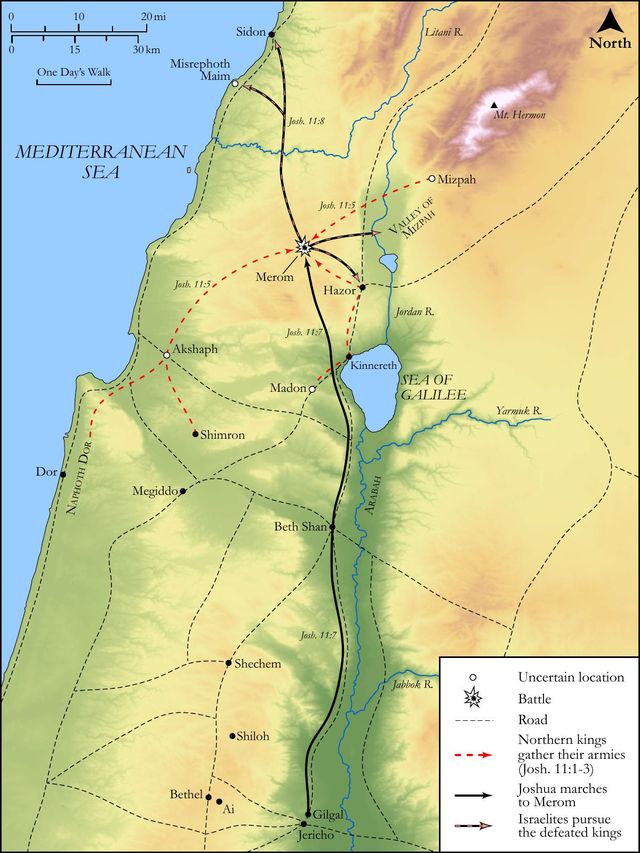
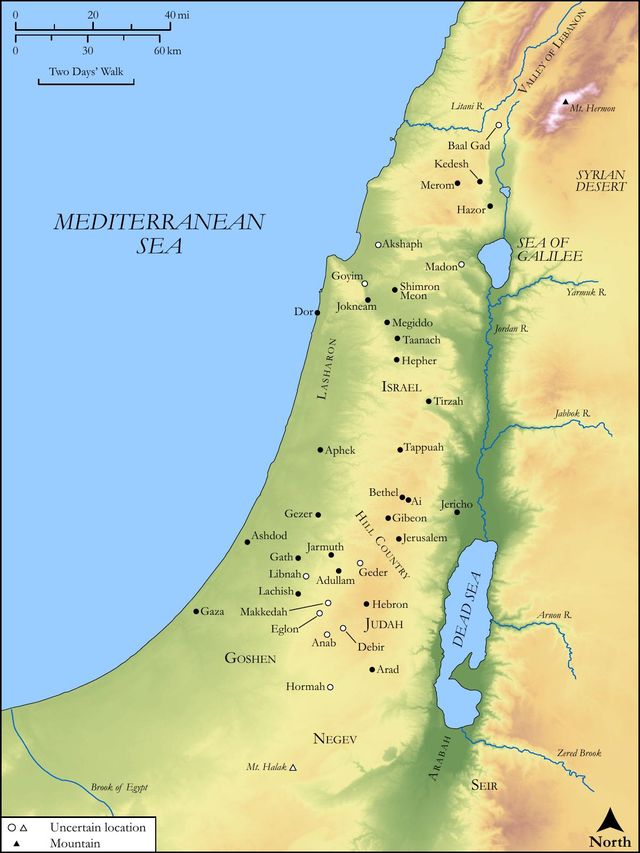
See on the biblical-era map
Study this verse
Public-domain commentary
Matthew Henry
From his Commentary on the Whole Bible. Henry comments on passages, not single verses — this entry covers Joshua 11:10–14.
We have here the same improvement made of this victory as was made of that in the foregoing chapter. 1. The destruction of Hazor is particularly recorded, because in it, and by the king thereof, this daring design against Israel was laid, Jos 11:10, Jos 11:11. The king of Hazor, it seems, escaped with his life out of the battle, and thought himself safe when he had got back into his own city, and Joshua had gone in pursuit of the scattered troops another way. But it proved that that which he thought would be for his welfare was his trap; in it he was taken as in an evil net; there he was slain, and his city, for his sake, burned. Yet we find that the remains of it being not well looked after by Israel the Canaanites rebuilt it, and settled there under another king of the same name, Jdg 4:2. 2. The rest of the cities of that part of the country are spoken of only in general, that Joshua got them all into his hands, but did not burn them as he did Hazor, for Israel was to dwell in great and goodly cities which they builded not (Deu 6:10) and in these among the rest. And here we find Israel rolling in blood and treasure. (1.) In the blood of their enemies; they smote all the souls (Jos 11:1), neither left they any to breathe (Jos 11:14), that there might be none to infect them with the abominations of Canaan, and none to disturb them in the possession of it. The children were cut off, lest they should afterwards lay claim to any part of this land in the right of their parents. (2.) In the wealth of their enemies. The spoil, and the cattle, they took for a prey to themselves, Jos 11:14. As they were enriched with the spoil of their oppressors when they came out of Egypt, wherewith to defray the charges of their apprenticeship in the wilderness, so they were now enriched with the spoil of their enemies for a stock wherewith to set up in the land of Canaan. Thus is the wealth of the sinner laid up for the just.
Continue studying Joshua 11:11 across the web’s major study libraries — every link below opens this exact verse, chapter, or book on the destination site.
Read & Compare
 BibleGatewayThis verse in more than 200 translations and 70 languages.
 Bible.comThe YouVersion reader — hundreds of translations, reading plans, and highlights.
 ESV.orgCrossway's official English Standard Version reader.
 NET BibleThe NET translation with 60,000+ translators' notes on every rendering decision.
 STEP BibleTyndale House's free study tool — original text, vocabulary, and scholarly resources.
 BibliaLogos Bible Software's free web reader.
 USCCBThe New American Bible (Revised Edition) with the U.S. bishops' study notes.
Commentaries
 BibleHub CommentariesDozens of classic commentaries on this verse, gathered on one page.
 StudyLightMore than 100 commentary sets — the largest collection on the web.
 BibleRefPlain-English commentary on what this verse means, verse by verse.
 Enduring WordDavid Guzik's free commentary on this chapter, widely used by Bible teachers.
 Bible Study ToolsVerse commentary alongside Greek and Hebrew study aids.
Original Language & Research
- BibleHub InterlinearThe verse word by word — original language, transliteration, and English.
- BibleHub LexiconEvery word's original-language definition and Strong's entry.
 Blue Letter BibleDeep-study tools — Strong's numbers, concordance, and word studies.
 SefariaThe Hebrew text with Rashi and centuries of Jewish commentary.
Sermons, Hymns & Audio


TrulyRandomVerse is not affiliated with these sites and doesn’t control their content. They’re linked because they’re genuinely useful.
Summary
Joshua 11:11 vividly recounts the climactic and decisive destruction of Hazor, the preeminent city of the northern Canaanite coalition, and its inhabitants by the Israelite forces. This verse underscores the meticulous fulfillment of God's command for "utter destruction" (Hebrew: cherem), leaving no survivors and culminating in the city's complete incineration. It marks the successful conclusion of the northern campaign, signifying God's unwavering faithfulness in delivering the promised land into Israel's hands and executing His righteous judgment against the deeply entrenched wickedness of the Canaanite nations.
Context
ShowHideLiterary Context
Joshua 11 serves as the narrative apex of Israel's conquest of Canaan, specifically detailing the northern campaign. Preceding this chapter, Israel had achieved significant victories in the southern and central regions. Here, the focus shifts to a formidable coalition of northern kings, led by Jabin, king of Hazor, who assembled at the Waters of Merom to confront Israel. Joshua 11:10 explicitly identifies Hazor as "the head of all those kingdoms," highlighting its unparalleled power, strategic importance, and leadership role in the resistance. God had previously assured Joshua of victory, promising to deliver these enemies into his hands and providing specific instructions on how to neutralize their military advantage by disabling their chariots and horses (Joshua 11:6). Verse 11, therefore, meticulously describes the precise and devastating fulfillment of this divine promise and command against the most significant northern stronghold, paralleling the complete destruction witnessed in earlier campaigns against cities like Jericho and Ai. The subsequent verses (Joshua 11:12-15) further emphasize the comprehensive nature of the conquest, noting that only Hazor was burned among the captured cities, underscoring its unique status and the severity of its judgment.
Historical & Cultural Context
Hazor was an exceptionally large and strategically vital city in the Late Bronze Age, controlling major trade routes and boasting impressive fortifications. Archaeological excavations at Tel Hazor confirm its immense prominence and its eventual destruction around the time of the Israelite conquest, aligning with the biblical account. The actions described in Joshua 11:11 are situated within the unique framework of "holy war," often referred to by the Hebrew term herem. This was not arbitrary violence but a specific, divinely mandated judicial act against the Canaanite inhabitants, whose cultures were steeped in extreme wickedness. This included widespread idolatry, child sacrifice (e.g., to Molech), temple prostitution, and other abhorrent practices explicitly condemned in Mosaic Law (Leviticus 18 and Deuteronomy 12:31). God had patiently delayed this judgment for centuries, allowing the "iniquity of the Amorites" to reach its full measure (Genesis 15:16). The destruction of Hazor and its people was thus a divinely ordained act of judgment, intended to cleanse the land and prevent the spiritual and moral corruption of Israel by these pervasive pagan influences.
Key Themes
ShowHideThis verse powerfully contributes to several overarching themes present in the book of Joshua and the broader Old Testament narrative. Firstly, it exemplifies Divine Judgment and Holy War, showcasing God's absolute sovereignty and His righteous wrath against profound human wickedness. The herem command underscores that God is not indifferent to sin but actively intervenes to purge evil from His chosen land. Secondly, it highlights Israel's Obedience, demonstrating their faithful and meticulous execution of God's specific and demanding instructions. This obedience was crucial for Israel to maintain its distinct identity as God's covenant people and avoid succumbing to the spiritual contamination of the Canaanite cultures. The thoroughness described—"not any left to breathe"—emphasizes Israel's adherence to the totality of the command. Thirdly, the verse reinforces the Totality of Conquest and Fulfillment of God's Promise. The destruction of Hazor, the "head" of the northern kingdoms, signifies the comprehensive nature of Israel's victory and the dismantling of the strongest opposition. It serves as a tangible demonstration that God was indeed fighting for Israel and fulfilling His ancient promise to give them the land of Canaan (Joshua 21:43-45).
Exposition and Analysis
ShowHideKey Word Analysis
ShowHideThis term, derived from the root meaning "to breathe," broadly refers to a living being, a person, or life itself. In this context, "all the souls that were therein" emphasizes the comprehensive destruction of every living individual within Hazor, highlighting the totality of the judgment. It underscores that the command extended to all inhabitants, not merely the military combatants.
This is a crucial theological term (herem) in the conquest narratives. Châram signifies something "devoted" or "set apart" to God, often in the context of complete destruction. When applied to cities and their inhabitants during the Canaanite conquest, it meant that they were to be dedicated to God by being completely destroyed, with no spoils taken by the Israelites (except in specific, divinely authorized cases). This was a unique divine command for the Canaanite conquest, intended to eliminate the pervasive evil and pagan influences that God deemed a severe threat to Israel's spiritual and moral integrity. It underscores the severity of God's judgment against profound wickedness and the necessity of radical separation from evil.
This phrase, literally "no breath remaining," powerfully emphasizes the absolute and complete eradication of life. It is an idiom for total annihilation, leaving no survivors. This expression, common in ancient Near Eastern conquest accounts, stresses the decisive nature of the victory and the thorough fulfillment of the cherem command, ensuring that the pagan influence would be completely removed from the land.
Verse Breakdown
ShowHide"And they smote all the souls that [were] therein with the edge of the sword"
This clause describes the direct, physical action taken by the Israelite army. "Smote" (נָכָה, nakah) indicates a decisive blow, and "edge of the sword" specifies the primary instrument of their military action. "All the souls" reiterates the comprehensive nature of the command, extending the judgment to every living inhabitant of Hazor, encompassing men, women, and children, in accordance with the cherem mandate.
"utterly destroying [them]: there was not any left to breathe"
This segment clarifies the divine purpose and absolute extent of the smiting. "Utterly destroying" translates the concept of cherem, emphasizing that the inhabitants were dedicated to God for complete annihilation. The follow-up phrase, "there was not any left to breathe," serves as a powerful hyperbole to underscore the absolute totality of this destruction, leaving no survivors to perpetuate the Canaanite wickedness or idolatry, thereby preventing the spiritual contamination of Israel.
"and he burnt Hazor with fire"
This final clause describes the specific fate of the city itself. While other conquered cities in the northern campaign were captured but not burned (Joshua 11:13), Hazor, as the "head of all those kingdoms," received a unique and more severe judgment. Burning with fire was a potent symbol of complete desolation and divine judgment, ensuring that the city's power and influence were utterly neutralized and that it could not be re-established as a center of paganism. This act served as a visible testament to God's wrath and Israel's decisive victory.
Literary Devices
ShowHideThe verse employs several potent Literary Devices to convey the intensity and totality of the conquest. Hyperbole is notably evident in the phrase "not any left to breathe," a common ancient Near Eastern literary convention used to emphasize the thoroughness and decisiveness of a military victory, rather than necessarily a literal, biological impossibility of any single individual escaping. This exaggerative language underscores the intent and impact of the cherem command. Repetition of the concept of totality—"all the souls," "utterly destroying," "not any left to breathe"—reinforces the comprehensive nature of the judgment and Israel's unwavering obedience. Furthermore, the act of burning Hazor with fire functions as powerful Symbolism. Fire in biblical narratives often symbolizes divine judgment, purification, and complete destruction. In this context, it signifies the absolute and irreversible end of Hazor's pagan influence and power, serving as a stark visual representation of God's wrath against profound wickedness.
Theological and Thematic Connections
ShowHideJoshua 11:11 stands as a stark testament to God's absolute holiness and His unwavering opposition to sin and evil. The command for cherem was a unique, divinely ordained act of judgment against cultures whose wickedness had reached its full measure, threatening to corrupt God's chosen people and the very land He had promised them. This account reveals a God who is not merely transcendent but also immanently involved in human history, executing justice and cleansing the earth of profound moral corruption. It underscores the seriousness of sin in God's eyes and the necessity of radical separation from anything that defiles or leads away from Him. While the specific commands of cherem were unique to Israel's historical conquest and are not directly applicable to believers today, the underlying theological principle of God's righteous judgment and the call to holiness remains eternally relevant.
Reflection and Application
ShowHideWhile the specific commands of cherem in Joshua 11:11 are rooted in a unique historical and theological context and are not a model for contemporary warfare or evangelism, this verse offers profound spiritual lessons for the believer. It serves as a powerful reminder of the absolute holiness of God and His uncompromising opposition to sin and evil. Just as Israel was commanded to utterly destroy the pagan influences in the land to preserve their spiritual purity, believers are called to engage in a spiritual "holy war" against the sin within themselves and the corrupting influences of the world. This means a radical commitment to "put to death" sinful desires and practices (Colossians 3:5) and to separate ourselves from anything that defiles our relationship with God. The totality of Hazor's destruction should impress upon us the seriousness with which God views unrighteousness and the certainty of His ultimate judgment against all evil, where no unrighteousness will be left to breathe in His new creation. It calls us to examine our own lives: are there areas where we are allowing "Canaanite" influences—idolatry, immorality, ungodliness—to linger, rather than utterly destroying them in obedience to Christ?
Questions for Reflection
ShowHideFAQ
ShowHideWhy did God command such extreme violence, including the killing of women and children, in the conquest of Canaan?
ShowHideThe command for cherem (utter destruction) in the Canaanite conquest, as seen in Joshua 11:11, is one of the most challenging aspects of the Old Testament. It is crucial to understand this within its unique theological and historical context. This was not a general command for all warfare but a specific, limited judicial act of God against particular nations. The Canaanites were steeped in profound wickedness, including widespread idolatry, child sacrifice, and extreme sexual immorality (Leviticus 18:24-28). God had delayed judgment for centuries, allowing their "iniquity" to reach its full measure (Genesis 15:16). The command to utterly destroy was a divine judgment, a form of capital punishment on a national scale, intended to cleanse the land and prevent the spiritual corruption of Israel, who were to be a holy nation set apart for God. It was a surgical act to remove a cancerous evil that threatened the very lineage through which the Messiah would come. From a biblical perspective, God, as the giver of life, also has the right to take life and execute justice. This was a unique, unrepeatable event in salvation history, not a blueprint for human behavior or warfare today.
Is the concept of cherem applicable to Christians today?
ShowHideNo, the physical command of cherem to utterly destroy cities and their inhabitants is not applicable to Christians today. It was a unique, specific command given to ancient Israel for a particular historical purpose: the conquest of Canaan and the establishment of a holy land. The New Testament transforms the concept of "holy war" from a physical conquest to a spiritual one. Believers are called to engage in spiritual warfare against sin, the flesh, and demonic forces (Ephesians 6:12). The "utter destruction" for Christians involves putting to death the deeds of the flesh (Colossians 3:5), separating from the world's corrupting influences (2 Corinthians 6:17), and dedicating our lives wholly to God. Our weapons are not carnal but spiritual (2 Corinthians 10:4), and our mission is to make disciples, not to physically conquer.
Christ-Centered Fulfillment
ShowHideThe total destruction of Hazor and its inhabitants, leaving "not any left to breathe," serves as a powerful Old Testament shadow pointing to the ultimate and decisive victory of Jesus Christ. Just as Joshua led Israel to conquer the physical enemies of God's people and cleanse the promised land of wickedness, Jesus, the greater Joshua, came to wage a spiritual holy war against the true enemies of humanity: sin, death, and the devil. His victory was not achieved through the edge of a sword but through His sacrificial death on the cross, where He disarmed the powers and authorities (Colossians 2:15). The "utter destruction" of evil that began in Canaan finds its perfect fulfillment in Christ's triumph over all unrighteousness. He is the one who "takes away the sin of the world" (John 1:29), and through His resurrection, He ensures that death has no more dominion (Romans 6:9). Ultimately, Joshua's burning of Hazor foreshadows the final, complete judgment that Christ will execute at His return, when all evil will be utterly destroyed, and "nothing unclean will ever enter" the new heavens and new earth (Revelation 21:27). In Christ, we find the definitive end to the reign of sin and the establishment of a perfectly holy kingdom where only righteousness can breathe.