


2 Corinthians 10:4
Bible text: King James Version (1769 Blayney text) · Public domain
Bible text: Berean Standard Bible · Public domain
Bible text: American Standard Version (1901) · Public domain
Bible text: World English Bible, Messianic edition · Public domain
Bible text: Geneva Bible (1599) · Public domain
Bible text: Young's Literal Translation · Public domain
- τὰtaTheG3588T-NPNDefinite article Nominative Plural Neuter
- γὰρgarforG1063CONJConjunction
- ὅπλαhoplaweaponsG3696N-NPNNoun Nominative Plural Neuter
- τῆςtēsof theG3588T-GSFDefinite article Genitive Singular Feminine
- στρατείαςstrateiaswarfareG4752N-GSFNoun Genitive Singular Feminine
- ἡμῶνhēmōnof usG3165P-1GPPersonal pronoun Genitive 1st Plural
- οὐou[are] notG3756PRT-NNegative Particle Negative
- σαρκικὰsarkikafleshlyG4559A-NPNAdjective Nominative Plural Neuter
- ἀλλὰallabutG235CONJConjunction
- δυνατὰdunatapowerfulG1415A-NPNAdjective Nominative Plural Neuter
- τῷtō<the>G3588T-DSMDefinite article Dative Singular Masculine
- θεῷtheōdivinelyG2316N-DSMNoun Dative Singular Masculine
- πρὸςprostoG4314PREPPreposition
- καθαίρεσινkathairesin[the] demolitionG2506N-ASFNoun Accusative Singular Feminine
- ὀχυρωμάτωνochurōmatōnof strongholdsG3794N-GPNNoun Genitive Plural Neuter
English is a literal word-by-word gloss of the Greek, not the KJV's wording. Why?
This is the original text the KJV's translators worked from — each Greek word with its own literal English meaning in this verse, prepared by scholars at Tyndale House, Cambridge. The KJV translates whole sentences, not word by word, so its wording differs: one Greek word can become several English words, and the KJV may choose “charity” where the gloss reads “love”. Both are faithful — they answer different questions. For the KJV's own rendering, switch to the KJV text.
Details
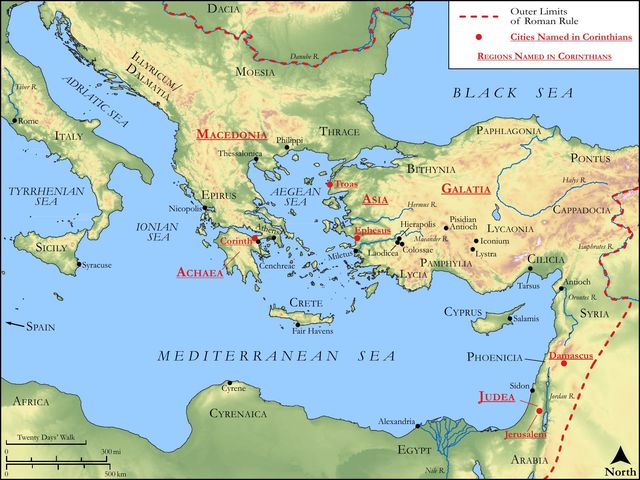
See on the biblical-era maps

Study this verse
Public-domain commentary
Matthew Henry
From his Commentary on the Whole Bible. Henry comments on passages, not single verses — this entry covers 2 Corinthians 10:1–6. His four-level outline is real structure in the source text, so it is rendered as structure.
Here we may observe,
I.The mild and humble manner in which the blessed apostle addresses the Corinthians, and how desirous he is that no occasion may be given him to use severity. 1. He addresses them in a very mild and humble manner: I Paul myself beseech you, Co2 10:1. We find, in the introduction to this epistle, he joined Timothy with himself; but now he speaks only for himself, against whom the false apostles had particularly levelled their reproaches; yet in the midst of the greatest provocations he shows humility and mildness, from the consideration of the meekness and gentleness of Christ, and desires this great example may have the same influence on the Corinthians. Note, When we find ourselves tempted or inclined to be rough and severe towards any body, we should think of the meekness and gentleness of Christ, that appeared in him in the days of his flesh, in the design of his undertaking, and in all the acts of his grace towards poor souls. How humbly also does this great apostle speak of himself, as one in presence base among them! So his enemies spoke of him with contempt, and he seems to acknowledge it; while others thought meanly, and spoke scornfully of him, he had low thoughts of himself, and spoke humbly of himself. Note, We should be sensible of our own infirmities, and think humbly of ourselves, even when men reproach us for them.
2.He is desirous that no occasion may be given to use severity, Co2 10:2. He beseeches them to give no occasion for him to be bold, or to exercise his authority against them in general, as he had resolved to do against some who unjustly charged him as walking according to the flesh, that is, regulating his conduct, even in his ministerial actions, according to carnal policy or with worldly views. This was what the apostle had renounced, and this is contrary to the spirit and design of the gospel, and was far from being the aim and design of the apostle. Hereupon,
II.He asserts the power of his preaching and his power to punish offenders.
1.The power of his preaching, Co2 10:3, Co2 10:5. Here observe,
(1.)The work of the ministry is a warfare, not after the flesh indeed, for it is a spiritual warfare, with spiritual enemies and for spiritual purposes. And though ministers walk in the flesh, or live in the body, and in the common affairs of life act as other men, yet in their work and warfare they must not go by the maxims of the flesh, nor should they design to please the flesh: this must be crucified with its affections and lusts; it must be mortified and kept under.
(2.)The doctrines of the gospel and discipline of the church are the weapons of this warfare; and these are not carnal: outward force, therefore, is not the method of the gospel, but strong persuasions, by the power of truth and the meekness of wisdom. A good argument this is against persecution for conscience' sake: conscience is accountable to God only; and people must be persuaded to God and their duty, not driven by force of arms. And so the weapons of our warfare are mighty, or very powerful; the evidence of truth is convincing and cogent. This indeed is through God, or owing to him, because they are his institutions, and accompanied with his blessing, which makes all opposition to fall before his victorious gospel. We may here observe,
[1.]What opposition is made against the gospel by the powers of sin and Satan in the hearts of men. Ignorance, prejudices, beloved lusts, are Satan's strong-holds in the souls of some; vain imaginations, carnal reasonings, and high thoughts, or proud conceits, in others, exalt themselves against the knowledge of God, that is, by these ways the devil endeavours to keep men from faith and obedience to the gospel, and secures his possession of the hearts of men, as his own house or property. But then observe,
[2.]The conquest which the word of God gains. These strong-holds are pulled down by the gospel as the means, through the grace and power of God accompanying it as the principal efficient cause. Note, The conversion of the soul is the conquest of Satan in that soul.
2.The apostle's power to punish offenders (and that in an extraordinary manner) is asserted in Co2 10:6. The apostle was a prime-minister in the kingdom of Christ, and chief officer in his army, and had in readiness (that is, he had power and authority at hand) to revenge all disobedience, or to punish offenders in a most exemplary and extraordinary manner. The apostle speaks not of personal revenge, but of punishing disobedience to the gospel, and disorderly walking among church-members, by inflicting church-censures. Note, Though the apostle showed meekness and gentleness, yet he would not betray his authority; and therefore intimates that when he would commend those whose obedience was fulfilled or manifested others would fall under severe censures.
Historical interpretation
Two Centuries of Reception
5 surviving comments on this verse. Each one is dated, so this reads as a timeline rather than a list.
Select a marker to jump to its quote. Markers stagger vertically where authors wrote within a few decades of each other.
But how will a Christian man war, nay, how will he serve even in peace, without a sword, which the Lord has taken away? For albeit soldiers had come unto John, and had received the formula of their rule; albeit, likewise, a centurion had believed; still the Lord afterward, in disarming Peter, unbe
Here, also, one who examines each word minutely can gain a very accurate knowledge of the meaning of the Holy Scripture, so that there is no excuse for any of us being led astray into the snare of sin by an erroneous belief that some sins are punished while others may be committed with impunity. For, what says the apostle?— “destroying counsels and every height that exalts itself against the knowledge of God”; so that every sin, because it is an expression of contempt for the divine law, is called a “height that exalts itself against the knowledge of God.”
All worldly things are corrupt, but Paul is strong because he is fighting with uncorrupted weapons.
"For our weapons are not of the flesh." For what sort of weapons are of the flesh? Wealth, glory, power, fluency, cleverness, circumventions, flatteries, hypocrisies, whatsoever else is similar to these. But ours are not of this sort: but of what kind are they? "Mighty before God." And he said not, 'we are not carnal,' but, "our weapons." For as I said, for the present he discourseth of the Preaching, and refers the whole power to God. And he says not, 'spiritual,' although this was the fitting opposite to "carnal," but "mighty," in this implying the other also, and showing that their weapons are weak and powerless. And mark the absence of pride in him; for he said not, 'we are mighty,' but, "our weapons are mighty before God." 'We did not make them such, but God Himself.' For because they were scourged, were persecuted, and suffered wrongs incurable without number, which things were proofs of weakness: to show the strength of God he says, "but they are mighty before God." For this especially shows His strength, that by these things He gains the victory. So that even though we are encompassed with them, yet it is He that warreth and worketh by them. Then he goes through a long eulogium upon them, saying, "To the casting down of strong holds." And lest when hearing of strong holds thou shouldest think of aught material, he says,
By “worldly weapons” Paul means the law of Moses.
Continue studying 2 Corinthians 10:4 across the web’s major study libraries — every link below opens this exact verse, chapter, or book on the destination site.
Read & Compare
 BibleGatewayThis verse in more than 200 translations and 70 languages.
 Bible.comThe YouVersion reader — hundreds of translations, reading plans, and highlights.
 ESV.orgCrossway's official English Standard Version reader.
 NET BibleThe NET translation with 60,000+ translators' notes on every rendering decision.
 STEP BibleTyndale House's free study tool — original text, vocabulary, and scholarly resources.
 BibliaLogos Bible Software's free web reader.
 USCCBThe New American Bible (Revised Edition) with the U.S. bishops' study notes.
Commentaries
 BibleHub CommentariesDozens of classic commentaries on this verse, gathered on one page.
 StudyLightMore than 100 commentary sets — the largest collection on the web.
 BibleRefPlain-English commentary on what this verse means, verse by verse.
 Enduring WordDavid Guzik's free commentary on this chapter, widely used by Bible teachers.
 Bible Study ToolsVerse commentary alongside Greek and Hebrew study aids.
Original Language & Research
- BibleHub InterlinearThe verse word by word — original language, transliteration, and English.
- BibleHub LexiconEvery word's original-language definition and Strong's entry.
 Blue Letter BibleDeep-study tools — Strong's numbers, concordance, and word studies.
 CNTR CollationThe earliest Greek manuscripts of this verse, collated letter by letter.
Sermons, Hymns & Audio


TrulyRandomVerse is not affiliated with these sites and doesn’t control their content. They’re linked because they’re genuinely useful.
Summary
In 2 Corinthians 10:4, the Apostle Paul articulates the profound nature of Christian ministry and life as a spiritual battle. He asserts that the means and methods employed in this warfare are not humanly derived or worldly ("carnal"), but are divinely empowered ("mighty through God"). The ultimate purpose of these spiritual weapons is the demolition of formidable intellectual and spiritual barriers ("strongholds") that oppose the truth of God and hinder spiritual growth.
Context
ShowHideLiterary Context
This verse marks a distinct shift in Paul's letter to the Corinthians. After chapters of reconciliation and appeal for generosity, Paul now begins a robust defense of his apostolic authority and ministry, which had been challenged by critics in Corinth. Chapter 10 opens with Paul appealing to the Corinthians "by the meekness and gentleness of Christ," yet immediately contrasts this with the bold stand he must take against those who accuse him of walking "according to the flesh" (2 Corinthians 10:2). Verse 4 lays the foundational principle for understanding the nature of Paul's conflict and the source of his power, setting the stage for his subsequent dismantling of the "arguments" and "every high thing that exalts itself against the knowledge of God" described in 2 Corinthians 10:5. This passage is crucial for understanding Paul's self-perception as an apostle and the spiritual reality of his mission.
Historical & Cultural Context
The city of Corinth was a vibrant, cosmopolitan hub, known for its intellectualism, rhetoric, and diverse religious practices. Paul's critics in Corinth, likely influential teachers or factions within the church, were judging him by worldly standards. They accused him of being unimpressive in person, lacking eloquent speech, and perhaps not having the imposing physical presence or rhetorical prowess that was highly valued in Greek society. They saw his humility and lack of worldly showmanship as weakness, contrasting it with their own perceived strengths. Paul's defense, therefore, directly addresses these worldly criteria, asserting that his authority and effectiveness do not stem from human wisdom, persuasive rhetoric, or social status, but from a divine source. The metaphor of "warfare" would have resonated strongly in a Roman-occupied city, but Paul redefines its terms from physical to spiritual.
Key Themes
ShowHideThis verse encapsulates several critical themes prevalent in Paul's theology and throughout the broader biblical narrative. Firstly, it introduces the concept of Spiritual Warfare, emphasizing that the Christian life and ministry are not merely intellectual or social endeavors but are engaged in a profound spiritual conflict against unseen forces and entrenched ideologies. Secondly, it underscores the theme of Divine Power vs. Human Means, asserting that true effectiveness in God's work comes not from human strength, cleverness, or worldly resources, but solely from the power supplied by God. This directly counters the worldly wisdom that Paul often confronts, as seen in 1 Corinthians 1:18-25. Finally, the verse highlights the theme of Overcoming Obstacles to the gospel. The "pulling down of strong holds" speaks to the ability of God's spiritual weapons to demolish formidable barriers—whether intellectual, spiritual, or moral—that resist the truth of God and hinder people from coming to a saving knowledge of Christ, as further elaborated in 2 Corinthians 10:5.
Exposition and Analysis
ShowHideKey Word Analysis
ShowHideThis term refers to an implement, utensil, or tool, specifically one used for offensive war. In this context, Paul uses it metaphorically to describe the spiritual means and resources God provides for the Christian's spiritual battle. These are not physical armaments but spiritual instruments of divine power.
Derived from a verb meaning "to be a soldier," this word denotes military service or a campaign. Paul applies it figuratively to the apostolic career, characterizing it as a demanding and perilous spiritual struggle. It emphasizes the ongoing, disciplined, and strategic nature of the Christian's engagement with spiritual opposition.
Meaning "pertaining to flesh," this adjective describes something bodily, temporal, or, by implication, unregenerate or worldly in a negative sense. It stands in stark contrast to that which is spiritual or divinely sourced. Paul uses it here to signify methods or resources that are human-centered, fleshly, and devoid of divine power or spiritual wisdom.
This word signifies being powerful or capable. When applied to the "weapons," it asserts that their effectiveness is not inherent in themselves as human tools, but is derived from and enabled by God. Their potency is divinely sourced, making them capable of achieving what human means cannot.
Literally meaning a castle or fortified place, this term is used metaphorically here to represent entrenched arguments, philosophies, ideologies, or patterns of thought that oppose or resist the knowledge of God. These are not physical fortresses but intellectual and spiritual bastions of rebellion against divine truth.
Verse Breakdown
ShowHide"For the weapons of our warfare [are] not carnal"
Paul begins by clarifying the nature of the Christian's spiritual conflict. The "weapons" (the means and methods used) and the "warfare" (the ongoing struggle) are fundamentally different from worldly conflicts. They are "not carnal," meaning they do not originate from human strength, worldly wisdom, eloquent rhetoric for its own sake, physical coercion, or any other fleshly or unregenerate means. Paul explicitly rejects the very standards by which his Corinthian critics were judging him.
"but mighty through God"
In sharp contrast to their carnal nature, these spiritual weapons are "mighty" (powerful and effective), and their power is explicitly "through God." This phrase underscores the divine source and enablement of their efficacy. Their potency is not inherent in human ability or strategy but is derived solely from God's power working through them. This divine empowerment is what makes them truly formidable.
"to the pulling down of strong holds;"
The ultimate purpose and outcome of wielding these divinely empowered weapons is the "pulling down" or demolition of "strongholds." These "strongholds" are not physical fortresses but metaphorical ones, representing deeply ingrained arguments, false philosophies, prideful human reasoning, deceptive ideologies, or even spiritual forces that erect barriers against the truth of the gospel and the knowledge of God. The phrase "pulling down" signifies a complete demolition, indicating that these spiritual weapons are capable of utterly dismantling such formidable opposition.
Literary Devices
ShowHideThe verse is rich in Military Imagery, employing terms like "weapons," "warfare," and "strongholds" to vividly portray the spiritual conflict in which believers are engaged. This imagery is not literal but Metaphorical, transforming the physical battlefield into a spiritual one where ideas, beliefs, and spiritual forces clash. A prominent device is Antithesis or Contrast, highlighted by the phrase "not carnal, but mighty through God." This stark opposition emphasizes the fundamental difference between humanly devised methods and divinely empowered ones, underscoring that the source of power is crucial to the nature of the battle. The phrase "pulling down of strong holds" also uses Hyperbole to convey the absolute effectiveness of these spiritual weapons in demolishing even the most formidable intellectual and spiritual barriers.
Theological and Thematic Connections
ShowHideThis verse profoundly shapes our understanding of Christian engagement with the world. It establishes that the primary battle for the believer is not against flesh and blood, but against spiritual forces and entrenched ideologies that oppose God's truth. The "strongholds" are not merely external enemies but can also represent internal patterns of thought, pride, and sin that resist the transforming power of the gospel. Theologically, this passage reinforces the absolute necessity of divine power for spiritual victory. Human wisdom, strength, or strategy are insufficient; only God's might can dismantle the deeply rooted deceptions and spiritual opposition that hinder the advance of His kingdom. It calls believers to rely entirely on God's provision and power in their spiritual walk and ministry, recognizing that the battle belongs to the Lord.
Reflection and Application
ShowHidePaul's words in 2 Corinthians 10:4 serve as a timeless reminder that the Christian life is a spiritual battle, and our effectiveness in it is directly proportional to our reliance on God's power, not our own. In a world that often values human ingenuity, persuasive rhetoric, and outward displays of power, this verse calls us back to the foundational truth that spiritual victories are won through spiritual means. We must identify the "strongholds" in our own lives—whether they are patterns of sin, destructive thought processes, prideful self-reliance, or deeply ingrained unbelief—and in the world around us, such as secular ideologies, materialism, or injustice that defy God's truth. Our response is not to engage with carnal weapons like manipulation, worldly politics, or human aggression, but to wield the spiritual weapons God provides: prayer, the Word of God, faith, righteousness, and the proclamation of the gospel. It is through these divinely empowered means that we participate in God's work of demolishing barriers and bringing every thought captive to Christ.
Questions for Reflection
ShowHideFAQ
ShowHideWhat exactly does Paul mean by "strongholds" in this context?
ShowHideIn 2 Corinthians 10:4, "strongholds" (Greek: ochýrōma) are not literal physical fortresses. Paul uses the term metaphorically to describe deeply entrenched arguments, philosophical systems, ideologies, prideful human reasoning, or even spiritual deceptions that resist the truth of the gospel and prevent people from knowing God. As he clarifies in the very next verse, 2 Corinthians 10:5, these strongholds include "imaginations" (logismous, meaning "reasonings" or "arguments") and "every high thing that exalteth itself against the knowledge of God." They represent intellectual and spiritual barriers, often built on human pride or worldly wisdom, that stand in opposition to divine truth and must be dismantled by God's power.
Christ-Centered Fulfillment
ShowHideThe spiritual warfare described in 2 Corinthians 10:4 finds its ultimate model and source of victory in Jesus Christ. He is the supreme warrior who, through His life, death, and resurrection, decisively triumphed over all the "strongholds" of sin, death, and the powers of darkness. His ministry was characterized by the demolition of spiritual strongholds, whether casting out demons (Mark 1:27), exposing the futility of human traditions (Matthew 15:1-9), or overcoming the ultimate stronghold of death itself (John 11:25). The "weapons of our warfare" are "mighty through God" precisely because they are Christ's weapons, empowered by His Spirit and rooted in His finished work. The cross, seemingly a sign of weakness, was in fact the ultimate display of God's power, where Christ "disarmed the rulers and authorities and put them to open shame, by triumphing over them in him" (Colossians 2:15). Our participation in this warfare is therefore a participation in Christ's already-won victory, bringing every thought captive to Him (2 Corinthians 10:5), and advancing His kingdom through the power that flows from His resurrection life within us.