


2 Corinthians 10:5
Bible text: King James Version (1769 Blayney text) · Public domain
Bible text: King James Version with Strong's numbers · Public domain
Bible text: Berean Standard Bible · Public domain
Bible text: American Standard Version (1901) · Public domain
Bible text: World English Bible, Messianic edition · Public domain
Bible text: Geneva Bible (1599) · Public domain
Bible text: Young's Literal Translation · Public domain
- λογισμοὺςlogismousargumentsG3053N-APMNoun Accusative Plural Masculine
- καθαιροῦντεςkathairountesoverthrowingG2507V-PAP-NPMVerb Present Active Participle Nominative Plural Masculine
- καὶkaiandG2532CONJConjunction
- πᾶνpaneveryG3956A-ASNAdjective Accusative Singular Neuter
- ὕψωμαhupsōmahigh thingG5313N-ASNNoun Accusative Singular Neuter
- ἐπαιρόμενονepairomenonlifting itself upG1869V-PMP-ASNVerb Present Middle Participle Accusative Singular Neuter
- κατὰkataagainstG2596PREPPreposition
- τῆςtēstheG3588T-GSFDefinite article Genitive Singular Feminine
- γνώσεωςgnōseōsknowledgeG1108N-GSFNoun Genitive Singular Feminine
- τοῦtou<the>G3588T-GSMDefinite article Genitive Singular Masculine
- θεοῦtheouof GodG2316N-GSM-TNoun Genitive Singular Masculine Title
- καὶkaiandG2532CONJConjunction
- αἰχμαλωτίζοντεςaichmalōtizontestaking captiveG163V-PAP-NPMVerb Present Active Participle Nominative Plural Masculine
- πᾶνpaneveryG3956A-ASNAdjective Accusative Singular Neuter
- νόημαnoēmathoughtG3540N-ASNNoun Accusative Singular Neuter
- εἰςeisintoG1519PREPPreposition
- τὴνtēntheG3588T-ASFDefinite article Accusative Singular Feminine
- ὑπακοὴνhupakoēnobedienceG5218N-ASFNoun Accusative Singular Feminine
- τοῦtou<the>G3588T-GSMDefinite article Genitive Singular Masculine
- ΧριστοῦChristouof ChristG5547N-GSM-TNoun Genitive Singular Masculine Title
English is a literal word-by-word gloss of the Greek, not the KJV's wording. Why?
This is the original text the KJV's translators worked from — each Greek word with its own literal English meaning in this verse, prepared by scholars at Tyndale House, Cambridge. The KJV translates whole sentences, not word by word, so its wording differs: one Greek word can become several English words, and the KJV may choose “charity” where the gloss reads “love”. Both are faithful — they answer different questions. For the KJV's own rendering, switch to the KJV text.
Details
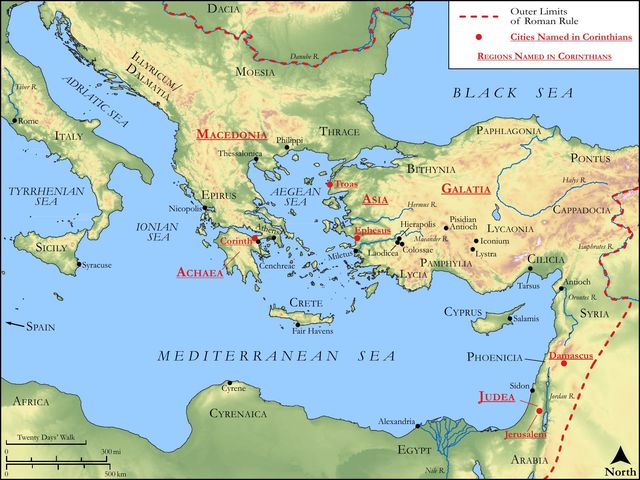
See on the biblical-era maps

Study this verse
Public-domain commentary
Matthew Henry
From his Commentary on the Whole Bible. Henry comments on passages, not single verses — this entry covers 2 Corinthians 10:1–6. His four-level outline is real structure in the source text, so it is rendered as structure.
Here we may observe,
I.The mild and humble manner in which the blessed apostle addresses the Corinthians, and how desirous he is that no occasion may be given him to use severity. 1. He addresses them in a very mild and humble manner: I Paul myself beseech you, Co2 10:1. We find, in the introduction to this epistle, he joined Timothy with himself; but now he speaks only for himself, against whom the false apostles had particularly levelled their reproaches; yet in the midst of the greatest provocations he shows humility and mildness, from the consideration of the meekness and gentleness of Christ, and desires this great example may have the same influence on the Corinthians. Note, When we find ourselves tempted or inclined to be rough and severe towards any body, we should think of the meekness and gentleness of Christ, that appeared in him in the days of his flesh, in the design of his undertaking, and in all the acts of his grace towards poor souls. How humbly also does this great apostle speak of himself, as one in presence base among them! So his enemies spoke of him with contempt, and he seems to acknowledge it; while others thought meanly, and spoke scornfully of him, he had low thoughts of himself, and spoke humbly of himself. Note, We should be sensible of our own infirmities, and think humbly of ourselves, even when men reproach us for them.
2.He is desirous that no occasion may be given to use severity, Co2 10:2. He beseeches them to give no occasion for him to be bold, or to exercise his authority against them in general, as he had resolved to do against some who unjustly charged him as walking according to the flesh, that is, regulating his conduct, even in his ministerial actions, according to carnal policy or with worldly views. This was what the apostle had renounced, and this is contrary to the spirit and design of the gospel, and was far from being the aim and design of the apostle. Hereupon,
II.He asserts the power of his preaching and his power to punish offenders.
1.The power of his preaching, Co2 10:3, Co2 10:5. Here observe,
(1.)The work of the ministry is a warfare, not after the flesh indeed, for it is a spiritual warfare, with spiritual enemies and for spiritual purposes. And though ministers walk in the flesh, or live in the body, and in the common affairs of life act as other men, yet in their work and warfare they must not go by the maxims of the flesh, nor should they design to please the flesh: this must be crucified with its affections and lusts; it must be mortified and kept under.
(2.)The doctrines of the gospel and discipline of the church are the weapons of this warfare; and these are not carnal: outward force, therefore, is not the method of the gospel, but strong persuasions, by the power of truth and the meekness of wisdom. A good argument this is against persecution for conscience' sake: conscience is accountable to God only; and people must be persuaded to God and their duty, not driven by force of arms. And so the weapons of our warfare are mighty, or very powerful; the evidence of truth is convincing and cogent. This indeed is through God, or owing to him, because they are his institutions, and accompanied with his blessing, which makes all opposition to fall before his victorious gospel. We may here observe,
[1.]What opposition is made against the gospel by the powers of sin and Satan in the hearts of men. Ignorance, prejudices, beloved lusts, are Satan's strong-holds in the souls of some; vain imaginations, carnal reasonings, and high thoughts, or proud conceits, in others, exalt themselves against the knowledge of God, that is, by these ways the devil endeavours to keep men from faith and obedience to the gospel, and secures his possession of the hearts of men, as his own house or property. But then observe,
[2.]The conquest which the word of God gains. These strong-holds are pulled down by the gospel as the means, through the grace and power of God accompanying it as the principal efficient cause. Note, The conversion of the soul is the conquest of Satan in that soul.
2.The apostle's power to punish offenders (and that in an extraordinary manner) is asserted in Co2 10:6. The apostle was a prime-minister in the kingdom of Christ, and chief officer in his army, and had in readiness (that is, he had power and authority at hand) to revenge all disobedience, or to punish offenders in a most exemplary and extraordinary manner. The apostle speaks not of personal revenge, but of punishing disobedience to the gospel, and disorderly walking among church-members, by inflicting church-censures. Note, Though the apostle showed meekness and gentleness, yet he would not betray his authority; and therefore intimates that when he would commend those whose obedience was fulfilled or manifested others would fall under severe censures.
Historical interpretation
Three Centuries of Reception
7 surviving comments on this verse. Each one is dated, so this reads as a timeline rather than a list.
Select a marker to jump to its quote. Markers stagger vertically where authors wrote within a few decades of each other.
For "to bring themselves into captivity," and to slay themselves, putting to death "the old man, who is through lusts corrupt," and raising the new man from death, "from the old conversation," by abandoning the passions, and becoming free of sin, both the Gospel and the apostle enjoin.
And the apostle too, in another place: "Casting down imaginations, and every high thing that exalteth itself against the knowledge of God, and bringing into captivity every thought to the obedience of Christ.".
that ye may be able to stand against the wiles of the devil; "casting down imaginations, and every high thing that exalteth itself against the knowledge of Christ"
A very wicked convention, however, leads us astray, and a perverted human tradition is the source of great evil for us; I mean that tradition according to which some sins are denounced and others are viewed indifferently. Crimes like homicide and adultery are the object of a violent but feigned indignation, while others, such as anger or reviling or drunkenness or avarice, are not considered deserving of even a simple rebuke.… And certainly, where every height that exalts itself against the knowledge of God is brought into captivity to the obedience of Christ and every disobedience receives just punishment, there nothing is left undestroyed.
Paul takes an intellect captive when he conquers it just as it is contradicting him by its reasonings, and he leads it, humbled and tame, to the Christian faith.
"Casting down imaginations." First giving emphasis by the figure, and then by this additional expression declaring the spiritual character of the warfare. For these strongholds besiege souls, not bodies. Whence they are stronger than the others, and therefore also the weapons they require are mightier. But by strongholds he means the Grecian pride, and the strength of their sophisms and their syllogisms. But nevertheless, 'these weapons,' he says, 'confounded every thing that stood up against them; for they cast down imaginations, And every high thing that is exalted against the knowledge of God.' He persisted in the metaphor that he might make the emphasis greater. 'For though there should be strongholds,' he saith, 'though fortifications, though any other thing soever, they yield and give way before these weapons.'
"And bringing every thought into captivity to the obedience of Christ." And yet the name, "captivity," hath an ill sound with it; for it is the destruction of liberty. Wherefore then has he used it? With a meaning of its own, in regard to another point. For the word "captivity" conveys two ideas, the loss of liberty, and the being so violently overpowered as not to rise up again. It is therefore in respect to this second meaning that he took it. As when he shall say "I robbed other churches," he does not intend the taking stealthily, but the stripping and taking their all, so also here in saying, "bringing into captivity." For the fight was not equally maintained, but he conquered with great ease. Wherefore he did not say, 'we conquer and have the better,' only; but 'we even bring "into captivity;"' just as above, he did not say, 'we advance engines against the "strongholds:"' but, 'we cast them down, for great is the superiority of our weapons." For we war not with words,' he saith, but with deeds against words, not with fleshly wisdom, but with the spirit of meekness and of power. How was it likely then I should hunt after honor, and boast in words, and threaten by letters;' (as they accused him, saying, "his letters are weighty,") 'when our might lay not in these things?' But having said, "bringing every thought into captivity to the obedience of Christ," because the name of "captivity" was unpleasant, he presently afterwards put an end to the metaphor, saying, "unto the obedience of Christ:" from slavery unto liberty, from death unto life, from destruction to salvation. For we came not merely to strike down, but to bring over to the truth those who are opposed to us.
A brother came to Poemen and said to him, ‘Many thoughts come into my mind and put me in danger.’ He sent him out into the open air, and said, ‘Open your lungs and do not breathe.’ He replied, ‘I can’t do that.’ Then he said to him: ‘Just as you can’t stop air coming into your lungs, so you can’t stop thoughts coming into your mind. Your part is to resist them.’
Continue studying 2 Corinthians 10:5 across the web’s major study libraries — every link below opens this exact verse, chapter, or book on the destination site.
Read & Compare
 BibleGatewayThis verse in more than 200 translations and 70 languages.
 Bible.comThe YouVersion reader — hundreds of translations, reading plans, and highlights.
 ESV.orgCrossway's official English Standard Version reader.
 NET BibleThe NET translation with 60,000+ translators' notes on every rendering decision.
 STEP BibleTyndale House's free study tool — original text, vocabulary, and scholarly resources.
 BibliaLogos Bible Software's free web reader.
 USCCBThe New American Bible (Revised Edition) with the U.S. bishops' study notes.
Commentaries
 BibleHub CommentariesDozens of classic commentaries on this verse, gathered on one page.
 StudyLightMore than 100 commentary sets — the largest collection on the web.
 BibleRefPlain-English commentary on what this verse means, verse by verse.
 Enduring WordDavid Guzik's free commentary on this chapter, widely used by Bible teachers.
 Bible Study ToolsVerse commentary alongside Greek and Hebrew study aids.
Original Language & Research
- BibleHub InterlinearThe verse word by word — original language, transliteration, and English.
- BibleHub LexiconEvery word's original-language definition and Strong's entry.
 Blue Letter BibleDeep-study tools — Strong's numbers, concordance, and word studies.
 CNTR CollationThe earliest Greek manuscripts of this verse, collated letter by letter.
Sermons, Hymns & Audio


TrulyRandomVerse is not affiliated with these sites and doesn’t control their content. They’re linked because they’re genuinely useful.
Summary
Second Corinthians 10:5 is a foundational declaration of the spiritual nature of Christian warfare, emphasizing the believer's imperative to actively dismantle intellectual strongholds and prideful human reasoning that oppose divine truth. It calls for a radical submission of every thought to the supreme authority and transformative power of Jesus Christ, highlighting the mind as the primary battlefield in the pursuit of spiritual obedience and genuine knowledge of God.
Context
ShowHideLiterary Context
This verse stands as a powerful climax within Paul's defense of his apostolic authority and ministry, which begins in 2 Corinthians 10. Paul is addressing criticisms from some in the Corinthian church who accused him of being weak in person but bold in letters. He contrasts their worldly methods of influence and judgment with the spiritual nature of his own warfare. Immediately preceding this verse, in 2 Corinthians 10:3-4, Paul asserts that while he lives in the flesh, he does not wage war according to the flesh, but rather with "divinely powerful weapons for pulling down strongholds." Verse 5 then specifies the nature of these strongholds and the target of this spiritual battle: the realm of human thought and intellectual pride. This entire section underscores that the true conflict for the believer is spiritual, not carnal, and is aimed at the transformation of the mind.
Historical & Cultural Context
The city of Corinth was a bustling, cosmopolitan hub, known for its diverse philosophical schools, rhetorical prowess, and often, its moral laxity. Intellectual pride and sophistry were prevalent, with many valuing human wisdom and eloquent argumentation above divine revelation. Paul's opponents in Corinth likely prided themselves on their rhetorical skills and worldly wisdom, contrasting it with Paul's seemingly unimpressive physical presence and simple preaching style (1 Corinthians 1:18-25). The language of "casting down" and "bringing into captivity" draws heavily on military imagery, which would have been readily understood in the Roman world. Roman military campaigns often involved besieging and demolishing fortified cities ("strongholds") and taking prisoners of war ("bringing into captivity"). Paul masterfully employs this familiar imagery to describe the spiritual conquest of rebellious thoughts and intellectual fortresses that resist God's truth.
Key Themes
ShowHide2 Corinthians 10:5 contributes significantly to several major themes throughout Paul's letters. Firstly, it highlights the spiritual nature of the Christian life and warfare, emphasizing that the battle is not against external human adversaries but against internal intellectual and spiritual strongholds. Secondly, it underscores the supremacy and authority of Christ over all human wisdom and reasoning; every thought must ultimately submit to His lordship. This theme resonates with Paul's broader teaching on Christ's headship over all things found in passages like Colossians 1:15-20. Thirdly, the verse speaks to the critical importance of intellectual humility and the transformation of the mind. It challenges believers to scrutinize their thought patterns and beliefs, ensuring they align with divine revelation rather than worldly philosophies. This aligns perfectly with Paul's exhortation in Romans 12:2 to "be transformed by the renewing of your mind." Finally, it implicitly addresses the theme of discerning truth from error, a vital aspect of spiritual maturity in a world filled with competing ideologies.
Exposition and Analysis
ShowHideKey Word Analysis
ShowHideFrom katá (down) and hairéomai (to take, choose), this verb means to lower, pull down, demolish, or destroy. In this context, it signifies a forceful and complete dismantling, much like tearing down a fortified wall or stronghold. It implies an active, aggressive, and decisive action against the intellectual and spiritual barriers.
Derived from logízomai (to reckon, compute, consider), logismós refers to human reasonings, calculations, arguments, or intellectual constructs. It denotes the processes and conclusions of human thought, often those that are self-sufficient, proud, or lead to conclusions contrary to God's revealed truth. It's not merely fanciful thinking but deliberate, often prideful, intellectual systems.
This is a vivid military term meaning to take as a prisoner of war, to lead away captive, or to subdue. It powerfully portrays the act of conquering rebellious thoughts and making them subservient. The imagery is one of total victory, where what was once rebellious is now under the control and authority of a new master—Christ.
Verse Breakdown
ShowHide"Casting down imaginations,"
This phrase initiates the active spiritual warfare. "Imaginations" (Greek: logismous) refers to human reasonings, arguments, and intellectual constructs that originate from a fallen mind and often lead to conclusions contrary to God's truth. The act of "casting down" (Greek: kathairountes) signifies a forceful demolition or dismantling of these mental strongholds, implying a deliberate and aggressive engagement with one's own thought life, refusing to allow ungodly or unbiblical thought patterns to persist.
"and every high thing that exalteth itself against the knowledge of God,"
This expands the scope of the spiritual battle beyond mere "imaginations" to include "every high thing" (Greek: hypsoma). This term denotes anything elevated or lifted up, often implying arrogance or a barrier. In context, it refers to any intellectual, philosophical, or spiritual stronghold, any system of thought, or any form of pride that elevates itself in opposition to or defiance of the true and revealed "knowledge of God" (Greek: gnōseōs tou Theou). This encompasses not only individual thoughts but also societal ideologies, cultural narratives, and personal biases that contradict divine truth.
"and bringing into captivity every thought to the obedience of Christ;"
This climactic phrase declares the ultimate goal and outcome of this spiritual warfare. The military imagery of "bringing into captivity" (Greek: aichmalōtizontes) emphasizes the complete subjugation of what was once rebellious. The target is "every thought" (Greek: pan noēma), signifying that no area of the mind, no concept, no reasoning, no internal narrative is exempt from this process. The purpose of this captivity is "to the obedience of Christ" (Greek: eis tēn hypakoēn tou Christou), meaning that all thoughts are to be brought into conformity with, and submission to, the will, truth, and lordship of Jesus Christ. This is not about suppressing thought, but about transforming it to align with divine truth.
Literary Devices
ShowHidePaul employs several powerful literary devices in 2 Corinthians 10:5 to convey his message with force and clarity. The most prominent is Military Metaphor, where the spiritual struggle is depicted using terms drawn from warfare. "Casting down," "strongholds" (from the preceding verse), and "bringing into captivity" are all vivid military terms that paint a picture of an active, aggressive, and victorious campaign. This metaphor effectively communicates the intensity and seriousness of the battle for the mind. Additionally, Paul uses Personification when he speaks of "every high thing that exalteth itself against the knowledge of God." These abstract concepts of pride and false wisdom are given human-like qualities of arrogance and rebellion, making the spiritual enemies feel more tangible and formidable. Finally, the phrase "every thought" can be seen as a form of Hyperbole, emphasizing the comprehensive and absolute nature of the submission required. It highlights that no area of intellectual life, no matter how seemingly insignificant or personal, is exempt from the lordship of Christ.
Theological and Thematic Connections
ShowHide2 Corinthians 10:5 is a cornerstone passage for understanding the spiritual discipline required in the Christian walk, particularly concerning the mind. It underscores the profound truth that genuine faith is not merely an emotional assent but involves a radical transformation of one's intellectual life. The battle against "imaginations" and "high things" speaks to the constant need for believers to critically evaluate their internal narratives, cultural influences, and philosophical frameworks against the unchanging standard of God's revealed truth. This verse calls for intellectual humility, recognizing that human reason, left to itself, can erect barriers against divine knowledge. The ultimate goal is not intellectual stagnation, but a mind fully surrendered to and illuminated by Christ, enabling a discerning and obedient walk.
Reflection and Application
ShowHideFor believers today, 2 Corinthians 10:5 serves as a vital and challenging call to spiritual vigilance and intentional engagement with our inner lives. In an age saturated with information, competing worldviews, and constant digital input, the ability to discern and filter our thoughts is more critical than ever. This verse reminds us that our minds are not neutral territory; they are a primary battleground where truth contends with falsehood, and Christ's authority challenges human autonomy. Practical application involves a daily, conscious effort to align our thinking with God's Word. This means actively identifying thoughts, beliefs, or assumptions that contradict biblical truth, whether they stem from personal biases, cultural narratives, or even subtle temptations. It requires cultivating a habit of bringing these thoughts before Christ, allowing His truth to expose their falsehood and His Spirit to transform our understanding. This ongoing process of mental renewal is foundational to spiritual maturity, enabling us to live out our faith authentically and effectively in a complex world.
Questions for Reflection
ShowHideFAQ
ShowHideWhat are "imaginations" and "high things" in the context of this verse?
ShowHideIn 2 Corinthians 10:5, "imaginations" (Greek: logismous) refers to human reasonings, arguments, and intellectual constructs that are often self-sufficient or contrary to divine truth. These are the internal thought processes and conclusions we form. "High things" (Greek: hypsoma) denotes anything elevated or exalted, specifically any intellectual system, philosophy, ideology, or form of pride that sets itself up in opposition to or defiance of the true "knowledge of God." Together, they represent the mental and intellectual strongholds that resist God's revelation and authority.
How do Christians "cast down" and "bring into captivity" these thoughts?
ShowHide"Casting down" and "bringing into captivity" are active, military terms describing the process of spiritual warfare for the mind. It involves a deliberate and aggressive engagement with one's thought life. Practically, this means:
Christ-Centered Fulfillment
ShowHide2 Corinthians 10:5 finds its ultimate fulfillment and power in Jesus Christ. He is not merely the object of our obedience but the very standard and enabler of this radical mental transformation. Christ Himself perfectly embodied a mind fully submitted to the will of God, even to the point of death on the cross (Philippians 2:5-8). The "knowledge of God" against which human imaginations exalt themselves is supremely revealed in Christ, who is the "image of the invisible God" (Colossians 1:15). It is through His atoning work that we are liberated from the dominion of sin, including the rebellion of our minds, and empowered by His Spirit to live in newness of life. The "obedience of Christ" to which every thought is brought captive is not a burdensome legalism, but a gracious invitation to participate in the freedom and truth found in Him (John 8:31-32). Thus, the battle for the mind is ultimately a surrender to the one who has already conquered, allowing His truth to reshape our entire intellectual and spiritual landscape.