


2 Corinthians 10:1
- ΑὐτὸςAutosMyselfG846P-NSMPersonal pronoun Nominative Singular Masculine
- δὲdenowG1161CONJConjunction
- ἐγὼegōI myselfG1473P-1NSPersonal pronoun Nominative 1st Singular
- ΠαῦλοςPaulosPaulG3972N-NSM-PNoun Nominative Singular Masculine Individual
- παρακαλῶparakalōexhortG3870V-PAI-1SVerb Present Active Indicative 1st Singular
- ὑμᾶςhumasyouG4771P-2APPersonal pronoun Accusative 2nd Plural
- διὰdiathroughG1223PREPPreposition
- τῆςtēstheG3588T-GSFDefinite article Genitive Singular Feminine
- πραΰτητοςprautētosmeeknessG4236N-GSFNoun Genitive Singular Feminine
- καὶkaiandG2532CONJConjunction
- ἐπιεικείαςepieikeiasgentlenessG1932N-GSFNoun Genitive Singular Feminine
- τοῦtou<the>G3588T-GSMDefinite article Genitive Singular Masculine
- ΧριστοῦChristouof ChristG5547N-GSM-TNoun Genitive Singular Masculine Title
- ὃςhoswhoG3739R-NSMRelative pronoun Nominative Singular Masculine
- κατὰkataas toG2596PREPPreposition
- πρόσωπονprosōponappearanceG4383N-ASNNoun Accusative Singular Neuter
- μὲνmenindeedG3303PRTParticle or Disjunctive
- ταπεινὸςtapeinos[am] humbleG5011A-NSMAdjective Nominative Singular Masculine
- ἐνenamongG1722PREPPreposition
- ὑμῖνhuminyouG4771P-2DPPersonal pronoun Dative 2nd Plural
- ἀπὼνapōnbeing absentG548V-PAP-NSMVerb Present Active Participle Nominative Singular Masculine
- δὲdehoweverG1161CONJConjunction
- θαρρῶtharrōI am boldG2292V-PAI-1SVerb Present Active Indicative 1st Singular
- εἰςeistowardG1519PREPPreposition
- ὑμᾶς·humasyouG4771P-2APPersonal pronoun Accusative 2nd Plural
English is a literal word-by-word gloss of the Greek, not the KJV's wording. Why?
This is the original text the KJV's translators worked from — each Greek word with its own literal English meaning in this verse, prepared by scholars at Tyndale House, Cambridge. The KJV translates whole sentences, not word by word, so its wording differs: one Greek word can become several English words, and the KJV may choose “charity” where the gloss reads “love”. Both are faithful — they answer different questions. For the KJV's own rendering, switch to the KJV text.
Details
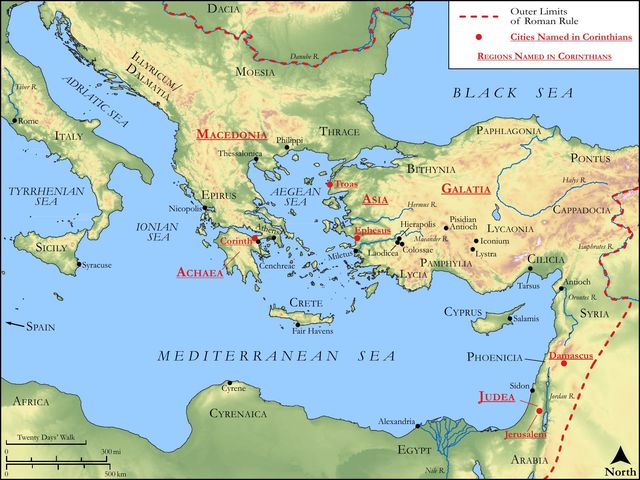
See on the biblical-era map

Study this verse
Public-domain commentary
Matthew Henry
From his Commentary on the Whole Bible. Henry comments on passages, not single verses — this entry covers 2 Corinthians 10:1–6. His four-level outline is real structure in the source text, so it is rendered as structure.
Here we may observe,
I.The mild and humble manner in which the blessed apostle addresses the Corinthians, and how desirous he is that no occasion may be given him to use severity. 1. He addresses them in a very mild and humble manner: I Paul myself beseech you, Co2 10:1. We find, in the introduction to this epistle, he joined Timothy with himself; but now he speaks only for himself, against whom the false apostles had particularly levelled their reproaches; yet in the midst of the greatest provocations he shows humility and mildness, from the consideration of the meekness and gentleness of Christ, and desires this great example may have the same influence on the Corinthians. Note, When we find ourselves tempted or inclined to be rough and severe towards any body, we should think of the meekness and gentleness of Christ, that appeared in him in the days of his flesh, in the design of his undertaking, and in all the acts of his grace towards poor souls. How humbly also does this great apostle speak of himself, as one in presence base among them! So his enemies spoke of him with contempt, and he seems to acknowledge it; while others thought meanly, and spoke scornfully of him, he had low thoughts of himself, and spoke humbly of himself. Note, We should be sensible of our own infirmities, and think humbly of ourselves, even when men reproach us for them.
2.He is desirous that no occasion may be given to use severity, Co2 10:2. He beseeches them to give no occasion for him to be bold, or to exercise his authority against them in general, as he had resolved to do against some who unjustly charged him as walking according to the flesh, that is, regulating his conduct, even in his ministerial actions, according to carnal policy or with worldly views. This was what the apostle had renounced, and this is contrary to the spirit and design of the gospel, and was far from being the aim and design of the apostle. Hereupon,
II.He asserts the power of his preaching and his power to punish offenders.
1.The power of his preaching, Co2 10:3, Co2 10:5. Here observe,
(1.)The work of the ministry is a warfare, not after the flesh indeed, for it is a spiritual warfare, with spiritual enemies and for spiritual purposes. And though ministers walk in the flesh, or live in the body, and in the common affairs of life act as other men, yet in their work and warfare they must not go by the maxims of the flesh, nor should they design to please the flesh: this must be crucified with its affections and lusts; it must be mortified and kept under.
(2.)The doctrines of the gospel and discipline of the church are the weapons of this warfare; and these are not carnal: outward force, therefore, is not the method of the gospel, but strong persuasions, by the power of truth and the meekness of wisdom. A good argument this is against persecution for conscience' sake: conscience is accountable to God only; and people must be persuaded to God and their duty, not driven by force of arms. And so the weapons of our warfare are mighty, or very powerful; the evidence of truth is convincing and cogent. This indeed is through God, or owing to him, because they are his institutions, and accompanied with his blessing, which makes all opposition to fall before his victorious gospel. We may here observe,
[1.]What opposition is made against the gospel by the powers of sin and Satan in the hearts of men. Ignorance, prejudices, beloved lusts, are Satan's strong-holds in the souls of some; vain imaginations, carnal reasonings, and high thoughts, or proud conceits, in others, exalt themselves against the knowledge of God, that is, by these ways the devil endeavours to keep men from faith and obedience to the gospel, and secures his possession of the hearts of men, as his own house or property. But then observe,
[2.]The conquest which the word of God gains. These strong-holds are pulled down by the gospel as the means, through the grace and power of God accompanying it as the principal efficient cause. Note, The conversion of the soul is the conquest of Satan in that soul.
2.The apostle's power to punish offenders (and that in an extraordinary manner) is asserted in Co2 10:6. The apostle was a prime-minister in the kingdom of Christ, and chief officer in his army, and had in readiness (that is, he had power and authority at hand) to revenge all disobedience, or to punish offenders in a most exemplary and extraordinary manner. The apostle speaks not of personal revenge, but of punishing disobedience to the gospel, and disorderly walking among church-members, by inflicting church-censures. Note, Though the apostle showed meekness and gentleness, yet he would not betray his authority; and therefore intimates that when he would commend those whose obedience was fulfilled or manifested others would fall under severe censures.
Historical interpretation
Historical reception
5 surviving comments on this verse. Each one is dated, so this reads as a timeline rather than a list.
Select a marker to jump to its quote. Markers stagger vertically where authors wrote within a few decades of each other.
Paul is saying that he is the same person whether present or absent. He refers here to the meekness and gentleness of Christ because he does not want to appear to be harsher in person than in a letter. At the same time, he warns them that he can be severe with them if he has to be and that if they do not put things right in his absence, they may get an unpleasant surprise when he comes.
"Who in your presence am lowly among you, but being absent am of good courage toward you." What, pray, is this? Surely he speaks in irony, using their speeches. For they said this, that 'when he is present indeed, he is worthy of no account, but poor and contemptible; but when absent, swells, and brags, and sets himself up against us, and threatens.' This at least he implies also afterwards, saying, "for his letters," say they, "are weighty, but his bodily presence is weak, and his speech of no account." He either then speaks in irony, manifesting great severity and saying, 'I, the base, I, the mean, when present, (as they say,) and when absent, lofty:' or else meaning that even though he should utter great things, it is not out of pride, but out of his confidence in them.
"But I beseech you, that I may hot when present show courage with the confidence, wherewith I count to be bold against some which count of us as if we walked according to the flesh." Seest thou how great his indignation, and how complete his refutation of those sayings of theirs? For he saith, 'I beseech you, do not compel me to show that even present I am strong and have power.' For since they said that 'when absent, he is quite bold against us and exalteth himself,' he uses their very words, 'I beseech therefore that they compel me not to use my power.' For this is the meaning of, "the confidence." And he said not, 'wherewith I am prepared,' but 'wherewith I count.' 'For I have not yet resolved upon this; they however give me reason enough, but not even so do I wish it.' And yet he was doing this not to vindicate himself, but the Gospel. Now if where it was necessary to vindicate the Message, he is not harsh, but draws back and delays, and beseeches that there may be no such necessity; much more would he never have done any thing of the kind in his own vindication. 'Grant me then this favor,' he saith, 'that ye compel me not to show, that even when present I am able to be bold against whomsoever it may be necessary; that is, to chastise and punish them.' Seest thou how free he was from ambition, how he did nothing for display, since even where it was matter of necessity, he hesitates not to call the act, boldness. "For I beseech you," he says, "that I may not when present show courage with the confidence, wherewith I think to be bold" against some. For this especially is the part of a teacher, not to be hasty in taking vengeance, but to work a reformation, and ever to be reluctant and slow in his punishments. How, pray, does he describe those whom he threatens? "Those that count of us as though we walked according to the flesh:" for they accused him as a hypocrite, as wicked, as a boaster.
"Now I Paul myself." Great emphasis, great weight is here. So he says elsewhere, "Behold I Paul say unto you;" and again, "As Paul the aged;" and again in another place, "Who lath been a succorer of many, and of me." So also here, "Now I Paul myself." This even is a great thing, that himself beseecheth; but that other is greater which he added, saying, "by the meekness and gentleness of Christ." For with the wish of greatly shaming them, he puts forward that "meekness and gentleness," making his entreaty in this way more forcible; as if he had said, 'Reverence the gentleness of Christ by which I beseech you.' And this he said, at the same time also showing that although they should lay ever so strong a necessity upon him, he himself is more inclined to this: it is from being meek, not from want of power, that he does not proceed against them: for Christ also did in like manner.
Some Jewish believers were ordering Gentile converts to follow the law of Moses. They condemned Paul, calling him base and stupid, and claiming that although he kept the law in secret himself, he was prepared to dispense the Gentiles from it publicly, because he thought they were too ignorant to be able to keep it. Paul refutes this charge by reminding the Corinthians of the miracles which he had done among them and of the gifts which they had received because of him.
Continue studying 2 Corinthians 10:1 across the web’s major study libraries — every link below opens this exact verse, chapter, or book on the destination site.
Read & Compare
 BibleGatewayThis verse in more than 200 translations and 70 languages.
 Bible.comThe YouVersion reader — hundreds of translations, reading plans, and highlights.
 ESV.orgCrossway's official English Standard Version reader.
 NET BibleThe NET translation with 60,000+ translators' notes on every rendering decision.
 STEP BibleTyndale House's free study tool — original text, vocabulary, and scholarly resources.
 BibliaLogos Bible Software's free web reader.
 USCCBThe New American Bible (Revised Edition) with the U.S. bishops' study notes.
Commentaries
 BibleHub CommentariesDozens of classic commentaries on this verse, gathered on one page.
 StudyLightMore than 100 commentary sets — the largest collection on the web.
 BibleRefPlain-English commentary on what this verse means, verse by verse.
 Enduring WordDavid Guzik's free commentary on this chapter, widely used by Bible teachers.
 Bible Study ToolsVerse commentary alongside Greek and Hebrew study aids.
Original Language & Research
- BibleHub InterlinearThe verse word by word — original language, transliteration, and English.
- BibleHub LexiconEvery word's original-language definition and Strong's entry.
 Blue Letter BibleDeep-study tools — Strong's numbers, concordance, and word studies.
 CNTR CollationThe earliest Greek manuscripts of this verse, collated letter by letter.
Sermons, Hymns & Audio


TrulyRandomVerse is not affiliated with these sites and doesn’t control their content. They’re linked because they’re genuinely useful.
Summary
In the Apostle Paul initiates a crucial defense of his apostolic authority and ministry. He appeals to the Corinthian believers not with worldly power or impressive rhetoric, but by invoking the very meekness and gentleness of Christ. This appeal directly confronts the accusations of his detractors, who claimed he appeared unimpressive and "base" when physically present among them, yet was "bold" and authoritative only when writing from a distance. Paul sets the stage for a profound exploration of true spiritual authority, which paradoxically manifests in humility and gentleness, even as it prepares to exercise firm discipline when necessary.
Context
ShowHideLiterary Context
2 Corinthians 10:1 marks a distinct shift in tone and subject matter within Paul's second letter to the Corinthians. The preceding chapters (2 Corinthians 1-9) primarily address themes of reconciliation, comfort in suffering, and the collection for the saints in Jerusalem. However, beginning with chapter 10, Paul directly confronts challenges to his apostolic authority and character, which were being propagated by certain influential individuals within the Corinthian church. This section (2 Corinthians 10-13) is often referred to as the "severe" or "tearful" section, reflecting a more confrontational and defensive posture as Paul refutes accusations and prepares to visit them again, potentially with disciplinary action. The verse immediately sets up the central tension: Paul's perceived weakness in person versus his boldness in writing.
Historical & Cultural Context
The Corinthian church was situated in a prominent Roman city, a hub of trade and Hellenistic culture, which valued rhetoric, philosophical debate, and impressive public speaking. Paul's opponents, often referred to as "super-apostles" or "false apostles," likely embodied these cultural ideals, boasting of their eloquence, commendations, and spiritual experiences. They criticized Paul for his lack of impressive oratorical skills, his unassuming physical presence, and his refusal to accept financial support, which they twisted into a sign of his lack of genuine apostleship. In this environment, Paul's appeal to "meekness and gentleness" would have seemed counter-cultural and weak to those accustomed to worldly displays of power and prestige. Paul's Jewish background and non-conformity to Hellenistic rhetorical norms made him an easy target for those who judged by outward appearance and worldly wisdom, rather than spiritual authority.
Key Themes
ShowHide2 Corinthians 10:1 introduces several key themes that permeate the subsequent chapters. Firstly, it highlights the theme of Apostolic Authority, emphasizing that Paul's authority is derived from Christ and exercised in a manner consistent with Christ's character, not worldly standards. Secondly, the verse immediately establishes the Paradox of Strength in Weakness, a recurring motif in Paul's theology, where his perceived human weakness becomes the very conduit for divine power, as he elaborates in 2 Corinthians 12:9-10. Thirdly, it underscores the theme of True Christian Leadership, which, unlike worldly leadership, is characterized by humility, gentleness, and a willingness to suffer for the sake of the gospel, even while being prepared to exercise necessary spiritual discipline. Finally, it sets the stage for the broader theme of Spiritual Warfare, as Paul prepares to dismantle arguments and every proud obstacle that sets itself up against the knowledge of God, as he states in 2 Corinthians 10:3-5.
Exposition and Analysis
ShowHideKey Word Analysis
ShowHideThis verb, G3870, means "to call near, invite, invoke (by imploration, hortation or consolation)." Paul is not issuing a command based on raw power, but making an earnest appeal, a heartfelt plea. It suggests a desire to persuade and comfort, even as he prepares to address difficult issues. This choice of word underscores his pastoral heart, even in confrontation.
Derived from práos, signifies "gentleness, by implication, humility." In classical Greek, práos was used to describe a wild horse that had been tamed – powerful, yet under control. It is not weakness or timidity, but strength under wraps, a humble and gentle disposition that is submissive to God's will and considerate of others. Paul appeals by this Christ-like quality.
Refers to "suitableness, equity, mildness, clemency." It implies fairness, reasonableness, and a willingness to yield or be lenient rather than insisting on strict rights. This quality complements meekness, portraying a leader who is not harsh or rigid, but gracious and understanding, even when firm action is required.
Means "depressed, i.e. (figuratively) humiliated (in circumstances or disposition); humble, of low degree (estate), lowly." This word captures the essence of the accusation against Paul – that his physical presence was unimpressive, lacking the charisma or worldly gravitas expected of a prominent figure. Paul acknowledges this perception, but implicitly redefines it as a mark of Christ-like humility.
Verse Breakdown
ShowHide"Now I Paul myself beseech you by the meekness and gentleness of Christ"
Paul begins with a direct, personal appeal ("I Paul myself"), emphasizing his own identity and authority. Crucially, he grounds his appeal not in his own status or power, but "by the meekness and gentleness of Christ." This sets the ethical and theological foundation for his upcoming defense and potential discipline, indicating that his actions are rooted in Christ's character, not personal ambition or vengeance. It's a powerful invocation of Christ's example as the ultimate standard for apostolic conduct.
"who in presence [am] base among you"
Paul directly addresses the criticism leveled against him. His opponents likely observed his physical appearance, his lack of impressive rhetoric, or his humble lifestyle, and deemed him "base" or contemptible (KJV "base" can also mean lowly, humble, or unimpressive). This clause acknowledges the Corinthian perception that Paul was unimpressive or weak when physically present, lacking the outward show of authority that they perhaps admired in others.
"but being absent am bold toward you"
This clause highlights the perceived contradiction in Paul's demeanor. His critics accused him of being timid or unassuming in person, but then bold, authoritative, and even harsh in his letters. This was used to undermine his credibility, suggesting he was a coward or a hypocrite who only dared to be firm from a distance. Paul acknowledges this perception, setting the stage to explain that his boldness, whether present or absent, is consistent with his Christ-centered authority.
Literary Devices
ShowHide2 Corinthians 10:1 masterfully employs several literary devices. The most prominent is Antithesis or Juxtaposition, specifically contrasting Paul's perceived demeanor "in presence" (base) with his demeanor "being absent" (bold). This stark opposition highlights the core accusation against him and sets up his subsequent defense, where he will reframe these perceptions within a spiritual understanding of strength and weakness. Paul also utilizes Pathos by appealing "by the meekness and gentleness of Christ." This emotional and ethical appeal invokes the beloved character of their shared Lord, aiming to disarm his critics and remind the Corinthians of the true nature of divine authority, which is not worldly or coercive. Furthermore, Paul engages in Apostolic Persona crafting, where he deliberately acknowledges the criticisms against him, not to concede their validity, but to prepare the ground for a robust theological and spiritual reinterpretation of his actions and authority, demonstrating his transparency and directness.
Theological and Thematic Connections
ShowHidePaul's appeal "by the meekness and gentleness of Christ" in 2 Corinthians 10:1 is profoundly theological. It establishes that true spiritual authority, unlike worldly power, is not characterized by outward show, rhetorical prowess, or a domineering spirit, but by the humble, self-giving character of Christ. This paradox—that ultimate power is revealed in humility and vulnerability—is central to Christian theology. Paul's willingness to be perceived as "base" or unimpressive in person, yet bold in his letters, mirrors Christ's own path of condescension and suffering that led to ultimate exaltation. It challenges the Corinthian church's (and our own) tendency to evaluate spiritual leadership based on superficial criteria, urging them instead to discern the Spirit of Christ at work, even in seemingly weak vessels. This verse underscores that the foundation of all legitimate Christian ministry is not human charisma or worldly wisdom, but the very nature of God revealed in Jesus Christ.
Reflection and Application
ShowHide2 Corinthians 10:1 offers profound insights for believers today, particularly concerning leadership, self-perception, and how we interact with others. It challenges our often-ingrained tendency to equate effectiveness with outward charisma, impressive speaking, or a forceful personality. Paul reminds us that true spiritual influence is rooted in the character of Christ—meekness and gentleness—even when firm and bold action is required. This means that our strength is not derived from our own abilities or reputation, but from our reliance on God's power, which is often perfected in our weakness. We are called to embody a humble posture, not seeking to impress or dominate, but to serve with integrity and love, always ready to speak truth with courage, whether in person or from a distance. It compels us to examine our own hearts: do we judge others, especially those in spiritual leadership, by worldly standards, or by the fruit of the Spirit and the character of Christ evident in their lives? This verse encourages us to embrace the paradox of Christian living, where humility and gentleness are not weaknesses but powerful expressions of Christ's nature, enabling us to act with spiritual authority when necessary.
Questions for Reflection
ShowHideFAQ
ShowHideWhy does Paul appeal by Christ's meekness and gentleness when he is about to be "bold" and confrontational?
ShowHidePaul's appeal to Christ's meekness and gentleness serves as the foundational principle for his upcoming "boldness." It signifies that any firmness or disciplinary action he might take is not born of personal anger, arrogance, or worldly ambition, but is rooted in the very character of Christ. Christ Himself, though meek and gentle (as seen in Matthew 11:29), also demonstrated righteous anger and boldness when confronting sin and hypocrisy (e.g., John 2:13-17). Paul's point is that his authority and actions, whether gentle or firm, are consistently aligned with the multifaceted character of Christ, aiming for the spiritual health and restoration of the Corinthians, not their destruction. His boldness is a spiritual boldness, exercised in love, not carnal aggression.
What does Paul mean by being "base" in presence but "bold" when absent?
ShowHidePaul is quoting or acknowledging a criticism leveled against him by his opponents in Corinth. When Paul was physically present, his detractors likely found him lacking in the impressive rhetorical skills, commanding presence, or charismatic showmanship that were valued in Hellenistic culture. "Base" (Greek: tapeinós) here implies humble, lowly, or unimpressive in outward appearance and demeanor. In contrast, they perceived his letters as "bold" (Greek: tharrhéō), meaning confident, assertive, and even severe. The accusation was that he was a coward in person but brave only from a distance. Paul acknowledges this perception to directly address it, arguing that his perceived "weakness" in person is actually a manifestation of Christ's humility, and his "boldness" in writing is a legitimate exercise of his God-given apostolic authority, which he is prepared to demonstrate in person if necessary (as he hints in 2 Corinthians 10:2).
Who were Paul's opponents in Corinth, and what was their main criticism?
ShowHidePaul's opponents in Corinth were likely a group of "super-apostles" or "false apostles" who had infiltrated the church. They were probably Jewish Christians, possibly from Jerusalem, who boasted of their impressive credentials, eloquent speech, and spiritual experiences, contrasting themselves with Paul. Their main criticism of Paul, as highlighted in 2 Corinthians 10:1 and throughout 2 Corinthians 10-13, was that he lacked true apostolic authority because he appeared unimpressive in person, was a poor speaker, and did not accept financial support from the Corinthians. They accused him of being weak, inconsistent, and not truly an apostle of Christ, thereby undermining his ministry and leading some Corinthians astray.
Christ-Centered Fulfillment
ShowHide2 Corinthians 10:1 finds its ultimate Christ-centered fulfillment in the very paradox of Jesus' earthly ministry and His redemptive work. Paul's appeal "by the meekness and gentleness of Christ" points directly to the incarnate Son of God who, though possessing all divine authority, "made himself nothing by taking the very nature of a servant" (Philippians 2:7). Jesus, the King of kings, presented Himself as "gentle and humble in heart" (Matthew 11:29), riding into Jerusalem on a donkey, not a warhorse (Zechariah 9:9). His perceived "baseness" or weakness culminated in His crucifixion, an event that appeared to be a defeat, yet was the ultimate display of God's power and wisdom, "for the foolishness of God is wiser than human wisdom, and the weakness of God is stronger than human strength" (1 Corinthians 1:25). This divine humility and self-sacrifice ultimately led to His resurrection and exaltation, where "all authority in heaven and on earth has been given to me" (Matthew 28:18). Paul's ministry, characterized by perceived weakness in presence and boldness in absence, thus perfectly mirrors the pattern of Christ's life, death, and resurrection, demonstrating that true spiritual authority flows from the crucified and risen Lord, not from worldly might or human impressiveness.