


2 Corinthians 10:2
Bible text: King James Version (1769 Blayney text) · Public domain
Bible text: King James Version with Strong's numbers · Public domain
Bible text: Berean Standard Bible · Public domain
Bible text: American Standard Version (1901) · Public domain
Bible text: World English Bible, Messianic edition · Public domain
Bible text: Geneva Bible (1599) · Public domain
Bible text: Young's Literal Translation · Public domain
- δέομαιdeomaiI implore [you]G1189V-PNI-1SVerb Present Middle Or Passive Deponent Indicative 1st Singular
- δὲdenowG1161CONJConjunction
- τὸtothatG3588T-NSNDefinite article Nominative Singular Neuter
- μὴmēnotG3361PRT-NNegative Particle Negative
- παρὼνparōnbeing presentG3918V-PAP-NSMVerb Present Active Participle Nominative Singular Masculine
- θαρρῆσαιtharrēsaito be boldG2292V-AANVerb Aorist Active Infinitive
- τῇtēawith theG3588T-DSFDefinite article Dative Singular Feminine
- πεποιθήσειpepoithēseiconfidenceG4006N-DSFNoun Dative Singular Feminine
- ᾗhēwith whichG3739R-DSFRelative pronoun Dative Singular Feminine
- λογίζομαιlogizomaiI reckonG3049V-PNI-1SVerb Present Middle Or Passive Deponent Indicative 1st Singular
- τολμῆσαιtolmēsaito be daringG5111V-AANVerb Aorist Active Infinitive
- ἐπίepitowardG1909PREPPreposition
- τιναςtinassomeG5100X-APMIndefinite pronoun Accusative Plural Masculine
- τοὺςtousthoseG3588T-APMDefinite article Accusative Plural Masculine
- λογιζομένουςlogizomenousreckoningG3049V-PNP-APMVerb Present Middle Or Passive Deponent Participle Accusative Plural Masculine
- ἡμᾶςhēmasusG3165P-1APPersonal pronoun Accusative 1st Plural
- ὡςhōsasG5613PRTParticle or Disjunctive
- κατὰkataaccording toG2596PREPPreposition
- σάρκαsarkafleshG4561N-ASFNoun Accusative Singular Feminine
- περιπατοῦνταςperipatountaswalkingG4043V-PAP-APMVerb Present Active Participle Accusative Plural Masculine
English is a literal word-by-word gloss of the Greek, not the KJV's wording. Why?
This is the original text the KJV's translators worked from — each Greek word with its own literal English meaning in this verse, prepared by scholars at Tyndale House, Cambridge. The KJV translates whole sentences, not word by word, so its wording differs: one Greek word can become several English words, and the KJV may choose “charity” where the gloss reads “love”. Both are faithful — they answer different questions. For the KJV's own rendering, switch to the KJV text.
Details
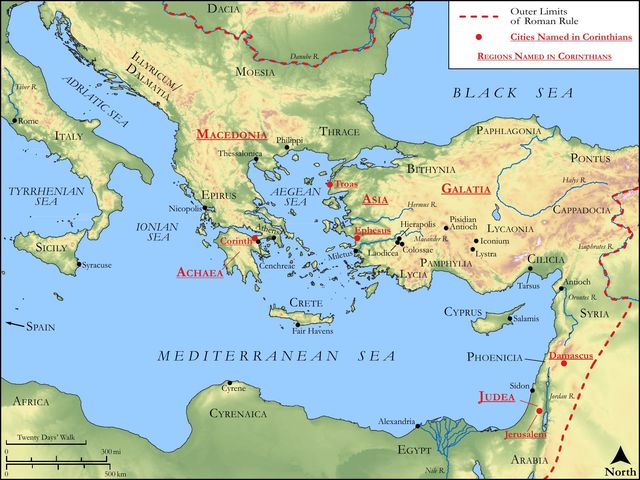
See on the biblical-era maps

Study this verse
Public-domain commentary
Matthew Henry
From his Commentary on the Whole Bible. Henry comments on passages, not single verses — this entry covers 2 Corinthians 10:1–6. His four-level outline is real structure in the source text, so it is rendered as structure.
Here we may observe,
I.The mild and humble manner in which the blessed apostle addresses the Corinthians, and how desirous he is that no occasion may be given him to use severity. 1. He addresses them in a very mild and humble manner: I Paul myself beseech you, Co2 10:1. We find, in the introduction to this epistle, he joined Timothy with himself; but now he speaks only for himself, against whom the false apostles had particularly levelled their reproaches; yet in the midst of the greatest provocations he shows humility and mildness, from the consideration of the meekness and gentleness of Christ, and desires this great example may have the same influence on the Corinthians. Note, When we find ourselves tempted or inclined to be rough and severe towards any body, we should think of the meekness and gentleness of Christ, that appeared in him in the days of his flesh, in the design of his undertaking, and in all the acts of his grace towards poor souls. How humbly also does this great apostle speak of himself, as one in presence base among them! So his enemies spoke of him with contempt, and he seems to acknowledge it; while others thought meanly, and spoke scornfully of him, he had low thoughts of himself, and spoke humbly of himself. Note, We should be sensible of our own infirmities, and think humbly of ourselves, even when men reproach us for them.
2.He is desirous that no occasion may be given to use severity, Co2 10:2. He beseeches them to give no occasion for him to be bold, or to exercise his authority against them in general, as he had resolved to do against some who unjustly charged him as walking according to the flesh, that is, regulating his conduct, even in his ministerial actions, according to carnal policy or with worldly views. This was what the apostle had renounced, and this is contrary to the spirit and design of the gospel, and was far from being the aim and design of the apostle. Hereupon,
II.He asserts the power of his preaching and his power to punish offenders.
1.The power of his preaching, Co2 10:3, Co2 10:5. Here observe,
(1.)The work of the ministry is a warfare, not after the flesh indeed, for it is a spiritual warfare, with spiritual enemies and for spiritual purposes. And though ministers walk in the flesh, or live in the body, and in the common affairs of life act as other men, yet in their work and warfare they must not go by the maxims of the flesh, nor should they design to please the flesh: this must be crucified with its affections and lusts; it must be mortified and kept under.
(2.)The doctrines of the gospel and discipline of the church are the weapons of this warfare; and these are not carnal: outward force, therefore, is not the method of the gospel, but strong persuasions, by the power of truth and the meekness of wisdom. A good argument this is against persecution for conscience' sake: conscience is accountable to God only; and people must be persuaded to God and their duty, not driven by force of arms. And so the weapons of our warfare are mighty, or very powerful; the evidence of truth is convincing and cogent. This indeed is through God, or owing to him, because they are his institutions, and accompanied with his blessing, which makes all opposition to fall before his victorious gospel. We may here observe,
[1.]What opposition is made against the gospel by the powers of sin and Satan in the hearts of men. Ignorance, prejudices, beloved lusts, are Satan's strong-holds in the souls of some; vain imaginations, carnal reasonings, and high thoughts, or proud conceits, in others, exalt themselves against the knowledge of God, that is, by these ways the devil endeavours to keep men from faith and obedience to the gospel, and secures his possession of the hearts of men, as his own house or property. But then observe,
[2.]The conquest which the word of God gains. These strong-holds are pulled down by the gospel as the means, through the grace and power of God accompanying it as the principal efficient cause. Note, The conversion of the soul is the conquest of Satan in that soul.
2.The apostle's power to punish offenders (and that in an extraordinary manner) is asserted in Co2 10:6. The apostle was a prime-minister in the kingdom of Christ, and chief officer in his army, and had in readiness (that is, he had power and authority at hand) to revenge all disobedience, or to punish offenders in a most exemplary and extraordinary manner. The apostle speaks not of personal revenge, but of punishing disobedience to the gospel, and disorderly walking among church-members, by inflicting church-censures. Note, Though the apostle showed meekness and gentleness, yet he would not betray his authority; and therefore intimates that when he would commend those whose obedience was fulfilled or manifested others would fall under severe censures.
Historical interpretation
Historical reception
4 surviving comments on this verse. Each one is dated, so this reads as a timeline rather than a list.
Select a marker to jump to its quote. Markers stagger vertically where authors wrote within a few decades of each other.
Paul is referring here to those who did not accept that his teaching was spiritual.
"Who in your presence am lowly among you, but being absent am of good courage toward you." What, pray, is this? Surely he speaks in irony, using their speeches. For they said this, that 'when he is present indeed, he is worthy of no account, but poor and contemptible; but when absent, swells, and brags, and sets himself up against us, and threatens.' This at least he implies also afterwards, saying, "for his letters," say they, "are weighty, but his bodily presence is weak, and his speech of no account." He either then speaks in irony, manifesting great severity and saying, 'I, the base, I, the mean, when present, (as they say,) and when absent, lofty:' or else meaning that even though he should utter great things, it is not out of pride, but out of his confidence in them.
"But I beseech you, that I may hot when present show courage with the confidence, wherewith I count to be bold against some which count of us as if we walked according to the flesh." Seest thou how great his indignation, and how complete his refutation of those sayings of theirs? For he saith, 'I beseech you, do not compel me to show that even present I am strong and have power.' For since they said that 'when absent, he is quite bold against us and exalteth himself,' he uses their very words, 'I beseech therefore that they compel me not to use my power.' For this is the meaning of, "the confidence." And he said not, 'wherewith I am prepared,' but 'wherewith I count.' 'For I have not yet resolved upon this; they however give me reason enough, but not even so do I wish it.' And yet he was doing this not to vindicate himself, but the Gospel. Now if where it was necessary to vindicate the Message, he is not harsh, but draws back and delays, and beseeches that there may be no such necessity; much more would he never have done any thing of the kind in his own vindication. 'Grant me then this favor,' he saith, 'that ye compel me not to show, that even when present I am able to be bold against whomsoever it may be necessary; that is, to chastise and punish them.' Seest thou how free he was from ambition, how he did nothing for display, since even where it was matter of necessity, he hesitates not to call the act, boldness. "For I beseech you," he says, "that I may not when present show courage with the confidence, wherewith I think to be bold" against some. For this especially is the part of a teacher, not to be hasty in taking vengeance, but to work a reformation, and ever to be reluctant and slow in his punishments. How, pray, does he describe those whom he threatens? "Those that count of us as though we walked according to the flesh:" for they accused him as a hypocrite, as wicked, as a boaster.
"Now I Paul myself." Great emphasis, great weight is here. So he says elsewhere, "Behold I Paul say unto you;" and again, "As Paul the aged;" and again in another place, "Who lath been a succorer of many, and of me." So also here, "Now I Paul myself." This even is a great thing, that himself beseecheth; but that other is greater which he added, saying, "by the meekness and gentleness of Christ." For with the wish of greatly shaming them, he puts forward that "meekness and gentleness," making his entreaty in this way more forcible; as if he had said, 'Reverence the gentleness of Christ by which I beseech you.' And this he said, at the same time also showing that although they should lay ever so strong a necessity upon him, he himself is more inclined to this: it is from being meek, not from want of power, that he does not proceed against them: for Christ also did in like manner.
Continue studying 2 Corinthians 10:2 across the web’s major study libraries — every link below opens this exact verse, chapter, or book on the destination site.
Read & Compare
 BibleGatewayThis verse in more than 200 translations and 70 languages.
 Bible.comThe YouVersion reader — hundreds of translations, reading plans, and highlights.
 ESV.orgCrossway's official English Standard Version reader.
 NET BibleThe NET translation with 60,000+ translators' notes on every rendering decision.
 STEP BibleTyndale House's free study tool — original text, vocabulary, and scholarly resources.
 BibliaLogos Bible Software's free web reader.
 USCCBThe New American Bible (Revised Edition) with the U.S. bishops' study notes.
Commentaries
 BibleHub CommentariesDozens of classic commentaries on this verse, gathered on one page.
 StudyLightMore than 100 commentary sets — the largest collection on the web.
 BibleRefPlain-English commentary on what this verse means, verse by verse.
 Enduring WordDavid Guzik's free commentary on this chapter, widely used by Bible teachers.
 Bible Study ToolsVerse commentary alongside Greek and Hebrew study aids.
Original Language & Research
- BibleHub InterlinearThe verse word by word — original language, transliteration, and English.
- BibleHub LexiconEvery word's original-language definition and Strong's entry.
 Blue Letter BibleDeep-study tools — Strong's numbers, concordance, and word studies.
 CNTR CollationThe earliest Greek manuscripts of this verse, collated letter by letter.
Sermons, Hymns & Audio


TrulyRandomVerse is not affiliated with these sites and doesn’t control their content. They’re linked because they’re genuinely useful.
Summary
In 2 Corinthians 10:2, the Apostle Paul articulates his earnest desire to avoid exercising a confrontational boldness when he is physically present with the Corinthian church. This preferred gentleness stands in stark contrast to the firm confidence he is prepared to demonstrate against those who wrongly accuse him and his fellow ministers of operating according to worldly principles, or "walking according to the flesh." The verse underscores Paul's pastoral heart while simultaneously asserting his readiness to wield apostolic authority against unrepentant opposition.
Context
ShowHideLiterary Context
This verse marks a significant shift in Paul's second letter to the Corinthians. Chapters 1-9 are characterized by themes of reconciliation, comfort, and the joy of partnership in the gospel, culminating in an appeal for generous giving. However, beginning with chapter 10, Paul adopts a much more direct, assertive, and defensive tone. He confronts a faction within the Corinthian church, likely influenced by "super-apostles" or false teachers, who were actively undermining his authority and ministry. 2 Corinthians 10:1 immediately precedes this verse, where Paul appeals to the Corinthians "by the meekness and gentleness of Christ," setting up the tension between his preferred approach and the necessary sternness he might have to employ. The subsequent verses in 2 Corinthians 10:3-6 further elaborate on the spiritual nature of his warfare, directly refuting the accusation that he operates "according to the flesh."
Historical & Cultural Context
The city of Corinth was a bustling, cosmopolitan trade center known for its wealth, diverse population, and moral laxity. The Corinthian church, though founded by Paul, struggled with internal divisions, spiritual immaturity, and the influence of Hellenistic rhetoric and philosophy. Paul's opponents in Corinth likely valued eloquent speech, impressive human credentials, and outward displays of power, contrasting these with Paul's often humble demeanor and lack of sophisticated rhetorical prowess. They accused him of being "weak in bodily presence, and his speech contemptible" (2 Corinthians 10:10). The charge of "walking according to the flesh" was a grave accusation in this context, implying that Paul's motivations and methods were earthly, self-serving, or driven by human weakness rather than divine inspiration and power. This was a common critique leveled against those perceived as lacking spiritual gravitas or operating outside accepted societal norms of influence.
Key Themes
ShowHideThis verse contributes significantly to several overarching themes in 2 Corinthians. Firstly, it highlights the theme of Apostolic Authority and its Proper Exercise. Paul asserts his God-given authority, not for personal gain or worldly power, but for the spiritual edification of the church, even if it requires disciplinary action (2 Corinthians 13:10). Secondly, it underscores the profound Contrast Between Spiritual and Carnal Living/Ministry. The accusation that Paul "walked according to the flesh" forces him to articulate the divine nature of his ministry, emphasizing that while he lives in the physical body, his warfare is not waged by human means but by God's power (2 Corinthians 10:3-4). Lastly, Paul's expressed desire to avoid harshness reveals his Pastoral Heart and Reluctance to Discipline. Despite his resolve to confront error, his preference is always for the Corinthians' repentance and restoration, demonstrating a deep love and concern for their spiritual well-being. This aligns with the broader theme of God's power being perfected in weakness (2 Corinthians 12:9), as Paul's apparent "weakness" was, in fact, a conduit for God's strength.
Exposition and Analysis
ShowHideKey Word Analysis
ShowHideThis word (G2292) signifies "to exercise courage," "to be confident." In this context, it carries the nuance of acting with decisive authority, particularly in a confrontational or disciplinary manner. Paul desires not to be forced into such a posture when he is present, implying he prefers a more gentle, persuasive approach. However, he is fully prepared to be bold against those who challenge his divine commission.
Occurring twice in the verse (G3049), this verb means "to take an inventory," "to estimate," "to reckon," or "to suppose." Its double use is crucial: Paul "thinks" (reckons, intends) to be bold against certain individuals, and these individuals "think" (reckon, suppose) that Paul walks according to the flesh. This highlights a battle of perceptions and judgments, where Paul is correcting a faulty assessment of his character and ministry.
This term (G4561) refers to "flesh" in its broadest sense, but here, in the phrase "walked according to the flesh," it signifies human nature with its inherent frailties, weaknesses, and passions, particularly as opposed to divine power or spiritual principles. To "walk according to the flesh" (using katá G2596, "according to," in conjunction with sárx) means to live, operate, or be motivated by human standards, worldly wisdom, or carnal desires, rather than by the Spirit of God. Paul vehemently denies this accusation, asserting that his ministry, though outwardly unimpressive to some, is profoundly spiritual.
Verse Breakdown
ShowHide"But I beseech [you], that I may not be bold when I am present with that confidence,"
Paul opens with a plea, expressing his earnest desire to avoid a confrontational demeanor upon his arrival. The "confidence" (pepoíthēsis, G4006) he refers to is the assuredness of his apostolic authority, which he is prepared to use. His preference is for the Corinthians to respond to his previous appeals, making stern measures unnecessary. This reveals his pastoral heart, desiring reconciliation over confrontation.
"wherewith I think to be bold against some,"
This clause reveals Paul's resolve and the specific target of his potential "boldness." He "thinks" or intends to exercise his authority against a particular group—those who are actively opposing him and causing division. This is not a general threat but a targeted warning to specific individuals or factions who are undermining the church's spiritual health.
"which think of us as if we walked according to the flesh."
This final clause clarifies the nature of the opposition and the accusation leveled against Paul. His opponents perceive him and his ministry as operating on worldly principles, driven by human weakness or self-interest, rather than by divine power and spiritual integrity. This was a serious charge, implying a lack of genuine spiritual authority and a reliance on carnal methods. Paul's subsequent arguments in chapter 10 are a direct refutation of this slander.
Literary Devices
ShowHidePaul employs a powerful use of Antithesis in this verse, contrasting his preferred gentle approach with the firm, bold confidence he is prepared to exercise. This highlights the tension between his pastoral heart and his apostolic responsibility. There is also an element of Irony in the opponents' accusation: they claim Paul "walks according to the flesh," yet their own judgments and methods are often characterized by worldly standards and human pride, precisely what they accuse Paul of. Furthermore, the phrase "walked according to the flesh" serves as a Metaphor for a life or ministry governed by human rather than divine principles, emphasizing a fundamental spiritual distinction.
Theological and Thematic Connections
ShowHidePaul's declaration in 2 Corinthians 10:2 underscores a critical theological principle: authentic spiritual authority is not exercised for personal gain or worldly dominance, but for the edification and spiritual health of the church. While Paul prefers to minister with gentleness and persuasion, he recognizes that true love for the flock sometimes necessitates firm correction and the wielding of God-given authority against those who sow discord or promote false teaching. This balance between grace and truth, gentleness and firmness, reflects the character of Christ himself and is a hallmark of godly leadership. The accusation of "walking according to the flesh" also brings to the forefront the perpetual tension between the spiritual and the carnal, reminding believers that true Christian life and ministry are empowered by the Holy Spirit, not by human wisdom or strength.
Reflection and Application
ShowHide2 Corinthians 10:2 offers profound insights for both leaders and all believers. For those in spiritual authority, it highlights the delicate balance between compassionate pastoral care and the necessary exercise of discipline. True leadership seeks to build up, not tear down, and prefers reconciliation over confrontation. However, it also recognizes that faithfulness to God's truth sometimes demands a firm stand against error and unrepentant sin, always with the aim of restoring individuals and protecting the integrity of the community. For every believer, this verse challenges us to examine our own lives and ministries: are we truly operating "according to the Spirit" or are we subtly influenced by worldly values, human wisdom, or self-serving motives? Our methods, motivations, and the source of our strength reveal whether we are walking according to the flesh or according to the Spirit.
Questions for Reflection
ShowHideFAQ
ShowHideWhat does "walking according to the flesh" mean in this context?
ShowHideIn 2 Corinthians 10:2, "walking according to the flesh" (Greek: kata sarka peripatoumen) does not primarily refer to immoral or licentious behavior, though that is one aspect of "the flesh" in other contexts. Here, it signifies operating according to human standards, worldly wisdom, carnal strength, or self-serving motives, as opposed to being guided by God's Spirit and divine power. Paul's opponents accused him of lacking true spiritual authority and relying on human manipulation or weakness, which he vehemently refutes in 2 Corinthians 10:3-4. He emphasizes that while he lives in the flesh, his warfare is not carnal but spiritual.
Christ-Centered Fulfillment
ShowHidePaul's struggle and resolve in 2 Corinthians 10:2 find their ultimate fulfillment and pattern in Christ. Jesus, though possessing all authority in heaven and on earth (Matthew 28:18), often ministered with profound humility and gentleness, appealing to hearts rather than coercing them (Matthew 11:29). Yet, He also demonstrated unwavering boldness and righteous indignation against hypocrisy and spiritual corruption, overturning tables in the temple (John 2:13-17) and directly confronting the self-righteous religious leaders (Matthew 23:13-36). The accusation of "walking according to the flesh" leveled against Paul also echoes the world's misunderstanding of Christ, who was "despised and rejected by men" (Isaiah 53:3), yet His apparent weakness on the cross was the ultimate display of divine power and love, conquering sin and death (1 Corinthians 1:23-25). Paul's ministry, like Christ's, was not about outward show or human wisdom, but about manifesting the power of God through apparent weakness, leading to the spiritual transformation of lives, a work only possible through the Spirit of Christ.