


Galatians 5:25
- εἰeiIfG1487CONDConjunction
- ζῶμενzōmenwe liveG2198V-PAI-1PVerb Present Active Indicative 1st Plural
- πνεύματιpneumatiby [the] SpiritG4151N-DSNNoun Dative Singular Neuter
- πνεύματιpneumatiby [the] SpiritG4151N-DSNNoun Dative Singular Neuter
- καὶkaialsoG2532CONJConjunction
- στοιχῶμενstoichōmenwe shall walkG4748V-PAS-1PVerb Present Active Subjunctive 1st Plural
English is a literal word-by-word gloss of the Greek, not the KJV's wording. Why?
This is the original text the KJV's translators worked from — each Greek word with its own literal English meaning in this verse, prepared by scholars at Tyndale House, Cambridge. The KJV translates whole sentences, not word by word, so its wording differs: one Greek word can become several English words, and the KJV may choose “charity” where the gloss reads “love”. Both are faithful — they answer different questions. For the KJV's own rendering, switch to the KJV text.
Details
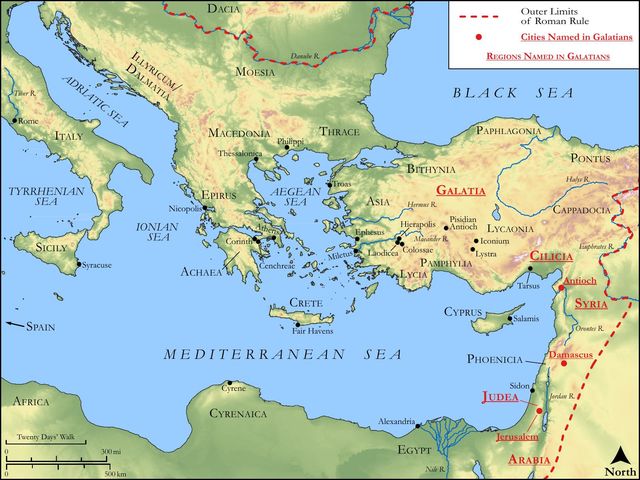
See on the biblical-era map

Study this verse
Public-domain commentary
Matthew Henry
From his Commentary on the Whole Bible. Henry comments on passages, not single verses — this entry covers Galatians 5:13–26. His three-level outline is real structure in the source text, so it is rendered as structure.
In the latter part of this chapter the apostle comes to exhort these Christians to serious practical godliness, as the best antidote against the snares of the false teachers. Two things especially he presses upon them: -
I.That they should not strive with one another, but love one another.
He tells them (Gal 5:13) that they had been called unto liberty, and he would have them to stand fast in the liberty wherewith Christ had made them free; but yet he would have them be very careful that they did not use this liberty as an occasion to the flesh - that they did not thence take occasion to indulge themselves in any corrupt affections and practices, and particularly such as might create distance and disaffection, and be the ground of quarrels and contentions among them: but, on the contrary, he would have them by love to serve one another, to maintain that mutual love and affection which, notwithstanding any minor differences there might be among them, would dispose them to all those offices of respect and kindness to each other which the Christian religion obliged them to. Note,
1.The liberty we enjoy as Christians is not a licentious liberty: though Christ has redeemed us from the curse of the law, yet he has not freed us from the obligation of it; the gospel is a doctrine according to godliness (Ti1 6:3), and is so far from giving the least countenance to sin that it lays us under the strongest obligations to avoid and subdue it.
2.Though we ought to stand fast in our Christian liberty, yet we should not insist upon it to the breach of Christian charity; we should not use it as an occasion of strife and contention with our fellow Christians, who may be differently minded from us, but should always maintain such a temper towards each other as may dispose us by love to serve one another. To this the apostle endeavours to persuade these Christians, and there are two considerations which he sets before them for this purpose: - (1.) That all the law is fulfilled in one word, even in this, Thou shalt love thy neighbour as thyself, Gal 5:14. Love is the sum of the whole law; as love to God comprises the duties of the first table, so love to our neighbour those of the second. The apostle takes notice of the latter here, because he is speaking of their behaviour towards one another; and, when he makes use of this as an argument to persuade them to mutual love, he intimates both that this would be a good evidence of their sincerity in religion and also the most likely means of rooting out those dissensions and divisions that were among them. It will appear that we are the disciples of Christ indeed when we have love one to another (Joh 13:35); and, where this temper is kept up, if it do not wholly extinguish those unhappy discords that are among Christians, yet at least it will so far accommodate them that the fatal consequences of them will be prevented. (2.) The sad and dangerous tendency of a contrary behaviour (Gal 5:15): But, says he, if instead of serving one another in love, and therein fulfilling the law of God, you bite and devour one another, take heed that you be not consumed one of another. If, instead of acting like men and Christians, they would behave themselves more like brute beasts, in tearing and rending one another, they could expect nothing as the consequence of it, but that they would be consumed one of another; and therefore they had the greatest reason not to indulge themselves in such quarrels and animosities. Note, Mutual strifes among brethren, if persisted in, are likely to prove a common ruin; those that devour one another are in a fair way to be consumed one of another. Christian churches cannot be ruined but by their own hands; but if Christians, who should be helps to one another and a joy one to another, be as brute beasts, biting and devouring each other, what can be expected but that the God of love should deny his grace to them, and the Spirit of love should depart from them, and that the evil spirit, who seeks the destruction of them all, should prevail?
II.That they should all strive against sin; and happy would it be for the church if Christians would let all their quarrels be swallowed up of this, even a quarrel against sin-if, instead of biting and devouring one another on account of their different opinions, they would all set themselves against sin in themselves and the places where they live. This is what we are chiefly concerned to fight against, and that which above every thing else we should make it our business to oppose and suppress. To excite Christians hereunto, and to assist them herein, the apostle shows,
1.That there is in every one a struggle between the flesh and the spirit (Gal 5:17): The flesh (the corrupt and carnal part of us) lusts (strives and struggles with strength and vigour) against the spirit: it opposes all the motions of the Spirit, and resists every thing that is spiritual. On the other hand, the spirit (the renewed part of us) strives against the flesh, and opposes the will and desire of it: and hence it comes to pass that we cannot do the things that we would. As the principle of grace in us will not suffer us to do all the evil which our corrupt nature would prompt us to, so neither can we do all the good that we would, by reason of the oppositions we meet with from that corrupt and carnal principle. Even as in a natural man there is something of this struggle (the convictions of his conscience and the corruption of his own heart strive with one another; his convictions would suppress his corruptions, and his corruptions silence his convictions), so in a renewed man, where there is something of a good principle, there is a struggle between the old nature and the new nature, the remainders of sin and the beginnings of grace; and this Christians must expect will be their exercise as long as they continue in this world.
2.That it is our duty and interest in this struggle to side with the better part, to side with our convictions against our corruptions and with our graces against our lusts. This the apostle represents as our duty, and directs us to the most effectual means of success in it. If it should be asked, What course must we take that the better interest may get the better? he gives us this one general rule, which, if duly observed, would be the most sovereign remedy against the prevalence of corruption; and that is to walk in the Spirit (Gal 5:16): This I say, then, Walk in the Spirit, and you shall not fulfil the lust of the flesh. By the Spirit here may be meant either the Holy Spirit himself, who condescends to dwell in the hearts of those whom he has renewed and sanctified, to guide and assist them in the way of their duty, or that gracious principle which he implants in the souls of his people and which lusts against the flesh, as that corrupt principle which still remains in them does against it. Accordingly the duty here recommended to us is that we set ourselves to act under the guidance and influence of the blessed Spirit, and agreeably to the motions and tendency of the new nature in us; and, if this be our care in the ordinary course and tenour of our lives, we may depend upon it that, though we may not be freed from the stirrings and oppositions of our corrupt nature, we shall be kept from fulfilling it in the lusts thereof; so that though it remain in us, yet it shall not obtain a dominion over us. Note, The best antidote against the poison of sin is to walk in the Spirit, to be much in conversing with spiritual things, to mind the things of the soul, which is the spiritual part of man, more than those of the body, which is his carnal part, to commit ourselves to the guidance of the word, wherein the Holy Spirit makes known the will of God concerning us, and in the way of our duty to act in a dependence on his aids and influences. And, as this would be the best means of preserving them from fulfilling the lusts of the flesh, so it would be a good evidence that they were Christians indeed; for, says the apostle (Gal 5:18), If you be led by the Spirit, you are not under the law. As if he had said, "You must expect a struggle between flesh and spirit as long as you are in the world, that the flesh will be lusting against the spirit as well as the spirit against the flesh; but if, in the prevailing bent and tenour of your lives, you be led by the Spirit, - if you act under the guidance and government of the Holy Spirit and of that spiritual nature and disposition he has wrought in you, - if you make the word of God your rule and the grace of God your principle, - it will hence appear that you are not under the law, not under the condemning, though you are still under the commanding, power of it; for there is now no condemnation to those that are in Christ Jesus, who walk not after the flesh, but after the Spirit; and as many as are led by the Spirit of God, they are the sons of God," Rom 8:1-14.
3.The apostle specifies the works of the flesh, which must be watched against and mortified, and the fruits of the Spirit, which must be cherished and brought forth (Gal 5:19, etc.); and by specifying particulars he further illustrates what he is here upon.
(1.)He begins with the works of the flesh, which, as they are many, so they are manifest. It is past dispute that the things he here speaks of are the works of the flesh, or the product of corrupt and depraved nature; most of them are condemned by the light of nature itself, and all of them by the light of scripture. The particulars he specifies are of various sorts; some are sins against the seventh commandment, such as adultery, fornication, uncleanness, lasciviousness, by which are meant not only the gross acts of these sins, but all such thoughts, and words, and actions, as have a tendency towards the great transgression. Some are sins against the first and second commandments, as idolatry and witchcraft. Others are sins against our neighbour, and contrary to the royal law of brotherly love, such as hatred, variance, emulations, wrath, strife, which too often occasion seditions, heresies, envyings, and sometimes break out into murders, not only of the names and reputation, but even of the very lives, of our fellow-creatures. Others are sins against ourselves, such as drunkenness and revellings; and he concludes the catalogue with an et cetera, and gives fair warning to all to take care of them, as they hope to see the face of God with comfort. Of these and such like, says he, I tell you before, as I have also told you in times past, that those who do such things, how much soever they may flatter themselves with vain hopes, shall not inherit the kingdom of God. These are sins which will undoubtedly shut men out of heaven. The world of spirits can never be comfortable to those who plunge themselves in the filth of the flesh; nor will the righteous and holy God ever admit such into his favour and presence, unless they be first washed and sanctified, and justified in the name of our Lord Jesus, and by the Spirit of our God, Co1 6:11.
(2.)He specifies the fruits of the Spirit, or the renewed nature, which as Christians we are concerned to bring forth, Gal 5:22, Gal 5:23. And here we may observe that as sin is called the work of the flesh, because the flesh, or corrupt nature, is the principle that moves and excites men to it, so grace is said to be the fruit of the Spirit, because it wholly proceeds from the Spirit, as the fruit does from the root: and whereas before the apostle had chiefly specified those works of the flesh which were not only hurtful to men themselves but tended to make them so to one another, so here he chiefly takes notice of those fruits of the Spirit which had a tendency to make Christians agreeable one to another, as well as easy to themselves; and this was very suitable to the caution or exhortation he had before given (Gal 5:13), that they should not use their liberty as an occasion to the flesh, but by love serve one another. He particularly recommends to us, love, to God especially, and to one another for his sake, - joy, by which may be understood cheerfulness in conversation with our friends, or rather a constant delight in God, - peace, with God and conscience, or a peaceableness of temper and behaviour towards others, - long-suffering, patience to defer anger, and a contentedness to bear injuries, - gentleness, such a sweetness of temper, and especially towards our inferiors, as disposes us to be affable and courteous, and easy to be entreated when any have wronged us, - goodness (kindness, beneficence), which shows itself in a readiness to do good to all as we have opportunity, - faith, fidelity, justice, and honesty, in what we profess and promise to others, - meekness, wherewith to govern our passions and resentments, so as not to be easily provoked, and, when we are so, to be soon pacified, - and temperance, in meat and drink, and other enjoyments of life, so as not to be excessive and immoderate in the use of them. Concerning these things, or those in whom these fruits of the Spirit are found, the apostle says, There is no law against them, to condemn and punish them. Yea, hence it appears that they are not under the law, but under grace; for these fruits of the Spirit, in whomsoever they are found, plainly show that such are led by the Spirit, and consequently that they are not under the law, as Gal 5:18. And as, by specifying these works of the flesh and fruits of the Spirit, the apostle directs us both what we are to avoid and oppose and what we are to cherish and cultivate, so (Gal 5:24) he informs us that this is the sincere care and endeavour of all real Christians: And those that are Christ's, says he (those who are Christians indeed, not only in show and profession, but in sincerity and truth), have crucified the flesh with the affections and lusts. As in their baptism they were obliged hereunto (for, being baptized into Christ, they were baptized into his death, Rom 6:3), so they are now sincerely employing themselves herein, and, in conformity to their Lord and head, are endeavouring to die unto sin, as he had died for it. They have not yet obtained a complete victory over it; they have still flesh as well as Spirit in them, and that has its affections and lusts, which continue to give them no little disturbance, but as it does not now reign in their mortal bodies, so as that they obey it in the lusts thereof (Rom 6:12), so they are seeking the utter ruin and destruction of it, and to put it to the same shameful and ignominious, though lingering death, which our Lord Jesus underwent for our sakes. Note, If we should approve ourselves to be Christ's, such as are united to him and interested in him, we must make it our constant care and business to crucify the flesh with its corrupt affections and lusts. Christ will never own those as his who yield themselves the servants of sin. But though the apostle here only mentions the crucifying of the flesh with the affections and lusts, as the care and character of real Christians, yet, no doubt, it is also implied that, on the other hand, we should show forth those fruits of the Spirit which he had just before been specifying; this is no less our duty than that, nor is it less necessary to evidence our sincerity in religion. It is not enough that we cease to do evil, but we must learn to do well. Our Christianity obliges us not only to die unto sin, but to live unto righteousness; not only to oppose the works of the flesh, but to bring forth the fruits of the Spirit too. If therefore we would make it appear that we do indeed belong to Christ, this must be our sincere care and endeavour as well as the other; and that it was the design of the apostle to represent both the one and the other of these as our duty, and as necessary to support our character as Christians, may be gathered from what follows (Gal 5:25), where he adds, If we live in the Spirit, let us also walk in the Spirit; that is, "If we profess to have received the Spirit of Christ, or that we are renewed in the Spirit of Christ, or that we are renewed in the spirit of our minds, and endued with a principle of spiritual life, let us make it appear by the proper fruits of the Spirit in our lives." He had before told us that the Spirit of Christ is a privilege bestowed on all the children of God, Gal 4:6. "Now," says he, "if we profess to be of this number, and as such to have obtained this privilege, let us show it by a temper and behaviour agreeable hereunto; let us evidence our good principles by good practices." Our conversation will always be answerable to the principle which we are under the guidance and government of: as those that are after the flesh do mind the things of the flesh, so those that are after the Spirit do mind the things of the Spirit, Rom 8:5. If therefore we would have it appear that we are Christ's, and that we are partakers of his Spirit, it must be by our walking not after the flesh, but after the spirit. We must set ourselves in good earnest both to mortify the deeds of the body, and to walk in newness of life.
4.The apostle concludes this chapter with a caution against pride and envy, Gal 5:26. He had before been exhorting these Christians by love to serve one another (Gal 5:13), and had put them in mind of what would be the consequence if, instead of that, they did bite and devour one another, Gal 5:15. Now, as a means of engaging them to the one and preserving them from the other of these, he here cautions them against being desirous of vain-glory, or giving way to an undue affectation of the esteem and applause of men, because this, if it were indulged, would certainly lead them to provoke one another and to envy one another. As far as this temper prevails among Christians, they will be ready to slight and despise those whom they look upon as inferior to them, and to be put out of humour if they are denied that respect which they think is their due from them, and they will also be apt to envy those by whom their reputation is in any danger of being lessened: and thus a foundation is laid for those quarrels and contentions which, as they are inconsistent with that love which Christians ought to maintain towards each other, so they are greatly prejudicial to the honour and interest of religion itself. This therefore the apostle would have us by all means to watch against. Note,
(1.)The glory which comes from men is vain-glory, which, instead of being desirous of, we should be dead to.
(2.)An undue regard to the approbation and applause of men is one great ground of the unhappy strifes and contentions that exist among Christians.
Historical interpretation
Historical reception
2 surviving comments on this verse. Each one is dated, so this reads as a timeline rather than a list.
Select a marker to jump to its quote. Markers stagger vertically where authors wrote within a few decades of each other.
Being governed by His laws. For this is the force of the words "let us walk," that is, let us be content with the power of the Spirit, and seek no help from the Law. Then, signifying that those who would fain have introduced circumcision were actuated by ambitious motives, he says,
(Verse 25.) If we live by the Spirit, let us also walk by the Spirit. Let us use this testimony against those who do not want to understand the Scriptures spiritually. But who is the one who lives by the Spirit, if not our hidden self, who sometimes tends to live according to the flesh? But when he lives by the Spirit, he walks by the Spirit. When he desires to walk in the flesh, he is alive but dead. The perfect man in Christ always lives in the Spirit: he obeys the Spirit, he never lives in the flesh. And on the contrary: He who gives himself entirely to the flesh and devotes himself to passions never lives in the spirit. Among these there are those whom we cannot call spiritual or carnal; but those who fluctuate between virtues and vices, sometimes being drawn back to better things and being spiritual, sometimes being tripped up by the slippery slope of the flesh and being carnal.
Continue studying Galatians 5:25 across the web’s major study libraries — every link below opens this exact verse, chapter, or book on the destination site.
Read & Compare
 BibleGatewayThis verse in more than 200 translations and 70 languages.
 Bible.comThe YouVersion reader — hundreds of translations, reading plans, and highlights.
 ESV.orgCrossway's official English Standard Version reader.
 NET BibleThe NET translation with 60,000+ translators' notes on every rendering decision.
 STEP BibleTyndale House's free study tool — original text, vocabulary, and scholarly resources.
 BibliaLogos Bible Software's free web reader.
 USCCBThe New American Bible (Revised Edition) with the U.S. bishops' study notes.
Commentaries
 BibleHub CommentariesDozens of classic commentaries on this verse, gathered on one page.
 StudyLightMore than 100 commentary sets — the largest collection on the web.
 BibleRefPlain-English commentary on what this verse means, verse by verse.
 Enduring WordDavid Guzik's free commentary on this chapter, widely used by Bible teachers.
 Bible Study ToolsVerse commentary alongside Greek and Hebrew study aids.
Original Language & Research
- BibleHub InterlinearThe verse word by word — original language, transliteration, and English.
- BibleHub LexiconEvery word's original-language definition and Strong's entry.
 Blue Letter BibleDeep-study tools — Strong's numbers, concordance, and word studies.
 CNTR CollationThe earliest Greek manuscripts of this verse, collated letter by letter.
Sermons, Hymns & Audio


TrulyRandomVerse is not affiliated with these sites and doesn’t control their content. They’re linked because they’re genuinely useful.
Summary
Galatians 5:25 encapsulates a profound truth about the Christian life: if believers have been spiritually regenerated by the Holy Spirit, their daily conduct and choices should consistently align with that divine indwelling. This verse serves as a concise summary of Paul's extended argument for Spirit-led living, emphasizing the indispensable connection between the new birth and ongoing sanctification, urging a practical outworking of one's spiritual identity.
Context
ShowHideLiterary Context
This verse concludes Paul's extensive teaching in Galatians 5, where he meticulously contrasts life lived under the influence of the sinful nature (the "flesh") with life empowered by the Holy Spirit. Paul has just presented the "works of the flesh" in Galatians 5:19-21 as a stark warning against legalism and license, followed immediately by the beautiful "fruit of the Spirit" in Galatians 5:22-23 as the positive outcome of Spirit-led living. Having established that "those who belong to Christ Jesus have crucified the flesh with its passions and desires" in Galatians 5:24, verse 25 then serves as a logical and powerful exhortation, transitioning from the theological reality of spiritual new birth to the practical imperative of daily conduct. It is a call to consistency, urging believers to align their walk with their new spiritual life.
Historical & Cultural Context
Paul wrote to the churches in Galatia, a region in Asia Minor, primarily to counter the influence of "Judaizers" who were teaching that Gentile converts needed to be circumcised and observe the Mosaic Law to be truly saved (Galatians 2:1-10). This legalistic pressure threatened the very core of the gospel—salvation by grace through faith in Christ alone. Paul's letter passionately defends Christian liberty, arguing that adherence to the Law cannot justify (Galatians 2:16). However, he immediately clarifies that this freedom is not a license for immorality but an opportunity to serve one another through love (Galatians 5:13). The cultural backdrop involved a struggle between Jewish legalism and pagan libertinism, both of which Paul addresses by presenting a third way: life empowered by the Holy Spirit, which naturally produces righteousness and love.
Key Themes
ShowHideThis verse contributes significantly to several major themes in Galatians and Pauline theology. It underscores the theme of Christian Liberty and Responsibility, clarifying that freedom from the Law does not equate to lawlessness but rather to a higher form of obedience empowered by the Spirit. It is central to the theme of The Role of the Holy Spirit in Sanctification, emphasizing that the Spirit is not only the agent of regeneration but also the guide for daily living. The contrast between the "flesh" and the "Spirit" (Galatians 5:16-18) is a dominant theme, and Galatians 5:25 provides the practical command for navigating this spiritual conflict. Finally, it highlights the theme of Consistency in Christian Living, asserting that one's spiritual identity ("living in the Spirit") must be matched by one's practical conduct ("walking in the Spirit"), thereby promoting authentic discipleship.
Exposition and Analysis
ShowHideKey Word Analysis
ShowHideThis verb signifies "to be alive," "to have life," or "to exist." In the context of Galatians 5:25, it refers to the spiritual regeneration that occurs when a person is born again by the Holy Spirit. It describes the new, vital principle imparted by God, a spiritual existence that is distinct from the former life dominated by the flesh. It is the initial, foundational work of the Spirit, making one spiritually alive.
Derived from a word meaning "a current of air" or "breath," pneûma here refers specifically to the Holy Spirit, the third person of the Trinity. It denotes the divine, supernatural agent who indwells believers, bringing spiritual life, empowering them, and guiding them. The repetition of "in the Spirit" emphasizes that both the source of new life and the sphere of daily conduct are centered on the Holy Spirit.
This verb means "to march in (military) rank," "to keep step," or "to conform to." It implies an orderly, disciplined, and progressive movement. Unlike a casual stroll, stoichéō suggests intentional alignment with a standard or a leader. In this verse, it denotes the believer's active, daily conduct and behavior, which should be in perfect alignment and step with the guidance and promptings of the Holy Spirit, reflecting the new life received.
Verse Breakdown
ShowHide"If we live in the Spirit"
This clause presents a foundational premise or condition. The "if" (G1487, ei) does not imply doubt, but rather assumes a reality: since believers have indeed received spiritual life from the Holy Spirit (the act of regeneration), then a certain consequence should follow. It points to the divine initiation of the Christian life, the new birth that makes one spiritually alive and indwelt by God's Spirit. This is a statement of spiritual fact for every true believer.
"let us also walk in the Spirit"
This clause is an imperative, a command that logically flows from the preceding statement of fact. The phrase "let us also walk" (G4748, stoichéō) is a call to action, urging believers to align their daily conduct, choices, and lifestyle with the spiritual life they have received. It signifies the ongoing process of sanctification, where the Spirit's indwelling power and guidance are to be actively embraced and followed, ensuring that one's outward life consistently reflects the inward spiritual reality. The "also" (G2532, kaí) emphasizes the necessary correspondence between the initial spiritual life and the subsequent practical living.
Literary Devices
ShowHideGalatians 5:25 primarily employs Conditional Statement and Parallelism. The verse is structured as a conditional sentence ("If X, then Y"), where the "if" clause ("If we live in the Spirit") states a foundational truth for believers, and the "then" clause (implied, "let us also walk in the Spirit") presents the logical and necessary consequence or command. This structure highlights the intrinsic link between spiritual regeneration and practical sanctification. Parallelism is evident in the repetition of the phrase "in the Spirit" and the conceptual alignment of "live" and "walk." This rhetorical device underscores the consistent and pervasive role of the Holy Spirit in both the initiation and the ongoing experience of the Christian life, creating a memorable and impactful exhortation. The verse also functions as a Summary Statement, encapsulating the essence of Paul's preceding arguments about Spirit-led living versus flesh-led living.
Theological and Thematic Connections
ShowHideGalatians 5:25 is a cornerstone verse for understanding the dynamic relationship between regeneration and sanctification. It asserts that the new life imparted by the Holy Spirit at conversion is not a static event but the foundation for an active, Spirit-guided existence. This "walking in the Spirit" is not about striving in one's own strength to obey a set of rules, but about continually yielding to the indwelling Spirit's promptings, allowing Him to produce Christ-like character and conduct. It underscores the New Covenant reality where God's Spirit empowers believers to live righteously, fulfilling the Law's true intent through love, rather than by external legalistic adherence. This verse beautifully bridges the theological truth of who we are in Christ with the practical reality of how we are to live for Christ, emphasizing divine enablement over human effort.
Reflection and Application
ShowHideGalatians 5:25 provides a profound and practical challenge for every believer: to ensure that our daily conduct is a genuine reflection of the new spiritual life we have received from the Holy Spirit. It calls us to an authentic and integrated faith, where our inner spiritual reality aligns seamlessly with our outward actions and attitudes. This isn't about mere moralism or self-effort, but about a conscious, continuous dependence on the Spirit's guidance. It encourages us to cultivate a sensitivity to His voice, to yield to His promptings, and to allow Him to lead us in every decision, interaction, and thought. When we truly "walk in the Spirit," we find ourselves naturally producing the fruit of righteousness, demonstrating Christ's character to a watching world, and experiencing the freedom and joy that come from living in harmony with God's will. This verse reminds us that the Christian life is not just about believing, but about belonging and behaving in a way that honors the Spirit who lives within us.
Questions for Reflection
ShowHideFAQ
ShowHideWhat is the difference between "live in the Spirit" and "walk in the Spirit"?
ShowHide"Live in the Spirit" refers to the initial, regenerative work of the Holy Spirit, whereby a person is given spiritual life and made alive to God. It speaks to the spiritual new birth or conversion, the moment one receives the indwelling Holy Spirit and becomes a new creation in Christ (2 Corinthians 5:17). "Walk in the Spirit," on the other hand, refers to the ongoing, daily conduct and lifestyle of the believer. It is the practical outworking of that new life, the process of sanctification where one consistently yields to the Spirit's guidance, allowing Him to direct thoughts, words, and actions. It's about living out the reality of one's new identity, keeping in step with the Spirit's leading, as also exhorted in Galatians 5:16.
Christ-Centered Fulfillment
ShowHideGalatians 5:25 finds its ultimate Christ-centered fulfillment in the person and work of Jesus Himself. Jesus perfectly embodied what it means to "live in the Spirit" and "walk in the Spirit." Though He was God incarnate, He lived His earthly life in complete dependence on the Holy Spirit, from His conception by the Spirit (Luke 1:35) to His baptism where the Spirit descended upon Him (Matthew 3:16), and throughout His ministry as He performed miracles and taught with the Spirit's power (Luke 4:14). His entire "walk" was a seamless alignment with the Father's will, empowered by the Spirit, demonstrating the perfect "fruit of the Spirit" in every aspect of His character. For believers, the promise of Galatians 5:25 is realized through union with Christ; we are given the same Spirit who indwelt and empowered Jesus. The Spirit not only regenerates us, making us "live in the Spirit," but also enables us to "walk in the Spirit," progressively transforming us into the likeness of Christ (2 Corinthians 3:18), thereby fulfilling God's redemptive purpose in us through the power of His Son.