


Romans 8:5
Bible text: King James Version (1769 Blayney text) · Public domain
Bible text: Berean Standard Bible · Public domain
Bible text: American Standard Version (1901) · Public domain
Bible text: World English Bible, Messianic edition · Public domain
Bible text: Geneva Bible (1599) · Public domain
Bible text: Young's Literal Translation · Public domain
- οἱhoiThoseG3588T-NPMDefinite article Nominative Plural Masculine
- γὰρgarforG1063CONJConjunction
- κατὰkataaccording toG2596PREPPreposition
- σάρκαsarkafleshG4561N-ASFNoun Accusative Singular Feminine
- ὄντεςontesbeingG1510V-PAP-NPMVerb Present Active Participle Nominative Plural Masculine
- τὰtathe [things]G3588T-APNDefinite article Accusative Plural Neuter
- τῆςtēsof theG3588T-GSFDefinite article Genitive Singular Feminine
- σαρκὸςsarkosfleshG4561N-GSFNoun Genitive Singular Feminine
- φρονοῦσινphronousinmindG5426V-PAI-3PVerb Present Active Indicative 3rd Plural
- οἱhoithoseG3588T-NPMDefinite article Nominative Plural Masculine
- δὲdehoweverG1161CONJConjunction
- κατὰkataaccording toG2596PREPPreposition
- πνεῦμαpneumaSpiritG4151N-ASNNoun Accusative Singular Neuter
- τὰtathe [things]G3588T-APNDefinite article Accusative Plural Neuter
- τοῦtouof theG3588T-GSNDefinite article Genitive Singular Neuter
- πνεύματοςpneumatosSpiritG4151N-GSNNoun Genitive Singular Neuter
English is a literal word-by-word gloss of the Greek, not the KJV's wording. Why?
This is the original text the KJV's translators worked from — each Greek word with its own literal English meaning in this verse, prepared by scholars at Tyndale House, Cambridge. The KJV translates whole sentences, not word by word, so its wording differs: one Greek word can become several English words, and the KJV may choose “charity” where the gloss reads “love”. Both are faithful — they answer different questions. For the KJV's own rendering, switch to the KJV text.
Details
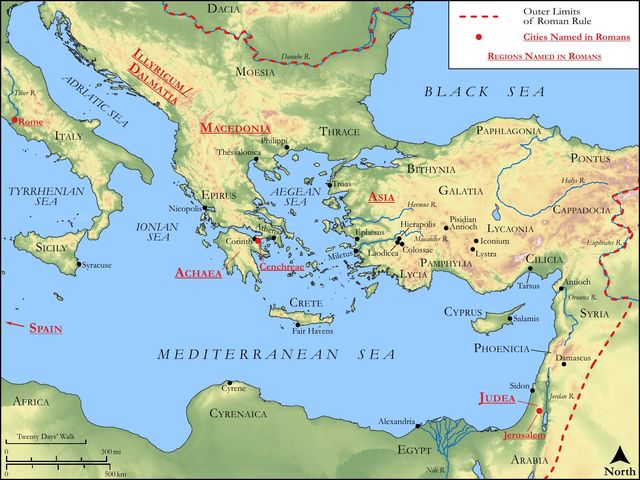
See on the biblical-era maps

Study this verse
Public-domain commentary
Matthew Henry
From his Commentary on the Whole Bible. Henry comments on passages, not single verses — this entry covers Romans 8:1–9. His four-level outline is real structure in the source text, so it is rendered as structure.
I.The apostle here beings with one signal privilege of true Christians, and describes the character of those to whom it belongs:
There is therefore now no condemnation to those that are in Christ Jesus, Rom 8:1. This is his triumph after that melancholy complaint and conflict in the foregoing chapter - sin remaining, disturbing, vexing, but, blessed be God, not ruining. The complaint he takes to himself, but humbly transfers the comfort with himself to all true believers, who are all interested in it.
1.It is the unspeakable privilege and comfort of all those that are in Christ Jesus that there is therefore now no condemnation to them. He does not say, "There is no accusation against them," for this there is; but the accusation is thrown out, and the indictment quashed. He does not say, "There is nothing in them that deserves condemnation," for this there is, and they see it, and own it, and mourn over it, and condemn themselves for it; but it shall not be their ruin. He does not say, "There is no cross, no affliction to them or no displeasure in the affliction," for this there may be; but no condemnation. They may be chastened of the Lord, but not condemned with the world. Now this arises from their being in Christ Jesus; by virtue of their union with him through faith they are thus secured. They are in Christ Jesus, as in their city of refuge, and so are protected from the avenger of blood. He is their advocate, and brings them off. There is therefore no condemnation, because they are interested in the satisfaction that Christ by dying made to the law. In Christ, God does not only not condemn them, but is well pleased with them, Mat 17:5.
2.It is the undoubted character of all those who are so in Christ Jesus as to be freed from condemnation that they walk not after the flesh but after the Spirit. Observe, The character is given from their walk, not from any one particular act, but from their course and way. And the great question is, What is the principle of the walk, the flesh or the spirit, the old or the new nature, corruption or grace? Which of these do we mind, for which of these doe we make provision, by which of these are we governed, which of these do we take part with?
II.This great truth, thus laid down, he illustrates in the following verses; and shows how we come by this great privilege, and how we may answer this character.
1.How we come by these privileges - the privilege of justification, that there is no condemnation to us - the privilege of sanctification, that we walk after the Spirit, and not after the flesh, which is no less our privilege than it is our duty. How comes it about?
(1.)The law could not do it, Rom 8:3. It could neither justify nor sanctify, neither free us from the guilt nor from the power of sin, having not the promises either of pardon or grace. The law made nothing perfect: It was weak. Some attempt the law made towards these blessed ends, but, alas! it was weak, it could not accomplish them: yet that weakness was not through any defect in the law, but through the flesh, through the corruption of human nature, by which we became incapable either of being justified or sanctified by the law. We had become unable to keep the law, and, in case of failure, the law, as a covenant of works, made no provision, and so left us as it found us. Or understand it of the ceremonial law; that was a plaster not wide enough for the wound, it could never take away sin, Heb 10:4.
(2.)The law of the Spirit of life in Christ Jesus does it, Rom 8:2. The covenant of grace made with us in Christ is a treasury of merit and grace, and thence we receive pardon and a new nature, are freed from the law of sin and death, that is, both from the guilt and power of sin - from the course of the law, and the dominion of the flesh. We are under another covenant, another master, another husband, under the law of the Spirit, the law that gives the Spirit, spiritual life to qualify us for eternal. The foundation of this freedom is laid in Christ's undertaking for us, of which he speaks Rom 8:3, God sending his own Son. Observe, When the law failed, God provided another method. Christ comes to do that which the law could not do. Moses brought the children of Israel to the borders of Canaan, and then died, and left them there; but Joshua did that which Moses could not do, and put them in possession of Canaan. Thus what the law could not do Christ did. The best exposition of this verse we have Heb 10:1-10. To make the sense of the words clear, which in our translation is a little intricate, we may read it thus, with a little transposition: - God sending his own Son in the likeness of sinful flesh, and a sacrifice for sin, condemned sin in the flesh, which the law could not do, in that it was weak through the flesh, etc., Rom 8:4. Observe,
[1.]How Christ appeared: In the likeness of sinful flesh. Not sinful, for he was holy, harmless, undefiled; but in the likeness of that flesh which was sinful. He took upon him that nature which was corrupt, though perfectly abstracted from the corruptions of it. His being circumcised, redeemed, baptized with John's baptism, bespeaks the likeness of sinful flesh. The bitings of the fiery serpents were cured by a serpent of brass, which had the shape, through free from the venom, of the serpents that bit them. It was great condescension that he who was God should be made in the likeness of flesh; but much greater that he who was holy should be made in the likeness of sinful flesh. And for sin, - here the best Greek copies place the comma. God sent him, en homoiōmati sarkos hamartias, kai peri hamartias - in the likeness of sinful flesh, and as a sacrifice for sin. The Septuagint call a sacrifice for sin no more than peri hamartias - for sin; so Christ was a sacrifice; he was sent to be so, Heb 9:26.
[2.]What was done by this appearance of his: Sin was condemned, that is, God did therein more than ever manifest his hatred of sin; and not only so, but for all that are Christ's both the damning and the domineering power of sin is broken and taken out of the way. He that is condemned can neither accuse nor rule; his testimony is null, and his authority null. Thus by Christ is sin condemned; though it live and remain, its life in the saints is still but like that of a condemned malefactor. it was by the condemning of sin that death was disarmed, and the devil, who had the power of death, destroyed. The condemning of sin saved the sinner from condemnation. Christ was made sin for us (Co2 5:21), and, being so made, when he was condemned sin was condemned in the flesh of Christ, condemned in the human nature: So was sanctification made to divine justice, and way made for the salvation of the sinner.
[3.]The happy effect of this upon us (Rom 8:4): That the righteousness of the law might be fulfilled in us. Both in our justification and in our sanctification, the righteousness of the law if fulfilled. A righteousness of satisfaction for the breach of the law is fulfilled by the imputation of Christ's complete and perfect righteousness, which answers the utmost demands of the law, as the mercy-seat was as long and as broad as the ark. A righteousness of obedience to the commands of the law is fulfilled in us, when by the Spirit the law of love is written upon the heart, and that love is the fulfilling of the law, Rom 13:10. Though the righteousness of the law is not fulfilled by us, yet, blessed be God, it is fulfilled in us; there is that to be found upon and in all true believers which answers the intention of the law. Us who walk not after the flesh, but after the Spirit. This is the description of all those that are interested in this privilege - they act from spiritual and not from carnal principles; as for others, the righteousness of the law will be fulfilled upon them in their ruin. Now,
2.Observe how we may answer to this character, Rom 8:5, etc.
(1.)By looking to our minds. How may we know whether we are after the flesh or after the Spirit? By examining what we mind, the things of the flesh or the things of the spirit. Carnal pleasure, worldly profit and honour, the things of sense and time, are the things of the flesh, which unregenerate people mind. The favour of God, the welfare of the soul, the concerns of eternity, are the things of the Spirit, which those that are after the Spirit do mind. The man is as the mind is. The mind is the forge of thoughts. As he thinketh in his heart, so is he, Pro 23:7. Which way do the thoughts move with most pleasure? On what do they dwell with most satisfaction? The mind is the seat of wisdom. Which way go the projects and contrivances? whether are we more wise for the world or for our souls? phronousi ta tēs sarkos - they savour the things of the flesh; so the word is rendered, Mat 16:23. It is a great matter what our savour is, what truths, what tidings, what comforts, we do most relish, and are most agreeable to us. Now, to caution us against this carnal-mindedness, he shows the great misery and malignity of it, and compares it with the unspeakable excellency and comfort of spiritual-mindedness.
[1.]It is death, Rom 8:6. It is spiritual death, the certain way to eternal death. It is the death of the soul; for it is its alienation from God, in union and communion with whom the life of the soul consists. A carnal soul is a dead soul, dead as a soul can die. She that liveth in pleasure is dead (Ti1 5:6), not only dead in law as guilty, but dead in state as carnal. Death includes all misery; carnal souls are miserable souls. But to be spiritually minded, phronēma tou pneumatos - a spiritual savour (the wisdom that is from above, a principle of grace) is life and peace; it is the felicity and happiness of the soul. The life of the soul consists in its union with spiritual things by the mind. A sanctified soul is a living soul, and that life is peace; it is a very comfortable life. All the paths of spiritual wisdom are paths of peace. It is life and peace in the other world, as well as in this. Spiritual-mindedness is eternal life and peace begun, and an assuring earnest of the perfection of it.
[2.]It is enmity to God (Rom 8:7), and this is worse than the former. The former speaks the carnal sinner a dead man, which is bad; but this speaks him a devil of a man. It is not only an enemy, but enmity itself. It is not only the alienation of the soul from God, but the opposition of the soul against God; it rebels against his authority, thwarts his design, opposes his interest, spits in his face, spurns at his bowels. Can there be a greater enmity? An enemy may be reconciled, but enmity cannot. How should this humble us for and warn us against, carnal-mindedness! Shall we harbour and indulge that which is enmity to God our creator, owner, ruler, and benefactor? To prove this, he urges that it is not subject to the law of God, neither indeed can be. The holiness of the law of God, and the unholiness of the carnal mind, are as irreconcilable as light and darkness. The carnal man may, by the power of divine grace, be made subject to the law of God, but the carnal mind never can; this must be broken and expelled. See how wretchedly the corrupt will of man is enslaved to sin; as far as the carnal mind prevails, there is no inclination to the law of God; therefore wherever there is a change wrought it is by the power of God's grace, not by the freedom of man's will. Hence he infers (Rom 8:8), Those that are in the flesh cannot please God. Those that are in a carnal unregenerate state, under the reigning power of sin, cannot do the things that please God, wanting grace, the pleasing principle, and an interest in Christ, the pleasing Mediator. The very sacrifice of the wicked is an abomination, Pro 15:8. Pleasing God is our highest end, of which those that are in the flesh cannot but fall short; they cannot please him, nay, they cannot but displease him. We may know our state and character,
(2.)By enquiring whether we have the Spirit of God and Christ, or not (Rom 8:9): You are not in the flesh, but in the Spirit. This expresses states and conditions of the soul vastly different. All the saints have flesh and spirit in them; but to be in the flesh and to be in the Spirit are contrary. It denotes our being overcome and subdued by one of these principles. As we say, A man is in love, or in drink, that is, overcome by it. Now the great question is whether we are in the flesh or in the Spirit; and how may we come to know it? Why, by enquiring whether the Spirit of God dwell in us. The Spirit dwelling in us is the best evidence of our being in the Spirit, for the indwelling is mutual (Jo1 4:16): Dwelleth in God, and God in him. The Spirit visits many that are unregenerate with his motions, which they resist and quench; but in all that are sanctified he dwells; there he resides and rules. He is there as a man at his own house, where he is constant and welcome, and has the dominion. Shall we put this question to our own hearts, Who dwells, who rules, who keeps house, here? Which interest has the ascendant? To this he subjoins a general rule of trial: If any man has not the Spirit of Christ, he is none of his. To be Christ's (that is, to be a Christian indeed, one of his children, his servants, his friends, in union with him) is a privilege and honour which many pretend to that have no part nor lot in the matter. None are his but those that have his Spirit; that is,
[1.]That are spirited as he was spirited-are meek, and lowly, and humble, and peaceable, and patient, and charitable, as he was. We cannot tread in his steps unless we have his spirit; the frame and disposition of our souls must be conformable to Christ's pattern.
[2.]That are actuated and guided by the Holy Spirit of God, as a sanctifier, teacher, and comforter. Having the Spirit of Christ is the same with having the Spirit of God to dwell in us. But those two come much to one; for all that are actuated by the Spirit of God as their rule are conformable to the spirit of Christ as their pattern. Now this description of the character of those to whom belongs this first privilege of freedom from condemnation is to be applied to all the other privileges that follow.
Historical interpretation
Two Centuries of Reception
8 surviving comments on this verse. Each one is dated, so this reads as a timeline rather than a list.
Select a marker to jump to its quote. Markers stagger vertically where authors wrote within a few decades of each other.
It is possible to think of those who have just recently been instructed in the faith and who are still little ones in Christ as carnal, for he calls those who have already believed by the Holy Spirit “spiritual” and those newly taught and not yet purified “carnal.” He speaks of these latter as carnal with good reason, for like the pagans they still mind the things of the flesh.
Now although the flesh is sinful, and we are forbidden to walk in accordance with it, and its works are condemned as lusting against the spirit, and men on its account are censured as carnal, yet the flesh has not such ignominy on its own account.
For so, too, does the apostle say, that "to savour according to the flesh is death, but to savour according to the spirit is life eternal in Jesus Christ our Lord." Again, through the holy prophetess Prisca the Gospel is thus preached: that "the holy minister knows how to minister sanctity.
The apostle, however, himself here comes to our aid; for, while explaining in what sense he would not have us "live in the flesh," although in the flesh-even by not living in the works of the flesh -he shows that when he wrote the words, "Flesh and blood cannot inherit the kingdom of God," it was not with the view of condemning the substance (of the flesh), but the works thereof; and because it is possible for these not to be committed by us whilst we are still in the flesh, they will therefore be properly chargeable, not on the substance of the flesh, but on its conduct.
Those who live according to the flesh are the Jews, whom Paul says are Israel according to the flesh. They know what belongs to the law of the flesh because they interpret the law according to the flesh. Those who live according to the Spirit are the people whom Paul calls Jews in spirit, not in the letter.
Paul says this because whoever obeys the temptation which comes through the flesh knows what the things of the flesh are.… Those who live according to the Spirit are those who have stomped on the lusts of the flesh by attacking sin. They have put the world behind them and although they still walk in the flesh they do not struggle according to the flesh. Their glory is not from men but from God. Dwelling in these spiritual works, they know what the things of the Spirit of God are and walk in his commandments.
Yet even this is no disparaging of the flesh. For so long as it keeps its own place, nothing amiss cometh to pass. But when we let it have its own will in everything, and it passes over its proper bounds, and rises up against the soul, then it destroys and corrupts everything, yet not owing to its own nature, but to its being out of proportion, and the disorder thereupon ensuing. "But they that are after the Spirit do mind the things of the Spirit."
Man is composed of spirit and flesh. When a man performs carnal deeds he is called “flesh,” but when he performs spiritual deeds he is called “Spirit.” For when one of these substances brings the other under its control, the subordinate substance in effect loses both its power and its name. For each substance desires what is connected and related to it.
Continue studying Romans 8:5 across the web’s major study libraries — every link below opens this exact verse, chapter, or book on the destination site.
Read & Compare
 BibleGatewayThis verse in more than 200 translations and 70 languages.
 Bible.comThe YouVersion reader — hundreds of translations, reading plans, and highlights.
 ESV.orgCrossway's official English Standard Version reader.
 NET BibleThe NET translation with 60,000+ translators' notes on every rendering decision.
 STEP BibleTyndale House's free study tool — original text, vocabulary, and scholarly resources.
 BibliaLogos Bible Software's free web reader.
 USCCBThe New American Bible (Revised Edition) with the U.S. bishops' study notes.
Commentaries
 BibleHub CommentariesDozens of classic commentaries on this verse, gathered on one page.
 StudyLightMore than 100 commentary sets — the largest collection on the web.
 BibleRefPlain-English commentary on what this verse means, verse by verse.
 Enduring WordDavid Guzik's free commentary on this chapter, widely used by Bible teachers.
 Bible Study ToolsVerse commentary alongside Greek and Hebrew study aids.
Original Language & Research
- BibleHub InterlinearThe verse word by word — original language, transliteration, and English.
- BibleHub LexiconEvery word's original-language definition and Strong's entry.
 Blue Letter BibleDeep-study tools — Strong's numbers, concordance, and word studies.
 CNTR CollationThe earliest Greek manuscripts of this verse, collated letter by letter.
Sermons, Hymns & Audio


TrulyRandomVerse is not affiliated with these sites and doesn’t control their content. They’re linked because they’re genuinely useful.
Summary
Romans 8:5 profoundly contrasts two distinct orientations of life: one governed by the fallen human nature, often termed "the flesh," and the other empowered and directed by the Holy Spirit. This verse serves as a foundational statement within Paul's theological framework, asserting that an individual's spiritual disposition—what they "mind" or focus on—determines their trajectory, leading either to spiritual death or to life and peace, thereby setting the stage for the transformative power of the indwelling Spirit in the believer's life.
Context
ShowHideLiterary Context
Romans 8:5 is a pivotal statement within Paul's magnum opus, the Epistle to the Romans, specifically nestled in chapter 8, which is often hailed as the "Magna Carta of the Holy Spirit." This verse immediately follows Paul's triumphant declaration in Romans 8:1 that "there is therefore now no condemnation to them which are in Christ Jesus," having just concluded the arduous struggle with sin and the Law described in Romans 7. Verse 5 establishes the core dichotomy—flesh versus Spirit—that explains how believers are freed from sin's dominion, not by human effort or adherence to the Law, but by a new, Spirit-led existence. It directly sets up the consequences of each mindset detailed in Romans 8:6-8, where the mind of the flesh is death, and the mind of the Spirit is life and peace.
Historical & Cultural Context
Paul's audience in Rome comprised both Jewish and Gentile believers, navigating the complexities of their respective backgrounds within a new Christian identity. The concept of "flesh" (Greek: sarx) in Jewish thought, particularly in the Old Testament, often referred to humanity's weakness and mortality. However, in Pauline theology, it takes on a deeper ethical and spiritual meaning, representing the unregenerate human nature, alienated from God and inherently prone to sin, not merely the physical body. This understanding would have resonated with those familiar with the Septuagint's use of sarx and the broader Jewish emphasis on the heart's inclination. Conversely, the "Spirit" (Greek: pneuma) would have evoked the divine presence and power, familiar from prophetic traditions where God's Spirit empowers individuals for divine service and brings about renewal, now understood as the indwelling Holy Spirit in believers.
Key Themes
ShowHideThis verse contributes significantly to several overarching themes in Romans and Pauline theology. The primary theme is the Dichotomy of Flesh and Spirit, which is not merely a physical versus spiritual contrast but a fundamental opposition between the fallen human nature and the divine, empowering presence of the Holy Spirit. This leads to the theme of Spiritual Mindset and Orientation, where the verb "mind" (Greek: phronéō) emphasizes that one's deepest affections, intentions, and priorities determine their spiritual reality. This is crucial for understanding the Nature of Christian Living, which is presented not as mere behavioral modification but as a radical transformation of one's inner disposition, enabled by the Spirit. This transformation is the very essence of the "new creation" in Christ, moving from a life dominated by sin and death to one characterized by the "life and peace" promised to those who walk in the Spirit, as further elaborated in Romans 8:6.
Exposition and Analysis
ShowHideKey Word Analysis
ShowHideIn Pauline theology, this term extends beyond mere physical substance to denote the fallen, unredeemed human nature, characterized by its inherent rebellion against God and its propensity toward sin. It represents the totality of human existence apart from the regenerating power of the Holy Spirit, encompassing sinful desires, earthly pursuits, and a self-centered orientation.
This refers specifically to the Holy Spirit, the third person of the Trinity. In the context of Romans 8, pneûma signifies the divine life-giving and empowering presence that indwells believers, enabling them to live righteously, overcome sin, and fulfill God's will. It is the source of spiritual life and transformation.
This verb signifies more than just intellectual thought; it implies setting one's affections, intentions, and entire disposition toward something. It speaks to a deep-seated mental attitude, a prevailing inclination, or what one values and pursues most earnestly. To "mind the things of the flesh" means to be consumed by, preoccupied with, and directed by the desires of the sinful nature. To "mind the things of the Spirit" means to be focused on, value, and pursue spiritual realities and God's will.
Verse Breakdown
ShowHide"For they that are after the flesh do mind the things of the flesh;"
This clause introduces the first of two contrasting groups. "After the flesh" (Greek: katá sárx) signifies a life lived according to the dictates and desires of the fallen human nature. Such individuals "mind" (Greek: phronéō) or set their affections and priorities on "the things of the flesh"—that is, on worldly, sinful, and self-serving pursuits that are contrary to God's will. This describes an orientation of life where the unredeemed nature is the dominant influence.
"but they that are after the Spirit the things of the Spirit."
This clause presents the stark contrast. "But" (Greek: dé) introduces the alternative. "After the Spirit" (Greek: katá pneûma) describes those whose lives are directed and empowered by the Holy Spirit. These individuals "mind" or have their affections and intentions set on "the things of the Spirit"—spiritual realities, God's will, righteousness, and eternal values. This signifies a life where the Holy Spirit is the guiding and transforming power.
Literary Devices
ShowHideRomans 8:5 is rich in Antithesis, presenting a direct and powerful contrast between two opposing ways of life: "after the flesh" versus "after the Spirit." This creates a clear Dichotomy, emphasizing that there is no middle ground in one's fundamental spiritual orientation. The "flesh" and "Spirit" are also used in a sense that borders on Personification, as if they are active agents or principles that exert influence over human behavior and thought. The repetition of "flesh" and "Spirit" (a form of Anaphora if considering the broader passage, but here more specifically Repetition for Emphasis) underscores the central conflict and the two distinct categories of existence Paul is defining. This rhetorical strategy effectively highlights the profound choice and the radical difference in outcomes between these two paths.
Theological and Thematic Connections
ShowHideRomans 8:5 is a cornerstone for understanding the radical transformation wrought by the Holy Spirit in the believer's life. It moves beyond a mere moral distinction to a fundamental ontological shift: one is either aligned with the fallen nature, leading to spiritual death, or aligned with the divine Spirit, leading to life and peace. This verse emphasizes that true spirituality is not just about outward actions but about the inward disposition of the heart and mind, reflecting a deep-seated orientation towards God or away from Him. It underscores the necessity of the Spirit's work for genuine godliness, as human nature, left to itself, is incapable of pleasing God.
Reflection and Application
ShowHideRomans 8:5 serves as a profound call to self-examination and intentional living for every believer. It challenges us to honestly assess the true north of our inner compass: What dominates our thoughts, shapes our desires, and dictates our actions? Are we primarily driven by self-gratification, worldly ambitions, and the impulses of our fallen nature, or are our minds increasingly set on God's will, spiritual truths, and the things that honor Him? This verse reminds us that the Christian life is not passive; it requires a conscious, daily yielding to the Holy Spirit's guidance. It is a continuous process of choosing to walk in obedience, to cultivate a mindset that aligns with Christ, and to allow the Spirit to transform our desires and priorities. This ongoing surrender empowers us to overcome the dominion of sin and experience the abundant life and peace that only the Spirit can provide, moving us from a state of spiritual death to vibrant spiritual vitality.
Questions for Reflection
ShowHideFAQ
ShowHideWhat does Paul mean by "the flesh" in Romans 8:5?
ShowHideIn Pauline theology, "the flesh" (Greek: sárx) does not primarily refer to the physical body itself, but to the sinful, unregenerate human nature. It represents humanity's inherent rebellion against God, its self-centeredness, and its inability to please God apart from divine grace. It encompasses all that is contrary to the Spirit of God, including sinful desires, worldly ambitions, and a disposition that is hostile to God's will. This is distinct from the physical body, which, though susceptible to sin, is not inherently evil and is ultimately redeemed and glorified by God. For more on this, see Romans 7:18.
How does one "mind the things of the Spirit"?
ShowHideTo "mind the things of the Spirit" (Greek: phronéō ta tou pneúmatos) means to set one's affections, thoughts, and entire disposition on spiritual realities, God's will, and the pursuits that honor Him. It involves a conscious and continuous choice to align one's inner life with the Holy Spirit's leading. This includes meditating on God's Word, praying, seeking righteousness, cultivating spiritual virtues, and prioritizing eternal values over temporal ones. It is an active orientation of the heart and mind, empowered by the indwelling Spirit, leading to a life of obedience and communion with God, as encouraged in Colossians 3:2.
Christ-Centered Fulfillment
ShowHideRomans 8:5, while contrasting the flesh and the Spirit, finds its ultimate Christ-centered fulfillment in the person and work of Jesus Christ. It is through Christ that the power of the flesh, which leads to death, is broken, and the life of the Spirit, which leads to life and peace, is made accessible. Jesus, as the incarnate Son, perfectly lived a life "after the Spirit," always doing the will of the Father and never yielding to the impulses of the flesh, even in the face of temptation (Matthew 4:1-11). His sacrificial death on the cross condemned sin in the flesh, rendering its power null for those who are "in Christ Jesus" (Romans 8:3). Furthermore, Christ's resurrection and ascension paved the way for the outpouring of the Holy Spirit, who now indwells believers, enabling them to "mind the things of the Spirit" and walk in newness of life (John 14:16-17; Acts 2:33). Thus, the ability to live "after the Spirit" is not a human achievement but a divine gift, secured by Christ's finished work and empowered by His Spirit, allowing believers to participate in His victory over sin and death, and to increasingly reflect His character (2 Corinthians 3:18).