


Colossians 3:3
- ἀπεθάνετεapethaneteYou have diedG599V-2AAI-2PVerb 2nd Aorist Active Indicative 2nd Plural
- γὰρgarforG1063CONJConjunction
- καὶkaiandG2532CONJConjunction
- ἡhētheG3588T-NSFDefinite article Nominative Singular Feminine
- ζωὴzōēlifeG2222N-NSFNoun Nominative Singular Feminine
- ὑμῶνhumōnof youG4771P-2GPPersonal pronoun Genitive 2nd Plural
- κέκρυπταιkekruptaihas been hiddenG2928V-RPI-3SVerb Perfect Passive Indicative 3rd Singular
- σὺνsunwithG4862PREPPreposition
- τῷtō<the>G3588T-DSMDefinite article Dative Singular Masculine
- ΧριστῷChristōChristG5547N-DSM-TNoun Dative Singular Masculine Title
- ἐνeninG1722PREPPreposition
- τῷtō<the>G3588T-DSMDefinite article Dative Singular Masculine
- θεῷ·theōGodG2316N-DSM-TNoun Dative Singular Masculine Title
English is a literal word-by-word gloss of the Greek, not the KJV's wording. Why?
This is the original text the KJV's translators worked from — each Greek word with its own literal English meaning in this verse, prepared by scholars at Tyndale House, Cambridge. The KJV translates whole sentences, not word by word, so its wording differs: one Greek word can become several English words, and the KJV may choose “charity” where the gloss reads “love”. Both are faithful — they answer different questions. For the KJV's own rendering, switch to the KJV text.
Details
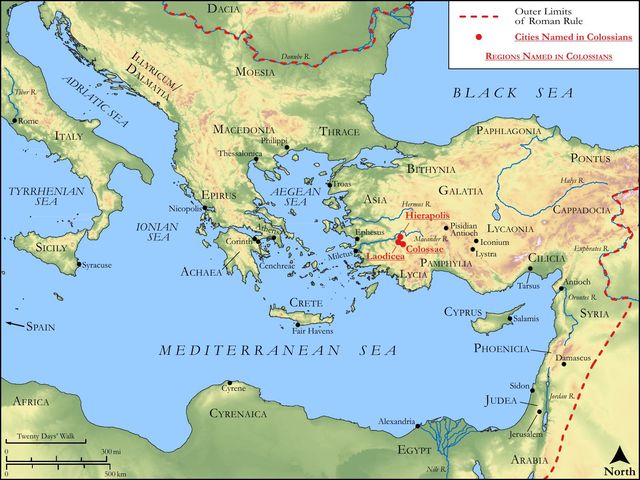
See on the biblical-era map

Study this verse
Public-domain commentary
Matthew Henry
From his Commentary on the Whole Bible. Henry comments on passages, not single verses — this entry covers Colossians 3:1–4. His three-level outline is real structure in the source text, so it is rendered as structure.
The apostle, having described our privileges by Christ in the former part of the epistle, and our discharge from the yoke of the ceremonial law, comes here to press upon us our duty as inferred thence. Though we are made free from the obligation of the ceremonial law, it does not therefore follow that we may live as we list. We must walk the more closely with God in all the instances of evangelical obedience. He begins with exhorting them to set their hearts on heaven, and take them off from this world: If you then have risen with Christ. It is our privilege that we have risen with Christ; that is, have benefit by the resurrection of Christ, and by virtue of our union and communion with him are justified and sanctified, and shall be glorified. Hence he infers that we must seek those things which are above. We must mind the concerns of another world more than the concerns of this. We must make heaven our scope and aim, seek the favour of God above, keep up our communion with the upper world by faith, and hope, and holy love, and make it our constant care and business to secure our title to and qualifications for the heavenly bliss. And the reason is because Christ sits at the right hand of God. He who is our best friend and our head is advanced to the highest dignity and honour in heaven, and has gone before to secure to us the heavenly happiness; and therefore we should seek and secure what he has purchased at so vast an expense, and is taking so much care about. We must live such a life as Christ lived here on earth and lives now in heaven, according to our capacities.
I.He explains this duty (Col 3:2):
Set your affections on things above, not on things on the earth. Observe, To seek heavenly things is to set our affections upon them, to love them and let our desires be towards them. Upon the wings of affection the heart soars upwards, and is carried forth towards spiritual and divine objects. We must acquaint ourselves with them, esteem them above all other things, and lay out ourselves in preparation for the enjoyment of them. David gave this proof of his loving the house of God, that he diligently sought after it, and prepared for it, Psa 27:4. This is to be spiritually minded (Rom 8:6), and to seek and desire a better country, that is, a heavenly, Heb 11:14, Heb 11:16. Things on earth are here set in opposition to things above. We must not dote upon them, nor expect too much from them, that we may set our affections on heaven; for heaven and earth are contrary one to the other, and a supreme regard to both is inconsistent; and the prevalence of our affection to one will proportionably weaken and abate our affection to the other.
II.He assigns three reasons for this, Col 3:3, Col 3:4.
1.That we are dead; that is, to present things, and as our portion. We are so in profession and obligation; for we are buried with Christ, and planted into the likeness of his death. Every Christian is crucified unto the world, and the world is crucified unto him, Gal 6:14. And if we are dead to the earth, and have renounced it as our happiness, it is absurd for us to set our affections upon it, and seek it. We should be like a dead thing to it, unmoved and unaffected towards it.
2.Our true life lies in the other world: You are dead, and your life is hid with Christ in God, Col 3:3. The new man has its livelihood thence. It is born and nourished from above; and the perfection of its life is reserved for that state. It is hid with Christ; not hid from us only, in point of secrecy, but hid for us, denoting security. The life of a Christian is hid with Christ. Because I live you shall live also, Joh 14:19. Christ is at present a hidden Christ, or one whom we have not seen; but this is our comfort, that our life is hid with him, and laid up safely with him. As we have reason to love him whom we have not seen (Pe1 1:8), so we may take the comfort of a happiness out of sight, and reserved in heaven for us.
3.Because at the second coming of Christ we hope for the perfection of our happiness. If we live a life of Christian purity and devotion now, when Christ, who is our life, shall appear, we shall also appear with him in glory, Col 3:4. Observe,
(1.)Christ is a believer's life. I live, yet not I, but Christ lives in me, Gal 2:20. He is the principle and end of the Christian's life. He lives in us by his Spirit, and we live to him in all we do. To me to live is Christ, Phi 1:21.
(2.)Christ will appear again. He is now hid; and the heavens must contain him; but he will appear in all the pomp of the upper world, with his holy angels, and in his own glory and his Father's glory, Mar 8:38; Luk 9:26.
(3.)We shall then appear with him in glory. It will be his glory to have his redeemed with him; he will come to be glorified in his saints (Th2 1:10); and it will be their glory to come with him, and be with him for ever. At the second coming of Christ there will be a general meeting of all the saints; and those whose life is now hid with Christ shall then appear with Christ in that glory which he himself enjoys, Joh 17:24. Do we look for such a happiness, and should we not set our affections upon that world, and live above this? What is there here to make us fond of it? What is there not there to draw our hearts to it? Our head is there, our home is there, our treasure is there, and we hope to be there for ever.
Historical interpretation
Two Centuries of Reception
6 surviving comments on this verse. Each one is dated, so this reads as a timeline rather than a list.
Select a marker to jump to its quote. Markers stagger vertically where authors wrote within a few decades of each other.
" The heretic erased the preposition in, and made the clause run thus: ("what is the fellowship of the mystery) which hath for ages been hidden from the God who created all things." The falsification, however, is flagrantly absurd.
We should be aware of the fact, therefore, that where God has planted the tree of life he has also planted a tree of the knowledge of good and evil in the midst of paradise. It is understood that he planted it in the middle. Therefore, in the middle of paradise there was both a tree of life and a cause for death. Keep in mind that man did not create life. By carrying out and observing the precepts of God it was possible for man to find life. This was the life mentioned by the apostle: "Your life is hidden with Christ in God." Man, therefore, was, figuratively speaking, either in the shadow of life—because our life on earth is but a shadow—or man had life, as it were, in pledge, for he had been breathed on by God.
For this is the meaning of flight: to know your goal, to unburden oneself of the world, to unburden oneself of the body…. This is the meaning of flight from here—to die to the elements of this world, to hide one’s life in God, to turn aside from corruptions, not to defile oneself with the objects of desire and to be ignorant of the things of this world.
"Set your mind on the things that are above, not on the things that are upon the earth. For ye died, and your life is hid with Christ in God. When Christ who is your life shall be manifested, then shall ye also with Him be manifested in glory."
This is not your life, he saith, it is some other one. He is now urgent to remove them, and insists upon showing that they are seated above, and are dead; from both considerations establishing the position, that they are not to seek the things which are here. For whether ye be dead, ye ought not to seek them; or whether ye be above, ye ought not to seek them. Doth Christ appear? Neither doth your life. It is in God, above. What then? When shall we live? When Christ shall be manifested, who is your life; then seek ye glory, then life, then enjoyment.
This is to prepare the way for drawing them off from pleasure and ease. Such is his wont: when establishing one position, he darts off to another; as, for instance, when discoursing of those who at supper were beforehand with one another, he all at once falls upon the observance of the Mysteries. For he hath a great rebuke when it is administered unsuspected. "It is hid," he saith, from you. "Then shall ye also with Him be manifested." So that, now, ye do not appear. See how he hath removed them into the very heaven. For, as I said, he is always bent upon showing that they have the very same things which Christ hath; and through all his Epistles, the tenor is this, to show that in all things they are partakers with Him. Therefore he uses the terms, Head, and Body, and does everything to convey this to them.
If therefore we shall then be manifested, let us not grieve, when we enjoy not honor: if this life be not life, but it be hidden, we ought to live this life as though dead. "Then shall ye also," he saith, "with Him be manifested in glory." "In glory," he said, not merely "manifested." For the pearl too is hidden so long as it is within the oyster. If then we be treated with insult, let us not grieve; or whatever it be we suffer; for this life is not our life, we are strangers and sojourners. "For ye died," he saith. Who is so witless, as for a corpse, dead and buried, either to buy servants, or build houses, or prepare costly raiment? None. Neither then do ye; but as we seek one thing only, namely, that we be not in a naked state, so here too let us seek one thing and no more. Our first man is buried: buried not in earth, but in water; not death-destroyed, but buried by death's destroyer, not by the law of nature, but by the governing command that is stronger than nature. For what has been done by nature, may perchance be undone; but what has been done by His command, never. Nothing is more blessed than this burial, whereat all are rejoicing, both Angels, and men, and the Lord of Angels. At this burial, no need is there of vestments, nor of coffin, nor of anything else of that kind. Wouldest thou see the symbol of this? I will show thee a pool wherein the one was buried, the other raised; in the Red Sea the Egyptians were sunk beneath it, but the Israelites went up from out of it; in the same act he buries the one, generates the other.
Marvel not that generation and destruction take place in Baptism; for, tell me, dissolving and cementing, are they not opposite? It is evident to all. Such is the effect of fire; for fire dissolves and destroys wax, but it cements together metallic earth, and works it into gold. So in truth here also, the force of the fire, having obliterated the statue of wax, has displayed a golden one in its stead; for in truth before the Bath we were of clay, but after it of gold. Whence is this evident? Hear him saying, "The first man is of the earth, earthy, the second man is the Lord from heaven." I spoke of a difference as great as that between clay and gold; but greater still do I find the difference between heavenly and earthy; not so widely do clay and gold differ, as do things earthy and heavenly. Waxen we were, and clay-formed. For the flame of lust did much more melt us, than fire doth wax, and any chance temptation did far rather shatter us than a stone doth things of clay.
Our life is hidden until the blessing of eternal life shall be revealed to all, when the glory of Christ shall appear in his second coming. .
For when God will be all in all, then nothing will be lacking to their desire. Such an end does not have an end. There no one dies, where no one comes unless he should die to this world, not by the death of all in which the body is abandoned by the soul but by the death of the elect in which, even when one still remains in mortal flesh, the heart is set on high. About this kind of death the apostle said, “For you are dead, and your life is hidden with Christ in God.” Perhaps about this it was said, “Strong as death is love.” For by this love it comes to pass that, dwelling in this still corruptible body, we die to this world and our life is hidden with Christ in God, nay rather, love itself is our death to the world and our life with God.
Continue studying Colossians 3:3 across the web’s major study libraries — every link below opens this exact verse, chapter, or book on the destination site.
Read & Compare
 BibleGatewayThis verse in more than 200 translations and 70 languages.
 Bible.comThe YouVersion reader — hundreds of translations, reading plans, and highlights.
 ESV.orgCrossway's official English Standard Version reader.
 NET BibleThe NET translation with 60,000+ translators' notes on every rendering decision.
 STEP BibleTyndale House's free study tool — original text, vocabulary, and scholarly resources.
 BibliaLogos Bible Software's free web reader.
 USCCBThe New American Bible (Revised Edition) with the U.S. bishops' study notes.
Commentaries
 BibleHub CommentariesDozens of classic commentaries on this verse, gathered on one page.
 StudyLightMore than 100 commentary sets — the largest collection on the web.
 BibleRefPlain-English commentary on what this verse means, verse by verse.
 Enduring WordDavid Guzik's free commentary on this chapter, widely used by Bible teachers.
 Bible Study ToolsVerse commentary alongside Greek and Hebrew study aids.
Original Language & Research
- BibleHub InterlinearThe verse word by word — original language, transliteration, and English.
- BibleHub LexiconEvery word's original-language definition and Strong's entry.
 Blue Letter BibleDeep-study tools — Strong's numbers, concordance, and word studies.
 CNTR CollationThe earliest Greek manuscripts of this verse, collated letter by letter.
Sermons, Hymns & Audio


TrulyRandomVerse is not affiliated with these sites and doesn’t control their content. They’re linked because they’re genuinely useful.
Summary
Colossians 3:3 profoundly declares the believer's radical transformation: a definitive spiritual death to the old self and a new, secure life inextricably united with Christ and divinely preserved in God. This verse serves as the theological bedrock for the preceding exhortation to seek heavenly realities, grounding Christian identity not in earthly existence but in an eternal, hidden union with the resurrected Christ.
Context
ShowHideLiterary Context
Colossians 3:3 stands as the foundational theological rationale for Paul's preceding exhortations in Colossians 3:1-2. Having called believers to "seek those things which are above, where Christ sitteth on the right hand of God" and to "set your affection on things above, not on things on the earth," Paul immediately provides the "why" in verse 3 with the conjunction "For." This verse explains how believers are able to live with a heavenly orientation: because their old self has died, and their true life is now supernaturally secured in Christ. It transitions from the indicative (what is true about believers) to the imperative (how believers ought to live in light of that truth), setting the stage for the practical ethical instructions that follow in Colossians 3:5-17.
Historical & Cultural Context
The city of Colossae was situated in Phrygia, a region known for its syncretistic religious tendencies, including elements of Gnosticism, Jewish mysticism, and local paganism. The "Colossian heresy," which Paul addresses throughout the epistle, involved a blend of asceticism, angel worship, philosophical speculation, and an overemphasis on human traditions rather than Christ's supremacy (see Colossians 2:8-23). In this context, Paul's declaration that believers "are dead" to the world's elemental principles and that their life is "hid with Christ in God" directly counters any notion that spiritual maturity or salvation could be achieved through human effort, adherence to rituals, or esoteric knowledge. It grounds their security and identity solely in Christ, offering a profound counter-narrative to the unstable and performance-driven spiritualities prevalent in their culture.
Key Themes
ShowHideColossians 3:3 powerfully encapsulates several major themes central to the book of Colossians and Pauline theology. The theme of Christ's Supremacy and Sufficiency is paramount, as the believer's life is entirely dependent on and hidden "with Christ in God," leaving no room for rival mediators or human systems. This verse also highlights the theme of Union with Christ, emphasizing a profound, mystical identification with His death and resurrection, a concept further explored in Romans 6:1-11. The New Creation theme is evident in the declaration of a "new life" that replaces the old, fallen existence, making the believer a new creation in Christ. Finally, the theme of Spiritual Security and Divine Preservation is vividly portrayed by the imagery of a life "hid" in God, assuring believers of their eternal safety beyond the reach of earthly threats or spiritual adversaries.
Exposition and Analysis
ShowHideKey Word Analysis
ShowHideThis verb signifies a definitive, completed act of dying or perishing. In the context of Colossians 3:3, it refers to a spiritual death—a decisive break from the old self, the dominion of sin, and the principles of the world. It is not a gradual process but a past, accomplished event, indicating a radical severance from one's former state of alienation from God.
This term refers to "life" in its truest, most profound sense, often denoting spiritual or eternal life, as opposed to mere physical existence (which is more commonly psychē). Here, it points to the new, vivifying, and eternal existence that believers receive through their union with Christ, a life that is qualitatively different and divinely sustained.
This verb means "to conceal," "to keep secret," or "to store away safely." Its use here emphasizes the security, mystery, and divine protection of the believer's new life. It is not visible to the world in its fullness, nor is it subject to the world's fluctuations or attacks; rather, it is supernaturally safeguarded within the very being of God through Christ.
Verse Breakdown
ShowHide"For ye are dead,"
This clause presents the foundational theological truth upon which the subsequent exhortations are built. The Greek verb is in the aorist tense, indicating a completed action in the past, specifically at the moment of conversion or spiritual regeneration. Believers have definitively died to their old identity, their former way of life, and the power of sin that once held them captive. This death is a radical, irreversible break from their unregenerate state, marking the end of their identification with the fallen world system.
"and your life"
This introduces the counterpoint to the preceding death. While the old self has died, a new life has simultaneously emerged. This "life" (Greek zōḗ) refers to the spiritual, eternal, and divine quality of existence that believers now possess. It is not merely a moral improvement but a profound, supernatural vitality that flows from their union with Christ. This life is distinct from their physical existence and transcends the limitations of earthly experience.
"is hid"
The verb "is hid" is in the perfect passive indicative, signifying a state resulting from a past action that continues into the present. It means this new spiritual life has been concealed or safely deposited, and it remains in that secure, hidden state. This implies that the true essence of the believer's life is not outwardly visible or fully comprehensible to the world. It is protected from external forces, human scrutiny, and the assaults of spiritual adversaries, indicating a profound security.
"with Christ"
This phrase clarifies the nature and location of the believer's hidden life. It is not merely hidden somewhere but specifically "with Christ." This emphasizes the unbreakable, intimate union between the believer and Jesus Christ. Our new life is inextricably bound up with His, meaning we share in His death, resurrection, and exalted position at the right hand of God. Our identity, security, and destiny are all wrapped up in Christ's.
"in God."
This final phrase adds another layer of divine security and ultimate preservation. Not only is our life hidden "with Christ," but it is ultimately "in God" Himself. This signifies divine ownership, sustenance, and eternal preservation. It means our life is held within the very being and power of the Almighty, making it eternally safe, beyond any threat or destruction. It underscores the divine origin and ultimate destination of the believer's new life.
Literary Devices
ShowHidePaul employs several powerful literary devices in Colossians 3:3 to convey its profound theological truth. Metaphor is central, with "ye are dead" serving as a vivid metaphor for a spiritual, not physical, demise. This imagery powerfully communicates a complete cessation of the old way of life and identification with sin. The phrase "your life is hid" utilizes Symbolism, where "hid" symbolizes security, divine protection, and the spiritual, often unseen, nature of the believer's true existence. This contrasts sharply with the visible, temporal realities of the world. Furthermore, the Parallelism between "dead" and "life is hid" creates a striking paradox: death leads to a new, hidden life. This antithetical construction emphasizes the radical transformation that occurs in the believer. The concise, declarative nature of the verse also lends it an air of Aphorism, a pithy statement of truth that is easily remembered and profoundly impactful, serving as a foundational principle for Christian living.
Theological and Thematic Connections
ShowHideColossians 3:3 is a cornerstone of Pauline theology, articulating the profound reality of the believer's union with Christ. This verse underscores that Christian identity is not defined by earthly circumstances, achievements, or even past failures, but by a radical, divine transformation. It teaches that through faith, believers participate in Christ's death to sin and His resurrection to new life, a truth that fundamentally reorients their existence. This hidden life is a source of immense security and peace, as it is eternally safeguarded within the very being of God, beyond the reach of any adversarial force. This divine security empowers believers to live with a heavenly mindset, knowing their true citizenship and ultimate destiny are not of this world.
Reflection and Application
ShowHideColossians 3:3 offers a profound and liberating truth for every believer: our true identity and most precious possession—our spiritual life—are not only secure but also hidden in the safest possible place, "with Christ in God." This reality should profoundly impact our daily lives. If we are truly dead to the old self and alive in Christ, then the allure of worldly values, the sting of past failures, and the fear of future uncertainties lose their grip. This verse calls us to a radical reorientation of our priorities and affections. It challenges us to live from a place of spiritual security rather than striving for external validation or temporary earthly gains. When we grasp that our life is hidden, we are freed from the need to prove ourselves, allowing us to live authentically, humbly, and confidently in the knowledge of God's unwavering love and protection. This hidden life, though unseen by the world, should manifest in visible acts of love, righteousness, and service, reflecting the very character of Christ within us.
Questions for Reflection
ShowHideFAQ
ShowHideWhat does it mean to be "dead" in Colossians 3:3?
ShowHideTo be "dead" in Colossians 3:3 does not refer to physical death, but to a spiritual and decisive break from one's former life dominated by sin and the world's values. It signifies that through faith in Christ, believers have participated in His death on the cross, dying to the power of sin and the old self. This is a completed, past action (indicated by the aorist tense in Greek), meaning the believer's identity is no longer defined by their unregenerate state or the "elemental spirits of the world" (as mentioned in Colossians 2:20). It's a radical severance from the old, enabling a new life in Christ.
Christ-Centered Fulfillment
ShowHideColossians 3:3 finds its profound Christ-centered fulfillment in the person and work of Jesus Christ, who is not merely the subject of our hidden life but its very source and sustainer. Our "death" is a participation in Christ's death, where He bore our sins and died to the power of sin on the cross, enabling us to be crucified with Him. Our "life" is the new, resurrected life that flows from His resurrection, as we are raised with Him through faith. The concept of our life being "hid with Christ in God" points directly to Christ's present exalted position at the right hand of the Father, where He intercedes for us and holds our eternal security. He is our life (as declared in Colossians 3:4), and because He lives, we live also (John 14:19). Our security is not based on our own strength or perseverance, but on the unbreakable union we have with the resurrected and glorified Christ, who is eternally "in God." This means that the very essence of our spiritual being is divinely protected, eternally secured, and ultimately revealed when Christ, who is our life, shall appear.