


Galatians 5:24
- οἱhoiThoseG3588T-NPMDefinite article Nominative Plural Masculine
- δὲdenowG1161CONJConjunction
- τοῦtou<the>G3588T-GSMDefinite article Genitive Singular Masculine
- ΧριστοῦChristouof ChristG5547N-GSM-TNoun Genitive Singular Masculine Title
- τὴνtēntheG3588T-ASFDefinite article Accusative Singular Feminine
- σάρκαsarkafleshG4561N-ASFNoun Accusative Singular Feminine
- ἐσταύρωσανestaurōsancrucifiedG4717V-AAI-3PVerb Aorist Active Indicative 3rd Plural
- σὺνsunwithG4862PREPPreposition
- τοῖςtois[its]G3588T-DPNDefinite article Dative Plural Neuter
- παθήμασινpathēmasinpassionsG3804N-DPNNoun Dative Plural Neuter
- καὶkaiandG2532CONJConjunction
- ταῖςtais<the>G3588T-DPFDefinite article Dative Plural Feminine
- ἐπιθυμίαιςepithumiaisdesiresG1939N-DPFNoun Dative Plural Feminine
English is a literal word-by-word gloss of the Greek, not the KJV's wording. Why?
This is the original text the KJV's translators worked from — each Greek word with its own literal English meaning in this verse, prepared by scholars at Tyndale House, Cambridge. The KJV translates whole sentences, not word by word, so its wording differs: one Greek word can become several English words, and the KJV may choose “charity” where the gloss reads “love”. Both are faithful — they answer different questions. For the KJV's own rendering, switch to the KJV text.
Details
See on the biblical-era map

Study this verse
Public-domain commentary
Matthew Henry
From his Commentary on the Whole Bible. Henry comments on passages, not single verses — this entry covers Galatians 5:13–26. His three-level outline is real structure in the source text, so it is rendered as structure.
In the latter part of this chapter the apostle comes to exhort these Christians to serious practical godliness, as the best antidote against the snares of the false teachers. Two things especially he presses upon them: -
I.That they should not strive with one another, but love one another.
He tells them (Gal 5:13) that they had been called unto liberty, and he would have them to stand fast in the liberty wherewith Christ had made them free; but yet he would have them be very careful that they did not use this liberty as an occasion to the flesh - that they did not thence take occasion to indulge themselves in any corrupt affections and practices, and particularly such as might create distance and disaffection, and be the ground of quarrels and contentions among them: but, on the contrary, he would have them by love to serve one another, to maintain that mutual love and affection which, notwithstanding any minor differences there might be among them, would dispose them to all those offices of respect and kindness to each other which the Christian religion obliged them to. Note,
1.The liberty we enjoy as Christians is not a licentious liberty: though Christ has redeemed us from the curse of the law, yet he has not freed us from the obligation of it; the gospel is a doctrine according to godliness (Ti1 6:3), and is so far from giving the least countenance to sin that it lays us under the strongest obligations to avoid and subdue it.
2.Though we ought to stand fast in our Christian liberty, yet we should not insist upon it to the breach of Christian charity; we should not use it as an occasion of strife and contention with our fellow Christians, who may be differently minded from us, but should always maintain such a temper towards each other as may dispose us by love to serve one another. To this the apostle endeavours to persuade these Christians, and there are two considerations which he sets before them for this purpose: - (1.) That all the law is fulfilled in one word, even in this, Thou shalt love thy neighbour as thyself, Gal 5:14. Love is the sum of the whole law; as love to God comprises the duties of the first table, so love to our neighbour those of the second. The apostle takes notice of the latter here, because he is speaking of their behaviour towards one another; and, when he makes use of this as an argument to persuade them to mutual love, he intimates both that this would be a good evidence of their sincerity in religion and also the most likely means of rooting out those dissensions and divisions that were among them. It will appear that we are the disciples of Christ indeed when we have love one to another (Joh 13:35); and, where this temper is kept up, if it do not wholly extinguish those unhappy discords that are among Christians, yet at least it will so far accommodate them that the fatal consequences of them will be prevented. (2.) The sad and dangerous tendency of a contrary behaviour (Gal 5:15): But, says he, if instead of serving one another in love, and therein fulfilling the law of God, you bite and devour one another, take heed that you be not consumed one of another. If, instead of acting like men and Christians, they would behave themselves more like brute beasts, in tearing and rending one another, they could expect nothing as the consequence of it, but that they would be consumed one of another; and therefore they had the greatest reason not to indulge themselves in such quarrels and animosities. Note, Mutual strifes among brethren, if persisted in, are likely to prove a common ruin; those that devour one another are in a fair way to be consumed one of another. Christian churches cannot be ruined but by their own hands; but if Christians, who should be helps to one another and a joy one to another, be as brute beasts, biting and devouring each other, what can be expected but that the God of love should deny his grace to them, and the Spirit of love should depart from them, and that the evil spirit, who seeks the destruction of them all, should prevail?
II.That they should all strive against sin; and happy would it be for the church if Christians would let all their quarrels be swallowed up of this, even a quarrel against sin-if, instead of biting and devouring one another on account of their different opinions, they would all set themselves against sin in themselves and the places where they live. This is what we are chiefly concerned to fight against, and that which above every thing else we should make it our business to oppose and suppress. To excite Christians hereunto, and to assist them herein, the apostle shows,
1.That there is in every one a struggle between the flesh and the spirit (Gal 5:17): The flesh (the corrupt and carnal part of us) lusts (strives and struggles with strength and vigour) against the spirit: it opposes all the motions of the Spirit, and resists every thing that is spiritual. On the other hand, the spirit (the renewed part of us) strives against the flesh, and opposes the will and desire of it: and hence it comes to pass that we cannot do the things that we would. As the principle of grace in us will not suffer us to do all the evil which our corrupt nature would prompt us to, so neither can we do all the good that we would, by reason of the oppositions we meet with from that corrupt and carnal principle. Even as in a natural man there is something of this struggle (the convictions of his conscience and the corruption of his own heart strive with one another; his convictions would suppress his corruptions, and his corruptions silence his convictions), so in a renewed man, where there is something of a good principle, there is a struggle between the old nature and the new nature, the remainders of sin and the beginnings of grace; and this Christians must expect will be their exercise as long as they continue in this world.
2.That it is our duty and interest in this struggle to side with the better part, to side with our convictions against our corruptions and with our graces against our lusts. This the apostle represents as our duty, and directs us to the most effectual means of success in it. If it should be asked, What course must we take that the better interest may get the better? he gives us this one general rule, which, if duly observed, would be the most sovereign remedy against the prevalence of corruption; and that is to walk in the Spirit (Gal 5:16): This I say, then, Walk in the Spirit, and you shall not fulfil the lust of the flesh. By the Spirit here may be meant either the Holy Spirit himself, who condescends to dwell in the hearts of those whom he has renewed and sanctified, to guide and assist them in the way of their duty, or that gracious principle which he implants in the souls of his people and which lusts against the flesh, as that corrupt principle which still remains in them does against it. Accordingly the duty here recommended to us is that we set ourselves to act under the guidance and influence of the blessed Spirit, and agreeably to the motions and tendency of the new nature in us; and, if this be our care in the ordinary course and tenour of our lives, we may depend upon it that, though we may not be freed from the stirrings and oppositions of our corrupt nature, we shall be kept from fulfilling it in the lusts thereof; so that though it remain in us, yet it shall not obtain a dominion over us. Note, The best antidote against the poison of sin is to walk in the Spirit, to be much in conversing with spiritual things, to mind the things of the soul, which is the spiritual part of man, more than those of the body, which is his carnal part, to commit ourselves to the guidance of the word, wherein the Holy Spirit makes known the will of God concerning us, and in the way of our duty to act in a dependence on his aids and influences. And, as this would be the best means of preserving them from fulfilling the lusts of the flesh, so it would be a good evidence that they were Christians indeed; for, says the apostle (Gal 5:18), If you be led by the Spirit, you are not under the law. As if he had said, "You must expect a struggle between flesh and spirit as long as you are in the world, that the flesh will be lusting against the spirit as well as the spirit against the flesh; but if, in the prevailing bent and tenour of your lives, you be led by the Spirit, - if you act under the guidance and government of the Holy Spirit and of that spiritual nature and disposition he has wrought in you, - if you make the word of God your rule and the grace of God your principle, - it will hence appear that you are not under the law, not under the condemning, though you are still under the commanding, power of it; for there is now no condemnation to those that are in Christ Jesus, who walk not after the flesh, but after the Spirit; and as many as are led by the Spirit of God, they are the sons of God," Rom 8:1-14.
3.The apostle specifies the works of the flesh, which must be watched against and mortified, and the fruits of the Spirit, which must be cherished and brought forth (Gal 5:19, etc.); and by specifying particulars he further illustrates what he is here upon.
(1.)He begins with the works of the flesh, which, as they are many, so they are manifest. It is past dispute that the things he here speaks of are the works of the flesh, or the product of corrupt and depraved nature; most of them are condemned by the light of nature itself, and all of them by the light of scripture. The particulars he specifies are of various sorts; some are sins against the seventh commandment, such as adultery, fornication, uncleanness, lasciviousness, by which are meant not only the gross acts of these sins, but all such thoughts, and words, and actions, as have a tendency towards the great transgression. Some are sins against the first and second commandments, as idolatry and witchcraft. Others are sins against our neighbour, and contrary to the royal law of brotherly love, such as hatred, variance, emulations, wrath, strife, which too often occasion seditions, heresies, envyings, and sometimes break out into murders, not only of the names and reputation, but even of the very lives, of our fellow-creatures. Others are sins against ourselves, such as drunkenness and revellings; and he concludes the catalogue with an et cetera, and gives fair warning to all to take care of them, as they hope to see the face of God with comfort. Of these and such like, says he, I tell you before, as I have also told you in times past, that those who do such things, how much soever they may flatter themselves with vain hopes, shall not inherit the kingdom of God. These are sins which will undoubtedly shut men out of heaven. The world of spirits can never be comfortable to those who plunge themselves in the filth of the flesh; nor will the righteous and holy God ever admit such into his favour and presence, unless they be first washed and sanctified, and justified in the name of our Lord Jesus, and by the Spirit of our God, Co1 6:11.
(2.)He specifies the fruits of the Spirit, or the renewed nature, which as Christians we are concerned to bring forth, Gal 5:22, Gal 5:23. And here we may observe that as sin is called the work of the flesh, because the flesh, or corrupt nature, is the principle that moves and excites men to it, so grace is said to be the fruit of the Spirit, because it wholly proceeds from the Spirit, as the fruit does from the root: and whereas before the apostle had chiefly specified those works of the flesh which were not only hurtful to men themselves but tended to make them so to one another, so here he chiefly takes notice of those fruits of the Spirit which had a tendency to make Christians agreeable one to another, as well as easy to themselves; and this was very suitable to the caution or exhortation he had before given (Gal 5:13), that they should not use their liberty as an occasion to the flesh, but by love serve one another. He particularly recommends to us, love, to God especially, and to one another for his sake, - joy, by which may be understood cheerfulness in conversation with our friends, or rather a constant delight in God, - peace, with God and conscience, or a peaceableness of temper and behaviour towards others, - long-suffering, patience to defer anger, and a contentedness to bear injuries, - gentleness, such a sweetness of temper, and especially towards our inferiors, as disposes us to be affable and courteous, and easy to be entreated when any have wronged us, - goodness (kindness, beneficence), which shows itself in a readiness to do good to all as we have opportunity, - faith, fidelity, justice, and honesty, in what we profess and promise to others, - meekness, wherewith to govern our passions and resentments, so as not to be easily provoked, and, when we are so, to be soon pacified, - and temperance, in meat and drink, and other enjoyments of life, so as not to be excessive and immoderate in the use of them. Concerning these things, or those in whom these fruits of the Spirit are found, the apostle says, There is no law against them, to condemn and punish them. Yea, hence it appears that they are not under the law, but under grace; for these fruits of the Spirit, in whomsoever they are found, plainly show that such are led by the Spirit, and consequently that they are not under the law, as Gal 5:18. And as, by specifying these works of the flesh and fruits of the Spirit, the apostle directs us both what we are to avoid and oppose and what we are to cherish and cultivate, so (Gal 5:24) he informs us that this is the sincere care and endeavour of all real Christians: And those that are Christ's, says he (those who are Christians indeed, not only in show and profession, but in sincerity and truth), have crucified the flesh with the affections and lusts. As in their baptism they were obliged hereunto (for, being baptized into Christ, they were baptized into his death, Rom 6:3), so they are now sincerely employing themselves herein, and, in conformity to their Lord and head, are endeavouring to die unto sin, as he had died for it. They have not yet obtained a complete victory over it; they have still flesh as well as Spirit in them, and that has its affections and lusts, which continue to give them no little disturbance, but as it does not now reign in their mortal bodies, so as that they obey it in the lusts thereof (Rom 6:12), so they are seeking the utter ruin and destruction of it, and to put it to the same shameful and ignominious, though lingering death, which our Lord Jesus underwent for our sakes. Note, If we should approve ourselves to be Christ's, such as are united to him and interested in him, we must make it our constant care and business to crucify the flesh with its corrupt affections and lusts. Christ will never own those as his who yield themselves the servants of sin. But though the apostle here only mentions the crucifying of the flesh with the affections and lusts, as the care and character of real Christians, yet, no doubt, it is also implied that, on the other hand, we should show forth those fruits of the Spirit which he had just before been specifying; this is no less our duty than that, nor is it less necessary to evidence our sincerity in religion. It is not enough that we cease to do evil, but we must learn to do well. Our Christianity obliges us not only to die unto sin, but to live unto righteousness; not only to oppose the works of the flesh, but to bring forth the fruits of the Spirit too. If therefore we would make it appear that we do indeed belong to Christ, this must be our sincere care and endeavour as well as the other; and that it was the design of the apostle to represent both the one and the other of these as our duty, and as necessary to support our character as Christians, may be gathered from what follows (Gal 5:25), where he adds, If we live in the Spirit, let us also walk in the Spirit; that is, "If we profess to have received the Spirit of Christ, or that we are renewed in the Spirit of Christ, or that we are renewed in the spirit of our minds, and endued with a principle of spiritual life, let us make it appear by the proper fruits of the Spirit in our lives." He had before told us that the Spirit of Christ is a privilege bestowed on all the children of God, Gal 4:6. "Now," says he, "if we profess to be of this number, and as such to have obtained this privilege, let us show it by a temper and behaviour agreeable hereunto; let us evidence our good principles by good practices." Our conversation will always be answerable to the principle which we are under the guidance and government of: as those that are after the flesh do mind the things of the flesh, so those that are after the Spirit do mind the things of the Spirit, Rom 8:5. If therefore we would have it appear that we are Christ's, and that we are partakers of his Spirit, it must be by our walking not after the flesh, but after the spirit. We must set ourselves in good earnest both to mortify the deeds of the body, and to walk in newness of life.
4.The apostle concludes this chapter with a caution against pride and envy, Gal 5:26. He had before been exhorting these Christians by love to serve one another (Gal 5:13), and had put them in mind of what would be the consequence if, instead of that, they did bite and devour one another, Gal 5:15. Now, as a means of engaging them to the one and preserving them from the other of these, he here cautions them against being desirous of vain-glory, or giving way to an undue affectation of the esteem and applause of men, because this, if it were indulged, would certainly lead them to provoke one another and to envy one another. As far as this temper prevails among Christians, they will be ready to slight and despise those whom they look upon as inferior to them, and to be put out of humour if they are denied that respect which they think is their due from them, and they will also be apt to envy those by whom their reputation is in any danger of being lessened: and thus a foundation is laid for those quarrels and contentions which, as they are inconsistent with that love which Christians ought to maintain towards each other, so they are greatly prejudicial to the honour and interest of religion itself. This therefore the apostle would have us by all means to watch against. Note,
(1.)The glory which comes from men is vain-glory, which, instead of being desirous of, we should be dead to.
(2.)An undue regard to the approbation and applause of men is one great ground of the unhappy strifes and contentions that exist among Christians.
Historical interpretation
Two Centuries of Reception
7 surviving comments on this verse. Each one is dated, so this reads as a timeline rather than a list.
Select a marker to jump to its quote. Markers stagger vertically where authors wrote within a few decades of each other.
"The people that loveth with their lips, but have their heart far away from the Lord," is another people, and trust in another, and have willingly sold themselves to another; but those who perform the commandments of the Lord, in every action "testify," by doing what He wishes, and consistently naming the Lord's name; and "testifying" by deed to Him in whom they trust, that they are those "who have crucified the flesh, with the affections and lusts." "If we live in the Spirit, let us also walk in the Spirit." "He that soweth to his flesh, shall of the flesh reap corruption; but he that soweth to the Spirit, shall of the Spirit reap life everlasting."
Paul proclaims in a loud and lofty voice, "But God forbid that I should glory, save in the cross of our Lord Jesus Christ, by whom the world is crucified unto me, and I unto the world." And yet a virgin in the Church glories concerning her fleshly appearance and the beauty of her body! Paul adds, and says, "For they that are Christ's have crucified their flesh, with its faults and lusts." And she who professes to have renounced the lusts and vices of the flesh, is found in the midst of those very things which she has renounced! Virgin, thou art taken, thou art exposed, thou boastest one thing and affectest another. You sprinkle yourself with the stains of carnal concupiscence, although you are a candidate of purity and modesty. "Cry," says the Lord to Isaiah, "All flesh is grass, and all the glory of it as the flower of the grass: the grass withereth, and the flower fadeth; but the word of the Lord endureth for ever." It is becoming for no Christian, and especially it is not becoming for a virgin, to regard any glory and honour of the flesh, but only to desire the word of God, to embrace benefits which shall endure for ever. Or, if she must glory in the flesh, then assuredly let her glory when she is tortured in confession of the name; when a woman is found to be stronger than the tortures; when she suffers fire, or the cross, or the sword, or the wild beasts, that she may be crowned. These are the precious jewels of the flesh, these are the better ornaments of the body.
We “crucify” the flesh, of course, by being baptized in the water of baptism, which is a likeness of the cross and his death, his entombment and his resurrection, as it is written.
Those, therefore, who imitate Christ, imitate Him earnestly. For those who have "put on Christ" [Romans 13:14] in truth, express His likeness in their thoughts, and in their whole life, and in all their behaviour: in word, and in deeds, and in patience, and in fortitude, and in knowledge, and in chastity, and in long-suffering, and in a pure heart, and in faith, and in hope, and in full and perfect love towards God.
If those who are Christ’s have crucified the flesh, it is therefore clear that the slaves of Christ have presented their flesh in purity along with its desires and passions. They are participating in Christ, thus acknowledging that he crucified the flesh. That is why the faithful, thinking the same thoughts as their Lord, have crucified the flesh. And if believers have crucified the flesh it is unthinkable that those who suffered on Christ’s behalf should not be reigning with him.
That they might not object, "And who is such a man as this?" he points out by their works those who have attained to this perfection, here again giving the name of the "flesh" to evil actions. He does not mean that they had destroyed their flesh, otherwise how were they going to live? for that which is crucified is dead and inoperative, but he indicates the perfect rule of life. For the desires, although they are troublesome, rage in vain. Since then such is the power of the Spirit, let us live therein and be content therewith.
(Ver. 24.) But those who belong to Christ have crucified the flesh with its vices and desires. Origen, connecting this passage with the previous ones, reads it as follows: There is no law against those who have crucified the flesh of Christ with its vices and desires, so that it does not mean, as it sounds in Latin, that they who belong to Christ say that they have crucified their own flesh with vices and desires; but Christ's flesh crucified by them with vices and desires. And he asks how in those who have the fruits of the Spirit, and against whom the Law ceased to be, the crucifixion of the flesh of the Lord is put in praise, when it is stated in Hebrews with condemnation: Crucifying again in themselves the Son of God, and making a show (Heb. VI, 6). As for 'crucifying again,' a better compound word in Greek is ἀνασταυροῦντες, which we can interpret as 'recrucifying.' First, therefore, it must be noted that crucifying is one thing, and re-crucifying is another. Furthermore, re-crucifying the Son of God is not the same as crucifying the flesh of Christ with vices and desires. For the flesh of Christ is not primarily and properly the Son of God, but Jesus Christ, who, when he was in the beginning with the Father, the Word of God was made flesh and emptied himself, taking the form of a servant, in order to crucify the flesh and strip off principalities and powers, triumphing over them in the cross, so that the words of the Apostle might be fulfilled: What is dead to sin is dead once (Rom. VI, 10). Therefore, if our bodies are the members of Christ, then our flesh is also the flesh of Christ, which we crucify, mortifying through it on earth, fornication, uncleanness, passion, evil desire, and greed. And now it is spoken of us in praise, who have crucified the flesh of Christ Jesus with vices and lusts, and always carry about in our body the mortification of Jesus, so that His life may also be revealed in our flesh. However, it is no small amount of labor to live in the present age, so that the life of Jesus may now be manifested in our flesh. For in this way, our mortal bodies will be made alive through the Spirit dwelling in us. Where the Latin interpreter placed vices, in Greek they are read as παθήματα, that is, passions. And because passion can signify both pain and other needs of the body, the Apostle cautiously introduced desires: so that he would not appear to deny the nature of the body in spiritual men, but vices. And let it be understood in this way, if we follow the Vulgate edition, as we read: But those who belong to Christ have crucified the flesh with its vices and desires; so that we may say, not that they have crucified the flesh of Christ, but their own. I have almost forgotten the second interpretation. For I have foretold that everything that follows is to be referred to the Law and circumcision. Therefore, the meaning is as follows: Those in whom there is the fruit of the Spirit, charity, joy, and the rest, have crucified the bodily understanding of Scripture, which is now called the flesh of Christ, with his passions and desires, which generate the nourishment of vices for infants and sucklings. He crucified the flesh of Christ, who does not wage war according to the flesh of history, but follows the spirit of allegory that precedes.
Continue studying Galatians 5:24 across the web’s major study libraries — every link below opens this exact verse, chapter, or book on the destination site.
Read & Compare
 BibleGatewayThis verse in more than 200 translations and 70 languages.
 Bible.comThe YouVersion reader — hundreds of translations, reading plans, and highlights.
 ESV.orgCrossway's official English Standard Version reader.
 NET BibleThe NET translation with 60,000+ translators' notes on every rendering decision.
 STEP BibleTyndale House's free study tool — original text, vocabulary, and scholarly resources.
 BibliaLogos Bible Software's free web reader.
 USCCBThe New American Bible (Revised Edition) with the U.S. bishops' study notes.
Commentaries
 BibleHub CommentariesDozens of classic commentaries on this verse, gathered on one page.
 StudyLightMore than 100 commentary sets — the largest collection on the web.
 BibleRefPlain-English commentary on what this verse means, verse by verse.
 Enduring WordDavid Guzik's free commentary on this chapter, widely used by Bible teachers.
 Bible Study ToolsVerse commentary alongside Greek and Hebrew study aids.
Original Language & Research
- BibleHub InterlinearThe verse word by word — original language, transliteration, and English.
- BibleHub LexiconEvery word's original-language definition and Strong's entry.
 Blue Letter BibleDeep-study tools — Strong's numbers, concordance, and word studies.
 CNTR CollationThe earliest Greek manuscripts of this verse, collated letter by letter.
Sermons, Hymns & Audio


TrulyRandomVerse is not affiliated with these sites and doesn’t control their content. They’re linked because they’re genuinely useful.
Summary
Galatians 5:24 articulates a foundational truth of Christian identity: those who belong to Christ have decisively put to death their sinful nature, along with its inherent desires and passions. This verse encapsulates the radical break from a life dominated by the "flesh" (sinful human nature) that occurs when one is united with Christ, establishing the basis for a life lived in the power and guidance of the Holy Spirit.
Context
ShowHideLiterary Context
Galatians 5:24 is situated within Paul's extensive argument contrasting life under the Mosaic Law with life in the Spirit. Following his theological exposition on justification by faith in earlier chapters, Paul shifts to practical Christian living in chapter 5. He first warns against returning to legalism (Galatians 5:1-12) and then contrasts the "works of the flesh" (Galatians 5:19-21), which include various sins, with the "fruit of the Spirit" (Galatians 5:22-23), which are virtues like love, joy, and peace. Verse 24 serves as the theological bedrock explaining how believers are enabled to produce the fruit of the Spirit and resist the works of the flesh: by a decisive break with their old, sinful self. It is a declaration of the spiritual reality that undergirds the call to "walk in the Spirit" found in Galatians 5:16.
Historical & Cultural Context
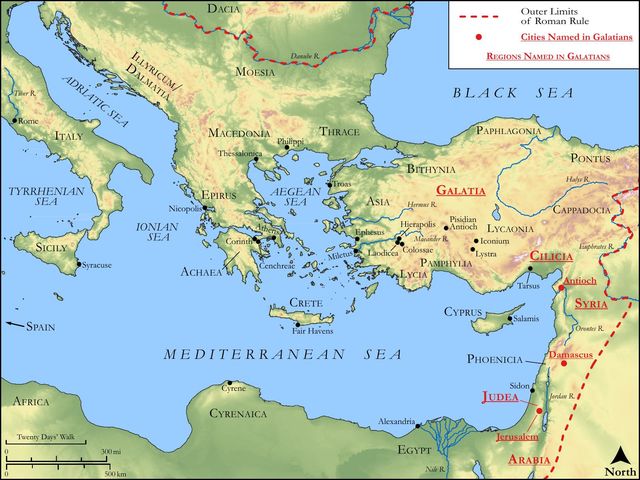
Paul wrote to the churches in Galatia, a region in Asia Minor, likely around 49-55 AD. The primary issue addressed in the letter was the influence of "Judaizers," who insisted that Gentile converts to Christianity must also observe Jewish laws, particularly circumcision, to be truly saved. This challenged the core gospel message of salvation by grace through faith alone. In this context, the "flesh" (σάρξ, sarx) in Galatians does not merely refer to physical desires but broadly to the unredeemed human nature, often expressed through self-reliance, legalism, or sinful indulgence, which stands in opposition to God's Spirit. The concept of "crucifixion" would have been a vivid and brutal image to Paul's audience, symbolizing a complete and agonizing death, underscoring the radical nature of the break with the old life.
Key Themes
ShowHideThis verse contributes significantly to several major themes in Galatians and Pauline theology. It reinforces the theme of Radical Transformation in Christ, emphasizing that conversion is not merely an intellectual assent but a profound reorientation of one's entire being. It highlights the Decisive Break with Sin's Dominion, asserting that believers are no longer enslaved to their sinful nature, a concept deeply explored in Romans 6. Furthermore, it underscores the Centrality of the Cross not only for atonement but also for sanctification, as the believer's identification with Christ's death on the cross is the means by which the power of the flesh is broken. Finally, it sets the stage for the Spirit-Empowered Life, showing that the ability to "walk in the Spirit" (as encouraged in Galatians 5:16) flows from this fundamental spiritual reality of having crucified the flesh.
Exposition and Analysis
ShowHideKey Word Analysis
ShowHideFrom χρίω (chrió), meaning "anointed." This term refers to the Messiah, an epithet of Jesus. To be "Christ's" signifies belonging to Him, being His possession, and being identified with Him. It implies a transfer of allegiance and ownership from self or sin to the Anointed One, Jesus, forming the basis for the radical transformation described in the verse.
From σταυρός (stauros), meaning "cross." This verb literally means "to impale on the cross." Figuratively, as used here, it means "to extinguish (subdue) passion or selfishness." The aorist tense in Greek indicates a completed action, suggesting a definitive, once-for-all act of putting to death the power of the flesh. It's not a gradual process of self-improvement, but a decisive spiritual execution of the old self's dominion.
Probably from the base of σαρόω (saroó), meaning "to strip off." While it can refer to the physical body, in this theological context, it signifies human nature in its unredeemed state, with its frailties, passions, and inherent propensity toward sin, often hostile to God and His Spirit. It represents the principle of sin at work within humanity.
From ἐπιθυμέω (epithymeó), meaning "to long for." This term denotes a strong longing or craving, often for what is forbidden or evil. It refers to the specific desires and cravings that are manifestations of the sinful flesh, driving individuals toward sin and self-gratification.
Verse Breakdown
ShowHide"And they that are Christ's"
This opening clause establishes the identity of the subjects. It refers to genuine believers, those who have, through faith, entered into a covenant relationship with Jesus Christ. To be "Christ's" implies a deep, personal possession and allegiance, signifying a transfer of ownership from sin and self to the Lord, establishing a new identity and purpose. This new identity is the prerequisite and foundation for the radical action that follows.
"have crucified the flesh"
This is the central declaration of the verse. "The flesh" here refers to the sinful human nature, the unredeemed aspect of humanity that is prone to sin and hostile to God. The verb "have crucified" is in the aorist tense, indicating a completed action in the past, specifically at the point of conversion or union with Christ. It signifies a decisive, definitive, and irreversible spiritual act of putting to death the ruling power and dominion of the old, sinful self. It is not a continuous struggle to perform the crucifixion, but rather a declaration of a spiritual reality that has already occurred.
"with the affections and lusts"
This phrase specifies what is crucified along with the flesh. "Affections" (πάθη, páthēma) refers to strong emotions, passions, or impulses, which, in this context, are the unruly or sinful desires that stem from the flesh. "Lusts" (ἐπιθυμίαι, epithymía) denotes specific, often evil or forbidden, cravings. By crucifying the flesh, believers have effectively severed the power and influence of these internal drives and manifestations of sin that previously held them captive and led them away from God. This means the power of these desires is broken, though their presence may still be felt.
Literary Devices
ShowHideThe most prominent literary device in Galatians 5:24 is Metaphor. The phrase "have crucified the flesh" is a powerful and vivid metaphor. The "flesh" is not literally nailed to a cross; rather, the act of crucifixion, a brutal and agonizing form of execution, is used to represent the decisive, complete, and painful putting to death of the sinful nature and its power over the believer's life. This metaphor emphasizes the radical and definitive break with the old way of life. Additionally, there is an element of Personification in treating "the flesh" as an entity capable of being crucified, giving it a quasi-personal agency that must be overcome. The use of "crucified" also contains a degree of Hyperbole, as it exaggerates the decisive nature of the spiritual break to underscore its finality and severity, ensuring the audience understands the profound and irreversible nature of their commitment to Christ.
Theological and Thematic Connections
ShowHideGalatians 5:24 stands as a cornerstone in Pauline theology regarding sanctification and the Christian's new identity. It asserts that the believer's union with Christ in His death is not merely a legal declaration but a profound spiritual reality that breaks the dominion of sin. This verse teaches that the power of the flesh, with its inherent sinful desires, has been decisively dealt with at the point of conversion. While the presence of sinful desires may still be felt, their tyrannical rule has been overthrown. This truth empowers believers to live a life no longer enslaved to sin but free to walk in the Spirit, producing His fruit. It is a call to live out the implications of this spiritual reality daily, actively choosing to reckon oneself dead to sin and alive to God.
Reflection and Application
ShowHideGalatians 5:24 presents a radical truth that demands a radical response in the daily life of a believer. It challenges us to live in alignment with the spiritual reality that has already occurred: our old, sinful self has been decisively put to death with Christ. This is not a call to self-effort or asceticism, but to a Spirit-empowered obedience that flows from our new identity. Practically, this means intentionally choosing to starve the desires of the flesh by refusing to indulge them, and instead, feeding the Spirit by immersing ourselves in God's Word, prayer, worship, and fellowship. It requires a conscious decision to yield to the Holy Spirit's guidance and power, allowing Him to produce His fruit in our lives. Understanding that the dominion of sin is broken frees us from the tyranny of guilt and empowers us to pursue righteousness, not out of obligation, but out of a transformed heart that desires to please God.
Questions for Reflection
ShowHideFAQ
ShowHideDoes "crucified the flesh" mean I will never struggle with sin again?
ShowHideNo, "crucified the flesh" (Greek: estaurōsan) refers to a decisive, completed act that occurred when you became "Christ's." It means the dominion and power of the sinful nature over your life have been broken. You are no longer a slave to sin (as explained in Romans 6:6-7). However, the presence of the flesh, or the old sinful desires, remains in this life. The Christian life is therefore an ongoing process of "walking in the Spirit" (Galatians 5:16), actively choosing to live according to your new identity in Christ and resisting the remaining pulls of the flesh. It's a call to reckon yourself "dead to sin and alive to God in Christ Jesus" (Romans 6:11).
What is the difference between "affections" and "lusts" in this verse?
ShowHideWhile both terms refer to desires stemming from the sinful nature, they have slightly different nuances. "Affections" (Greek: páthēma) generally refers to strong emotions, passions, or impulses. In the New Testament, it often denotes unruly or sinful passions that can lead to sin (e.g., Romans 1:26). "Lusts" (Greek: epithymía) specifically denotes strong cravings or desires, which are frequently used in a negative sense to describe evil, forbidden, or covetous desires (e.g., 1 John 2:16). So, "affections" might be the broader category of sinful impulses, while "lusts" are the more specific, often intense, evil cravings that are manifestations of those impulses. Both are crucified with the flesh, meaning their power to control the believer is broken.
Christ-Centered Fulfillment
ShowHideGalatians 5:24 finds its profound Christ-centered fulfillment in the finished work of Jesus on the cross. The believer's ability to "crucify the flesh" is not an act of self-improvement or human will, but a spiritual reality made possible by their union with Christ in His death and resurrection. When Jesus was "made sin for us" (2 Corinthians 5:21), He not only bore our guilt but also broke the power of sin's dominion over humanity. Our "old man was crucified with him, that the body of sin might be destroyed, that henceforth we should not serve sin" (Romans 6:6). Therefore, the crucifixion of the flesh in the believer is a participation in Christ's own crucifixion, a spiritual identification with His death to sin. He is both the example and the power source; His sacrifice provides the atonement for our sins, and His resurrection life provides the dynamic power by which we can now "walk in newness of life" (Romans 6:4) and live free from the tyranny of our sinful nature, empowered by the Spirit He has given us (Romans 8:2).