


Luke 4:14
- ΚαὶKaiAndG2532CONJConjunction
- ὑπέστρεψενhupestrepsenreturnedG5290V-AAI-3SVerb Aorist Active Indicative 3rd Singular
- ὁho<the>G3588T-NSMDefinite article Nominative Singular Masculine
- ἸησοῦςIēsousJesusG2424N-NSM-PNoun Nominative Singular Masculine Individual
- ἐνeninG1722PREPPreposition
- τῇtēatheG3588T-DSFDefinite article Dative Singular Feminine
- δυνάμειdunameipowerG1411N-DSFNoun Dative Singular Feminine
- τοῦtouof theG3588T-GSNDefinite article Genitive Singular Neuter
- πνεύματοςpneumatosSpiritG4151N-GSNNoun Genitive Singular Neuter
- εἰςeistoG1519PREPPreposition
- τὴνtēn<the>G3588T-ASFDefinite article Accusative Singular Feminine
- ΓαλιλαίανGalilaianGalileeG1056N-ASF-LNoun Accusative Singular Feminine Location
- καὶkaiandG2532CONJConjunction
- φήμηphēmēa reportG5345N-NSFNoun Nominative Singular Feminine
- ἐξῆλθενexēlthenwent outG1831V-2AAI-3SVerb 2nd Aorist Active Indicative 3rd Singular
- καθ᾽kath᾽intoG2596PREPPreposition
- ὅληςholēsallG3650A-GSFAdjective Genitive Singular Feminine
- τῆςtēstheG3588T-GSFDefinite article Genitive Singular Feminine
- περιχώρουperichōrousurrounding regionG4066N-GSFNoun Genitive Singular Feminine
- περὶpericoncerningG4012PREPPreposition
- αὐτοῦautouHimG846P-GSMPersonal pronoun Genitive Singular Masculine
English is a literal word-by-word gloss of the Greek, not the KJV's wording. Why?
This is the original text the KJV's translators worked from — each Greek word with its own literal English meaning in this verse, prepared by scholars at Tyndale House, Cambridge. The KJV translates whole sentences, not word by word, so its wording differs: one Greek word can become several English words, and the KJV may choose “charity” where the gloss reads “love”. Both are faithful — they answer different questions. For the KJV's own rendering, switch to the KJV text.
Details
See on the biblical-era map
Study this verse
Public-domain commentary
Matthew Henry
From his Commentary on the Whole Bible. Henry comments on passages, not single verses — this entry covers Luke 4:14–30. His four-level outline is real structure in the source text, so it is rendered as structure.
After Christ had vanquished the evil spirit, he made it appear how much he was under the influence of the good Spirit; and, having defended himself against the devil's assaults, he now begins to act offensively, and to make those attacks upon him, by his preaching and miracles, which he could not resist or repel. Observe,
I.What is here said in general of his preaching, and the entertainment it met with in Galilee, a remote part of the country, distant from Jerusalem; it was a part of Christ's humiliation that he began his ministry there.
But, 1. Thither he came in the power of the Spirit. The same Spirit that qualified him for the exercise of his prophetical office strongly inclined him to it. He was not to wait for a call from men, for he had light and life in himself. 2. There he taught in their synagogues, their places of public worship, where they met, not, as in the temple, for ceremonial services, but for the moral acts of devotion, to read, expound, and apply, the word, to pray and praise, and for church-discipline; these came to be more frequent since the captivity, when the ceremonial worship was near expiring. 3. This he did so as that he gained a great reputation. A fame of him went through all that region (Luk 4:14), and it was a good fame; for (Luk 4:15) he was glorified of all. Every body admired him, and cried him up; they never heard such preaching in all their lives. Now, at first, he met with no contempt or contradiction; all glorified him, and there were none as yet that vilified him.
II.Of his preaching at Nazareth, the city where he was brought up; and the entertainment it met with there. And here we are told how he preached there, and how he was persecuted.
1.How he preached there. In that observe,
(1.)The opportunity he had for it: He came to Nazareth when he had gained a reputation in other places, in hopes that thereby something at least of the contempt and prejudice with which his countrymen would look upon him might be worn off. There he took occasion to preach,
[1.]In the synagogue, the proper place, where it had been his custom to attend when he was a private person, Luk 4:16. We ought to attend on the public worship of God, as we have opportunity. But, now that he was entered upon his public ministry, there he preached. Where the multitudes of fish were, there this wise Fisherman would cast his net.
[2.]On the sabbath day, the proper time which the pious Jews spent, not in a mere ceremonial rest from worldly labour, but in the duties of God's worship, as of old they frequented the schools of the prophets on the new moons and the sabbaths. Note, It is good to keep sabbaths in solemn assemblies.
(2.)The call he had to it.
[1.]He stood up to read. They had in their synagogues seven readers every sabbath, the first a priest, the second a Levite, and the other five Israelites of that synagogue. We often find Christ preaching in other synagogues, but never reading, except in this synagogue at Nazareth, of which he had been many years a member. Now he offered his service as he had perhaps often done; he read one of the lessons out of the prophets, Act 13:15. Note, The reading of the scripture is very proper work to be done in religious assemblies; and Christ himself did not think it any disparagement to him to be employed in it.
[2.]The book of the prophet Esaias was delivered to him, either by the ruler of the synagogue or by the minister mentioned (Luk 4:20), so that he was no intruder, but duly authorized pro hac vice - on this occasion. The second lesson for that day being in the prophecy of Esaias, they gave him that volume to read in.
(3.)The text he preached upon. He stood up to read, to teach us reverence in reading and hearing the word of God. When Ezra opened the book of the law, all the people stood up (Neh 8:5); so did Christ here, when he read in the book of the prophets. Now the book being delivered to him,
[1.]He opened it. The books of the Old Testament were in a manner shut up till Christ opened them, Isa 29:11. Worthy is the Lamb that was slain to take the book, and open the seals; for he can open, not the book only, but the understanding.
[2.]He found the place which was appointed to be read that day in course, which he needed not to be directed to; he soon found it, and read it, and took it for his text. Now his text was taken out of Isa 61:1, Isa 61:2, which is here quoted at large, Luk 4:18, Luk 4:19. There was a providence in it that that portion of scripture should be read that day, which speaks so very plainly of the Messiah, that they might be left inexcusable who knew him not, though they heard the voices of the prophets read every sabbath day, which bore witness of him, Act 13:27. This text gives a full account of Christ's undertaking, and the work he came into the world to do. Observe,
First, How he was qualified for the work: The Spirit of the Lord is upon me. All the gifts and graces of the Spirit were conferred upon him, not by measure, as upon other prophets, but without measure, Joh 3:34. He now came in the power of the Spirit, Luk 4:14.
Secondly, How he was commissioned: Because he had anointed me, and sent me. His extraordinary qualification amounted to a commission; his being anointed signifies both his being fitted for the undertaking and called to it. Those whom God appoints to any service he anoints for it: "Because he hath sent me, he hath sent his Spirit along with me."
Thirdly, What his work was. He was qualified and commissioned,
1.To be a great prophet. He was anointed to preach; that is three times mentioned here, for that was the work he was now entering upon. Observe,
(1.)To whom he was to preach: to the poor; to those that were poor in the world, whom the Jewish doctors disdained to undertake the teaching of and spoke of with contempt; to those that were poor in spirit, to the meek and humble, and to those that were truly sorrowful for sin: to them the gospel and the grace of it will be welcome, and they shall have it, Mat 11:5.
(2.)What he was to preach. In general, he must preach the gospel. He is sent evangelizesthai - to evangelize them; not only to preach to them, but to make that preaching effectual; to bring it, not only to their ears, but to their hearts, and deliver them into the mould of it. Three things he is to preach: -
[1.]Deliverance to the captives, The gospel is a proclamation of liberty, like that to Israel in Egypt and in Babylon. By the merit of Christ sinners may be loosed from the bonds of guilt, and by his Spirit and grace from the bondage of corruption. It is a deliverance from the worst of thraldoms, which all those shall have the benefit of that are willing to make Christ their Head, and are willing to be ruled by him.
[2.]Recovering of sight to the blind. He came not only by the word of his gospel to bring light to them that sat in the dark, but by the power of his grace to give sight to them that were blind; not only the Gentile world, but every unregenerate soul, that is not only in bondage, but in blindness, like Samson and Zedekiah. Christ came to tell us that he has eye-salve for us, which we may have for the asking; that, if our prayer be, Lord, that our eyes may be opened, his answer shall be, Receive your sight.
[3.]The acceptable year of the Lord, Luk 4:19. He came to let the world know that the God whom they had offended was willing to be reconciled to them, and to accept of them upon new terms; that there was yet a way of making their services acceptable to him; that there is now a time of good will toward men. It alludes to the year of release, or that of jubilee, which was an acceptable year to servants, who were then set at liberty; to debtors, against whom all actions then dropped; and to those who had mortgaged their lands, for then they returned to them again. Christ came to sound the jubilee-trumpet; and blessed were they that heard the joyful sound, Psa 89:15. It was an acceptable time, for it was a day of salvation.
2.Christ came to be a great Physician; for he was sent to heal the broken-hearted, to comfort and cure afflicted consciences, to give peace to those that were troubled and humbled for sins, and under a dread of God's wrath against them for them, and to bring them to rest who were weary and heavy-laden, under the burden of guilt and corruption.
3.To be a great Redeemer. He not only proclaims liberty to the captives, as Cyrus did to the Jews in Babylon (Whoever will, may go up), but he sets at liberty them that are bruised; he doth by his Spirit incline and enable them to make use of the liberty granted, as then none did but those whose spirit God stirred up, Ezr 1:5. He came in God's name to discharge poor sinners that were debtors and prisoners to divine justice. The prophets could but proclaim liberty, but Christ, as one having authority, as one that had power on earth to forgive sins, came to set at liberty; and therefore this clause is added here. Dr. Lightfoot thinks that, according to a liberty the Jew allowed their readers, to compare scripture with scripture, in their reading, for the explication of the text, Christ added it from Isa 58:6, where it is made the duty of the acceptable year to let the oppressed go free, where the phrase the Septuagint uses is the same with this here.
(4.)Here is Christ's application of this text to himself (Luk 4:21): When he had read it, he rolled up the book, and gave it again to the minister, or clerk, that attended, and sat down, according to the custom of the Jewish teachers; he sat daily in the temple, teaching, Mat 26:55. Now he began his discourse thus, "This day is this scripture fulfilled in your ears. This, which Isaiah wrote by way of prophecy, I have now read to you by way of history." It now began to be fulfilled in Christ's entrance upon his public ministry; now, in the report they heard of his preaching and miracles in other places; now, in his preaching to them in their own synagogue. It is most probable that Christ went on, and showed particularly how this scripture was fulfilled in the doctrine he preached concerning the kingdom of heaven at hand; that it was preaching liberty, and sight, and healing, and all the blessings of the acceptable year of the Lord. Many other gracious words proceeded out of his mouth, which these were but the beginning of; for Christ often preached long sermons, which we have but a short account of. This was enough to introduce a great deal: This day is this scripture fulfilled. Note,
[1.]All the scriptures of the Old Testament that were to be fulfilled in the Messiah had their full accomplishment in the Lord Jesus, which abundantly proves that this was he that should come.
[2.]In the providences of God, it is fit to observe the fulfilling of the scriptures. The works of God are the accomplishment not only of his secret word, but of his word revealed; and it will help us to understand both the scriptures and the providences of God to compare them one with another.
(5.)Here is the attention and admiration of the auditors.
[1.]Their attention (Luk 4:20): The eyes of all them that were in the synagogue (and, probably, there were a great many) were fastened on him, big with expectation what he would say, having heard so much of late concerning him. Note, It is good, in hearing the word, to keep the eye fixed upon the minister by whom God is speaking to us; for, as the eye effects the heart, so, usually, the heart follows the eye, and is wandering, or fixed, as that is. Or, rather, let us learn hence to keep the eye fixed upon Christ speaking to us in and by the minister. What saith my Lord unto his servants?
[2.]Their admiration (Luk 4:22): They all bore him witness that he spoke admirably well, and to the purpose. They all commended him, and wondered at the gracious words that proceeded out of his mouth; and yet, as appears by what follows, they did not believe in him. Note, It is possible that those who are admirers of good ministers and good preaching may yet be themselves not true Christians. Observe, First, What it was they admired: The gracious words which proceedeth out of his mouth. The words of grace; good words, and spoken in a winning melting way. Note, Christ's words are words of grace, for, grace being poured into his lips (Psa 45:2), words of grace poured from them. And these words of grace are to be wondered at; Christ's name was Wonderful, and in nothing was he more so than in his grace, in the words of his grace, and the power that went along with those words. We may well wonder that he should speak such words of grace to such graceless wretches as we are. Secondly, What it was that increased their wonder and that was the consideration of his original: They said, Is not this Joseph's son, and therefore his extraction mean and his education mean? Some from this suggestion took occasion perhaps so much the more to admire his gracious words, concluding he must needs be taught of God, for they knew no one else had taught him; while others perhaps with this consideration corrected their wonder at his gracious words, and concluded there could be nothing really admirable in them, whatever appeared, because he was the Son of Joseph. Can any thing great, or worthy our regard, come from one so mean?
(6.)Christ's anticipating an objection which he knew to be in the minds of many of his hearers. Observe,
[1.]What the objection was (Luk 4:23): "You will surely say to me, Physician, heal thyself. Because you know that I am the Son of Joseph, your neighbour, you will expect that I should work miracles among you, as I have done in other places; as one would expect that a physician, if he be able, should heal, not only himself, but those of his own family and fraternity." Most of Christ's miracles were cures; - "Now why should not the sick in thine own city be healed as well as those in other cities?" They were designed to cure people of their unbelief; - "Now why should not the disease of unbelief, if it be indeed a disease, be cured in those of thine own city as well as in those of others? Whatsoever we have heard done in Capernaum, that has been so much talked of, do here also in thine own country." They were pleased with Christ's gracious words, only because they hoped they were but the introduction to some wondrous works of his. They wanted to have their lame, and blind, and sick, and lepers, healed and helped, that the charge of their town might be eased; and that was the chief thing they looked at. They thought their own town as worthy to be the stage of miracles as any other; and why should not he rather draw company to that than to any other? And why should not his neighbours and acquaintances have the benefit of his preaching and miracles, rather than any other?
[2.]How he answers this objection against the course he took.
First, By a plain and positive reason why he would not make Nazareth his headquarters (Luk 4:24), because it generally holds true that no prophet is accepted in his own country, at least not so well, nor with such probability of doing good, as in some other country; experience seals this. When prophets have been sent with messages and miracles of mercy, few of their own country-men, that have known their extraction and education, have been fit to receive them. So Dr. Hammond. Familiarity breeds contempt; and we are apt to think meanly of those whose conversation we have been accustomed to; and they will scarcely be duly honoured as prophets who were well known when they were in the rank of private men. That is most esteemed that is far-fetched and dear-bought, above what is home-bred, though really more excellent. This arises likewise from the envy which neighbours commonly have towards one another, so that they cannot endure to see him their superior whom awhile ago they took to be every way their inferior. For this reason, Christ declined working miracles, or doing any thing extraordinary, at Nazareth, because of the rooted prejudices they had against him there.
Secondly, By pertinent examples of two of the most famous prophets of the Old Testament, who chose to dispense their favours among foreigners rather than among their own countrymen, and that, no doubt, by divine direction. 1. Elijah maintained a widow of Sarepta, a city of Sidon, one that was a stranger to the commonwealth of Israel, when there was a famine in the land, Luk 4:25, Luk 4:26. The story we have Kg1 17:9, etc. It is said there that the heaven was shut up three years and six months; whereas it is said, Kg1 18:1, that in the third year Elijah showed himself to Ahab, and there was rain; but that was not the third year of the drought, but the third year of Elijah's sojourning with the widow of Sarepta. As God would hereby show himself a Father of the fatherless, and a Judge of the widows, so he would show that he was rich in mercy to all, even to the Gentiles. 2. Elisha cleansed Naaman the Syrian of his leprosy, though he was a Syrian, and not only a foreigner, but an enemy to Israel (Luk 4:27); Many lepers were in Israel in the days of Eliseus, four particularly, that brought the news of the Syrians' raising the siege of Samaria with precipitation, and leaving the plunder of their tents to enrich Samaria, when Elisha was himself in the besieged city, and this was the accomplishment of his prophecy too; see Kg2 7:1, Kg2 7:3, etc. And yet we do not find that Elisha cleansed them, no not for a reward of their service, and the good tidings they brought, but only the Syrian; for none besides had faith to apply himself to the prophet for a cure. Christ himself often met with greater faith among Gentiles than in Israel. And here he mentions both these instances, to show that he did not dispense the favour of his miracles by private respect, but according to God's wise appointment. And the people of Israel might as justly have said to Elijah, or Elisha, as the Nazarenes to Christ, Physician, heal thyself. Nay, Christ wrought his miracles, though not among his townsmen, yet among Israelites, whereas these great prophets wrought theirs among Gentiles. The examples of the saints, though they will not make a bad action good, yet will help to free a good action from the blame of exceptious people.
2.How he was persecuted at Nazareth.
(1.)That which provoked them was his taking notice of the favour which God by Elijah and Elisha showed to the Gentiles: When they heard these things, they were filled with wrath (Luk 4:28), they were all so; a great change since Luk 4:22, when they wondered at the gracious words that proceeded out of his mouth; thus uncertain are the opinions and affections of the multitude, and so very fickle. If they had mixed faith with those gracious words of Christ which they wondered at, they would have been awakened by these latter words of his to take heed of sinning away their opportunities; but those only pleased the ear, and went no further, and therefore these grated on the ear, and irritated their corruptions. They were angry that he should compare himself, whom they knew to be the son of Joseph, with those great prophets, and compare them with the men of that corrupt age, when all had bowed the knee to Baal. But that which especially exasperated them was that he intimated some kindness God had in reserve for the Gentiles, which the Jews could by no means bear the thoughts of, Act 22:21. Their pious ancestors pleased themselves with the hopes of adding the Gentiles to the church (witness many of David's psalms and Isaiah's prophecies); but this degenerate race, when they had forfeited the covenant themselves, hated to think that any others should be taken in.
(2.)They were provoked to that degree that they made an attempt upon his life. This was a severe trial, now at his setting out, but a specimen of the usage he met with when he came to his own, and they received him not.
[1.]They rose up in a tumultuous manner against him, interrupted him in his discourse, and themselves in their devotions, for they could not stay until their synagogue-worship was over.
[2.]They thrust him out of the city, as one not worthy to have a residence among them, though there he had had a settlement so long. They thrust from them the Saviour and the salvation, as if he had been the offscouring of all things. How justly might he have called for fire from heaven upon them! But this was the day of his patience.
[3.]They led him to the brow of the hill, with a purpose to throw him down headlong, as one not fit to live. Though they knew how inoffensively he had for so many years lived among them, how shining his conversation had been, - though they had heard such a fame of him and had but just now themselves admired his gracious words, - though in justice he ought to have been allowed a fair hearing and liberty to explain himself, yet they hurried him away in a popular fury, or frenzy rather, to put him to death in a most barbarous manner. Sometimes they were ready to stone him for the good works he did (Joh 10:32), here for not doing the good works they expected from him. To such a height of wickedness was violence sprung up.
(3.)Yet he escaped, because his hour was not yet come: He passed through the midst of them unhurt. Either he blinded their eyes, as God did those of the Sodomites and Syrians, or he bound their hands, or filled them with confusion, so that they could not do what they designed; for his work was not done, it was but just begun; his hour was not yet come, when it was come, he freely surrendered himself. They drove him from them, and he went his way. He would have gathered Nazareth, but they would not, and therefore their house is left to them desolate. This added to the reproach of his being Jesus of Nazareth, that not only it was a place whence no good thing was expected, but that it was such a wicked, rude place, and so unkind to him. Yet there was a providence in it, that he should not be much respected by the men of Nazareth, for that would have looked like a collusion between him and his old acquaintance; but now, though they received him not, there were those that did.
Historical interpretation
Nine Centuries of Reception
12 surviving comments on this verse. Each one is dated, so this reads as a timeline rather than a list.
Select a marker to jump to its quote. Markers stagger vertically where authors wrote within a few decades of each other.
For you will not be able to affirm that "son" to be David rather than Christ; or the "bounds of the earth" to have been promised rather to David, who reigned within the single (country of) Judea, than to Christ, who has already taken captive the whole orb with the faith of His gospel; as He says through Isaiah: "Behold, I have given Thee for a covenant of my family, for a light of Gentiles, that Thou mayst open the eyes of the blind"-of course, such as err-"to outloose from bonds the bound"-that is, to free them from sins-"and from the house of prison"-that is, of death-"such as sit in darkness" -of ignorance, to wit.
First of all, "Jesus, full of the Holy Spirit, returned from the Jordan and was led by the Spirit into the desert for forty days." When Jesus was being tempted by the devil, the word spirit is put down twice without any qualification since the Lord still had to struggle against him. See what is written about the Spirit emphatically and carefully, after he had fought and had overcame the three temptations that Scripture mentions. The passage says, "Jesus returned in the power of the Spirit." "Power" has been added, because he had trodden down the dragon and conquered the tempter in hand-to-hand combat. So "Jesus returned in the power of the Spirit to the land of Galilee, and reports about him went out to the whole surrounding region. He was teaching in their synagogues, and was glorified by all."
But John, who had commenced his Gospel from God, saying, In the beginning was the Word, did not describe the temptation of the Lord, because God can not be tempted, of whom he wrote. But because in the Gospels of Matthew and Luke the human generations are given, and in Mark it is man who is tempted, therefore Matthew, Luke, and Mark have described the temptation of the Lord.
The Lord having overcome the tempter, power was added to Him, i. e. as far as regards the manifestation of it. Hence it is said, And Jesus returned in the power of the Spirit.
(Orat. 2. cont. Arian.) He says this to explain to us the cause of the revelation made to the world, and of His taking upon Him the human nature. For as the Son, though He is the giver of the Spirit, does not refuse to confess as man that by the Spirit He casts out devils, so, inasmuch as He was made man, He does not refuse to say, The Spirit of the Lord is upon me.
What was the custom of him who had come just now? He had come to Galilee and had begun to teach, not outside of the synagogue but within it. Since the matter was known through their worship service, he came to talk to them about their God. Otherwise it would have been in order for him to proclaim to them outside their synagogue.
(non occ.) Or, He came to heal the broken hearted, i. e. to afford a remedy to those that have their heart broken by Satan through sin, because beyond all other things sin lays prostrate the human heart.
The Lord in every thing so humbled Himself to obedience, that He did not despise even the office of a reader, as it follows, And he rose up to read, and there was delivered unto him the book, &c. He received the book indeed, that He might show Himself to be the same who spoke in the Prophets, and that He might stop the blasphemies of the wicked, who say that there is one God of the Old Testament, another of the New; or who say that Christ had His beginning from a virgin. For how did He begin from a virgin, who spoke before that virgin was?
You see the Trinity coeternal and perfect. The Scripture speaks of Jesus as perfect God and perfect man. It speaks of the Father, and the Holy Spirit, who was shown to be a cooperator, when in a bodily form as a dove He descended upon Christ.
Or, He is anointed all over with spiritual oil, and heavenly virtue, that He might enrich the poverty of man's condition with the everlasting treasure of His resurrection.
Or, by the acceptable year of the Lord, he means this day extended through endless ages, which knows of no return to a world of labour, and grants to men everlasting reward and rest. It follows, And he closed the book, and he gave it again.
Now He performed miracles not from any external power, and from having as it were the acquired grace of the Holy Spirit, as other saints, but rather as being by nature the Son of God, and partaking of all things which are the Father's, He exercises as by His own power and operation that grace which is of the Holy Spirit. But it was right that from that time He should become known, and that the mystery of His humanity should shine forth among those who were of the seed of Israel. It therefore follows, And his fame went out.
After he mightily defeated Satan—after he crowned human nature in his own person with the spoils won by the victory over Satan—he returned to Galilee in the power of the Spirit, both exercising might and authority. He performed very many miracles and greatly astonished his people. He performed miracles, because he is by nature and in truth the Son of God the Father, not because he received the grace of the Spirit from the outside as a gift, as the company of the saints do. He took what was his as his own proper inheritance. Yes, he said to the Father, "All that is mine is yours, and yours mine, and I am glorified in them." He is glorified therefore by exercising as his own might and power the power of the Spirit who shares his substance.
By the power of the Spirit he means showing forth of miracles.
And because wisdom belongs to teaching, but power to works, both are joined here, as it follows, And he taught in the synagogue.
Synagogue, which is a Greek word, is rendered in Latin congregatio. By this name then the Jews were accustomed to call not only the gathering together of people, but also the house where they met together to hear the word of God; as we call by the name of Church, both the place and the company of the faithful. But there is this difference between the synagogue which is called congregation, and the Church which is interpreted convocation, that flocks and cattle, and any thing else can be gathered together in one, but only rational beings can be called together. Accordingly the Apostolical doctors thought right to call a people which was distinguished by the superior dignity of a new grace rather by the name of Church, than Synagogue. But rightly also was the fact of His being magnified by those present proved, by actual evidence of word and deed, as it follows, And he was magnified by all.
They flocked together on the Sabbath day in the synagogues, that, resting from all worldly occupations, they might set themselves down with a quiet mind to meditate on the precepts of the Law. Hence it follows, And he entered as was his custom on the Sabbath day into the synagogue.
He is sent also to preach the Gospel to the poor, saying, Blessed are the poor, for yours is the kingdom of heaven.
Or, because it is written, A broken and a contrite heart God will not despise. (Ps. 51:17.) He says therefore, that He is sent to heal the broken hearted, as it is written, Who heals the broken hearted. (Ps. 147:3.)
It follows, And to preach deliverance to the captives.
Or, to set at liberty them that are bruised; i. e. to relieve those who had been heavy laden with the intolerable burden of the Law.
For not only was that year acceptable in which our Lord preached, but that also in which the Apostle preaches, saying, Behold, now is the accepted time. (2 Cor. 6:2.) After the acceptable year of the Lord, he adds, And the day of retribution;a that is, the final retribution, when the Lord shall give to every one according to his work.
He read the book to those who were present to hear Him, but having read it, He returned it to the minister; for while He was in the world He spoke openly, teaching in the synagogues and in the temple; but about to return to heaven, He committed the office of preaching the Gospel to those who from the beginning were eye-witnesses and ministers of the word. He read standing, because while explaining those Scriptures which were written of Him, He condescended to work in the flesh; but having returned the book, He sits down, because He restored Himself to the throne of heavenly rest. For standing is the part of the workman, but sitting of one who is resting or judging. So also let the preacher of the word rise up and read and work and preach, and sit down, i. e. wait for the reward of rest. But He opens the book and reads, because sending the Spirit, He taught His Church all truth; having shut the book, He returned it to the minister, because all things were not to be said unto all, but He committed the word to the teacher to be dispensed according to the capacity of the hearers. It follows, And the eyes of all in the synagogue were fastened on him.
Because, in fact, as that Scripture had foretold, the Lord was both doing great things, and preaching greater.
And Jesus returned in the power of the Spirit into Galilee, and a report about him went out through all the surrounding region. And he taught in their synagogues, being glorified by all. The power of the Spirit here means the signs of miracles. As also elsewhere, the Jews marveled. "Whence," they say, "does this man get this wisdom and these mighty works?" (Matt. XIII). That is, they refer wisdom to teaching, and power to deeds. Both are equally combined in this passage, as it declares that Jesus, having entered in the power of the Spirit, also taught in their synagogues. Hence, deservedly, he was magnified by those present and his fame spread through the absent ones. This could not happen unless by the evidence of his deeds or words manifest to those present. But anyone searching for the time and order of these events will find it in the Gospel of John, as has been mentioned. Setting aside other details, I will quote one testimony: "When he came to Galilee, the Galileans welcomed him, having seen all that he had done in Jerusalem at the feast" (John IV). It should be noted that first Jesus demonstrated the power of the Spirit and later dispensed the grace of doctrine; he recalls that first fame spread because of the miracles, and then the teaching was magnified. According to the order briefly commended in the Acts of the Apostles: "Jesus began to do and teach" (Acts I). For he first began to do, and then to teach, lest any teacher should presume to command his hearers things which he himself has not yet accomplished.
That He might teach us to benefit and instruct first our brethren, then to extend our kindness to the rest of our friends.
But these things may be understood also of the dead, who being taken captive have been loosed from the dominion of hell by the resurrection of Christ. It follows, And recovering of sight to the blind.
Continue studying Luke 4:14 across the web’s major study libraries — every link below opens this exact verse, chapter, or book on the destination site.
Read & Compare
 BibleGatewayThis verse in more than 200 translations and 70 languages.
 Bible.comThe YouVersion reader — hundreds of translations, reading plans, and highlights.
 ESV.orgCrossway's official English Standard Version reader.
 NET BibleThe NET translation with 60,000+ translators' notes on every rendering decision.
 STEP BibleTyndale House's free study tool — original text, vocabulary, and scholarly resources.
 BibliaLogos Bible Software's free web reader.
 USCCBThe New American Bible (Revised Edition) with the U.S. bishops' study notes.
Commentaries
 BibleHub CommentariesDozens of classic commentaries on this verse, gathered on one page.
 StudyLightMore than 100 commentary sets — the largest collection on the web.
 BibleRefPlain-English commentary on what this verse means, verse by verse.
 Enduring WordDavid Guzik's free commentary on this chapter, widely used by Bible teachers.
 Bible Study ToolsVerse commentary alongside Greek and Hebrew study aids.
Original Language & Research
- BibleHub InterlinearThe verse word by word — original language, transliteration, and English.
- BibleHub LexiconEvery word's original-language definition and Strong's entry.
 Blue Letter BibleDeep-study tools — Strong's numbers, concordance, and word studies.
 CNTR CollationThe earliest Greek manuscripts of this verse, collated letter by letter.
Sermons, Hymns & Audio


TrulyRandomVerse is not affiliated with these sites and doesn’t control their content. They’re linked because they’re genuinely useful.
Summary
Luke 4:14 marks the pivotal transition from Jesus' wilderness temptation to the official commencement of His public ministry. Having triumphed over Satan, Jesus returns to Galilee, His home region, not merely geographically, but supernaturally empowered by the Holy Spirit. This divine enablement immediately results in His widespread renown, as reports of His authority and miraculous capabilities begin to spread throughout the surrounding area, setting the stage for His transformative work.
Context
ShowHideLiterary Context
This verse serves as a crucial hinge in Luke's Gospel, immediately following Jesus' victorious forty-day period of fasting and temptation in the wilderness (Luke 4:1-13). His return to Galilee signifies the end of His personal spiritual preparation and the beginning of His public mission. It directly precedes His inaugural sermon in Nazareth, where He declares His Spirit-anointed mission from Isaiah 61:1-2, further emphasizing the theme of spiritual empowerment (Luke 4:16-21). The narrative flow highlights that Jesus' authority and effectiveness in ministry are a direct consequence of His triumph over temptation and His anointing by the Spirit.
Historical & Cultural Context
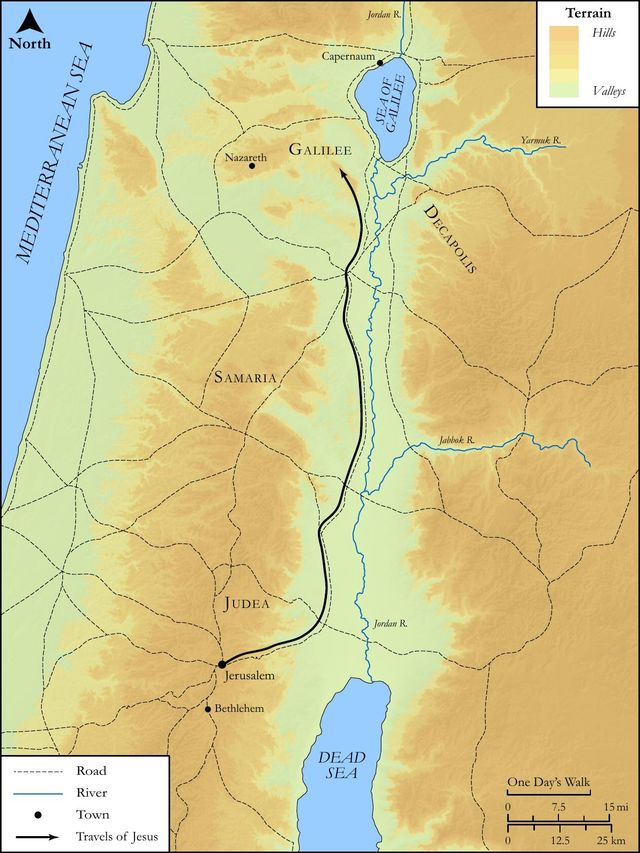
Galilee, often referred to as "Galilee of the Gentiles" (Isaiah 9:1), was a northern region of Israel, culturally diverse due to its proximity to Gentile lands and trade routes. It was generally looked down upon by the religious elite in Jerusalem, who considered its inhabitants less pure in their adherence to Jewish law. However, it was Jesus' home base, and His decision to begin His ministry there, rather than in Judea, was significant. The rapid spread of "fame" (Greek: phēmē) was common in the ancient world, often through word-of-mouth, travelers, and local markets, demonstrating how quickly news, especially of extraordinary events or individuals, could travel within a connected region.
Key Themes
ShowHideThis verse powerfully introduces several foundational themes that will characterize Jesus' ministry in Luke's Gospel. Firstly, Divine Empowerment is paramount; Jesus' ministry is not merely human effort but is explicitly stated to be "in the power of the Spirit," underscoring the Holy Spirit's essential role in His life and mission, a theme introduced at His baptism (Luke 3:21-22). Secondly, it marks the Launch of Public Ministry, signaling the transition from preparation to active engagement. The "fame" that spreads highlights the theme of Recognition and Anticipation, as people begin to take notice of this remarkable figure. Finally, the geographical setting emphasizes God's Work in Unexpected Places, as the Messiah's ministry begins not in the religious center of Jerusalem but in the often-maligned region of Galilee, fulfilling prophetic expectations (Matthew 4:15-16).
Exposition and Analysis
ShowHideKey Word Analysis
ShowHideMeaning "to turn under (behind), i.e., to return (literally or figuratively)." This word signifies more than just a geographical movement; it marks a decisive re-entry. Jesus is not merely coming back to Galilee; He is returning with a new spiritual status and purpose, having successfully navigated the profound spiritual challenge of the wilderness.
Meaning "force (literally or figuratively); specially, miraculous power (usually by implication, a miracle itself)." This term denotes inherent strength, ability, and effectiveness, often associated with supernatural or miraculous capabilities. It emphasizes that Jesus' subsequent actions and teachings would be characterized by divine authority and supernatural manifestation, not merely human skill or wisdom.
Meaning "a saying, i.e., rumor ('fame')." This word describes the widespread report or renown that quickly spread about Jesus. It indicates that His presence, actions, or perhaps even the very aura surrounding Him, generated significant public interest and discussion, creating a buzz that preceded His formal teachings and miracles.
Verse Breakdown
ShowHide"And Jesus returned in the power of the Spirit into Galilee:"
This clause establishes the central theological and narrative point. Jesus' return is not a simple geographical relocation but a Spirit-empowered re-entry. The phrase "in the power of the Spirit" is crucial, indicating that His subsequent ministry is divinely enabled and authorized, a direct result of His anointing at baptism and His victory over temptation. Galilee, His home region, becomes the initial stage for this Spirit-anointed work.
"and there went out a fame of him through all the region round about."
This second clause describes the immediate and widespread consequence of Jesus' Spirit-empowered presence. His "fame" or reputation rapidly spread throughout the entire surrounding region of Galilee. This indicates that His presence, perhaps marked by early teachings or unrecorded acts, immediately captured public attention, creating an eager audience and a fertile ground for His ministry to blossom.
Literary Devices
ShowHideLuke 4:14 employs several literary devices to convey its profound message. It functions as a Narrative Transition, marking a distinct shift from Jesus' private preparation and spiritual warfare to His public ministry. The phrase "in the power of the Spirit" is a clear instance of Divine Agency, emphasizing that Jesus' authority and effectiveness are not inherent to His humanity alone but are supernaturally endowed by the Holy Spirit. The description of "fame" spreading "through all the region round about" utilizes Hyperbole or Emphasis to underscore the widespread and rapid nature of His renown, suggesting a pervasive impact that transcends mere local recognition. This widespread fame also serves as Foreshadowing, hinting at the immense impact and widespread recognition Jesus will achieve throughout His ministry, drawing crowds and challenging established norms.
Theological and Thematic Connections
ShowHideLuke 4:14 is profoundly significant, establishing the foundational principle that Jesus' earthly ministry, though fully human, was entirely dependent on and empowered by the Holy Spirit. This truth sets a paradigm for all subsequent Spirit-empowered ministry within the Christian tradition. Just as Jesus' victory over temptation preceded His public anointing for service, it highlights that spiritual preparation and reliance on God's power are prerequisites for effective Kingdom work. His return to Galilee, a region often overlooked, also underscores God's willingness to work in unexpected places and through seemingly ordinary means to accomplish His extraordinary purposes. The immediate spread of His fame demonstrates the intrinsic attractiveness and undeniable impact of divine power and truth.
Reflection and Application
ShowHideLuke 4:14 offers a powerful model for every believer and for the Church today. Just as Jesus, the Son of God, relied entirely on the Holy Spirit for His ministry, we too must recognize that true spiritual effectiveness flows not from human strength, charisma, or strategic planning alone, but from being "in the power of the Spirit." This verse challenges us to prioritize spiritual preparation, including wrestling with temptations and seeking intimacy with God, before embarking on service. It reminds us that our "fame" or influence should not be sought for personal glory, but should be a natural outflow of God's power working through us, drawing attention to Him. When we genuinely live and serve in the Spirit's power, our lives and ministries will naturally generate a compelling witness that impacts our "region round about," much like Jesus' initial impact in Galilee.
Questions for Reflection
ShowHideFAQ
ShowHideWhat does "in the power of the Spirit" mean for Jesus' ministry?
ShowHideThe phrase "in the power of the Spirit" (Greek: dýnamis tou Pneúmatos) signifies that Jesus' entire public ministry was not merely a demonstration of human capabilities or wisdom, but was supernaturally enabled and directed by the Holy Spirit. This power refers to inherent strength, miraculous ability, and divine authority. It means that His teachings carried divine weight, His healings were true miracles, and His actions were backed by the very power of God. This divine empowerment was a direct result of His anointing at baptism (Luke 3:21-22) and His triumph over temptation in the wilderness, establishing His qualifications as the Messiah.
Why is Galilee significant as the starting point for Jesus' ministry?
ShowHideGalilee, a region in northern Israel, was significant for several reasons. Firstly, it was Jesus' home territory, fulfilling the prophecy that the Messiah would arise from this region, often called "Galilee of the Gentiles" (Isaiah 9:1-2, quoted in Matthew 4:15-16). While often looked down upon by the religious elite in Judea, its diverse population and less rigid religious atmosphere made it fertile ground for Jesus' inclusive message. Starting in Galilee demonstrated that God's salvation was not limited to the religious establishment in Jerusalem but extended to all, including those on the periphery. It also allowed Jesus to build a strong base of disciples before confronting the religious authorities in Jerusalem.
How did Jesus' "fame" spread so quickly throughout the region?
ShowHideIn the ancient world, news traveled rapidly through word-of-mouth, especially concerning extraordinary individuals or events. Jesus' "fame" (Greek: phḗmē, meaning a report or rumor) likely spread through various channels: people returning from the Jordan where John the Baptist was baptizing and where Jesus was baptized, early disciples sharing their experiences, and perhaps initial acts of teaching or healing that, though not explicitly detailed here, would have been remarkable. The combination of His unique presence, His recent triumph over temptation, and the divine power emanating from Him would have created an undeniable buzz. People would have discussed Him in synagogues, markets, and homes, leading to widespread anticipation and curiosity before His more formal public declarations.
Christ-Centered Fulfillment
ShowHideLuke 4:14 is a profound Christ-centered statement, revealing Jesus as the Spirit-anointed Messiah, fully equipped for His redemptive mission. His "return in the power of the Spirit" directly fulfills Old Testament prophecies of the coming Servant and King who would be endowed with the Spirit of the Lord (Isaiah 11:2, Isaiah 42:1, Isaiah 61:1). This verse underscores that Jesus' entire ministry – His authoritative teaching, miraculous healings, and ultimately His atoning death and resurrection – was not merely human effort but the manifestation of God's own power working through Him. He is the ultimate example of a life lived in perfect obedience and dependence on the Spirit, demonstrating what it means for humanity to be fully restored to God's image. His fame, spreading throughout Galilee, foreshadows the global renown He would achieve as the Savior of the world, drawing all people to Himself through the power of His Spirit-empowered gospel (John 12:32, Acts 1:8).