


Matthew 4:25
Bible text: King James Version (1769 Blayney text) · Public domain
Bible text: King James Version with Strong's numbers · Public domain
Bible text: Berean Standard Bible · Public domain
Bible text: American Standard Version (1901) · Public domain
Bible text: World English Bible, Messianic edition · Public domain
Bible text: Geneva Bible (1599) · Public domain
Bible text: Young's Literal Translation · Public domain
- καὶkaiAndG2532CONJConjunction
- ἠκολούθησανēkolouthēsanfollowedG190V-AAI-3PVerb Aorist Active Indicative 3rd Plural
- αὐτῷautōHimG846P-DSMPersonal pronoun Dative Singular Masculine
- ὄχλοιochloicrowdsG3793N-NPMNoun Nominative Plural Masculine
- πολλοὶpolloigreatG4183A-NPMAdjective Nominative Plural Masculine
- ἀπὸapofromG575PREPPreposition
- τῆςtēs<the>G3588T-GSFDefinite article Genitive Singular Feminine
- ΓαλιλαίαςGalilaiasGalileeG1056N-GSF-LNoun Genitive Singular Feminine Location
- καὶkaiandG2532CONJConjunction
- ΔεκαπόλεωςDekapoleōs[the] DecapolisG1179N-GSF-LNoun Genitive Singular Feminine Location
- καὶkaiandG2532CONJConjunction
- ἹεροσολύμωνHi'erosolumōnJerusalemG2414N-GPN-LNoun Genitive Plural Neuter Location
- καὶkaiandG2532CONJConjunction
- ἸουδαίαςIoudaiasJudeaG2449N-GSF-LNoun Genitive Singular Feminine Location
- καὶkaiandG2532CONJConjunction
- πέρανperanbeyondG4008PREPPreposition
- τοῦtoutheG3588T-GSMDefinite article Genitive Singular Masculine
- ἸορδάνουIordanouJordanG2446N-GSM-LNoun Genitive Singular Masculine Location
English is a literal word-by-word gloss of the Greek, not the KJV's wording. Why?
This is the original text the KJV's translators worked from — each Greek word with its own literal English meaning in this verse, prepared by scholars at Tyndale House, Cambridge. The KJV translates whole sentences, not word by word, so its wording differs: one Greek word can become several English words, and the KJV may choose “charity” where the gloss reads “love”. Both are faithful — they answer different questions. For the KJV's own rendering, switch to the KJV text.
Details
See on the biblical-era maps
Study this verse
Public-domain commentary
Matthew Henry
From his Commentary on the Whole Bible. Henry comments on passages, not single verses — this entry covers Matthew 4:23–25. His three-level outline is real structure in the source text, so it is rendered as structure.
See here, I. What an industrious preacher Christ was; He went about all Galilee, teaching in their synagogues, and preaching the gospel of the kingdom. Observe, 1. What Christ preached - the gospel of the kingdom. The kingdom of heaven, that is, of grace and glory, is emphatically the kingdom, the kingdom that was now to come; that kingdom which shall survive, as it doth surpass, all the kingdoms of the earth. The gospel is the charter of that kingdom, containing the King's coronation oath, by which he has graciously obliged himself to pardon, protect, and save the subjects of that kingdom; it contains also their oath of allegiance, by which they oblige themselves to observe his statutes and seek his honour; this is the gospel of the kingdom; this Christ was himself the Preacher of, that our faith in it might be confirmed. 2. Where he preached - in the synagogues; not there only, but there chiefly, because those were the places of concourse, where wisdom was to lift up her voice (Pro 1:21); because they were places of concourse for religious worship, and there, it was to be hoped, the minds of the people would be prepared to receive the gospel; and there the scriptures of the Old Testament were read, the exposition of which would easily introduce the gospel of the kingdom. 3. What pains he took in preaching; He went about all Galilee, teaching. He might have issued out a proclamation to summon all to come to him; but, to show his humility, and the condescensions of his grace, he goes to them; for he waits to be gracious, and comes to seek and save. Josephus says, There were above two hundred cities and towns in Galilee, and all, or most of them, Christ visited. He went about doing good. Never was there such an itinerant preacher, such an indefatigable one, as Christ was; he went from town to town, to beseech poor sinners to be reconciled to God. This is an example to ministers, to lay themselves out to do good, and to be instant, and constant, in season, and out of season, to preach the word.
II.What a powerful physician Christ was; he went about not only teaching, but healing, and both with his word, that he might magnify that above all his name. He sent his word, and healed them. Now observe,
1.What diseases he cured - all without exception. He healed all manner of sickness, and all manner of disease. There are diseases which are called the reproach of physicians, being obstinate to all the methods they can prescribe; but even those were the glory of this Physician, for he healed them all, however inveterate. His word was the true panpharmacon - all-heal.
Three general words are here used to intimate this; he healed every sickness, noson, as blindness, lameness, fever, dropsy; every disease, or languishing, malakian, as fluxes and consumptions; and all torments, basanous, as gout, stone, convulsions, and such like torturing distempers; whether the disease was acute or chronical; whether it was a racking or a wasting disease; none was too bad, none too hard, for Christ to heal with a word's speaking.
Three particular diseases are specified; the palsy, which is the greatest weakness of the body; lunacy, which is the greatest malady of the mind, and possession of the Devil, which is the greatest misery and calamity of both, yet Christ healed all: for he is the sovereign Physician both of soul and body, and has command of all diseases.
2.What patients he had. A physician who was so easy of access, so sure of success, who cured immediately, without either a painful suspense and expectation, or such painful remedies as are worse than the disease; who cured gratis, and took no fees, could not but have abundance of patients. See here, what flocking there was to him from all parts; great multitudes of people came, not only from Galilee and the country about, but even from Jerusalem and from Judea, which lay a great way off; for his fame went throughout all Syria, not only among all the people of the Jews, but among the neighbouring nations, which, by the report that now spread far and near concerning him, would be prepared to receive his gospel, when afterwards it should be brought them. This is given as the reason why such multitudes came to him, because his fame had spread so widely. Note, What we hear of Christ from others, should invite us to him. The queen of Sheba was induced, by the fame of Solomon, to pay him a visit. The voice of fame is "Come, and see." Christ both taught and healed. They who came for cures, met with instruction concerning the things that belonged to their peace. It is well if any thing will bring people to Christ; and they who come to him will find more in him than they expected. These Syrians, like Naaman the Syrian, coming to be healed of their diseases, many of them being converts, Kg2 5:15, Kg2 5:17. They sought health for the body, and obtained the salvation of the soul; like Saul, who sought the asses, and found the kingdom. Yet it appeared, by the issue, that many of those who rejoiced in Christ as a Healer, forgot him as a Teacher.
Now concerning the cures which Christ wrought, let us, once for all, observe the miracle, the mercy, and the mystery, of them.
(1.)The miracle of them. They were wrought in such a manner, as plainly spake them to be the immediate products of a divine and supernatural power, and they were God's seal to his commission. Nature could not do these things, it was the God of nature; the cures were many, of diseases incurable by the art of the physician, of persons that were strangers, of all ages and conditions; the cures were wrought openly, before many witnesses, in mixed companies of persons that would have denied the matter of fact, if they could have had any colour for so doing; no cure ever failed, or was afterwards called in question; they were wrought speedily, and not (as cures by natural causes) gradually; they were perfect cures, and wrought with a word's speaking; all which proves him a Teacher come from God, for, otherwise, none could have done the works that he did, Joh 3:2. He appeals to these as credentials, Mat 11:4, Mat 11:5; Joh 5:36. It was expected that the Messiah should work miracles (Joh 7:31); miracles of this nature (Isa 35:5, Isa 35:6); and we have this indisputable proof of his being the Messiah; never was there any man that did thus; and therefore his healing and his preaching generally went together, for the former confirmed the latter; thus here he began to do and to teach, Act 1:1.
(2.)The mercy of them. The miracles that Moses wrought, to prove his mission, were most of them plagues and judgments, to intimate the terror of that dispensation, though from God; but the miracles that Christ wrought, were most of them cures, and all of them (except the cursing of the barren fig tree) blessings and favours; for the gospel dispensation is founded, and built up in love, and grace, and sweetness; and the management is such as tends not to affright but to allure us to obedience. Christ designed by his cures to win upon people, and to ingratiate himself and his doctrine into their minds, and so to draw them with the bands of love, Hos 11:4. The miracle of them proved his doctrine a faithful saying, and convinced men's judgments; the mercy of them proved it worthy of all acceptation, and wrought upon their affections. They were not only great works, but good works, that he showed them from his Father (Joh 10:32); and this goodness was intended to lead men to repentance (Rom 2:4), as also to show that kindness, and beneficence, and doing good to all, to the utmost of our power and opportunity, are essential branches of that holy religion which Christ came into the world to establish.
(3.)The mystery of them. Christ, by curing bodily diseases, intended to show, that his great errand into the world was to cure spiritual maladies. He is the Sun of righteousness, that arises with this healing under his wings. As the Converter of sinners, he is the Physician of souls, and has taught us to call him so, Mat 9:12, Mat 9:13. Sin is the sickness, disease, and torment of the soul; Christ came to take away sin, and so to heal these. And the particular stories of the cures Christ wrought, may not only be applied spiritually, by way of allusion and illustration, but, I believe, are very much intended to reveal to us spiritual things, and to set before us the way and method of Christ's dealing with souls, in their conversion and sanctification; and those cures are recorded, that were most significant and instructive this way; and they are therefore so to be explained and improved, to the honour and praise of that glorious Redeemer, who forgiveth all our iniquities, and so healeth all our diseases.
Historical interpretation
Nine Centuries of Reception
7 surviving comments on this verse. Each one is dated, so this reads as a timeline rather than a list.
Select a marker to jump to its quote. Markers stagger vertically where authors wrote within a few decades of each other.
CHRYSOSTOM.a By which too He showed the Jews that He came not as an enemy of God, or a seducer of souls, but as consenting with his Father.
We must consider that when some great change is being wrought, as the introduction of a new polity, God is wont to work miracles, giving pledges of His power to those who are to receive His laws. Thus when He would make man, He first created a world, and then at length gave man in paradise a law. When He would dispense a law to the holy Noah, he showed truly great wonders; and again when He was about to ordain the Law for the Jews, He first showed great prodigies, and then at length gave them the commandments. So now when about to introduce a sublime discipline of life, He first provided a sanction to His instructions by mighty signs, because the eternal kingdom He preached was not seen, by the things which did appear, He made sure that which as yet did not appear.
Observe the reserve of the Evangelist; he does not give an account of any one of the various cases of healing, but passes in one brief phrase an abundance of miracles, they brought to him all their sick.
He requires no direct profession of faith from them, both because He had not yet given them any proofs of His miraculous power, and because in bringing their sick from far they had shown no small faith.
When therefore He had caught them, then He begins in their presence to work miracles, by His deeds confirming the words of John concerning Him. And He was continually frequenting their synagogues, even by this instructing them that He was not a sort of adversary of God and deceiver, but that He was come in accordance with the Father.
And while frequenting them, He did not preach only, but also showed forth miracles. And this, because on every occasion, whensoever anything is done strange and surprising, and any polity is introduced, God is wont to work miracles as pledges of His power, which He affords to them that are to receive His laws. Thus, for instance, when He was about to make man, He created a whole world, and then gave him that law which he had in Paradise. And when He was to give laws to Noah, He showed forth anew great miracles, in that He reduced again the whole creation to its elements, that fearful sea to prevail for a full year; and in that, amid so great a tempest, He preserved that righteous man. And in the time of Abraham too He vouchsafed many signs; as his victory in the war, the plague upon Pharaoh, his deliverance from dangers. And when about to legislate for the Jews, He showed forth those marvellous and great prodigies, and then gave the law. Just so in this case also, being to introduce a certain high polity, and to tell them what they had never heard, by the display of the miracles He confirms what He saith. Thus because the kingdom He was preaching appeared not, by the things that appear, He makes it, though invisible, manifest.
And mark the evangelist's care to avoid superfluity of words; how he tells us not of every one of them that are healed, but in a few words speeds over showers of miracles.
For "they brought unto Him," saith he, "all that were sick with divers diseases, and torments, and those which were possessed with devils, and those which were lunatic, and those that had the palsy, and He healed them."
But our inquiry is this; why it can have been that He demanded faith of none of them? For He said not, what we find Him saying after this, "Believe ye that I am able to do this?" because He had not as yet given proof of His power. And besides, the very act of approaching Him, and of bringing others to Him, exhibited no common faith. For they brought them even from far; whereas they would never have brought them, unless they had persuaded themselves of great things concerning Him.
Not really smitten by the moon, but who were believed to be so through the subtlety of the dæmons, who by observing the seasons of the moon, sought to bring an evil report against the creature, that it might redound to the blasphemy of the Creator.
Kings, when about to go to war with their enemies, first gather an army, and so go out to battle; thus the Lord when about to war against the Devil, first collected Apostles, and then began to preach the Gospel.
Because they being weak could not come to their physician, He as a zealous Physician went about to visit those who had any grievous sickness. The Lord went round the several regions, and after His example the pastors of each region ought to go round to study the several dispositions of their people, that for the remedy of each disease some medicine may be found in the Church.
Or, He taught natural righteousness, those things which natural reason teaches, as chastity, humility, and the like, which all men of themselves see to be goods. Such things are necessary to be taught not so much for the sake of making them known as for stirring the heart. For beneath the prevalence of carnal delights the knowledge of natural righteousness sleeps forgotten. When then a teacher begins to denounce carnal sins, his teaching does not bring up a new knowledge, but recalls to memory one that had been forgotten. But He preached the Gospel, in telling of good things which the ancients had manifestly not heard of, as the happiness of heaven, the resurrection of the dead, and the like. Or, He taught by interpreting the prophecies concerning Himself; He preached by declaring the benefits that were to come from Himself.
Or, by disease we may understand any passion of the mind, as avarice, lust, and such like, by malady unbelief, that is, weakness of faith. Or, the diseases are the more grievous pains of the body, the maladies the slighter. As He cured the bodily pains by virtue of His divine power, so He cured the spiritual by the word of His mercy. He first teaches, and then performs the cures, for two reasons. First, that what is needed most may come first; for it is the word of holy instruction, and not miracles, that edify the soul. Secondly, because teaching is commended by miracles, not the converse.
In some places it is, He cured many; but here, He cured them, meaning 'all;' as a new physician first entering a town cures all who come to him. to beget a good opinion concerning himself.
An example of life for doctors; that they should not be inactive, they are instructed in these words, And Jesus went about.
That they should not be acceptors of persons the preachers are instructed in what follows, the whole of Galilee. That they should not go about empty, by the word teaching. That they should seek to benefit not few but many, in what follows, in their synagogues.
That they should not preach error nor fable, but sound doctrine, is inculcated in the words, preaching the Gospel of the kingdom. 'Teaching' and 'preaching' differ; teaching refers to things present, preaching to things to come; He taught present commandments and preached future promises.
That the teacher should study to commend his teaching by his own virtuous conduct is conveyed in those words, healing every sort of disease and malady among the people; maladies of the body, diseases of the soul.
By these he would have us understand various but slighter diseases; but when he says, seized with divers sicknesses and torments, he would have those understood, of whom it is subjoined, and who had dæmons.
'Lunatics' are so called from the moon; for as it waxes in its monthly seasons they are tormented.
Or, they follow the Lord from Galilee, that is, from the unstable world; from Decapolis, (the country of ten towns,) signifying those who break the Ten Commandments; and from Jerusalem, because before it was preserved unhurt in peace; and from Jordan, that is, from the confession of the Devil; and from beyond Jordan, they who were first planted in paganism, but passing the water of Baptism came to Christ.
Syria here is all the region from Euphrates to the Great sea, from Cappadocia to Egypt, in which is the country of Palestine, inhabited by Jews.
Paralytics are those whose bodies have their nerves slackened or resolved from a Greek word, signifying this.
crowds that followed Him consisted of four sorts of men, some followed for the heavenly teaching as disciples, some for the curing of their diseases, some from the reports concerning Him alone, and curiosity to find whether they were true; others from envy, wishing to catch Him in some matter that they might accuse Him. Mystically, Syria is interpreted 'lofty,' Galilee, 'turning:' or 'a wheel;' that is, the Devil and the world; the Devil is both proud and always turned round to the bottom; the world in which the fame of Christ went abroad through preaching: the dæmoniacs are the idolaters; the lunatics, the unstable; the paralytics, the slow and careless.
(ap. Anselm.) Because preachers should have good testimony from those who are without, lest if their life is open to censure, their preaching be contemned, he adds, And the fame of him went abroad through all Syria.
'Sickness' means a lasting ailment; 'torment' is an acute pain, as pleurisy, and such like; they who had dæmons are they who were tormented by the dæmons.
(ap. Anselm.) The crowds that follow the Lord, are they of the Church, which is spiritually designated by Galilee, passing to virtuousness; Decapolis is he who keeps the Ten Commandments; Jerusalem and Judæa, he who is enlightened by the vision of peace and confession; and beyond Jordan, he who having passed the waters of Baptism enters the land of promise.
Continue studying Matthew 4:25 across the web’s major study libraries — every link below opens this exact verse, chapter, or book on the destination site.
Read & Compare
 BibleGatewayThis verse in more than 200 translations and 70 languages.
 Bible.comThe YouVersion reader — hundreds of translations, reading plans, and highlights.
 ESV.orgCrossway's official English Standard Version reader.
 NET BibleThe NET translation with 60,000+ translators' notes on every rendering decision.
 STEP BibleTyndale House's free study tool — original text, vocabulary, and scholarly resources.
 BibliaLogos Bible Software's free web reader.
 USCCBThe New American Bible (Revised Edition) with the U.S. bishops' study notes.
Commentaries
 BibleHub CommentariesDozens of classic commentaries on this verse, gathered on one page.
 StudyLightMore than 100 commentary sets — the largest collection on the web.
 BibleRefPlain-English commentary on what this verse means, verse by verse.
 Enduring WordDavid Guzik's free commentary on this chapter, widely used by Bible teachers.
 Bible Study ToolsVerse commentary alongside Greek and Hebrew study aids.
Original Language & Research
- BibleHub InterlinearThe verse word by word — original language, transliteration, and English.
- BibleHub LexiconEvery word's original-language definition and Strong's entry.
 Blue Letter BibleDeep-study tools — Strong's numbers, concordance, and word studies.
 CNTR CollationThe earliest Greek manuscripts of this verse, collated letter by letter.
Sermons, Hymns & Audio


TrulyRandomVerse is not affiliated with these sites and doesn’t control their content. They’re linked because they’re genuinely useful.
Summary
Matthew 4:25 vividly portrays the immediate and widespread impact of Jesus' early ministry, describing the immense multitudes that followed Him from diverse regions across Galilee, Decapolis, Jerusalem, Judaea, and beyond the Jordan. This verse serves as a powerful testament to the burgeoning fame and compelling authority of Jesus, setting the stage for the profound teachings and miraculous works that would define His public ministry, particularly the Sermon on the Mount.
Context
ShowHideLiterary Context
Matthew 4:25 concludes the introductory phase of Jesus' public ministry, acting as a direct consequence and culmination of the events described in the preceding verses. It follows Jesus' initial proclamation of the Kingdom of Heaven and call to repentance (Matthew 4:17), the calling of His first disciples (Matthew 4:18-22), and a concise summary of His extensive teaching and healing ministry throughout Galilee (Matthew 4:23-24). This verse effectively illustrates the result of His initial efforts, demonstrating the magnetic pull of His person and message. It serves as a vital bridge, preparing the reader for the significant discourse that immediately follows: the Sermon on the Mount, which is delivered to these very crowds, beginning in Matthew 5:1.
Historical & Cultural Context
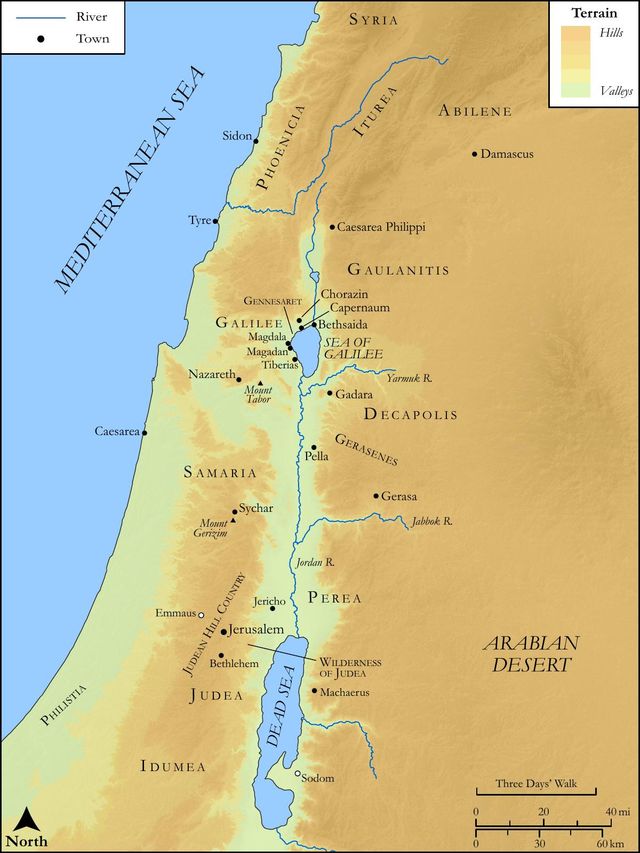
The regions listed in Matthew 4:25 highlight the extensive geographical reach of Jesus' fame among the Jews and the Gentiles round about. Galilee was Jesus' primary base, a northern region with a mixed Jewish and Gentile population. Decapolis, meaning "Ten Cities," was a league of largely Hellenistic (Greek-speaking) cities predominantly east and southeast of Galilee, indicating that Jesus' appeal transcended purely Jewish audiences. Jerusalem and Judaea represented the religious and political heartland of Judaism in the south, signifying that His reputation had reached the epicenter of Jewish life and authority. "Beyond Jordan" refers to the region of Perea, east of the Jordan River, which also had a mixed population. Travel in this era, often on foot, was arduous, underscoring the profound motivation of these "great multitudes" to seek out Jesus, driven by curiosity, spiritual hunger, or the hope of healing.
Key Themes
ShowHideMatthew 4:25 contributes significantly to several key themes within the Gospel of Matthew and the broader biblical narrative. Firstly, it underscores the Widespread Appeal of Jesus, demonstrating that His message and miraculous works resonated across diverse populations, from the Jewish heartland to Gentile territories, fulfilling prophecies of a Messiah who would draw all peoples to Himself. Secondly, it highlights Jesus' Divine Authority and Power, as the sheer volume of people drawn to Him was a direct response to His authoritative teaching and undeniable healing miracles, as described in the preceding verses. This attests to His unique identity as the Son of God, possessing unparalleled power over sickness and sin, a theme echoed in passages like Mark 1:27. Finally, the gathering of such a vast and diverse audience signifies Preparation for the Kingdom Proclamation. These multitudes represent the "harvest" ready to hear the Kingdom message, setting the stage for the detailed exposition of Kingdom ethics and principles in the Sermon on the Mount, aligning with Jesus' later observation about the plentiful harvest in Matthew 9:37-38.
Exposition and Analysis
ShowHideKey Word Analysis
ShowHideFrom a root meaning "to be in the same way with," this verb signifies more than mere casual observation; it implies accompanying someone, often as a disciple or follower. In this context, it suggests that the multitudes were not just onlookers but were actively moving with Jesus, drawn by His ministry and seeking to be near Him, indicative of an initial commitment or profound interest.
This adjective denotes abundance, quantity, or magnitude. When applied to "multitudes," it emphasizes the immense size of the crowds, underscoring the extraordinary and rapid growth of Jesus' fame and influence. It conveys a sense of overwhelming numbers, highlighting the broad impact of His early ministry.
This term refers to a throng, a crowd, or the rabble. It typically describes a large, undifferentiated mass of people, often spontaneously gathered and lacking formal organization. Its use here emphasizes the sheer number of individuals, highlighting the popular, grassroots nature of the movement Jesus was initiating, drawing people from all walks of life.
Verse Breakdown
ShowHide"And there followed him great multitudes of people"
This opening clause immediately establishes the central action and its scale. The verb "followed" (akolouthéō) suggests an intentional movement towards Jesus, indicating that people were actively seeking Him out, not merely stumbling upon Him. The description "great multitudes of people" (polýs óchlos) vividly conveys the immense size and diverse composition of the crowds, emphasizing the widespread and compelling appeal of Jesus' person, teaching, and miraculous works. It highlights the burgeoning momentum of His ministry.
"from Galilee, and from Decapolis, and from Jerusalem, and from Judaea, and from beyond Jordan"
This detailed geographical listing underscores the extraordinary reach of Jesus' fame. "Galilee" was His primary operational base. "Decapolis," a region of ten Gentile cities, indicates His influence extended beyond Jewish populations. "Jerusalem" and "Judaea" represent the religious and political heartland of Judaism, signaling that His reputation had penetrated the very core of Jewish society. "Beyond Jordan" (Perea) further expands the scope to the eastern bank of the Jordan River. This comprehensive list paints a picture of a movement that transcended regional, ethnic, and religious boundaries, drawing people from all corners of the land.
Literary Devices
ShowHideMatthew 4:25 employs several literary devices to convey the profound impact of Jesus' early ministry. The most prominent is Geographical Listing or Catalogue, where the specific enumeration of regions—Galilee, Decapolis, Jerusalem, Judaea, and beyond Jordan—serves to emphasize the extensive and diverse reach of Jesus' fame. This detailed list creates a vivid mental map for the reader, illustrating that His influence was not confined to one locality but had spread across Galilee, Judaea and the lands beyond Jordan. Furthermore, the phrase "great multitudes" functions as a form of Hyperbole, an intentional exaggeration not meant to be taken literally as every single person from these regions, but rather to underscore the overwhelming and unprecedented number of people drawn to Jesus. This exaggeration effectively communicates the astonishing scale of His popular appeal. Finally, the verse acts as Foreshadowing, subtly hinting at the universal scope of the Gospel message. The gathering of such diverse crowds—Jewish and Gentile, from north to south and east—prefigures the Great Commission and the ultimate gathering of believers from "every tribe and language and people and nation" into God's Kingdom, revealing the global destiny of Jesus' mission.
Theological and Thematic Connections
ShowHideMatthew 4:25 is more than a geographical report; it is a theological statement about the magnetic power of the Messiah. The gathering of "great multitudes" from such diverse regions signifies the initial fulfillment of ancient prophecies foretelling a Messiah who would draw all peoples to Himself. It underscores the universal nature of Jesus' appeal and the inherent power of the Kingdom message to transcend social, ethnic, and geographical boundaries. This influx of people, drawn by His authoritative teaching and miraculous healings, demonstrates God's active work in preparing hearts for the profound revelations of the Sermon on the Mount and the broader Kingdom of God. It is a testament to the fact that when the true Light shines, people from all walks of life are drawn to it, seeking truth, healing, and hope.
Reflection and Application
ShowHideMatthew 4:25 offers a powerful reminder of the enduring and universal appeal of Jesus Christ. Just as people from diverse backgrounds and distant regions were compelled to seek Him out in His earthly ministry, so too is His message of salvation and transformation relevant and powerful for all people today. The magnetic pull of Jesus' teaching and miraculous works highlights the inherent power of the Gospel to attract and transform lives across every conceivable boundary—social, cultural, and geographical. This verse encourages us to consider our own spiritual hunger and needs, prompting us to actively "follow" Jesus, seeking His truth, His healing, and His presence in our lives. It also serves as a profound encouragement for believers: the rapid spread of Jesus' fame without modern communication methods illustrates the organic and irresistible way truth can spread when truly lived, proclaimed, and demonstrated. We are called to be part of this ongoing movement, sharing the good news of Jesus Christ with others, confident in its transformative power.
Questions for Reflection
ShowHideFAQ
ShowHideWhy did so many people from different regions follow Jesus?
ShowHideThe "great multitudes" from various regions followed Jesus primarily because of His authoritative teaching and undeniable miraculous healings, as detailed in the preceding verses of Matthew 4:23-24. His message of the Kingdom of Heaven resonated deeply, offering hope, healing, and spiritual transformation that transcended geographical and social boundaries. People were drawn by the compelling evidence of His divine power over sickness and disease, and by the profound wisdom of His words, which were unlike anything they had heard from traditional religious leaders (Matthew 7:28-29). The sheer novelty and power of His ministry created a magnetic pull, prompting individuals to travel significant distances to hear and experience His presence.
What is the significance of the specific regions listed in Matthew 4:25?
ShowHideThe listing of Galilee, Decapolis, Jerusalem, Judaea, and beyond Jordan is highly significant. It highlights the extensive and diverse reach of Jesus' early ministry, demonstrating that His fame was not confined to one area or one type of people. Galilee was His operational base, while Decapolis, a predominantly Gentile region, shows His appeal extended beyond Jewish populations. Jerusalem and Judaea represent the religious heartland, indicating His reputation had reached the very center of Jewish life. "Beyond Jordan" (Perea) further expands the scope to the eastern bank. This comprehensive geographical catalogue underscores the universal nature of the Gospel, foreshadowing Jesus' mission to draw people from "all nations" to Himself (Matthew 28:19).
Christ-Centered Fulfillment
ShowHideMatthew 4:25, with its depiction of "great multitudes" from diverse regions following Jesus, serves as a powerful foreshadowing of Christ's ultimate and universal reign. This early gathering of people from Galilee, Decapolis, Jerusalem, Judaea, and beyond Jordan is an initial manifestation of Jesus as the true Shepherd who gathers His sheep from every corner, fulfilling ancient prophecies of a Messiah who would draw all peoples to Himself. He is the Light of the World (John 8:12), naturally attracting all humanity to His divine truth and saving grace. This magnetic presence culminates in His sacrificial death on the cross, through which He declared, "And I, when I am lifted up from the earth, will draw all people to myself" (John 12:32). The scene in Matthew 4:25 anticipates the Great Commission, where His disciples are commanded to "make disciples of all nations" (Matthew 28:18-20), and ultimately, the glorious vision in Revelation of a multitude "from every tribe and language and people and nation" standing before the throne of the Lamb (Revelation 7:9-10). Thus, the crowds in Matthew 4:25 are a microcosm of the global redeemed community that Christ, through His life, death, and resurrection, would gather into His eternal Kingdom.