


Mark 6:2
Bible text: King James Version (1769 Blayney text) · Public domain
Bible text: King James Version with Strong's numbers · Public domain
Bible text: Berean Standard Bible · Public domain
Bible text: American Standard Version (1901) · Public domain
Bible text: World English Bible, Messianic edition · Public domain
Bible text: Geneva Bible (1599) · Public domain
Bible text: Young's Literal Translation · Public domain
- καὶkaiAndG2532CONJConjunction
- γενομένουgenomenouwhen was becomingG1096V-2ADP-GSNVerb 2nd Aorist Middle Deponent Participle Genitive Singular Neuter
- σαββάτουsabbatou[the] SabbathG4521N-GSNNoun Genitive Singular Neuter
- ἤρξατοērxatoHe beganG757V-ADI-3SVerb Aorist Middle Deponent Indicative 3rd Singular
- διδάσκεινdidaskeinto teachG1321V-PANVerb Present Active Infinitive
- ἐνeninG1722PREPPreposition
- τῇtēatheG3588T-DSFDefinite article Dative Singular Feminine
- συναγωγῇ·sunagōgēasynagogueG4864N-DSFNoun Dative Singular Feminine
- καὶkaiandG2532CONJConjunction
- πολλοὶpolloimanyG4183A-NPMAdjective Nominative Plural Masculine
- ἀκούοντεςakouonteshearingG191V-PAP-NPMVerb Present Active Participle Nominative Plural Masculine
- ἐξεπλήσσοντοexeplēssontowere astonishedG1605V-IPI-3PVerb Imperfect Passive Indicative 3rd Plural
- λέγοντες·legontessayingG3004V-PAP-NPMVerb Present Active Participle Nominative Plural Masculine
- πόθενpothenFrom whereG4159ADV-IAdverb Interrogative
- τούτῳtoutōto this [man]G3778D-DSMDemonstrative pronoun Dative Singular Masculine
- ταῦταtautathese thingsG3778D-NPNDemonstrative pronoun Nominative Plural Neuter
- καὶkaiandG2532CONJConjunction
- τίςtiswhat [is]G5101I-NSFInterrogative pronoun Nominative Singular Feminine
- ἡhētheG3588T-NSFDefinite article Nominative Singular Feminine
- σοφίαsophiawisdomG4678N-NSFNoun Nominative Singular Feminine
- ἡhēwhichG3588T-NSFDefinite article Nominative Singular Feminine
- δοθεῖσαdotheisahaving been givenG1325V-APP-NSFVerb Aorist Passive Participle Nominative Singular Feminine
- τούτῳtoutōto HimG3778D-DSMDemonstrative pronoun Dative Singular Masculine
- ὅτιhotiforG3754CONJConjunction
- καὶkaievenG2532CONJConjunction
- δυνάμειςdunameismiraclesG1411N-NPFNoun Nominative Plural Feminine
- τοιαῦταιtoiautaisuchG5108D-NPFDemonstrative pronoun Nominative Plural Feminine
- διὰdiathroughG1223PREPPreposition
- τῶνtōntheG3588T-GPFDefinite article Genitive Plural Feminine
- χειρῶνcheirōnhandsG5495N-GPFNoun Genitive Plural Feminine
- αὐτοῦautouof HimG846P-GSMPersonal pronoun Genitive Singular Masculine
- γινόμεναι;ginomenaiare done?G1096V-PNP-NPFVerb Present Middle Or Passive Deponent Participle Nominative Plural Feminine
English is a literal word-by-word gloss of the Greek, not the KJV's wording. Why?
This is the original text the KJV's translators worked from — each Greek word with its own literal English meaning in this verse, prepared by scholars at Tyndale House, Cambridge. The KJV translates whole sentences, not word by word, so its wording differs: one Greek word can become several English words, and the KJV may choose “charity” where the gloss reads “love”. Both are faithful — they answer different questions. For the KJV's own rendering, switch to the KJV text.
Details
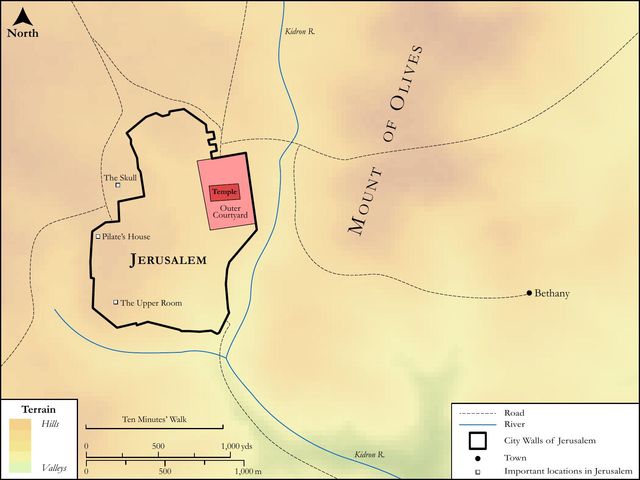
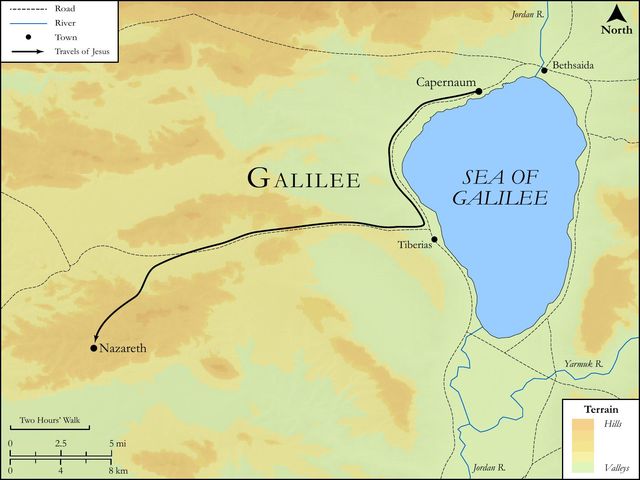
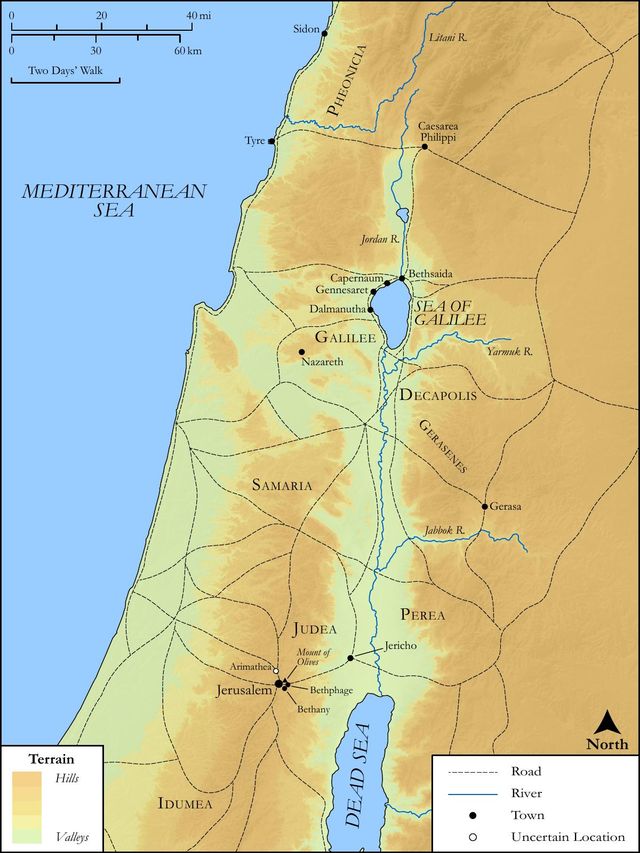
See on the biblical-era maps
Study this verse
Public-domain commentary
Matthew Henry
From his Commentary on the Whole Bible. Henry comments on passages, not single verses — this entry covers Mark 6:1–6. His two-level outline is real structure in the source text, so it is rendered as structure.
Here, I. Christ makes a visit to his own country, the place not of his birth, but of his education; that was Nazareth; where his relations were. He had been in danger of his life among them (Luk 4:29), and yet he came among them again; so strangely doth he wait to be gracious, and seek the salvation of his enemies. Whither he went, though it was into danger, his disciples followed him (Mar 6:1); for they had left all, to follow him whithersoever he went.
II.There he preached in their synagogue, on the sabbath day, Mar 6:2.
It seems, there was not such flocking to him there as in other places, so that he had no opportunity of preaching till they came together on the sabbath day; and then he expounded a portion of scripture with great clearness. In religious assemblies, on sabbath days, the word of God is to be preached according to Christ's example. We give glory to God by receiving instruction from him.
III.They could not but own that which was very honourable concerning him.
1.That he spoke with great wisdom, and that this wisdom was given to him, for they knew he had no learned education.
2.That he did mighty works, did them with his own hands, for the confirming of the doctrine he taught. They acknowledged the two great proofs of the divine original of his gospel - the divine wisdom that appeared in the contrivance of it, and the divine power that was exerted for the ratifying and recommending of it; and yet, though they could not deny the premises, they would not admit the conclusion.
IV.They studied to disparage him, and to raise prejudices in the minds of people against him, notwithstanding.
All this wisdom, and all these mighty works, shall be of no account, because he had a home-education, had never travelled, nor been at any university, or bred up at the feet of any of their doctors (Mar 6:3); Is not this the Carpenter? In Matthew, they upbraid him with being the carpenter's son, his supposed father Joseph being of that trade. But, it seems, they could say further, Is not this the Carpenter? our Lord Jesus, it is probable, employing himself in that business with his father, before he entered upon his public ministry, at least, sometimes in journey-work.
1.He would thus humble himself, and make himself of no reputation, as one that had taken upon him the form of a servant, and came to minister. Thus low did our Redeemer stoop, when he came to redeem us out of our low estate.
2.He would thus teach us to abhor idleness, and to find ourselves something to do in this world; and rather to take up with mean and laborious employments, and such as no more is to be got by than a bare livelihood, than indulge ourselves in sloth. Nothing is more pernicious for young people than to get a habit of sauntering. The Jews had a good rule for this - that their young men who were designed for scholars, were yet bred up to some trade, as Paul was a tent-maker, that they might have some business to fill up their time with, and, if need were, to get their bread with.
3.He would thus put an honour upon despised mechanics, and encourage those who eat the labour of their hands, though great men look upon them with contempt.
Another thing they upbraided him with, was, the meanness of his relations; "He is the son of Mary; his brethren and sisters are here with us; we know his family and kindred;" and therefore, though they were astonished at his doctrine (Mar 6:2), yet they were offended at his person (Mar 6:3), were prejudiced against him, and looked upon him with contempt; and for that reason would not receive his doctrine, though ever so well recommended. May we think that if they had not known his pedigree, but he had dropped among them from the clouds, without father, without mother, and without descent, they would have entertained him with any more respect? Truly, no; for in Judea, where this was not know, that was made an objection against him (Joh 9:29); As for this fellow, we know not from whence he is. Obstinate unbelief will never want excuses.
V.Let us see how Christ bore this contempt.
1.He partly excused it, as a common thing, and what might be expected, though not reasonably or justly (Mar 6:4); A prophet is not despised any where but in his own country. Some exceptions there may be to this rule; doubtless many have got over this prejudice, but ordinarily it holds good, that ministers are seldom so acceptable and successful in their own country as among strangers; familiarity in the younger years breeds a contempt, the advancement of one that was an inferior begets envy, and men will hardly set those among the guides of their souls whose fathers they were ready to set with the dogs of their flock; in such a case therefore it must not be thought hard, it is common treatment, it was Christ's, and wisdom is profitable to direct to other soil.
2.He did some good among them, notwithstanding the slights they put upon him, for he is kind even to the evil and unthankful; He laid his hands upon a few sick folks, and healed them. Note, It is generous, and becoming the followers of Christ, to content themselves with the pleasure and satisfaction of doing good, though they be unjustly denied the praise of it.
3.Yet he could there do no such mighty works, at least not so many, as in other places, because of the unbelief that prevailed among the people, by reason of the prejudices which their leaders instilled into them against Christ, Mar 6:5. It is a strange expression, as if unbelief tied the hands of omnipotence itself; he would have done as many miracles there as he had done elsewhere, but he could not, because people would not make application to him, nor sue for his favours; he could have wrought them, but they forfeited the honour of having them wrought for them. Note, By unbelief and contempt of Christ men stop the current of his favours to them, and put a bar in their own door.
4.He marvelled because of their unbelief, Mar 6:6. We never find Christ wondering but at the faith of the Gentiles that were strangers, as the centurion (Mat 8:10), and the woman of Samaria, and at the unbelief of Jews that were his own countrymen. Note, The unbelief of those that enjoy the means of grace, is a most amazing thing.
5.He went round about the village, teaching. If we cannot do good where we would, we must do it where we can, and be glad if we may have any opportunity, though but in the villages, of serving Christ and souls. Sometimes the gospel of Christ finds better entertainment in the country villages, where there is less wealth, and pomp, and mirth, and subtlety, than in the populous cities.
Historical interpretation
Four Centuries of Reception
3 surviving comments on this verse. Each one is dated, so this reads as a timeline rather than a list.
Select a marker to jump to its quote. Markers stagger vertically where authors wrote within a few decades of each other.
Jesus is called the son of a workman, of that one, however, whose work was the morning and the sun, that is, the first and second Church, as a figure of which the woman and the damsel are healed.
Oftentimes also the origin of a man brings him contempt, as it is written, (1 Sam. 25:10. Ps. 138:6) Who is the son of Jesse? for the Lord hath respect unto the lowly; as to the proud, He beholdeth them afar off.
(in Marc. 2, 23) He means by His country, Nazareth, in which He was brought up. But how great the blindness of the Nazarenes! they despise Him, Who by His words and deeds they might know to be the Christ, solely on account of His kindred. It goes on, And when the sabbath day was come, he began to teach in the synagogue: and many hearing him were astonished, saying, From whence hath this man these things? and what wisdom is this which is given unto him, that even such mighty works are wrought by his hands? By wisdom is meant His doctrine, by powers, the cures and miracles which He did. It goes on, Is not this the carpenter, the son of Mary?
(ubi sup.) For although human things are not to be compared with divine, still the type is complete, because the Father of Christ works by fire and spirit. It goes on, The brother of James, and Joses, of Jude, and, of Simon. And are not his sisters here with us? They bear witness that His brothers and sisters were with Him, who nevertheless are not to be taken for the sons of Joseph or of Mary, as heretics say, but rather, as is usual in Scripture, we must understand them to be His relations, as Abraham and Lot are called brothers, though Lot was brother's son to Abraham. And they were offended at him. The stumbling and the error of the Jews is our salvation, and the condemnation of heretics. For so much did they despise the Lord Jesus Christ, as to call Him a carpenter, and son of a carpenter. It goes on, And Jesus said unto them, A prophet is not without honour, but in his own country. Even Moses bears witness that the Lord is called a Prophet in the Scripture, for predicting His future Incarnation to the sons of Israel, he says, A Prophet shall the Lord raise up unto you of your brethren. (Acts 7:37) But not only He Himself, Who is Lord of prophets, but also Elias, Jeremiah, and the remaining lesser prophets, were worse received in their own country than in strange cities, for it is almost natural for men to envy their fellow-townsmen; for they do not consider the present works of the man, but they remember the weakness of His infancy.
(ubi sup.) Not as if He Who knows all things before they are done, wonders at what He did not expect or look forward to, but knowing the hidden things of the heart, and wishing to intimate to men that it was wonderful, He openly shows that He wonders. And indeed the blindness of the Jews is wonderful, for they neither believed what their prophets said of Christ, nor would in their own persons believe on Christ, Who was born amongst them. Mystically again; Christ is despised in His own house and country, that is, amongst the people of the Jews, and therefore He worked few miracles there, lest they should become altogether inexcusable. But He performs greater miracles every day amongst the Gentiles, not so much in the healing of their bodies, as in the salvation of their souls.
After the miracles which have been related, the Lord returns into His own country, not that He was ignorant that they would despise Him, but that they might have no reason to say, If Thou hadst come, we had believed Thee; wherefore it is said, And he went out from thence, and came into his own country.
Or again, if the prophet has noble relations, his countrymen hate them, and on that account do not honour the prophet. There follows, And he could there do no mighty work, &c. What, however, is here expressed by He could not, we must take to mean, He did not choose, because it was not that He was weak, but that they were faithless; He does not therefore work any miracles there, for he spared them, lest they should be worthy of greater blame, if they believed not, even with miracles before their eyes. Or else, for the working of miracles, not only the power of the Worker is necessary, but the faith of the recipient, which was wanting in this case: therefore Jesus did not choose to work any signs there. There follows, And he marvelled at their unbelief.
Continue studying Mark 6:2 across the web’s major study libraries — every link below opens this exact verse, chapter, or book on the destination site.
Read & Compare
 BibleGatewayThis verse in more than 200 translations and 70 languages.
 Bible.comThe YouVersion reader — hundreds of translations, reading plans, and highlights.
 ESV.orgCrossway's official English Standard Version reader.
 NET BibleThe NET translation with 60,000+ translators' notes on every rendering decision.
 STEP BibleTyndale House's free study tool — original text, vocabulary, and scholarly resources.
 BibliaLogos Bible Software's free web reader.
 USCCBThe New American Bible (Revised Edition) with the U.S. bishops' study notes.
Commentaries
 BibleHub CommentariesDozens of classic commentaries on this verse, gathered on one page.
 StudyLightMore than 100 commentary sets — the largest collection on the web.
 BibleRefPlain-English commentary on what this verse means, verse by verse.
 Enduring WordDavid Guzik's free commentary on this chapter, widely used by Bible teachers.
 Bible Study ToolsVerse commentary alongside Greek and Hebrew study aids.
Original Language & Research
- BibleHub InterlinearThe verse word by word — original language, transliteration, and English.
- BibleHub LexiconEvery word's original-language definition and Strong's entry.
 Blue Letter BibleDeep-study tools — Strong's numbers, concordance, and word studies.
 CNTR CollationThe earliest Greek manuscripts of this verse, collated letter by letter.
Sermons, Hymns & Audio


TrulyRandomVerse is not affiliated with these sites and doesn’t control their content. They’re linked because they’re genuinely useful.
Summary
Mark 6:2 captures the profound and paradoxical reaction of the people in Jesus' hometown synagogue as He began to teach on the Sabbath. Their astonishment at His unparalleled wisdom and the miraculous power evident in His hands quickly morphed into a questioning skepticism rooted in their familiarity with His humble origins. This verse vividly portrays the tension between divine revelation and human expectation, setting the stage for Jesus' subsequent inability to perform many mighty works there due to their unbelief.
Context
ShowHideLiterary Context
This verse immediately follows Jesus' return to "His own country," identified as Nazareth in Mark 6:1. Mark's narrative consistently portrays Jesus' ministry as one of teaching and healing, often encountering varied responses from awe to hostility. The preceding chapters detail numerous miracles and authoritative teachings, establishing Jesus' reputation. His arrival in Nazareth, His childhood home, is presented as a deliberate act, allowing Him to minister among those who knew Him best. The events of Mark 6:2-6 form a cohesive unit, highlighting the Nazareth incident as a significant turning point where familiarity breeds contempt, ultimately limiting His public ministry in that specific locality. This rejection contrasts sharply with the widespread acclaim He often received elsewhere.
Historical & Cultural Context
The Sabbath day, a cornerstone of Jewish life, was a time of rest and religious observance, including synagogue attendance. Synagogues served as vital community centers for prayer, reading of the Torah and Prophets, and instruction. It was customary for esteemed members or visiting rabbis to be invited to read from the Scriptures and expound upon them. Jesus, though not formally trained in rabbinical schools, took this opportunity to teach. The audience in Nazareth would have known Jesus not as a recognized religious scholar, but as a local carpenter, the son of Mary, with known siblings (Mark 6:3). This deep-seated familiarity and their knowledge of His ordinary background created a profound cultural barrier to accepting His extraordinary claims and divine authority. Their question, "From whence hath this man these things?" reflects a cultural expectation that wisdom and power should come from established, recognized sources, not from a humble tradesman from their own village.
Key Themes
ShowHideMark 6:2 contributes significantly to several overarching themes in the Gospel of Mark. Firstly, it underscores the theme of Jesus' Divine Authority and Wisdom. The crowd's astonished reaction ("what wisdom is this which is given unto him?") acknowledges a quality of teaching and insight far beyond human capacity, echoing earlier observations of His teaching "as one having authority, and not as the scribes" (Mark 1:22). Secondly, the verse highlights the pervasive theme of Human Unbelief and Rejection. Despite witnessing His profound wisdom and the evidence of "mighty works," their familiarity with Jesus' human origins became a stumbling block, illustrating how preconceived notions can hinder faith. This foreshadows the broader rejection Jesus would face from His own people, as depicted throughout the Gospels. Finally, the mention of "mighty works" (Greek: dynameis) reinforces the theme of Jesus' Miraculous Power, which serves as tangible proof of His divine identity and mission, even when met with skepticism. The tension between the undeniable power and the people's unbelief is a central dramatic element in Mark's narrative, particularly evident in this passage and its immediate aftermath in Mark 6:5-6.
Exposition and Analysis
ShowHideKey Word Analysis
ShowHideFrom the provided Strong's data, this word means "to strike with astonishment." It conveys a sense of being utterly amazed, dumbfounded, or struck out of one's senses. It is a stronger term than mere surprise, indicating an overwhelming wonder or shock that leaves one bewildered. In this context, it highlights the profound impact Jesus' teaching and works had on the hearers, forcing them to confront something entirely unexpected and inexplicable by conventional means.
According to Strong's, this refers to "wisdom (higher or lower, worldly or spiritual)." Here, it denotes a profound, divine insight and understanding that transcends human intellect or acquired knowledge. The people recognized a unique quality in Jesus' teaching that went beyond the rabbinical instruction they were accustomed to, suggesting a supernatural source for His profound understanding of spiritual truths and the Law.
This term, from the root meaning "force," specifically denotes "miraculous power (usually by implication, a miracle itself)." It refers to acts of divine power, supernatural demonstrations, or miracles. The people of Nazareth acknowledged that the "works wrought by his hands" were not ordinary feats but powerful, supernatural interventions, further prompting their bewildered inquiry into the source of His authority and ability.
Verse Breakdown
ShowHide"And when the sabbath day was come, he began to teach in the synagogue:"
This sets the scene, establishing the time (Sabbath) and place (synagogue) of Jesus' teaching. It highlights His consistent practice of engaging with Jewish religious life and utilizing established platforms for His ministry. His "beginning to teach" implies a deliberate and authoritative act, not merely a casual conversation.
"and many hearing [him] were astonished, saying,"
This describes the immediate and widespread reaction of the audience. The word "astonished" (as analyzed above) conveys a profound sense of wonder and bewilderment. Their verbal response ("saying") indicates that their astonishment was so great it compelled them to articulate their confusion and questions aloud.
"From whence hath this [man] these things?"
This is the first of two rhetorical questions, revealing their perplexity regarding the source of Jesus' extraordinary abilities. They are grappling with how someone they knew so well, from such a humble background, could possess such profound wisdom and power. This question implies a search for an origin that makes sense within their conventional understanding.
"and what wisdom [is] this which is given unto him,"
This second rhetorical question focuses specifically on the nature of His wisdom. They recognize it as something "given," implying a divine or supernatural bestowal, rather than something acquired through human study or training. Yet, they struggle to reconcile this divine gift with His familiar, human identity.
"that even such mighty works are wrought by his hands?"
This clause provides the concrete evidence that fuels their astonishment and questions. The "mighty works" (miracles) are undeniable, tangible demonstrations of power. The phrase "wrought by his hands" emphasizes the direct, personal agency of Jesus in performing these supernatural acts, making His identity and the source of His power an urgent and bewildering inquiry for the people of Nazareth.
Literary Devices
ShowHideMark 6:2 employs several literary devices to convey its powerful message. The most prominent is Rhetorical Question, seen in "From whence hath this man these things? and what wisdom is this which is given unto him...?" These questions are not posed to elicit information but to express the profound bewilderment and internal conflict of the crowd. They highlight the paradox of Jesus' divine authority emanating from a seemingly ordinary human origin. There is also an element of Irony, as the very people who should have been most open to Jesus, knowing Him intimately, are instead the most resistant due to their familiarity. This sets up a tragic irony where Jesus' own hometown becomes a place of limited ministry. Furthermore, the verse uses Contrast by juxtaposing Jesus' humble, known background ("this man") with the extraordinary, unexplainable wisdom and "mighty works" that emanate from Him. This contrast underscores the divine nature of Jesus, which defies human categorization and expectation.
Theological and Thematic Connections
ShowHideThe astonishment and subsequent questioning in Mark 6:2 highlight a fundamental theological tension: the clash between divine revelation and human expectation. The people of Nazareth, accustomed to Jesus' ordinary life, struggled to reconcile His humble humanity with the undeniable evidence of His divine wisdom and miraculous power. This inability to see beyond His earthly origins reveals a profound spiritual blindness, a common theme throughout the Gospels where human pride and preconceived notions hinder faith. The "wisdom" and "mighty works" point directly to Jesus' unique identity as the Son of God, possessing inherent authority and power, yet this truth was obscured by their familiarity. This passage serves as a cautionary tale, demonstrating how familiarity can breed contempt and how a lack of faith can limit the manifestation of God's power, not because God is unwilling, but because human receptivity is a prerequisite for spiritual transformation.
Reflection and Application
ShowHideMark 6:2 serves as a powerful mirror for our own hearts and minds. How often do we, like the people of Nazareth, allow our preconceived notions, our familiarity with the "ordinary," or our human biases to limit our perception of God's work and presence? We might intellectualize faith, seeking to fit God into our neat categories, rather than allowing His extraordinary wisdom and power to challenge and transform us. This verse calls us to cultivate a posture of humility and openness, recognizing that God often works in unexpected ways and through unexpected people. True wisdom and authority reside in Christ alone, regardless of our human judgments or the channels He chooses. Our challenge is to move beyond mere astonishment to genuine faith, allowing the truth of who Jesus is to reshape our understanding and our lives, rather than letting our familiarity become a barrier to His transformative power.
Questions for Reflection
ShowHideFAQ
ShowHideWhy were the people of Nazareth astonished by Jesus' teaching and works?
ShowHideThe people were astonished because Jesus, whom they knew as a local carpenter from a humble background, was demonstrating extraordinary wisdom in His teaching and performing "mighty works" (miracles). This was completely unexpected from someone they had grown up with and whose family they knew well (Mark 6:3). Their astonishment stemmed from the profound disconnect between His ordinary origins and His undeniable, supernatural abilities, leading them to question the source of His power and wisdom.
What is the significance of the people asking "From whence hath this man these things?"
ShowHideThis question reveals their deep perplexity and skepticism. It's not a genuine inquiry seeking understanding, but an expression of their inability to reconcile Jesus' humble background with His divine authority and power. They were looking for a conventional explanation (e.g., rabbinical training, a known teacher), but Jesus defied their categories. Their familiarity became a barrier to faith, as they struggled to believe that such profound wisdom and power could come from "this man" from their own town. This question foreshadows their ultimate rejection of Him, as detailed in Mark 6:4-6.
Christ-Centered Fulfillment
ShowHideMark 6:2, with its depiction of Jesus' rejection in His hometown, serves as a poignant foreshadowing of His greater rejection by the nation of Israel. The people's inability to see past His humble origins ("From whence hath this man these things?") echoes the prophetic words of Isaiah 53:2-3, describing the Suffering Servant who would have "no beauty or majesty to attract us to him, nothing in his appearance that we should desire him." Though Jesus was the very Word made flesh (John 1:14), full of grace and truth, His own people "received him not" (John 1:11). This rejection, beginning in Nazareth, culminated in His crucifixion, the ultimate act of human unbelief and hostility towards the divine. Yet, paradoxically, it is through this very path of rejection and suffering that Jesus, the Lamb of God, accomplished the "mighty works" of redemption, offering salvation to all who believe. His humble entry into the world, His life of service, and His sacrificial death, though despised by many, reveal the true wisdom of God, which is foolishness to the world but power to those who are being saved (1 Corinthians 1:18-25). Thus, the Nazareth incident, far from being a mere historical anecdote, prophetically illustrates the pattern of the Messiah's mission: to come in humility, to be rejected by His own, and through that very rejection, to secure eternal life for a multitude from every nation.