


John 1:11
Bible text: King James Version (1769 Blayney text) · Public domain
Bible text: Berean Standard Bible · Public domain
Bible text: American Standard Version (1901) · Public domain
Bible text: World English Bible, Messianic edition · Public domain
Bible text: Geneva Bible (1599) · Public domain
Bible text: Young's Literal Translation · Public domain
- εἰςeisToG1519PREPPreposition
- τὰta<the>G3588T-APNDefinite article Accusative Plural Neuter
- ἴδιαidia[His] ownG2398A-APNAdjective Accusative Plural Neuter
- ἦλθενēlthenHe cameG2064V-2AAI-3SVerb 2nd Aorist Active Indicative 3rd Singular
- καὶkaiandG2532CONJConjunction
- οἱhoi<the>G3588T-NPMDefinite article Nominative Plural Masculine
- ἴδιοιidioi[His] ownG2398A-NPMAdjective Nominative Plural Masculine
- αὐτὸνautonHimG846P-ASMPersonal pronoun Accusative Singular Masculine
- οὐounotG3756PRT-NNegative Particle Negative
- παρέλαβονparelabonreceivedG3880V-2AAI-3PVerb 2nd Aorist Active Indicative 3rd Plural
English is a literal word-by-word gloss of the Greek, not the KJV's wording. Why?
This is the original text the KJV's translators worked from — each Greek word with its own literal English meaning in this verse, prepared by scholars at Tyndale House, Cambridge. The KJV translates whole sentences, not word by word, so its wording differs: one Greek word can become several English words, and the KJV may choose “charity” where the gloss reads “love”. Both are faithful — they answer different questions. For the KJV's own rendering, switch to the KJV text.
Details
See on the biblical-era maps
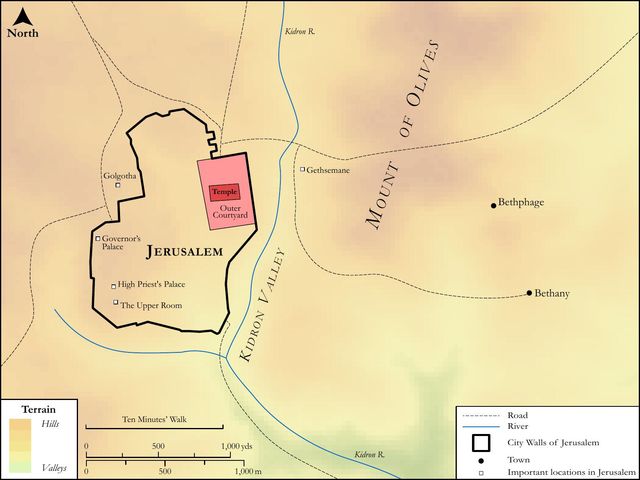
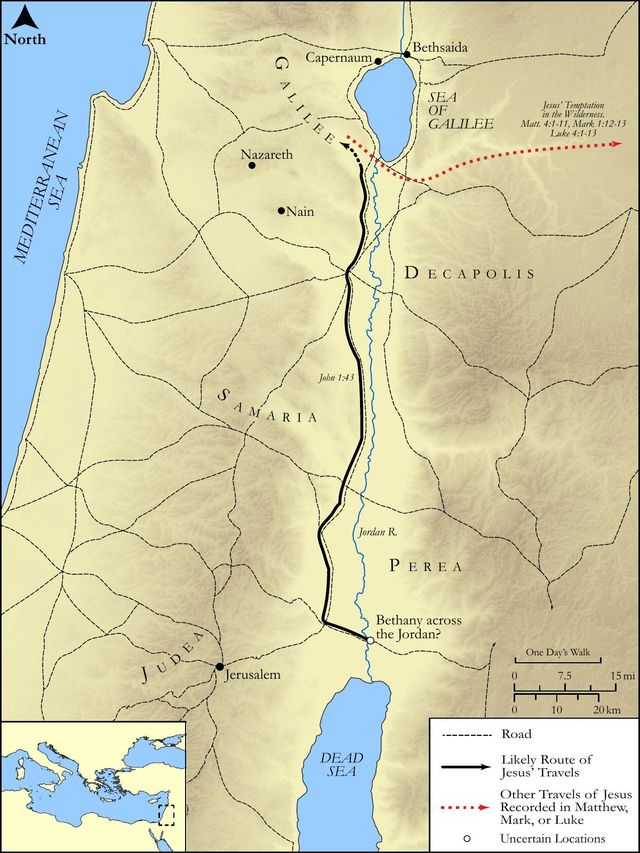
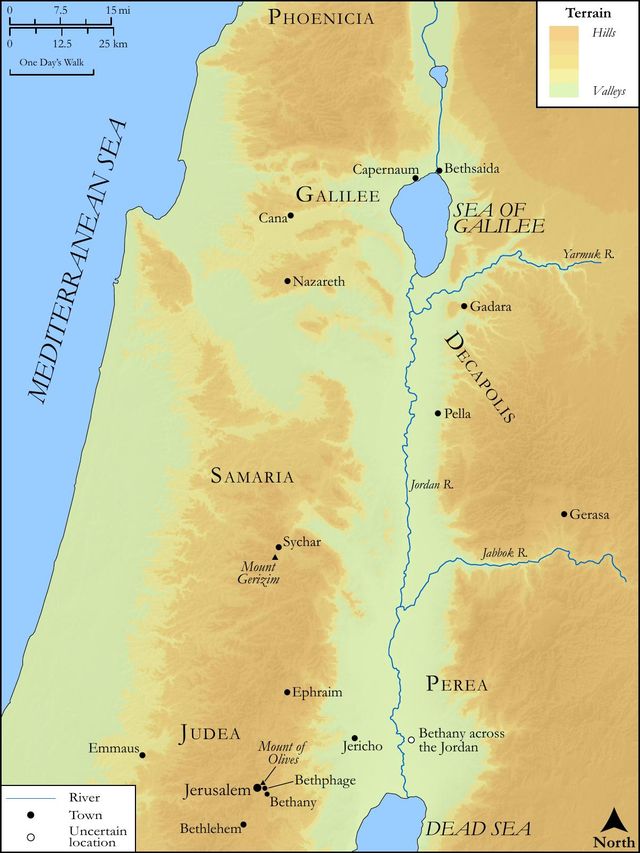
Study this verse
Public-domain commentary
Matthew Henry
From his Commentary on the Whole Bible. Henry comments on passages, not single verses — this entry covers John 1:6–14. His four-level outline is real structure in the source text, so it is rendered as structure.
The evangelist designs to bring in John Baptist bearing an honourable testimony to Jesus Christ, Now in these verses, before he does this,
I.He gives us some account of the witness he is about to produce.
His name was John, which signifies gracious; his conversation was austere, but he was not the less gracious. Now,
1.We are here told concerning him, in general, that he was a man sent of God. The evangelist had said concerning Jesus Christ that he was with God and that he was God; but here concerning John that he was a man, a mere man. God is pleased to speak to us by men like ourselves. John was a great man, but he was a man, a son of man; he was sent from God, he was God's messenger, so he is called, Mal 3:1. God gave him both his mission and his message, both his credentials and his instructions. John wrought no miracle, nor do we find that he had visions and revelations; but the strictness and purity of his life and doctrine, and the direct tendency of both to reform the world, and to revive the interests of God's kingdom among men, were plain indications that he was sent of God.
2.We are here told what his office and business were (Joh 1:7): The same came for a witness, an eye-witness, a leading witness. He came eis marturian - for a testimony. The legal institutions had been long a testimony for God in the Jewish church. By them revealed religion was kept up; hence we read of the tabernacle of the testimony, the ark of the testimony, the law and the testimony: but now divine revelation is to be turned into another channel; now the testimony of Christ is the testimony of God, Co1 1:6; Co1 2:1. Among the Gentiles, God indeed had not left himself without witness (Act 14:17), but the Redeemer had no testimonies borne him among them. There was a profound silence concerning him, till John Baptist came for a witness to him. Now observe,
(1.)The matter of his testimony: He came to bear witness to the light. Light is a thing which witnesses for itself, and carries its own evidence along with it; but to those who shut their eyes against the light it is necessary there should be those that bear witness to it. Christ's light needs not man's testimony, but the world's darkness does. John was like the night watchman that goes round the town, proclaiming the approach of the morning light to those that have closed their eyes, and are not willing themselves to observe it; or like that watchman that was set to tell those who asked him what of the night that the morning comes, and, if you will enquire, enquire ye, Isa 21:11, Isa 21:12. He was sent of God to tell the world that the long-looked-for Messiah was now come, who should be a light to enlighten the Gentiles and the glory of his people Israel; and to proclaim that dispensation at hand which would bring life and immortality to light.
(2.)The design of his testimony: That all men through him might believe; not in him, but in Christ, whose way he was sent to prepare. He taught men to look through him, and pass through him, to Christ; through the doctrine of repentance for sin to that of faith in Christ. He prepared men for the reception and entertainment of Christ and his gospel, by awakening them to a sight and sense of sin; and that, their eyes being thereby opened, they might be ready to admit those beams of divine light which, in the person and doctrine of the Messiah, were now ready to shine in their faces. If they would but receive this witness of man, they would soon find that the witness of God was greater, Jo1 5:9. See Joh 10:41. Observe, it was designed that all men through him might believe, excluding none from the kind and beneficial influences of his ministry that did not exclude themselves, as multitudes did, who rejected the counsel of God against themselves, and so received the grace of God in vain.
3.We are here cautioned not to mistake him for the light who only came to bear witness to it (Joh 1:8): He was not that light that was expected and promised, but only was sent to bear witness of that great and ruling light. He was a star, like that which guided the wise men to Christ, a morning star; but he was not the Sun; not the Bridegroom, but a friend of the Bridegroom; not the Prince, but his harbinger. There were those who rested in John's baptism, and looked no further, as those Ephesians, Act 19:3. To rectify this mistake, the evangelist here, when he speaks very honourably of him, yet shows that he must give place to Christ. He was great as the prophet of the Highest, but not the Highest himself. Note, We must take heed of over-valuing ministers, as well as of under-valuing them; they are not our lords, nor have they dominion over our faith, but ministers by whom we believe, stewards of our Lord's house. We must not give up ourselves by an implicit faith to their conduct, for they are not that light; but we must attend to, and receive, their testimony; for they are sent to bear witness of that light; so then let us esteem them, and not otherwise. Had John pretended to be that light he had not been so much as a faithful witness of that light. Those who usurp the honour of Christ forfeit the honour of being the servants of Christ; yet John was very serviceable as a witness to the light, though he was not that light. Those may be of great use to us who yet shine with a borrowed light.
II.Before he goes on with John's testimony, he returns to give us a further account of this Jesus to whom John bore record.
Having shown in the beginning of the chapter the glories of his Godhead, he here comes to show the graces of his incarnation, and his favours to man as Mediator.
1.Christ was the true Light (Joh 1:9); not as if John Baptist were a false light, but, in comparison with Christ, he was a very small light. Christ is the great light that deserves to be called so. Other lights are but figuratively and equivocally called so: Christ is the true light. The fountain of all knowledge and of all comfort must needs be the true light. He is the true light, for proof of which we are not referred to the emanations of his glory in the invisible world (the beams with which he enlightens that), but to those rays of his light which are darted downwards, and with which this dark world of ours is enlightened. But how does Christ enlighten every man that comes into the world?
(1.)By his creating power he enlightens every man with the light of reason; that life which is the light of men is from him; all the discoveries and directions of reason, all the comfort it gives us, and all the beauty it puts upon us, are from Christ.
(2.)By the publication of his gospel to all nations he does in effect enlighten every man. John Baptist was a light, but he enlightened only Jerusalem and Judea, and the region round about Jordan, like a candle that enlightens one room; but Christ is the true light, for he is a light to enlighten the Gentiles. His everlasting gospel is to be preached to every nation and language, Rev 14:6. Like the sun which enlightens every man that will open his eyes, and receive its light (Psa 19:6), to which the preaching of the gospel is compared. See Rom 10:18. Divine revelation is not now to be confined, as it had been, to one people, but to be diffused to all people, Mat 5:15.
(3.)By the operation of his Spirit and grace he enlightens all those that are enlightened to salvation; and those that are not enlightened by him perish in darkness. The light of the knowledge of the glory of God is said to be in the face of Jesus Christ, and is compared with that light which was at the beginning commanded to shine out of darkness, and which enlightens every man that comes into the world. Whatever light any man has, he is indebted to Christ for it, whether it be natural or supernatural.
2.Christ was in the world, Joh 1:10. He was in the world, as the essential Word, before his incarnation, upholding all things; but this speaks of his being in the world when he took our nature upon him, and dwelt among us; see Joh 16:28. I am come into the world. The Son of the Highest was here in this lower world; that light in this dark world; that holy thing in this sinful polluted world. He left a world of bliss and glory, and was here in this melancholy miserable world. He undertook to reconcile the world to God, and therefore was in the world, to treat about it, and settle that affair; to satisfy God's justice for the world, and discover God's favour to the world. He was in the world, but not of it, and speaks with an air of triumph when he can say, Now I am no more in it, Joh 17:11. The greatest honour that ever was put upon this world, which is so mean and inconsiderable a part of the universe, was that the Son of God was once in the world; and, as it should engage our affections to things above that there Christ is, so it should reconcile us to our present abode in this world that once Christ was here. He was in the world for awhile, but it is spoken of as a thing past; and so it will be said of us shortly, We were in the world. O that when we are here no more we may be where Christ is! Now observe here,
(1.)What reason Christ had to expect the most affectionate and respectful welcome possible in this world; for the world was made by him. Therefore he came to save a lost world because it was a world of his own making. Why should he not concern himself to revive the light that was of his own kindling, to restore a life of his own infusing, and to renew the image that was originally of his own impressing? The world was made by him, and therefore ought to do him homage.
(2.)What cold entertainment he met with, notwithstanding: The world knew him not. The great Maker, Ruler, and Redeemer of the world was in it, and few or none of the inhabitants of the world were aware of it. The ox knows his owner, but the more brutish world did not. They did not own him, did not bid him welcome, because they did not know him; and they did not know him because he did not make himself known in the way that they expected - in external glory and majesty. His kingdom came not with observation, because it was to be a kingdom of trail and probation. When he shall come as a Judge the world shall know him.
3.He came to his own (Joh 1:11); not only to the world, which was his own, but to the people of Israel, that were peculiarly his own above all people; of them he came, among them he lived, and to them he was first sent. The Jews were at this time a mean despicable people; the crown was fallen from their head; yet, in remembrance of the ancient covenant, bad as they were, and poor as they were, Christ was not ashamed to look upon them as his own. Ta idia - his own things; not tous idious - his own persons, as true believers are called, Joh 13:1. The Jews were his, as a man's house, and lands, and goods are his, which he uses and possesses; but believers are his as a man's wife and children are his own, which he loves and enjoys. He came to his own, to seek and save them, because they were his own. He was sent to the lost sheep of the house of Israel, for it was he whose own the sheep were. Now observe,
(1.)That the generality rejected him: His own received him not. He had reason to expect that those who were his own should have bidden him welcome, considering how great the obligations were which they lay under to him, and how fair the opportunities were which they had of coming to the knowledge of him. They had the oracles of God, which told them beforehand when and where to expect him, and of what tribe and family he should arise. He came among them himself, introduced with signs and wonders, and himself the greatest; and therefore it is not said of them, as it was of the world (Joh 1:10), that they knew him not; but his own, though they could not but know him, yet received him not; did not receive his doctrine, did not welcome him as the Messiah, but fortified themselves against him. The chief priests, that were in a particular manner his own (for the Levites were God's tribe), were ring-leaders in this contempt put upon him. Now this was very unjust, because they were his own, and therefore he might command their respect; and it was very unkind and ungrateful, because he came to them, to seek and save them, and so to court their respect. Note, Many who in profession are Christ's own, yet do not receive him, because they will not part with their sins, nor have him to reign over them.
(2.)That yet there was a remnant who owned him, and were faithful to him. Though his own received him not, yet there were those that received him (Joh 1:12): But as many as received him. Though Israel were not gathered, yet Christ was glorious. Though the body of that nation persisted and perished in unbelief, yet there were many of them that were wrought upon to submit to Christ, and many more that were not of that fold. Observe here,
[1.]The true Christian's description and property; and that is, that he receives Christ, and believes on his name; the latter explains the former. Note, First, To be a Christian indeed is to believe on Christ's name; it is to assent to the gospel discovery, and consent to the gospel proposal, concerning him. His name is the Word of God; the King of kings, the Lord our righteousness; Jesus a Saviour. Now to believe on his name is to acknowledge that he is what these great names bespeak him to be, and to acquiesce in it, that he may be so to us. Secondly, Believing in Christ's name is receiving him as a gift from God. We must receive his doctrine as true and good; receive his law as just and holy; receive his offers as kind and advantageous; and we must receive the image of his grace, and impressions of his love, as the governing principle of our affections and actions.
[2.]The true Christian's dignity and privilege are twofold: -
First, The privilege of adoption, which takes them into the number of God's children: To them gave he power to become the sons of God. Hitherto, the adoption pertained to the Jews only (Israel is my son, my first-born); but now, by faith in Christ, Gentiles are the children of God, Gal 3:26. They have power, exousian - authority; for no man taketh this power to himself, but he who is authorized by the gospel charter. To them gave he a right; to them gave he this pre-eminence. This power have all the saints. Note, 1. It is the unspeakable privilege of all good Christians, that they are become the children of God. They were by nature children of wrath, children of this world. If they be the children of God, they become so, are made so Fiunt, non nascuntur Christiani - Persons are not born Christians, but made such. - Tertullian. Behold what manner of love is this, Jo1 3:1. God calls them his children, they call him Father, and are entitled to all the privileges of children, those of their way and those of their home. 2. The privilege of adoption is entirely owing to Jesus Christ; he gave this power to them that believe on his name. God is his Father, and so ours; and it is by virtue of our espousals to him, and union with him, that we stand related to God as a Father. It was in Christ that we were predestinated to the adoption; from him we receive both the character and the Spirit of adoption, and he is the first-born among many brethren. The Son of God became a Son of man, that the sons and daughters of men might become the sons and daughters of God Almighty.
Secondly, The privilege of regeneration (Joh 1:13): Which were born. Note, All the children of God are born again; all that are adopted are regenerated. This real change evermore attends that relative one. Wherever God confers the dignity of children, he creates the nature and disposition of children. Men cannot do so when they adopt. Now here we have an account of the original of this new birth. 1. Negatively. (1.) It is not propagated by natural generation from our parents. It is not of blood, nor of the will of the flesh, nor of corruptible seed, Pe1 1:23. Man is called flesh and blood, because thence he has his original: but we do not become the children of God as we become the children of our natural parents. Note, Grace does not run in the blood, as corruption does. Man polluted begat a son in his own likeness (Gen 5:3); but man sanctified and renewed does not beget a son in that likeness. The Jews gloried much in their parentage, and the noble blood that ran in their veins: We are Abraham's seed; and therefore to them pertained the adoption because they were born of that blood; but this New Testament adoption is not founded in any such natural relation. (2.) It is not produced by the natural power of our own will. As it is not of blood, nor of the will of the flesh, so neither is it of the will of man, which labours under a moral impotency of determining itself to that which is good; so that the principles of the divine life are not of our own planting, it is the grace of God that makes us willing to be his. Nor can human laws or writings prevail to sanctify and regenerate a soul; if they could, the new birth would be by the will of man. But, 2. Positively: it is of God. This new birth is owing to the word of God as the means (Pe1 1:23), and to the Spirit of God as the great and sole author. True believers are born of God, Jo1 3:9; Jo1 5:1. And this is necessary to their adoption; for we cannot expect the love of God if we have not something of his likeness, nor claim the privileges of adoption if we be not under the power of regeneration.
4.The word was made flesh, Joh 1:14. This expresses Christ's incarnation more clearly than what went before. By his divine presence he always was in the world, and by his prophets he came to his own. But now that the fulness of time was come he was sent forth after another manner, made of a woman (Gal 4:4); God manifested in the flesh, according to the faith and hope of holy Job; Yet shall I see God in my flesh, Job 19:26. Observe here,
(1.)The human nature of Christ with which he was veiled; and that expressed two ways.
[1.]The word was made flesh. Forasmuch as the children, who were to become the sons of God, were partakers of flesh and blood, he also himself likewise took part of the same, Heb 2:14. The Socinians agree that Christ is both God and man, but they say that he was man, and was made a God, as Moses (Exo 7:1), directly contrary to John here, who saith, Theos ēn - He was God, but sarxegeneto - He was made flesh. Compare v. 1 with this. This intimates not only that he was really and truly man, but that he subjected himself to the miseries and calamities of the human nature. He was made flesh, the meanest part of man. Flesh bespeaks man weak, and he was crucified through weakness, Co2 13:4. Flesh bespeaks man mortal and dying (Psa 78:39), and Christ was put to death in the flesh Pe1 3:18. Nay, flesh bespeaks man tainted with sin (Gen 6:3), and Christ, though he was perfectly holy and harmless, yet appeared in the likeness of sinful flesh (Rom 8:3), and was made sin for us, Co2 5:21. When Adam had sinned, God said to him, Dust thou art; not only because made out of the dust, but because by sin he was sunk into dust. His fall did, sōmatoun tēn psuchēn, turn him as it were all into body, made him earthly; therefore he that was made a curse for us was made flesh, and condemned sin in the flesh, Rom 8:3. Wonder at this, that the eternal Word should be made flesh, when flesh was come into such an ill name; that he who made all things should himself be made flesh, one of the meanest things, and submit to that from which he was at the greatest distance. The voice that ushered in the gospel cried, All flesh is grass (Isa 40:6), to make the Redeemer's love the more wonderful, who, to redeem and save us, was made flesh, and withered as grass; but the Word of the Lord, who was made flesh, endures for ever; when made flesh, he ceased not to be the Word of God.
[2.]He dwelt among us, here in this lower world. Having taken upon him the nature of man, he put himself into the place and condition of other men. The Word might have been made flesh, and dwelt among the angels; but, having taken a body of the same mould with ours, in it he came, and resided in the same world with us. He dwelt among us, us worms of the earth, us that he had no need of, us that he got nothing by, us that were corrupt and depraved, and revolted from God. The Lord God came and dwelt even among the rebellious, Psa 68:18. He that had dwelt among angels, those noble and excellent beings, came and dwelt among us that are a generation of vipers, us sinners, which was worse to him than David's swelling in Mesech and Kedar, or Ezekiel's dwelling among scorpions, or the church of Pergamus dwelling where Satan's seat is. When we look upon the upper world, the world of spirits, how mean and contemptible does this flesh, this body, appear, which we carry about with us, and this world in which our lot is cast, and how hard is it to a contemplative mind to be reconciled to them! But that the eternal Word was made flesh, was clothed with a body as we are, and dwelt in this world as we do, this has put an honour upon them both, and should make us willing to abide in the flesh while God has any work for us to do; for Christ dwelt in this lower world, bad as it is, till he had finished what he had to do here, Joh 17:4. He dwelt among the Jews, that the scripture might be fulfilled, He shall dwell in the tents of Shem, Gen 9:27. And see Zac 2:10. Though the Jews were unkind to him, yet he continued to dwell among them; though (as some of the ancient writers tell us) he was invited to better treatment by Abgarus king of Edessa, yet he removed not to any other nation. He dwelt among us. He was in the world, not as a wayfaring man that tarries but for a night, but he dwelt among us, made a long residence, the original word is observable, eskēnōsen en hēmin - he dwelt among us, he dwelt as in a tabernacle, which intimates, First, That he dwelt here in very mean circumstances, as shepherds that dwell in tents. He did not dwell among us as in a palace, but as in a tent; for he had not where to lay his head, and was always upon the remove. Secondly, That his state here was a military state. Soldiers dwell in tents; he had long since proclaimed war with the seed of the serpent, and now he takes the field in person, sets up his standard, and pitches his tent, to prosecute this war. Thirdly, That his stay among us was not to be perpetual. He dwelt here as in a tent, not as at home. The patriarchs, by dwelling in tabernacles, confessed that they were strangers and pilgrims on earth, and sought the better country, and so did Christ, leaving us an example, Heb 13:13, Heb 13:14. Fourthly, That as of old God dwelt in the tabernacle of Moses, by the shechinah between the cherubim, so now he dwells in the human nature of Christ; that is now the true shechinah, the symbol of God's peculiar presence. And we are to make all our addresses to God through Christ, and from him to receive divine oracles.
(2.)The beams of his divine glory that darted through this veil of flesh: We beheld his glory, the glory as of the only begotten of the Father, full of grace and truth. The sun is still the fountain of light, though eclipsed or clouded; so Christ was still the brightness of his Father's glory, even when he dwelt among us in this lower world. And how slightly soever the Jews thought of him there were those that saw through the veil. Observe,
[1.]Who were the witnesses of this glory: we, his disciples and followers, that conversed most freely and familiarly with him; we among whom he dwelt. Other men discover their weaknesses to those that are most familiar with them, but it was not so with Christ; those that were most intimate with him saw most of his glory. As it was with his doctrine, the disciples knew the mysteries of it, while others had it under the veil of parables; so it was with his person, they saw the glory of his divinity, while others saw only the veil of his human nature. He manifested himself to them, and not unto the world. These witnesses were a competent number, twelve of them, a whole jury of witnesses; men of plainness and integrity, and far from any thing of design or intrigue.
[2.]What evidence they had of it: We saw it. They had not their evidence by report, at second hand, but were themselves eye-witnesses of those proofs on which they built their testimony that he was the Son of the living God: We saw it. The word signifies a fixed abiding sight, such as gave them an opportunity of making their observations. This apostle himself explains this: What we declare unto you of the Word of life is what we have seen with our eyes, and what we have looked upon, Jo1 1:1.
[3.]What the glory was: The glory as of the only begotten of the Father. The glory of the Word made flesh was such a glory as became the only begotten Son of God, and could not be the glory of any other. Note, First, Jesus Christ is the only begotten of the Father. Believers are the children of God by the special favour of adoption and the special grace of regeneration. They are in a sense homoiousioi - of a like nature (Pe2 1:4), and have the image of his perfections; but Christ is homousios - of the same nature, and is the express image of his person, and the Son of God by an eternal generation. Angels are sons of God, but he never said to any of them, This day have I begotten thee, Heb 1:5. Secondly, He was evidently declared to be the only begotten of the Father, by that which was seen of his glory when he dwelt among us. Though he was in the form of a servant, in respect of outward circumstances, yet, in respect of graces, his form was as that of the fourth in the fiery furnace, like the Son of God. His divine glory appeared in the holiness and heavenliness of his doctrine; in his miracles, which extorted from many this acknowledgment, that he was the Son of God; it appeared in the purity, goodness, and beneficence, of his whole conversation. God's goodness is his glory, and he went about doing good; he spoke and acted in every thing as an incarnate Deity. Perhaps the evangelist had a particular regard to the glory of his transfiguration, of which he was an eye-witness; see Pe2 1:16-18. God's calling him his beloved Son, in whom he was well pleased, intimated that he was the only begotten of the Father; but the full proof of this was at his resurrection.
[4.]What advantage those he dwelt among had from this. He dwelt among them, full of grace and truth. In the old tabernacle wherein God dwelt was the law, in this was grace; in that were types, in this was truth. The incarnate Word was every way qualified for his undertaking as Mediator; for he was full of grace and truth, the two great things that fallen man stands in need of; and this proved him to be the Son of God as much as the divine power and majesty that appeared in him. First, He has a fulness of grace and truth for himself; he had the Spirit without measure. He was full of grace, fully acceptable to his Father, and therefore qualified to intercede for us; and full of truth, fully apprized of the things he was to reveal, and therefore fit to instruct us. He had a fulness of knowledge and a fulness of compassion. Secondly, He has a fulness of grace and truth for us. He received, that he might give, and God was well pleased in him, that he might be well pleased with us in him; and this was the truth of the legal types.
Historical interpretation
Eight Centuries of Reception
12 surviving comments on this verse. Each one is dated, so this reads as a timeline rather than a list.
Select a marker to jump to its quote. Markers stagger vertically where authors wrote within a few decades of each other.
But what matters of deep moment are contained in the Lord's prayer! How many and! How great, briefly collected in the words, but spiritually abundant in virtue! so that there is absolutely nothing passed over that is not comprehended in these our prayers and petitions, as in a compendium of heavenly doctrine. "After this manner," says He, "pray ye: Our Father, which art in heaven." The new man, born again and restored to his God by His grace, says "Father," in the first place because he has now begun to be a son. "He came," He says, "to His own, and His own received Him not. But as many as received Him, to them gave He power to become the sons of God, even to them that believe in His name." The man, therefore, who has believed in His name, and has become God's son, ought from this point to begin both to give thanks and to profess himself God's son, by declaring that God is his Father in heaven; and also to bear witness, among the very first words of his new birth, that he has renounced an earthly and carnal father, and that he has begun to know as well as to have as a father Him only who is in heaven, as it is written: "They who say unto their father and their mother, I have not known thee, and who have not acknowledged their own children these have observed Thy precepts and have kept Thy covenant. Also the Lord in His Gospel has bidden us to call "no man our father upon earth, because there is to us one Father, who is in heaven." And to the disciple who had made mention of his dead father, He replied, "Let the dead bury their dead; " for he had said that his father was dead, while the Father of believers is living.
That it was previously foretold that they would neither know the Lord, nor understand, nor receive Him. In Isaiah: "Hear, O heaven, and give ear, O earth: for the Lord hath spoken; I have begotten and brought up children, but they have rejected me. The ox knoweth his owner, and the ass his master's crib: but Israel hath not known me, and my people hath not perceived me. Ah sinful nation, a people filled with sins, a wicked seed, corrupting children: ye have forsaken the Lord, and have sent that Holy One of Israel into anger." In the same also the Lord says: "Go and tell this people, Ye shall hear with the ear, and shall not understand; and seeing, ye shall see, and shall not perceive. For the heart of this people hath waxed gross, and they hardly hear with their ears, and they have shut up their eyes, lest haply they should see with their eyes, and hear with their ears, and understand with their heart, and should return, and I should heal them." Also in Jeremiah the Lord says: "They have forsaken me, the fountain of living water, and have dug for themselves worn-out cisterns, which could not hold water." Moreover, in the same: "Behold, the word of the Lord has become unto them a reproach, and they do not wish for it." Again in the same the Lord says: "The kite knoweth his time, the turtle, and the swallow; the sparrows of the field keep the time of their coining in; but my people doth not know the judgment of the Lord. How say ye, We are wise, and the law of the Lord is with us? The false measurement has been made vain; the scribes are confounded the wise men have trembled, and been taken, because they have rejected the word of the Lord." In Solomon also: "Evil men seek me, and shall not find me; for they held wisdom in hatred and did not receive the word of the Lord." Also in the twenty-seventh Psalm: "Render to them their deserving, because they have not perceived in the works of the Lord." Also in the eighty-first Psalm: "They have not known, neither have they understood; they shall walk on in darkness." In the Gospel, too, according to John: "He came unto His own, and His own received Him not. As many as received Him, to them gave He power to become the sons of God who believe on His name."
Unspeakable of a truth are the riches of the goodness of God, and passing all excess. Consider; "He came to His own," not for His personal need, (for, as I said, the Divinity is without wants,) but to do good unto His own people. Yet not even so did His own receive Him, when He came to His own for their advantage, but repelled Him, and not this only, but they even cast Him out of the vineyard, and slew Him. Yet not for this even did He shut them out from repentance, but granted them, if they had been willing, after such wickedness as this, to wash off all their transgressions by faith in Him, and to be made equal to those who had done no such thing, but are His especial friends.
"He came to His own, and His own received Him not." Whence came He, who filleth all things, and who is everywhere present? What place did He empty of His presence, who holdeth and graspeth all things in His hand? He exchanged not one place for another; how should He? But by His coming down to us He effected this. For since, though being in the world, He did not seem to be there, because He was not yet known, but afterwards manifested Himself by deigning to take upon Him our flesh, he (St. John) calls this manifestation and descent "a coming."
(Hom. viii. c. 8. 56.) But they who were the friends of God, knew Him even before His presence in the body; whence Christ saith below, Your father Abraham rejoiced to see My day. When the Gentiles then interrupt us with the question, Why has He come in these last times to work our salvation, having neglected us so long? we reply, that He was in the world before, superintending what He had made, and was known to all who were worthy of Him; and that, if the world knew Him not, those of whom the world was not worthy knew Him. The reason follows, why the world knew Him not. The Evangelist calls those men the world, who are tied to the world, and savour of worldly things; for there is nothing that disturbs the mind so much, as this melting with the love of present things.
(Hom. in Joan. ix. 1) When He said that the world knew Him not, he referred to the times of the old dispensation, but what follows has reference to the time of his preaching; He came unto his own.
(Hom. x. [ix.] 2) He came then unto His own, not for His own good, but for the good of others. But whence did He Who fills all things, and is every where present, come? He came out of condescension to us, though in reality He had been in the world all along. But the world not seeing Him, because it knew Him not, He deigned to put on flesh. And this manifestation and condescension is called His advent. But the merciful God so contrives His dispensations, that we may shine forth in proportion to our goodness, and therefore He will not compel, but invites men, by persuasion and kindness, to come of their own accord: and so, when He came, some received Him, and others received Him not. He desires not an unwilling and forced service; for no one who comes unwillingly devotes himself wholly to Him. Whence what follows, And his own received him not. (Hom. ix. [viii.] 1). He here calls the Jews His own, as being his peculiar people; as indeed are all men in some sense, being made by Him. And as above, to the shame of our common nature, he said, that the world which was made by Him, knew not its Maker: so here again, indignant at the ingratitude of the Jews, he brings a heavier charge, viz. that His own received Him not.
One might wonder at the disciple who is not ashamed of the dishonor of his Teacher, but even records the insolence which was used towards Him: yet this is no small proof of his truth-loving disposition. And besides, he who feels shame should feel it for those who have offered an insult, not for the person outraged. Indeed He by this very thing shone the brighter, as taking, even after the insult, so much care for those who had offered it; while they appeared ungrateful and accursed in the eyes of all men, for having rejected Him who came to bring them so great goods, as hateful to them, and an enemy.
For they, being ignorant of God's righteousness and going about to establish their own righteousness, have not submitted themselves unto the righteousness of God. Wherefore they have suffered this. And again, explaining the same matter in other terms, he says, What shall we say then? That the Gentiles which followed not after righteousness, have attained unto righteousness, even the righteousness which is of faith; but Israel, which followed after the law of righteousness, hath not attained to the law of righteousness. Wherefore? Because they sought it not by faith. For they stumbled at that stumbling stone. His meaning is this: These men's unbelief has been the cause of their misfortunes, and their haughtiness was parent of their unbelief. For when having before enjoyed greater privileges than the heathen, through having received the law, through knowing God, and the rest which Paul enumerates, they after the coming of Christ saw the heathen and themselves called on equal terms through faith, and after faith received one of the circumcision in nothing preferred to the Gentile, they came to envy and were stung by their haughtiness, and could not endure the unspeakable and exceeding lovingkindness of the Lord. So this has happened to them from nothing else but pride, and wickedness, and unkindness.
He came to His own, and His own received Him not, now calling the Jews "His own," as His peculiar people, or perhaps even all mankind, as created by Him. And as above, when perplexed at the folly of the many, and ashamed of our common nature, he said that "the world by Him was made," and having been made, did not recognize its Maker; so here again, being troubled beyond bearing at the stupidity of the Jews and the many, he sets forth the charge in a yet more striking manner, saying, that "His own received Him not," and that too when "He came to them."
For it is a thing indeed worthy of our amazement, how they who were nurtured in knowledge of the prophetical books, who heard Moses every day telling them ten thousand things concerning the coming of the Christ, and the other prophets afterwards, who moreover themselves beheld Christ Himself daily working miracles among them, giving up His time to them alone, neither as yet allowing His disciples to depart into the way of the Gentiles, or to enter into a city of Samaritans, nor doing so Himself, but everywhere declaring that He was sent to the lost sheep of the house of Israel: how, I say, while they saw the signs, and heard the Prophets, and had Christ Himself continually putting them in remembrance, they yet made themselves once for all so blind and dull, as by none of these things to be brought to faith in Christ.
"He came unto His own,"-because all these things were made by Him,-"and His own received Him not." Who are they? The men whom He made. The Jews whom He at the first made to be above all nations. Because other nations worshipped idols and served demons; but that people was born of the seed of Abraham, and in an eminent sense His own, because kindred through that flesh which He deigned to assume. "He came unto His own, and His own received Him not." Did they not receive Him at all? Did no one receive Him? Was there no one saved? For no one shall be saved unless he who shall have received the coming Christ.
The Evangelist pursues his plea that the world did not know its illuminator, that is, the Only Begotten, and from the worse sin of the children of Israel, he hurries to clench the charges against the Gentiles and shows the disease of ignorance alike and unbelief that lay upon the whole world.… For it was not surprising that the world did not know the Only Begotten, he says, seeing that it had left the understanding that befits humanity and was ignorant that it is and was made in honor, being compared with the beasts that perish, as the divine psalmist also said. It also was not surprising that the very people who, above all, were supposed to belong to him rejected him when he was present in the flesh. They would not receive him when he came among them for a salvation that was offered to all, rewarding their faith with the kingdom of heaven. But observe how exact his language is about these things. For he accuses the world of having no idea of the one who enlightens it, elaborating for it a pardon so to speak just on this account and preparing beforehand reasonable causes for the grace given to it. But of those of Israel who were considered among those especially belonging to him, he says they “received him not.” For it would not have been true to say “knew him not,” when the older law had preached about him and the prophets who came after led them by the hand to the apprehension of the truth.…For the world, or the Gentiles, having lost their relation … with God through their downfall into evil, also lost the knowledge of him who enlightens them. But the others, who were rich in knowledge through the law and called to a governance pleasing to God, were at length voluntarily falling away from it, not receiving the Word of God who was already known to them and who came among them as to his own. For the whole world is God’s own, in regard to its creation, and its very existence comes from him and through him. But Israel will more rightly be called his own and will gain the glory both because of the election of the holy patriarchs and because he [i.e., Israel] was named the beginning and the firstborn of the children of God. For “Israel is my son, my firstborn,” says God somewhere to Moses.… But when [Christ] was not received, he transfers the grace to the Gentiles. And the world, which knew him not at the beginning, is enlightened through repentance and faith, whereas Israel returns to the darkness it came from.
Here the Evangelist clearly begins his account of the divine economy of the Incarnation. The whole thread of what he says is this: the true Light was already in the world without flesh, and was not recognized. Then He came in the flesh unto His own. By His own you may understand either the whole world, or the Jews, whom He had chosen as the line of His inheritance, His portion, and His own possession. And His own received Him not, neither the Jews, nor the rest of mankind, who had been created by Him. Here the Evangelist bewails man’s madness, and marvels at the Master’s love for mankind. Although they are His very own, not all received Him. For the Lord draws no one to Himself by force, but by a man’s own will and choice.
Continue studying John 1:11 across the web’s major study libraries — every link below opens this exact verse, chapter, or book on the destination site.
Read & Compare
 BibleGatewayThis verse in more than 200 translations and 70 languages.
 Bible.comThe YouVersion reader — hundreds of translations, reading plans, and highlights.
 ESV.orgCrossway's official English Standard Version reader.
 NET BibleThe NET translation with 60,000+ translators' notes on every rendering decision.
 STEP BibleTyndale House's free study tool — original text, vocabulary, and scholarly resources.
 BibliaLogos Bible Software's free web reader.
 USCCBThe New American Bible (Revised Edition) with the U.S. bishops' study notes.
Commentaries
 BibleHub CommentariesDozens of classic commentaries on this verse, gathered on one page.
 StudyLightMore than 100 commentary sets — the largest collection on the web.
 BibleRefPlain-English commentary on what this verse means, verse by verse.
 Enduring WordDavid Guzik's free commentary on this chapter, widely used by Bible teachers.
 Bible Study ToolsVerse commentary alongside Greek and Hebrew study aids.
Original Language & Research
- BibleHub InterlinearThe verse word by word — original language, transliteration, and English.
- BibleHub LexiconEvery word's original-language definition and Strong's entry.
 Blue Letter BibleDeep-study tools — Strong's numbers, concordance, and word studies.
 CNTR CollationThe earliest Greek manuscripts of this verse, collated letter by letter.
Sermons, Hymns & Audio


TrulyRandomVerse is not affiliated with these sites and doesn’t control their content. They’re linked because they’re genuinely useful.
Summary
John 1:11 profoundly captures the tragic irony of Christ's incarnation: the eternal Word, who created and sustains all things, entered the world He made, specifically coming to His chosen people, Israel. Yet, despite His divine origin and their long-awaited hope for a Messiah, "His own"—those who should have recognized and welcomed Him—deliberately rejected Him, setting the stage for the broader offer of salvation to all who would believe.
Context
ShowHideLiterary Context
This verse serves as a pivotal transition within the Prologue of John's Gospel (John 1:1-18). Following the majestic declarations of Jesus as the pre-existent Word (Logos), the Life, and the True Light shining into the darkness, John 1:11 shifts from eternal and abstract truths to the concrete reality of His earthly arrival and reception. It immediately precedes the glorious counterpoint in John 1:12-13, which highlights the privilege granted to those who do receive Him, contrasting sharply with the rejection described here. The progression moves from universal revelation to specific, personal response, emphasizing the critical choice humanity faced and continues to face regarding Jesus.
Historical & Cultural Context
The phrase "His own" carries deep historical and cultural weight. Primarily, it refers to the nation of Israel, God's covenant people, whom He had chosen, nurtured, and prepared for centuries for the coming of the Messiah. Through the Mosaic Law, the prophets, and the temple system, God had established a unique relationship with Israel, promising a deliverer from the line of David. The Jewish people, therefore, were "His own" in a profound, intimate sense, having received divine revelation and a clear expectation of the Messiah's advent. Their land, their traditions, and their very identity were interwoven with the anticipation of God's direct intervention. The rejection described in this verse is not merely a general human failing but a specific, heartbreaking refusal by those who had been uniquely positioned to welcome their long-awaited King.
Key Themes
ShowHideJohn 1:11 encapsulates several foundational themes of the Gospel. It underscores the Divine Incarnation and Humility, revealing the Creator entering His creation in vulnerability, only to be spurned. This highlights the profound Tragedy of Unbelief and Rejection, particularly by those most privileged to receive God's revelation. It also reinforces the theme of Light vs. Darkness, echoing John 1:5, where the darkness "did not comprehend" or "overcome" the light. Here, the darkness actively refuses the light. Furthermore, it subtly introduces the theme of Sovereignty and Human Choice, demonstrating that while God's plan unfolds, human beings retain the capacity for willful rejection, even of divine truth. This rejection, however, paradoxically paves the way for a broader, more inclusive salvation, as seen in John 1:12.
Exposition and Analysis
ShowHideKey Word Analysis
ShowHideThis verb signifies a purposeful arrival, a deliberate act of coming into a specific place or situation. It is not an accidental or passive appearance but an active, intentional movement. In the context of Jesus, it emphasizes His voluntary condescension from His pre-existent glory to enter human history and dwell among humanity.
This word is crucial for understanding the dual layer of rejection. In the first instance ("He came unto his own"), the Greek is ta idia, referring to "His own things" or "His own home/country" – signifying the world He created, the realm of His dominion. In the second instance ("and his own received him not"), the Greek is hoi idioi, referring to "His own people" or "His own family" – specifically, the nation of Israel, God's chosen covenant people. This distinction highlights both the universal rejection by creation and the more poignant, specific rejection by His beloved people.
This verb implies more than mere intellectual acknowledgment; it means "to take near," "to welcome," "to accept into fellowship or intimacy." It suggests a deliberate act of embracing, acknowledging, and associating with. The negative "received him not" (ou parelabon) therefore denotes an active, conscious refusal to welcome, acknowledge, or accept Jesus' person and claims, rather than a simple lack of understanding or passive ignorance. It signifies a deliberate act of exclusion.
Verse Breakdown
ShowHide"He came unto his own"
This clause describes the Incarnation, the divine Son's arrival into the world. "His own" first refers to the entire created order, as Jesus is the Creator of all things (John 1:3). More specifically and poignantly, it refers to Israel, the people God had chosen as His special possession, to whom He gave His law and prophets, and from whom the Messiah was prophesied to come. This highlights the intimate connection Jesus had with those He approached.
"and his own received him not"
This second clause reveals the tragic outcome of His arrival. Despite His identity as Creator and Messiah, and despite coming to the very people prepared for Him, they did not welcome or accept Him. The refusal was not due to ignorance but a deliberate choice, a rejection of His person, His claims, and the salvation He offered. This sets up the dramatic contrast with the next verse, which speaks of those who did receive Him.
Literary Devices
ShowHideJohn 1:11 is rich with Irony. The ultimate irony lies in the Creator coming to His creation, and the King coming to His kingdom, only to be rejected by those who should have been most eager to welcome Him. This is a profound reversal of expectation. There is also strong Antithesis or Contrast at play, setting up a stark opposition between "He came unto his own" (an act of divine love and condescension) and "his own received him not" (an act of human rebellion and rejection). This contrast emphasizes the profound tragedy of the situation and underscores the theme of light rejected by darkness, which permeates the Prologue. The use of the repeated phrase "his own" (first referring to His domain, then to His people) also functions as a subtle form of Parallelism with a deepening sense of sorrow, moving from a general rejection by creation to a specific, more painful rejection by His chosen people.
Theological and Thematic Connections
ShowHideJohn 1:11 is a theological cornerstone, revealing the depth of human depravity and the profound nature of divine love. It underscores that God's presence and truth are not automatically embraced, even by those with the most exposure to divine revelation. The rejection of Jesus by "His own" highlights the pervasive nature of sin, which blinds individuals and even a chosen nation to the very light and life offered by God. This rejection, while tragic, was also part of God's sovereign plan, ultimately paving the way for the inclusion of Gentiles into the family of God, demonstrating that salvation is not based on national identity or lineage but on personal faith in Christ. It foreshadows the broader narrative of the New Testament, where the Gospel, initially offered to the Jews, extends to the ends of the earth.
Reflection and Application
ShowHideJohn 1:11 challenges us to deeply consider our own response to Jesus Christ. Just as "His own" failed to recognize and receive Him, we too can be susceptible to spiritual blindness, allowing familiarity, preconceived notions, or worldly distractions to prevent us from truly embracing Him. This verse serves as a sober reminder that merely being exposed to Christian teaching or belonging to a religious community does not guarantee genuine reception of Christ. Receiving Jesus means more than intellectual assent; it involves a radical surrender, a welcoming of His lordship into every area of our lives, and a belief in His name that transforms our identity and purpose. It calls for an open heart, a willingness to relinquish control, and a humble submission to the One who is the very source of life and light. The question for us today is not just "Do I know about Jesus?" but "Have I truly received Him?" Are there areas in our lives where we, like "His own," are still resisting His transformative presence and truth?
Questions for Reflection
ShowHideFAQ
ShowHideWhy did "His own" reject Jesus, especially since they were God's chosen people?
ShowHideThe rejection of Jesus by "His own" (primarily Israel) was complex, stemming from a combination of factors. Many held political and nationalistic expectations of the Messiah, envisioning a conquering king who would liberate them from Roman rule, rather than a suffering servant who would establish a spiritual kingdom. Their understanding of the Law had often become legalistic and external, leading to spiritual pride and a resistance to Jesus' radical teachings on grace, humility, and inner transformation. Furthermore, the religious leaders, in particular, felt threatened by Jesus' authority, His claims to divinity, and His challenge to their established traditions and power structures. This spiritual blindness and hardened hearts, despite centuries of divine preparation, ultimately led to their tragic rejection of the very One they had awaited. This is a recurring theme in the Gospels, such as when Jesus laments over Jerusalem in Matthew 23:37.
Christ-Centered Fulfillment
ShowHideThe poignant rejection of Jesus by "His own" in John 1:11 is not the final word but a crucial, if painful, step in God's redemptive plan, ultimately fulfilled in Christ. While Israel's rejection was a profound tragedy, it paradoxically opened the door for the Gospel to extend beyond the confines of a single nation. This rejection, though not God's ideal, allowed for the broader inclusion of Gentiles, demonstrating that salvation is not predicated on ethnic lineage but on faith in Jesus Christ, as beautifully articulated in Romans 11:11-12. Jesus, the rejected cornerstone, became the head of a new spiritual house, composed of all who believe, Jew or Gentile, fulfilling prophecies of a universal kingdom (Psalm 118:22 and 1 Peter 2:7-8). His crucifixion, the ultimate act of rejection, became the means of atonement, allowing all who receive Him to become children of God (John 1:12) and inherit eternal life. Thus, the very act of rejection by "His own" was woven into the tapestry of God's sovereign plan to bring about a more expansive, grace-filled salvation for all humanity through the finished work of Christ.