


John 1:3
Bible text: King James Version (1769 Blayney text) · Public domain
Bible text: Berean Standard Bible · Public domain
Bible text: American Standard Version (1901) · Public domain
Bible text: World English Bible, Messianic edition · Public domain
Bible text: Geneva Bible (1599) · Public domain
Bible text: Young's Literal Translation · Public domain
- πάνταpantaAll thingsG3956A-NPNAdjective Nominative Plural Neuter
- δι᾽di᾽throughG1223PREPPreposition
- αὐτοῦautouHimG846P-GSMPersonal pronoun Genitive Singular Masculine
- ἐγένετοegenetocame into beingG1096V-2ADI-3SVerb 2nd Aorist Middle Deponent Indicative 3rd Singular
- καὶkaiandG2532CONJConjunction
- χωρὶςchōriswithoutG5565PREPPreposition
- αὐτοῦautouHimG846P-GSMPersonal pronoun Genitive Singular Masculine
- ἐγένετοegenetocame into beingG1096V-2ADI-3SVerb 2nd Aorist Middle Deponent Indicative 3rd Singular
- οὐδὲoudenot evenG3761CONJ-NConjunction Negative
- ἓνhenone [thing]G1520A-NSNAdjective Nominative Singular Neuter
- ὃhothatG3739R-NSNRelative pronoun Nominative Singular Neuter
- γέγονενgegonenhas come into beingG1096V-2RAI-3SVerb 2nd Perfect Active Indicative 3rd Singular
English is a literal word-by-word gloss of the Greek, not the KJV's wording. Why?
This is the original text the KJV's translators worked from — each Greek word with its own literal English meaning in this verse, prepared by scholars at Tyndale House, Cambridge. The KJV translates whole sentences, not word by word, so its wording differs: one Greek word can become several English words, and the KJV may choose “charity” where the gloss reads “love”. Both are faithful — they answer different questions. For the KJV's own rendering, switch to the KJV text.
Details
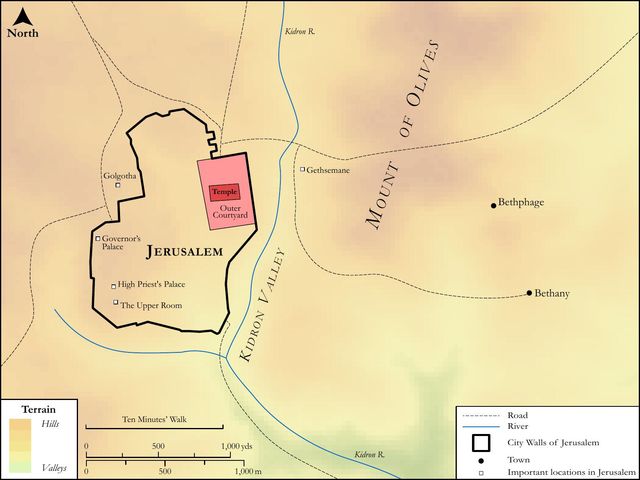
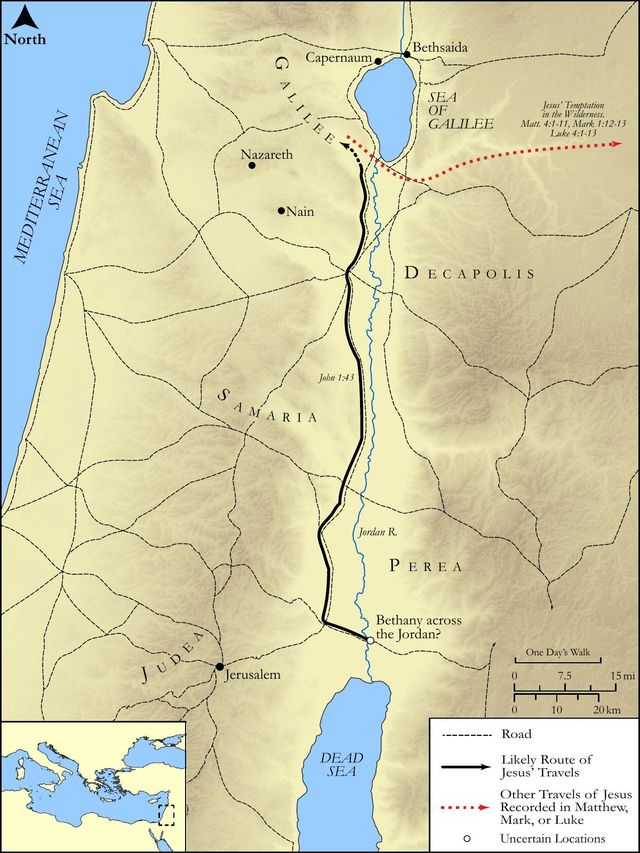
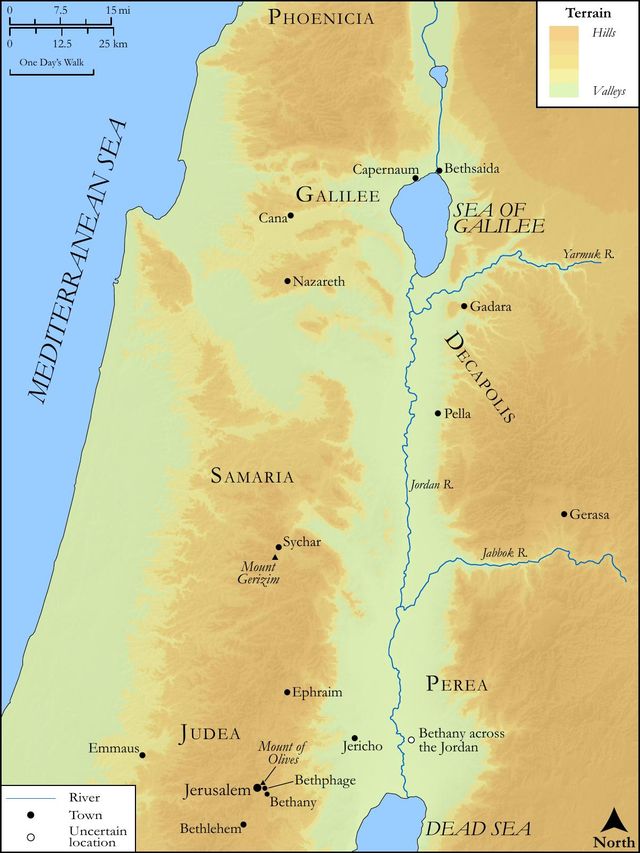
See on the biblical-era maps
Study this verse
Public-domain commentary
Matthew Henry
From his Commentary on the Whole Bible. Henry comments on passages, not single verses — this entry covers John 1:1–5. His four-level outline is real structure in the source text, so it is rendered as structure.
Austin says (de Civitate Dei, lib. 10, cap. 29) that his friend Simplicius told him he had heard a Platonic philosopher say that these first verses of St. John's gospel were worthy to be written in letters of gold. The learned Francis Junius, in the account he gives of his own life, tells how he was in his youth infected with loose notions in religion, and by the grace of God was wonderfully recovered by reading accidentally these verses in a bible which his father had designedly laid in his way. He says that he observed such a divinity in the argument, such an authority and majesty in the style, that his flesh trembled, and he was struck with such amazement that for a whole day he scarcely knew where he was or what he did; and thence he dates the beginning of his being religious. Let us enquire what there is in those strong lines. The evangelist here lays down the great truth he is to prove, that Jesus Christ is God, one with the Father. Observe,
I.Of whom he speaks - The Word - ho logos.
This is an idiom peculiar to John's writings. See Jo1 1:1; Jo1 5:7; Rev 19:13. Yet some think that Christ is meant by the Word in Act 20:32; Heb 4:12; Luk 1:2. The Chaldee paraphrase very frequently calls the Messiah Memra - the Word of Jehovah, and speaks of many things in the Old Testament, said to be done by the Lord, as done by that Word of the Lord. Even the vulgar Jews were taught that the Word of God was the same with God. The evangelist, in the close of his discourse (Joh 1:18), plainly tells us why he calls Christ the Word - because he is the only begotten Son, who is in the bosom of the Father, and has declared him. Word is two-fold: logos endiathetos - word conceived; and logos prophorikos - word uttered. The logos ho esō and ho exō, ratio and oratio - intelligence and utterance.
1.There is the word conceived, that is, thought, which is the first and only immediate product and conception of the soul (all the operations of which are performed by thought), and it is one with the soul. And thus the second person in the Trinity is fitly called the Word; for he is the first-begotten of the Father, that eternal essential Wisdom which the Lord possessed, as the soul does its thought, in the beginning of his way, Pro 8:22. There is nothing we are more sure of than that we think, yet nothing we are more in the dark about than how we think; who can declare the generation of thought in the soul? Surely then the generations and births of the eternal mind may well be allowed to be great mysteries of godliness, the bottom of which we cannot fathom, while yet we adore the depth.
2.There is the word uttered, and this is speech, the chief and most natural indication of the mind. And thus Christ is the Word, for by him God has in these last days spoken to us (Heb 1:2), and has directed us to hear him, Mat 17:5. He has made known God's mind to us, as a man's word or speech makes known his thoughts, as far as he pleases, and no further. Christ is called that wonderful speaker (see notes on Dan 8:13), the speaker of things hidden and strange. He is the Word speaking from God to us, and to God for us. John Baptist was the voice, but Christ the Word: being the Word, he is the Truth, the Amen, the faithful Witness of the mind of God.
II.What he saith of him, enough to prove beyond contradiction that he is God. He asserts,
1.His existence in the beginning: In the beginning was the Word. This bespeaks his existence, not only before his incarnation, but before all time. The beginning of time, in which all creatures were produced and brought into being, found this eternal Word in being. The world was from the beginning, but the Word was in the beginning. Eternity is usually expressed by being before the foundation of the world. The eternity of God is so described (Psa 90:2), Before the mountains were brought forth. So Pro 8:23. The Word had a being before the world had a beginning. He that was in the beginning never began, and therefore was ever, achronos - without beginning of time. So Nonnus.
2.His co-existence with the Father: The Word was with God, and the Word was God. Let none say that when we invite them to Christ we would draw them from God, for Christ is with God and is God; it is repeated in Joh 1:2 : the same, the very same that we believe in and preach, was in the beginning with God, that is, he was so from eternity. In the beginning the world was from God, as it was created by him; but the Word was with God, as ever with him. The Word was with God,
(1.)In respect of essence and substance; for the Word was God: a distinct person or substance, for he was with God; and yet the same in substance, for he was God, Heb 1:3.
(2.)In respect of complacency and felicity. There was a glory and happiness which Christ had with God before the world was (Joh 17:5), the Son infinitely happy in the enjoyment of his Father's bosom, and no less the Father's delight, the Son of his love, Pro 8:30.
(3.)In respect of counsel and design. The mystery of man's redemption by this Word incarnate was hid in God before all worlds, Eph 3:9. He that undertook to bring us to God (Pe1 3:18) was himself from eternity with God; so that this grand affair of man's reconciliation to God was concerted between the Father and Son from eternity, and they understand one another perfectly well in it, Zac 6:13; Mat 11:27. He was by him as one brought up with him for this service, Pro 8:30. He was with God, and therefore is said to come forth from the Father.
3.His agency in making the world, Joh 1:3. This is here,
(1.)Expressly asserted: All things were made by him. He was with God, not only so as to be acquainted with the divine counsels from eternity, but to be active in the divine operations in the beginning of time. Then was I by him, Pro 8:30. God made the world by a word (Psa 33:6) and Christ was the Word. By him, not as a subordinate instrument, but as a co-ordinate agent, God made the world (Heb 1:2), not as the workman cuts by his axe, but as the body sees by the eye.
(2.)The contrary is denied: Without him was not any thing made that was made, from the highest angel to the meanest worm. God the Father did nothing without him in that work. Now,
[1.]This proves that he is God; for he that built all things is God, Heb 3:4. The God of Israel often proved himself to be God with this, that he made all things: Isa 40:12, Isa 40:28; Isa 41:4; and see Jer 10:11, Jer 10:12.
[2.]This proves the excellency of the Christian religion, that the author and founder of it is the same that was the author and founder of the world. How excellent must that constitution needs be which derives its institution from him who is the fountain of all excellency! When we worship Christ, we worship him to whom the patriarchs gave honour as the Creator of the world, and on whom all creatures depend.
[3.]This shows how well qualified he was for the work of our redemption and salvation. Help was laid upon one that was mighty indeed; for it was laid upon him that made all things; and he is appointed the author of our bliss who was the author of our being.
4.The original of life and light that is in him: In him was life, Joh 1:4. This further proves that he is God, and every way qualified for his undertaking; for,
(1.)He has life in himself; not only the true God, but the living God. God is life; he swears by himself when he saith, As I live.
(2.)All living creatures have their life in him; not only all the matter of the creation was made by him, but all the life too that is in the creation is derived from him and supported by him. It was the Word of God that produced the moving creatures that had life, Gen 1:20; Act 17:25. He is that Word by which man lives more than by bread, Mat 4:4.
(3.)Reasonable creatures have their light from him; that life which is the light of men comes from him. Life in man is something greater and nobler than it is in other creatures; it is rational, and not merely animal. When man became a living soul, his life was light, his capacities such as distinguished him fRom. and dignified him above, the beasts that perish. The spirit of a man is the candle of the Lord, and it was the eternal Word that lighted this candle. The light of reason, as well as the life of sense, is derived from him, and depends upon him. This proves him fit to undertake our salvation; for life and light, spiritual and eternal life and light, are the two great things that fallen man, who lies so much under the power of death and darkness, has need of. From whom may we better expect the light of divine revelation than from him who gave us the light of human reason? And if, when God gave us natural life, that life was in his Son, how readily should we receive the gospel-record, that he hath given us eternal life, and that life too is in his Son!
5.The manifestation of him to the children of men. It might be objected, If this eternal Word was all in all thus in the creation of the world, whence is it that he has been so little taken notice of and regarded? To this he answers (Joh 1:5), The light shines, but the darkness comprehends it not. Observe,
(1.)The discovery of the eternal Word to the lapsed world, even before he was manifested in the flesh: The light shineth in darkness. Light is self-evidencing, and will make itself known; this light, whence the light of men comes, hath shone, and doth shine.
[1.]The eternal Word, as God, shines in the darkness of natural conscience. Though men by the fall are become darkness, yet that which may be known of God is manifested in them; see Rom 1:19, Rom 1:20. The light of nature is this light shining in darkness. Something of the power of the divine Word, both as creating and as commanding, all mankind have an innate sense of; were it not for this, earth would be a hell, a place of utter darkness; blessed be God, it is not so yet.
[2.]The eternal Word, as Mediator, shone in the darkness of the Old Testament types and figures, and the prophecies and promises which were of the Messiah from the beginning. He that had commanded the light of this world to shine out of darkness was himself long a light shining in darkness; there was a veil upon this light, Co2 3:13.
(2.)The disability of the degenerate world to receive this discovery: The darkness comprehended it not; the most of men received the grace of God in these discoveries in vain.
[1.]The world of mankind comprehended not the natural light that was in their understandings, but became vain in their imaginations concerning the eternal God and the eternal Word, Rom 1:21, Rom 1:28. The darkness of error and sin overpowered and quite eclipsed this light. God spoke once, yea twice, but man perceived it not, Job 33:14.
[2.]The Jews, who had the light of the Old Testament, yet comprehended not Christ in it. As there was a veil upon Moses's face, so there was upon the people's hearts. In the darkness of the types and shadows the light shone; but such as the darkness of their understandings that they could not see it. It was therefore requisite that Christ should come, both to rectify the errors of the Gentile world and to improve the truths of the Jewish church.
Historical interpretation
Ten Centuries of Reception
38 surviving comments on this verse. Each one is dated, so this reads as a timeline rather than a list.
Select a marker to jump to its quote. Markers stagger vertically where authors wrote within a few decades of each other.
Nor is He a mere man, by whom and in whom all things were made; for "all things were made by Him." "When He made the heaven, I was present with Him; and I was there with Him, forming [the world along with Him], and He rejoiced in me daily." And how could a mere man be addressed in such words as these: "Sit Thou at My right hand? " And how, again, could such an one declare: "Before Abraham was, I am? " And, "Glorify Me with Thy glory which I had before the world was? " What man could ever say, "I came down from heaven, not to do Mine own will, but the will of Him that sent Me? " And of what man could it be said, "He was the true Light, which lighteth every man that cometh into the world: He was in the world, and the world was made by Him, and the world knew Him not. He came unto His own, and His own received Him not? " How could such a one be a mere man, receiving the beginning of His existence from Mary, and not rather God the Word, and the only-begotten Son? For "in the beginning was the Word, and the Word was with God, and the Word was God." And in another place, "The Lord created Me, the beginning of His ways, for His ways, for His works. Before the world did He found Me, and before all the hills did He beget Me."
Do not abhor us who have made this attainment, but, repudiating the demons, follow the one God. "All things were made by Him, and without Him not one thing was made." If there is poison in natural productions, this has supervened through our sinfulness. I am able to show the perfect truth of these things; only do you hearken, and he who believes will understand.
"The same was in the beginning with God"-this clause discloses the order of production. "All things were made by Him, and without Him was nothing made; ".
for the Word was the author of form and beginning to all the Aeons that came into existence after Him. But "what was made in Him "says John, "is life.".
And again, "All things were made by Him, and without Him was nothing made.".
His own Word is both suitable and sufficient for the formation of all things, even as John, the disciple of the Lord, declares regarding Him: "All things were made by Him, and without Him was nothing made.".
For when he had spoken of the Word of God as having been in the Father, he added, "All things were made by Him, and without Him was not anything made.".
), and was formed by the hand of God, that is, by the Word of God, for "all things were made by Him".
and as we read in the Gospel, "All things were made by Him; and without Him was nothing made; "
The divine Instructor is trustworthy, adorned as He is with three of the fairest ornament"-knowledge, benevolence, and authority of utterance;-with knowledge, for He is the paternal wisdom: "All Wisdom is from the Lord, and with Him for evermore; "-with authority of utterance, for He is God and Creator: "For all things were made by Him, and without Him was not anything made; ".
He that is illuminated is therefore awake towards God; and such an one lives. "For what was made in Him was life.".
At home, therefore, they ought to regard with modesty parents and domestics; in the ways, those they meet; in the baths, women; in solitude, themselves; and everywhere the Word, who is everywhere, "and without Him was not anything.".
But a rational work is accomplished through God. "And nothing "it is said, "was made without Him"-the Word of God.
And since the unoriginated Being is one, the Omnipotent God; one, too, is the First-begotten, "by whom all things were made, and without whom not one thing ever was made.".
"Understand now for me the mystery of the truth, granting pardon if I shrink from advancing further in the treatment of it, by announcing this alone: "All things were made by Him, and without Him was not even one thing.".
and if "all things were made by Him, and without Him was not anything made that was made".
"by whom all things were made, and without whom not even one thing was made.".
(that is, of the great High Priest, "by whom all things were made, and without whom not even one thing was made".
For the knowledge and apprehension of intellectual objects must necessarily be called certain scientific knowledge, whose function in reference to divine things is to consider what is the First Cause, and what that "by whom all things were made, and without whom nothing was made; "
If Christ is not "the first-begotten before every creature," as that "Word of God by whom all things were made, and without whom nothing was made; " if "all things were" not "in Him created, whether in heaven or on earth, visible and invisible, whether they be thrones or dominions, or principalities, or powers; "if "all things were" not "created by Him and for Him" (for these truths Marcion ought not to allow concerning Him), then the apostle could not have so positively laid it down, that "He is before all.
In the first place, because all things were made by the Word of God, and without Him was nothing made. Now the flesh, too, had its existence from the Word of God, because of the principle, that here should be nothing without that Word.
For if indeed Wisdom in this passage seems to say that She was created by the Lord with a view to His works, and to accomplish His ways, yet proof is given in another Scripture that "all things were made by the Word, and without Him was there nothing made; " as, again, in another place (it is said), "By His word were the heavens established, and all the powers thereof by His Spirit" -that is to say, by the Spirit (or Divine Nature) which was in the Word: thus is it evident that it is one and the same power which is in one place described under the name of Wisdom, and in another passage under the appellation of the Word, which was initiated for the works of God which "strengthened the heavens; " "by which all things were made," "and without which nothing was made." Nor need we dwell any longer on this point, as if it were not the very Word Himself, who is spoken of under the name both of Wisdom and of Reason, and of the entire Divine Soul and Spirit.
But (if we are to follow the heretics), the Gospel itself will have to be rejected, because it tells us that all things were made by God through the Word, without whom nothing was made. And if I am not mistaken, there is also another passage in which it is written: "By the Word of the Lord were the heavens made, and all the hosts of them by His Spirit.
For the Father acts by mind and thought; whilst the Son, who is in the Father's mind and thought, gives effect and form to what He sees. Thus all things were made by tile Son, and without Him was not anything made.
But all the rest of the created things did He in like manner make, who made the former ones-I mean the Word of God. "through whom all things were made, and without whom nothing was made." Now if He too is God, according to John, (who says.
I revere the fulness of His Scripture, in which He manifests to me both the Creator and the creation. In the gospel, moreover, I discover a Minister and Witness of the Creator, even His Word. But whether all things were made out of any underlying Matter, I have as yet failed anywhere to find.
For, says he, it is necessary that the magnitudes be declared, and that they thus be declared by all everywhere, "in order that hearing they may not hear, and seeing they may not see." For if, he says, the magnitudes were not declared, the world could not have obtained consistence. These are the three tumid expressions (of these heretics), Caulacau, Saulasu, Saulasu. Saulasu, i.e., Adam, who is farthest above; Saulasau, that is, the mortal one below; Zeesar, that is, Jordan that flows upwards. This, he says, is the hermaphrodite man (present) in all. But those who are ignorant of him, call him Geryon with the threefold body-Geryon, i.e., as if (in the sense of) flowing from earth-but (whom) the Greeks by common consent (style) "celestial horn of the moon," because he mixed and blended all things in all. "For all things," he says, "were made by him, and not even one thing was made without him, and what was made in him is life." This, says he, is the life, the ineffable generation of perfect men, which was not known by preceding generations. But the passage, "nothing was made without him," refers to the formal world, for it was created without his instrumentality by the third and fourth (of the quaternion named above). For says he, this is the cup "Condy, out of which the king, while he quaffs, draws his omens." This, he says, has been discovered hid in the beauteous seeds of Benjamin.
The Phrygians, however, further assert that the father of the universe is "Amygdalus," not a tree, he says, but that he is "Amygdalus" who previously existed; and he having in himself the perfect fruit, as it were, throbbing and moving in the depth, rent his breasts, and produced his now invisible, and nameless, and ineffable child. respecting whom we shall speak. For the word "Amyxai" signifies, as it were, to burst and sever through, as he says (happens) in the case of inflamed bodies, and which have in themselves any tumour; and when doctors have cut this, they call it "Amychai." In this way, he says, the Phrygians call him "Amygdalus," from which proceeded and was born the Invisible (One), "by whom all things were made, and nothing was made without Him." And the Phrygians say that what has been thence produced is "Syrictas" (piper), because the Spirit that is born is harmonious. "For God," he says, "is Spirit; wherefore," he affirms, "neither in this mountain do the true worshippers worship, nor in Jerusalem, but in spirit. For the adoration of the perfect ones," he says, "is spiritual, not carnal." The Spirit, however, he says, is there where likewise the Father is named, and the Son is there born from this Father. This, he says, is the many-named, thousand-eyed Incomprehensible One, of whom every nature-each, however, differently-is desirous. This, he says, is the word of God, which, he says, is a word of revelation of the Great Power. Wherefore it will be sealed, and hid, and concealed, lying in the habitation where lies the basis of the root of the universe, viz. Aeons, Powers, Intelligences, Gods, Angels, delegated Spirits, Entities, Nonentities, Generables, Ingenerables, Incomprehensibles, Comprehensibles, Years, Months, Days, Hours, (and) Invisible Point from which what is least begins to increase gradually. That which is, he says, nothing, and which consists of nothing, inasmuch as it is indivisible-(I mean) a point-will become through its own reflective power a certain incomprehensible magnitude. This, he says, is the kingdom of heaven, the grain of mustard seed, the point which is indivisible in the body; and, he says, no one knows this (point) save the spiritual only. This, he says, is what has been spoken: "There is no speech nor language where their voice is not heard."
Now let us see why the statement “And without him was not anything made” is added. Some might think it superfluous to subjoin “without him was not anything made” to “all things were made through him.” For if every conceivable thing has been made “through the Word,” nothing has been made “without the Word.” That all things have been made through the Word, however, does not now follow from the assertion that nothing has been made without the Word. It is possible that not only have all things been made through the Word but also that some things have been made by the Word.We must know, therefore, how the expression “all things” is to be understood and how “nothing” should be understood. For it is possible, if both expressions have not been made clear, to take it to mean that if all things were made through the Word, and evil and all the profusion of sin and wickedness belong to the “all things,” that these too, were made through the Word. But this is a false conclusion. For … it is not surprising that all creatures have been made through the Word … but this does not now follow also for acts of sin and falling away.
(tom. ii. c. 8) Here too Valentinus errs, saying, that the Word supplied to the Creator the cause of the creation of the worlde. If this interpretation is true, it should have been written that all things had their existence from the Word through the Creator, not contrariwise, through the Word from the Creator.
And without him was not any thing made
(Hom. iii. in div. loc.): Or thus, that thou mightest not think that the things made by the Word had a separate existence, and were not contained in the Word, he says, and without Him was not any thing made: that is, not any thing was made externally of Him; for He encircles all things, as the Preserver of all things.
(in Joh. tom. ii. c. 7) If all things were made by the Word, and in the number of all things is wickedness, and the whole influx of sin, these too were made by the Word; which is false. Now 'nothing' and 'a thing which is not,' mean the same. And the Apostle seems to call wicked things, things which are not, God calleth those things which be not, (Rom. 4:17) as though they were. All wickedness then is called nothing, forasmuch as it is made without the Word. Those who say however that the devil is not a creature of God, err. In so far as he is the devil, he is not a creature of God; but he, whose character it is to be the devil, is a creature of God. It is as if we should say a murderer is not a creature of God, when, so far as he is a man, he is a creature of God.
(tom. ii. c. 8) Valentinus excludes from the things made by the Word, all that were made in the ages which he believes to have existed before the Word. This is plainly false; inasmuch as the things which he accounts divine are thus excluded from the "all things," and what he deems wholly corrupt are properly 'all things!'
(tom. ii. c. 9) If 'the word' be taken for that which is in each man, inasmuch as it was implanted in each by the Word, which was in the beginning, then also, we commit nothing without this 'word' [reason] taking this word 'nothing' in a popular sense. For the Apostle says that sin was dead without the law, but when the commandment came, sin revived; for sin is not imputed when there is no law. But neither was there sin, when there was no Word, for our Lord says, If I had not come and spoken to them, they had not had sin. (John 15:22) For every excuse is withdrawn from the sinner, if, with the Word present, and enjoining what is to be done, he refuses to obey Him. Nor is the Word to be blamed on this account; any more than a master, whose discipline leaves no excuse open to a delinquent pupil on the ground of ignorance. All things then were made by the Word, not only the natural world, but also whatever is done by those acting without reason.
So far as the meaning of “nothing” and “not being” are concerned, they will appear to be synonyms. “Not being” would be meant by “nothing,” and “nothing” by “not being.” The apostle indeed appears to use the expression “those things that are not” not for things that exist nowhere but for things that are wicked, considering “those things that are not” to be things that are bad. For he says, “God called those things that are not as those that are.” … “Not being” and “nothing” are synonyms, and for this reason those “who are not” are “nothing,” and all evil is “nothing,” since it too is “not being.” And evil, which is called “nothing,” has been made without the Word, not being included in “all things.” We have presented then to the best of our ability, what the “all things” are that have been made through the Word, and what that is which was made without him, and, because it never was, is also for this reason called “nothing.”
For he set forth His proper personality, saying, "In the beginning was the Word, and the Word was with God, and the Word was God. All things were made by Him; and without Him was not anything made that was made." For if all things were made by Him, how comes it that He who gave to the things which are made their existence, at one time Himself was not? For the Word which makes is not to be defined as being of the same nature with the things which are made.
Who that hears these words of the Gospel, "the only-begotten Son;" and, "by Him were all things made," will not hate those who declare He is one of the things made? For how can He be one of the things made by Him?
(ii. de Trin. c. 17) Or thus: [It is said], the Word indeed was in the beginning, but it may be that He was not before the beginning. But what saith he; All things were made by him. He is infinite by Whom every thing, which is, was made: and since all things were made by Him, time is likewisec.
(lib. ii. de Trin. c. 18) Or thus; That all things were made by him, is pronouncing too much, it may be said. There is an Unbegotten Who is made of none, and there is the Son Himself begotten from Him Who is Unbegotten. The Evangelist however again implies the Author, when he speaks of Him as Associated; saying, without Him was not any thing made. This, that nothing was made without Him, I understand to mean the Son's not being alone, for 'by whom' is one thing, 'not without whom' another.
“All things were made through him” needs qualification. There is the Unbegotten who no one made; there is also the Son, begotten of the unborn Father. “All things” is an unguarded statement, admitting no exceptions. While we are silent, not daring to answer or trying to think of some reply, you [John] break in with, “And without him was nothing made.” You have restored the author of the Godhead to his place while proclaiming that he has a companion. From your saying that nothing was made “without him,” I learn that he was not alone. He through whom the work was done is one; he without whom it was not done is another: a distinction is drawn between Creator and Companion.Reverence for the one unbegotten Creator distressed me, lest in your sweeping assertion that all things were made by the Word you had included him. You have banished my fears by your “without him was nothing made.” Yet this same “without him was nothing made” brings its own trouble and distraction. There was, then, something made by that other; not made, it is true, “without him.” If the other did make anything, even if the Word were present at the making, then it is untrue that “through him all things were made.” It is one thing to be the Creator’s Companion, quite another to be the Creator’s self. I could find answers of my own to the previous objections; in this case, fisherman, I can only turn at once to your words, “All things were made through him.” And now I understand, for the apostle has enlightened me with these words: “Things visible and things invisible, whether thrones or dominions or principalities or powers, all are “through” him and “in him.”
He himself who calls the Son of God the maker even of heavenly things has also plainly said that all things were made in the Son, that in the renewal of his works he might by no means separate the Son from the Father but unite him to the Father.
And what is that? It is to make the sentence end at "was made," and to begin the next sentence with, "In Him was Life." What (the Evangelist) says is this, "Without Him was not anything made that was made"; whatever created thing was made, says he, was not made without Him. See you how by this short addition he has rectified all the besetting difficulties; for the saying, that "without Him was not anything made," and then the adding, "which was made," includes things cognizable by the intellect, but excludes the Spirit. For after he had said that "all things were made by Him," and "without Him was not anything made," he needed this addition, lest some one should say, "If all things were made by Him, then the Spirit also was made." "I," he replies, "asserted that whatever was made was made by Him, even though it be invisible, or incorporeal, or in the heavens. For this reason, I did not say absolutely, 'all things,' but 'whatever was made,' that is, 'created things,' but the Spirit is uncreated."
Moses in the beginning of the history and writings of the Old Testament speaks to us of the objects of sense, and enumerates them to us at length. For, "In the beginning," he says, "God made the heaven and the earth," and then he adds, that light was created, and a second heaven and the stars, the various kinds of living creatures, and, that we may not delay by going through particulars, everything else. But this Evangelist, cutting all short, includes both these things and the things which are above these in a single sentence; with reason, because they were known to his hearers, and because he is hastening to a greater subject, and has instituted all his treatise, that he might speak not of the works but of the Creator, and Him who produced them all. And therefore Moses, though he has selected the smaller portion of the creation, (for he has spoken nothing to us concerning the invisible powers,) dwells on these things; while John, as hastening to ascend to the Creator Himself, runs by both these things, and those on which Moses was silent, having comprised them in one little saying, "All things were made by Him." And that you may not think that he merely speaks of all the things mentioned by Moses, he adds, that "without Him was not anything made that was made." That is to say, that of created things, not one, whether it be visible or intelligible was brought into being without the power of the Son.
But if you think that the expression "by" is a mark of inferiority, (as making Christ an instrument,) hear him say, "Thou, Lord, in the beginning, hast laid the foundation of the earth, and the heavens are the work of Thy hands." He says of the Son what is said of the Father in His character of Creator; which he would not have said, unless he had deemed of Him as of a Creator, and yet not subservient to any. And if the expression "by Him" is here used, it is put for no other reason but to prevent any one from supposing the Son to be Unbegotten. For that in respect of the title of Creator He is nothing inferior to the Father; hear from Himself, where He saith, "As the Father raiseth up the dead and quickeneth them, even so the Son quickeneth whom He will."
(Hom. v. [iv.] 1) Moses indeed, in the beginning of the Old Testament, speaks to us in much detail of the natural world, saying, In the beginning God made the heaven and the earth; and then relates how that the light, and the firmament, and the stars, and the various kinds of animals were created. But the Evangelist sums up the whole of this in a word, as familiar to his hearers; and hastens to loftier matter, making the whole of his book to bear not on the works, but on the Maker.
(Hom. in Joan. v. [iv.] c. 2) If the preposition by perplex thee, and thou wouldest learn from Scripture that the Word Itself made all things, hear David, Thou, Lord, in the beginning hast laid the foundation of the earth, and the heavens are the work of Thy hands. (Ps. 101) That he spoke this of the Only-Begotten, you learn from the Apostle, who in the Epistle to the Hebrews applies these words to the Son.
(Hom. v. c. 2. 3) But if you say that the prophet spoke this of the Father, and that Paul applied it to the Son, it comes to the same thing. For he would not have mentioned that as applicable to the Son, unless he fully considered that the Father and the Son were of equal dignity. If again thou dream that in the preposition by any subjection is implied, why does Paul use t of the Father? as, God is faith ful, by Whom ye were called into the fellowship of His Son; (1 Cor. 1:9) and again, Paul an Apostle by the will of God. (2 Cor. 1:1)
(Hom. v. in princ.) That you may not suppose, when he says, All things were made by Him, that he meant only the things Moses had spoken of, he seasonably brings in, And without Him was not any thing made, nothing, that is, cognizable either by the senses, or the understanding. Or thus; Lest you should suspect the sentence, All things were made by Him, to refer to the miracles which the other Evangelists had related, he adds, and without Him was not any thing made.
Though you came from the mouth of God,
Born as his Word on earth below,
Yet as his Wisdom you lived
Forever in the Father’s heart.
This Wisdom uttered made the sky,
The sky and light and all besides;
All by the Word’s almighty power
Were fashioned, for the Word was God.
But when the universe was formed
And ordered by unchanging laws,
The Cause and architect divine
In the Father’s bosom still remained,
Until the slow revolving years
In centuries at length had passed,
And he himself condescended to come
Down to the world grown old in sin.…
But such destruction of humankind
The heart of Christ could not endure;
And lest his Father’s handiwork,
Unvindicated, should be lost,
He clothed himself in mortal flesh,
That by arising from the tomb
He might unlock the chains of death
And bring man to his Father’s house.
This is your natal day, on which
The high Creator sent you forth,
And gave to you a form of clay,
Uniting flesh with his own Word.
Intending to make the divinity of the Only Begotten clearer, [the Evangelist] wanted to show the difference [of the Son] not only by indicating his dignity but also by demonstrating that he has no participation with the created order. He says, “[The Word] was with God in the beginning,” and “All things were made through him.” By saying this, he has opposed himself to “all things made.” He was, he says, in the beginning with God, all creatures were made through him. And clearly he made a comparison with “in the beginning was,” and its opposite, “all things were made through him.” Therefore he was not made, because in the beginning he was; they were made because they did not exist before. He himself is the explanation of the precedents. He shows what he means through the words “In the beginning was,” clearly asserting his eternity.
Give good heed to what follows, brethren, "All things were made by Him, and without Him was nothing made," so as not to imagine that "nothing" is something. For many, wrongly understanding "without Him was nothing made," are wont to fancy that "nothing" is something. Sin, indeed, was not made by Him; and it is plain that sin is nothing, and men become nothing when they sin. An idol also was not made by the Word ;-it has indeed a sort of human form, but man himself was made by the Word;-for the form of man in an idol was not made by the Word, and it is written, "We know that an idol is nothing." Therefore these things were not made by the Word; but whatever was made in the natural manner, whatever belongs to the creature, everything that is fixed in the sky, that shines from above, that flies under the heavens, and that moves in universal nature, every creature whatsoever: I will speak more plainly, brethren, that you may understand me; I will say, from an angel even to a worm. What more excellent than an angel among created things? what lower than a worm? He who made the angel made the worm also; but the angel is fit for heaven, the worm for earth. He who created also arranged. If He had placed the worm in heaven, thou mightest have found fault; if He had willed that angels should spring from decaying flesh, thou mightest have found fault: and yet God almost does this, and He is not to be found fault with. For all men born of flesh, what are they but worms? and of these worms God makes angels. For if the Lord Himself says, "But I am a worm and no man," who will hesitate to say what is written also in Job, "How much more is man rottenness, and the son of man a worm?" First he said, "Man is rottenness;" and afterwards, "The son of man a worm:" because a worm springs from rottenness, therefore "man is rottenness," and "the son of man a worm." Behold what for thy sake He was willing to become, who "in the beginning was the Word, and the Word was with God, and the Word was God!" Why did He for thy sake become this? That thou mightest suck, who wert not able to chew. Wholly in this sense, then, brethren, understand "All things were made by Him, and without Him was nothing made." For every creature, great and small, was made by Him: by Him were made things above and things beneath; spiritual and corporeal, by Him were they made. For no form, no structure, no agreement of parts, no substance whatever that can have weight, number, measure, exists but by that Word, and by that Creator Word, to whom it is said, "Thou hast ordered all things in measure, and in number, and in weight."
(1. de Gen ad lit. cap. 2) Since all things were made by him, it is evident that light was also, when God said, Let there be light. And in like manner the rest. But if so, that which God said, viz. Let there be light, is eternal. For the Word of God, God with God, is coeternal with the Father, though the world created by Him be temporal. For whereas our when and sometimes are words of time, in the Word of God, on the contrary, when a thing ought to be made, is eternal; and the thing is then made, when in that Word it is that it ought to be made, which Word hath in It neither when, or at sometimes, since It is all eternal.
(in Joan. tract. i. c. 11) How then can the Word of God be made, when God by the Word made all things? For if the Word Itself were made, by what other Word was It made? If you say it was the Word of the Word by Which That was made, that Word I call the Only-Begotten Son of God. But if thou dost not call It the Word of the Word, then grant that that Word was not made, by which all things were made.
(de Trin. i. c. 9. [vi.]) And if It is not made, It is not a creature; but if It is not a creature, It is of the same Substance with the Father. For every substance which is not God is a creature; and what is not a creature is God.
(Quæst. Test. N. V. qu. 97) Or, by saying, without Him was not any thing made, he tells us not to suspect Him in any sense to be a thing made. For how can He be a thing made, when God, it is said, made nothing without Him?
(in Joh. tract. i. c. 13) For sin was not made by Him; for it is manifest that sin is nothing, and that men become nothing when they sin. Nor was an idol made by the Word. It has indeed a sort of form of man, and man himself was made by the Word; but the form of man in an idol was not made by the Word: for it is written, we know that an idol is nothing. (1 Cor. 8:4) These then were not made by the Word; but whatever things were made naturally, the whole universe, were; every creature from an angel to a worm.
(de Natura boni, c. 25) The folly of those men is not to be listened to, who think nothing is to be understood here as something, because it is placed at the end of the sentence: as if it made any difference whether it was said, without Him nothing was made, or, without Him was made nothing.
What then, brethren? why have I said these things? Shut the ears of your hearts against the wiles of the enemy. Understand that God made all things, and arranged them in their orders. Why, then, do we suffer many evils from a creature that God made? Because we have offended God? Do angels suffer these things? Perhaps we, too, in that life of theirs, would have no such thing to fear. For thy punishment, accuse thy sin, not the Judge. For, on account of our pride, God appointed that tiny and contemptible creature to torment us; so that, since man has become proud and has boasted himself against God, and, though mortal, has oppressed mortals, and, though man, has not acknowledged his fellowman,-since he has lifted himself up, he may be brought low by gnats. Why art thou inflated with human pride? Some one has censured thee, and thou art swollen with rage. Drive off the gnats, that thou mayest sleep: understand who thou art. For, that you may know, brethren, it was for the taming of our pride these things were created to be troublesome to us, God could have humbled Pharaoh's proud people by bears, by lions, by serpents; He sent flies and frogs upon them, that their pride might be subdued by the meanest creatures.
We have found the genuine poor person. We have found him to be kind and humble, not trusting in himself, truly poor, a member of the poor man, who became poor for our sake, though he was rich. Look at this rich man of ours, who "for our sake became poor, though he was rich;" see how rich he is: "All things were made through him, and without him was made nothing." There is more to making gold than to having it. You are rich in gold, silver, flocks, household, farms, produce; you were unable to create these things for yourself, though. See how rich he is: "All things were made though him." See how poor he is: "The Word became flesh and dwelt among us." Who can fittingly reflect on his riches, how he makes and is not made, how he creates and is not created, is not formed but forms, forms changeable things while changelessly abiding ephemeral things while he himself is everlasting? Who can fittingly ponder his riches? Let us ponder his poverty instead, in case being poor ourselves we may just be able to grasp it.
Therefore let the Prophet have honor among us, because He had no honor in His own country. He had no honor in His country, wherein He was formed; let Him have honor in the country which He has formed. For in that country was He, the Maker of all, made as to the form of a servant. For that city in which He was made, that Zion, that nation of the Jews He Himself made when He was with the Father as the Word of God: for "all things were made by Him, and without Him was nothing made."
Therefore, let no one deceive you, when perchance you suffer annoyance from flies. For some have been mocked by the devil, and taken with flies. As fowlers are accustomed to put flies in their traps to deceive hungry birds, so these have been deceived with flies by the devil. Some one or other was suffering annoyance from flies; a Manichaean found him in his trouble, and when he said that he could not bear flies, and hated them exceedingly, immediately the Manichaean said, "Who made them?" And since he was suffering from annoyance, and hated them, he dared not say, "God made them," though he was a Catholic. The other immediately added, "If God did not make them, who made them?" "Truly," replied the Catholic, "I believe the devil made them." And the other immediately said, "If the devil made the fly, as I see you allow, because you understand the matter well, who made the bee, which is a little larger than the fly?" The Catholic dared not say that God made the bee and not the fly, for the case was much the same. From the bee he led him to the locust; from the locust to the lizard; from the lizard to the bird; from the bird to the sheep; from the sheep to the cow; from that to the elephant, and at last to man; and persuaded a man that man was not made by God. Thus the miserable man, being troubled with the flies, became himself a fly, and the property of the devil. In fact, Beelzebub, they say, means "Prince of flies;" and of these it is written, "Dying flies deprive the ointment of its sweetness."
CHAPTER V. That the Son is by Nature Creator with the Father, as being of His Essence, and not taken to Him as a minister.
All things were made by Him, and without Him was not anything made.
The blessed Evangelist, having overthrown the intricate objections of the unholy heretics, and having completed his subtil and most exact utterance respecting the Only-Begotten, comes to another snare of the devil compounded of the ancient deceit, and putting forth to us the sting of the polytheic error, which has wounded and cast down many, and widening the way of perdition, and throwing open the broad and spacious gate of death, heaped up souls of men in herds unto hell and set rich food as it were before the devil and brought before him choice meat. For since the children of the Greeks applying themselves to the wisdom of the world, and having plenteously in their mind the spirit of the ruler of this world, were carried away unto polytheic error, and perverted the beauty of the truth and, like to those who walk in mist and darkness, went down to the pit of their own ignorance, serving lifeless idols, and saying to a stock, Thou art my father, and to a stone, Thou hast brought me forth: others again transgressing akin to them, devising nevertheless a more polished error, deemed that they ought to worship the creature more than the Creator, and lavished the glory that befitted the Divine Nature Alone on the elements that were made by It, of necessity does the Divine introduce to us the Only-Begotten as Maker and Creator by Nature, saying that all things were made by Him and that without Him nothing passed into being, that he might close for the future the entrance for their deceits, and might show to them that know Him |51 not the Creator of all things, and by the very words wherein he says that the creation was made, might clearly teach that other than it is He Who called it into being, and by His Ineffable Power brought things that are from not being unto birth. For thus at length was it possible by the beauty of the creatures proportionally to see the Maker, and to recognize Him Who is in truth God, through Whom all things have been already made, and made are preserved. Against the false-worship then of the Greeks do I deem that he thus well arrayed the Gospel word, and for this cause do we believe that the Only-Begotten was introduced by the voice of the saint as Maker and Creator.
But since it is meet to consider the crooked inventions of the heretics, I think that we ought looking to their ways too to say again a little.
All things, says he, were made by Him, and without Him was not anything made.
This God-befitting dignity too does he put about the Son, on all sides showing that He is Consubstantial with God Who begat Him and saying that all things that belong to Him by Nature are in His Offspring: that He may be conceived of as truly God of God, not (as we) having the appellation adventitious and accruing to us by grace alone, according to the words, I have said, Ye are gods and all of you are children of the most High. For if all things were made by Him, He will be Other than they all. For in this, All things, there is nothing which is not seen among all things. As the blessed Paul too is found to have understood the all things: for when in one of his Epistles he was discoursing of our Saviour and said that all things were put in subjection under His feet, excellently does he subjoin, For in that he saith all, he left nothing that is not put under Him. Therefore since we believe that all things were made by the Son, we will not think that He is one of all, but will conclude that He is external to all, and severing Him from the nature and kin of things originate, will at length confess that He is none else save God of God by Nature. For what will intervene between God and the creature? I do not mean in regard of essence, for much intervenes, but only in regard to the position of anything that is, in conception. Or what other position will the Son have, Who surpasses the nature of things made, yea rather is Himself the Maker? For all things were made "by Him, as by the Power, as by the Wisdom of God the Father, not hidden in the Nature of Him Who begat Him, as in man is for instance his innate wisdom and power, but existing separately and by Himself, yet proceeding according to the ineffable mode of Generation from the Father, that the Wisdom and Power of the Father may be conceived of as truly-existing Son.
But though the blessed Evangelist says that all things were made through Him, the saying will not I deem at all minister damage to the words concerning Him. For not because it is said that the things that are were made through Him, will the Son be introduced as an underworker, or a minister of others' wills, so that He should be no longer conceived of as being by Nature Creator, nor will He be one given the power of Creation by some other, but rather being Himself Alone the Strength of God the Father, as Son, as Only-Begotten, He works all things, the Father and the Holy Ghost co-working and co-with Him: for all things are from the Father through the Son in the Holy Ghost. And we conceive of the Father as co-with the Son, not as though He were powerless to work ought of things that are, but as being wholly in Him, by reason of unchangeableness of Essence, and His entire kin and the absence of any medium towards His Natural Procession from Him. As though one were to say that to the sweet scent of a flower, the flower itself was co-present for the operation of the sweet scent, since it proceeds from it naturally. But the force of the example is slight and the Nature That is above all will overpass this too, receiving of it little-impresses of ideas. Since how shall we understand, My Father worketh hitherto and I work? For not separately and by Himself does the Son say that God the Father works ought regarding things that are, and that Himself again likewise works apart from the Father, the Essence Whence He is after some sort resting: for so the Creator would be two and not One, if Either work apart and separately. Moreover the Father will be recipient of the power of not having the Son ever in Him, and the Son likewise will be seen to not have the Father ever in Him, if it were possible that Either should work apart and separately with regard to things that are, as we said before, and the Son will not be true, when He says, I am in the Father and the Father in Me. For it is not, I suppose, merely after likeness of Essence, that we see the Son in the Father as Express Image, or again the Father in the Son as Archetype; but we hold that the Son beams forth by Generation from the Essence of the Father, and is and subsists in It and of It in distinct Being, God the Word: and that the Father again is in the Son, as in Consubstantial Offspring, Connaturally, yet severally, according to simply the difference of being, and being conceived of as that which He is. For the Father remains that which He is, even though He be Connaturally in the Son, as we say that the Sun is in its brightness. And the Son again will be conceived of, as not other than He is, even if He be Connaturally in the Father, as in the sun its brightness. For thus, the Father being conceived of and being in truth Father, the Son again being and conceived of as Son, the Holy Ghost having His place with them, the number of the Holy Trinity mounts to One and the Same Godhead.
For how will God be at all conceived of as One, if Each of the Persons mentioned withdraw into a complete individuality, and, while wholly removed from Connature and Essential participation with the Other, be called God? Therefore let us conceive of Father, Son and Spirit, according to the mode of individual being, not mixing up the difference of the Persons or names in regard to That Which Each IS: but while we reserve severally to each the being and being called what He IS, and thus believe, referring them still of Nature to One Godhead, and refusing to hold a complete severance, because the Son is called the Word and Wisdom and Brightness and Express Image and Might of the Father. For He is Word and Wisdom, by reason of these being, immediately and without any intervention, of the mind and in the mind, and because of the reciprocal interpassing into one another so to say of both. For the mind is seen in word and wisdom, and word in its turn in the mind, and there is nought that intervenes, or severs the one from the other. He is called Power again, as being a quality inherent without any interval in those who have it, and that can nowise be severed from them in the manner of an accident, apart from the destruction of the subject: Express Image again, as being even connate, and unable to be severed from the essence of which it is the express image.
Hence since Either is naturally and of necessity in Other, when the Father works the Son will work, as being His Natural and Essential and Hypostatic Power. Likewise when the Son works, the Father too works, as the Source, of the Creating Word, Naturally In-existent in His Own Offspring, even as the fire too in the heat that proceeds from it.
It is clear then, that vainly has been iterated the accusation of the opponents against the Only-Begotten, who introduce Him to us as creator by having learnt, yea rather as minister too; because of the Blessed Evangelist saying, All things were made through Him and without Him, was not anything made. Much do I marvel at the unholy heretics: for whatever seems any way to undo the Dignity of the Only-Begotten and to show Him second to Him Who begat Him, according to their own view, this they hunt with much zeal, and from all sides bring to it the drugs of their own stubbornness; whatever again are healthfully and rightly said and bring the Son up to the Glory of the Father, these things they bury most surely in deep silence, as having one sole aim, to in vain revile Him Who is glorified of all the creation. For when they hear that All things were made through Him, they hotly bring on Him the name of service, dreaming that the Son is bond instead of free, and worshipper rather than Lord. But when they learn that without Him was not anything made, they do not mount up to think ought great and marvellous of Him. For since it is not in God the Father to create otherwise than by His own Offspring, Which is His Wisdom |55 and Power, the Evangelist says that nought at all was made without Him. For therefore is the Only-Begotten the Glory of God the Father (for He is glorified as Creator through the Son); for He worketh all things and bringeth into being things that are not.
And well will one conceive of the words, without Him, was not anything made, if he consider with himself what was said at the creation of man. For Let us make man, says he, in Our image after Our likeness. For here specially one can behold in the Son of a truth nought that is lowly, as in a minister according to their phrase. For God the Father does not command the Word, Make man, but as Co-with Him by Nature and His inseparably so to say In-existing Co-worker, He made Him also Partaker of His Counsel respecting man, not anticipating the knowledge that is in the Son in regard to any conception, but as Mind inseparably and apart from time manifested in the in-imaged and in-existing Word.
Let God-befitting contemplations again be above the reach of the example. Yet we say that He co-works with the Son, not conceiving as of two severally, lest there be conceived to be two gods, nor yet as though both together were one, in order that neither the Son be compressed into Father, nor again the Father into Son, but rather in such sort as if one allowed to be co-existent in the brightness from light the light whence it flashed forth: for in such examples the generator seems to be separated in idea from the generated and that which springs forth from it indivisibly; yet are both one and the same by nature, and the one in no wise separate from the other. But above this too will God again be, inasmuch as He is both Super-substantial and has nothing wholly like Him in things originate, that it should be taken as a image of the Holy Trinity, without any difference, in exactness of doctrine. But if they deem that the word, through Whom, said of the Son, can bring down His Essence from Equality and Natural likeness to the Father, so as to be minister rather than Creator, let those insane consider and come forward and make answer, what we are to conceive of the Father Himself also, and Whom we are to suppose Him too to be, seeing that He clearly receives the words through Whom in the Divine Scripture: for God, says he, is faithful, through Whom ye were called unto the fellowship of His Son, and Paul an Apostle of Jesus Christ through the will of God: and again Paul writeth to some, Wherefore thou art no more a servant but a son; and if a son, then an heir through God . All these then have reference to the Person of God the Father, and no one I suppose will rush to that extreme of madness (except perchance he hold with the above mentioned), as to say that the name and fact of service, is reasonably predicated of the very glory of the Father, because the word through Whom is applied to Him too. For the Divine Scripture is sometimes indifferent in regard to its words, in no wise wronging the subject thereby, but applying to the things signified in a less proper sense both the words themselves and those whereby it deems that they are well explained. But it is well to say of those, that The glory of the Lord veileth speech. For little in truth is all might of words unto the exact exposition of the Ineffable and God-befitting glory. Wherefore one must not be offended at the meanness of the things uttered, but must rather yield supremacy, and might in tongue, and keenness of every mind, to the Divine and unutterable Nature, for thus shall we be and not in small degree pious.
(in loc.) The other Evangelists describe Christ as born in time; John witnesseth that He was in the beginning, saying, In the beginning was the Word. The others describe His sudden appearance among men; he witnesseth that He was ever with God, saying, And the Word was with God. The others prove Him very man; he very God, saying, And the Word was God. The others exhibit Him as man conversing with men for a season; he pronounces Him God abiding with God in the beginning, saying, The Same was in the beginning with God. The others relate the great deeds which He did amongst men; he that God the Father made every creature through Him, saying, All things were made by Him, and without Him was not any thing made.
After speaking of the nature of the Son, he proceeds to His operations, saying, All things were made by him, i. e. every thing whether substance, or property.
(in loc.) The Arians are wont to say, that all things are spoken of as made by the Son, in the sense in which we say a door is made by a saw, viz. as an instrument; not that He was Himself the Maker. And so they talk of the Son as a thing made, as if He were made for this purpose, that all things might be made by Him. Now we to the inventors of this lie reply simply: If, as ye say, the Father had created the Son, in order to make use of Him as an instrument, it would appear that the Son were less honourable than the things made, just as things made by a saw are more noble than the saw itself; the saw having been made for their sake. In like way do they speak of the Father creating the Son for the sake of the things made, as if, had He thought good to create the universe, neither would He have produced the Son. What can be more insane than such language? They argue, however, why was it not said that the Word made all things, instead of the preposition by1 being used? For this reason, that thou mightest not understand an Unbegotten and Unoriginate Son, a rival Godd.
Do not think, the Evangelist is saying, that the Word is like a spoken word which is uttered and then dies away in the air. The Word is the Maker of everything, both that which is perceived by the mind and that perceived by the senses. Again the Arians leap to the attack, saying, "We may also say that a door was made by a saw, that is, by a tool, yet the craftsman who moves the tool differs greatly from the tool itself. Therefore, where it is written that all things were made by the Son, it does not mean that the Son is the Maker, but that he is an instrument, just like the saw. God the Father is the Maker Who uses the Son as His tool. Therefore the Son is something which was created for the very purpose of making all other things, just as a saw is made as the tool by which crafted items are produced." This is how the wicked band of Arians speaks. How do we answer? Simply and directly, that if, as they claim, the Father created the Son to be the instrument whereby He fashioned the world, then the Son would be held in less honor than the created world. The things made by a saw are more precious than the saw itself, which is only a tool. The saw was made for the sake of the things which it will produce; the crafted objects were not made for the sake of the saw. In the same vein, creation would be honored more highly than the Only-begotten Son, since the Father made the Son, they say, for the sake of creation, and if He had not intended to make the universe, neither would He have formed the Only-begotten Son. What could be more foolish than these words? "But," protests the Arian, "why did the Evangelist not say directly, ’The Word Himself made all things,’ but instead that the Father made all things by [dia] the Son?" Why? So that you would not think that the Word, because He was uncreated and without beginning, was also an enemy and rival of God. Imagine a king intending to build a new city, who entrusts the work to his son. If one said, The city was founded by the son of the king, this would not mean that the son of the king is a servant. It would show, instead, that the son has a father and that he is not acting alone. So it is here, that when the Evangelist says that all things were made by the Son, he shows that the Father used Him, as it were, as an intermediary in the creating, not as someone inferior to Himself, but, on the contrary, as One of equal power, able to carry out such a great command. I will add this: if you are still troubled by the preposition by, and want to find in Scripture some expression that says that the Word Himself made all things, listen to the words of David. In the beginning, O Lord, Thou didst lay the foundation of the earth, and the heavens are the works of Thy hands. [Ps. 101:25] You see that he did not say, "By Thee were the heavens made and the foundation of the earth was laid," but, Thou didst lay the foundation, and "these things are the work of Thy hands." That David said this concerning the Only-begotten Son and not the Father, you may learn from the Apostle Paul himself, who used these lines in his Letter to the Hebrews. [Heb. 1:8-10] It is also clear in the very same Psalm. For when it says that the Lord hath looked upon the earth, to hear the groaning of them that be in fetters, to loose the sons of the slain, to declare in Sion the name of the Lord [Ps. 101:20-21], to whom else can it refer except the Son of God? For it is He who looked upon the earth, meaning either this earth on which we move, or our nature which became earthly, or our flesh of which it was said, Earth thou art. [Gen. 3:20] This earthly flesh He took upon Himself and loosed us who were bound by the bonds of our own sins, and freed us, the sons of the slain, Adam and Eve, and declared in Sion the name of the Lord. For He stood in the temple and taught concerning His Father, as He Himself says, I have manifested Thy name unto the men which Thou gavest Me. [Jn. 17:6] To Whom do these things apply, to the Father or to the Son? Certainly, they apply to the Son. For the Son declared the name of the Father as He taught. After saying these things, the blessed David then adds the words, In the beginning, O Lord, Thou didst lay the foundation of the earth, and the heavens are the works of Thy hands. Does not David clearly present the Son as the Maker, and not as an instrument? But if the preposition dia still seems to you to indicate something lesser and inferior, what will you say when Paul uses this same preposition to refer to the Father? For he writes, God is faithful, by [dia] Whom ye were called into the communion of His Son. [I Cor. 1:9] Surely Paul here does not suggest that the Father is an instrument. And again, Paul, …an apostle …by [dia] the will of God. [I Cor. 1:1] But enough said: let us return to where we began. All things were made by Him. Moses described the visible creation and revealed nothing to us concerning the creation of the noetic world. But the Evangelist with one word includes all. All things were made by Him, both the visible and the noetic. And without Him was not any thing made that was made. The Evangelist first says that all things were made by the Son. Then, to dispel any idea that the Son also created the Holy Spirit, he carefully defines the words, all things. Every thing which is by its nature created was made by the Word. But the Spirit is not part of created nature, and therefore It was not made by the Son. Without the power of the Word was not any thing made that was of a created nature.
Continue studying John 1:3 across the web’s major study libraries — every link below opens this exact verse, chapter, or book on the destination site.
Read & Compare
 BibleGatewayThis verse in more than 200 translations and 70 languages.
 Bible.comThe YouVersion reader — hundreds of translations, reading plans, and highlights.
 ESV.orgCrossway's official English Standard Version reader.
 NET BibleThe NET translation with 60,000+ translators' notes on every rendering decision.
 STEP BibleTyndale House's free study tool — original text, vocabulary, and scholarly resources.
 BibliaLogos Bible Software's free web reader.
 USCCBThe New American Bible (Revised Edition) with the U.S. bishops' study notes.
Commentaries
 BibleHub CommentariesDozens of classic commentaries on this verse, gathered on one page.
 StudyLightMore than 100 commentary sets — the largest collection on the web.
 BibleRefPlain-English commentary on what this verse means, verse by verse.
 Enduring WordDavid Guzik's free commentary on this chapter, widely used by Bible teachers.
 Bible Study ToolsVerse commentary alongside Greek and Hebrew study aids.
Original Language & Research
- BibleHub InterlinearThe verse word by word — original language, transliteration, and English.
- BibleHub LexiconEvery word's original-language definition and Strong's entry.
 Blue Letter BibleDeep-study tools — Strong's numbers, concordance, and word studies.
 CNTR CollationThe earliest Greek manuscripts of this verse, collated letter by letter.
Sermons, Hymns & Audio


TrulyRandomVerse is not affiliated with these sites and doesn’t control their content. They’re linked because they’re genuinely useful.
Summary
John 1:3 profoundly declares the absolute and universal creative agency of Jesus Christ, the eternal Word of God. It asserts that every single thing in existence was brought into being through Him, and emphatically states that nothing created came into being apart from His direct involvement. This verse lays a foundational truth about the deity and pre-eminence of Christ, establishing His integral role in the very fabric of the cosmos before detailing His incarnation and redemptive work.
Context
ShowHideLiterary Context
John 1:3 is an integral part of John's theological prologue (John 1:1-18), which introduces Jesus Christ as the pre-existent, divine "Word" (Greek: Logos). Following the profound declarations in John 1:1 that the Word was with God and was God, and John 1:2 confirming His eternal co-existence with God, verse 3 immediately establishes the Word's active role in creation. This placement is crucial, as it grounds the Word's divine identity not just in His relationship with God, but also in His sovereign power over all that exists. The subsequent verses in the prologue, such as John 1:4-5, then elaborate on the Word as the source of life and light, further building on the foundation of His creative power. The prologue as a whole serves as a theological lens through which the entire Gospel narrative of Jesus' life, ministry, death, and resurrection is to be understood, emphasizing His divine origin and cosmic significance from the outset.
Historical & Cultural Context
The concept of the "Logos" (Word) in John's prologue would have resonated with both Jewish and Hellenistic audiences. For Jewish readers, "Word" (Hebrew: Davar) often referred to God's active power in creation and revelation, as seen in Genesis 1 where God creates by speaking, and in wisdom literature (e.g., Proverbs 8:22-31) where Wisdom is personified as co-existent with God and instrumental in creation. For Hellenistic (Greek) thinkers, Logos carried philosophical weight, often referring to the divine reason or principle that orders the universe. John masterfully employs this term, filling it with uniquely Christian meaning by identifying this cosmic Logos as a distinct person, Jesus Christ, who became flesh (John 1:14). By attributing all creation to the Logos in verse 3, John asserts Christ's supremacy over all other philosophical concepts of a mediating principle, and over any created being or force, firmly placing Him as the uncreated Creator.
Key Themes
ShowHideThis verse is foundational to several key theological themes within John's Gospel and broader Christian theology. Firstly, it powerfully underscores The Deity of Christ, unequivocally attributing the act of creation—a prerogative solely belonging to God—to the Word. This is a direct affirmation of Jesus' divine nature, reinforcing the claims made in John 1:1. Secondly, it highlights Christ's Essential Role in Creation, establishing Him not merely as a prophet or a wise teacher, but as the active agent through whom the entire cosmos came into being. This theme is echoed throughout the New Testament, as seen in Colossians 1:16 and Hebrews 1:2. Thirdly, the verse emphasizes The Universality and Exclusivity of Christ's Creative Power, using the comprehensive phrase "all things" and the emphatic double negative "without him was not any thing made that was made." This leaves no room for any aspect of creation, seen or unseen, to exist independently of Christ's agency, asserting His absolute sovereignty over all reality.
Exposition and Analysis
ShowHideKey Word Analysis
ShowHideThis word, G3956, signifies "all, any, every, the whole." In the context of John 1:3, its use is absolute and comprehensive, leaving no exceptions. It emphasizes the totality of creation—visible and invisible, material and spiritual—as having its origin in the Word. The breadth of this term underscores the boundless scope of Christ's creative power.
This verb, G1096, means "to cause to be," "to become," or "to come into being." It speaks to the active process of creation, not merely a passive state. The aorist tense (in the original Greek) indicates a completed action in the past, referring to the initial act of creation. The use of gínomai here, rather than a verb like poieō (to make or do), often emphasizes the origin or coming into existence of something, perfectly suiting the context of creation.
This preposition, G1223, denotes the "channel of an act" or "through." It indicates the agency or instrumentality. When used with the genitive case (as it is with "him" in this verse), it signifies the means or instrument by which something is accomplished. Thus, "by him" means "through Him" or "by means of Him," clearly identifying the Word as the active agent or intermediary in the creative process, not merely a passive observer.
Verse Breakdown
ShowHide"All things were made by him"
This opening clause asserts the universal scope of the Word's creative work. "All things" (Greek: panta) is an unqualified statement, encompassing the entire cosmos—from the smallest atom to the grandest galaxy, including all life and even spiritual realities (as understood in Colossians 1:16). The phrase "were made by him" (Greek: di' autou egeneto) signifies that the Word was the active, instrumental agent through whom everything came into being. This is a direct declaration of Christ's pre-existence and His essential, active role in the initial act of creation, establishing Him as the uncreated Creator.
"and without him was not any thing made that was made."
This second clause functions as an emphatic reiteration and intensification of the first, using a strong double negative in the original Greek ("ouden... ou"). It means, literally, "and apart from him not even one thing came into being that has come into being." This serves to eliminate any possible exception to the Word's creative activity. It categorically denies the existence of anything that did not originate through Him, underscoring His absolute sovereignty and exclusivity in the creative process. The repetition of "made that was made" (Greek: ho gegonen) further emphasizes that every existing entity, every "thing that has come into being," owes its existence solely to the Word.
Literary Devices
ShowHideJohn 1:3 employs several powerful Literary Devices to convey its profound theological truth. The most prominent is Emphasis through Repetition and Negation. The verse first states positively that "All things were made by him," and then immediately reinforces this with a strong negative assertion: "and without him was not any thing made that was made." This double affirmation, first positive then negative, creates an undeniable and absolute statement, leaving no room for exceptions. The use of the comprehensive term "All things" (Greek: panta) functions as a form of Hyperbole or Universality, ensuring that the reader understands the boundless scope of Christ's creative power. Furthermore, the phrase "that was made" (Greek: ho gegonen) at the end of the verse serves as a Pleonasm in a sense, but primarily as a device for Intensification, emphasizing that every single thing that has come into existence, without exception, did so through the Word. This precise and emphatic language underscores the Word's unique and indispensable role in creation.
Theological and Thematic Connections
ShowHideJohn 1:3 is a cornerstone of Christian theology, establishing the pre-existence and deity of Jesus Christ by attributing the very act of creation to Him. This aligns Christ directly with God the Father as the sole source of all being, challenging any notion that He is merely a created being or a lesser deity. Theologically, if all things were made through Him, then He is inherently superior to all creation, possessing divine authority and power. This truth underpins His redemptive work, for only the Creator could effectively redeem and reconcile His creation. It also implies His ongoing sustenance of the universe, as the one who brought it into being also upholds it. The verse thus lays the groundwork for understanding Jesus not just as a historical figure, but as the cosmic Christ, central to God's plan for creation and salvation.
Reflection and Application
ShowHideUnderstanding that Jesus, the One who walked the dusty roads of Galilee, healed the sick, and ultimately died on a cross for our sins, is the very Creator of the universe, profoundly reshapes our perception of Him and our place in the world. This truth calls us to a deeper sense of awe and worship, recognizing His infinite power, wisdom, and sovereignty. If "all things were made by him," then every sunrise, every intricate living organism, every law of physics, every human life, bears the imprint of His design and purpose. This provides immense comfort and confidence, knowing that the Creator of the cosmos is intimately involved in our lives, capable of sustaining us through any circumstance and working all things according to His perfect will. It also challenges us to treat His creation with reverence and care, seeing it as a testament to His glory. Moreover, if we ourselves are "made by Him," then our very existence has divine purpose and meaning, inviting us to live in alignment with His creative intent for our lives.
Questions for Reflection
ShowHideFAQ
ShowHideDoes "all things" include evil or sin?
ShowHideNo, the phrase "all things" in John 1:3 refers to all created existence, the universe and everything in it, as originally brought into being by God. It speaks to the created order, the good and perfect world God intended. Evil and sin are not created entities; rather, they are the result of the corruption of good creation through the choices of moral agents (angels and humans) who rebelled against God's will. God created a world with the capacity for free will, and the misuse of that freedom introduced sin and evil, which are distortions of His good creation, not His direct creative acts.
How does John 1:3 relate to God the Father's role in creation?
ShowHideJohn 1:3 affirms that "all things were made by him" (the Word), but this does not diminish the Father's role; rather, it clarifies the divine unity in creation. Christian theology understands creation as a work of the triune God. The Father is the ultimate source and planner of creation, the Son (the Word) is the active agent or instrument through whom creation occurs, and the Holy Spirit is the sustainer and enabler (as seen in Genesis 1:2). So, while the Father is the ultimate author, the Son is the one through whom the Father's creative will is executed. This verse highlights the Word's essential and active participation in the divine act of creation, demonstrating His co-equality and co-eternality with the Father.
Christ-Centered Fulfillment
ShowHideJohn 1:3, declaring Christ as the Creator of "all things," sets the stage for His ultimate work of redemption and new creation. The One through whom the cosmos was brought into being is also the One through whom it is reconciled and renewed. His creative power is not merely a historical fact but an ongoing reality that undergirds His capacity to save and transform. Just as He spoke the world into existence, He speaks new life into those who are spiritually dead (John 5:24). The cosmic scope of His creative work foreshadows the cosmic scope of His redemptive work, where He is not only the Creator but also the Head of the new creation (Colossians 1:15-20). The brokenness of the first creation due to sin is overcome by the perfect, redemptive work of the Creator Himself, who became flesh (John 1:14) to reconcile all things to Himself (2 Corinthians 5:17). Ultimately, the "all things" made by Him will be fully restored and brought to their glorious completion in Him, culminating in a new heaven and a new earth where He reigns supreme (Revelation 21:1-5). Thus, the creative power revealed in John 1:3 is the very foundation of our hope for redemption and eternal life in Christ.