


Isaiah 40:12
- מִיmiwho?H4310InterrogPronoun Interrogative
- מָדַדma·Dadhas he measuredH4058V-Qal-Perf-3msVerb Qal Perfect 3rd Singular Masculine
- בְּשָׁעֳלוֹbe·sho·'o·Loin [the] his hollow of handH8168Prep-b ¦ N-msc ¦ 3msNoun Singular Masculine Constructבְּinשָׁעֳל[the] hollow of handוֹhis
- מַיִםMa·yim[the] watersH4325N-mpNoun Plural Masculine Absolute
- וְשָׁמַיִםve·sha·Ma·yimand [the] heavensH8064Conj-w ¦ N-mpNoun Plural Masculine Absoluteוְandשָׁמַיִם[the] heavens
- בַּזֶּרֶתba·Ze·retwith <the> spanH2239Prep-b ¦ N-fsNoun Singular Feminine Absoluteבַּwith <the>זֶּרֶתspan
- תִּכֵּןti·Kenhas he marked off?H8505V-Piel-Perf-3msVerb Piel Perfect 3rd Singular Masculine
- וְכָלve·kholand has he contained?H3557Conj-w ¦ V-Qal-Perf-3msVerb Qal Perfect 3rd Singular Masculineוְandכָלhas he contained?
- בַּשָּׁלִשׁba·sha·Lishin <the> third of a measureH7991Prep-b ¦ N-msNoun Singular Masculine Absoluteבַּin <the>שָּׁלִשׁthird of a measure
- עֲפַר'a·Far[the] dust ofH6083N-mscNoun Singular Masculine Construct
- הָאָרֶץha·'A·retzthe earthH776Art ¦ N-fsNoun Singular Feminine Absoluteהָtheאָרֶץearth
- וְשָׁקַלve·sha·Kaland has he weighed?H8254Conj-w ¦ V-Qal-ConsecPerf-3msVerb Qal Consecutive Perfect 3rd Singular Masculineוְandשָׁקַלhas he weighed?
- בַּפֶּלֶסba·Pe·leswith <the> balanceH6425Prep-b ¦ N-msNoun Singular Masculine Absoluteבַּwith <the>פֶּלֶסbalance
- הָרִיםha·RimmountainsH2022N-mpNoun Plural Masculine Absolute
- וּגְבָעוֹתu·ge·va·'otand hillsH1389Conj-w ¦ N-fpNoun Plural Feminine Absoluteוּandגְבָעוֹתhills
- בְּמֹאזְנָיִםbe·mo·ze·Na·yimwith scalesH3976Prep-b ¦ N-mdNoun Dual Masculine Absoluteבְּwithמֹאזְנָיִםscales
English is a literal word-by-word gloss of the Hebrew, not the KJV's wording. Why?
This is the original text the KJV's translators worked from — each Hebrew word with its own literal English meaning in this verse, prepared by scholars at Tyndale House, Cambridge. The KJV translates whole sentences, not word by word, so its wording differs: one Hebrew word can become several English words, and the KJV may choose “the LORD” where the gloss reads “Yahweh”. Both are faithful — they answer different questions. For the KJV's own rendering, switch to the KJV text.
Details
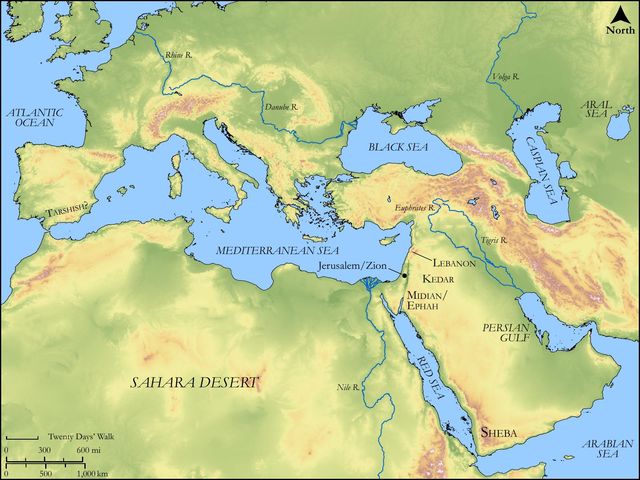
See on the biblical-era map
Study this verse
Public-domain commentary
Matthew Henry
From his Commentary on the Whole Bible. Henry comments on passages, not single verses — this entry covers Isaiah 40:12–17. His two-level outline is real structure in the source text, so it is rendered as structure.
The scope of these verses is to show what a great and glorious being the Lord Jehovah is, who is Israel's God and Saviour. It comes in here, 1. To encourage his people that were captives in Babylon to hope in him, and to depend upon him for deliverance, though they were ever so weak and their oppressors ever so strong. 2. To engage them to cleave to him, and not to turn aside after other gods; for there are none to be compared with him. 3. To possess all those who receive the glad tidings of redemption by Christ with a holy awe and reverence of God. Though it was said (Isa 40:9), Behold your God, and (Isa 40:11) He shall feed his flock like a shepherd, yet these condescensions of his grace must not be thought of with any diminution to the transcendencies of his glory. Let us see how great our God is, and fear before him; for,
I.His power is unlimited, and what no creature can compare with, much less contend with, Isa 40:12.
1.He has a vast reach. View the celestial globe, and you are astonished at the extent of it; but the great God metes the heavens with a span; to him they are but a hand-breadth, so large-handed is he. View the terraqueous globe, and he has the command of that too. All the waters in the world he can measure in the hollow of his hand, where we can hold but a little water; and the dry land he easily manages, for he comprehends the dust of the earth in a measure, or with his three fingers; it is no more to him than a pugil, or that which we take up between our thumb and two fingers.
2.He has a vast strength, and can as easily move mountains and hills as the tradesman heaves his goods into the scales and out of them again; he poises them with his hand as exactly as if he weighed them in a pair of balances. This may refer to the work of creation, when the heavens were stretched out as exactly as that which is spanned, and the earth and waters were put together in just proportions, as if they had been measured, and the mountains made of such a weight as to serve for ballast to the globe, and no more. Or it may refer to the work of providence (which is a continued creation) and the consistency of all the creatures with each other.
II.His wisdom is unsearchable, and what no creature can give either information or direction to, Isa 40:13, Isa 40:14.
As none can do what God has done and does, so none can assist him in the doing of it or suggest any thing to him which he thought not of. When the Lord by his Spirit made the world (Job 26:13) there was none that directed his Spirit, or gave him any advice, either what to do or how to do it. Nor does he need any counsellor to direct him in the government of the world, nor is there any with whom he consults, as the wisest kings do with those that know law and judgment, Est 1:13. God needs not to be told what is done, for he knows it perfectly; nor needs he be advised concerning what is to be done, for he knows both the right end and the proper means. This is much insisted upon here, because the poor captives had no politicians among them to manage their concerns at court or to put them in a way of gaining their liberty. "No matter," says the prophet, "you have a God to act for you, who needs not the assistance of statesmen." In the great work of our redemption by Christ matters were concerted before the world was, when there was one to teach God in the path of judgment, Co1 2:7.
III.The nations of the world are nothing in comparison of him, Isa 40:15, Isa 40:17.
Take them all together, all the great and mighty nations of the earth, kings the most pompous, kingdoms the most populous, both the most wealthy; take the isles, the multitude of them, the isles of the Gentiles: Before him, when they stand in competition with him or in opposition to him, they are as a drop of the bucket compared with the vast ocean, or the small dust of the balance (which does not serve to turn it, and therefore is not regarded, it is so small) in comparison with all the dust of the earth. He takes them up, and throws them away from him, as a very little thing, not worth speaking of. They are all in his eye as nothing, as if they had no being at all; for they add nothing to his perfection and all-sufficiency. They are counted by him, and are to be counted by us in comparison of him, less than nothing, and vanity. When he pleases, he can as easily bring them all into nothing as at first he brought them out of nothing. When God has work to do he values not either the assistance or the resistance of any creature. They are all vanity; the word that is used for the chaos (Gen 1:2), to which they will at last be reduced. Let this beget in us high thoughts of God and low thoughts of this world, and engage us to make God, and not man, both our fear and our hope. This magnifies God's love to the world, that, though it is of such small account and value with him, yet, for the redemption of it, he gave his only-begotten Son, Joh 3:16.
IV.The services of the church can make no addition to him nor do they bear any proportion to his infinite perfections (Isa 40:16):
Lebanon is not sufficient to burn; not the wood of it, to be for the fuel of the altar, though it be so well stocked with cedars; not the beasts of it, to be for sacrifices, though it be so well stocked with cattle, Isa 40:16. Whatever we honour God with, it falls infinitely short of the merit of his perfection; for he is exalted far above all blessing and praise, all burnt-offerings and sacrifices.
Historical interpretation
Two Centuries of Reception
11 surviving comments on this verse. Each one is dated, so this reads as a timeline rather than a list.
Select a marker to jump to its quote. Markers stagger vertically where authors wrote within a few decades of each other.
[Christ] … is of no reputation in the world but of illustrious fame in heaven, being betrayed by those who are ignorant [of his perfections] to those who know him not, being accounted as a drop from a cask. We, however, [Isaiah] says, are spiritual, who, from the life-giving water of Eu phrates, which flows through the midst of Babylon, choose our own peculiar quality as we pass through the true gate, which is the blessed Jesus.
The words “I AM THAT I AM” were clearly an adequate indication of God’s infinity. But, in addition, we needed to apprehend the operation of his majesty and power. For while absolute existence is peculiar to him who, abiding eternally, had no beginning in a past however remote, we hear again an utterance worthy of himself issuing from the eternal and holy God, who says, “who holds the heaven in his palm and the earth in his hand,” and again, “The heaven is my throne and the earth is the footstool of my feet. What house will you build me or what shall be the place of my rest?” The whole heaven is held in the palm of God, the whole earth grasped in his hand.Now the word of God … reveals a deeper meaning to the patient student.… This heaven that is held in the palm of God is also his throne, and the earth that is grasped in his hand is also the footstool beneath his feet. This was not written that … we should conclude that he has extension in space, as of a body.… It was written that in all born and created things God might be known within them and without, overshadowing and indwelling, surrounding all and interfused through all, since palm and hand, which hold, reveal the might of his external control, while throne and footstool, by their support of a sitter, display the subservience of outward things to One who, himself outside them, encloses all in his grasp.… Being infinite, he is present in all things. In him who is infinite all are included.
The words “I am that I am” were clearly an adequate indication of God’s infinity. But, in addition, we needed to apprehend the operation of his majesty and power. For while absolute existence is peculiar to him who, abiding eternally, had no beginning in a past however remote, we hear again an utterance worthy of himself issuing from the eternal and holy God, who says, “who holds the heaven in his palm and the earth in his hand,” and again, “The heaven is my throne and the earth is the footstool of my feet. What house will you build me or what shall be the place of my rest?” The whole heaven is held in the palm of God, the whole earth grasped in his hand.
Now the word of God … reveals a deeper meaning to the patient student.… This heaven that is held in the palm of God is also his throne, and the earth that is grasped in his hand is also the footstool beneath his feet. This was not written that … we should conclude that he has extension in space, as of a body.… It was written that in all born and created things God might be known within them and without, overshadowing and indwelling, surrounding all and interfused through all, since palm and hand, which hold, reveal the might of his external control, while throne and footstool, by their support of a sitter, display the subservience of outward things to One who, himself outside them, encloses all in his grasp.… Being infinite, he is present in all things. In him who is infinite all are included. - "On the Trinity 1.6"
Let the great sea praise the hands of the Son that measured it, and was astonished.… Blessed be his noble act!
Now this Father of our Lord Jesus Christ is not circumscribed to some place, nor is there heaven beyond him, but “the heavens are the work of his fingers,” and “the whole earth is held in the hollow of his hand.” He is in everything and yet nothing contains him.
For this cause [God] comprehends in himself all the intelligible creation, that all things may remain in existence controlled by his encompassing power.
Who would deny that God has made these things, who spoke through the Prophet, saying: 'Who has measured the waters in the hollow of His hand, and marked off the heavens with a span, enclosed the dust of the earth in a measure, and weighed the mountains in scales and the hills in a balance, who has directed the Spirit of the Lord, or who has been his counselor or instructed Him?' We also read elsewhere: Because it holds the circuit of the earth and has made the earth as nothing.
(Verse 12 and following) Who measured the waters in the hollow of his hand and marked off the heavens with a span? Who has held the dust of the earth in a basket, or weighed the mountains on the scales and the hills on a balance? Who has directed the Spirit of the Lord, or instructed him as his counselor? Whom did he consult to enlighten him, and who taught him the right way? Who was it that taught him knowledge, or showed him the path of understanding? Surely the nations are like a drop in a bucket; they are regarded as dust on the scales; he weighs the islands as though they were fine dust. And Lebanon is not enough to burn, and its animals are not enough for a burnt offering. All nations are as nothing before him, they are accounted by him as less than nothing and emptiness. Who has measured the waters in the hollow of his hand and marked off the heavens with a span, enclosed the dust of the earth in a measure and weighed the mountains in scales and the hills in a balance? Who has measured the Spirit of the Lord, or what man shows him his counsel? Whom did he consult, and who made him understand? Who taught him the path of justice, and taught him knowledge, and showed him the way of understanding? Who has shown him the way of justice, and who has taught him knowledge? Behold, all the nations are as a drop in a bucket and are accounted as the dust on the scales. Lebanon is not sufficient to burn, nor all the animals enough for a burnt offering. All the nations are as nothing in his sight, and they are counted as worthless. Let no one think that the calling of the nations is difficult, and that all flesh will see the salvation of God. They are commanded to climb the high mountain, those who proclaim the good news to Zion; and the Lord himself will come in strength, and will reward each one according to his work; he will gather the lambs in his arms and carry the nursing ewes. His greatness is described, for nothing is impossible for him; and he who has created everything, and is the Creator of all, can accomplish even these things which are small in comparison. But he uses the words and measurements of human custom, that we may learn the power of God through our words. In the place where the Seventy translated: Who has measured the water with his hand? or as we translate: Who has measured the waters with a handful? Aquila translated: Who has measured the waters with the smallest finger? For this word λιχὰς signifies that the vastness of all the waters is weighed not with the whole hand but with the small finger, which is commonly called the taster: but σπιθαμὴ, that is, the palm, signifies the hand stretched out from the thumb to the extreme finger. But if we contract our hand, it becomes a fist, so that through the palm and the fist we might know the outspread heavens and the globe of the earth. For the fist, which they brought over to the comprehension of the earth as seventy, is written in Hebrew Salt (), which Symmachus interprets as threefold and Aquila as three-handed: and to make it more evident, we turn it into three fingers; so that, indeed, the mass of the earth and the lofty mountains and hills seem to hang by means of three little fingers and in a small moment from the balance; whereby the majesty of God and the power of the Creator is demonstrated. Who, he says, aided the spirit of the Lord, or who was his counselor and showed him? etc. For which Symmachus interpreted: Who prepared the spirit of the Lord, and who showed him the man of his counsel? with whom he entered into counsel, and gave him understanding, and taught him the way of judgment, and instructed him in knowledge, and showed him the path of prudence? By which it is shown more clearly that the spirit is prepared or established, of which it is read in the Apostle: But the Lord is the Spirit. And on whom the Spirit of God rested, the Spirit of wisdom and understanding, etc. He says in the following: The Spirit of the Lord is upon me: because He has anointed me (Isaiah 61:1). He is truly the Spirit of the Lord and the man of His counsel, in whom the fullness of divinity dwelt bodily (Colossians 2). With Him entered into the counsel, of which we spoke above (Ad 11:6): Wonderful, counselor. And in Proverbs it is written: God by wisdom hath founded the earth, by prudence hath prepared the heavens (Prov. III, 19). Moreover, the LXX said: Who hath known the mind of the Lord? Or who hath been his counseller? They wish to understand that the mind, reason and understanding of God, by whom all things were made and without whom nothing was made, is the one of whom it is sung in the Psalms: By the word of the Lord the heavens were established, and all the power of them by the breath of his mouth (Ps. XXXII, 6). All peoples who did not know their Creator or the whole human race in comparison to God are like a drop from a bucket and like a speck of dust on a scale that tilts lightly to one side. And just as if a small drop falls from a bucket, it is ignored by the one carrying it; so too the entire multitude of nations, compared to the divine ministries and the multitude of angels, is considered as nothing. Even islands are considered like spit, or as Symmachus and Theodotion place it in their Hebrew translation, as 'leptos (a little thing)' which falls off, for which Aquila translated as 'leptos ballōmenon (a tiny thing thrown).' But the Hebrews say that this word signifies the finest dust, which, being carried by the wind, is often thrown into the eyes and is felt rather than seen. Therefore, the tiniest particles of dust, almost invisible, are called by this word: which perhaps Democritus, with his atom, calls them with Epicurus. There are many names which are read (or understood) in Greek in the same way as they are in Hebrew, because of the difficulty of interpretation, and for the comparison of the poverty of the Hebrew language, both in Greek and in Latin speech. At the same time, as he gradually withdraws people from idolatry, he abolishes the ceremonies of sacrifices; and he teaches that all the trees of Lebanon and the cattle that feed on them are not sufficient for his burnt offerings. But if all nations are in his sight as if they were not, and are considered as nothing and empty (though in all nations and in Israel also), therefore he himself is also as if he were not, and is considered as nothing and empty. We say this, so that his pride may be broken, and so that he may know that he is like the other nations.
He [Christ], who … balances the universe, cannot be contained in a single sepulcher.
God sits in heaven and measures the heaven with his palm. Does the same heaven become broad when God sits in it and narrow when he measures it? Or, when God is seated, is he no wider than the palm of his hand? If this is the case, then God has not made us to his own likeness, for with us the palm of the hand is much narrower than the bodily part on which we sit. So, if God is just as broad in the palm of his hand as when he is seated, he has made our members quite different. Not in this does the likeness consist. For shame!
Although these things seem illogical when heard by us according to our human capacity, nevertheless we are moved by them to think of spiritual things in an ineffable manner. Hence, even if we think that the body of the Lord, which when raised from the grave into heaven was not without human form and did indeed have bodily members, nevertheless he is not to be thought of as sitting on the right hand of the Father, as if the Father could be seen sitting on his left. In that blessedness indeed that surpasses all human understanding, “the right” is the name of that same blessedness.
Continue studying Isaiah 40:12 across the web’s major study libraries — every link below opens this exact verse, chapter, or book on the destination site.
Read & Compare
 BibleGatewayThis verse in more than 200 translations and 70 languages.
 Bible.comThe YouVersion reader — hundreds of translations, reading plans, and highlights.
 ESV.orgCrossway's official English Standard Version reader.
 NET BibleThe NET translation with 60,000+ translators' notes on every rendering decision.
 STEP BibleTyndale House's free study tool — original text, vocabulary, and scholarly resources.
 BibliaLogos Bible Software's free web reader.
 USCCBThe New American Bible (Revised Edition) with the U.S. bishops' study notes.
Commentaries
 BibleHub CommentariesDozens of classic commentaries on this verse, gathered on one page.
 StudyLightMore than 100 commentary sets — the largest collection on the web.
 BibleRefPlain-English commentary on what this verse means, verse by verse.
 Enduring WordDavid Guzik's free commentary on this chapter, widely used by Bible teachers.
 Bible Study ToolsVerse commentary alongside Greek and Hebrew study aids.
Original Language & Research
- BibleHub InterlinearThe verse word by word — original language, transliteration, and English.
- BibleHub LexiconEvery word's original-language definition and Strong's entry.
 Blue Letter BibleDeep-study tools — Strong's numbers, concordance, and word studies.
 SefariaThe Hebrew text with Rashi and centuries of Jewish commentary.
Sermons, Hymns & Audio


TrulyRandomVerse is not affiliated with these sites and doesn’t control their content. They’re linked because they’re genuinely useful.
Summary
Isaiah 40:12 presents a series of profound rhetorical questions that serve as a majestic declaration of God's incomparable greatness, omnipotence, and meticulous sovereignty over all creation. It challenges humanity to consider who else could possibly perform such cosmic feats, asserting that only the Lord God possesses limitless power, infinite wisdom, and absolute authority over the vastness of the universe, from the deepest oceans to the highest heavens and the very dust of the earth, thereby establishing Him as utterly unique and worthy of all trust.
Context
ShowHideLiterary Context
This verse stands at the threshold of a new, pivotal section within the Book of Isaiah, encompassing chapters 40-66, often aptly termed the "Book of Comfort" or "Second Isaiah." Following the somber prophecies of judgment and the impending Babylonian exile in the preceding chapters, Isaiah 40 inaugurates a dramatic shift in tone, delivering a vibrant message of hope, restoration, and divine intervention for a disheartened and displaced Israel. The prophet's initial, comforting summons to "Comfort, comfort my people" found in Isaiah 40:1 sets the grand stage for a sweeping declaration of God's absolute sovereignty and unmatched power. This foundational assurance is crucial for the promises of deliverance and renewal that unfold. Specifically, Isaiah 40:12 establishes God's supreme authority as a stark and undeniable contrast to the impotence of pagan idols and the inherent limitations of humanity, thereby preparing the audience to fully embrace and believe in His unfailing ability to fulfill His prophetic word.
Historical & Cultural Context
The prophecies articulated in Isaiah 40-66 are primarily directed towards the Jewish exiles enduring their captivity in Babylon. This community had suffered immense loss, displacement, and profound spiritual disorientation. They were immersed in the polytheistic culture of Babylon, a civilization that revered powerful deities like Marduk and where human monarchs frequently claimed divine prerogatives. In this environment of despair and exposure to rival pantheons, Isaiah's message was nothing short of revolutionary. He meticulously reminded the exiles of the utterly unique and incomparable nature of Yahweh, the covenant God of Israel. The series of rhetorical questions posed in Isaiah 40:12 directly challenges the prevailing worldview, asserting with unwavering conviction that no human king, no pagan deity, nor any created entity could ever possess the cosmic power and precise control that belongs exclusively to the Lord. This emphatic declaration served as a vital bulwark for the faith of a people tempted to doubt God's power or to assimilate by turning to the gods of their captors.
Key Themes
ShowHideIsaiah 40:12 is deeply saturated with profound theological themes that resonate throughout the entire book of Isaiah and beyond. The most prominent theme is God's Incomparable Greatness, asserting unequivocally that no one, absolutely no one, can measure up to God's power, knowledge, or understanding. He is utterly unique, supreme, and without peer, a truth powerfully reinforced later in Isaiah 40:25. This leads directly to the theme of Divine Sovereignty over Creation, portraying God not merely as the initial Architect of the universe but as its ongoing Sustainer and meticulous Manager. He not only called the cosmos into existence, as detailed in Genesis 1:1, but continues to hold and manage it with effortless precision. The vivid imagery employed highlights God's Omnipotence and Omniscience, demonstrating His limitless power and perfect, comprehensive knowledge, knowing every intricate detail of His creation. Finally, the verse implicitly presents a profound Challenge to Human Limitations, starkly contrasting God's boundless capabilities with the inherent finiteness of humanity. Human measuring tools and understanding are utterly inadequate for the tasks God performs, underscoring our smallness in comparison to His majestic and infinite nature, a concept also extensively explored in passages like Job 38:4-5.
Exposition and Analysis
ShowHideKey Word Analysis
ShowHideThis primitive root (H4058) properly means "to stretch," and by implication, "to measure (as if by stretching a line)." Figuratively, it can convey the idea of being extended. In this context, when applied to God measuring the vast waters, it powerfully communicates His comprehensive knowledge and precise control, as if effortlessly surveying and determining the exact dimensions and quantities of the immense oceans with a divine measuring line. It speaks to His intimate familiarity with the immeasurable.
Derived from a root meaning "to spread," this noun (H2239) refers to the spread of the fingers, specifically the distance from the thumb to the little finger when fully extended. It represents a small, inherently human unit of measure. Applying this small, finite measure to the immense heavens dramatically emphasizes God's effortless comprehension, organization, and mastery of the cosmos, reducing its seemingly infinite vastness to something easily grasped and contained within His divine hand.
A primitive root (H3557), kûwl properly means "to keep in" or "to contain." From this, it extends to "to measure" and, figuratively, "to maintain." Here, it signifies God's astonishing ability to contain, weigh, or measure the entire "dust of the earth" within a mere "measure" (H7991, shâlîysh, an indefinite, great quantity, perhaps a large container or treble ephah). This word underscores God's capacity to grasp, manage, and account for even the smallest, most granular elements of creation with effortless ease and precision, demonstrating His total knowledge and control.
Verse Breakdown
ShowHide"Who hath measured the waters in the hollow of his hand,"
This opening rhetorical question immediately sets the tone, asserting God's unparalleled power over the most immense elements of creation. The vivid imagery of measuring or containing all the world's oceans in the "hollow of his hand" (Hebrew, shôʻal, referring to the palm or a handful) conveys an effortless, intimate, and complete control over quantities far beyond human comprehension or capability. It suggests that what is immeasurable to humanity is easily grasped and accounted for by God.
"and meted out heaven with the span,"
Continuing the theme of cosmic measurement, this clause depicts God's effortless arrangement and precise determination of the heavens. To "mete out" (Hebrew, tâkan, to balance or measure out by weight or dimension) the expansive cosmos with a mere "span" (Hebrew, zereth, the distance from thumb to little finger) emphasizes His absolute mastery and the ease with which He ordered and established the celestial spheres. It highlights the vast disproportion between the infinite Creator and His finite, though immense, creation.
"and comprehended the dust of the earth in a measure,"
This phrase extends God's meticulous and comprehensive control to the smallest, most granular components of the earth. To "comprehend" (Hebrew, kûwl, to contain or measure) the entire "dust of the earth" (Hebrew, ʻâphâr, referring to fine particles, clay, or ground) within a "measure" (Hebrew, shâlîysh, an indefinite, great quantity, perhaps a large container) signifies His intimate knowledge and management of every minute detail of the terrestrial world, from its largest features to its finest particles, demonstrating His omnipresence and omniscience even in the seemingly insignificant.
"and weighed the mountains in scales, and the hills in a balance?"
The final part of the verse powerfully reinforces God's precise and effortless control over the earth's heaviest, most imposing, and seemingly immovable features. The imagery of weighing immense "mountains" (Hebrew, har) and "hills" (Hebrew, gibʻâh) in "scales" (Hebrew, peleç) and a "balance" (Hebrew, môʼzên) speaks to His perfect equilibrium, meticulous ordering, and foundational establishment of the earth's topography. It portrays God as the ultimate architect and engineer, who has established the very foundations and contours of the world with perfect accuracy, stability, and ease.
Literary Devices
ShowHideIsaiah 40:12 is masterfully crafted with several potent literary devices. Foremost is Rhetorical Question, where a series of questions is posed not to elicit an answer, but to make a forceful and undeniable assertion. The repeated "Who hath...?" implicitly demands the resounding answer, "No one but God!" This technique powerfully emphasizes God's absolute uniqueness and incomparability. The verse also employs vivid Imagery and Anthropomorphism, depicting God performing cosmic acts using human-like measurements (e.g., "hollow of his hand," "span," "scales"). This exaggerated imagery of God effortlessly measuring oceans in His hand or weighing mountains on scales serves to convey His infinite power and wisdom in terms that finite humans can grasp, highlighting the vast disproportion between the Creator and His creation. Furthermore, the structure of the verse demonstrates skillful Parallelism, where successive clauses express similar ideas using different words or with different examples (e.g., "measured the waters" and "meted out heaven"; "dust of the earth" and "mountains... and the hills"). This repetitive and cumulative structure builds intensity, reinforces the central message of God's absolute sovereignty, and underscores His meticulous control over all aspects of His creation.
Theological and Thematic Connections
ShowHideIsaiah 40:12 serves as a foundational declaration of God's absolute sovereignty, omnipotence, and omniscience, laying the groundwork for the profound comfort and enduring hope offered to a disheartened Israel. The verse's profound and expansive imagery of God effortlessly managing the entire cosmos underscores His infinite wisdom and boundless power, assuring His people that the God who created and meticulously sustains the universe is more than capable of delivering on His magnificent promises of restoration and redemption. This truth serves as a potent antidote to despair and a powerful counter to idolatry, redirecting focus from human limitations or the impotence of false gods to the one true, incomparable God who holds all things in His sovereign hand. It invites a posture of profound awe, humble worship, and unwavering trust in His providential care over all creation and, most intimately, over His covenant people.
Reflection and Application
ShowHideIsaiah 40:12 offers profound encouragement and a powerful call to worship for believers in every generation. In a world often characterized by chaos, uncertainty, and seemingly insurmountable problems, this verse serves as a majestic reminder that our God is infinitely greater than any challenge we face. If He can effortlessly measure the oceans, span the heavens, and weigh the mountains with perfect precision, then no personal anxiety, global crisis, or spiritual struggle is too complex, too overwhelming, or too large for His divine management and providential care. This liberating truth should inspire us to relinquish our worries and burdens into His infinitely capable hands, fostering a deep sense of trust, peace, and security that transcends circumstances. Furthermore, meditating on God's incomprehensible power and meticulous care over all creation should naturally lead us to profound awe, humble worship, and a right understanding of our finite nature in comparison to His infinite majesty. It cultivates a proper perspective on our place in the cosmos, reminding us that our ultimate hope, security, and purpose rest not in human strength, wisdom, or achievements, but solely in the boundless power, perfect knowledge, and unwavering faithfulness of the Creator and Sustainer of all things.
Questions for Reflection
ShowHideFAQ
ShowHideWhat is the main message of Isaiah 40:12?
ShowHideThe main message of Isaiah 40:12 is a powerful and unequivocal declaration of God's absolute and incomparable greatness, omnipotence, and meticulous control over all creation. Through a series of profound rhetorical questions, it asserts that only the Lord God possesses the power to effortlessly measure, span, comprehend, and weigh the vast elements of the universe, from the oceans and heavens to the dust of the earth and the mountains. It serves to starkly contrast God's infinite capabilities with the finite nature of humanity and the impotence of pagan idols, thereby inspiring profound trust and awe in His unique majesty. This verse sets the theological stage for the comforting message of God's ability to deliver His people, a central theme found throughout Isaiah 40.
How does this verse relate to the concept of God's omniscience and omnipotence?
ShowHideIsaiah 40:12 is a prime biblical example of God's omnipotence (all-powerful) and omniscience (all-knowing). The cosmic acts described—measuring the waters, spanning the heavens, comprehending the dust, and weighing the mountains—are feats of immense power that utterly transcend human capability, demonstrating His boundless might and unlimited strength. The precision implied in "measuring," "meting out," and "weighing" also points directly to His perfect knowledge and comprehensive understanding of every minute detail of His creation. He doesn't merely create; He knows and controls every particle, every dimension, and every law of the universe with effortless precision, affirming that His understanding is infinite and unsearchable, as also beautifully articulated in Psalm 147:5.
Why does Isaiah use rhetorical questions in this verse?
ShowHideIsaiah employs rhetorical questions in Isaiah 40:12 to make a forceful, undeniable, and self-evident assertion. The repeated questions "Who hath...?" are not posed to elicit a literal answer from the audience, but rather to implicitly demand the resounding conclusion: "No one but God!" This powerful literary device serves several crucial purposes: it directly engages the audience, compelling them to deeply consider the profound implications of God's unparalleled power; it highlights the unique and utterly incomparable nature of Yahweh, the God of Israel; and by posing these questions, Isaiah emphasizes the sheer absurdity of comparing God to anything or anyone else, thereby reinforcing the message of His absolute sovereignty and encouraging His people to place their trust and hope solely in Him, the one true Creator.
Christ-Centered Fulfillment
ShowHideIsaiah 40:12, with its majestic portrayal of God's cosmic power and meticulous control over creation, finds its ultimate fulfillment and deepest resonance in the person of Jesus Christ. The New Testament consistently presents Jesus as the divine agent through whom the Father accomplished all these magnificent works. As the Word who was with God and was God, Jesus is revealed as the one "through whom all things were made" (John 1:3). The very acts of "measuring the waters" and "meting out heaven with the span" point to the Son, who is the image of the invisible God, the firstborn of all creation, for "by him all things were created, in heaven and on earth, visible and invisible... all things were created through him and for him" (Colossians 1:16). Furthermore, the one who "comprehended the dust of the earth in a measure" is the same Christ who not only created but also "upholds the universe by the word of his power" (Hebrews 1:3). The infinite wisdom and power so grandly demonstrated in Isaiah 40:12 are fully embodied in Jesus, who is "the power of God and the wisdom of God" (1 Corinthians 1:24). He is the Creator, Sustainer, and Redeemer, the one who holds all things together, assuring us that the God of cosmic might is intimately involved in our salvation and daily lives, bringing comfort and hope to His people.