


1 Corinthians 2:7
Bible text: King James Version (1769 Blayney text) · Public domain
Bible text: Berean Standard Bible · Public domain
Bible text: American Standard Version (1901) · Public domain
Bible text: World English Bible, Messianic edition · Public domain
Bible text: Geneva Bible (1599) · Public domain
Bible text: Young's Literal Translation · Public domain
- ἀλλὰallaButG235CONJConjunction
- λαλοῦμενlaloumenwe speakG2980V-PAI-1PVerb Present Active Indicative 1st Plural
- θεοῦtheouof GodG2316N-GSM-TNoun Genitive Singular Masculine Title
- σοφίανsophianwisdomG4678N-ASFNoun Accusative Singular Feminine
- ἐνeninG1722PREPPreposition
- μυστηρίῳmustēriōa mysteryG3466N-DSNNoun Dative Singular Neuter
- τὴνtēnwhichG3588T-ASFDefinite article Accusative Singular Feminine
- ἀποκεκρυμμένηνapokekrummenēnhiddenG613V-RPP-ASFVerb Perfect Passive Participle Accusative Singular Feminine
- ἣνhēnwhichG3739R-ASFRelative pronoun Accusative Singular Feminine
- προώρισενproōrisenforeordainedG4309V-AAI-3SVerb Aorist Active Indicative 3rd Singular
- ὁho<the>G3588T-NSMDefinite article Nominative Singular Masculine
- θεὸςtheosGodG2316N-NSM-TNoun Nominative Singular Masculine Title
- πρὸprobeforeG4253PREPPreposition
- τῶνtōntheG3588T-GPMDefinite article Genitive Plural Masculine
- αἰώνωνaiōnōnagesG165N-GPMNoun Genitive Plural Masculine
- εἰςeisforG1519PREPPreposition
- δόξανdoxangloryG1391N-ASFNoun Accusative Singular Feminine
- ἡμῶνhēmōnof usG3165P-1GPPersonal pronoun Genitive 1st Plural
English is a literal word-by-word gloss of the Greek, not the KJV's wording. Why?
This is the original text the KJV's translators worked from — each Greek word with its own literal English meaning in this verse, prepared by scholars at Tyndale House, Cambridge. The KJV translates whole sentences, not word by word, so its wording differs: one Greek word can become several English words, and the KJV may choose “charity” where the gloss reads “love”. Both are faithful — they answer different questions. For the KJV's own rendering, switch to the KJV text.
Details
See on the biblical-era maps
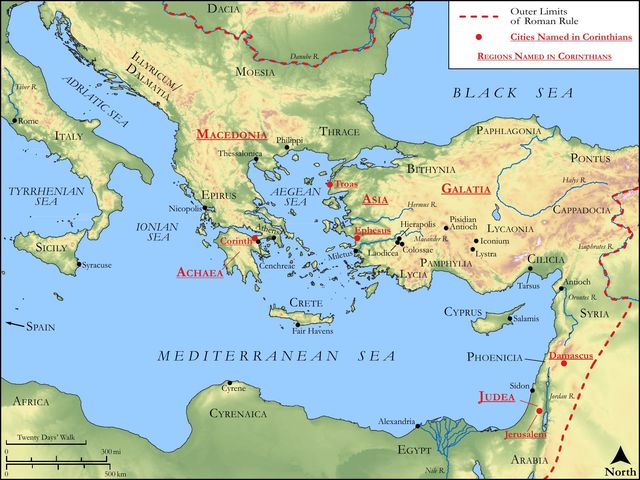

Study this verse
Public-domain commentary
Matthew Henry
From his Commentary on the Whole Bible. Henry comments on passages, not single verses — this entry covers 1 Corinthians 2:6–16. His three-level outline is real structure in the source text, so it is rendered as structure.
In this part of the chapter the apostle shows them that though he had not come to them with the excellency of human wisdom, with any of the boasted knowledge and literature of the Jews or Greeks, yet he had communicated to them a treasure of the truest and the highest wisdom: We speak wisdom among those who are perfect (Co1 2:6), among those who are well instructed in Christianity, and come to some maturity in the things of God. Those that receive the doctrine as divine, and, having been illuminated by the Holy Spirit, have looked well into it, discover true wisdom in it. They not only understand the plain history of Christ, and him crucified, but discern the deep and admirable designs of the divine wisdom therein. Though what we preach is foolishness to the world, it is wisdom to them. They are made wise by it, and can discern wisdom in it. Note, Those who are wise themselves are the only proper judges of what is wisdom; not indeed the wisdom of this world, nor of the princes of this world, but the wisdom of God in a mystery (Co1 2:6, Co1 2:7); not worldly wisdom, but divine; not such as the men of this world could have discovered, nor such as worldly men, under the direction of pride, and passion, and appetite, and worldly interest, and destitute of the Spirit of God, can receive. Note, How different is the judgment of God from that of the world! He seeth not as man seeth. The wisdom he teaches is of a quite different kind from what passes under that notion in the world. It is not the wisdom of politicians, nor philosophers, nor rabbis (see Co1 2:6), not such as they teach nor such as they relish; but the wisdom of God in a mystery, the hidden wisdom of God - what he had a long time kept to himself, and concealed from the world, and the depth of which, now it is revealed, none but himself can fathom. It is the mystery which hath been hid from ages and generations, though now made manifest to the saints (Col 1:26), hid in a manner entirely from the heathen world, and made mysterious to the Jews, by being wrapped up in dark types and distant prophecies, but revealed and made known to us by the Spirit of God. Note, See the privilege of those who enjoy the gospel revelation: to them types are unveiled, mysteries made plain, prophecies interpreted, and the secret counsels of God published and laid open. The wisdom of God in a mystery is now made manifest to the saints. Now, concerning this wisdom, observe,
I.The rise and origin of it:
It was ordained of God, before the world, to our glory, Co1 2:7. It was ordained of God; he had determined long ago to reveal and make it known, from many ages past, from the beginning, nay, from eternity; and that to our glory, the glory of us, either us apostles or us Christians. It was a great honour put upon the apostles, to be entrusted with the revelation of this wisdom. It was a great and honourable privilege for Christians to have this glorious wisdom discovered to them. And the wisdom of God discovered to them. And the wisdom of God discovered in the gospel, the divine wisdom taught by the gospel, prepares for our everlasting glory and happiness in the world to come. The counsels of God concerning our redemption are dated from eternity, and designed for the glory and happiness of the saints. And what deep wisdom was in these counsels! Note, The wisdom of God is both employed and displayed for the honour of the saints-employed from eternity, and displayed in time, to make them glorious both here and hereafter, in time and to eternity. What honour does he put on his saints!
II.The ignorance of the great men of the world about it:
Which none of the princes of this world knew (Co1 2:8), the principal men in authority and power, or in wisdom and learning. The Roman governor, and the guides and rulers of the Jewish church and nation, seem to be the persons here chiefly meant. These were the princes of this world, or this age, who, had they known this true and heavenly wisdom, would not have crucified the Lord of glory. This Pilate and the Jewish rulers literally did when our Redeemer was crucified upon the sentence of the one and the clamorous demands of the other. Observe, Jesus Christ is the Lord of Glory, a title much too great for any creature to bear: and the reason why he was hated was because he was not known. Had his crucifiers known him, known who and what he was, they would have withheld their impious hands, and not have taken and slain him. This he pleaded with his Father for their pardon: Father, forgive them, for they know not what they do, Luk 23:34. Note, There are many things which people would not do if they knew the wisdom of God in the great work of redemption. They act as they do because they are blind or heedless. They know not the truth, or will not attend to it.
III.It is such wisdom as could not have been discovered without a revelation, according to what the prophet Isaiah says (Isa 64:4), Eye hath not seen, nor ear heard, nor have entered into the heart of man the things which God hath prepared for those that love him - for him that waiteth for him, that waiteth for his mercy, so the Septuagint. It was a testimony of love to God in the Jewish believers to live in expectation of the accomplishment o evangelical promises. Waiting upon God is an evidence of love to him. Lo, this is our God, we have waited for him, Isa 25:9. Observe, There are things which God hath prepared for those that love him, and wait for him. There are such things prepared in a future life for them, things which sense cannot discover, no present information can convey to our ears, nor can yet enter our hearts. Life and immortality are brought to light through the gospel, Ti2 1:10. But the apostle speaks here of the subject-matter of the divine revelation under the gospel. These are such as eye hath not seen nor ear heard. Observe, The great truths of the gospel are things lying out of the sphere of human discovery: Eye hath not seen, nor ear heard them, nor have they entered into the heart of man. Were they objects of sense, could they be discovered by an eye of reason, and communicated by the ear to the mind, as matters of common human knowledge may, there had been no need of a revelation. But, lying out of the sphere of nature, we cannot discover them but by the light of revelation. And therefore we must take them as they lie in the scriptures, and as God has been pleased to reveal them.
IV.We here see by whom this wisdom is discovered to us:
God hath revealed them to us by his Spirit, Co1 2:10. The scripture is given by inspiration of God. Holy men spoke of old as they were moved by the Holy Ghost, Pe2 1:21. And the apostles spoke by inspiration of the same Spirit, as he taught them, and gave them utterance. Here is a proof of the divine authority of the holy scriptures. Paul wrote what he taught: and what he taught was revealed of God by his Spirit, that Spirit that searches all things, yea, the deep things of God, and knows the things of God, as the spirit of a man that is in him knows the things of a man, Co1 2:11. A double argument is drawn from these words in proof of the divinity of the Holy Ghost: - 1. Omniscience is attributed to him: He searches all things, even the deep things of God. He has exact knowledge of all things, and enters into the very depths of God, penetrates into his most secret counsels. Now who can have such a thorough knowledge of God but God? 2. This allusion seems to imply that the Holy Spirit is as much in God as a man's mind is in himself. Now the mind of the man is plainly essential to him. He cannot be without his mind. Now can God be without his Spirit. He is as much and as intimately one with God as the man's mind is with the man. The man knows his own mind because his mind is one with himself. The Spirit of God knows the things of God because he is one with God. And as no man can come at the knowledge of what is in another man's mind till he communicates and reveals it, so neither can we know the secret counsels and purposes of God till they are made known to us by his Holy Spirit. We cannot know them at all till he had proposed them objectively (as it is called) in the external revelation; we cannot know or believe them to salvation till he enlightens the faculty, opens the eye of the mind, and gives us such a knowledge and faith of them. And it was by this Spirit that the apostles had received the wisdom of God in a mystery, which they spoke. "Now we have received not the spirit of the world, but the Spirit which is of God, that we might know the things freely given to us of God (Co1 2:12); not the spirit which is in the wise men of the world (Co1 2:6), nor in the rulers of the world (Co1 2:8), but the Spirit which is of God, or proceedeth from God. We have what we deliver in the name of God by inspiration from him; and it is by his gracious illumination and influence that we know the things freely given to us of God unto salvation" - that is, "the great privileges of the gospel, which are the free gift of God, distributions of mere and rich grace." Though these things are given to us, and the revelation of this gift is made to us, we cannot know them to any saving purpose till we have the Spirit. The apostles had the revelation of these things from the Spirit of God, and the saving impression of them from the same Spirit.
V.We see here in what manner this wisdom was taught or communicated:
Which things we speak, not in the words which man's wisdom teaches, but which the Holy Ghost teaches, Co1 2:13. They had received the wisdom they taught, not from the wise men of the world, but from the Spirit of God. Nor did they put a human dress on it, but plainly declared the doctrine of Christ, in terms also taught them by the Holy Spirit. He not only gave them the knowledge of these things, but gave them utterance. Observe, The truths of God need no garnishing by human skill or eloquence, but look best in the words which the Holy Ghost teaches. The Spirit of God knows much better how to speak of the things of God than the best critics, orators, or philosophers. Comparing spiritual things with spiritual - one part of revelation with another, the revelation of the gospel with that of the Jews, the discoveries of the New Testament with the types and prophecies of the Old. The comparing of matters of revelation with matters of science, things supernatural with things natural and common, is going by a wrong measure. Spiritual things, when brought together, will help to illustrate one another; but, if the principles of human art and science are to be made a test of revelation, we shall certainly judge amiss concerning it, and the things contained in it. Or, adapting spiritual things to spiritual - speaking of spiritual matters, matters of revelation, and the spiritual life, in language that is proper and plain. The language of the Spirit of God is the most proper to convey his meaning.
VI.We have an account how this wisdom is received.
1.The natural man receiveth not the things of God, for they are foolishness to him, neither can he know them, because they are spiritually discerned, Co1 2:14. The natural man, the animal man. Either,
(1.)The man under the power of corruption, and never yet illuminated by the Spirit of God, such as Jude calls sensual, not having the Spirit, Jde 1:19. Men unsanctified receive not the things of God. The understanding, through the corruption of nature by the fall, and through the confirmation of this disorder by customary sin, is utterly unapt to receive the rays of divine light; it is prejudiced against them. The truths of God are foolishness to such a mind. The man looks on them as trifling and impertinent things, not worth his minding. The light shineth in darkness, and the darkness comprehendeth it not, Joh 1:5. Not that the natural faculty of discerning is lost, but evil inclinations and wicked principles render the man unwilling to enter into the mind of God, in the spiritual matters of his kingdom, and yield to their force and power. It is the quickening beams of the Spirit of truth and holiness that must help the mind to discern their excellency, and to so thorough a conviction of their truth as heartily to receive and embrace them. Thus the natural man, the man destitute of the Spirit of God, cannot know them, because they are spiritually discerned. Or,
(2.)The natural man, that is, the wise man of the world (Co1 1:19, Co1 1:20), the wise man after the flesh, or according to the flesh (v. 26), one who hath the wisdom of the world, man's wisdom (Co1 2:4-6), a man, as some of the ancients, that would learn all truth by his own ratiocinations, receive nothing by faith, nor own any need of supernatural assistance. This was very much the character of the pretenders to philosophy and the Grecian learning and wisdom in that day. Such a man receives not the things of the Spirit of God. Revelation is not with him a principle of science; he looks upon it as delirium and dotage, the extravagant thought of some deluded dreamer. It is no way to wisdom among the famous masters of the world; and for that reason he can have no knowledge of things revealed, because they are only spiritually discerned, or made known by the revelation of the Spirit, which is a principle of science or knowledge that he will not admit.
2.But he that is spiritual judgeth all things, yet he himself is judged, or discerned, of no man, Co1 2:15. Either,
(1.)He who is sanctified and made spiritually-minded (Rom 8:6) judgeth all things, or discerneth all things - he is capable of judging about matters of human wisdom, and has also a relish and savour of divine truths; he sees divine wisdom, and experiences divine power, in gospel revelations and mysteries, which the carnal and unsanctified mind looks upon as weakness and folly, as things destitute of all power and not worthy any regard. It is the sanctified mind that must discern the real beauties of holiness; but, by the refinement of its facilities, they do not lose their power of discerning and judging about common and natural things. The spiritual man may judge of all things, natural and supernatural, human and divine, the deductions of reason and the discoveries of revelation. But he himself is judged or discerned of NO MAN. God's saints are his hidden ones, Psa 83:3. Their life is hid with Christ in God, Col 3:3. The carnal man knows no more of a spiritual man than he does of other spiritual things. He is a stranger to the principles, pleasures, and actings, of the divine life. The spiritual man does not lie open to his observation. Or,
(2.)He that is spiritual (who has had divine revelations made to him, receives them as such, and founds his faith and religion upon them) can judge both of common things and things divine; he can discern what is, and what is not, the doctrine of the gospel and of salvation, and whether a man preaches the truths of God or not. He does not lose the power of reasoning, nor renounce the principles of it, by founding his faith and religion on revelation. But he himself is judged of no man - can be judged, so as to be confuted, by no man; nor can any man who is not spiritual, not under a divine afflatus himself (see Co1 14:37), or not founding his faith on a divine revelation, discern or judge whether what he speaks be true or divine, or not. In short, he who founds all his knowledge upon principles of science, and the mere light of reason, can never be a judge of the truth or falsehood of what is received by revelation. For who hath known the mind of the Lord, that he may instruct him (Co1 2:16), that is, the spiritual man? Who can enter so far into the mind of God as to instruct him who has the Spirit of God, and is under his inspiration? He only is the person to whom God immediately communicates the knowledge of his will. And who can inform or instruct him in the mind of God who is so immediately under the conduct of his own Spirit? Very few have known any thing of the mind of God by a natural power. But, adds the apostle, we have the mind of Christ; and the mind of Christ is the mind of God. He is God, and the principal messenger and prophet of God. And the apostles were empowered by his Spirit to make known his mind to us. And in the holy scriptures the mind of Christ, and the mind of God in Christ, are fully revealed to us. Observe, It is the great privilege of Christians that they have the mind of Christ revealed to them by his Spirit.
Historical interpretation
Two Centuries of Reception
7 surviving comments on this verse. Each one is dated, so this reads as a timeline rather than a list.
Select a marker to jump to its quote. Markers stagger vertically where authors wrote within a few decades of each other.
These, we know, were publicly instituted in Israel; but they lay overshadowed with latent meanings, in which the wisdom of God was concealed to be brought to light by and by amongst "the perfect," when the time should come, but "pre-ordained in the counsels of God before the ages." But whose ages, if not the Creator's? For because ages consist of times, and times are made up of days, and months, and years; since also days, and months, and years are measured by suns, and moons, and stars, which He ordained for this purpose (for "they shall be," says He, "for signs of the months and the years"), it clearly follows that the ages belong to the Creator, and that nothing of what was fore-ordained before the ages can be said to be the property of any other being than Him who claims the ages also as His own.
But this consideration may perhaps have influenced them, that if there were any true religion, it would exert itself and assert its authority, and not permit the existence of anything opposed to it. For they were unable to see at all, on what account, or by whom, and in what manner true religion was depressed, which partakes of a divine mystery and a heavenly secret. And no man can know this by any means, unless he is taught.
Paul testifies that he has been sent to reveal a secret wisdom which the princes of this world do not know and which they therefore label stupid. The wisdom of God is hidden because it is not in words but in power. It is impossible in human terms, but it can be believed by the power of the Spirit. God foresaw the future sins of the world and therefore decreed this in order to confound those who would turn his wisdom into their own stupidity, and also to glorify us, who would believe it.
"But we speak God's wisdom in a mystery." What mystery? For surely Christ saith, "What ye have heard in the ear, proclaim upon the housetops." How then does he call it "a mystery?" Because that neither angel nor archangel, nor any other created power knew of it before it actually took place. Wherefore he saith, "That now unto the principalities and powers in heavenly places might be known by the Church the manifold wisdom of God." And this hath God done in honor to us, so that they not without us should hear the mysteries. For we, too, ourselves, whomsoever we make our friends, use to speak of this as a sure proof of friendship towards them, that we tell our secrets to no one in preference to them. Let those hear who expose to shame the secrets of the Gospel, and unto all indiscriminately display the "pearls" and the doctrine, and who cast "the holy things" unto "dogs," and "swine," and useless reasonings. For the Mystery wants no argumentation; but just what it is, that only is to be declared. Since it will not be a mystery, divine and whole in all its parts, when thou addest any thing to it of thyself also.
And in another sense, too, a mystery is so called; because we do not behold the things which we see, but some things we see and others we believe. For such is the nature of our Mysteries. I, for instance, feel differently upon these subjects from an unbeliever. I hear, "Christ was crucified;" and forthwith I admire His loving-kindness unto men: the other hears, and esteems it weakness. I hear, "He became a servant;" and I wonder at his care for us: the other hears, and counts it dishonor. I hear, "He died;" and am astonished at His might, that being in death He was not holden, but even broke the bands of death: the other hears, and surmises it to be helplessness. He hearing of the resurrection, saith, the thing is a legend; I, aware of the facts which demonstrate it, fall down and worship the dispensation of God. He hearing of a layer, counts it merely as water: but I behold not simply the thing which is seen, but the purification of the soul which is by the Spirit. He considers only that my body hath been washed; but I have believed that the soul also hath become both pure and holy; and I count it the sepulchre, the resurrection, the sanctification, the righteousness, the redemption, the adoption, the inheritance, the kingdom of heaven, the plenary effusion of the Spirit. For not by the sight do I judge of the things that appear, but by the eyes of the mind. I hear of the "Body of Christ:" in one sense I understand the expression, in another sense the unbeliever.
And just as children, looking on their books, know not the meaning of the letters, neither know what they see; yea more, if even a grown man be unskilful in letters, the same thing will befall him; but the skilful will find much meaning stored up in the letters, even complete lives and histories: and an epistle in the hands of one that is unskilful will be accounted but paper and ink; but he that knows how to read will both hear a voice, and hold converse with the absent, and will reply whatsoever he chooses by means of writing: so it is also in regard of the Mystery. Unbelievers albeit they hear, seem not to hear: but the faithful, having the skill which is by the Spirit, behold the meaning of the things stored therein.
In another point of view, the word indicates also the Gospel's being contrary to all expectation. By no other name is Scripture wont to call what happens beyond all hope and above all thought of men.
And though it be everywhere preached, still is it a mystery; for as we have been commanded, "what things we have heard in the ear, to speak upon the house tops," so have we been also charged, "not to give the holy things unto dogs nor yet to cast our pearls before swine." For some are carnal and do not understand: others have a veil upon their hearts and do not see: wherefore that is above all things a mystery, which everywhere is preached, but is not known of those who have not a right mind; and is revealed not by wisdom but by the Holy Ghost, so far as is possible for us to receive it. And for this cause a man would not err, who in this respect also should entitle it a mystery, the utterance whereof is forbidden. For not even unto us, the faithful, hath been committed entire certainty and exactness. Wherefore Paul also said, "We know in part, and we prophesy in part: for now we see in a mirror darkly; but then face to face."
For this cause he saith, "We speak wisdom in a mystery, the hidden wisdom which God fore-ordained before the worlds unto our glory. Hidden:" that is, that no one of the powers above hath learnt it before us; neither do the many know it now.
"Which he fore-ordained unto our glory" and yet, elsewhere he saith, "unto his own glory," for he considereth our salvation to be His own glory: even as also He calleth it His own riches, though He be Himself rich in good and need nothing in order that He may be rich.
"Fore-ordained," he saith, pointing out the care had of us. For so those are accounted most both to honor and to love us, whosoever shall have laid themselves out to do us good from the very beginning: which indeed is what fathers do in the case of children. For although they give not their goods until afterwards, yet at first and from the beginning they had predetermined this. And this is what Paul is earnest to point out now; that God always loved us even from the beginning and when as yet we were not. For unless He had loved us, He would not have fore-ordained our riches. Consider not then the enmity which hath come between; for more ancient than that was the friendship.
As to the words, "before the worlds," they mean eternal. For in another place also He saith thus, "Who is before the worlds." The Son also, if you mark it, will be found to be eternal in the same sense. For concerning Him he saith, "By Him He made the worlds;" which is equivalent to subsistence before the worlds; for it is plain that the maker is before the things which are made.
[Daniel 10:13] "But the prince of the kingdom of Persia withstood me for twenty-one days." In my opinion this was the angel to whose charge Persia was committed, in accordance with what we read in Deuteronomy: "When the Most High divided the nations and distributed the children of Adam abroad, then He established the bounds of the nations according to the number of the angels of God" (Deuteronomy 32:8). These are the princes of whom Paul also says: "We speak forth among the perfect a wisdom which none of the princes of this world knew. For if they had known it, they would never have crucified the Lord of Glory" (1 Corinthians 2:6-8). And so the prince or angel of the Persians offered resistance, acting on behalf of the province entrusted to him, in order that the entire captive nation might not be released. And it may well be that although the prophet was graciously heard by God from the day when he set his heart to understand, the angel was nevertheless not sent to proclaim to him God's gracious decision, for the reason that the prince of Persia opposed him for twenty-one days, enumerating the sins of the Jewish people as a ground for their justly being kept in captivity and as proof that they ought not to be released.
"And behold, Michael, one of the chief princes, came to my assistance." That is, while the angel of the Persians was resisting thy petitions and my representations on thy behalf as I presented thy prayers to God, then there came to my assistance the angel Michael, who has oversight of the people of Israel. By chief princes we are of course to understand archangels.
"And I remained there close by the king of the Persians." He designates the angel or prince by the term "king of the Persians," and shows that he had tarried with Michael for a little as he spoke in opposition to the prince of the Persians.
By wisdom Paul means the cross and the whole dispensation of salvation.
Paul does not mean that he is now communicating in secrets and riddles but that the message he preaches was once hidden.
Continue studying 1 Corinthians 2:7 across the web’s major study libraries — every link below opens this exact verse, chapter, or book on the destination site.
Read & Compare
 BibleGatewayThis verse in more than 200 translations and 70 languages.
 Bible.comThe YouVersion reader — hundreds of translations, reading plans, and highlights.
 ESV.orgCrossway's official English Standard Version reader.
 NET BibleThe NET translation with 60,000+ translators' notes on every rendering decision.
 STEP BibleTyndale House's free study tool — original text, vocabulary, and scholarly resources.
 BibliaLogos Bible Software's free web reader.
 USCCBThe New American Bible (Revised Edition) with the U.S. bishops' study notes.
Commentaries
 BibleHub CommentariesDozens of classic commentaries on this verse, gathered on one page.
 StudyLightMore than 100 commentary sets — the largest collection on the web.
 BibleRefPlain-English commentary on what this verse means, verse by verse.
 Enduring WordDavid Guzik's free commentary on this chapter, widely used by Bible teachers.
 Bible Study ToolsVerse commentary alongside Greek and Hebrew study aids.
Original Language & Research
- BibleHub InterlinearThe verse word by word — original language, transliteration, and English.
- BibleHub LexiconEvery word's original-language definition and Strong's entry.
 Blue Letter BibleDeep-study tools — Strong's numbers, concordance, and word studies.
 CNTR CollationThe earliest Greek manuscripts of this verse, collated letter by letter.
Sermons, Hymns & Audio


TrulyRandomVerse is not affiliated with these sites and doesn’t control their content. They’re linked because they’re genuinely useful.
Summary
Paul articulates that the message he preaches is not based on human eloquence or philosophical insight, but rather on a profound, divine wisdom. This wisdom, previously concealed and incomprehensible to the world, was eternally purposed by God before creation, specifically designed to lead believers into a state of ultimate glory. It stands in stark contrast to the transient wisdom of the world, revealing God's sovereign plan for salvation through Christ.
Context
ShowHideLiterary Context
This verse is a pivotal statement in Paul's argument in 1 Corinthians 2, where he systematically contrasts human wisdom with divine wisdom. In 1 Corinthians 2:1-5, Paul asserts that his preaching was not with "excellency of speech or of wisdom" but in "demonstration of the Spirit and of power," so that the Corinthians' faith would rest on God's power, not human wisdom. 1 Corinthians 2:7 then introduces the content of this Spirit-empowered message: a profound, hidden wisdom from God. This sets the stage for the subsequent verses, where Paul explains that this wisdom is revealed by the Spirit to those who are spiritual, not to the "natural man" who cannot understand the things of God (1 Corinthians 2:9-16).
Historical & Cultural Context
The city of Corinth was a bustling cosmopolitan center, renowned for its intellectual pursuits, philosophical schools, and appreciation for rhetorical skill. Greek culture highly valued eloquent speech and sophisticated arguments, often equating them with true wisdom. Many Corinthians, therefore, might have been inclined to judge Paul's plain preaching style as lacking in intellectual depth compared to the orators and philosophers of their day. Paul's emphasis on a "wisdom of God in a mystery" directly challenges this cultural predisposition, asserting that true wisdom does not originate from human intellect or persuasive rhetoric, but from a divine source, revealed to those who embrace God's seemingly foolish message of the cross (1 Corinthians 1:18-25).
Key Themes
ShowHide1 Corinthians 2:7 is rich with several interconnected themes. The primary theme is the Divine Wisdom of God, which stands in stark opposition to the "wisdom of this world" (1 Corinthians 1:20). This divine wisdom is not a philosophical system but God's eternal plan of salvation, centered on the crucified Christ, whom Paul proclaims as "the power of God and the wisdom of God" (1 Corinthians 1:24). Another crucial theme is Mystery and Revelation. The wisdom is described as a "mystery" and "hidden," indicating a truth previously veiled but now unveiled by God through the gospel, accessible only through spiritual discernment, not human reason. This concept of a divine plan "ordained before the world" underscores God's Sovereignty and Foreknowledge, emphasizing that salvation is not an afterthought but part of His eternal purpose. Finally, the phrase "unto our glory" highlights the Believer's Ultimate Destiny, revealing that God's profound plan culminates in the glorification of His people, a future hope that far surpasses any earthly achievement or wisdom (Romans 8:18).
Exposition and Analysis
ShowHideKey Word Analysis
ShowHideFrom σοφός; wisdom (higher or lower, worldly or spiritual):--wisdom. In this context, sophía refers specifically to a divine, spiritual wisdom that is fundamentally different from and superior to human intellectual prowess or philosophical insight. It embodies God's perfect plan and understanding, particularly concerning salvation through Christ, which appears as foolishness to the world but is ultimate truth and power to believers.
From a derivative of (to shut the mouth); a secret or "mystery" (through the idea of silence imposed by initiation into religious rites):--mystery. In biblical usage, a mystḗrion is not something unknowable or incomprehensible, but rather a profound truth that was previously concealed by God and has now been divinely revealed to those who believe. It signifies a truth that cannot be discovered by human reason but must be unveiled by God Himself.
From ἀπό and κρύπτω; to conceal away (i.e. fully); figuratively, to keep secret:--hide. This word reinforces the idea that God's wisdom was not openly accessible or discernible to all. It was kept secret, veiled from human understanding and the "princes of this world" until God chose to disclose it through the preaching of the gospel and the illumination of the Holy Spirit.
From πρό and ὁρίζω; to limit in advance, i.e. (figuratively) predetermine:--determine before, ordain, predestinate. This term emphasizes God's eternal sovereignty and foreknowledge. It signifies that God's plan of salvation, the "hidden wisdom," was not an improvised response to human sin, but a pre-determined, fixed, and purposeful design established by God before the very beginning of time and creation.
Verse Breakdown
ShowHide"But we speak the wisdom of God in a mystery"
Paul contrasts his message with human wisdom, asserting that he and other apostles proclaim a wisdom that originates from God. This wisdom is presented "in a mystery," meaning it is a truth that was once hidden or partially revealed, but is now being unveiled through the gospel message. It is not something to be figured out by human intellect but received by divine revelation.
"even the hidden wisdom"
This phrase clarifies and emphasizes the nature of the "mystery." It is a wisdom that was previously concealed, inaccessible to the natural human mind or the rulers of this age. Its "hidden" nature underscores its divine origin and its transcendence over any earthly knowledge or philosophy.
"which God ordained before the world"
This clause highlights God's eternal planning and sovereignty. The wisdom Paul preaches is not a new invention or an afterthought, but a pre-determined, divinely purposed plan established by God before the creation of the heaven and the earth. This speaks to the unchangeable and eternal nature of God's redemptive purpose.
"unto our glory"
This final phrase reveals the ultimate purpose and glorious outcome of God's hidden wisdom. The entire divine plan, from its eternal ordination to its revelation in Christ, is designed to lead believers into a state of ultimate glory. This "glory" encompasses not only future exaltation and participation in Christ's splendor but also the present spiritual transformation and dignity bestowed upon those who embrace God's wisdom.
Literary Devices
ShowHidePaul employs several literary devices in this verse to underscore the profound nature of God's wisdom. The most prominent is Contrast, setting the "wisdom of God" against the implied "wisdom of this world" (as established in preceding verses), highlighting their fundamental opposition and the superiority of the divine. There is also an element of Paradox, as this ultimate wisdom was "hidden" and yet now "spoken," implying that what was once inaccessible is now revealed. The concept of "mystery" itself functions as a Metaphor for a profound truth that is not inherently unknowable but requires divine unveiling, much like a treasure hidden from plain sight that is then discovered. The phrase "ordained before the world" utilizes Hyperbole to emphasize the eternal and ancient nature of God's plan, stretching beyond human comprehension of time.
Theological and Thematic Connections
ShowHideThe wisdom of God, spoken of as a mystery and hidden, connects deeply to the overarching biblical narrative of God's redemptive plan. This plan, conceived in eternity, progressively revealed through the Old Testament, and fully unveiled in Christ, demonstrates God's sovereign control over history and His unwavering purpose for humanity. It emphasizes that salvation is entirely God's initiative, not a human achievement, and that true understanding comes through divine revelation, not human intellect. This eternal wisdom culminates in the believer's glory, signifying God's ultimate intention to bring His people into full fellowship and likeness with Christ, sharing in His divine splendor. This profound truth underpins the security and hope of the Christian faith.
Reflection and Application
ShowHide1 Corinthians 2:7 offers immense encouragement and a vital reorientation of our values. In a world that often prioritizes human intelligence, worldly success, and eloquent persuasion, this verse reminds us that true wisdom and lasting glory come from God alone. It challenges us to humble ourselves, recognizing that the most profound truths about life, salvation, and destiny are not discoverable through our own efforts but are graciously revealed by God through His Spirit. Embracing this "hidden wisdom" means prioritizing the gospel message, even when it seems foolish to others, and trusting in God's eternal, purposeful plan for our lives. It assures us that our faith is rooted in an ancient, divine design for our ultimate good and glorification, inviting us to live with confidence in God's perfect foresight and provision.
Questions for Reflection
ShowHideFAQ
ShowHideWhat is the "mystery" Paul refers to in 1 Corinthians 2:7?
ShowHideThe "mystery" (Greek: mystḗrion) in 1 Corinthians 2:7 does not mean something incomprehensible or unknowable. Rather, in biblical usage, it refers to a truth previously concealed by God in past ages but now divinely revealed and made plain, particularly through the gospel of Jesus Christ. It is a truth that cannot be discovered through human reason or philosophical inquiry but must be unveiled by God's Spirit. This "hidden wisdom" is God's eternal plan for salvation, centered on the cross of Christ, which was hidden from the "princes of this world" (1 Corinthians 2:8) but is now revealed to believers.
Why was this wisdom "hidden" if it was meant for "our glory"?
ShowHideGod's wisdom was "hidden" not to withhold it arbitrarily, but because its full revelation required a specific time and context within God's redemptive plan. It was hidden from the "princes of this world" (likely referring to demonic powers or human authorities who orchestrated Christ's crucifixion) precisely so they would not understand and thus unwittingly fulfill God's plan through their actions (1 Corinthians 2:8). The timing of its revelation was also part of God's eternal design, ensuring that it would be unveiled at the opportune moment for "our glory," meaning the ultimate salvation, sanctification, and glorification of believers through Christ. This demonstrates God's perfect timing and purposeful design.
Christ-Centered Fulfillment
ShowHide1 Corinthians 2:7 finds its profound Christ-centered fulfillment in the person and work of Jesus Christ, who is the very embodiment of God's hidden wisdom. The "mystery" that was "ordained before the world" is none other than God's eternal plan to redeem humanity through His Son. Christ Himself is declared to be "the power of God and the wisdom of God" (1 Corinthians 1:24), and in Him "are hidden all the treasures of wisdom and knowledge" (Colossians 2:3). The "hidden wisdom" that was previously inaccessible to human understanding is now unveiled through the gospel message, which proclaims Christ crucified and risen. This revelation of Christ, once a mystery, is now "Christ in you, the hope of glory" (Colossians 1:27). Furthermore, the ultimate purpose of this divine wisdom, "unto our glory," is realized through Christ, as believers are conformed to His image (Romans 8:29) and will share in His eternal glory (Romans 8:17). Thus, Jesus Christ is both the content and the means by which God's eternal, hidden wisdom is revealed and brings about the believer's ultimate glorification.