


2 Peter 1:3
Bible text: King James Version (1769 Blayney text) · Public domain
Bible text: King James Version with Strong's numbers · Public domain
Bible text: Berean Standard Bible · Public domain
Bible text: American Standard Version (1901) · Public domain
Bible text: World English Bible, Messianic edition · Public domain
Bible text: Geneva Bible (1599) · Public domain
Bible text: Young's Literal Translation · Public domain
- ὡςhōsAccordinglyG5613PRTParticle or Disjunctive
- πάνταpantaall thingsG3956A-APNAdjective Accusative Plural Neuter
- ἡμῖνhēminto usG3165P-1DPPersonal pronoun Dative 1st Plural
- τῆςtēsby theG3588T-GSFDefinite article Genitive Singular Feminine
- θείαςtheiasdivineG2304A-GSFAdjective Genitive Singular Feminine
- δυνάμεωςdunameōspowerG1411N-GSFNoun Genitive Singular Feminine
- αὐτοῦautouof HimG846P-GSMPersonal pronoun Genitive Singular Masculine
- τὰta<the>G3588T-APNDefinite article Accusative Plural Neuter
- πρὸςprostowardG4314PREPPreposition
- ζωὴνzōēnlifeG2222N-ASFNoun Accusative Singular Feminine
- καὶkaiandG2532CONJConjunction
- εὐσέβειανeusebeiangodlinessG2150N-ASFNoun Accusative Singular Feminine
- δεδωρημένηςdedōrēmenēshaving himself givenG1433V-RMP-GSFVerb Perfect Middle Participle Genitive Singular Feminine
- διὰdiathroughG1223PREPPreposition
- τῆςtēstheG3588T-GSFDefinite article Genitive Singular Feminine
- ἐπιγνώσεωςepignōseōsknowledgeG1922N-GSFNoun Genitive Singular Feminine
- τοῦtouof the [One who]G3588T-GSMDefinite article Genitive Singular Masculine
- καλέσαντοςkalesantoshaving calledG2564V-AAP-GSMVerb Aorist Active Participle Genitive Singular Masculine
- ἡμᾶςhēmasusG3165P-1APPersonal pronoun Accusative 1st Plural
- ἰδίᾳidia[by His] ownG2398A-DSFAdjective Dative Singular Feminine
- δόξῃdoxēgloryG1391N-DSFNoun Dative Singular Feminine
- καὶkaiandG2532CONJConjunction
- ἀρετῇaretēaexcellenceG703N-DSFNoun Dative Singular Feminine
English is a literal word-by-word gloss of the Greek, not the KJV's wording. Why?
This is the original text the KJV's translators worked from — each Greek word with its own literal English meaning in this verse, prepared by scholars at Tyndale House, Cambridge. The KJV translates whole sentences, not word by word, so its wording differs: one Greek word can become several English words, and the KJV may choose “charity” where the gloss reads “love”. Both are faithful — they answer different questions. For the KJV's own rendering, switch to the KJV text.
Details
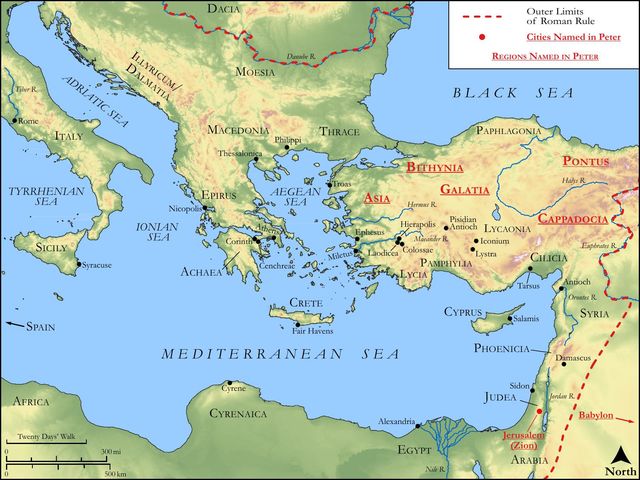
See on the biblical-era maps

Study this verse
Public-domain commentary
Matthew Henry
From his Commentary on the Whole Bible. Henry comments on passages, not single verses — this entry covers 2 Peter 1:1–4. His four-level outline is real structure in the source text, so it is rendered as structure.
The apostle Peter, being moved by the Holy Ghost to write once more to those who from among the Jews were turned to faith in Christ, begins this second epistle with an introduction, wherein the same persons are described and the same blessings are desired that are in the preface to his former letter; but there are some additions or alterations which ought to be taken notice of, in all the three parts of the introduction.
I.We have here a description of the person who wrote the epistle, by the name of Simon, as well as Peter, and by the title of servant, as well as that of apostle. Peter, being in both epistles, seems to be the name most frequently used, and with which he may be thought to be best pleased, it being given him by our Lord, upon his confessing Jesus to be Christ the Son of the living God, and the very name signifying and sealing that truth to be the fundamental article, the rock on which all must build; but the name Simon, though omitted in the former epistle, is mentioned in this, lest the total omission of that name, which was given him when he was circumcised, should make the Jewish believers, who were all zealous of the law, to become jealous of the apostle, as if he disclaimed and despised circumcision. He here styles himself a servant (as well as an apostle) of Jesus Christ; in this he may be allowed to glory, as David does, Psa 116:16. The service of Christ is the way to the highest honour, Joh 12:26. Christ himself is King of kings, and Lord of lords; and he makes all his servants kings and priests unto God, Rev 1:6. How great an honour is it to be the servants of this Master! This is what we cannot, without sin, be ashamed of. To triumph in being Christ's servant is very proper for those who are engaging others to enter into or abide in the service of Christ.
II.We have an account of the people to whom the epistle is written.
They are described in the former epistle as elect according to the foreknowledge of God the Father, and here as having obtained precious faith in our Lord Jesus Christ; for the faith here mentioned is vastly different from the false faith of the heretic, and the feigned faith of the hypocrite, and the fruitless faith of the formal professor, how orthodox soever he is. It is the faith of God's elect (Tit 1:1), wrought by the Spirit of God in effectual calling. Observe,
1.True saving faith is a precious grace, and that not only as it is very uncommon, very scarce, even in the visible church, a very small number of true believers among a great multitude of visible professors (Mat 22:14), but true faith is very excellent and of very great use and advantage to those who have it. The just lives by faith, a truly divine spiritual life; faith procures all the necessary supports and comforts of this excellent life; faith goes to Christ, and buys the wine and milk (Isa 55:1) which are the proper nourishment of the new creature; faith buys and brings home the tried gold, the heavenly treasure that enriches; faith takes and puts on the white raiment, the royal robes that clothe and adorn, Rev 3:18. Observe,
2.Faith is alike precious in the private Christian and in the apostle; it produces the same precious effects in the one and in the other. Faith unites the weak believer to Christ as really as it does the strong one, and purifies the heart of one as truly as of another; and every sincere believer is by his faith justified in the sight of God, and that from all sins, Act 13:39. Faith, in whomsoever it exists, takes hold of the same precious Saviour, and applies the same precious promises.
3.This precious faith is obtained of God. Faith is the gift of God, wrought by the Spirit, who raised up Jesus Christ from the dead.
4.The preciousness of faith, as well as our obtaining it, is through the righteousness of Christ. The satisfactory meritorious righteousness and obedience of Christ gives faith all its value and preciousness: and the righteousness of such a person cannot but be of infinite value to those who by faith receive it. For,
(1.)This Jesus Christ is God, yea, our God, as it is in the original. He is truly God, an infinite Being, who has wrought out this righteousness, and therefore it must be of infinite value.
(2.)He is the Saviour of those that believe, and as such he yielded this meritorious obedience; and therefore it is of such great benefit and advantage to them, because, as surety and Saviour, he wrought out this righteousness in their stead.
III.We have the apostolical benediction, wherein he wishes for the multiplication and increase of the divine favour to them, and the advancement and growth of the work of grace in them, and that peace with God and in their own consciences (which cannot be without grace) may abound in them. This is the very same benediction that is in the former epistle; but here he adds,
1.An account of the way and means whereby grace and peace are multiplied - it is through the knowledge of God and Jesus Christ; this acknowledging or believing in the only living and true God, and Jesus Christ whom he has sent, is the great improvement of spiritual life, or it could not be the way to life eternal, Joh 17:3.
2.The ground of the apostle's faith in asking, and of the Christian's hope in expecting, the increase of grace. What we have already received should encourage us to ask for more; he who has begun the work of grace will perfect it. Observe,
(1.)The fountain of all spiritual blessings is the divine power of Jesus Christ, who could not discharge all the office of Mediator, unless he was God as well as man.
(2.)All things that have any relation to, and influence upon, the true spiritual life, the life and power of godliness, are from Jesus Christ; in him all fulness dwells, and it is from him that we receive, and grace for grace (Joh 1:16), even all that is necessary for the preserving, improving, and perfecting of grace and peace, which, according to some expositors, are called here in this verse godliness and life.
(3.)Knowledge of God, and faith in him, are the channel whereby all spiritual supports and comforts are conveyed to us; but then we must own and acknowledge God as the author of our effectual calling, for so he is here described: Him that hath called us to glory and virtue. Observe here, The design of God in calling or converting men is to bring them to glory and virtue, that is, peace and grace, as some understand it; but many prefer the marginal rendering, by glory and virtue; and so we have effectual calling set forth as the work of the glory and virtue, or the glorious power, of God, which is described Eph 1:19. It is the glory of God's power to convert sinners; this is the power and glory of God which are seen and experienced in his sanctuary (Psa 63:2); this power or virtue is to be extolled by all that are called out of darkness into marvellous light, Pe1 2:9.
(4.)In the fourth verse the apostle goes on to encourage their faith and hope in looking for an increase of grace and peace, because the same glory and virtue are employed and evidenced in giving the promises of the gospel that are exercised in our effectual calling. Observe,
[1.]The good things which the promises make over are exceedingly great. Pardon of sin is one of the blessings here intended; how great this is all who know any thing of the power of God's anger will readily confess, and this is one of those promised favours in bestowing whereof the power of the Lord is great, Num 14:17. To pardon sins that are numerous and heinous (every one of which deserves God's wrath and curse, and that for ever) is a wonderful thing, and is so called, Psa 119:18.
[2.]The promised blessings of the gospel are very precious; as the great promise of the Old Testament was the Seed of the woman, the Messiah (Heb 11:39), so the great promise of the New Testament is the Holy Ghost (Luk 24:49), and how precious must the enlivening, enlightening, sanctifying Spirit be!
[3.]Those who receive the promises of the gospel partake of the divine nature. They are renewed in the spirit of their mind, after the image of God, in knowledge, righteousness, and holiness; their hearts are set for God and his service; they have a divine temper and disposition of soul; though the law is the ministration of death, and the letter killeth, yet the gospel is the ministration of life, and the Spirit quickeneth those who are naturally dead in trespasses and sins.
[4.]Those in whom the Spirit works the divine nature are freed from the bondage of corruption. Those who are, by the Spirit of grace, renewed in the spirit of their mind, are translated into the liberty of the children of God; for it is the world in which corruption reigns. Those who are not of the Father, but of the world, are under the power of sin; the world lies in wickedness, Jo1 5:19. And the dominion that sin has in the men of the world is through lust; their desires are to it, and therefore it rules over them. The dominion that sin has over us is according to the delight we have in it.
Historical interpretation
Seven Centuries of Reception
5 surviving comments on this verse. Each one is dated, so this reads as a timeline rather than a list.
Select a marker to jump to its quote. Markers stagger vertically where authors wrote within a few decades of each other.
Here Peter is talking about the Scriptures, the miracles which Christ did in the flesh, the work of baptism and the doctrine which was preached, all of which bring us into the enjoyment of eternal life.
Just as His divine power has given us all things, etc. This statement depends on the previous sentences. The meaning is: Grace and peace be multiplied to you as you come to know our Lord Jesus Christ perfectly. And know this too through Him, that all things of His divine power have been given to us through His grace, which are sufficient for attaining life and preserving piety. Hence, He says: Because everything I have heard from My Father I have made known to you (John XV). And elsewhere: And the glory which You have given Me, I have given them (John XVII). But if it is read as some manuscripts have: Which has been given for life and piety, then the meaning will be: So that you may understand how our Lord has given all things of His divine power to us according to the measure of our capacity, which power has been given for us to attain life and piety. For this form of expression is very common in the Scriptures; and it is called by grammarians ellipsis, that is, the omission of a necessary word, such as in the Psalm: For neither from the east, nor from the west, nor from the desert mountains. It implies, for the way of escape is evident, for God is judge everywhere (Psalm LXXIV).
Through the knowledge of Him who called us by His own glory and virtue. And this too depends on the previous passage, because through the knowledge of our Lord and Savior, we have recognized all the mysteries of His divinity by which we are saved. He called us by His own glory and virtue, for He did not send an angel to our salvation, nor an archangel, nor did He find in us any merit for which we were to be saved, but rather seeing us as weak and inglorious, He redeemed us by His own power and glory. Hence He says: You did not choose Me, but I chose you (John XV).
As all things are given to you by His divine power, which pertains to life and godliness, through the knowledge of Him who called us by His glory and virtue, by which precious and great promises have been granted to you, so that through these you may become partakers of the divine nature, having escaped the corruption that is in the world through lust.
Indeed, a long series has been presented, and this is the understanding: Just as countless good things have been received through the appearance of Christ, by which we may become partakers of the divine nature and be led back to life and godliness: so we must conduct ourselves, so that we may support virtue through faith, and by this means progress towards the promotion of godliness, until we reach the perfection of diligence, which is love. Moreover, we have become partakers of the divine nature through the coming of the Lord and God, who took the first fruits of our nature upon Himself and sanctified it by assuming it. If the first fruits are holy, the mass is also holy. Furthermore, the mass of the first fruits is nothing other than those from which the first fruits come. However, Peter speaks of the corruption that comes from worldly lust, as if it were concerning the corruptible and those things that are corruptible.
Grace and peace are the means by which God gives us everything we need in order to live godly lives.
Continue studying 2 Peter 1:3 across the web’s major study libraries — every link below opens this exact verse, chapter, or book on the destination site.
Read & Compare
 BibleGatewayThis verse in more than 200 translations and 70 languages.
 Bible.comThe YouVersion reader — hundreds of translations, reading plans, and highlights.
 ESV.orgCrossway's official English Standard Version reader.
 NET BibleThe NET translation with 60,000+ translators' notes on every rendering decision.
 STEP BibleTyndale House's free study tool — original text, vocabulary, and scholarly resources.
 BibliaLogos Bible Software's free web reader.
 USCCBThe New American Bible (Revised Edition) with the U.S. bishops' study notes.
Commentaries
 BibleHub CommentariesDozens of classic commentaries on this verse, gathered on one page.
 StudyLightMore than 100 commentary sets — the largest collection on the web.
 BibleRefPlain-English commentary on what this verse means, verse by verse.
 Enduring WordDavid Guzik's free commentary on this chapter, widely used by Bible teachers.
 Bible Study ToolsVerse commentary alongside Greek and Hebrew study aids.
Original Language & Research
- BibleHub InterlinearThe verse word by word — original language, transliteration, and English.
- BibleHub LexiconEvery word's original-language definition and Strong's entry.
 Blue Letter BibleDeep-study tools — Strong's numbers, concordance, and word studies.
 CNTR CollationThe earliest Greek manuscripts of this verse, collated letter by letter.
Sermons, Hymns & Audio


TrulyRandomVerse is not affiliated with these sites and doesn’t control their content. They’re linked because they’re genuinely useful.
Summary
Second Peter 1:3 stands as a profound declaration of God's complete and all-sufficient provision for believers. It asserts that through His inherent divine power, God has already bestowed upon us everything necessary for living a life characterized by spiritual vitality and genuine godliness. This abundant supply is accessed and activated through an intimate, experiential knowledge of Jesus Christ, who has sovereignly called us to participate in His own splendor and moral excellence.
Context
ShowHideLiterary Context
This verse is strategically placed within the opening salutation of Peter's second epistle, immediately following his greeting to those who have received "like precious faith" (2 Peter 1:1) and a prayer for grace and peace to be multiplied through the knowledge of God and Jesus (2 Peter 1:2). Verse 3 serves as the foundational theological premise upon which Peter builds his subsequent exhortation for believers to diligently grow in their faith, adding virtues like goodness, knowledge, self-control, perseverance, godliness, brotherly kindness, and love (2 Peter 1:5-7). It establishes that the Christian life is not a struggle to earn God's favor or power, but a response to His already-granted enablement, setting the stage for the call to make one's calling and election sure (2 Peter 1:10).
Historical & Cultural Context
Peter's audience likely consisted of various Christian communities in Asia Minor, facing internal challenges from false teachers who denied the second coming of Christ and promoted immoral living (2 Peter 2). In a Hellenistic world where philosophical knowledge (gnosis) was highly valued, Peter emphasizes a distinct kind of "knowledge" – an epígnōsis, or full, experiential knowledge of God and Christ, as the true source of spiritual power and life, contrasting it with the empty promises of the deceivers. The call to "glory and virtue" would have resonated with the Greek ideal of aretē (excellence), but Peter redefines it through a divine lens, rooting it in God's character rather than human achievement. This divine provision would have been a powerful antidote to despair or moral laxity in the face of such pressures.
Key Themes
ShowHideThe verse encapsulates several pivotal themes central to Peter's message and the broader New Testament. Foremost is the theme of Divine Provision and Sufficiency, asserting that God has fully equipped believers for every aspect of their spiritual journey, leaving no need unmet. This provision is inextricably linked to the Centrality of Christ-Knowledge, where a deep, personal relationship with Jesus is the conduit through which God's power flows into the believer's life. Furthermore, the verse highlights the High Calling of the Believer, emphasizing that Christians are called not merely to salvation from sin, but to a transformative life reflecting God's own character, marked by both Godliness (a life devoted to God) and the pursuit of Glory and Virtue (moral excellence and participation in divine splendor). This echoes the concept of being "partakers of the divine nature" found in 2 Peter 1:4, which immediately follows this verse.
Exposition and Analysis
ShowHideKey Word Analysis
ShowHide(theîos, G2304; dýnamis, G1411) Peter emphasizes that the source of all provision is God's inherent, supernatural, and all-sufficient ability. Theîos describes that which pertains to God, His divine nature, while dýnamis signifies His dynamic, miraculous, and inherent force. Together, they convey that the power at work in believers is not merely great, but intrinsically divine, flowing from the very essence of God Himself, enabling miraculous and transformative works.
More than just outward religious observance, eusébeia denotes a deep, inward reverence and piety towards God that manifests in a life consistent with His will and character. It encompasses true devotion, practical holiness, and a lifestyle that honors God in all aspects, reflecting a genuine relationship with Him.
This term signifies not mere intellectual understanding (gnosis), but a full, precise, and experiential recognition or acknowledgement. It implies a deep, personal, and transformative intimacy with God, gained through revelation and relationship, which leads to a profound discernment and a changed life. This is the kind of knowledge that truly transforms.
(dóxa, G1391; arétē, G703) These terms represent the dual aspects of the believer's high calling. Dóxa refers to God's inherent splendor, majesty, and honor, to which believers are called to participate and reflect. Arétē signifies excellence, intrinsic or attributed, often implying moral excellence, goodness, or courage. It describes the qualities that reflect God's character in human life, a life of moral and spiritual distinction.
Verse Breakdown
ShowHide"According as his divine power hath given unto us all things that [pertain] unto life and godliness,"
This opening clause establishes the source and scope of God's provision. The phrase "according as" (hōs) indicates the manner or extent of God's giving. It is "his divine power" (theîos dýnamis), God's own inherent, supernatural might, that has "given" (dōréomai, to bestow gratuitously) these things. The past tense "hath given" emphasizes that this provision is a completed act, a present reality for believers. The scope is "all things" (pâs), indicating a comprehensive supply, specifically those things that "pertain unto life and godliness." "Life" (zōḗ) here refers to spiritual life, vitality, and true existence in Christ, while "godliness" (eusébeia) denotes practical piety and devotion to God. This means God has equipped believers with everything needed for both their spiritual existence and their walk of faith.
"through the knowledge of him that hath called us"
This clause reveals the means by which this divine provision is accessed and activated. It is "through" (diá, denoting the channel) "the knowledge" (epígnōsis, full, experiential knowledge) of Christ. This is not mere intellectual assent, but a deep, personal, and relational understanding of Jesus, "him that hath called us." The calling is a divine initiative, a sovereign act of God drawing believers to Himself. The one who called us is Christ Himself, underscoring His central role as the object of this transformative knowledge.
"to glory and virtue:"
This final phrase specifies the purpose and destination of God's calling and provision. Believers are called "to glory" (dóxa) and "virtue" (arétē). "Glory" refers to God's magnificent splendor, implying that believers are called to reflect His character and participate in His divine nature. "Virtue" signifies moral excellence and spiritual courage, the practical outworking of godliness. Thus, the divine provision and the knowledge of Christ are given so that believers might live lives that manifest God's own excellence and splendor.
Literary Devices
ShowHidePeter employs several literary devices to convey the profound truth of God's provision. Hyperbole is evident in the phrase "all things that pertain unto life and godliness," emphasizing the comprehensive and limitless nature of God's supply, ensuring no spiritual need is left unaddressed. The use of Metonymy is present in "the knowledge of him that hath called us," where "knowledge" stands for the intimate, transformative relationship with Christ that such knowledge implies and fosters. The verse also exhibits Parallelism through the pairing of "life and godliness" and "glory and virtue," creating a rhythmic balance and highlighting the dual aspects of spiritual vitality and moral excellence. Finally, there is a strong sense of Emphasis placed on the divine source ("his divine power") and the completed action ("hath given"), underscoring God's initiative and the certainty of His provision before any human effort.
Theological and Thematic Connections
ShowHideThis verse lays a robust theological foundation for Christian living, asserting that spiritual growth and effective ministry are rooted in God's prior, comprehensive provision, not in human striving alone. It underscores the New Testament emphasis on divine enablement for the Christian life, shifting the focus from human capability to God's boundless power. The "knowledge of Him" is presented not as an academic pursuit, but as a transformative, relational encounter with Christ that unlocks the divine resources already given. This perspective fosters humility, gratitude, and a confident reliance on God, while simultaneously motivating believers to actively pursue the "glory and virtue" to which they have been called, understanding that the means for such a life have been divinely supplied. It connects deeply with the concept of the New Covenant, where God inscribes His laws on hearts and empowers His people from within.
Reflection and Application
ShowHide2 Peter 1:3 offers immense encouragement and a clear framework for the Christian life. It fundamentally reorients our perspective from one of lack or striving to one of abundant provision. We are not left to our own devices to conjure up "life and godliness"; rather, God, in His infinite power, has already "given unto us all things" necessary. This truth liberates us from performance-based religion and invites us into a life of confident reliance on Christ. Our primary task, then, is to cultivate a deeper, more intimate "knowledge of Him" – not just about Him, but a personal, experiential relationship that allows His divine power to flow freely through us. This knowledge is the key that unlocks the spiritual resources for living a life that reflects His "glory and virtue" in a world desperately in need of it. It calls us to live out our high calling with assurance, knowing that the divine enabling is already ours.
Questions for Reflection
ShowHideFAQ
ShowHideDoes "all things" mean I don't need to do anything for my spiritual life?
ShowHideNo, "all things" refers to God's complete provision of the necessary spiritual resources and enablement for a godly life, not an invitation to passivity. Peter immediately follows this verse by exhorting believers to "make every effort" to add virtues to their faith (2 Peter 1:5). God provides the power and the means, but believers are called to actively appropriate these resources through diligent pursuit of Christ-knowledge and the cultivation of Christian character. It's a divine-human partnership, where God's grace empowers human responsibility.
What is the difference between the "knowledge" mentioned here and mere intellectual understanding?
ShowHideThe Greek word used here is epígnōsis (G1922), which signifies a full, precise, and experiential knowledge, distinct from gnosis (G1108), which is more general intellectual understanding. Peter is not referring to simply knowing facts about Jesus, but to a deep, personal, and transformative relationship with Him that comes through revelation and intimate fellowship. This kind of knowledge changes one from the inside out, leading to discernment and practical application of truth. It's akin to knowing a person intimately, not just knowing facts about them.
How do "glory and virtue" relate to daily Christian living?
ShowHide"Glory" (dóxa, G1391) refers to God's inherent splendor and majesty, while "virtue" (arétē, G703) signifies moral excellence and goodness. Being called "to glory and virtue" means that believers are called to live lives that reflect God's character and splendor in the world. This translates into daily living through demonstrating Christ-like qualities such as love, joy, peace, patience, kindness, goodness, faithfulness, gentleness, and self-control (Galatians 5:22-23). It's about living a life of moral excellence and spiritual beauty that points others to God.
Christ-Centered Fulfillment
ShowHide2 Peter 1:3 finds its ultimate fulfillment and meaning in Jesus Christ. He is the very embodiment of the "divine power" that gives us "all things that pertain unto life and godliness." It is through His incarnation, His perfect life, His atoning death on the cross, and His glorious resurrection that this divine power was unleashed and made accessible to humanity. The "knowledge of him that hath called us" is not merely knowledge about a historical figure, but an intimate, saving relationship with the living Lord, Jesus Christ. He is the one who, by His Spirit, empowers us for "life" (He is the Way, the Truth, and the Life) and "godliness" (He is our perfect example of devotion to God). Furthermore, Christ Himself is the ultimate expression of "glory and virtue." He perfectly reflected the Father's glory (John 1:14) and lived a life of unparalleled virtue, calling us to participate in His divine nature (2 Peter 1:4). Thus, every aspect of God's provision in this verse flows from and leads back to Jesus, the Alpha and Omega, the source and goal of our salvation and sanctification.