


2 Peter 1:4
Bible text: King James Version (1769 Blayney text) · Public domain
Bible text: King James Version with Strong's numbers · Public domain
Bible text: Berean Standard Bible · Public domain
Bible text: American Standard Version (1901) · Public domain
Bible text: World English Bible, Messianic edition · Public domain
Bible text: Geneva Bible (1599) · Public domain
Bible text: Young's Literal Translation · Public domain
- δι᾽di᾽throughG1223PREPPreposition
- ὧνhōnwhichG3739R-GPNRelative pronoun Genitive Plural Neuter
- τὰtatheG3588T-APNDefinite article Accusative Plural Neuter
- τίμιαtimiapreciousG5093A-NPNAdjective Nominative Plural Neuter
- καὶkaiandG2532CONJConjunction
- μέγισταmegistamagnificentG3173A-NPN-SAdjective Nominative Plural Neuter Superlative
- ἡμῖνhēminto usG3165P-1DPPersonal pronoun Dative 1st Plural
- ἐπαγγέλματαepangelmatapromisesG1862N-APNNoun Accusative Plural Neuter
- δεδώρηταιdedōrētaiHe has himself givenG1433V-RMI-3SVerb Perfect Middle Indicative 3rd Singular
- ἵναinaso thatG2443CONJConjunction
- διὰdiathroughG1223PREPPreposition
- τούτωνtoutōntheseG3778D-GPNDemonstrative pronoun Genitive Plural Neuter
- γένησθεgenēstheyou may becomeG1096V-2ADS-2PVerb 2nd Aorist Middle Deponent Subjunctive 2nd Plural
- θείαςtheiasof [the] divineG2304A-GSFAdjective Genitive Singular Feminine
- κοινωνοὶkoinōnoipartakersG2844N-NPMNoun Nominative Plural Masculine
- φύσεωςphuseōsnatureG5449N-GSFNoun Genitive Singular Feminine
- ἀποφυγόντεςapophugonteshaving escapedG668V-2AAP-NPMVerb 2nd Aorist Active Participle Nominative Plural Masculine
- τῆςtēstheG3588T-GSFDefinite article Genitive Singular Feminine
- ἐνeninG1722PREPPreposition
- κόσμῳkosmōworldG2889N-DSMNoun Dative Singular Masculine
- ἐνeninG1722PREPPreposition
- ἐπιθυμίᾳepithumiadesireG1939N-DSFNoun Dative Singular Feminine
- φθορᾶςphthorasdecayG5356N-GSFNoun Genitive Singular Feminine
English is a literal word-by-word gloss of the Greek, not the KJV's wording. Why?
This is the original text the KJV's translators worked from — each Greek word with its own literal English meaning in this verse, prepared by scholars at Tyndale House, Cambridge. The KJV translates whole sentences, not word by word, so its wording differs: one Greek word can become several English words, and the KJV may choose “charity” where the gloss reads “love”. Both are faithful — they answer different questions. For the KJV's own rendering, switch to the KJV text.
Details
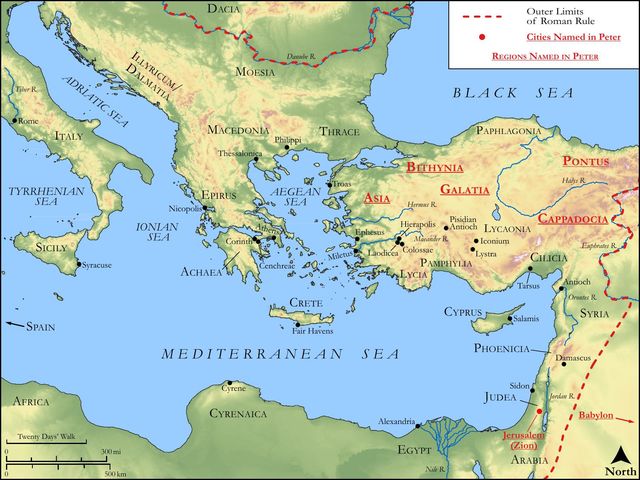
See on the biblical-era maps

Study this verse
Public-domain commentary
Matthew Henry
From his Commentary on the Whole Bible. Henry comments on passages, not single verses — this entry covers 2 Peter 1:1–4. His four-level outline is real structure in the source text, so it is rendered as structure.
The apostle Peter, being moved by the Holy Ghost to write once more to those who from among the Jews were turned to faith in Christ, begins this second epistle with an introduction, wherein the same persons are described and the same blessings are desired that are in the preface to his former letter; but there are some additions or alterations which ought to be taken notice of, in all the three parts of the introduction.
I.We have here a description of the person who wrote the epistle, by the name of Simon, as well as Peter, and by the title of servant, as well as that of apostle. Peter, being in both epistles, seems to be the name most frequently used, and with which he may be thought to be best pleased, it being given him by our Lord, upon his confessing Jesus to be Christ the Son of the living God, and the very name signifying and sealing that truth to be the fundamental article, the rock on which all must build; but the name Simon, though omitted in the former epistle, is mentioned in this, lest the total omission of that name, which was given him when he was circumcised, should make the Jewish believers, who were all zealous of the law, to become jealous of the apostle, as if he disclaimed and despised circumcision. He here styles himself a servant (as well as an apostle) of Jesus Christ; in this he may be allowed to glory, as David does, Psa 116:16. The service of Christ is the way to the highest honour, Joh 12:26. Christ himself is King of kings, and Lord of lords; and he makes all his servants kings and priests unto God, Rev 1:6. How great an honour is it to be the servants of this Master! This is what we cannot, without sin, be ashamed of. To triumph in being Christ's servant is very proper for those who are engaging others to enter into or abide in the service of Christ.
II.We have an account of the people to whom the epistle is written.
They are described in the former epistle as elect according to the foreknowledge of God the Father, and here as having obtained precious faith in our Lord Jesus Christ; for the faith here mentioned is vastly different from the false faith of the heretic, and the feigned faith of the hypocrite, and the fruitless faith of the formal professor, how orthodox soever he is. It is the faith of God's elect (Tit 1:1), wrought by the Spirit of God in effectual calling. Observe,
1.True saving faith is a precious grace, and that not only as it is very uncommon, very scarce, even in the visible church, a very small number of true believers among a great multitude of visible professors (Mat 22:14), but true faith is very excellent and of very great use and advantage to those who have it. The just lives by faith, a truly divine spiritual life; faith procures all the necessary supports and comforts of this excellent life; faith goes to Christ, and buys the wine and milk (Isa 55:1) which are the proper nourishment of the new creature; faith buys and brings home the tried gold, the heavenly treasure that enriches; faith takes and puts on the white raiment, the royal robes that clothe and adorn, Rev 3:18. Observe,
2.Faith is alike precious in the private Christian and in the apostle; it produces the same precious effects in the one and in the other. Faith unites the weak believer to Christ as really as it does the strong one, and purifies the heart of one as truly as of another; and every sincere believer is by his faith justified in the sight of God, and that from all sins, Act 13:39. Faith, in whomsoever it exists, takes hold of the same precious Saviour, and applies the same precious promises.
3.This precious faith is obtained of God. Faith is the gift of God, wrought by the Spirit, who raised up Jesus Christ from the dead.
4.The preciousness of faith, as well as our obtaining it, is through the righteousness of Christ. The satisfactory meritorious righteousness and obedience of Christ gives faith all its value and preciousness: and the righteousness of such a person cannot but be of infinite value to those who by faith receive it. For,
(1.)This Jesus Christ is God, yea, our God, as it is in the original. He is truly God, an infinite Being, who has wrought out this righteousness, and therefore it must be of infinite value.
(2.)He is the Saviour of those that believe, and as such he yielded this meritorious obedience; and therefore it is of such great benefit and advantage to them, because, as surety and Saviour, he wrought out this righteousness in their stead.
III.We have the apostolical benediction, wherein he wishes for the multiplication and increase of the divine favour to them, and the advancement and growth of the work of grace in them, and that peace with God and in their own consciences (which cannot be without grace) may abound in them. This is the very same benediction that is in the former epistle; but here he adds,
1.An account of the way and means whereby grace and peace are multiplied - it is through the knowledge of God and Jesus Christ; this acknowledging or believing in the only living and true God, and Jesus Christ whom he has sent, is the great improvement of spiritual life, or it could not be the way to life eternal, Joh 17:3.
2.The ground of the apostle's faith in asking, and of the Christian's hope in expecting, the increase of grace. What we have already received should encourage us to ask for more; he who has begun the work of grace will perfect it. Observe,
(1.)The fountain of all spiritual blessings is the divine power of Jesus Christ, who could not discharge all the office of Mediator, unless he was God as well as man.
(2.)All things that have any relation to, and influence upon, the true spiritual life, the life and power of godliness, are from Jesus Christ; in him all fulness dwells, and it is from him that we receive, and grace for grace (Joh 1:16), even all that is necessary for the preserving, improving, and perfecting of grace and peace, which, according to some expositors, are called here in this verse godliness and life.
(3.)Knowledge of God, and faith in him, are the channel whereby all spiritual supports and comforts are conveyed to us; but then we must own and acknowledge God as the author of our effectual calling, for so he is here described: Him that hath called us to glory and virtue. Observe here, The design of God in calling or converting men is to bring them to glory and virtue, that is, peace and grace, as some understand it; but many prefer the marginal rendering, by glory and virtue; and so we have effectual calling set forth as the work of the glory and virtue, or the glorious power, of God, which is described Eph 1:19. It is the glory of God's power to convert sinners; this is the power and glory of God which are seen and experienced in his sanctuary (Psa 63:2); this power or virtue is to be extolled by all that are called out of darkness into marvellous light, Pe1 2:9.
(4.)In the fourth verse the apostle goes on to encourage their faith and hope in looking for an increase of grace and peace, because the same glory and virtue are employed and evidenced in giving the promises of the gospel that are exercised in our effectual calling. Observe,
[1.]The good things which the promises make over are exceedingly great. Pardon of sin is one of the blessings here intended; how great this is all who know any thing of the power of God's anger will readily confess, and this is one of those promised favours in bestowing whereof the power of the Lord is great, Num 14:17. To pardon sins that are numerous and heinous (every one of which deserves God's wrath and curse, and that for ever) is a wonderful thing, and is so called, Psa 119:18.
[2.]The promised blessings of the gospel are very precious; as the great promise of the Old Testament was the Seed of the woman, the Messiah (Heb 11:39), so the great promise of the New Testament is the Holy Ghost (Luk 24:49), and how precious must the enlivening, enlightening, sanctifying Spirit be!
[3.]Those who receive the promises of the gospel partake of the divine nature. They are renewed in the spirit of their mind, after the image of God, in knowledge, righteousness, and holiness; their hearts are set for God and his service; they have a divine temper and disposition of soul; though the law is the ministration of death, and the letter killeth, yet the gospel is the ministration of life, and the Spirit quickeneth those who are naturally dead in trespasses and sins.
[4.]Those in whom the Spirit works the divine nature are freed from the bondage of corruption. Those who are, by the Spirit of grace, renewed in the spirit of their mind, are translated into the liberty of the children of God; for it is the world in which corruption reigns. Those who are not of the Father, but of the world, are under the power of sin; the world lies in wickedness, Jo1 5:19. And the dominion that sin has in the men of the world is through lust; their desires are to it, and therefore it rules over them. The dominion that sin has over us is according to the delight we have in it.
Historical interpretation
Eight Centuries of Reception
14 surviving comments on this verse. Each one is dated, so this reads as a timeline rather than a list.
Select a marker to jump to its quote. Markers stagger vertically where authors wrote within a few decades of each other.
And as, if one devote himself to Ischomachus, he will make him a farmer; and to Lampis, a mariner; and to Charidemus, a military commander; and to Simon, an equestrian; and to Perdices, a trader; and to Crobytus, a cook; and to Archelaus, a dancer; and to Homer, a poet; and to Pyrrho, a wrangler; and to Demosthenes, an orator; and to Chrysippus, a dialectician; and to Aristotle, a naturalist; and to Plato, a philosopher: so he who listens to the Lord, and follows the prophecy given by Him, will be formed perfectly in the likeness of the teacher—made a god going about in flesh.
But if thou art desirous of also becoming a god, obey Him that has created thee, and resist not now, in order that, being found faithful in that which is small, you may be enabled to have entrusted to you also that which is great.
wasted by disease. For thou hast become God:
What is the fellowship of the Holy Spirit? Peter describes this by calling it “sharing in the divine nature.”
The word of Christ bestows immortality. But immortality is the companion of divinity, because divinity is immortal, and so immortality is the result of partaking in the divine nature.
Since the Christian is conscious of having been made a partaker of the divine nature, as blessed Peter says in his second epistle, he must measure the nature of God not by the laws of our own nature, but evaluate the divine truths in accordance with the magnificence of God’s testimony concerning himself.
When Christ’s body and blood become the tissue of our members, we become Christ-bearers and “partakers of the divine nature,” as the blessed Peter said.
Why should I add further, carrying you, as it were, through the whole course, that God made man partaker of the Divine nature, as we read in the Epistle of Peter? Whence one says not improperly, We also are His offspring, for He made us akin to Himself, and we are of a rational nature, that we might seek for that Godhead Which is not far from each one of us, in Whom we live and move and have our being.
Just as God stepped out of his nature to become a partaker of our humanity, so we are called to step out of our nature to become partakers of his divinity.
Realize your dignity, O Christian! Once you have been made a partaker of the divine nature, do not return to your former baseness by a life unworthy of that dignity. Remember whose head it is and whose body of which you constitute a member!
God has blessed us abundantly—that is the meaning of this passage. We have received thousands of good things as a result of Christ’s coming, and through them we can become partakers of the divine nature and be turned toward life and godliness. Therefore we must behave in such a way as to add virtue to faith, and in virtue walk along the way which leads to godliness until we come to the perfection of all good things, which is love.
Fleeing from the corruption of lust that is in the world. He rightly says that the lust of the world has corruption, and therefore must be fled from, according to him who says: "Flee from sin as from the face of a serpent" (Ecclesiasticus 21), because there is also incorruptible lust, about which it is sung: "My soul has desired and fainted after the courts of the Lord" (Psalm 83). About which also in the book of Wisdom through a figure of speech called in Greek κλῖμαξ, in Latin gradation, it is very beautifully reported: "The beginning," he says, "of wisdom is the most true desire for discipline" (Wisdom 6). Therefore, care for discipline is love, and love is the keeping of its laws. But keeping of the laws is the completion of incorruption. And incorruption makes one to be near to God. Therefore, the desire for wisdom leads to the eternal kingdom.
That through these things you may become partakers of the divine nature. He suddenly changes the person, and who had previously spoken about himself and his own things: He has given us precious promises, immediately turned to those to whom he was speaking: That through these, he says, you may become partakers of the divine nature. This he does not by chance, but providentially. Therefore (he says) the Lord has revealed to us, who by nature are Jews, who are born under the law, who are even physically instructed by his teaching, all the secrets of his divine power, therefore to us, that is, to his disciples, he has given the greatest and most precious promises of his Spirit, that through these even you who are from the Gentiles, who were not able to see him physically, might be made partakers of his divine nature by us who teach you what we have heard from him, by us consecrating you through his mysteries. Hence, very rightly he said above: May grace and peace be multiplied to you in the knowledge of our Lord Jesus Christ, how all things of his divine power which have been given to us for life and piety, can also be taken as said: May grace and peace be multiplied to you in this, that you may know our Lord Jesus Christ, even you, just as to us through him all the promises or gifts of his divine power, which lead to life and piety, have been given. So that just as we have received the promised gifts from him, or we confidently trust without any doubt that we will receive them, so also may you not doubt about his gifts.
By which He has given us exceedingly great and precious promises. By which means, through the knowledge of Him, because the more perfectly one knows God, the more profoundly one feels the greatness of His promises.
As all things are given to you by His divine power, which pertains to life and godliness, through the knowledge of Him who called us by His glory and virtue, by which precious and great promises have been granted to you, so that through these you may become partakers of the divine nature, having escaped the corruption that is in the world through lust.
Indeed, a long series has been presented, and this is the understanding: Just as countless good things have been received through the appearance of Christ, by which we may become partakers of the divine nature and be led back to life and godliness: so we must conduct ourselves, so that we may support virtue through faith, and by this means progress towards the promotion of godliness, until we reach the perfection of diligence, which is love. Moreover, we have become partakers of the divine nature through the coming of the Lord and God, who took the first fruits of our nature upon Himself and sanctified it by assuming it. If the first fruits are holy, the mass is also holy. Furthermore, the mass of the first fruits is nothing other than those from which the first fruits come. However, Peter speaks of the corruption that comes from worldly lust, as if it were concerning the corruptible and those things that are corruptible.
Continue studying 2 Peter 1:4 across the web’s major study libraries — every link below opens this exact verse, chapter, or book on the destination site.
Read & Compare
 BibleGatewayThis verse in more than 200 translations and 70 languages.
 Bible.comThe YouVersion reader — hundreds of translations, reading plans, and highlights.
 ESV.orgCrossway's official English Standard Version reader.
 NET BibleThe NET translation with 60,000+ translators' notes on every rendering decision.
 STEP BibleTyndale House's free study tool — original text, vocabulary, and scholarly resources.
 BibliaLogos Bible Software's free web reader.
 USCCBThe New American Bible (Revised Edition) with the U.S. bishops' study notes.
Commentaries
 BibleHub CommentariesDozens of classic commentaries on this verse, gathered on one page.
 StudyLightMore than 100 commentary sets — the largest collection on the web.
 BibleRefPlain-English commentary on what this verse means, verse by verse.
 Enduring WordDavid Guzik's free commentary on this chapter, widely used by Bible teachers.
 Bible Study ToolsVerse commentary alongside Greek and Hebrew study aids.
Original Language & Research
- BibleHub InterlinearThe verse word by word — original language, transliteration, and English.
- BibleHub LexiconEvery word's original-language definition and Strong's entry.
 Blue Letter BibleDeep-study tools — Strong's numbers, concordance, and word studies.
 CNTR CollationThe earliest Greek manuscripts of this verse, collated letter by letter.
Sermons, Hymns & Audio


TrulyRandomVerse is not affiliated with these sites and doesn’t control their content. They’re linked because they’re genuinely useful.
Summary
2 Peter 1:4 reveals the profound spiritual inheritance granted to believers through God's magnificent promises, enabling them to participate in the divine nature and escape the world's corrupting influence driven by sinful desires. This verse serves as the foundation for Christian growth, emphasizing that God's gracious provision empowers believers to live a life increasingly reflective of His character, free from the dominion of worldly decay.
Context
ShowHideLiterary Context
This verse is deeply embedded within Peter's opening exhortation to spiritual growth and diligence. Following his greeting in 2 Peter 1:1-2, Peter immediately establishes the divine foundation for the Christian life. 2 Peter 1:3 declares that God's divine power has already "given unto us all things that pertain unto life and godliness, through the knowledge of him that hath called us to glory and virtue." Verse 4 then elaborates on how these "all things" are given—namely, through "exceeding great and precious promises." It logically precedes Peter's subsequent call to "add to your faith virtue" and other Christian graces in 2 Peter 1:5-7, demonstrating that the capacity for such growth is divinely supplied, not merely human effort.
Historical & Cultural Context
Peter is writing to a dispersed Christian audience, likely facing various pressures, including internal false teachings and external societal temptations. The concept of "corruption that is in the world through lust" would resonate strongly with believers living among the Gentiles under Rome, amid pervasive idolatry, moral depravity, and philosophical systems that often promoted self-indulgence or asceticism. The idea of "partaking of the divine nature" would have been astonishing in a polytheistic context, where gods were often capricious and distant. For Jewish believers, it would connect to the covenant relationship with a holy God, while for Gentiles, it offered a radical alternative to their former ways of life, emphasizing a genuine transformation rather than mere ritualistic adherence.
Key Themes
ShowHideA central theme in 2 Peter is the authenticity of the Christian faith and the importance of genuine spiritual knowledge in the face of false teachers. Verse 4 contributes to this by establishing the divine source of true spiritual life and the means by which believers are preserved from worldly corruption. The theme of divine provision and human responsibility is also prominent; God provides the promises and the means, but believers must actively respond by escaping corruption and pursuing godliness. Furthermore, the concept of sanctification—the process of becoming more like Christ—is powerfully introduced, underscoring that believers are not merely forgiven but are also being transformed to reflect God's character, moving away from the "corruption that is in the world through lust" as described in 2 Peter 2:19.
Exposition and Analysis
ShowHideKey Word Analysis
ShowHideThis word, in the middle voice, signifies to "bestow gratuitously." It emphasizes that the promises and the resulting privilege of partaking in the divine nature are not earned but are a free, unmerited gift from God. It highlights God's initiative and generosity in providing the means for salvation and transformation.
Derived from a root meaning "common," this term denotes a "sharer" or "associate." It indicates a genuine, intimate fellowship and participation in something. Here, it means believers truly share in, or participate in, the qualities and character of God, not His essence or deity. This is a profound spiritual union, enabling believers to reflect God's moral attributes.
This word signifies "decay," "ruin," or "moral deterioration." It describes the pervasive decay and destructive power of sin that characterizes the fallen world. The verse implies that through God's promises and the divine nature, believers are enabled to escape this destructive influence, which is driven by "lust" or sinful desires.
Verse Breakdown
ShowHide"Whereby are given unto us exceeding great and precious promises"
This clause establishes the mechanism through which God's divine power (mentioned in 2 Peter 1:3) operates. The "promises" are not just future hopes but active, powerful declarations of God's character and intentions, already bestowed upon believers. They are "exceeding great" in their scope and magnitude, encompassing all of God's covenant blessings, and "precious" due to their inestimable value, secured by Christ's sacrifice.
"that by these ye might be partakers of the divine nature"
This phrase reveals the glorious purpose and result of receiving these promises. "By these" (the promises), believers are enabled to become "partakers"—sharers or associates—in God's "divine nature." This does not imply deification, but a profound spiritual transformation where believers increasingly reflect God's moral attributes, such as holiness, righteousness, love, and truth. It signifies a spiritual union and an internal transformation that aligns the believer's character with God's.
"having escaped the corruption that is in the world through lust"
This final clause describes the negative aspect of this transformation and the state from which believers are delivered. "Having escaped" indicates a decisive break from the dominion of sin. The "corruption" refers to the pervasive moral decay and spiritual ruin that characterizes the fallen world, driven by "lust" (sinful desires or cravings). Through the divine nature imparted by God's promises, believers are empowered to break free from the world's destructive influence and the cycle of sin.
Literary Devices
ShowHidePeter employs several literary devices to convey the profound truth of this verse. The use of hyperbole in "exceeding great and precious promises" emphasizes the immense value and magnitude of God's provisions, underscoring their unparalleled worth. The phrase "partakers of the divine nature" functions as a powerful metaphor, illustrating a deep, intimate spiritual union and transformation rather than a literal change in essence. This metaphor highlights the profound shift in identity and character available to believers. Furthermore, the contrast between "divine nature" and "corruption that is in the world through lust" creates a stark antithesis, sharply delineating the two opposing realities—the life of godliness empowered by God versus the destructive path of worldly sin. This contrast serves to magnify the grace and power of God in delivering believers from spiritual decay.
Theological and Thematic Connections
ShowHideThis verse articulates a core theological truth: the believer's transformation is rooted in God's gracious initiative and His powerful promises, leading to an intimate participation in His moral character. It underscores the profound shift from a life dominated by worldly corruption and sinful desires to one empowered by God's own nature. This participation is not a mystical absorption into divinity, but an ethical and spiritual conformity to God's holiness, righteousness, and love, made possible through the indwelling Holy Spirit and the truth of His Word. It speaks to the ongoing process of sanctification, where believers are progressively conformed to the image of Christ, reflecting His glory and virtue.
Reflection and Application
ShowHide2 Peter 1:4 offers a breathtaking vision of the Christian life, reminding us that our spiritual journey is not merely about avoiding sin, but about actively participating in God's very nature. This means we are called to a life of profound transformation, where God's character is increasingly reflected in our thoughts, words, and actions. To truly live out this verse, we must deeply internalize and rely upon God's "exceeding great and precious promises"—promises of forgiveness, power, presence, and eternal life. These promises are not abstract concepts but living truths that empower us to resist the pervasive "corruption that is in the world through lust." Our daily walk becomes a dynamic process of choosing the divine nature over worldly impulses, allowing the Spirit to cultivate holiness, love, and righteousness within us. This verse compels us to ask ourselves if we are truly leveraging the divine resources available to us, actively seeking to embody God's character and escape the destructive patterns of the world.
Questions for Reflection
ShowHideFAQ
ShowHideDoes "partakers of the divine nature" mean believers become gods?
ShowHideNo, the phrase "partakers of the divine nature" (Greek: koinōnós theîos phýsis) does not mean believers become divine in essence or become gods themselves. This interpretation would contradict the clear biblical teaching of God's unique sovereignty and deity. Instead, it signifies that believers, through faith in Christ and the indwelling Holy Spirit, are enabled to share in God's moral attributes and character. It means we are transformed to reflect His holiness, righteousness, love, truth, and purity, rather than His omnipotence, omniscience, or omnipresence. It's about spiritual and ethical conformity to God's character, not a change in our created essence. This transformation is a process of sanctification, making us more like Christ, as seen in passages like Romans 8:29 and Ephesians 4:22-24.
Christ-Centered Fulfillment
ShowHide2 Peter 1:4 finds its ultimate fulfillment and enablement in Jesus Christ. The "exceeding great and precious promises" are all "Yes" and "Amen" in Him, as 2 Corinthians 1:20 declares. It is through Christ's atoning sacrifice and resurrection that humanity is reconciled to God, making possible the very access to these promises and the transformative power they convey. The ability to be "partakers of the divine nature" is not an abstract concept but a reality grounded in our union with Christ. As believers are "in Christ," they are united with the very Son who perfectly embodies the divine nature (Colossians 2:9). Through His Spirit, Christ indwells believers, empowering them to live out this new nature, enabling them to "escape the corruption that is in the world through lust." He is the Lamb of God who takes away the sin of the world (John 1:29), and it is His victory over sin and death that provides the ultimate escape from the world's pervasive corruption. Thus, our participation in the divine nature is a participation in Christ's own life, character, and victory, progressively conforming us to His image (Romans 8:29).