


Colossians 3:10
Bible text: King James Version (1769 Blayney text) · Public domain
Bible text: Berean Standard Bible · Public domain
Bible text: American Standard Version (1901) · Public domain
Bible text: World English Bible, Messianic edition · Public domain
Bible text: Geneva Bible (1599) · Public domain
Bible text: Young's Literal Translation · Public domain
- καὶkaiandG2532CONJConjunction
- ἐνδυσάμενοιendusamenoihaving put onG1746V-AMP-NPMVerb Aorist Middle Participle Nominative Plural Masculine
- τὸνtontheG3588T-ASMDefinite article Accusative Singular Masculine
- νέονneonnewG3501A-ASMAdjective Accusative Singular Masculine
- τὸνtonwhichG3588T-ASMDefinite article Accusative Singular Masculine
- ἀνακαινούμενονanakainoumenonis being renewedG341V-PPP-ASMVerb Present Passive Participle Accusative Singular Masculine
- εἰςeisinG1519PREPPreposition
- ἐπίγνωσινepignōsinknowledgeG1922N-ASFNoun Accusative Singular Feminine
- κατ᾽kat᾽according toG2596PREPPreposition
- εἰκόναeikona[the] imageG1504N-ASFNoun Accusative Singular Feminine
- τοῦtouof the [one who]G3588T-GSMDefinite article Genitive Singular Masculine
- κτίσαντοςktisantoshaving createdG2936V-AAP-GSMVerb Aorist Active Participle Genitive Singular Masculine
- αὐτόν·autonhimG846P-ASMPersonal pronoun Accusative Singular Masculine
English is a literal word-by-word gloss of the Greek, not the KJV's wording. Why?
This is the original text the KJV's translators worked from — each Greek word with its own literal English meaning in this verse, prepared by scholars at Tyndale House, Cambridge. The KJV translates whole sentences, not word by word, so its wording differs: one Greek word can become several English words, and the KJV may choose “charity” where the gloss reads “love”. Both are faithful — they answer different questions. For the KJV's own rendering, switch to the KJV text.
Details
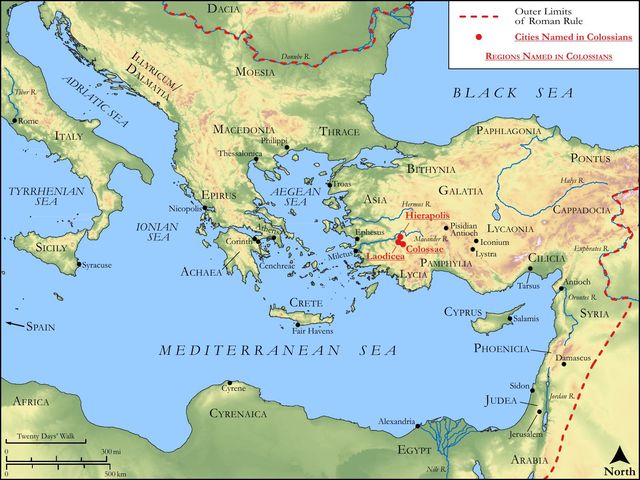
See on the biblical-era maps

Study this verse
Public-domain commentary
Matthew Henry
From his Commentary on the Whole Bible. Henry comments on passages, not single verses — this entry covers Colossians 3:8–11.
As we are to mortify inordinate appetites, so we are to mortify inordinate passions (Col 3:8): But now you also put off all these, anger wrath, malice; for these are contrary to the design of the gospel, as well as grosser impurities; and, though they are more spiritual wickedness, have not less malignity in them. The gospel religion introduces a change of the higher as well as the lower powers of the soul, and supports the dominion of right reason and conscience over appetite and passion. Anger and wrath are bad, but malice is worse, because it is more rooted and deliberate; it is anger heightened and settled. And, as the corrupt principles in the heart must be cut off, so the product of them in the tongue; as blasphemy, which seems there to mean, not so much speaking ill of God as speaking ill of men, giving ill language to them, or raising ill reports of them, and injuring their good name by any evil arts, - filthy communication, that is, all lewd and wanton discourse, which comes from a polluted mind in the speaker and propagates the same defilements in the hearers, - and lying: Lie not one to another (Col 3:9), for it is contrary both to the law of truth and the law of love, it is both unjust and unkind, and naturally tends to destroy all faith and friendship among mankind. Lying makes us like the devil (who is the father of lies), and is a prime part of the devil's image upon our souls; and therefore we are cautioned against this sin by this general reason: Seeing you have put off the old man with his deeds, and have put on the new man, Col 3:10. The consideration that we have by profession put away sin and espoused the cause and interest of Christ, that we have renounced all sin and stand engaged to Christ, should fortify us against this sin of lying. Those who have put off the old man have put it off with its deeds; and those who have put on the new man must put on all its deeds - not only espouse good principles but act them in a good conversation. The new man is said to be renewed in knowledge, because an ignorant soul cannot be a good soul. Without knowledge the heart cannot be good, Pro 19:2. The grace of God works upon the will and affections by renewing the understanding. Light is the first thing in the new creation, as it was in the first: after the image of him who created him. It was the honour of man in innocence that he was made after the image of God; but that image was defaced and lost by sin, and is renewed by sanctifying grace: so that a renewed soul is something like what Adam was in the day he was created. In the privilege and duty of sanctification there is neither Greek nor Jew, circumcision nor uncircumcision, Barbarian, Scythian, bond nor free, Col 3:11. There is now no difference arising from different country or different condition and circumstance of life: it is as much the duty of the one as of the other to be holy, and as much the privilege of the one as of the other to receive from God the grace to be so. Christ came to take down all partition-walls, that all might stand on the same level before God, both in duty and privilege. And for this reason, because Christ is all in all. Christ is a Christian's all, his only Lord and Saviour, and all his hope and happiness. And to those who are sanctified, one as well as another and whatever they are in other respects, he is all in all, the Alpha and Omega, the beginning and the end: he is all in all things to them.
Historical interpretation
Two Centuries of Reception
3 surviving comments on this verse. Each one is dated, so this reads as a timeline rather than a list.
Select a marker to jump to its quote. Markers stagger vertically where authors wrote within a few decades of each other.
For what other visible fruit is there of the invisible Spirit, than the rendering of the flesh mature and capable of in corruption? If then
One royal form it hath, that, namely, of Christ. They whom he has in view, appear to me rather to be of the Gentiles. For like as earth, being but sand, even though one part be greater, another less, losing its own previous form, doth afterwards become gold; and like as wool, of whatever kind it be, receiveth another aspect, and hides its former one: so truly is it also with the faithful.
"Seeing that ye have put off the old man with his doings, and have put on the new man, which is being renewed unto knowledge after the image of Him that created him."
It is worth enquiring here, what can be the reason why he calls the corrupt life, "members," and "man," and "body," and again the virtuous life, the same. And if "the man" means "sins," how is it that he saith, "with his doings"? For once he said, "the old man," showing that this is not man, but the other. The moral choice doth rather determine one than the substance, and is rather "man" than the other. For his substance casteth him not into hell, nor leadeth him into the kingdom, but men the themselves: and we neither love nor hate any one so far as he is man, but so far as he is such or such a man. If then the substance be the body, and in either sort cannot be accountable, how doth he say that it is evil? But what is that he saith, "with his doings"? He means the choice, with the acts. And he calleth him "old," on purpose to show his deformity, and hideousness, and imbecility; and "new," as if to say, Do not expect that it will be with this one even as with the other, but the reverse: for ever as he farther advances, he hasteneth not on to old age, but to a youthfulness greater than the preceding. For when he hath received a fuller knowledge, he is both counted worthy of greater things, and is in more perfect maturity, in higher vigor; and this, not from youthfulness alone, but from that "likeness" also, "after" which he is. Lo! the best life is styled a creation, after the image of Christ: for this is the meaning of, "after the image of Him that created him," for Christ too came not finally to old age, but was so beautiful as it is not even possible to tell.
Continue studying Colossians 3:10 across the web’s major study libraries — every link below opens this exact verse, chapter, or book on the destination site.
Read & Compare
 BibleGatewayThis verse in more than 200 translations and 70 languages.
 Bible.comThe YouVersion reader — hundreds of translations, reading plans, and highlights.
 ESV.orgCrossway's official English Standard Version reader.
 NET BibleThe NET translation with 60,000+ translators' notes on every rendering decision.
 STEP BibleTyndale House's free study tool — original text, vocabulary, and scholarly resources.
 BibliaLogos Bible Software's free web reader.
 USCCBThe New American Bible (Revised Edition) with the U.S. bishops' study notes.
Commentaries
 BibleHub CommentariesDozens of classic commentaries on this verse, gathered on one page.
 StudyLightMore than 100 commentary sets — the largest collection on the web.
 BibleRefPlain-English commentary on what this verse means, verse by verse.
 Enduring WordDavid Guzik's free commentary on this chapter, widely used by Bible teachers.
 Bible Study ToolsVerse commentary alongside Greek and Hebrew study aids.
Original Language & Research
- BibleHub InterlinearThe verse word by word — original language, transliteration, and English.
- BibleHub LexiconEvery word's original-language definition and Strong's entry.
 Blue Letter BibleDeep-study tools — Strong's numbers, concordance, and word studies.
 CNTR CollationThe earliest Greek manuscripts of this verse, collated letter by letter.
Sermons, Hymns & Audio


TrulyRandomVerse is not affiliated with these sites and doesn’t control their content. They’re linked because they’re genuinely useful.
Summary
Colossians 3:10 encapsulates the profound spiritual transformation of believers, describing a new identity in Christ characterized by having "put on the new man." This new self is not static but dynamically "renewed in knowledge," a continuous process of growth in understanding God and His will. The ultimate purpose of this renewal is to restore humanity to its original design, reflecting the very image of God who created all things.
Context
ShowHideLiterary Context
Colossians 3:10 is strategically placed within a pivotal section of Paul's letter, immediately following his strong exhortation to "put to death" the practices and desires of the "old man" or "old self" (e.g., sexual immorality, impurity, covetousness, anger, malice, lying) as detailed in Colossians 3:5-9. Having commanded believers to strip off these former ways of life, Paul then transitions to the positive command of "putting on" the "new man" (Colossians 3:10-17). This stark contrast highlights the radical break from a life dominated by sin to one transformed by Christ. The verses that follow further elaborate on the characteristics of this new man, emphasizing unity, compassion, kindness, humility, gentleness, patience, forgiveness, and love, all culminating in the peace of Christ ruling in their hearts. The passage thus moves from the negative (what to put off) to the positive (what to put on), providing a comprehensive picture of Christian sanctification.
Historical & Cultural Context
The city of Colossae was situated in Phrygia, a region known for its syncretistic religious practices, blending various philosophical and spiritual traditions. Paul wrote this letter to address a specific "Colossian heresy," which appears to have been a mix of Jewish legalism, asceticism, angel worship, and a form of Gnosticism that emphasized secret knowledge and philosophical speculation. This heresy undermined the supremacy and sufficiency of Christ. In this context, Paul's emphasis on being "renewed in knowledge" (Gk. epígnōsis) directly counters the false, speculative "knowledge" promoted by the heretics. The concept of a "new man" or "new creation" would have resonated with both Jewish ideas of spiritual cleansing and Hellenistic philosophical notions of self-improvement, but Paul grounds this transformation firmly in Christ, not human effort or esoteric rituals. The call to reflect the "image of him that created him" also speaks to the broader biblical narrative of creation and humanity's fall, offering a redemptive vision that would have been understood against the backdrop of ancient creation myths.
Key Themes
ShowHideColossians 3:10 contributes significantly to several overarching themes in the letter and Pauline theology.
The New Man/New Self
This verse is central to the theme of radical identity transformation in Christ. It signifies a spiritual rebirth where believers are no longer defined by their sinful past but by their union with Christ. This concept is foundational to Christian living, as seen in other Pauline epistles like 2 Corinthians 5:17, where believers are called "new creatures." It's a shift from a life "dead in trespasses" to one "made alive together with Christ" (Ephesians 2:1-5).
Renewed in Knowledge
The renewal of the new man is specifically "in knowledge" (Gk. epígnōsis), which is not merely intellectual understanding but a deep, experiential, and transformative knowledge of God and His will. This knowledge is crucial for living out the new identity, guiding moral choices and spiritual growth. It involves a continuous process of learning and growing in spiritual insight, which impacts one's character and actions. This echoes the idea of the renewing of the mind found in Romans 12:2, where believers are exhorted to be transformed by the renewal of their minds, proving what is the good and acceptable and perfect will of God.
After the Image of Him that Created Him
This phrase points to the ultimate goal of the renewal: to be restored to the original likeness of God, in which humanity was created (Genesis 1:27). Sin marred this divine image, but through Christ, believers are being progressively conformed to His character, reflecting His holiness, righteousness, and true knowledge. This process of becoming more like Christ is central to sanctification and glorification, a journey of being conformed to the image of God's Son (Romans 8:29).
Exposition and Analysis
ShowHideKey Word Analysis
ShowHideFrom the root meaning "to sink into a garment," this verb signifies to invest with clothing, literally or figuratively. Here, it is used metaphorically to describe the act of adopting a new spiritual identity and character. It implies a deliberate, active choice to embrace and live out the qualities of the "new man," much like putting on a new set of clothes signifies a change in appearance or role. The aorist tense in the Greek indicates a decisive act that has already taken place (the initial conversion and identification with Christ), with ongoing implications.
Derived from an (again) and kainos (new in quality, fresh), this word means to renovate, to make new again, or to restore to a former good state. The present participle form indicates an ongoing, continuous process of being made new. This is not a one-time event but a progressive transformation that continually updates and refreshes the believer's inner being, bringing it into conformity with God's original design.
This term denotes a full, precise, or experiential knowledge, a deep and accurate discernment, rather than mere intellectual acquaintance (gnosis). It implies a relational and transformative understanding that leads to genuine spiritual insight and acknowledgement. In the context of the Colossian heresy, this "true knowledge" stands in contrast to the false, speculative knowledge offered by human philosophies, emphasizing that genuine spiritual renewal is rooted in a profound and accurate understanding of God and His will, particularly as revealed in Christ.
Verse Breakdown
ShowHide"And have put on the new [man]"
This clause describes the decisive act of conversion and identification with Christ, where believers metaphorically clothe themselves with a new identity. This "new man" (or "new self") represents the regenerated nature of the believer, a spiritual rebirth that fundamentally changes one's core being and orientation away from sin and towards God. It is a radical break from the former way of life, implying a new set of values, desires, and behaviors.
"which is renewed in knowledge"
This specifies the means and nature of the new man's ongoing transformation. The new self is not static but dynamically and continuously "renewed." This renewal is fundamentally "in knowledge," meaning a deep, experiential, and accurate understanding of God. This knowledge is not merely intellectual but transformative, shaping the believer's thoughts, attitudes, and actions, and guiding them in living out their new identity.
"after the image of him that created him"
This phrase reveals the ultimate goal and pattern of the renewal. The "new man" is being conformed to the original likeness of God, in which humanity was created. Sin marred this divine image, but through Christ, believers are being progressively restored to reflect God's character, holiness, righteousness, and true knowledge. This points back to the creation account and forward to the believer's ultimate glorification, emphasizing that the purpose of salvation is to restore humanity to its intended relationship and resemblance to its Creator.
Literary Devices
ShowHideColossians 3:10 employs several potent literary devices to convey its profound theological message. The most prominent is Metaphor, specifically the clothing metaphor of "putting on the new man." This vivid imagery illustrates the active and intentional nature of adopting a new spiritual identity, much like one changes garments. It contrasts sharply with the earlier command to "put off" the old self, creating a clear Antithesis or Contrast between the former sinful life and the new life in Christ. This juxtaposition powerfully communicates the radical transformation required of believers. Furthermore, the phrase "after the image of him that created him" utilizes Allusion to the Genesis creation account (Genesis 1:26-27), drawing on established biblical Imagery of humanity's original design and purpose. This allusion reminds the reader of humanity's intended state and the redemptive goal of being restored to that divine likeness. The cumulative effect of these devices is to present a dynamic and comprehensive picture of Christian sanctification as both a decisive act and an ongoing process of conforming to God's character.
Theological and Thematic Connections
ShowHideColossians 3:10 is a cornerstone for understanding Christian anthropology and the doctrine of sanctification. It underscores that salvation is not merely forgiveness of sins but a radical re-creation of the individual, restoring humanity to its intended purpose and likeness. This restoration is a progressive work of the Holy Spirit, enabling believers to grow in true knowledge and reflect the character of God, who is the ultimate Creator. The verse connects the new creation in Christ directly to the original creation, implying that redemption is a re-establishment of God's perfect design. It highlights the importance of spiritual growth through knowledge, which is not merely intellectual but transformative, leading to practical righteousness and holiness in daily life. This ongoing renewal culminates in a life that increasingly bears the image of Christ, who is the perfect image of the invisible God.
Reflection and Application
ShowHideColossians 3:10 is not just a theological statement but a profound call to active participation in our spiritual growth. The command to "put on the new man" implies a deliberate, ongoing choice to align our thoughts, attitudes, and actions with the character of Christ. This is not a passive process but an intentional engagement with God's transforming power. It means consciously shedding the habits and mindsets of our old, sinful nature and actively cultivating virtues like compassion, kindness, humility, gentleness, and patience, as outlined in the verses immediately following this passage (Colossians 3:12-17). The "renewal in knowledge" emphasizes the critical role of God's Word and the Holy Spirit in shaping our understanding and behavior. It means continually seeking a deeper, more experiential knowledge of God, allowing His truth to penetrate and transform every area of our lives. Ultimately, living out this verse means striving daily to reflect the image of our Creator, becoming more like Jesus in every aspect of our being, and letting our transformed lives bear witness to the power of the Gospel.
Questions for Reflection
ShowHideFAQ
ShowHideWhat does it mean to "put on the new man" practically?
ShowHideTo "put on the new man" means to actively embrace and live out the new identity you have in Christ. Practically, this involves a conscious decision to shed sinful habits, attitudes, and ways of thinking (the "old man") and to adopt Christ-like virtues and behaviors (the "new man"). It's a daily process of choosing righteousness over sin, love over hate, humility over pride, and forgiveness over bitterness. It means allowing the Holy Spirit to transform your character so that your actions, words, and thoughts increasingly reflect God's nature. This is not about human effort alone, but cooperation with the Spirit who empowers us to live out this new reality, as seen in passages like Ephesians 4:22-24.
Is "renewed in knowledge" just about intellectual learning?
ShowHideNo, "renewed in knowledge" (Greek: epígnōsis) goes far beyond mere intellectual learning or head knowledge. While it certainly involves understanding biblical truths, the term signifies a deep, experiential, and transformative knowledge of God and His will. It's a relational knowledge that impacts one's entire being – mind, emotions, and will. This kind of knowledge leads to genuine spiritual insight, discernment, and practical wisdom, enabling believers to live in a way that truly honors God. It's the kind of knowledge that transforms the mind and heart, leading to a changed life, as emphasized in Romans 12:2.
How does this verse relate to the original creation in God's image?
ShowHideColossians 3:10 directly links the believer's spiritual renewal to the original creation of humanity. The phrase "after the image of him that created him" is an explicit allusion to Genesis 1:26-27, where God states His intention to create humanity in His own "image" and "likeness." Sin marred this divine image, causing humanity to fall short of God's glory. This verse teaches that through Christ, believers are being progressively restored to that original, unblemished image. The "new man" is precisely the individual who is being remade to reflect God's character – His holiness, righteousness, and true knowledge – as He originally intended. It highlights that redemption is not just about salvation from sin, but also about the restoration of humanity to its intended purpose and resemblance to its Creator.
Christ-Centered Fulfillment
ShowHideColossians 3:10 finds its ultimate fulfillment and meaning in Jesus Christ. He is the archetypal "new man," the perfect and unblemished "image of the invisible God" (Colossians 1:15). Humanity was created in God's image, but this image was marred by sin. Christ, through His incarnation, life, death, and resurrection, perfectly embodies and restores that image. When believers "put on the new man," they are, in essence, putting on Christ Himself, being united with Him in His death to sin and His resurrection to new life (Romans 6:3-11). Our renewal "in knowledge" is a progressive conformity to Christ, who is the very embodiment of divine wisdom and knowledge (Colossians 2:2-3). The Holy Spirit works within us to transform us "into the same image from one degree of glory to another" (2 Corinthians 3:18), making us more and more like Jesus, who perfectly reflects the Creator. Thus, Colossians 3:10 is a powerful declaration that our new identity, ongoing renewal, and ultimate destiny are all inextricably linked to and fulfilled in Christ, the one who perfectly reveals and restores the image of our Creator.