


Romans 8:29
- ὅτιhotiForG3754CONJConjunction
- οὓςhousthose whomG3739R-APMRelative pronoun Accusative Plural Masculine
- προέγνωproegnōHe foreknewG4267V-2AAI-3SVerb 2nd Aorist Active Indicative 3rd Singular
- καὶkaialsoG2532CONJConjunction
- προώρισενproōrisenHe predestined [to be]G4309V-AAI-3SVerb Aorist Active Indicative 3rd Singular
- συμμόρφουςsummorphousconformed toG4832A-APMAdjective Accusative Plural Masculine
- τῆςtēstheG3588T-GSFDefinite article Genitive Singular Feminine
- εἰκόνοςeikonosimageG1504N-GSFNoun Genitive Singular Feminine
- τοῦtouof theG3588T-GSMDefinite article Genitive Singular Masculine
- υἱοῦhuiouSonG5207N-GSMNoun Genitive Singular Masculine
- αὐτοῦautouof HimG846P-GSMPersonal pronoun Genitive Singular Masculine
- εἰςeisforG1519PREPPreposition
- τὸto<the>G3588T-ASNDefinite article Accusative Singular Neuter
- εἶναιeinaito beG1511V-PANVerb Present Active Infinitive
- αὐτὸνautonHimG846P-ASMPersonal pronoun Accusative Singular Masculine
- πρωτότοκονprōtotokonfirstbornG4416A-ASMAdjective Accusative Singular Masculine
- ἐνenamongG1722PREPPreposition
- πολλοῖςpolloismanyG4183A-DPMAdjective Dative Plural Masculine
- ἀδελφοῖς·adelphoisbrothersG80N-DPMNoun Dative Plural Masculine
English is a literal word-by-word gloss of the Greek, not the KJV's wording. Why?
This is the original text the KJV's translators worked from — each Greek word with its own literal English meaning in this verse, prepared by scholars at Tyndale House, Cambridge. The KJV translates whole sentences, not word by word, so its wording differs: one Greek word can become several English words, and the KJV may choose “charity” where the gloss reads “love”. Both are faithful — they answer different questions. For the KJV's own rendering, switch to the KJV text.
Details
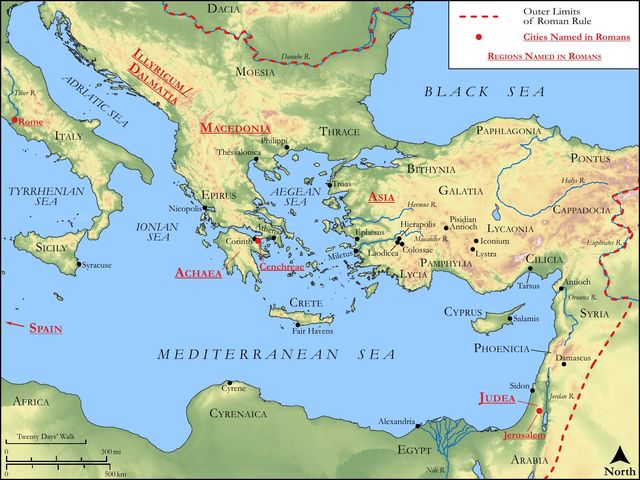
See on the biblical-era map

Study this verse
Public-domain commentary
Matthew Henry
From his Commentary on the Whole Bible. Henry comments on passages, not single verses — this entry covers Romans 8:29–30. His two-level outline is real structure in the source text, so it is rendered as structure.
The apostle, having reckoned up so many ingredients of the happiness of true believers, comes here to represent the ground of them all, which he lays in predestination. These precious privileges are conveyed to us by the charter of the covenant, but they are founded in the counsel of God, which infallibly secures the event. That Jesus Christ, the purchaser, might not labour in vain, nor spend his strength and life for nought and in vain, there is a remnant given him, a seed that he shall see, so that the good pleasure of the Lord shall prosper in his hands. For the explication of this he here sets before us the order of the causes of our salvation, a golden chain, which cannot be broken. There are four links of it: -
I.Whom he did foreknow he also did predestinate to be conformed to the image of his Son.
All that God designed for glory and happiness as the end he decreed to grace and holiness as the way. Not, whom he did foreknow to be holy those he predestinated to be so. The counsels and decrees of God do not truckle to the frail and fickle will of men; no, God's foreknowledge of the saints is the same with that everlasting love wherewith he is said to have loved them, Jer 31:3. God's knowing his people is the same with his owning them, Psa 1:6; Joh 10:14; Ti2 2:19. See Rom 11:2. Words of knowledge often in scripture denote affection; so here: Elect according to the foreknowledge of God, Pe1 1:2. And the same word is rendered fore-ordained, Pe1 1:20. Whom he did foreknow, that is, whom he designed for his friends and favourites. I know thee by name, said God to Moses, Exo 33:12. Now those whom god thus foreknew he did predestinate to be conformed to Christ.
1.Holiness consists in our conformity to the image of Christ. This takes in the whole of sanctification, of which Christ is the great pattern and sampler. To be spirited as Christ was, to walk and live as Christ did, to bear our sufferings patiently as Christ did. Christ is the express image of his Father, and the saints are conformed to the image of Christ. Thus it is by the mediation and interposal of Christ that we have God's love restored to us and God's likeness renewed upon us, in which two things consists the happiness of man.
2.All that God hath from eternity foreknown with favour he hath predestinated to this conformity. It is not we that can conform ourselves to Christ. Our giving ourselves to Christ takes rise in God's giving us to him; and, in giving us to him, he predestinated us to be conformable to his image. It is a mere cavil therefore to call the doctrine of election a licentious doctrine, and to argue that it gives encouragement to sin, as if the end were separated from the way and happiness from holiness. None can know their election but by their conformity to the image of Christ; for all that are chosen are chosen to sanctification (Th2 2:13), and surely it cannot be a temptation to any to be conformed to the world to believe that they were predestinated to be conformed to Christ.
3.That which is herein chiefly designed is the honour of Jesus Christ, that he might be the first-born among many brethren; that is, that Christ might have the honour of being the great pattern, as well as the great prince, and in this, as in other things, might have pre-eminence. It was in the first-born that all the children were dedicated to God under the law. The first-born was the head of the family, on whom all the rest did depend: now in the family of the saints Christ must have the honour of being the first-born. And blessed be God that there are many brethren; though they seem but a few in one place at one time, yet, when they come all together, they will be a great many. There is, therefore, a certain number predestinated, that the end of Christ's undertaking might be infallibly secured. Had the event been left at uncertainties in the divine counsels, to depend upon the contingent turn of man's will, Christ might have been the first-born among but few or no brethren - a captain without soldiers and a prince without subjects - to prevent which, and to secure to him many brethren, the decree is absolute, the thing ascertained, that he might be sure to see his seed, there is a remnant predestinated to be conformed to his image, which decree will certainly have its accomplishment in the holiness and happiness of that chosen race; and so, in spite of all the opposition of the powers of darkness, Christ will be the first-born among many, very many brethren.
II.Whom he did predestinate those he also called, not only with the external call (so many are called that were not chosen, Mat 20:16; Mat 22:14), but with the internal and effectual call. The former comes to the ear only, but this to the heart. All that God did from eternity predestinate to grace and glory he does, in the fulness of time, effectually call. The call is then effectual when we come at the call; and we then come at the call when the Spirit draws us, convinces the conscience of guilt and wrath, enlightens the understanding, bows the will, persuades and enables us to embrace Christ in the promises, makes us willing in the day of his power. It is an effectual call from self and earth to God, and Christ, and heaven, as our end - from sin and vanity to grace, and holiness, and seriousness as our way. This is the gospel call. Them he called, that the purpose of God, according to election, might stand: we are called to that to which we were chosen. So that the only way to make our election sure is to make sure our calling, Pe2 1:10.
III.Whom he called those he also justified.
All that are effectually called are justified, absolved from guilt, and accepted as righteous through Jesus Christ. They are recti in curia - right in court; no sin that ever they have been guilty of shall come against them, to condemn them. The book is crossed, the bond cancelled, the judgment vacated, the attainder reversed; and they are no longer dealt with as criminals, but owned and loved as friends and favourites. Blessed is the man whose iniquity is thus forgiven. None are thus justified but those that are effectually called. Those that stand it out against the gospel call abide under guilt and wrath.
IV.Whom he justified those he also glorified.
The power of corruption being broken in effectual calling, and the guilt of sin removed in justification, all that which hinders is taken out of the way, and nothing can come between that soul and glory. Observe, It is spoken of as a thing done: He glorified, because of the certainty of it; he hath saved us, and called us with a holy calling. In the eternal glorification of all the elect, God's design of love has its full accomplishment. This was what he aimed at all along - to bring them to heaven. Nothing less than that glory would make up the fulness of his covenant relation to them as God; and therefore, in all he does for them, and in them, he has this in his eye. Are they chosen? It is to salvation. Called? It is to his kingdom and glory. Begotten again? It is to an inheritance incorruptible. Afflicted: It is to work for them this exceeding and eternal weight of glory. Observe, The author of all these is the same. It is God himself that predestinated, calleth, justifieth, glorifieth; so the Lord alone did lead him, and there was no strange God with him. Created wills are so very fickle, and created powers so very feeble, that, if any of these did depend upon the creature, the whole would shake. But God himself hath undertaken the doing of it from first to last, that we might abide in a constant dependence upon him and subjection to him, and ascribe all the praise to him - that every crown may be cast before the throne. This is a mighty encouragement to our faith and hope; for, as for God, his way, his work, is perfect. He that hath laid the foundation will build upon it, and the top-stone will at length be brought forth with shoutings, and it will be our eternal work to cry, Grace, grace to it.
Historical interpretation
Eight Centuries of Reception
12 surviving comments on this verse. Each one is dated, so this reads as a timeline rather than a list.
Select a marker to jump to its quote. Markers stagger vertically where authors wrote within a few decades of each other.
We know that Christ was in the form of God and took on himself the form of a servant also. Which of these two is it that the believer is to be conformed to?… In my opinion, new converts are conformed to the image of the servant, and as they progress in the faith, they become conformed to that image which is the image of God.In Scripture, words like foreknew and predestined do not apply equally to both good and evil. For the careful student of the Bible will realize that these words are used only of the good.… When God speaks of evil people, he says that he “never knew” them. … They are not said to be foreknown, not because there is anything which can escape God’s knowledge, which is present everywhere and nowhere absent, but because everything which is evil is considered to be unworthy of his knowledge or of his foreknowledge.
Those whom God foreknew would believe in him he chose to receive the promises. But those who appear to believe yet do not persevere in the faith are not chosen by God, because whoever God chooses will persevere.Christ is rightly called the “firstborn” because he was not made before the rest of creation but begotten, and God has chosen to adopt men as his children following Christ’s example. He is the firstborn in the regeneration of the Spirit, in the resurrection from the dead and in the ascension into heaven. Therefore, the firstborn in all things is said to be our brother, because he chose to be born as a man, but he is also Lord, because he is our God.
This text does not take away our free will. It uses the word foreknew before predestined. Now it is clear that “foreknowledge” does not by itself impose any particular kind of behavior. What is said here would be clearer if we started from the end and worked backwards. Whom did God glorify? Those whom he justified. Whom did he predestine? Those whom he foreknew, who were called according to his plan, i.e., who demonstrated that they were worthy to be called by his plan and made conformable to Christ.
For when the Arians say that the “only begotten” God, the Creator of all, … is the work and creation and product of God and therefore interpret the phrase “firstborn of every creature” to mean that he is the brother of every creature, taking precedence because of the rights of primogeniture, as Reuben did over his brothers, and that he is placed first not because of his nature but because of the rights of the eldest, this must be said to them first of all—it is not possible for the same person to be the only begotten and the firstborn as well.
"For whom He did foreknow, He also did predestinate to be conformed to the Image of His Son." See what superb honor! for what the Only-begotten was by Nature, this they also have become by grace. And still he was not satisfied with this calling of them conformed thereto, but even adds another point, "that He might be the first-born." And even here he does not come to a pause, but again after this he proceeds to mention another point, "Among many brethren." So wishing to use all means of setting the relationship in a clear light. Now all these things you are to take as said of the Incarnation. For according to the Godhead He is Only-begotten. See, what great things He hath given unto us! Doubt not then about the future. For he showeth even upon other grounds His concern for us by saying, that things were fore-ordered in this way from the beginning. For men have to derive from things their conceptions about them, but to God these things have been long determined upon, and from of old He bare good-will toward us, he says.
God’s purpose is his plan to save by faith alone those whom he had known in advance would believe, and those whom he freely called to salvation he will glorify all the more as they work toward it. To predestine is the same as to know in advance. Those whom God foresaw would be conformed in life he intended to be conformed in glory so that he might be the firstborn among many brethren.
Paul says “the image of the Son” meaning the Holy Spirit, because just as the Son is the immutable image of the Father, so the Spirit is of the Son. For those who have been made worthy by the Holy Spirit live according to the Spirit and are conformed to the Spirit, who is the image of the Son.
Not all who are called are called according to God’s purpose, for the purpose relates to God’s foreknowledge and predestination. God only predestined those whom he knew would believe and follow the call. Paul refers to them as the “elect.” For many do not come, even though they have been called, but no one comes who has not been called.We should understand our Lord as “only begotten” in one sense and as “firstborn” in another. Christ is called “only begotten” because he has no brothers and is the Son of God by nature, the Word in the beginning by whom all things were made. But by his assumption of humanity and by the dispensation of the incarnation, through which even we who are not sons by nature have been called into the adoption of sons, he is said to be the “firstborn” of many brothers. For before him there was no resurrection of the dead … but now after him comes the resurrection of many saints, whom he does not hesitate to call “brothers” because he shares in their common humanity.
There are some who think that in the resurrection all will be men and that women will lose their sex. This view springs from this text and Ephesians: “Until we all attain to perfect manhood.” … For my part, I think that those who believe that there will be two sexes in the resurrection are more sensible.
If as the only begotten he became the “firstborn among many brethren” and yet remains the only begotten, what is the paradox if, although suffering in the flesh according to his humanity, he is known to be impassible according to his divinity?
God did not simply predestine; he predestined those whom he foreknew. Paul says everything precisely and writes “conformed to the image of his Son” and not just “conformed to his Son.” … For our body is not conformed to Christ’s divinity but to his glorified body. It is as a man that Christ is the firstborn; as God he is the only begotten. Nor does Christ as God have brothers. It is as a man that he calls all men his brothers.
Now, if someone does not wish, whether like the sinful woman to embrace the feet of Christ [Luke 7:38], or like the prodigal son to run back to Him with burning repentance [Luke 15:11ff], or like the woman with a hemorrhage and bowed with infirmity [Luke 8:43 and 13:11] even to approach Him, why does he then make excuses for his sins by saying, “Those whom He foreknew, them also“-and them alone!-“He called“?
One may perhaps reasonably reply to the person so disposed that “God, Who is before eternity and Who knows all things before creating them, also knew you beforehand, knew that you would not obey Him when He called, that you would not believe in His promises and in His words, yet still, even while knowing this, He “bowed the heavens and came down” [Psalm 18:19] and became man, and for your sake has come to the place where you lie prone. Indeed, visiting you many times every day, sometimes in His own Person and sometimes as well through His servants, He exhorts you to get up from the calamity in which you lie and to follow Him Who ascends to the Kingdom of Heaven and enter it together with Him. But you, you still refuse to do it. - "Second Ethical Discourse"
Continue studying Romans 8:29 across the web’s major study libraries — every link below opens this exact verse, chapter, or book on the destination site.
Read & Compare
 BibleGatewayThis verse in more than 200 translations and 70 languages.
 Bible.comThe YouVersion reader — hundreds of translations, reading plans, and highlights.
 ESV.orgCrossway's official English Standard Version reader.
 NET BibleThe NET translation with 60,000+ translators' notes on every rendering decision.
 STEP BibleTyndale House's free study tool — original text, vocabulary, and scholarly resources.
 BibliaLogos Bible Software's free web reader.
 USCCBThe New American Bible (Revised Edition) with the U.S. bishops' study notes.
Commentaries
 BibleHub CommentariesDozens of classic commentaries on this verse, gathered on one page.
 StudyLightMore than 100 commentary sets — the largest collection on the web.
 BibleRefPlain-English commentary on what this verse means, verse by verse.
 Enduring WordDavid Guzik's free commentary on this chapter, widely used by Bible teachers.
 Bible Study ToolsVerse commentary alongside Greek and Hebrew study aids.
Original Language & Research
- BibleHub InterlinearThe verse word by word — original language, transliteration, and English.
- BibleHub LexiconEvery word's original-language definition and Strong's entry.
 Blue Letter BibleDeep-study tools — Strong's numbers, concordance, and word studies.
 CNTR CollationThe earliest Greek manuscripts of this verse, collated letter by letter.
Sermons, Hymns & Audio


TrulyRandomVerse is not affiliated with these sites and doesn’t control their content. They’re linked because they’re genuinely useful.
Summary
Romans 8:29 unveils a profound aspect of God's eternal plan for believers, articulating the divine sequence of foreknowledge and predestination that culminates in their transformation into the likeness of Jesus Christ. This verse reveals God's ultimate purpose for His elect: to be conformed to the image of His Son, thereby establishing Christ's preeminent position as the "firstborn among many brethren" and securing the believer's glorious destiny within God's family.
Context
ShowHideLiterary Context
Romans 8:29 is a pivotal verse within Paul's grand theological argument in Romans 8, which assures believers of their unwavering security in Christ and the certainty of their future glorification. It immediately follows the comforting promise of Romans 8:28, which declares God's providential working of all things for the good of those who love Him and are called according to His purpose. Verse 29 then elaborates on who these "called" ones are and what God's purpose for them entails, initiating the famous "golden chain of salvation" that continues into Romans 8:30. This chain—foreknowledge, predestination, calling, justification, and glorification—presents a seamless, divinely orchestrated process from eternity past to eternity future, guaranteeing the believer's ultimate salvation and conformity to Christ.
Historical & Cultural Context
Paul wrote his letter to the church in Rome, a diverse community of Jewish and Gentile believers grappling with issues of identity, law, grace, and their place within God's redemptive plan. The concept of "foreknowledge" (προγινώσκω) in biblical thought often carried a relational connotation, implying a prior choosing or intimate acquaintance, rather than mere intellectual foresight. Similarly, "predestination" (προορίζω) would have resonated with the Roman concept of a pre-ordained destiny, but Paul redefines it within the framework of God's loving and sovereign election, distinct from pagan fatalism. The idea of "firstborn" (πρωτότοκος) held significant cultural weight, denoting preeminence, inheritance rights, and leadership, which Paul applies to Christ to underscore His unique status while simultaneously including believers as "brethren" into this privileged family.
Key Themes
ShowHideThis verse contributes significantly to several major theological themes prevalent in Romans and throughout Paul's epistles. Firstly, it powerfully underscores Divine Sovereignty and Election, emphasizing God's initiative in salvation, which begins with His eternal foreknowledge and predestination. This highlights that salvation is not primarily a human endeavor but a divine work, rooted in God's eternal purpose, as seen in passages like Ephesians 1:4-5. Secondly, it establishes Conformity to Christ as the ultimate goal of God's redemptive work. The purpose of predestination is not merely salvation from wrath, but transformation into the very image of God's Son, a process of sanctification that begins now and culminates in glorification, as believers are progressively renewed into Christ's likeness, as described in 2 Corinthians 3:18. Thirdly, it speaks to Christ's Preeminence and Our Corporate Identity. By declaring Christ the "firstborn among many brethren," Paul affirms Jesus's unique status as the Son of God and head of the new humanity, while simultaneously assuring believers of their adoption into God's family and their shared spiritual kinship with Christ, echoing the themes found in Colossians 1:15-18.
Exposition and Analysis
ShowHideKey Word Analysis
ShowHideMeaning "to know beforehand, i.e. foresee." In biblical usage, particularly in a theological context, "foreknow" often implies more than mere intellectual foresight. It carries the nuance of a pre-ordained relationship, a choosing, or a setting apart by God. It signifies God's prior, intimate, and loving recognition and selection of individuals for a specific purpose, rather than simply being aware of their future choices.
Meaning "to limit in advance, i.e. (figuratively) predetermine." This term conveys the idea of God setting boundaries or marking out a destiny beforehand. It speaks to God's sovereign and deliberate plan, His pre-ordaining of the ultimate end for those He foreknew. In this verse, the specific purpose of this predestination is clearly stated: "to be conformed to the image of his Son."
Meaning "jointly formed, i.e. (figuratively) similar." This word emphasizes a deep, internal transformation that results in sharing the same form or likeness. It implies a congruence or correspondence, indicating that believers are to be shaped into the very character, nature, and moral likeness of Jesus Christ. This is not a superficial imitation but a profound spiritual renewal that aligns their being with His.
Verse Breakdown
ShowHide"For whom he did foreknow"
This clause establishes the divine initiative and the eternal scope of God's plan. It refers to those individuals whom God, in His sovereign wisdom and love, knew in a deeply personal and redemptive way before the foundation of the world. This foreknowledge is the foundational step in God's saving purpose, implying a prior relationship and choice rather than just a passive awareness.
"he also did predestinate [to be] conformed to the image of his Son"
This is the central purpose and goal of God's foreknowledge. For those He foreknew, God also predetermined their ultimate destiny: to be transformed into the likeness of Jesus Christ. This "conformity" involves both an internal spiritual renewal, reflecting Christ's character and holiness, and a future, complete transformation at glorification, where believers will fully resemble Christ in their resurrected bodies and perfected spirits.
"that he might be the firstborn among many brethren"
This final clause clarifies the reason and outcome of this divine plan. God's purpose in conforming believers to the image of His Son is so that Christ Himself might hold the preeminent position as the "firstborn." This title signifies Christ's unique status, His supremacy, and His position as the head of a new spiritual family—a vast company of believers who, through Him, become God's adopted children and His spiritual siblings, sharing in His divine sonship and inheritance.
Literary Devices
ShowHideRomans 8:29 employs several powerful Literary Devices. The verse functions as a crucial link in a Theological Chain (often called the "golden chain" in Romans 8:29-30), where each divine action (foreknowledge, predestination, calling, justification, glorification) is inextricably linked to the next, demonstrating the unbreakable certainty of God's redemptive plan. This creates a sense of logical progression and divine assurance. The phrase "conformed to the image of his Son" utilizes Metaphor and Symbolism, portraying spiritual transformation as a process of being molded into Christ's likeness. The "image" (εἰκών) is not merely an outward resemblance but an inward, essential conformity, symbolizing the believer's new identity in Christ. Furthermore, the description of Christ as the "firstborn among many brethren" uses Figurative Language to highlight Christ's preeminence while simultaneously affirming the believer's adoption and inclusion into God's family, creating a powerful image of spiritual kinship and shared inheritance.
Theological and Thematic Connections
ShowHideRomans 8:29 is a cornerstone for understanding the profound doctrines of divine election, sanctification, and glorification. It asserts that God's saving work is not an afterthought but an eternal, purposeful design, initiated by His sovereign foreknowledge and meticulously executed through predestination. This divine blueprint aims at nothing less than the transformation of believers into the very likeness of Jesus Christ, making them participants in His divine nature and heirs with Him. This conformity to Christ's image is the ultimate goal of salvation, encompassing both the ongoing process of sanctification in this life and the perfected state of glorification in the life to come. It underscores that our identity and destiny are rooted in God's unchanging character and His unwavering commitment to His people, ensuring their ultimate good and His supreme glory.
Reflection and Application
ShowHideRomans 8:29 offers immense comfort and profound purpose for the believer. Understanding that our salvation and ultimate identity are rooted in God's eternal foreknowledge and predestination provides an unshakable foundation for our faith, freeing us from anxiety about our standing with God and the uncertainty of our future. This truth should cultivate deep humility and gratitude, recognizing that our redemption is entirely a work of God's grace, not our merit. Furthermore, the verse provides a clear and compelling direction for our lives: the divine goal for us is to become increasingly like Jesus. This calls us to actively pursue holiness, grow in Christian character, and intentionally seek to reflect Christ's love, truth, and compassion in every aspect of our lives. It reminds us that our journey of faith is not random but part of a glorious, divine plan orchestrated by a loving God who desires our ultimate good and His glory, empowering us to live with confidence and purpose.
Questions for Reflection
ShowHideFAQ
ShowHideWhat is the difference between "foreknow" and "predestinate" in this verse?
ShowHideWhile closely related in God's eternal plan, "foreknow" (G4267, proginṓskō) and "predestinate" (G4309, proorízō) describe distinct aspects of God's divine initiative. "Foreknow" implies God's prior, intimate, and loving knowledge or choosing of individuals. It's not merely intellectual foresight of who will believe, but a relational "knowing beforehand" that sets apart. For example, God says to Jeremiah, "Before I formed you in the womb I knew you," indicating a personal, pre-existent relationship. "Predestinate," on the other hand, refers to God's act of determining or marking out beforehand the ultimate destiny or purpose for those He foreknew. In the context of Romans 8:29, the specific purpose of this predestination is "to be conformed to the image of his Son." So, foreknowledge is the prior, relational choosing, and predestination is the pre-determining of the glorious outcome for those chosen.
Does Romans 8:29 negate human free will or responsibility?
ShowHideRomans 8:29 emphasizes God's sovereign initiative and eternal purpose in salvation, but it does not negate human free will or responsibility. The Bible consistently presents both God's sovereignty and human responsibility as true, without fully explaining how they perfectly intertwine. While God "foreknows" and "predestinates" believers to be conformed to Christ's image, this divine action does not compel unwilling individuals. Instead, it speaks to God's perfect plan for those who do respond to His call and believe. The call to repentance and faith is still extended to all, as seen in John 3:16. The purpose of predestination is not to exclude, but to secure the ultimate glorification and Christ-likeness of those whom God has chosen in His grace, ensuring that His redemptive purposes will be fully realized.
What does it mean for Christ to be "the firstborn among many brethren"?
ShowHideThe title "firstborn" (G4416, prōtótokos) applied to Christ in this verse signifies His absolute preeminence and unique status, not that He was the first created being. It denotes His supreme authority, His position as the heir of all things, and His unique relationship as the Son of God. For instance, Colossians 1:15 states He is "the firstborn of all creation," meaning He existed before all creation and holds supremacy over it. In Romans 8:29, it specifically means He is the prototype and head of a new humanity—a vast family of believers. By being conformed to His image, believers become "brethren" with Him, sharing in His spiritual sonship through adoption, as highlighted in Galatians 4:5-7. He leads the way in resurrection, glory, and sonship, and we, His adopted siblings, follow in His likeness.
Christ-Centered Fulfillment
ShowHideRomans 8:29 finds its ultimate fulfillment and deepest meaning in the person and work of Jesus Christ. He is not merely the model for our conformity but the very means by which it is accomplished. As the divine Son, Christ is the perfect "image of the invisible God" (Colossians 1:15), and it is into His likeness that believers are predestined to be conformed. His incarnation demonstrates the divine nature taking on human form, making the path for our transformation possible. His atoning death and resurrection not only justify us but also empower us for sanctification, breaking the power of sin and enabling us to walk in newness of life (Romans 6:4). Furthermore, Christ's status as the "firstborn among many brethren" underscores His unique position as the pioneer and perfecter of our faith (Hebrews 12:2), who has gone before us into glory and now brings "many sons to glory" (Hebrews 2:10). Our conformity to His image is not a human striving but a Spirit-empowered process, ultimately culminating in our glorification where we will fully reflect His likeness, for "we shall be like him, for we shall see him as he is". Thus, Christ is both the source and the glorious destiny of God's eternal plan for humanity.