


Revelation 13:8
Bible text: King James Version (1769 Blayney text) · Public domain
Bible text: King James Version with Strong's numbers · Public domain
Bible text: Berean Standard Bible · Public domain
Bible text: American Standard Version (1901) · Public domain
Bible text: World English Bible, Messianic edition · Public domain
Bible text: Geneva Bible (1599) · Public domain
Bible text: Young's Literal Translation · Public domain
- καὶkaiAndG2532CONJConjunction
- προσκυνήσουσινproskunēsousinwill worshipG4352V-FAI-3PVerb Future Active Indicative 3rd Plural
- αὐτὸνautonitG846P-ASMPersonal pronoun Accusative Singular Masculine
- πάντεςpantesallG3956A-NPMAdjective Nominative Plural Masculine
- οἱhoithoseG3588T-NPMDefinite article Nominative Plural Masculine
- κατοικοῦντεςkatoikountesdwellingG2730V-PAP-NPMVerb Present Active Participle Nominative Plural Masculine
- ἐπὶepionG1909PREPPreposition
- τῆςtēstheG3588T-GSFDefinite article Genitive Singular Feminine
- γῆςgēsearthG1093N-GSFNoun Genitive Singular Feminine
- οὗhoueach of whomG3739R-GSMRelative pronoun Genitive Singular Masculine
- οὐounotG3756PRT-NNegative Particle Negative
- γέγραπταιgegraptaihave been writtenG1125V-RPI-3SVerb Perfect Passive Indicative 3rd Singular
- τὸtotheG3588T-NSNDefinite article Nominative Singular Neuter
- ὄνομαonomanameG3686N-NSNNoun Nominative Singular Neuter
- ἐνeninG1722PREPPreposition
- τῷtōtheG3588T-DSNDefinite article Dative Singular Neuter
- βιβλίῳbibliōbookG975N-DSNNoun Dative Singular Neuter
- τῆςtēs<the>G3588T-GSFDefinite article Genitive Singular Feminine
- ζωῆςzōēsof lifeG2222N-GSFNoun Genitive Singular Feminine
- τοῦtouof theG3588T-GSNDefinite article Genitive Singular Neuter
- ἀρνίουarniouLambG721N-GSNNoun Genitive Singular Neuter
- τοῦtouwhichG3588T-GSNDefinite article Genitive Singular Neuter
- ἐσφαγμένουesphagmenouslainG4969V-RPP-GSNVerb Perfect Passive Participle Genitive Singular Neuter
- ἀπὸapofromG575PREPPreposition
- καταβολῆςkatabolēs[the] foundingG2602N-GSFNoun Genitive Singular Feminine
- κόσμουkosmouof [the] worldG2889N-GSMNoun Genitive Singular Masculine
English is a literal word-by-word gloss of the Greek, not the KJV's wording. Why?
This is the original text the KJV's translators worked from — each Greek word with its own literal English meaning in this verse, prepared by scholars at Tyndale House, Cambridge. The KJV translates whole sentences, not word by word, so its wording differs: one Greek word can become several English words, and the KJV may choose “charity” where the gloss reads “love”. Both are faithful — they answer different questions. For the KJV's own rendering, switch to the KJV text.
Details
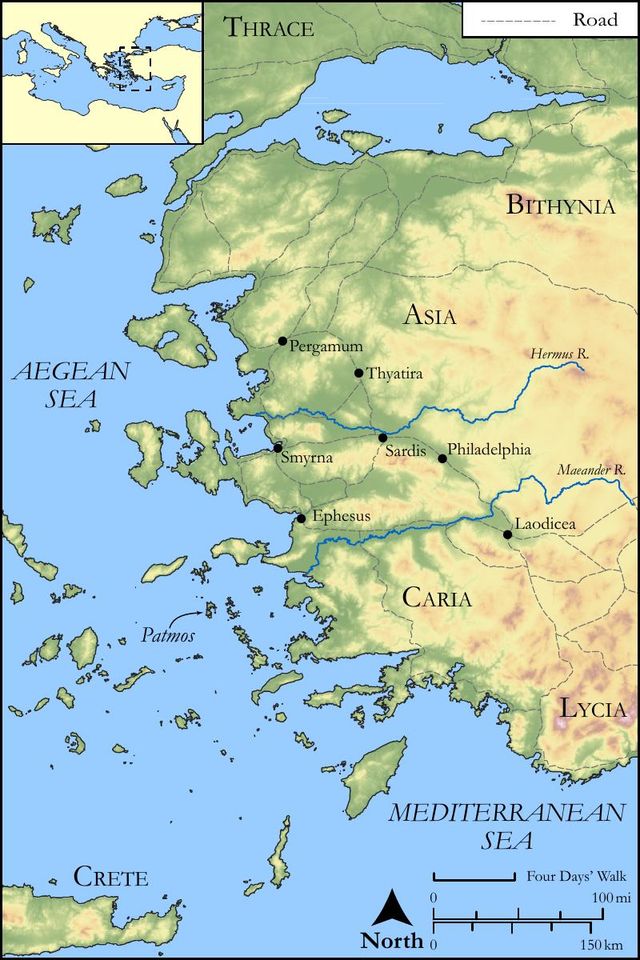
See on the biblical-era maps

Study this verse
Public-domain commentary
Matthew Henry
From his Commentary on the Whole Bible. Henry comments on passages, not single verses — this entry covers Revelation 13:1–10.
We have here an account of the rise, figure, and progress of the first beast; and observe, 1. From what situation the apostle saw this monster. He seemed to himself to stand upon the sea-shore, though it is probable he was still in a rapture; but he took himself to be in the island Patmos, but whether in the body or out of the body he could not tell. 2. Whence this beast came - out of the sea; and yet, by the description of it, it would seem more likely to be a land-monster; but the more monstrous every thing about it was the more proper an emblem it would be to set forth the mystery of iniquity and tyranny. 3. What was the form and shape of this beast. It was for the most part like a leopard, but its feet were like the feet of a bear and its mouth as the mouth of a lion; it had seven heads, and ten horns, and upon its heads the name of blasphemy: the most horrid and hideous monster! In some part of this description here seems to be an allusion to Daniel's vision of the four beasts, which represented the four monarchies, Dan 7:1-3, etc. One of these beasts was like a lion, another like a bear, and another like a leopard; this beast was a sort of composition of those three, with the fierceness, strength, and swiftness, of them all; the seven heads and the ten horns seem to design its several powers; the ten crowns, its tributary princes; the word blasphemy on its forehead proclaims its direct enmity and opposition to the glory of God, by promoting idolatry. 4. The source and spring of his authority - the dragon; he gave him his power, and seat, and great authority. He was set up by the devil, and supported by him to do his work and promote his interest; and the devil lent him all the assistance he could. 5. A dangerous wound given him, and yet unexpectedly healed, Rev 13:3. Some think that by this wounded head we are to understand the abolishing of pagan idolatry; and by the healing of the wound the introducing of the popish idolatry, the same in substance with the former, only in a new dress, and which as effectually answers the devil's design as that did. 6. The honour and worship paid to this infernal monster: All the world wondered after the beast; they all admired his power, and policy, and success, and they worshipped the dragon that gave power to the beast, and they worshipped the beast; they paid honour and subjection to the devil and his instruments, and thought there was no power able to withstand them: so great were the darkness, degeneracy, and madness of the world! 7. How he exercised his infernal power and policy: He had a mouth, speaking great things, and blasphemies; he blasphemed God, the name of God, the tabernacle of God, and all those that dwell in heaven; and he made war with the saints, and overcame them, and gained a sort of universal empire in the world. His malice was principally levelled at the God of heaven, and his heavenly attendants - at God, in making images of him that is invisible, and in worshipping them; - at the tabernacle of God, that is, say some, at the human nature of the Lord Jesus Christ, in which God dwells as in a tabernacle; this is dishonoured by their doctrine of transubstantiation, which will not suffer his body to be a true body, and will put it into the power of every priest to prepare a body for Christ; - and against those that dwell in heaven, the glorified saints, by putting them into the place of the pagan demons, and praying to them, which they are so far from being pleased with that they truly judge themselves wronged and dishonoured by it. Thus the malice of the devil shows itself against heaven and the blessed inhabitants of heaven. These are above the reach of his power. All he can do is to blaspheme them; but the saints on earth are more exposed to his cruelty, and he sometimes is permitted to triumph over them and trample upon them. 8. The limitation of the devil's power and success, and that both as to time and persons. He is limited in point of time; his reign is to continue forty-and-two months (Rev 13:5), suitable to the other prophetical characters of the reign of antichrist. He is also limited as to the persons and people that he shall entirely subject his will and power; it will be only those whose names are not written in the Lamb's book of life. Christ had a chosen remnant, redeemed by his blood, recorded in his book, sealed by his Spirit; and though the devil and antichrist might overcome their bodily strength, and take away their natural life, they could never conquer their souls, nor prevail with them to forsake their Saviour and revolt to his enemies. 9. Here is a demand of attention to what is here discovered of the great sufferings and troubles of the church, and an assurance given that when God has accomplished his work on mount Zion, his refining work, then he will turn his hand against the enemies of his people, and those who have killed with the sword shall themselves fall by the sword (Rev 13:10), and those who led the people of God into captivity shall themselves be made captives. Here now is that which will be proper exercise for the patience and faith of the saints - patience under the prospect of such great sufferings, and faith in the prospect of so glorious a deliverance.
Historical interpretation
Four Centuries of Reception
5 surviving comments on this verse. Each one is dated, so this reads as a timeline rather than a list.
Select a marker to jump to its quote. Markers stagger vertically where authors wrote within a few decades of each other.
By saying that he opened his mouth, it shows that he spoke with that damnable bravado that while before he blasphemed secretly, he will at that time do so publicly. For he will have dared to attribute to himself that honor that especially belongs to [Christ]. And he speaks his inquities arrogantly, for he is hostile to Christ and wishes to be accepted instead of Christ, either by the use of force or by supplanting him with fraudulent means. For a time he will attain power, which he will use in an evil way to harm the body of Christ, so that as Christ suffers, the persecutors praise [the beast] all the more since [Christ] is crucified more cruelly with his [saints]. Of this power the Lord said, “You would have no power over me unless it had been given you from above.” If, therefore, at the time of his passion Christ had temporarily given power to his persecutors, although the prince of this world could find in him nothing worthy of death, why is it surprising that in his church he allows evil persons to attack, so that one might say that [the beast] has defeated them? Even we must understand the part from the whole, namely, that part which he is able to conquer.
Whose names are not written in the book of life of the Lamb. It is just that those who serve the author of death should not be written in the book of life, and those who are deceived by the simulated death of the beast should lack the fellowship of the Lamb who took away the sins of the world. He says,
The Lamb who was slain from the foundation of the world. The Lamb, as Peter says, without blemish, foreordained indeed before the foundation of the world, but manifest in these last times (1 Peter I). Another edition translates it as the Lamb marked from the foundation of the world. It can also be understood through hyperbaton that the names of the saints have been written in the book of life from the beginning.
And all who dwell on the earth will worship him. He said all, but he meant those who dwell on the earth. For those who depart from you, he says, will be written in the earth (Jeremiah XVII).
Of whom it says whose names are not written in the book of life of heaven of the sealed from the foundation of the world; the vision very securely predetermined this; for since it has been said that all the inhabitants of the inhabited world have worshiped the apostate Devil, there were nevertheless a few who were pure from this worship, both from the Gentiles and from Israel, such as Job, his four friends, Melchizedek, and the holy prophets of Israel, and those who are testified to in the Old Testament for godliness.
He says all have worshipped him, except these who, because of their godliness, and the precision and purity of their citizenship, are written in heaven, and are guarded by God; for this is signified by the sealing of the book. Concerning this book the Lord says to his holy disciples according to the divinely inspired Luke: "nevertheless in this do not rejoice, that the spirits are subject to you; but rejoice that your names were written in heaven." (Luke 10:20)
Continue studying Revelation 13:8 across the web’s major study libraries — every link below opens this exact verse, chapter, or book on the destination site.
Read & Compare
 BibleGatewayThis verse in more than 200 translations and 70 languages.
 Bible.comThe YouVersion reader — hundreds of translations, reading plans, and highlights.
 ESV.orgCrossway's official English Standard Version reader.
 NET BibleThe NET translation with 60,000+ translators' notes on every rendering decision.
 STEP BibleTyndale House's free study tool — original text, vocabulary, and scholarly resources.
 BibliaLogos Bible Software's free web reader.
 USCCBThe New American Bible (Revised Edition) with the U.S. bishops' study notes.
Commentaries
 BibleHub CommentariesDozens of classic commentaries on this verse, gathered on one page.
 StudyLightMore than 100 commentary sets — the largest collection on the web.
 BibleRefPlain-English commentary on what this verse means, verse by verse.
 Enduring WordDavid Guzik's free commentary on this chapter, widely used by Bible teachers.
 Bible Study ToolsVerse commentary alongside Greek and Hebrew study aids.
Original Language & Research
- BibleHub InterlinearThe verse word by word — original language, transliteration, and English.
- BibleHub LexiconEvery word's original-language definition and Strong's entry.
 Blue Letter BibleDeep-study tools — Strong's numbers, concordance, and word studies.
 CNTR CollationThe earliest Greek manuscripts of this verse, collated letter by letter.
Sermons, Hymns & Audio


TrulyRandomVerse is not affiliated with these sites and doesn’t control their content. They’re linked because they’re genuinely useful.
Summary
Revelation 13:8 starkly delineates the ultimate allegiance of humanity during the apocalyptic tribulation, presenting a profound contrast between those who succumb to the worship of the beast and those whose eternal security is divinely assured. This verse underscores the pervasive nature of end-time deception, highlighting that only those whose names were pre-eternally inscribed in the Book of Life, predicated on the sacrifice of the Lamb, will resist the beast's dominion, thereby affirming God's sovereign foreknowledge and redemptive plan.
Context
ShowHideLiterary Context
Revelation 13 introduces two formidable symbolic figures: the "beast from the sea" and the "beast from the earth." The beast from the sea, described in Revelation 13:1-8, embodies a powerful, blasphemous, and persecuting political-religious empire, granted authority by the dragon (Satan). The beast from the earth, detailed in Revelation 13:11-18, acts as a false prophet, compelling humanity to worship the first beast and receive its mark. Revelation 13:8 serves as a climactic statement within the description of the first beast's authority, emphasizing the global scope of its influence and the critical distinction between its worshippers and God's elect. It sets the stage for the intense spiritual conflict that characterizes the final days.
Historical & Cultural Context
The book of Revelation was written during a period of intense persecution of Christians, likely under the Roman Emperor Domitian (late 1st century AD), who demanded emperor worship. This historical backdrop provides a crucial lens for understanding the "beast" as a symbol of oppressive political power that demands absolute allegiance, often at the cost of one's faith. The concept of a "book of life" was not new; it has roots in Old Testament imagery (e.g., Exodus 32:32 and Psalm 69:28), representing a divine register of those chosen for life or salvation. The cultural context of emperor worship made the choice between worshipping the beast or remaining faithful to Christ a matter of life and death, resonating deeply with the early Christian audience.
Key Themes
ShowHideThis verse powerfully contributes to several overarching themes in Revelation and biblical theology. Firstly, it underscores the theme of Universal Deception and Apostasy, highlighting how the beast's authority will lead nearly all inhabitants of the earth astray, demonstrating the profound spiritual battle for human allegiance in the last days. Secondly, the mention of the "Book of Life" emphasizes Divine Election and Security, affirming God's sovereign foreknowledge and the eternal security of those chosen for salvation, whose names are recorded before time. This theme resonates with passages like Ephesians 1:4 and 2 Timothy 1:9. Thirdly, the profound statement "the Lamb slain from the foundation of the world" introduces the theme of Christ's Pre-ordained Sacrifice and Redemptive Plan, asserting that Christ's atoning work was not an afterthought but an integral part of God's eternal decree, foundational to all creation and redemption, as seen in 1 Peter 1:19-20.
Exposition and Analysis
ShowHideKey Word Analysis
ShowHideThis word, derived from a primary word, signifies "soil," "a region," or the "solid part or the whole of the terrene globe." In Revelation 13:8, "all that dwell upon the earth" (G1093) emphasizes the global scope of the beast's influence, encompassing all humanity who are not divinely marked for salvation. It highlights the universality of the deception.
A primary verb meaning "to grave," especially "to write," or figuratively "to describe." The passive voice "are not written" (G1125) indicates that the action of writing is performed by another (God), underscoring divine agency in the inscription of names into the Book of Life. This signifies a definitive, established record.
A primary verb meaning "to butcher (especially an animal for food or in sacrifice)" or "to slaughter," or "to maim (violently)." The perfect passive participle "slain" (G4969) emphasizes a completed action with ongoing results. Applied to the Lamb, it powerfully conveys the violent, sacrificial nature of Christ's death, which is the eternal basis for salvation and the inscription of names in the Book of Life.
Verse Breakdown
ShowHide"And all that dwell upon the earth shall worship him,"
This clause establishes the universal scope of the beast's influence and the widespread apostasy that will occur. "All that dwell upon the earth" refers to the unredeemed inhabitants of the world, those whose allegiance is not to God. "Shall worship him" indicates a compulsory and pervasive act of homage to the beast, signifying a complete surrender to its authority and a rejection of the true God.
"whose names are not written in the book of life"
This phrase introduces the critical distinction between those who worship the beast and those who do not. The "book of life" is a divine register, a celestial record of those chosen for eternal salvation. The negative "not written" identifies the worshippers of the beast as those who are eternally lost, emphasizing that their names were never intended to be in God's book of salvation. This highlights divine foreknowledge and election.
"of the Lamb slain from the foundation of the world."
This profound theological statement clarifies the basis for inclusion in the Book of Life and the nature of God's redemptive plan. The "Lamb" refers to Jesus Christ, whose sacrificial death ("slain") was not an impromptu response to sin but an integral part of God's eternal decree, conceived "from the foundation of the world." This phrase can be interpreted in two primary ways: either the Lamb was slain in God's eternal plan before creation, or the names were written in the book from the foundation of the world of the Lamb slain. The KJV syntax strongly supports the former, emphasizing the timeless efficacy and pre-ordained nature of Christ's atoning sacrifice as the very foundation of salvation.
Literary Devices
ShowHideRevelation 13:8 employs several powerful literary devices to convey its message. Symbolism is paramount, with "the beast" representing oppressive, anti-God political and spiritual power, and "the Lamb" symbolizing Jesus Christ, the innocent, sacrificial Savior. The "Book of Life" is a potent symbol of divine election, eternal security, and God's sovereign record-keeping. Contrast is vividly utilized, setting the "all that dwell upon the earth" (the lost, who worship the beast) against those "whose names are not written" (implicitly, those whose names are written, the saved). This stark binary underscores the ultimate spiritual divide. Furthermore, the phrase "slain from the foundation of the world" is a form of Prolepsis or Anachronism, presenting an event (Christ's death) as having significance and reality in God's eternal plan even before its historical occurrence. This emphasizes the timelessness of God's redemptive purpose and the eternal efficacy of Christ's sacrifice.
Theological and Thematic Connections
ShowHideRevelation 13:8 profoundly shapes our understanding of divine sovereignty, human responsibility, and the eternal nature of God's redemptive plan. It asserts that salvation is not a mere human decision but is rooted in God's eternal foreknowledge and the pre-ordained sacrifice of Christ. The "Book of Life" signifies God's immutable decree, distinguishing those who belong to Him from those who will ultimately align with the forces of evil. This verse underscores the battle between good and evil, highlighting that even in the face of overwhelming deception, God's elect are secure, their salvation secured by a plan laid before creation itself. It challenges believers to consider the eternal implications of their allegiance, urging steadfastness in faith against worldly pressures.
Reflection and Application
ShowHideRevelation 13:8 serves as both a sobering warning and a profound source of comfort for believers. It warns us of the pervasive nature of spiritual deception in the last days, reminding us that the world system, under the influence of the enemy, will seek to demand ultimate allegiance, diverting worship from the one true God. This calls for spiritual discernment, a deep grounding in God's Word, and unwavering commitment to Christ. We are urged to examine our own allegiances: where do we place our trust, our hope, and our worship? Do we conform to the pressures of the world, or do we stand firm in our identity as followers of the Lamb? Simultaneously, the verse offers immense comfort in the security of God's eternal plan. Our salvation is not precarious or dependent on our fleeting strength, but is rooted in God's sovereign choice and the timeless, effective sacrifice of Jesus Christ. This truth should inspire confidence, gratitude, and a zealous desire to live lives that reflect the Lamb's worthiness.
Questions for Reflection
ShowHideFAQ
ShowHideWhat does "the Lamb slain from the foundation of the world" truly mean?
ShowHideThis profound phrase in Revelation 13:8 signifies that the atoning sacrifice of Jesus Christ, the Lamb of God, was not an afterthought or a contingency plan in response to human sin, but was an integral part of God's eternal purpose and redemptive design. Before the creation of the universe, God, in His infinite wisdom and foreknowledge, decreed that His Son would be "slain" – that is, would suffer a violent, sacrificial death – to redeem humanity. This means that the cross, though a historical event, has an eternal significance, being the very foundation upon which God's plan for salvation, including the Book of Life, rests. It highlights God's perfect plan, demonstrating that His love and provision for humanity's redemption were established even before sin entered the world.
Christ-Centered Fulfillment
ShowHideRevelation 13:8 finds its ultimate Christ-centered fulfillment in the person and work of Jesus Christ, the "Lamb slain from the foundation of the world." This title profoundly underscores that the entire drama of salvation history, from creation to consummation, hinges upon the pre-ordained sacrifice of God's Son. Jesus is the divine Lamb, whose innocent, substitutionary death on the cross (John 1:29) was not a reactive measure but the central, eternal act of God's love to redeem a fallen humanity. His blood, shed for the forgiveness of sins (Matthew 26:28), is the sole basis upon which names are inscribed in the Book of Life. Thus, the security of the saints, those whose names are written, is not based on their merit or endurance, but on the unchangeable, eternal efficacy of Christ's finished work. He is the one who conquered death and the grave (Revelation 1:18), making it possible for humanity to escape the beast's dominion and enter into eternal life, a life secured by His sacrifice and resurrection, a plan conceived before the very fabric of time was woven (Hebrews 9:26).