


Titus 1:2
Bible text: King James Version (1769 Blayney text) · Public domain
Bible text: Berean Standard Bible · Public domain
Bible text: American Standard Version (1901) · Public domain
Bible text: World English Bible, Messianic edition · Public domain
Bible text: Geneva Bible (1599) · Public domain
Bible text: Young's Literal Translation · Public domain
- ἐπ᾽ep᾽inG1909PREPPreposition
- ἐλπίδιelpidi[the] hopeG1680N-DSFNoun Dative Singular Feminine
- ζωῆςzōēsof lifeG2222N-GSFNoun Genitive Singular Feminine
- αἰωνίουaiōnioueternalG166A-GSFAdjective Genitive Singular Feminine
- ἣνhēnwhichG3739R-ASFRelative pronoun Accusative Singular Feminine
- ἐπηγγείλατοepēngeilatopromisedG1861V-ADI-3SVerb Aorist Middle Deponent Indicative 3rd Singular
- ὁho<the>G3588T-NSMDefinite article Nominative Singular Masculine
- ἀψευδὴςapseudēswho cannot lieG893A-NSMAdjective Nominative Singular Masculine
- θεὸςtheosGodG2316N-NSM-TNoun Nominative Singular Masculine Title
- πρὸprobeforeG4253PREPPreposition
- χρόνωνchronōntimeG5550N-GPMNoun Genitive Plural Masculine
- αἰωνίωνaiōniōneternalG166A-GPMAdjective Genitive Plural Masculine
English is a literal word-by-word gloss of the Greek, not the KJV's wording. Why?
This is the original text the KJV's translators worked from — each Greek word with its own literal English meaning in this verse, prepared by scholars at Tyndale House, Cambridge. The KJV translates whole sentences, not word by word, so its wording differs: one Greek word can become several English words, and the KJV may choose “charity” where the gloss reads “love”. Both are faithful — they answer different questions. For the KJV's own rendering, switch to the KJV text.
Details
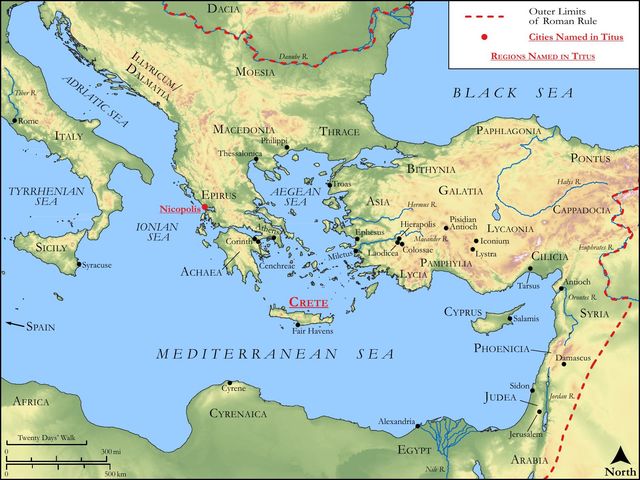
See on the biblical-era maps

Study this verse
Public-domain commentary
Matthew Henry
From his Commentary on the Whole Bible. Henry comments on passages, not single verses — this entry covers Titus 1:1–4. His two-level outline is real structure in the source text, so it is rendered as structure.
Here is the preface to the epistle, showing,
I.The writer.
Paul, a Gentile name taken by the apostle of the Gentiles, Act 13:9, Act 13:46, Act 13:47. Ministers will accommodate even smaller matters, so that they may be any furthering of acceptance in their work. When the Jews rejected the gospel, and the Gentiles received it, we read no more of this apostle by his Jewish name Saul, but by his Roman one, Paul. A servant of God, and an apostle of Jesus Christ. Here he is described by his relation and office: A servant of God, not in the general sense only, as a man and a Christian, but especially as a minister, serving God in the gospel of his Son, Rom 1:9. This is a high honour; it is the glory of angels that they are ministering spirits, and sent forth to minister for those who shall be heirs of salvation, Heb 1:14. Paul is described more especially as a chief minister, an apostle of Jesus Christ; one who had seen the Lord, and was immediately called and commissioned by him, and had his doctrine from him. Observe, The highest officers in the church are but servants. (Much divinity and devotion are comprehended in the inscriptions of the epistles.) The apostles of Jesus Christ, who were employed to spread and propagate his religion, were therein also the servants of God; they did not set up any thing inconsistent with the truths and duties of natural religion. Christianity, which they preached, was in order to clear and enforce those natural principles, as well as to advance them, and to superadd what was fit and necessary in man's degenerate and revolted state: therefore the apostles of Jesus Christ were the servants of God, according to the faith of God's elect. Their doctrine agreed with the faith of all the elect from the beginning of the world, and was for propagating and promoting the same. Observe, There are elect of God (Pe1 1:2), and in these the Holy Spirit works precious divine faith, proper to those who are chosen to eternal life (Th2 2:13, Th2 2:14): God hath from the beginning chosen you to salvation, through sanctification of the Spirit and belief of the truth, whereunto he called you by our gospel. Faith is the first principle of sanctification. And the acknowledging of the truth which is after godliness. The gospel is truth; the great, sure, and saving truth (Col 1:5), the word of the truth of the gospel. Divine faith rests not on fallible reasonings and probable opinions, but on the infallible word, the truth itself, which is after godliness, of a godly nature and tendency, pure, and purifying the heart of the believer. By this mark judge of doctrines and of spirits - whether they be of God or not; what is impure, and prejudicial to true piety and practical religion, cannot be of divine original. All gospel truth is after godliness, teaching and nourishing reverence and fear of God, and obedience to him; it is truth not only to be known, but acknowledged; it must be held forth in word and practice, Phi 2:15, Phi 2:16. With the heart man believes to righteousness, and with the mouth confession is made unto salvation, Rom 10:10. Such as retain the truth in unrighteousness neither know nor believe as they ought. To bring to this knowledge and faith, and to the acknowledging and professing of the truth which is after godliness, is the great end of the gospel ministry, even of the highest degree and order in it; their teachings should have this chief aim, to beget faith and confirm in it. In (or for) hope of eternal life, Tit 1:2. This is the further intent of the gospel, to beget hope as well as faith; to take off the mind and heart from the world, and to raise them to heaven and the things above. The faith and godliness of Christians lead to eternal life, and give hope and well-grounded expectation of it; for God, that cannot lie, hath promised it. It is the honour of God that he cannot lie or deceive: and this is the comfort of believers, whose treasure is laid up in his faithful promises. But how is he said to promise before the world began? Answer, By promise some understand his decree: he purposed it in his eternal counsels, which were as it were his promise in embryo: or rather, say some, pro chronōn aiōniōn is before ancient times, or many years ago, referring to the promise darkly delivered, Gen 3:15. Here is the stability and antiquity of the promise of eternal life to the saints. God, who cannot lie, hath promised before the world began, that is, many ages since. How excellent then is the gospel, which was the matter of divine promise so early! how much to be esteemed by us, and what thanks due for our privilege beyond those before us! Blessed are your eyes, for they see, etc. No wonder if the contempt of it be punished severely, since he has not only promised it of old, but (Tit 1:3) has in due times manifested his word through preaching; that is, made that his promise, so darkly delivered of old, in due time (the proper season before appointed) more plain by preaching; that which some called foolishness of preaching has been thus honoured. Faith comes by hearing, and hearing by the word of God, by the word preached. Which is committed unto me. The ministry is a trust; none taketh this honour, but he who is thereunto appointed; and whoso is appointed and called must preach the word. Co1 9:16, Woe is unto me if I preach not the gospel. Nonpreaching ministers are none of the apostle's successors. According to the commandment of God our Saviour. Preaching is a work appointed by a God as a Saviour. See a proof here of Christ's deity, for by him was the gospel committed to Paul when he was converted (Act 9:15, Act 9:17, and Act 22:10, Act 22:14, Act 22:15), and again when Christ appeared to him, Act 22:17. He therefore is this Saviour; not but that the whole Timothy concur therein: the Father saves by the Son through the Spirit, and all concur in sending ministers. Let none rest therefore in men's calling, without God's; he furnishes, inclines, authorizes, and gives opportunity for the work.
II.The person written to, who is described,
1.By his name, Titus, a Gentile Greek, yet called both to the faith and ministry. Observe, the grace of God is free and powerful. What worthiness or preparation was there in one of heathen stock and education?
2.By his spiritual relation to the apostle: My own (or my genuine) son, not by natural generation, but by supernatural regeneration. I have begotten you through the gospel, said he to the Corinthians, Co1 4:15. Ministers are spiritual fathers to those whom they are the means of converting, and will tenderly affect and care for them, and must be answerably regarded by them. "My own son after the common faith, that faith which is common to all the regenerate, and which thou hast in truth, and expressest to the life." This might be said to distinguish Titus from hypocrites and false teachers, and to recommend him to the regard of the Cretans, as being among them a lively image of the apostle himself, in faith, and life, and heavenly doctrine. To this Titus, deservedly so dear to the apostle, is,
III.The salutation and prayer, wishing all blessings to him:
Grace, mercy, and peace, from God the Father, and the Lord Jesus Christ our Saviour. Here are,
1.The blessings wished: Grace, mercy, and peace. Grace, the free favour of God, and acceptance with him. Mercy, the fruits of that favour, in pardon of sins, and freedom from all miseries by it, both here and hereafter. And peace, the positive effect and fruit of mercy. Peace with God through Christ who is our peace, and with the creatures and ourselves; outward and inward peace, comprehending all good whatsoever, that makes for our happiness in time and to eternity. Observe, Grace is the fountain of all blessings. Mercy, and peace, and all good, spring out of this. Get into God's favour, and all must be well; for,
2.These are the persons from whom blessings are wished: From God the Father, the fountain of all good. Every blessing, every comfort, comes to us from God as a Father; he is the Father of all by creation, but of the good by adoption and regeneration. And the Lord Jesus Christ our Saviour, as the way and means of procurement and conveyance. All is from the Father by the Son, who is Lord by nature, heir of all things, and our Lord, Redeemer, and head, ordering and ruling his members. All are put under him; we hold of him, as in capite, and owe subjection and obedience to him, who is also Jesus and Christ, the anointed Saviour, and especially our Saviour, who believe in him, delivering us from sin and hell, and bringing us to heaven and happiness.
Thus far is the preface to the epistle; then follows the entrance into the matter, by signifying the end of Titus's being left in Crete.
Historical interpretation
Nine Centuries of Reception
7 surviving comments on this verse. Each one is dated, so this reads as a timeline rather than a list.
Select a marker to jump to its quote. Markers stagger vertically where authors wrote within a few decades of each other.
Having then this hope [in the resurrection], let our souls be bound to him who is faithful in his promises and just in his judgments. He who has commanded us not to lie shall much more himself not lie; for nothing is impossible with God, except to lie.
Since the periods of time, therefore, come within the scope of our knowledge or speculations, we pass judgment upon them according to the understanding of human reasoning. In this way we believe ourselves justified in saying about anything: “It has not been before it is born.” The times that have already past always come before the origin of everything. Since in the things of God, that is, in the birth of God, everything is before the eternal time, then we cannot say of him: “Before he was born.” Nor can we say that he to whom the eternal promise was made before the eternal time has the “hope of life everlasting,” according to the statement of the apostle, which the God who does not lie has promised to him before the eternal time, nor can we say that at one time he had not been. We cannot assume that he whom we must confess as being before the eternal time has had his beginning after something.
But God can neither be in doubt, nor can he be deceived. For he only is in doubt who is ignorant of the future. One who has predicted one thing while something else has happened is deceived about the future. Not so with God. What is plainer than the fact that Scripture states the Father to have said one thing of the Son and that the same Scripture proves another thing to have taken place? The Son was beaten, he was mocked, was crucified and died. He suffered much worse things in the flesh than those servants who had been appointed before. Was the Father deceived? Was he ignorant of it? Was he unable to give help? The One who is the truth cannot make a mistake. It is written that “the ever-truthful God cannot lie.” How could he who knows all be ignorant? What could he not do, who could do all?
Ver. 2. "Which God, that cannot lie, promised before the world began."
That is, not now upon a change of mind, but from the beginning it was so foreordained. This he often asserts, as when he says, "Separated unto the Gospel of God." (Rom. i. 1.) And again, "Whom He did foreknow, He also did predestinate." (Rom. viii. 29.) Thus showing our high origin, in that He did not love us now first, but from the beginning: and it is no little matter to be loved of old, and from the beginning.
"Which God, that cannot lie, promised." If He "cannot lie," what He has promised will assuredly be fulfilled. If He "cannot lie," we ought not to doubt it, though it be after death. "Which God, that cannot lie," he says, "promised before the world began"; by this also, "before the world began," he shows that it is worthy of our belief. It is not because the Jews have not come in, that these things are promised. It had been so planned from the first. Hear therefore what he says,
"But hath in His own times manifested."
Wherefore then was the delay? From His concern for men, and that it might be done at a seasonable time. "It is time for Thee, Lord, to work" (Ps. cxix. 125), says the Prophet. For by "His own times" is meant the suitable times, the due, the fitting.
"According to the faith of the elect of God and the knowledge of the truth, which is in accordance with piety towards eternal life, which God, who does not lie, promised before eternal times and has manifested in due time His word in preaching, believed in accordance with the command of our Savior God by me, Titus, his dear son according to the common faith: Grace and peace from God the Father, and Jesus Christ our Savior." If anyone knows the art of grammar, or dialectic, in order to have the correct reasoning of speech, and to judge between false and true. Also, geometry and arithmetic and music have truth in their science; but that is not the science of piety. The science of piety is to know the Law, understand the prophets, believe in the Gospel, and not ignore the apostles. Conversely, there are many who have a true knowledge of piety: but not immediately the truth of the other arts of which we have just mentioned above. Therefore, this truth, whose knowledge is in line with piety, is placed in the hope of eternal life: because he who knows himself immediately bestows on him the reward of immortality. Without piety, knowledge of the truth is pleasing at present: but it does not have the eternity of rewards, which the truthful God promised before eternal times: and he manifested it in his time in Christ Jesus. To whom did he promise it before and afterwards made it clear except to His wisdom, which was always with the Father, when He rejoiced over the perfect world and rejoiced over the sons of men, and promised them who would believe in Him, that they would have eternal life? Before the foundation of the world was laid, before the seas were spread, the mountains established, the sky hung, and the earth with a solid mass lowered, God promised this, in whom there is no falsehood. Not because He can lie, and does not want to break out into words of falsehood: but because He is the father of truth and has no lie in Him, according to the saying: But let God be true: and every man a liar (Rom. 3:4). Therefore, God is called not a liar: indeed, when He promises certain things to the prophets with an oath, in order that we may be more secure, we hope that what is foretold will come to pass, and believing with our whole heart, we may be prepared to attain what is to come.
It seems not irrelevant briefly to discuss why God alone is true, and every man a liar, as it is said by the voice of the Apostles. And if I am not mistaken, how is he alone said to have immortality, when he has made angels and many rational creatures to whom he has given immortality: so too he is said to be true alone, not because the others, who are not immortal, are not lovers of truth, but because he alone is naturally, and immortal, and true. The others, indeed, attain immortality and truth by his gift, and it is one thing to be true, but another to have something in and of oneself: it is another thing to have what the giver has in his power to give. But I also think that this should not be passed over in silence, that God is not a liar, having promised eternal life before the eternal ages: from which, according to the history of Genesis, the world was made, and through the succession of nights and days, months and years, times were established. In this cycle and wheel of the world, times slip away and come, and either the future or the past is. Hence some philosophers do not believe that there is a present time: but either the past or the future; because everything that we speak, do, or think, either passes if it has happened, or if it has not yet happened, we expect it to come. Therefore, before the times of this world, it must be believed that there was a certain eternity of centuries, in which the Father always was with the Son and the Holy Spirit: and, so to speak, the time of God is one, that is, all eternity: in fact, there are innumerable times, since he who exceeds all times was there before all time. But not even a thousand years of our world are yet completed: and how many previous eternities, how many times, how many origins of ages must be considered, in which the angels, thrones, dominations, and other powers served God: and without the vicissitudes and measures of times, they stood by God's command! Before all these times, therefore, which neither speech can utter nor mind can grasp, nor silent thought dare touch, God the Father promised his Word and Wisdom, and his very Wisdom and the life of those who were to believe, should come into the world. Pay close attention to the text and order of the reading: for eternal life, which the not false God promised before eternal ages, is none other than the Word of God. For he has manifested his word in due time, saying: Therefore the word itself, which was in the beginning with the Father, must be that life eternal which he had promised; and the Word was God, and the Word was made flesh and dwelt among us. (John 1) But that the Word of God, which is Christ himself, is life, he testifies in another place, saying: I am the life (John 14:6). Now life is not short, not bounded by certain periods; but eternal, which was manifested in the last ages, in the preaching which was believed in by the teacher of the gentiles, Paul, and revealed to the world, and made known to men, according to the command of the Savior God, who wished us to be saved, and fulfilled what he had promised. And the Apostle writes to his beloved son Titus, which is called in Greek, γνησίῳ τέκνῳ: and cannot be explained in Latin: for γνήσιος means this rather, when someone is called faithful and proper, and (so to speak) legitimate or genuine without comparison to another. From which we understand that there was much difference even among the sons of Paul, that he had some γνησίους, that is, most genuine, closely connected to himself, and born of true marriage and free procreation; but others almost from a handmaid and from Hagar, who cannot receive inheritance with the free son, Isaac. For the speech and wisdom and doctrine by which Titus instructed the Churches of Christ, made him a true son of the Apostle, and separate from all the companionship of others. Let us see after this what follows: According to the common faith, whether he said that it was common to all who believed in Christ, or common to him and Titus alone. Indeed, to me it seems that the common faith of the Apostle Paul and Titus was better than that of all believers; among whom, due to the variety of opinions, faith could not be common but diverse. Finally, the preface of the Epistle and the greeting of the Apostle's preface to Titus are completed with such an ending: Grace and peace from God the Father and Christ Jesus our Savior. Whether both grace and peace are given to both the Father and Christ Jesus, and both can be understood from each other, or whether grace refers to the Father and peace to the Son, must not be passed over without doubt. The Apostle had cursed some, that grace and peace would multiply to them: now, to Titus, peace and grace are placed without multiplication. Noah the righteous man, and the only one saved in a storm-tossed world, is said to have found not many graces, but one grace before God. And Moses said to the Lord, "If I have found grace with you" (Exodus 33:13). And wherever grace is placed in the person of the saints, seek and you shall find it, not that they have found graces but grace. That merchant of the Gospel who had many pearls, at last found one precious one, which he bought alone from many pearls (Matthew 13). For the perfect, indeed, it is to buy one pearl and one treasure for all pearls and all their substance by their business: but for those who are just beginning and are still on the way, not only one and alone but many pearls must be had.
I confess that I do not know what ages passed before the human race was created, yet I am perfectly sure that no one creature is coeternal with the Creator. Curiously enough, the apostle uses the expression tempora aeterna in reference not to the future but to the past. Thus he says: “in the hope of eternal life which God, who does not lie, promised before the eternal times, he has in due times manifested, his word.” He seems to be saying that time stretches backward eternally; yet time is not coeternal with God, since not only did God exist “before eternal times” but he promised eternal life which he manifested in his own time, that is, in due time. Now, what he promised was his Word. For the Word is eternal life. But how did he make this promise, since it was made to those who certainly did not exist before the “eternal times”? The meaning, then, must be that what was to take place in its own time was already predestined and determined in his eternity and in his coeternal Word.
in the hope of eternal life, which God, who never lies, promised before the beginning of time.
in hope of eternal life. Indeed, to know the truth itself for its own sake is a great reward beyond thousands, but now the generous God also gives, besides this very reward, eternal life. For it is said to be for the knowledge of the truth, of the life that is based on hope, eternal. And the term "eternal," making a comparison to the Jews: for they had the promise of present life.
which God, who never lies. If God is without deceit, He will certainly fulfill what He has promised.
promised before the beginning of time. Not by a later decree or repentance, Paul says, did God determine this, but from the beginning. The greatest honor is that we were loved from the beginning.
Continue studying Titus 1:2 across the web’s major study libraries — every link below opens this exact verse, chapter, or book on the destination site.
Read & Compare
 BibleGatewayThis verse in more than 200 translations and 70 languages.
 Bible.comThe YouVersion reader — hundreds of translations, reading plans, and highlights.
 ESV.orgCrossway's official English Standard Version reader.
 NET BibleThe NET translation with 60,000+ translators' notes on every rendering decision.
 STEP BibleTyndale House's free study tool — original text, vocabulary, and scholarly resources.
 BibliaLogos Bible Software's free web reader.
 USCCBThe New American Bible (Revised Edition) with the U.S. bishops' study notes.
Commentaries
 BibleHub CommentariesDozens of classic commentaries on this verse, gathered on one page.
 StudyLightMore than 100 commentary sets — the largest collection on the web.
 BibleRefPlain-English commentary on what this verse means, verse by verse.
 Enduring WordDavid Guzik's free commentary on this chapter, widely used by Bible teachers.
 Bible Study ToolsVerse commentary alongside Greek and Hebrew study aids.
Original Language & Research
- BibleHub InterlinearThe verse word by word — original language, transliteration, and English.
- BibleHub LexiconEvery word's original-language definition and Strong's entry.
 Blue Letter BibleDeep-study tools — Strong's numbers, concordance, and word studies.
 CNTR CollationThe earliest Greek manuscripts of this verse, collated letter by letter.
Sermons, Hymns & Audio


TrulyRandomVerse is not affiliated with these sites and doesn’t control their content. They’re linked because they’re genuinely useful.
Summary
Titus 1:2 anchors Christian hope in the unshakeable promise of eternal life, a promise made by God, who is inherently truthful and incapable of deception, and which was purposed by Him in the depths of eternity, long before the creation of the world. This foundational declaration establishes the divine authority and trustworthiness of Paul's apostolic message and the entire Christian faith, providing a stable ground for the practical instructions and theological truths that follow in the Epistle to Titus.
Context
ShowHideLiterary Context
Titus 1:2 immediately follows Paul's self-identification as "a servant of God, and an apostle of Jesus Christ, according to the faith of God's elect, and the acknowledging of the truth which is after godliness" (Titus 1:1). This verse serves as the theological bedrock for Paul's apostolic mission and the very purpose of the Christian faith. It grounds the practical instructions Paul gives to Titus concerning the organization of the church in Crete, the appointment of elders, and the combating of false teaching. The certainty of the Christian hope, rooted in God's eternal promise, provides the motivation and stability for sound doctrine and godly living, which are central themes throughout the entire letter, particularly as Paul addresses the challenges of establishing order and truth in the Cretan churches (e.g., Titus 1:5-9 regarding elders and Titus 2:1-10).
Historical & Cultural Context
The Apostle Paul had left Titus in Crete to "set in order the things that are wanting, and ordain elders in every city" (Titus 1:5). Crete was known for its difficult cultural environment, with its inhabitants famously described by a Cretan prophet as "alway liars, evil beasts, slow bellies" (Titus 1:12). In such a context, where deceit and moral laxity were prevalent, the emphasis on God's absolute truthfulness ("cannot lie") was not merely a theological statement but a powerful counter-cultural declaration. It provided a stark contrast to the prevailing character of the Cretans and underscored the unwavering reliability of the Christian message in a society marked by instability and falsehood. Establishing churches and sound doctrine in this environment required a foundation built on the unchangeable character of God.
Key Themes
ShowHideTitus 1:2 contributes significantly to several key themes within the epistle and broader Pauline theology. Firstly, it highlights the Certainty of Christian Hope, emphasizing that the believer's expectation of eternal life is not a mere wish but a confident assurance founded on God's character. Secondly, it underscores God's Unwavering Faithfulness and Truthfulness, asserting that God is inherently incapable of falsehood, which makes all His promises utterly reliable. This attribute is crucial for understanding God's nature throughout Scripture (e.g., Numbers 23:19). Thirdly, the phrase "promised before the world began" reveals the Pre-temporal Nature of God's Redemptive Plan, indicating that salvation and eternal life were part of God's sovereign design from eternity past, not an afterthought. This theme is echoed in other Pauline epistles, such as when Paul speaks of God's grace "given us in Christ Jesus before the world began" (2 Timothy 1:9). This eternal purpose provides a robust theological framework for the gospel message and the church's mission.
Exposition and Analysis
ShowHideKey Word Analysis
ShowHideThis word signifies not a mere wishful thinking but a confident expectation or assurance, often with pleasure. In the biblical context, it denotes a strong, theological certainty that provides an anchor for the soul, rooted in God's reliable promises rather than human optimism.
Meaning perpetual, everlasting, or extending for an age. When applied to "life" (G2222, zōḗ), it denotes a quality of life that is not merely unending in duration but also characterized by the very nature of God's own life—fullness, righteousness, and communion with Him. It refers to a life belonging to the age to come, which has already broken into the present through Christ.
This adjective literally means "without falsehood," "truth-speaking," or "incapable of falsehood." It emphasizes God's inherent nature of truthfulness, His utter reliability, and the impossibility of Him ever deceiving or failing to fulfill His word. This attribute is foundational to the trustworthiness of all divine revelation and promises.
Verse Breakdown
ShowHide"In hope of eternal life"
This phrase establishes the ultimate orientation and confident expectation of the Christian faith. The "hope" (Greek, elpís) is not a mere wish but a firm assurance, a theological certainty that rests upon the character and promises of God. "Eternal life" (Greek, zōḗ aiṓnios) refers not just to unending existence but to a quality of life—the very life of God Himself—that begins in the present through faith in Christ and culminates in perfect communion with Him forever. This hope provides stability, purpose, and perseverance for believers.
"which God, that cannot lie"
This clause provides the absolute guarantee for the hope of eternal life. The declaration that God "cannot lie" (Greek, apseudḗs) is a powerful affirmation of His divine character. Unlike humans, God is perfectly truthful, faithful, and immutable. His nature precludes any possibility of deception, falsehood, or unfaithfulness. This attribute ensures the absolute reliability of all His promises, making the hope of eternal life a certainty rather than a mere possibility. It is the bedrock of all trust in God's word.
"promised before the world began;"
This final clause reveals the pre-temporal nature of God's redemptive plan. The promise of eternal life was not an afterthought or a reaction to human sin, but a deliberate, sovereign purpose conceived and established by God in eternity past, before the creation of time itself (Greek, pró chrónōn aiōníōn, literally "before eternal times" or "before times of ages"). This highlights God's omniscience, His meticulous design for humanity's salvation, and the fact that salvation is entirely by divine grace, rooted in His eternal counsel, rather than human merit or temporal circumstance.
Literary Devices
ShowHideThe verse employs several impactful literary devices. Divine Attribute Emphasis is prominent, with the phrase "God, that cannot lie" serving as a powerful declaration of God's inherent truthfulness and immutability. This emphasizes His trustworthiness as the foundation for all hope. There is also a strong sense of Pre-existence/Eternality conveyed by "before the world began," which highlights God's sovereign plan unfolding outside of human time and history, underscoring His omnipotence and foreknowledge. The structure of the verse itself, moving from the human experience of "hope" to the divine source and eternal origin of that hope, creates a sense of Theological Grounding, firmly rooting the believer's future in the unchangeable past and character of God.
Theological and Thematic Connections
ShowHideTitus 1:2 offers a profound theological statement on the nature of God and the certainty of His promises. It establishes that the Christian's hope is not a subjective wish but an objective reality grounded in the immutable character of a God who is inherently truthful. This divine attribute, that God "cannot lie," is the ultimate guarantee for the reliability of all His covenants, prophecies, and redemptive acts. The fact that this promise was made "before the world began" points to God's eternal counsel and sovereign plan, revealing that salvation is not a contingency but a pre-ordained purpose, demonstrating His faithfulness across all ages. This deep theological truth provides immense comfort and stability, assuring believers that their eternal destiny is secured by an omnipotent and perfectly truthful God.
Reflection and Application
ShowHideTitus 1:2 provides a powerful anchor for the soul in a world often characterized by instability, broken promises, and shifting truths. For believers today, this verse serves as a profound reminder that our hope of eternal life is not built on fleeting human assurances or wishful thinking, but on the unshakeable character of God Himself. When faced with trials, uncertainties, or the deceptive voices of the world, we can cling to the absolute certainty that the God who promised eternal life "cannot lie." This truth should inspire unwavering confidence, steadfastness in our faith, and a deep sense of peace. It empowers us to live with purpose, knowing that our future is secured by divine faithfulness. Furthermore, it provides a compelling foundation for sharing the Gospel, as the message we proclaim is rooted in the trustworthy promises of an unchanging God, offering genuine hope to a world desperately in need of it.
Questions for Reflection
ShowHideFAQ
ShowHideWhat does "hope" mean in the context of Titus 1:2, and how is it different from common usage?
ShowHideIn common usage, "hope" often implies a desire for something uncertain, a wishful thinking that may or may not come to pass. However, in Titus 1:2 and throughout the New Testament, the Greek word for "hope" (elpís) carries a much stronger connotation. It signifies a confident expectation, a firm assurance, and a theological certainty. This hope is not based on human optimism or favorable circumstances, but entirely on the reliable character and promises of God. Because God "cannot lie," the hope of eternal life is not a mere possibility but a guaranteed future reality for those who believe. It is an anchor for the soul, providing stability and confidence.
Why is it so significant that God "cannot lie" in this verse?
ShowHideThe declaration that God "cannot lie" (apseudḗs) is profoundly significant because it establishes the absolute trustworthiness and immutability of God's character as the foundation for all Christian faith and hope. In a world where human promises are often broken and truth is subjective, this attribute of God provides an unshakeable bedrock. If God could lie, then all His promises—including the promise of eternal life—would be unreliable. But because He is inherently truthful, His word is infallible, and His promises are certain. This divine attribute ensures the validity of the Gospel message and the security of the believer's salvation, reinforcing that our faith is placed in a perfectly faithful and true God. This concept is echoed in other scriptures like Hebrews 6:18 which states "it was impossible for God to lie."
What does "promised before the world began" tell us about God's plan?
ShowHideThe phrase "promised before the world began" (pró chrónōn aiōníōn) reveals the eternal and pre-temporal nature of God's redemptive plan. It signifies that the promise of eternal life was not an afterthought, a reactive measure to human sin, or a plan developed within human history. Instead, it was conceived, purposed, and established by God in eternity past, before creation and before the concept of time as we know it. This highlights God's absolute sovereignty, His omniscience, and His meticulous design for humanity's salvation. It underscores that salvation is entirely a work of divine grace, rooted in God's eternal counsel, demonstrating His faithfulness across all ages and providing assurance that His plan will certainly come to fruition. This eternal purpose is also highlighted in 2 Timothy 1:9.
Christ-Centered Fulfillment
ShowHideTitus 1:2, with its declaration of God's eternal promise of life by a God who "cannot lie," finds its ultimate and glorious fulfillment in Jesus Christ. The "eternal life" promised before time began is not an abstract concept but a Person—Jesus Christ Himself, who declared, "I am the way, the truth, and the life" (John 14:6). God's ancient promise was realized in the incarnation of His Son, who is the very embodiment of truth and faithfulness. Through Christ's sacrificial death and glorious resurrection, the barrier of sin was overcome, and the pathway to this eternal life was opened for humanity (Romans 6:23). The God who "cannot lie" fulfilled His promise by sending His Son, demonstrating His unwavering commitment to His eternal purpose. Jesus is the "Lamb slain from the foundation of the world" (Revelation 13:8), signifying that His redemptive work was part of God's pre-temporal plan. Thus, the hope of eternal life is not merely a future expectation but a present reality for those who are "in Christ," for "he that hath the Son hath life" (1 John 5:11-12). Jesus is the faithful witness, the Amen, the beginning of the creation of God, through whom God's eternal promise is eternally and irrevocably secured.