


1 Corinthians 4:15
- ἐὰνeanIfG1437CONDConjunction
- γὰρgarforG1063CONJConjunction
- μυρίουςmuriousten thousandG3463A-APMAdjective Accusative Plural Masculine
- παιδαγωγοὺςpaidagōgousguardiansG3807N-APMNoun Accusative Plural Masculine
- ἔχητεechēteyou shall haveG2192V-PAS-2PVerb Present Active Subjunctive 2nd Plural
- ἐνeninG1722PREPPreposition
- ΧριστῷChristōChristG5547N-DSM-TNoun Dative Singular Masculine Title
- ἀλλ᾽all᾽yetG235CONJConjunction
- οὐounotG3756PRT-NNegative Particle Negative
- πολλοὺςpollousmanyG4183A-APMAdjective Accusative Plural Masculine
- πατέρας·paterasfathersG3962N-APMNoun Accusative Plural Masculine
- ἐνeninG1722PREPPreposition
- γὰρgarforG1063CONJConjunction
- ΧριστῷChristōChristG5547N-DSM-TNoun Dative Singular Masculine Title
- ἸησοῦIēsouJesusG2424N-DSM-PNoun Dative Singular Masculine Individual
- διὰdiathroughG1223PREPPreposition
- τοῦtoutheG3588T-GSNDefinite article Genitive Singular Neuter
- εὐαγγελίουeuangeliougospelG2098N-GSNNoun Genitive Singular Neuter
- ἐγὼegōI myselfG1473P-1NSPersonal pronoun Nominative 1st Singular
- ὑμᾶςhumasyouG4771P-2APPersonal pronoun Accusative 2nd Plural
- ἐγέννησαegennēsabegotG1080V-AAI-1SVerb Aorist Active Indicative 1st Singular
English is a literal word-by-word gloss of the Greek, not the KJV's wording. Why?
This is the original text the KJV's translators worked from — each Greek word with its own literal English meaning in this verse, prepared by scholars at Tyndale House, Cambridge. The KJV translates whole sentences, not word by word, so its wording differs: one Greek word can become several English words, and the KJV may choose “charity” where the gloss reads “love”. Both are faithful — they answer different questions. For the KJV's own rendering, switch to the KJV text.
Details
See on the biblical-era map

Study this verse
Public-domain commentary
Matthew Henry
From his Commentary on the Whole Bible. Henry comments on passages, not single verses — this entry covers 1 Corinthians 4:14–16.
Here Paul challenges their regard to him as their father. He tells them, 1. That what he had written was not for their reproach, but admonition; not with the gall of an enemy, but the bowels of a father (Co1 4:14): I write not to shame you, but as my beloved children I warn you. Note, In reproving for sin, we should have a tender regard to the reputation, as well as the reformation, of the sinner. We should aim to distinguish between them and their sins, and take care not to discover any spite against them ourselves, nor expose them to contempt and reproach in the world. Reproofs that expose commonly do but exasperate, when those that kindly and affectionately warn are likely to reform. When the affections of a father mingle with the admonitions of a minister, it is to be hoped that they may at once melt and mend; but to lash like an enemy or executioner will provoke and render obstinate. To expose to open shame is but the way to render shameless. 2. He shows them upon what foundation he claimed paternal relation to them, and called them his sons. They might have other pedagogues or instructors, but he was their father; for in Christ Jesus he had begotten them by the gospel, Co1 4:15. They were made Christians by his ministry. He had laid the foundation of a church among them. Others could only build upon it. Whatever other teachers they had, he was their spiritual father. He first brought them off from pagan idolatry to the faith of the gospel and the worship of the true and living God. He was the instrument of their new birth, and therefore claimed the relation of a father to them, and felt the bowels of a father towards them. Note, There commonly is, and always ought to be, an endeared affection between faithful ministers and those they beget in Christ Jesus through the gospel. They should love like parents and children. 3. We have here the special advice he urges on them: Wherefore I beseech you be you followers of me, Co1 4:16. This he elsewhere explains and limits (Co1 11:1): "Be you followers of me, as I also am of Christ. Follow me as far as I follow Christ. Come up as close as you can to my example in those instances wherein I endeavour to copy after his pattern. Be my disciples, as far as I manifest myself to be a faithful minister and disciple of Christ, and no further. I would not have you be my disciples, but his. But I hope I have approved myself a faithful steward of the mysteries of Christ, and a faithful servant of my master Christ; so far follow me, and tread in my steps." Note, Ministers should so live that their people may take pattern from them, and live after their copy. They should guide them by their lives as well as their lips, go before them in the way to heaven, and not content themselves with pointing it out. Note, As ministers are to set a pattern, others must take it. They should follow them as far as they are satisfied that they follow Christ in faith and practice.
Historical interpretation
Two Centuries of Reception
7 surviving comments on this verse. Each one is dated, so this reads as a timeline rather than a list.
Select a marker to jump to its quote. Markers stagger vertically where authors wrote within a few decades of each other.
And again he writes to the Corinthians: "For though you may have ten thousand instructors in Christ, yet you have not many fathers. For in Christ I have begotten you through the gospel."
He says specifically "sons of men," and not men promiscuously; thus exhibiting to us those who were the children of men truly so called, choice men, apostles. "For," says he, "I have begotten you through the gospel; " and "Ye are my children, of whom I travail again in birth.
Grant, now, that Abraham is our father; grant, too, that Paul is. "In the Gospel," says he, "I have begotten you." Show yourself a son even of Abraham.
The father is the one who has sown the seed of the gospel in their souls. The guides are those who have taken the child later on and helped him develop.
And again, "In Christ Jesus I have begotten you through the Gospel."
Paul is telling the Corinthians that nobody else will ever love them the way he does.
"For though," saith he, "ye have ten thousand tutors in Christ, yet have ye not many fathers." He is not here setting forth his dignity, but the exceeding greatness of his love. Thus neither did he wound the other teachers: since he adds the clause, "in Christ:" but rather soothed them, designating not as parasites but as tutors those among them who were zealous and patient of labor: and also manifested his own anxious care of them. On this account he said not, "Yet not many masters," but, "not many fathers." So little was it his object to set down any name of dignity, or to argue that of him they had received the greater benefit: but granting to the others the great pains they had taken for the Corinthians, (for that is the force of the word Tutor,) the superiority in love he reserves for his own portion: for that again is the force of the word Father.
And he saith not merely, No one loves you so much; a statement which admired not of being called in question; but he also brings forward a real fact. What then is this? "For in Christ Jesus I begat you through the Gospel. In Christ Jesus." Not unto myself do I impute this. Again, he strikes at those who gave their own names to their teaching. For "ye," saith he, "are the seal of mine Apostleship." And again, "I planted:" and in this place, "I begat." He said not, "I preached the word," but, "I begat;" using the words of natural relationship. For his one care at the moment was, to shew forth the love which he had for them. "For they indeed received you from me, and led you on; but that you are believers at all came to pass through me." Thus, because he had said, "as children;" lest you should suppose that the expression was flattery he produces also the matter of fact.
Continue studying 1 Corinthians 4:15 across the web’s major study libraries — every link below opens this exact verse, chapter, or book on the destination site.
Read & Compare
 BibleGatewayThis verse in more than 200 translations and 70 languages.
 Bible.comThe YouVersion reader — hundreds of translations, reading plans, and highlights.
 ESV.orgCrossway's official English Standard Version reader.
 NET BibleThe NET translation with 60,000+ translators' notes on every rendering decision.
 STEP BibleTyndale House's free study tool — original text, vocabulary, and scholarly resources.
 BibliaLogos Bible Software's free web reader.
 USCCBThe New American Bible (Revised Edition) with the U.S. bishops' study notes.
Commentaries
 BibleHub CommentariesDozens of classic commentaries on this verse, gathered on one page.
 StudyLightMore than 100 commentary sets — the largest collection on the web.
 BibleRefPlain-English commentary on what this verse means, verse by verse.
 Enduring WordDavid Guzik's free commentary on this chapter, widely used by Bible teachers.
 Bible Study ToolsVerse commentary alongside Greek and Hebrew study aids.
Original Language & Research
- BibleHub InterlinearThe verse word by word — original language, transliteration, and English.
- BibleHub LexiconEvery word's original-language definition and Strong's entry.
 Blue Letter BibleDeep-study tools — Strong's numbers, concordance, and word studies.
 CNTR CollationThe earliest Greek manuscripts of this verse, collated letter by letter.
Sermons, Hymns & Audio


TrulyRandomVerse is not affiliated with these sites and doesn’t control their content. They’re linked because they’re genuinely useful.
Summary
In 1 Corinthians 4:15, the Apostle Paul powerfully asserts his unique spiritual paternity over the Corinthian believers, contrasting his foundational role in their spiritual birth through the gospel with the numerous other instructors they might encounter. This verse underscores the profound and intimate bond between Paul and the church he founded, emphasizing that while many can offer guidance, only he was instrumental in their regeneration into new life in Christ. It highlights the transformative power of the gospel as the divine instrument of spiritual new birth.
Context
ShowHideLiterary Context
This verse is situated within Paul's broader argument in 1 Corinthians concerning divisions, spiritual immaturity, and the nature of true apostolic ministry. Chapters 1-3 address the Corinthians' factions, rooted in their misguided allegiance to human leaders and their overvaluation of worldly wisdom. Paul contrasts this with the "foolishness" of the cross and the humble, suffering reality of true apostleship. Chapter 4 specifically sees Paul defending his ministry and the apostles' status, not as powerful or eloquent figures, but as "fools for Christ's sake" (1 Corinthians 4:10) and "servants of Christ and stewards of the mysteries of God" (1 Corinthians 4:1). Verse 15 serves as a poignant climax to this defense, establishing his unique, life-giving relationship with them, which transcends any other teaching relationship. He is not merely another teacher; he is their spiritual father.
Historical & Cultural Context
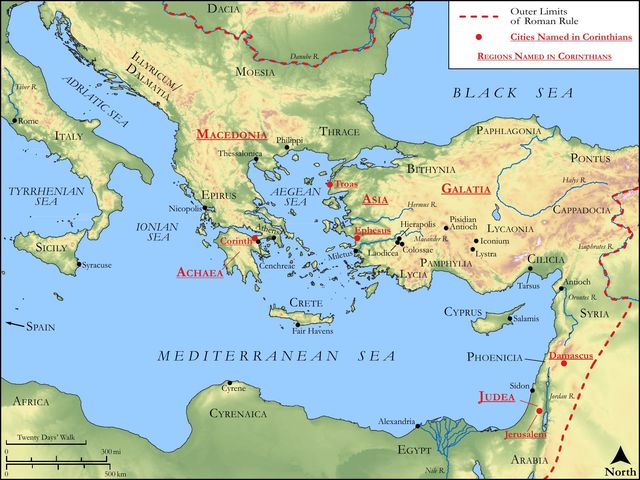
Corinth was a major Roman provincial capital, a bustling port city known for its wealth, diverse population, and a blend of Greek philosophical traditions, Roman administration, and various pagan cults, including the temple of Aphrodite. The Corinthian church was a relatively young community, founded by Paul during his second missionary journey (Acts 18:1-18). The city's culture valued rhetoric, wisdom, and influential teachers, which likely contributed to the factions Paul addresses. In Greco-Roman society, a paidagogos (instructor/tutor) was often a slave responsible for escorting a child to school, overseeing their discipline, and moral training. This role was important but temporary and did not carry the authority, affection, or foundational identity associated with a biological father (patēr). Paul leverages this cultural understanding to highlight the depth and permanence of his spiritual relationship with them, contrasting it sharply with the more superficial or temporary role of other teachers.
Key Themes
ShowHideThis verse contributes significantly to several key themes in 1 Corinthians and Pauline theology. It powerfully articulates Spiritual Paternity, positioning Paul not just as an evangelist or teacher, but as the one who "begot" them into spiritual life, establishing a unique and foundational bond. This contrasts with the theme of Spiritual Immaturity prevalent in the Corinthian church, as Paul seeks to guide them from a childish reliance on human wisdom to a mature understanding of Christ. The verse also underscores the Power and Efficacy of the Gospel, emphasizing that spiritual regeneration is not achieved through human eloquence or wisdom but "through the gospel" (1 Corinthians 4:15), echoing Paul's earlier assertion that the gospel is "the power of God for salvation" Romans 1:16. Finally, it speaks to Apostolic Authority and Humility, as Paul, despite his unique authority as their spiritual father, consistently models humility and suffering for Christ's sake, contrasting with the Corinthians' pride and self-sufficiency (as seen in 1 Corinthians 4:8-13).
Exposition and Analysis
ShowHideKey Word Analysis
ShowHideFrom the Greek paidagōgós, meaning a "boy-leader" or tutor. In ancient Greco-Roman culture, a paidagōgós was typically a trusted servant or slave who accompanied a child to school, supervised their conduct, and provided moral instruction. This role was crucial for discipline and training but was distinct from the child's biological father. Paul uses this term to describe the "ten thousand" other teachers in Corinth, implying their role was more supervisory and temporary, lacking the deep, life-giving bond of a father.
From the Greek gennáō, meaning "to procreate," "to bear," or "to beget." This verb emphasizes the act of giving birth or bringing into existence. Paul's use of this word is profoundly significant, asserting that he was the instrument through whom the Corinthians received spiritual life. It is a powerful metaphor for spiritual regeneration, indicating a foundational, life-imparting relationship, not merely an educational one.
From the Greek euangélion, meaning "a good message" or "good news." This refers to the core message of salvation through Jesus Christ's death, burial, and resurrection. Paul explicitly states that he "begot" them "through the gospel," highlighting that their spiritual birth was not a result of his personal charisma or wisdom, but through the divine power inherent in the message of Christ. The gospel is the channel through which new life is imparted.
Verse Breakdown
ShowHide"For though ye have ten thousand instructors in Christ"
Paul acknowledges the abundance of teachers and guides within the Christian community in Corinth. The phrase "ten thousand" (Greek mýrioi) is a hyperbole, meaning "innumerably many" or "very many," emphasizing the sheer number of people who could offer instruction or guidance. These "instructors in Christ" are those who teach Christian doctrine or principles, but their relationship to the believers is primarily pedagogical.
"yet [have ye] not many fathers"
This clause presents a stark contrast. Despite the multitude of instructors, Paul asserts that true spiritual fathers are rare. The term "fathers" (patḗr) here refers to those who have been instrumental in the spiritual birth and foundational nurturing of believers. This highlights a qualitative difference between imparting knowledge and imparting life.
"for in Christ Jesus I have begotten you through the gospel"
This is Paul's powerful declaration of his unique spiritual paternity. He explicitly states that he, and not others, was the one through whom they received spiritual life. The phrase "in Christ Jesus" signifies that this spiritual birth occurred within the sphere of Christ's redemptive work and identity. Crucially, this spiritual generation was accomplished "through the gospel," emphasizing that the message of Christ's death and resurrection was the divine instrument for their regeneration, not Paul's own power or wisdom.
Literary Devices
ShowHidePaul masterfully employs several literary devices in 1 Corinthians 4:15 to convey his message with clarity and impact. The most prominent is Contrast, as he sharply distinguishes between "ten thousand instructors" and "not many fathers." This juxtaposition highlights the qualitative difference between mere teaching and life-giving spiritual paternity. He uses Hyperbole with "ten thousand" (mýrioi) to emphasize the overwhelming number of teachers compared to the scarcity of true spiritual fathers, making his claim of unique paternity even more striking. Furthermore, the verse is built upon a central Metaphor of spiritual birth and family. Paul portrays himself as the "father" who has "begotten" the Corinthians, drawing on the deeply understood biological relationship to describe a profound spiritual reality. This metaphor underscores the intimacy, foundational nature, and life-imparting quality of his ministry to them, distinguishing it from the more functional and temporary role of an instructor.
Theological and Thematic Connections
ShowHidePaul's assertion of spiritual fatherhood in 1 Corinthians 4:15 is a profound theological statement about the nature of spiritual regeneration and the role of apostolic ministry. It emphasizes that new life in Christ is not merely a matter of intellectual assent or moral instruction, but a supernatural birth, a divine act of creation mediated through the proclamation of the gospel. This spiritual paternity implies a deep, enduring bond of love, responsibility, and nurturing, akin to a natural parent-child relationship. It underscores the foundational nature of evangelism and discipleship, where the initial impartation of life through the gospel establishes a unique connection between the spiritual parent and child. This relationship is rooted "in Christ Jesus," signifying that all spiritual life and identity flow from union with Him.
Reflection and Application
ShowHide1 Corinthians 4:15 offers rich insights for both believers and those engaged in ministry. For believers, it encourages a deep appreciation for those who were instrumental in their spiritual birth and foundational growth. While we may learn from many teachers, there is a unique debt of gratitude and respect owed to those God used to bring us into new life through the gospel. This verse challenges us to recognize the profound, life-altering impact of spiritual regeneration and to value the spiritual relationships that foster such growth. For those in ministry, Paul's example calls for a commitment that transcends mere instruction. It is a call to cultivate genuine, life-imparting relationships, to be spiritual parents who invest deeply, nurture, and guide others from spiritual infancy to maturity. It reminds us that the ultimate power lies not in our eloquence or wisdom, but in the gospel itself, which is the divine instrument for bringing about new life. Our role is to faithfully proclaim that life-giving message and then to shepherd those born through it with a father's or mother's heart.
Questions for Reflection
ShowHideFAQ
ShowHideWhat is the difference between an "instructor" and a "father" in this context?
ShowHidePaul draws a crucial distinction between an "instructor" (paidagōgós) and a "father" (patḗr). An instructor, in the Greco-Roman world, was typically a tutor or disciplinarian, often a slave, who guided a child in their education and manners. This role was important but temporary and focused on external discipline and knowledge transfer. A "father," however, is the one who imparts life, establishing a foundational and permanent bond. Paul uses this metaphor to assert that while many teachers (instructors) might provide guidance or further instruction to the Corinthians, he was the unique instrument through whom they received spiritual life and were "begotten" into the family of God "through the gospel" 1 Corinthians 4:15.
How did Paul "beget" the Corinthians through the gospel?
ShowHidePaul "begot" the Corinthians through the gospel by being the primary evangelist who first proclaimed the good news of Jesus Christ to them in Corinth. His preaching of the gospel was the means by which the Holy Spirit brought about their spiritual regeneration, leading them to faith and new life in Christ. This is not to say that Paul himself imparted life, but that he was the human instrument God used. The power resides in the gospel message itself, which is "the power of God for salvation to everyone who believes" Romans 1:16. Paul's role was to faithfully preach this message, and through it, the Corinthians were spiritually born.
Does this verse mean only one person can be our spiritual father?
ShowHideWhile Paul emphasizes his unique role as the one who "begot" the Corinthians, implying a singular foundational spiritual parent, this does not preclude believers from having multiple spiritual mentors, teachers, or even "fathers" (or mothers) in different seasons of their spiritual journey. Paul is making a specific claim about their initial conversion and the establishment of the church in Corinth. He laid the foundation 1 Corinthians 3:10. Other teachers built upon that foundation. The verse highlights the special, foundational bond with the one who led them to Christ, while acknowledging that many others can contribute to their ongoing growth and instruction.
Christ-Centered Fulfillment
ShowHide1 Corinthians 4:15, with Paul's declaration of spiritual paternity, finds its ultimate fulfillment and meaning in Christ Jesus. Paul's ability to "beget" believers through the gospel is not a power inherent in himself, but a reflection of the life-giving power of Christ. It is Christ who is the "firstborn from the dead" Colossians 1:18, the source of all new creation and spiritual life. Believers are "born again" not of perishable seed but through the living and abiding word of God, which is the gospel of Christ 1 Peter 1:23. Our adoption as children of God is "through Jesus Christ" Ephesians 1:5, making God our ultimate Father. Paul, as a spiritual father, mirrors the profound truth that God, through Christ, brings dead souls to life, making them His own children. Thus, Paul's spiritual fatherhood is a testament to the transformative work of Christ, who is the true giver of life, and whose gospel is the means by which we are brought into His eternal family. Every spiritual birth, whether through Paul or any other gospel messenger, ultimately points to the regenerating power of the resurrected Christ.