


Titus 1:12
- εἶπένeipenSaidG2036V-2AAI-3SVerb 2nd Aorist Active Indicative 3rd Singular
- τιςtisoneG5100X-NSMIndefinite pronoun Nominative Singular Masculine
- ἐξexofG1537PREPPreposition
- αὐτῶνautōnthemG846P-GPMPersonal pronoun Genitive Plural Masculine
- ἴδιοςidiosownG2398A-NSMAdjective Nominative Singular Masculine
- αὐτῶνautōnof themG846P-GPMPersonal pronoun Genitive Plural Masculine
- προφήτης·prophētēsa prophetG4396N-NSMNoun Nominative Singular Masculine
- ΚρῆτεςKrētesCretansG2912N-NPM-LGNoun Nominative Plural Masculine Location Gentilic
- ἀεὶaei[are] alwaysG104ADVAdverb
- ψεῦσταιpseustailiarsG5583N-NPMNoun Nominative Plural Masculine
- κακὰkakaevilG2556A-NPNAdjective Nominative Plural Neuter
- θηρίαthēriabeastsG2342N-NPNNoun Nominative Plural Neuter
- γαστέρεςgasteresgluttonsG1064N-NPFNoun Nominative Plural Feminine
- ἀργαίargailazyG692A-NPFAdjective Nominative Plural Feminine
English is a literal word-by-word gloss of the Greek, not the KJV's wording. Why?
This is the original text the KJV's translators worked from — each Greek word with its own literal English meaning in this verse, prepared by scholars at Tyndale House, Cambridge. The KJV translates whole sentences, not word by word, so its wording differs: one Greek word can become several English words, and the KJV may choose “charity” where the gloss reads “love”. Both are faithful — they answer different questions. For the KJV's own rendering, switch to the KJV text.
Details
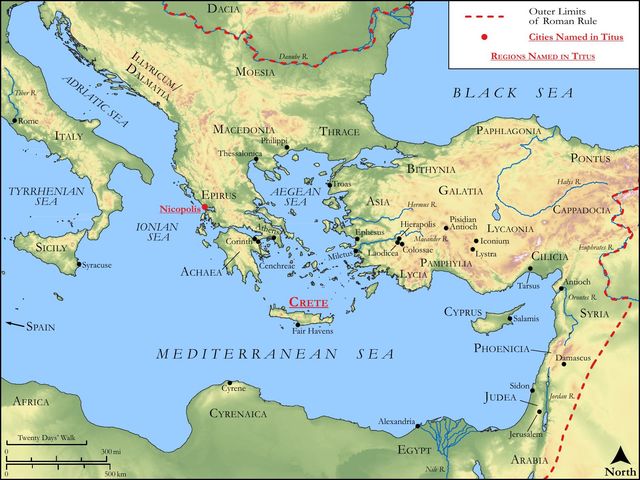
See on the biblical-era map

Study this verse
Public-domain commentary
Matthew Henry
From his Commentary on the Whole Bible. Henry comments on passages, not single verses — this entry covers Titus 1:6–16. His four-level outline is real structure in the source text, so it is rendered as structure.
The apostle here gives Titus directions about ordination, showing whom he should ordain, and whom not.
I.Of those whom he should ordain.
He points out their qualifications and virtues; such as respect their life and manners, and such as relate to their doctrine: the former in the sixth, seventh, and eighth verses, and the latter in the ninth.
1.Their qualifications respecting their life and manners are,
(1.)More general: If any be blameless; not absolutely without fault, so none are, for there is none that liveth and sinneth not; nor altogether unblamed, this is rare and difficult. Christ himself and his apostles were blamed, though not worthy of it. In Christ thee was certainly nothing blamable; and his apostles were not such as their enemies charged them to be. But the meaning is, He must be one who lies not under an ill character; but rather must have good report, even from those that are without; not grossly or scandalously guilty, so as would bring reproach upon the holy function; he must not be such a one.
(2.)More particularly.
[1.]There is his relative character. In his own person, he must be of conjugal chastity: The husband of one wife. The church of Rome says the husband of no wife, but from the beginning it was not so; marriage is an ordinance from which no profession nor calling is a bar. Co1 9:5, Have I not power, says Paul, to lead about a sister, a wife, as well as other apostles? Forbidding to marry is one of the erroneous doctrines of the antichristian church, Ti1 4:3. Not that ministers must be married; this is not meant; but the husband of one wife may be either not having divorced his wife and married another (as was too common among those of the circumcision, even for slight causes), or the husband of one wife, that is, at one and the same time, no bigamist; not that he might not be married to more than one wife successively, but, being married, he must have but one wife at once, not two or more, according to the too common sinful practice of those times, by a perverse imitation of the patriarchs, from which evil custom our Lord taught a reformation. Polygamy is scandalous in any, as also having a harlot or concubine with his lawful wife; such sin, or any wanton libidinous demeanour, must be very remote from such as would enter into so sacred a function. And, as to his children, having faithful children, obedient and good, brought up in the true Christian faith, and living according to it, at least as far as the endeavours of the parents can avail. It is for the honour of ministers that their children be faithful and pious, and such as become their religion. Not accused of riot, nor unruly, not justly so accused, as having given ground and occasion for it, for otherwise the most innocent may be falsely so charged; they must look to it therefore that there be no colour for such censure. Children so faithful, and obedient, and temperate, will be a good sign of faithfulness and diligence in the parent who has so educated and instructed them; and, from his faithfulness in the less, there may be encouragement to commit to him the greater, the rule and government of the church of God. The ground of this qualification is shown from the nature of his office (Tit 1:7): For a bishop must be blameless, as the steward of God. Those before termed presbyters, or elders, are in this verse styled bishops; and such they were, having no ordinary fixed and standing officers above them. Titus's business here, it is plain, was but occasional, and his stay short, as was before noted. Having ordained elders, and settled in their due form, he went and left all (for aught that appears in scripture) in the hands of those elders whom the apostle here calls bishops and stewards of God. We read not in the sacred writings of any successor he had in Crete; but to those elders or bishops was committed the full charge of feeding, ruling, and watching over their flock; they wanted not any powers necessary for carrying on religion and the ministry of it among them, and committing it down to succeeding ages. Now, being such bishops and overseers of the flock, who were to be examples to them, and God's stewards to take care of the affairs of his house, to provide for and dispense to them things needful, there is great reason that their character should be clear and good, that they should be blameless. How else could it be but that religion must suffer, their work be hindered, and souls prejudiced and endangered, whom they were set to save? These are the relative qualifications with the ground of them.
[2.]The more absolute ones are expressed, First, Negatively, showing what an elder or bishop must not be: Not self-willed. The prohibition is of large extent, excluding self-opinion, or overweening conceit of parts and abilities, and abounding in one's own sense, - self-love, and self-seeking, making self the centre of all, - also self-confidence and trust, and self-pleasing, little regarding or setting by others, - being proud, stubborn, froward, inflexible, set on one's own will and way, or churlish as Nabal: such is the sense expositors have affixed to the term. A great honour it is to a minister not to be thus affected, to be ready to ask and to take advice, to be ready to defer as much as reasonably may be to the mind and will of others, becoming all things to all men, that they may gain some. Not soon angry, mē orgilon, not one of a hasty angry temper, soon and easily provoked and inflamed. How unfit are those to govern a church who cannot govern themselves, or their own turbulent and unruly passions! The minister must be meek and gentle, and patient towards all men. Not given to wine; thee is no greater reproach on a minister than to be a wine-bibber, one who loves it, and gives himself undue liberty this way who continues at the wine or strong drink till it inflames him. Seasonable and moderate use of this, as of the other good creatures of God, is not unlawful. Use a little wine for thy stomach's sake, and thine often infirmities, said Paul to Timothy, Ti1 5:23. But excess therein is shameful in all, especially in a minister. Wine takes away the heart, turns the man into a brute: here most proper is that exhortation of the apostle (Eph 5:18), Be not drunk with wine, wherein is excess; but be filled with the Spirit. Here is no exceeding, but in the former too easily there may: take heed therefore of going too near the brink. No striker, in any quarrelsome or contentious manner, not injuriously nor out of revenge, with cruelty or unnecessary roughness. Not given to filthy lucre; not greedy of it (as Ti1 3:3), whereby is not meant refusing a just return for their labours, in order to their necessary support and comfort; but not making gain their first or chief end, not entering into the ministry nor managing it with base worldly views. Nothing is more unbecoming a minister, who is to direct his own and others' eyes to another world, than to be too intent upon this. It is called filthy lucre, from its defiling the soul that inordinately affects or greedily looks after it, as if it were any otherwise desirable than for the good and lawful uses of it. Thus of the negative part of the bishop's character. But, Secondly, Positively: he must be (Tit 1:8) a lover of hospitality, as an evidence that he is not given to filthy lucre, but is willing to use what he has to the best purposes, not laying up for himself, so as to hinder charitable laying out for the good of others; receiving and entertaining strangers (as the word imports), a great and necessary office of love, especially in those times of affliction and distress, when Christians were made to fly and wander for safety from persecution and enemies, or in travelling to and fro where there were not such public houses for reception as in our days, nor, it may be, had many poor saints sufficiency of their own for such uses - then to receive and entertain them was good and pleasing to God. And such a spirit and practice, according to ability and occasion, are very becoming such as should be examples of good works. A lover of good men, or of good things; ministers should be exemplary in both; this will evince their open piety, and likeness to God and their Master Jesus Christ: Do good to all, but especially to those of the household of faith, those who are the excellent of the earth, in whom should be all our delight. Sober, or prudent, as the word signifies; a needful grace in a minister both for his ministerial and personal carriage and management. He should be a wise steward, and one who is not rash, or foolish, or heady; but who can govern well his passions and affections. Just in things belonging to civil life, and moral righteousness, and equity in dealings, giving to all their due. Holy, in what concerns religion; one who reverences and worships God, and is of a spiritual and heavenly conversation. Temperate; it comes from a word that signifies strength, and denotes one who has power over his appetite and affections, or, in things lawful, can, for good ends, restrain and hold them in. Nothing is more becoming a minister than such things as these, sobriety, temperance, justice, and holiness - sober in respect of himself, just and righteous towards all men, and holy towards God. And thus of the qualifications respecting the minister's life and manners, relative and absolute, negative and positive, what he must not, and what he must, be and do.
2.As to doctrine,
(1.)Here is his duty: Holding fast the faithful word, as he has been taught, keeping close to the doctrine of Christ, the word of his grace, adhering thereto according to the instructions he has received - holding it fast in his own belief and profession, and in teaching others. Observe,
[1.]The word of God, revealed in the scripture, is a true and infallible word; the word of him that is the amen, the true and faithful witness, and whose Spirit guided the penmen of it. Holy men of God spoke as they were moved by the Holy Ghost.
[2.]Ministers must hold fast, and hold forth, the faithful word in their teaching and life. I have kept the faith, was Paul's comfort (Ti2 4:7), and not shunned to declare the whole counsel of God; there was his faithfulness, Act 20:27.
(2.)Here is the end: That he may be able, by sound doctrine, both to exhort, and to convince the gainsayers, to persuade and draw others to the true faith, and to convince the contrary-minded. How should he do this if he himself were uncertain or unsteady, not holding fast that faithful word and sound doctrine which should be the matter of this teaching, and the means and ground of convincing those that oppose the truth? We see here summarily the great work of the ministry - to exhort those who are willing to know and do their duty, and to convince those that contradict, both which are to be done by sound doctrine, that is, in a rational instructive way, by scripture-arguments and testimonies, which are the infallible words of truth, what all may and should rest and be satisfied in and determined by. And thus of the qualifications of the elders whom Titus was to ordain.
II.The apostle's directory shows whom he should reject or avoid - men of another character, the mention of whom is brought in as a reason of the care he had recommended about the qualifications of ministers, why they should be such, and only such, as he had described. The reasons he takes both from bad teachers and hearers among them, Tit 1:10, to the end.
1.From bad teachers.
(1.)Those false teachers are described. They were unruly, headstrong and ambitious of power, refractory and untractable (as some render it), and such as would not bear nor submit themselves to the discipline and necessary order in the church, impatient of good government and of sound doctrine. And vain talkers and deceivers, conceiting themselves to be wise, but really foolish, and thence great talkers, falling into errors and mistakes, and fond of them, and studious and industrious to draw others into the same. Many such there were, especially those of the circumcision, converts as they pretended, at least, from the Jews, who yet were for mingling Judaism and Christianity together, and so making a corrupt medley. These were the false teachers.
(2.)Here is the apostle's direction how to deal with them (Tit 1:11): Their mouths must be stopped; not by outward force (Titus had no such power, nor was this the gospel method), but by confutation and conviction, showing them their error, not giving place to them even for an hour. In case of obstinacy indeed, breaking the peace of the church, and corrupting other churches, censures are to have place, the last means for recovering the faulty and preventing the hurt of many. Observe, Faithful ministers must oppose seducers in good time, that, their folly being made manifest, they may proceed no further.
(3.)The reasons are given for this.
[1.]From the pernicious effects of their errors: They subvert whole houses, teaching things which they ought not (namely, the necessity of circumcision, and of keeping the law of Moses, etc.), so subverting the gospel and the souls of men; not some few only, but whole families. It was unjustly charged on the apostles that they turned the world upside down; but justly on these false teachers that they drew many from the true faith to their ruin: the mouths of such should be stopped, especially considering,
[2.]Their base end in what they do: For filthy lucre's sake, serving a worldly interest under pretence of religion. Love of money is the root of all evil. Most fit it is that such should be resisted, confuted, and put to shame, by sound doctrine, and reasons from the scriptures. Thus of the grounds respecting the bad teachers.
II.In reference to their people or hearers, who are described from ancient testimony given of them.
1.Here is the witness (Tit 1:12): One of themselves, even a prophet of their own, that is, one of the Cretans, not of the Jews, Epimenides a Greek poet, likely to know and unlikely to slander them. A prophet of their own; so their poets were accounted, writers of divine oracles; these often witnessed against the vices of the people: Aratus, Epimenides, and others among the Greeks; Horace, Juvenal, and Persius, among the Latins: much smartness did they use against divers vices.
2.Here is the matter of his testimony: Krētes aei pseustaî kaka thēriâ gasteres argai - The Cretans are always liars, evil beasts, slow bellies. Even to a proverb, they were infamous for falsehood and lying; kretizein, to play the Cretan, or to lie, is the same; and they were compared to evil beasts for their sly hurtfulness and savage nature, and called slow bellies for their laziness and sensuality, more inclined to eat than to work and live by some honest employment. Observe, Such scandalous vices as were the reproach of heathens should be far from Christians: falsehood and lying, invidious craft and cruelty, all beastly and sensual practices, with idleness and sloth, are sins condemned by the light of nature. For these were the Cretans taxed by their own poets.
3.Here is the verification of this by the apostle himself: Tit 1:13. This witness is true, The apostle saw too much ground for that character. The temper of some nations is more inclined to some vices than others. The Cretans were too generally such as here described, slothful and ill-natured, false and perfidious, as the apostle himself vouches. And thence,
4.He instructs Titus how to deal with them: Wherefore rebuke them sharply. When Paul wrote to Timothy he bade him instruct with meekness; but now, when he writes to Titus, he bids him rebuke them sharply. The reason of the difference may be taken from the different temper of Timothy and Titus; the former might have more keenness in his disposition, and be apt to be warm in reproving, whom therefore he bids to rebuke with meekness; and the latter might be one of more mildness, therefore he quickens him, and bids him rebuke sharply. Or rather it was from the difference of the case and people: Timothy had a more polite people to deal with, and therefore he must rebuke them with meekness; and Titus had to do with those who were more rough and uncultivated, and therefore he must rebuke them sharply; their corruptions were many and gross, and committed without shame or modesty, and therefore should be dealt with accordingly. There must in reproving be a distinguishing between sins and sins; some are more gross and heinous in their nature, or in the manner of their commission, with openness and boldness, to the greater dishonour of God and danger and hurt to men: and between sinners and sinners; some are of a more tender and tractable temper, apter to be wrought on by gentleness, and to be sunk and discouraged by too much roughness and severity; others are more hardy and stubborn, and need more cutting language to beget in them remorse and shame. Wisdom therefore is requisite to temper and manage reproofs aright, as may be most likely to do good. Jde 1:22, Jde 1:23, Of some have compassion, making a difference; and others save with fear, pulling them out of the fire. The Cretans' sins and corruptions were many, great, and habitual; therefore they must be rebuked sharply. But that such direction might not be misconstrued,
5.Here is the end of it noted: That they may be sound in the faith (Tit 1:14), not giving heed to Jewish fables, and commandments of men, that turn from the truth; that is, that they may be and show themselves truly and effectually changed from such evil tempers and manners as those Cretans in their natural state lived in, and may not adhere to nor regard (as some who were converted might be too ready to do) the Jewish traditions and the superstitions of the Pharisees, which would be apt to make them disrelish the gospel, and the sound and wholesome truths of it. Observe,
(1.)The sharpest reproofs must aim at the good of the reproved: they must not be of malice, nor hatred, nor ill-will, but of love; not to gratify pride, passion, nor any evil affection in the reprover, but to reclaim and reform the erroneous and the guilty.
(2.)Soundness in the faith is most desirable and necessary. This is the soul's health and vigour, pleasing to God, comfortable to the Christian, and what makes ready to be cheerful and constant in duty.
(3.)A special means to soundness in the faith is to turn away the ear from fables and the fancies of men (Ti1 1:4): Neither give heed to fables and endless genealogies, that minister questions rather than godly edifying, which is in faith. So Ti1 4:7, Refuse profane and old wives' fables, and exercise thyself rather to godliness. Fancies and devices of men in the worship of God are contrary to truth and piety. Jewish ceremonies and rites, that were at first divine appointments, the substance having come and their season and use being over, are now but unwarranted commands of men, which not only stand not with, but turn fRom. the truth, the pure gospel truth and spiritual worship, set up by Christ instead of that bodily service under the law.
(4.)A fearful judgment it is to be turned away from the truth, to leave Christ for Moses, the spiritual worship of the gospel for the carnal ordinances of the law, or the true divine institutions and precepts for human inventions and appointments. Who hath bewitched you (said Paul to the Galatians, Gal 3:1, Gal 3:3) that you should not obey the truth? Having begun in the Spirit, are you made perfect by the flesh? Thus having shown the end of sharply reproving the corrupt and vicious Cretans, that they might be sound in the faith, and not heed Jewish fables and commands of men,
6.He gives the reasons of this, from the liberty we have by the gospel from legal observances, and the evil and mischief of a Jewish spirit under the Christian dispensation in the last two verses. To good Christians that are sound in the faith and thereby purified all things are pure. Meats and drinks, and such things as were forbidden under the law (the observances of which some still maintain), in these there is now no such distinction, all are pure (lawful and free in their use), but to those that are defiled and unbelieving nothing is pure; things lawful and good they abuse and turn to sin; they suck poison out of that from which others draw sweetness; their mind and conscience, those leading faculties, being defiled, a taint is communicated to all they do. The sacrifice of the wicked is an abomination to the Lord, Pro 15:8. And Pro 21:4, The ploughing of the wicked is sin, not in itself, but as done by him; the carnality of the mind and heart mars all the labour of the hand.
Objection. But are not these judaizers (as you call them) men who profess religion, and speak well of God, and Christ, and righteousness of life, and should they be so severely taxed? Answer, They profess that they know God; but in works they deny him, being abominable, and disobedient, and to every good work reprobate, Tit 1:16. There are many who in word and tongue profess to know God, and yet in their lives and conversations deny and reject him; their practice is a contradiction to their profession. They come unto thee as the people cometh, and they sit before thee as my people, and they hear thy words, but they will not do them: with their mouth they show much love, but their heart goeth after their covetousness, Eze 33:31. Being abominable, and disobedient, and to every good work reprobate. The apostle, instructing Titus to rebuke sharply, does himself rebuke sharply; he gives them very hard words, yet doubtless no harder than their case warranted and their need required. Being abominable - bdeluktoi, deserving that God and good men should turn away their eyes from them as nauseous and offensive. And disobedient - apeitheis, unpersuadable and unbelieving. They might do divers things; but it was not the obedience of faith, nor what was commanded, or short of the command. To every good work reprobate, without skill or judgment to do any thing aright. See the miserable condition of hypocrites, such as have a form of godliness, but without the power; yet let us not be so ready to fix this charge on others as careful that it agree not to ourselves, that there be not in us an evil heart of unbelief, in departing from the living God; but that we be sincere and without offence till the day of Christ, being filled with the fruits of righteousness, which are by Jesus Christ unto the glory and praise of God, Phi 1:10, Phi 1:11.
Historical interpretation
Eight Centuries of Reception
12 surviving comments on this verse. Each one is dated, so this reads as a timeline rather than a list.
Select a marker to jump to its quote. Markers stagger vertically where authors wrote within a few decades of each other.
Though some one says that the Cretans are liars.
What wonder, too, that others, such as Heracles and Perseus, should be called gods on the ground of their strength? And yet others, as Asclepius, on the ground of their skill? Either their subjects accorded them this honor or else the rulers themselves seized it. Some got the title from fear, others from reverence.… And those who lived later accepted these deifications uncritically.The Cretans always lie; for they, O King,
Have built your tomb, and you are not yet dead.
While you, Callimachus, believe in the birth of Zeus, you disbelieve in his tomb. While you imagine you are hiding the truth, you actually proclaim, even to those who do not realize it, that Zeus is dead.
Comic poets deride the Phrygians for their cowardice; Sallust reproaches the Moors for their levity, and the Dalmatians for their cruelty; even the apostle brands the Cretans as "liars." Very likely, too, something must be set down to the score of bodily condition and the state of the health.
Your Jupiter too, stolen in his infancy, was unworthy of both the home and the nutriment accorded to human beings; and, as he deserved for so bad a child, he had to live in Crete. Afterwards, when full-grown, he dethrones his own father, who, whatever his parental character may have been, was most prosperous in his reign, king as he was of the golden age.
But the heretic, though he use scriptural terms, yet, as being equally dangerous and depraved, shall be asked in the words of the Spirit, “Why do you preach my laws and take my covenant in your mouth?” Thus, the devil, though speaking from the Scriptures, is silenced by the Savior. The blessed Paul, though he speaks from profane writers, “The Cretans are always liars,” and ‘We are his offspring,” and “Evil communications corrupt good manners,” yet has a religious meaning, as being holy—is “doctor of the nations, in faith and verity,” as having “the mind of Christ.”
There are several questions here. First, who it was that said this? Secondly, why Paul quoted it? Thirdly, why he brings forward a testimony that is not correct? Let us then offer a seasonable solution of these, having premised some other things. For when Paul was discoursing to the Athenians, in the course of his harangue he quoted these words, "To the Unknown God": and again, "For we also are His offspring, as certain also of your own poets have said." (Acts xvii. 23, Acts xvii. 28.) It was Epimenides who said this, himself a Cretan, and whence he was moved to say it is necessary to mention. It is this. The Cretans have a tomb of Jupiter, with this inscription. "Here lieth Zan, whom they call Jove." On account of this inscription, then, the poet ridiculing the Cretans as liars, as he proceeds, introduces, to increase the ridicule, this passage.
For even a tomb, O King, of thee
They made, who never diedst, but aye shalt be.
If then this testimony is true, observe what a difficulty! For if the poet is true who said that they spoke falsely, in asserting that Jupiter could die, as the Apostle says, it is a fearful thing! Attend, beloved, with much exactness. The poet said that the Cretans were liars for saying that Jupiter was dead. The Apostle confirmed his testimony: so, according to the Apostle, Jupiter is immortal: for he says, "this witness is true"! What shall we say then? Or rather how shall we solve this? The Apostle has not said this, but simply and plainly applied this testimony to their habit of falsehood. Else why has he not added, "For even a tomb, O king, of thee, they made"? So that the Apostle has not said this, but only that one had well said, "The Cretans are always liars." But it is not only from hence that we are confident that Jupiter is not a God. From many other arguments we are able to prove this, and not from the testimony of the Cretans. Besides, he has not said, that in this they were liars. Nay and it is more probable that they were deceived as to this point too. For they believed in other gods, on which account the Apostle calls them liars.
And as to the question, why does he cite the testimonies of the Greeks? It is because we put them most to confusion when we bring our testimonies and accusations from their own writers, when we make those their accusers, who are admired among themselves.
"A certain one of them, their own prophet, said: 'Cretans are always liars, evil beasts, lazy gluttons.' This testimony is true. For this cause, reprove them sharply, so that they may be sound in the faith, not paying attention to Jewish myths and commandments of people who turn away from the truth." As for the text of the discourse and the context of the passage, what he says: "A certain one of them, their own prophet," seems to be referring to those he spoke of earlier, especially those who are of the circumcision, who must be silenced because they are upsetting entire households by teaching things they should not for the sake of shameful gain. And he continues, "A certain one of them, their own prophet." However, since this hexameter verse is not found in any of the prophets who prophesied in Judah, it seems to me that it should be read in two ways: either that what he says, "A certain one of them, their own prophet," is connected with what came before, in order to correct the things that were lacking in Crete, or that it refers specifically to the Cretans. But because there are many things in between, and this seems absurd and perhaps no one will accept it, therefore, with regard to the things that are closer, it must be read differently from what came before, as follows: "For there are many rebellious people, full of meaningless talk and deception, especially those of the circumcision group; they must be silenced, because they are disrupting whole households by teaching things they ought not to teach, and that for the sake of dishonest gain." A certain one of them, their own prophet, said: so that what is said, "their own prophet," does not refer specifically to the Jews, and especially to those of the circumcision, but rather to many who are rebellious, full of meaningless talk and deception, who must be silenced along with those of the circumcision group, who are disrupting whole households by teaching things they should not, and who, since they were in Crete, should be believed to be Cretans. However, this couplet is said to be found in the oracles of the Cretan poet Epimenides; he called him a prophet, jokingly or allusively, meaning that Christians of such kind deserve to have prophets, just as prophets belonged to Baal and to the confusion of the Jews and to other offenses, and the scriptures mention any wicked prophets, genuinely because he wrote about oracles and responses that also foretold the future and predicted things that were to come long before. Finally, the book itself is titled Oracles, and because it seemed to promise something divine, I think the Apostle looked into it to see what the pagan divination promised, and in due time he used the couplet when he wrote to Titus, who was on Crete, in order to convict the false teachers of Crete with their own teacher. However, Paul is found to have done this not only in this place, but also in others. In the Acts of the Apostles, when he preached to the people, and in the Areopagus, which is the court of the Athenians, he argued, he says among other things: For we are his offspring, as some of your own poets have said (Acts 17), which hemistich is read in the Phaenomena Arati; which Cicero translated into Latin; and Germanicus Caesar, and recently Avienus, and many others, whom to enumerate is too long. To the Corinthians also (1 Cor. 15:33), who were themselves polished by Attic eloquence; and because of the proximity of the places, they were seasoned with the taste of Athenians, he took an iambic verse from Menander's comedy: Evil company corrupts good habits. Nor is it surprising if, for the opportunity of the time, he abuses the verses of pagan poets: for even altering some inscription of an altar, he spoke to the Athenians: "For as I passed by, and beheld your devotions, I found an altar with this inscription, TO THE UNKNOWN GOD. Whom therefore ye ignorantly worship, him declare I unto you. But the inscription on the altar was not as Paul asserted, to an unknown God, but as follows: To the Gods of Asia, Europe, and Africa; to unknown and foreign gods. But because Paul did not need many unknown gods, but only one unknown God, he used a unique expression; so that he would teach that he was their God whom the Athenians had marked with the title of the altar; and, knowing it correctly, they ought to worship him whom they were ignorant of and could not ignore. But Paul did this seldom, and as the circumstances of the place more than suitability demanded it, in the manner of bees, which are accustomed to compose honey from various flowers and to adapt the cells of their favors. Some consider this verse taken from Callimachus the Cyrenian poet, and are not entirely wrong. In his praise of Jupiter against the Cretans, who boasted about showing his tomb, he says, "The Cretans are always liars, who also built his tomb with a sacrilegious mind." But, as we said above, the whole verse was taken by the Apostle from Epimenides the poet, and Callimachus used his exordium in his poem. Or perhaps he turned the common proverb by which the Cretans were called deceitful into a meter without stealing the labor of others. Some believe that the Apostle should be blamed for having imprudently fallen; and when he rebuked false teachers, he proved that verse by saying that the Cretans were called deceitful because they had built the empty tomb of Jupiter. For they say that Epimenides or Callimachus accused the Cretans of being deceitful and dangerous beasts and lazy gluttons, because they do not feel the divine; and (even though) they create Jupiter, who reigns in heaven, buried on their own island; and this that they said is confirmed by the view of the Apostles: thus it follows that Jupiter is not dead, but alive. Therefore, it was unskillful of Paul, the destroyer of idolatry, while fighting against perverse teachers, to assert that the gods which he was attacking did exist. To this we must briefly respond that, in the case where he said "Evil company corrupts good morals," he did not immediately approve Menander's entire comedy or Aratus' book, but rather he used an opportunity provided by a verse. Similarly, in the present case, he did not confirm the entire work of Callimachus or Epimenides, whose one praises Jupiter and the other writes about oracles through one verse; rather, he only rebuked the Cretans as liars, blaming them for the vice of their people, not due to their opinion, which is praised by poets, but due to their innate ease of lying. But those who think that the whole book ought to be followed by the one who has made use of a part of the book, seem to me to admit the Apocryphal Book of Enoch, ((or of the Enochs)), concerning which Judas the Apostle gave testimony in his Epistle, among the sacred Scriptures of the Church; and many other things which the Apostle Paul spoke of in a hidden way. For we can say this by way of argument: that since he said that he worshipped the unknown God among the Athenians, whom they had written on an altar, Paul ought to follow and do those things also which were written on the altar, and those things which the Athenians were doing, since he had come to an agreement with them in part regarding the worship of an unknown God. Far be it from me to draw argument and scholastic elegance into calumny. There is no one so wicked, so much of a criminal, so much of a poisoner, who has not done something good at some time. Therefore, if I approve of one good thing of his, when I see it, and it is necessary for me to support the rest, which were bad, what is that to be blamed? If he is accused by an enemy against us and cries out, will he not speak some truth among the words of conflicts? And this too, is not always blamed by us against whom he speaks. So Callimachus and Epimenides, did not say that Jupiter is a god, and the rest that is contained in their poems, because the Cretans are deceitful; but they only spoke the truth, because they were expressing the inborn vice of the Cretans in terms of lies: because they are deceitful, they did not always speak the truth. For Jupiter would not cease to be a god even if the Cretans spoke the truth; but nevertheless, while they were silent, he who was dead would not have the name of a god. Finally, let us know that the Apostle spoke against the Cretans not by chance, and not incidentally (as they think), but carefully and watchfully, and defending himself in every way against the Cretans: This is a true testimony, he says; not the whole poem from which the testimony is taken, not the whole work: but only this testimony, this verse in which they are called liars. And certainly he who agreed only in one part of the poem, is to be believed to have refuted the rest. However, we have discussed in the Epistle of Paul to the Galatians how either the Cretans are deceitful and foolish, or the Galatians are hard-necked, or each province is represented by its own vice. And since there is nothing else we can add here, we are content with that. Therefore rebuke them sharply, he says, they are liars and evil beasts, and lazy gluttons, who deceive with falsehoods and thirst for the blood of the deceived like wild animals, and not working in silence, eat their own bread, whose god is their belly, and their glory is in their shame, and rebuke them so that they may be sound in the faith. Speak of the health of faith and what follows: that old men be sober, honorable, chaste, sound in the faith and love and patience, to whose faith the health of teachings is also called. For a time will come, he says, when they will not listen to sound doctrine. There are also speeches of health, of which he speaks in the first letter to Timothy: if anyone teaches differently and does not agree to the sound words of our Lord Jesus Christ and to the teaching that is according to piety (1 Tim. 6:3). And in the second: Holding the example of sound words that you have heard from me (2 Tim. 1:13). Those who have this health of faith and doctrine and sound words, do not heed Jewish fables and the commands of men who turn away from the truth. Let us acquiesce for a short time to the Jews, and listen patiently to their foolishness, and then we will understand what the Jewish tales are which have no authority from Scripture, nor any rational basis, but are the product of the fables and imaginations of certain people about animals and legends, of whom Isaiah prophesied, saying: "This people honors me with their lips, but their heart is far from me. They worship me in vain, teaching as doctrines the commandments of men" (Isaiah 29:13). This is confirmed by the testimony of the Savior in the Gospel, who accuses them of giving preference to the commandments of men over the Law of God. For God said, "Honor your father and mother." They, on the other hand, say, "Whatever gift you might have received from me is Corban, that is, an offering to God" (Mark 7:11-12). Anyone who falls short of circumcision after the coming of Christ is a slave to Jewish myths and the commandments of men, who turn away from truth. For it is not the one who appears to be a Jew outwardly who is, but the one who is in secret; and circumcision is of the heart, by the Spirit, not by the letter. Whoever keeps the Passover, but not in the sincerity and truth of unleavened bread, so that he may purge out of his soul all the old leaven of wickedness and malice: this person attends to fables, and follows shadows, neglecting the truth. Whoever does not rise with Christ, nor seek the things that are above, but those that are below, saying, "Do not touch, do not taste, do not handle," which all perish with use, according to the commandments and doctrines of men: this person follows not good justices and not good precepts. But where is truth, and where is the spiritual law, where there are good justification, and the best of precepts is observed, and whoever does them shall live in them.
You ask me at the close of your letter why it is that sometimes in my writings I quote examples from secular literature and thus defile the purity of the church with the foulness of heathenism.… For who is there who does not know that both in Moses and the prophets there are passages cited from Gentile books and that Solomon proposed questions to the philosophers of Tyre and answered others put to him by them.… The apostle Paul also, in writing to Titus, has used a line of the poet Epimenides: “The Cretans are always liars, evil beasts, slow bellies.” Half of this line was afterward adopted by Callimachus.
Having criticized the dangers that arise from Christians of Jewish background, Paul now does the same with Gentile believers. “Of their own” does not refer to the Jews but to a poet or prophet of Gentile background, even one of the Cretans. He wished to criticize the Cretans because they believed they could show the tomb of Jove, even though Jove existed not as a man (as the poet thought) but as a god.
If you were to hear, even from one who was profane, the prayer of the priest couched in words suitable to the mysteries of the gospel, can you possibly say to him, “Your prayer is not true,” though he himself may be not only a false priest but not a priest at all? The apostle Paul said that certain testimony of a Cretan prophet (he knew not which) was true, though he was not reckoned among the prophets of God.… If, therefore, the apostle himself bore witness to the testimony of some obscure prophet of a foreign race because he found it to be true, why do not we, when we find in any one what belongs to Christ and is true even though the man with whom it may be found is deceitful and perverse? Why do we not in such a case make a distinction between the fault which is found in the man and the truth which he has not of his own but of God?
The quote is from Callimachus, who is not a Jewish prophet but a pagan poet. He calls the Cretans liars on account of a tomb of Jove. Paul is not here offering fables but insisting on the inconsistency of the Cretans, for it is true that the one they call Jove is in another place dead and they have built him a tomb.
One of them, a prophet of their own, said: "Cretans are always liars, evil beasts, lazy gluttons."
It is asked for what reason Paul brought forward the testimony of the Greeks, and commended it, especially since it was not rightly said? But what is the testimony? The Cretans built a tomb for Zeus. And so a certain poet says: The Cretans built a tomb for you, O king; but you are by no means dead, for you always live. Part of this prophecy is: The Cretans are always liars, etc. However, the Apostle attested that this saying is true. But if this testimony is true, then Zeus must be immortal. Yet we say that in this alone he said the testimony was true, because he called them liars themselves.
— [OECUMENIUS] Epimenides the Cretan, the oracle of the prophet. Callimachus has also made use of the verse spoken by him in the hymn to Zeus. [end of the excerpt by Oecumenius G f. 314r] —
Where Paul says: "This testimony," namely that he says they themselves are liars. Indeed, someone might say this is so: but why did he bring forth testimony from the Greeks? And we say that this affected them with the greatest shame that it produced testimony of their own wickedness from their own people. For since those among us do not have faith in them, Paul brought their own accusers to them. This God was also doing when, through the star, He indicated Christ to the Magi, so that they would be occupied with astronomy (Matt. 2), as if admonishing them by their own. Again, the prophet from the oxen drawing the ark (2 Sam. 6:3). Moreover, Saul from the woman having the spirit of Python (Acts 16:16), because he believed her. In these ways God was revealing Himself. Nor is it opposed by the fact that Christ and afterwards the apostles forbade demons to speak: for signs were made which could persuade (Mark 9:38). It was necessary that they persuade men by those whom they believed.
Continue studying Titus 1:12 across the web’s major study libraries — every link below opens this exact verse, chapter, or book on the destination site.
Read & Compare
 BibleGatewayThis verse in more than 200 translations and 70 languages.
 Bible.comThe YouVersion reader — hundreds of translations, reading plans, and highlights.
 ESV.orgCrossway's official English Standard Version reader.
 NET BibleThe NET translation with 60,000+ translators' notes on every rendering decision.
 STEP BibleTyndale House's free study tool — original text, vocabulary, and scholarly resources.
 BibliaLogos Bible Software's free web reader.
 USCCBThe New American Bible (Revised Edition) with the U.S. bishops' study notes.
Commentaries
 BibleHub CommentariesDozens of classic commentaries on this verse, gathered on one page.
 StudyLightMore than 100 commentary sets — the largest collection on the web.
 BibleRefPlain-English commentary on what this verse means, verse by verse.
 Enduring WordDavid Guzik's free commentary on this chapter, widely used by Bible teachers.
 Bible Study ToolsVerse commentary alongside Greek and Hebrew study aids.
Original Language & Research
- BibleHub InterlinearThe verse word by word — original language, transliteration, and English.
- BibleHub LexiconEvery word's original-language definition and Strong's entry.
 Blue Letter BibleDeep-study tools — Strong's numbers, concordance, and word studies.
 CNTR CollationThe earliest Greek manuscripts of this verse, collated letter by letter.
Sermons, Hymns & Audio


TrulyRandomVerse is not affiliated with these sites and doesn’t control their content. They’re linked because they’re genuinely useful.
Summary
Titus 1:12 captures a stark and unflattering assessment of the Cretan character, quoted by the Apostle Paul from one of their own ancient poets. This verse serves as a critical contextual backdrop for Paul's urgent instructions to Titus regarding the establishment of qualified church leadership and the necessity of upholding sound doctrine on the island, highlighting the profound moral and spiritual challenges that the nascent Christian communities faced in this particular cultural environment.
Context
ShowHideLiterary Context
This verse immediately follows Paul's detailed instructions to Titus concerning the essential qualifications for elders in the church (Titus 1:5-9). The negative portrayal of the Cretans in verse 12 directly underscores why such stringent moral and theological standards for leadership were imperative. It sets the stage for Paul's subsequent commands to Titus to "rebuke them sharply, that they may be sound in the faith" (Titus 1:13) and to counter the influence of false teachers who were corrupting households with their deceitful doctrines (Titus 1:10-11). The characterization of the Cretans explains the pervasive moral decay that the gospel was meant to confront and transform.
Historical & Cultural Context
The "prophet of their own" is widely identified as Epimenides of Knossos, a 6th-century BC Cretan philosopher and poet. His statement, "Cretans are always liars, evil beasts, idle bellies," was a well-known proverb in the ancient world, even quoted by other classical authors. Crete itself had a notorious reputation in antiquity for deceitfulness and gluttony, often associated with the phrase "to Cretanize" meaning to lie or cheat. Paul's strategic use of this local, non-Christian source demonstrates his keen awareness of the cultural milieu in which Titus was ministering. It validates the urgent need for spiritual transformation and ethical uprightness within the Cretan churches, providing a culturally relevant justification for the firm pastoral directives Paul was issuing.
Key Themes
ShowHideThis verse contributes significantly to several key themes within the book of Titus and Paul's broader theology. Firstly, it highlights the theme of Moral Degeneration and the pervasive nature of sin, illustrating the depth of human depravity that necessitates divine intervention. The description of Cretans as "alway liars, evil beasts, slow bellies" paints a vivid picture of a society steeped in dishonesty, unrestrained immorality, and self-indulgence, which the gospel of Christ sought to address and transform. Secondly, it underscores the critical importance of Sound Doctrine and ethical living. Paul's insistence on godly leadership and "sound doctrine" (Titus 1:9) is presented as the antidote to such widespread moral corruption. Finally, it exemplifies Apostolic Wisdom and Cultural Engagement. Paul's willingness to quote a secular source to make a theological point reveals his pragmatic approach to ministry, using a recognized local saying to effectively communicate the profound spiritual need and to justify the firm and clear pastoral instructions he was giving to Titus, particularly concerning the qualifications for elders in Titus 1.
Exposition and Analysis
ShowHideKey Word Analysis
ShowHideThis term denotes a "falsifier," someone who habitually speaks what is untrue. The KJV's "alway liars" (using G104, aeí, "always") emphasizes the ingrained and constant nature of this deceitfulness among the Cretans, suggesting that lying was not an occasional lapse but a characteristic, pervasive trait of their culture.
A diminutive meaning "a dangerous animal" or "wild beast." Coupled with "evil" (G2556, kakós), meaning "worthless," "depraved," or "injurious," this metaphor likens the Cretans to untamed, destructive animals. It implies a lack of moral restraint, savagery, and harmful, unbridled passions, suggesting a society acting on instinct rather than reason or virtue.
Meaning "the stomach" or, figuratively, "a gourmand." Paired with "slow" (G692, argós), which means "inactive," "unemployed," "lazy," or "useless," the phrase "slow bellies" (or "idle bellies") points to gluttony, indolence, and self-indulgence. It describes individuals whose primary concern is their physical appetites and comfort, leading to spiritual and practical laziness, an unproductive and self-serving existence.
Verse Breakdown
ShowHide"One of themselves, even a prophet of their own, said,"
This clause establishes the source of the following statement as an internal, authoritative voice within Cretan society. Paul is not merely leveling an accusation but quoting a recognized figure (Epimenides) from their own cultural heritage, lending weight and credibility to the critique.
"The Cretians [are] alway liars,"
This is the first and perhaps most direct accusation, highlighting a deep-seated cultural tendency towards dishonesty. The inclusion of "alway" (G104, aeí) emphasizes the habitual and pervasive nature of this deceit, suggesting it was a defining characteristic rather than an occasional failing.
"evil beasts,"
This phrase employs a powerful metaphor, likening the Cretans to wild, dangerous animals. It conveys a sense of their uncontrolled passions, their potential for savagery, and a lack of moral or ethical restraint, suggesting actions driven by base instincts rather than reason or virtue.
"slow bellies."
This final phrase is a vivid and somewhat crude idiom. "Slow" (G692, argós) implies idleness or laziness, while "bellies" (G1064, gastḗr) refers to gluttony and self-indulgence. The combined phrase paints a picture of people consumed by their physical appetites, leading to sloth, unproductive lives, and a general lack of discipline or spiritual ambition.
Literary Devices
ShowHideTitus 1:12 effectively employs several literary devices. The most prominent is Metaphor, where the Cretans are directly compared to "evil beasts" and "slow bellies." These comparisons are not literal but serve to vividly describe their moral and behavioral characteristics: the "beasts" metaphor highlights their uncontrolled, perhaps savage, passions and lack of moral restraint, while "slow bellies" metaphorically represents their gluttony, laziness, and self-indulgence. The statement itself can also be seen as a form of Hyperbole, an exaggeration used for emphasis. While perhaps not every single Cretan exhibited all these traits all the time, the proverb captures a prevailing cultural reputation in an amplified way to underscore the severity of the moral landscape. Furthermore, Paul's act of quoting Epimenides demonstrates a strategic use of Ethos, appealing to the credibility of a recognized local authority to validate his assessment of the Cretan character, thereby strengthening his argument for the necessity of sound doctrine and upright leadership.
Theological and Thematic Connections
ShowHideTitus 1:12, while a specific cultural critique, resonates with broader biblical themes concerning human fallenness, the pervasive nature of sin, and the transformative power of the gospel. It reminds us that sin manifests differently across cultures but always leads to moral decay, whether through deceit, unrestrained passions, or self-indulgent laziness. This verse underscores the universal need for redemption and the radical change that Christ brings, turning "liars" into truth-tellers, "evil beasts" into gentle and compassionate followers, and "slow bellies" into diligent servants of God. It highlights the church's ongoing mission to be a beacon of truth and righteousness in a fallen world, upholding standards that stand in stark contrast to prevailing cultural norms, and providing a living testimony to the transforming grace of God.
Reflection and Application
ShowHideTitus 1:12, though harsh, serves as a powerful reminder for contemporary believers to engage in honest self-assessment and cultural discernment. We are called to recognize the specific "liars, evil beasts, and slow bellies" tendencies within our own hearts and the surrounding society, acknowledging the unique forms of sin and brokenness that permeate our contexts. This verse challenges us to confront the reality that fallen human nature, left unchecked, gravitates towards deceit, unrestrained indulgence, and spiritual apathy. However, it simultaneously points to the profound hope of the gospel: that no person or culture is beyond the transforming power of God's grace. Our application lies in allowing the Holy Spirit to expose and eradicate these sinful patterns in our lives, embracing truth, cultivating self-control, and actively pursuing diligence in our service to God and others. Furthermore, it compels the church to maintain its distinctiveness, upholding sound doctrine and godly standards as a counter-cultural witness, demonstrating the liberating and sanctifying power of Christ in a world still grappling with its own forms of moral and spiritual decay.
Questions for Reflection
ShowHideFAQ
ShowHideWho was the "prophet of their own" mentioned in Titus 1:12?
ShowHideThe "prophet of their own" is widely identified as Epimenides of Knossos, a semi-mythical 6th-century BC Cretan philosopher and poet. His statement about the Cretans was a well-known proverb in the ancient world, even quoted by other classical authors. Paul's use of this secular source demonstrates his familiarity with local culture and his strategic approach to ministry, using a recognized saying to underscore the moral challenges faced by the church in Crete.
Why did Paul quote a non-Christian source to describe the Cretans?
ShowHidePaul's quotation of Epimenides highlights his apostolic wisdom and practical approach to ministry. By citing a respected local figure, Paul lent credibility to his assessment of the Cretan character in the eyes of his audience. It was a common rhetorical device in the ancient world to quote well-known proverbs or poets to make a point. This demonstrated Paul's understanding of the cultural context and underscored the urgent need for spiritual transformation and ethical uprightness among the Cretan believers, directly informing his instructions to Titus regarding the qualifications for elders and the necessity of sound doctrine, as seen in Titus 1:5-9.
Does this verse imply that all Cretans were inherently bad, or does it offer hope for transformation?
ShowHideWhile the verse presents a stark and unflattering description of the prevailing Cretan character and reputation in the ancient world, it does not imply that all individuals were beyond hope or that Paul was issuing a blanket, immutable condemnation. Rather, it sets the stage for the gospel's transformative power. Paul's entire letter to Titus is about establishing churches and sound leadership precisely because the gospel can transform such individuals and communities. The New Testament consistently teaches that God's grace brings salvation and enables believers to "deny ungodliness and worldly lusts, and to live soberly, righteously, and godly in the present age" (Titus 2:11-12). Thus, even those described as "liars, evil beasts, and slow bellies" could be radically changed through faith in Christ.
Christ-Centered Fulfillment
ShowHideTitus 1:12, with its stark portrayal of human depravity, finds its profound Christ-centered fulfillment in the person and work of Jesus, who stands as the ultimate antithesis and divine solution to such moral decay. Where humanity is characterized by deceit, Christ is the very embodiment of Truth, declaring, "I am the way, the truth, and the life" (John 14:6). In contrast to "evil beasts" driven by unrestrained passions, Jesus is the Good Shepherd who lays down His life for His sheep, demonstrating perfect self-control, sacrificial love, and gentle leadership (John 10:11). And against the backdrop of "slow bellies" consumed by gluttony and idleness, Christ calls His followers to deny themselves, take up their cross daily, and follow Him (Luke 9:23). The gospel, centered on Christ, transforms "liars" into those who speak truth in love (Ephesians 4:25), "evil beasts" into those who bear the fruit of the Spirit—love, joy, peace, patience, kindness, goodness, faithfulness, gentleness, and self-control (Galatians 5:22-23), and "slow bellies" into diligent servants who work heartily as for the Lord (Colossians 3:23). Through His atoning sacrifice and the power of His indwelling Spirit, Jesus not only redeems humanity from the consequences of sin but also radically re-creates individuals, making them new creations in Him, fit for every good work (2 Corinthians 5:17; Ephesians 2:10).