


Mark 8:33
Bible text: King James Version (1769 Blayney text) · Public domain
Bible text: King James Version with Strong's numbers · Public domain
Bible text: Berean Standard Bible · Public domain
Bible text: American Standard Version (1901) · Public domain
Bible text: World English Bible, Messianic edition · Public domain
Bible text: Geneva Bible (1599) · Public domain
Bible text: Young's Literal Translation · Public domain
- ὁho<the>G3588T-NSMDefinite article Nominative Singular Masculine
- δὲdeAndG1161CONJConjunction
- ἐπιστραφεὶςepistrapheishaving turnedG1994V-2APP-NSMVerb 2nd Aorist Passive Participle Nominative Singular Masculine
- καὶkaiandG2532CONJConjunction
- ἰδὼνidōnhaving looked uponG1492V-2AAP-NSMVerb 2nd Aorist Active Participle Nominative Singular Masculine
- τοὺςtoustheG3588T-APMDefinite article Accusative Plural Masculine
- μαθητὰςmathētasdisciplesG3101N-APMNoun Accusative Plural Masculine
- αὐτοῦautouof HimG846P-GSMPersonal pronoun Genitive Singular Masculine
- ἐπετίμησενepetimēsenHe rebukedG2008V-AAI-3SVerb Aorist Active Indicative 3rd Singular
- τῷtō<the>G3588T-DSMDefinite article Dative Singular Masculine
- ΠέτρῳPetrōPeterG4074N-DSM-PNoun Dative Singular Masculine Individual
- λέγει·legeispeaksG3004V-PAI-3SVerb Present Active Indicative 3rd Singular
- ὕπαγεhupagedo goG5217V-PAM-2SVerb Present Active Imperative 2nd Singular
- ὀπίσωopisōbehindG3694PREPPreposition
- μουmouMeG3165P-1GSPersonal pronoun Genitive 1st Singular
- σατανᾶsatanaSatanG4567N-VSM-TNoun Vocative Singular Masculine Person Gentilic
- ὅτιhotiforG3754CONJConjunction
- οὐounotG3756PRT-NNegative Particle Negative
- φρονεῖςphroneisyou have in mindG5426V-PAI-2SVerb Present Active Indicative 2nd Singular
- τὰtathe [things]G3588T-APNDefinite article Accusative Plural Neuter
- τοῦtou<of the>G3588T-GSMDefinite article Genitive Singular Masculine
- θεοῦtheouof GodG2316N-GSM-TNoun Genitive Singular Masculine Title
- ἀλλὰallabutG235CONJConjunction
- τὰtathe [things]G3588T-APNDefinite article Accusative Plural Neuter
- τῶνtōn<of the>G3588T-GPMDefinite article Genitive Plural Masculine
- ἀνθρώπωνanthrōpōnof menG444N-GPMNoun Genitive Plural Masculine
English is a literal word-by-word gloss of the Greek, not the KJV's wording. Why?
This is the original text the KJV's translators worked from — each Greek word with its own literal English meaning in this verse, prepared by scholars at Tyndale House, Cambridge. The KJV translates whole sentences, not word by word, so its wording differs: one Greek word can become several English words, and the KJV may choose “charity” where the gloss reads “love”. Both are faithful — they answer different questions. For the KJV's own rendering, switch to the KJV text.
Details
See on the biblical-era maps
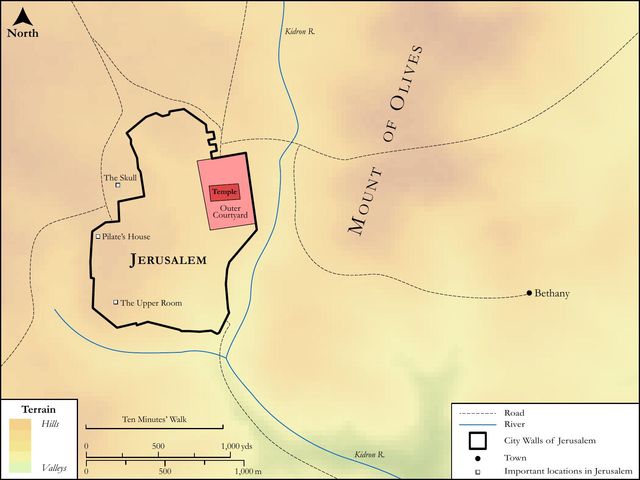
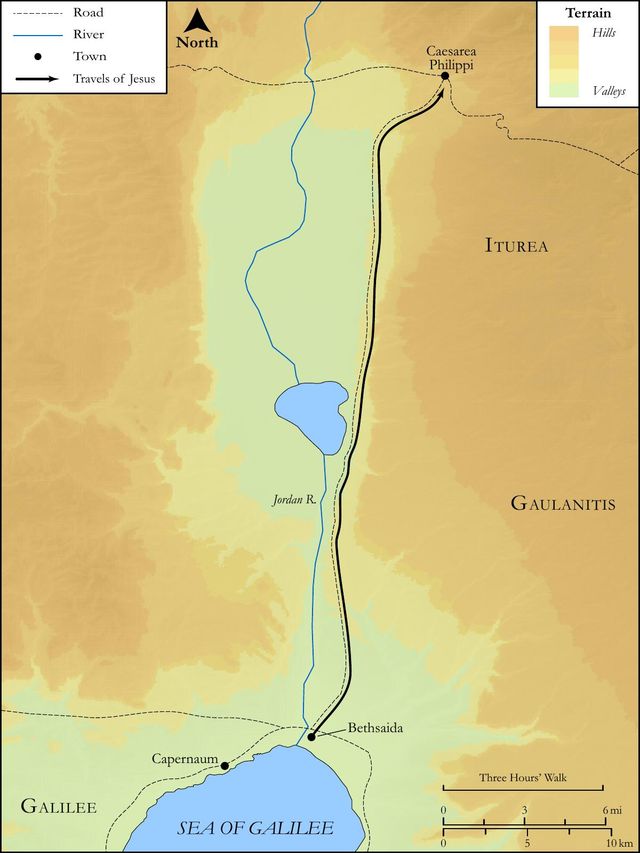
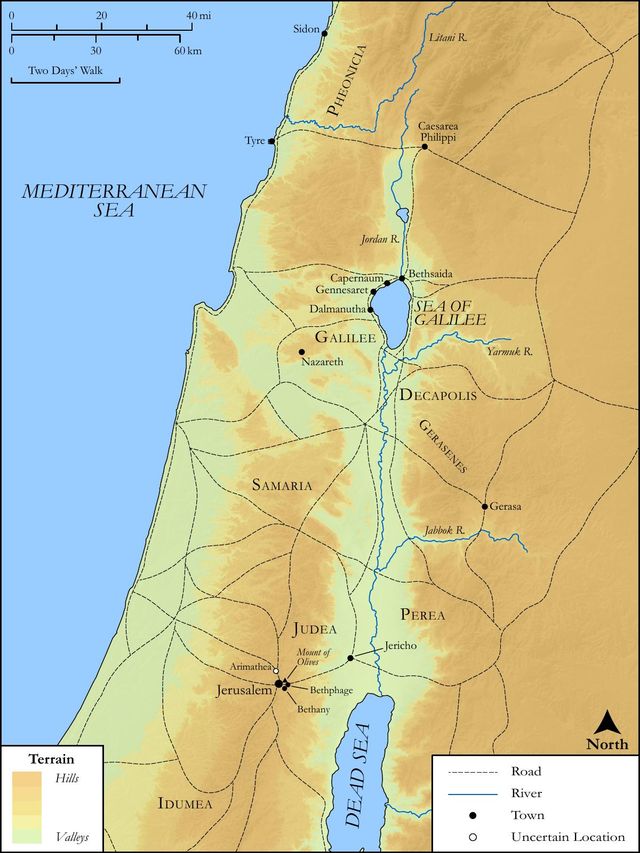
Study this verse
Public-domain commentary
Matthew Henry
From his Commentary on the Whole Bible. Henry comments on passages, not single verses — this entry covers Mark 8:27–38. His three-level outline is real structure in the source text, so it is rendered as structure.
We have read a great deal of the doctrine Christ preached, and the miracles he wrought, which were many, and strange, and well-attested, of various kinds, and wrought in several places, to the astonishment of the multitudes that were eye-witnesses of them. It is now time for us to pause a little, and to consider what these things mean; the wondrous works which Christ then forbade the publishing of, being recorded in these sacred writings, are thereby published to all the world, to us, to all ages; now what shall we think of them? Is the record of those things designed only for an amusement, or to furnish us with matter for discourse? No, certainly these things are written, that we may believe that Jesus is the Christ the Son of God (Joh 20:31); and this discourse which Christ had with his disciples, will assist us in making the necessary reflections upon the miracles of Christ, and a right use of them. Three things we are here taught to infer from the miracles Christ wrought.
I.They prove that he is the true Messiah, the Son of God, and Saviour of the world:
this the works he did witnessed concerning him; and this his disciples, who were the eye-witnesses of those works, here profess their belief of; which cannot but be a satisfaction to us in making the same inference from them.
1.Christ enquired of them what the sentiments of the people were concerning him; Who did men say that I am? Mar 8:27. Note, Though it is a small thing for us to be judged of men, yet it may sometimes do us good to know what people say of us, not that we may seek our own glory, but that we may hear our faults. Christ asked them, not that he might be informed, but that they might observe it themselves, and inform one another.
2.The account they gave him, was such as plainly intimated the high opinion the people had of him. Though they came short of the truth, yet they were convinced by his miracles that he was an extraordinary person, sent from the invisible world with a divine commission. It is probable that they would have acknowledged him to be the Messiah, if they had not been possessed by their teachers with a notion that the Messiah must be a temporal Prince, appearing in external pomp and power, which the figure Christ made, would not comport with; yet (whatever the Pharisees said, whose copyhold was touched by the strictness and spirituality of his doctrine) none of the people said that he was a Deceiver, but some said that he was John Baptist, others Elias, others one of the prophets, Mar 8:28. All agreed that he was one risen from the dead.
3.The account they gave him of their own sentiments concerning him, intimated their abundant satisfaction in him, and in their having left all to follow him, which now, after some time of trial, they see no reason to repent; But whom say ye that I am? To this they have an answer ready, Thou art the Christ, the Messiah often promised, and long expected, Mar 8:29. To be a Christian indeed, is, sincerely to believe that Jesus is the Christ, and to act accordingly; and that he is so, plainly appears by his wondrous works. This they knew, and must shortly publish and maintain; but for the present they must keep it secret (Mar 8:30), till the proof of it was completed, and they were completely qualified to maintain it, by the pouring out of the Holy Ghost; and then let all the house of Israel know assuredly that God has made this same Jesus, whom ye crucified, both Lord and Christ, Act 2:36.
II.These miracles of Christ take off the offence of the cross, and assure us that Christ was, in it, not conquered, but a Conqueror.
Now that the disciples are convinced that Jesus is the Christ, they may bear to hear of his sufferings, which Christ now begins to give them notice of, Mar 8:31.
1.Christ taught his disciples that he must suffer many things, Though they had got over the vulgar error of the Messiah's being a temporal Prince, so far as to believe their Master to be the Messiah, notwithstanding his present meanness, yet still they retained it, so far as to expect that he would shortly appear in outward pomp and grandeur, and restore the kingdom to Israel; and therefore, to rectify that mistake, Christ here gives them a prospect of the contrary, that he must be rejected of the elders, and the chief priests, and the scribes, who, they expected, should be brought to own and prefer him; that, instead of being crowned, he must be killed, he must be crucified, and after three days he must rise again to a heavenly life, and to be no more in this world. This he spoke openly (Mar 8:32), parrēsia. He said it freely and plainly, and did not wrap it up in ambiguous expressions. The disciples might easily understand it, if they had not been very much under the power of prejudice: or, it intimates that he spoke it cheerfully and without any terror, and would have them to hear it so: he spoke that saying boldly, as one that not only knew he must suffer and die, but was resolved he would, and made it his own act and deed.
2.Peter opposed it; He took him, and began to rebuke him. Here Peter showed more love than discretion, a zeal for Christ and his safety, but not according to knowledge. He took him - proslabomenos. He took hold of him, as it were to stop and hinder him, took him in his arms, and embraced him (so some understand it); he fell on his neck, as impatient to hear that his dear Master should suffer such hard things; or he took him aside privately, and began to rebuke him. This was not the language of the least authority, but of the greatest affection, of that jealousy for the welfare of those we love, which is strong as death. Our Lord Jesus allowed his disciples to be free with him, but Peter here took too great a liberty.
3.Christ checked him for his opposition (Mar 8:33); He turned about, as one offended, and looked on his disciples, to see if the rest of them were of the same mind, and concurred with Peter in this, that, if they did, they might take the reproof to themselves, which he was now about to give to Peter; and he said, Get thee behind me, Satan. Peter little thought to have had such a sharp rebuke for such a kind dissuasive, but perhaps expected as much commendation now for his love as he had lately for his faith. Note, Christ sees that amiss in what we say and do, which we ourselves are not aware of, and knows what manner of spirit we are of, when we ourselves do not.
(1.)Peter spoke as one that did not rightly understand, nor had duly considered, the purposes and counsels of God. When he saw such proofs as he every day saw of the power of Christ, he might conclude that he could not be compelled to suffer; the most potent enemies could not overpower him whom diseases and deaths, whom winds and waves and devils themselves, were forced to obey and yield to: and when he saw so much of the wisdom of Christ every day, he might conclude that he would not choose to suffer but for some very great and glorious purposes; and therefore he ought not thus to have contradicted him, but to have acquiesced. He looked upon his death only as a martyrdom, like that of the prophets, which he thought might be prevented, if either he would take a little care not to provoke the chief priests, or to keep out of the way; but he knew not that the thing was necessary for the glory of God, the destruction of Satan, and the salvation of man, that the Captain of our salvation must be made perfect through sufferings, and so must bring many sons to glory. Note, The wisdom of man is perfect folly, when it pretends to give measures to the divine counsels. The cross of Christ, the great instance of God's power and wisdom, was to some a stumbling-block, and to others foolishness.
(2.)Peter spoke as one that did not rightly understand, nor had duly considered, the nature of Christ's kingdom; he took it to be temporal and human, whereas it is spiritual and divine. Thou savourest not the things that are of God, but those that are of men; ou phroneis - thou mindest not; so the word is rendered, Rom 8:5. Peter seemed to mind more the things that relate to the lower world, and the life that now is, than those which relate to the upper world, and the life to come. Minding the things of men more than the things of God, our own credit, ease, and safety, more than the things of God, and his glory and kingdom, is a very great sin, and the root of much sin, and very common among Christ's disciples; and it will appear in suffering times, those times of temptation, when those in whom the things of men have the ascendant, are in danger of falling off. Non sapis - Thou art not wise (so it may be read) in the things of God, but in the things of men. It is important to consider what generation we appear wise in, Luk 16:8. It seems policy to shun trouble, but if with that we shun duty, it is fleshly wisdom (Co2 1:12), and it will be folly in the end.
III.These miracles of Christ should engage us all to follow him, whatever it cost us, not only as they were confirmations of his mission, but as they were explications of his design, and the tendency of that grace which he came to bring; plainly intimating that by his Spirit he would do that for our blind, deaf, lame, leprous, diseased, possessed souls, which he did for the bodies of those many who in those distresses applied themselves to him. Frequent notice had been taken of the great flocking that there was to him for help in various cases: now this is written, that we may believe that he is the great Physician of souls, and may become his patients, and submit to his regimen; and here he tells us upon what terms we may be admitted; and he called all the people to him, to hear this, who modestly stood at some distance when he was in private conversation with his disciples. This is that which all are concerned to know, and consider, if they expect Christ should heal their souls.
1.They must not be indulgent of the ease of the body; for (Mar 8:34), "Whosoever will come after me for spiritual cures, as these people do for bodily cures, let him deny himself, and live a life of self-denial, mortification, and contempt of the world; let him not pretend to be his own physician, but renounce all confidence in himself and his own righteousness and strength, and let him take up his cross, conforming himself to the pattern of a crucified Jesus, and accommodating himself to the will of God in all the afflictions he lies under; and thus let him continue to follow me;" as many of those did, whom Christ healed. Those that will be Christ's patients must attend on him, converse with him, receive instruction and reproof from him, as those did that followed him, and must resolve they will never forsake him.
2.They must not be solicitous, no, not for the life of the body, when they cannot keep it without quitting Christ, Mar 8:35. Are we invited by the words and works of Christ to follow him? Let us sit down, and count the cost, whether we can prefer our advantages by Christ before life itself, whether we can bear to think of losing our life for Christ's sake and the gospel's. When the devil is drawing away disciples and servants after him, he conceals the worst of it, tells them only of the pleasure, but nothing of the peril, of his service; Ye shall not surely die; but what there is of trouble and danger in the service of Christ, he tells us of it before, tells us we shall suffer, perhaps we shall die, in the cause; and represents the discouragements not less, but greater, than commonly they prove, that it may appear he deals fairly with us, and is not afraid that we should know the worst; because the advantages of his service abundantly suffice to balance the discouragements, if we will but impartially set the one over against the other. In short,
(1.)We must not dread the loss of our lives, provided it be in the cause of Christ (Mar 8:35); Whosoever will save his life, by declining Christ, and refusing to come to him, or by disowning and denying him after he has in profession come to Christ, he shall lose it, shall lose the comfort of his natural life, the root and fountain of his spiritual life, and all his hopes of eternal life; such a bad bargain will he make for himself. But whosoever shall lose his life, shall be truly willing to lose it, shall venture it, shall lay it down when he cannot keep it without denying Christ, he shall save it, he shall be an unspeakable gainer; for the loss of his life shall be made up to him in a better life. It is looked upon to be some kind of recompence to those who lose their lives in the service of their prince and country, to have their memories honoured and their families provided for; but what is that to the recompence which Christ makes in eternal life to all that die for him?
(2.)We must dread the loss of our souls, yea, though we should gain the whole world by it (Mar 8:36, Mar 8:37); For what shall it profit a man, if he should gain the whole world, and all the wealth, honour, and pleasure, in it, by denying Christ, and lose his own soul? "True it is," said Bishop Hooper, the night before he suffered martyrdom, "that life is sweet, and death is bitter, but eternal death is more bitter, and eternal life is more sweet." As the happiness of heaven with Christ, is enough to countervail the loss of life itself for Christ, so the gain of all the world in sin, is not sufficient to countervail the ruin of the soul by sin.
What that is that men do, to save their lives, and gain the world, he tells us (Mar 8:38), and of what fatal consequence it will be to them; Whosoever therefore shall be ashamed of me, and of my words, in this adulterous and sinful generation, of him shall the Son of man be ashamed. Something like this we had, Mat 10:33. But it is here expressed more fully. Note, [1.] The disadvantage that the cause of Christ labours under this world, is, that it is to be owned and professed in an adulterous and sinful generation; such the generation of mankind is, gone a whoring from God, in the impure embraces of the world and the flesh, lying in wickedness; some ages, some places, are more especially adulterous and sinful, as that was in which Christ lived; in such a generation the cause of Christ is opposed and run down, and those that own it, are exposed to reproach and contempt, and every where ridiculed and spoken against. [2.] There are many, who, though they cannot but own that the cause of Christ is a righteous cause, are ashamed of it, because of the reproach that attends the professing of it; they are ashamed of their relation to Christ, and ashamed of the credit they cannot but give to his words; they cannot bear to be frowned upon and despised, and therefore throw off their profession, and go down the stream of a prevailing apostasy. [3.] There is a day coming, when the cause of Christ will appear as bright and illustrious as now it appears mean and contemptible; when the Son of man comes in the glory of his Father with his holy angels, as the true Shechinah, the brightness of his Father's glory, and the Lord of angels. [4.] Those that are ashamed of Christ in this world where he is despised, he will be ashamed of in that world where he is eternally adored. They shall not share with him in his glory then, that were not willing to share with him in his disgrace now.
Historical interpretation
Seven Centuries of Reception
7 surviving comments on this verse. Each one is dated, so this reads as a timeline rather than a list.
Select a marker to jump to its quote. Markers stagger vertically where authors wrote within a few decades of each other.
And He says to him, If thou enter into the town, tell it not to any one, that is, relate continually to thy neighbours thy blindness, but never tell them of thy virtue.
(Hom. in Mat. 54) From the manner, however, itself of the question, He leads them to a higher feeling, and to higher thoughts, concerning Him, that they might not agree with the multitude. But the next words show what the head of the disciples, the mouth of the Apostles, answered; when all were asked, Peter answereth and saith unto him, Thou art the Christ.
(ubi sup.) Or else, that He might wait to fix the pure faith in their minds, till the Crucifixion, which was an offence to them, was over, for after it was once perfected, about the time of His ascension, He said unto the Apostles, Go ye and teach all nations.
(Vict. Ant. e Cat. in Marc. v. Chrys. ubi sup.) The reason, however, why the Lord told them this, was to show, that after His cross and resurrection, Christ must be preached by His witnesses. Again, Peter alone, from the fervour of his disposition, had the boldness to dispute about these things. Wherefore it goes on, And Peter took him up, and began to rebuke hime.
But how is this, that Peter, gifted with a revelation from the Father, has so soon fallen, and become unstable? Surely, however, it was not wonderful that one who had received no revelation concerning the Passion should be ignorant of this. For that He was the Christ, the Son of the living God, he had learnt by revelation; but the mystery of His cross and resurrection had not yet been revealed to him. He Himself, however, showing that He must come to His Passion, rebuked Peter; wherefore there follows, And when he had turned about and looked on his disciples, he rebuked Peter, &c.
(Vict. Ant. e Cat. in Marc.) He asks the question with a purpose, for it was right that His disciples should praise Him better than the crowd.
(Vict. Ant. e Cat. in Marc.) But He saith not to the devil, when tempting Him, Get thee behind me, but to Peter He saith, Get thee behind me, that is, follow Me, and resist not the design of My voluntary Passion. There follows, For thou savourest not the things which be of God, but which be of men.
For you are not mindful of the things of God, but of the things of men. It is of my will, and of the Father's, whose will I have come to do, that I should die for the salvation of men. Considering only your will, you do not wish the grain of wheat to fall into the ground, that it might bring forth much fruit.
(in Marc. 2, 35) Philip was that brother of Herod, of whom we spoke above, who in honour of Tiberius Cæsar called that town, which is now called Paneas, Cæsarea Philippi. It goes on, And by the way he asked his disciples, saying unto them, Whom do men say that I am?
(ubi sup.) Wherefore He first asks what is the opinion of men, in order to try the faith of the disciples, lest their confession should appear to be founded on the common opinion. It goes on, And they answered, saying, Some say John the Baptist, some Elias, and others, One of the prophets.
(ubi sup. Chrys. ubi sup.) This, however, he speaks with the feelings of a man who loves and desires; as if he said, This cannot be, neither can mine ears receive that the Son of God is to be slain.
When he had turned and saw his disciples, he rebuked Peter, saying: Go behind me, Satan. Satan is interpreted as adversary or contrary. Because you speak contrary (he said) to my will, you should be called adversary. Many think that it was not Peter who was corrected, but the adversarial spirit that suggested these things to the apostle to say. But to me, an apostolic error, arising from the affection of piety, will never seem to be the incentive of the devil. Go, Satan, is said to the devil: Go behind me. Peter hears: Go behind me, that is, follow my judgment.
After taking His disciples afar from the Jews, He then asks them concerning Himself, that they might speak the truth without fear of the Jews; wherefore it is said, And Jesus entered, and his disciples, into the towns of Cæsarea Philippi.
For many thought that John had risen from the dead, as even Herod believed, and that he had performed miracles after his resurrection. After however having enquired into the opinion of others, He asks them what was the belief of their own minds on this point; wherefore it continues, And he saith unto them, But whom say ye that I am?
He confesses indeed that He is the Christ announced by the Prophets; but the Evangelist Mark passes over what the Lord answered to his confession, and how He blessed him, lest by this way of relating it, he should seem to be favouring his master Peter; Matthew plainly goes through the whole of it.
For He wished in the mean time to hide His glory, lest many should be offended because of Him, and so earn a worse punishment.
But after the Lord had accepted the confession of the disciples, who called Him the true God, He then reveals to them the mystery of the Cross. Wherefore it goes on, And he began to teach them that the Son of man must suffer many things, and be rejected of the elders and of the chief priests, and the scribes, and be killed, and after three days rise again; and he spake that saying openly, that is, concerning His future passion. But His disciples did not understand the order of the truth, neither could they comprehend His resurrection, but thought it better that He should not suffer.
For the Lord, wishing to show that His Passion was to take place on account of the salvation of men, and that Satan alone was unwilling that Christ should suffer, and the race of man be saved, called Peter Satan, because he savoured the things that were of Satan, and, from unwillingness that Christ should suffer, became His adversary; for Satan is interpreted 'the adversary.'
He says that Peter savours the things which be of men, in that he in some way savoured carnal affections, for Peter wished that Christ should spare Himself and not be crucified.
Continue studying Mark 8:33 across the web’s major study libraries — every link below opens this exact verse, chapter, or book on the destination site.
Read & Compare
 BibleGatewayThis verse in more than 200 translations and 70 languages.
 Bible.comThe YouVersion reader — hundreds of translations, reading plans, and highlights.
 ESV.orgCrossway's official English Standard Version reader.
 NET BibleThe NET translation with 60,000+ translators' notes on every rendering decision.
 STEP BibleTyndale House's free study tool — original text, vocabulary, and scholarly resources.
 BibliaLogos Bible Software's free web reader.
 USCCBThe New American Bible (Revised Edition) with the U.S. bishops' study notes.
Commentaries
 BibleHub CommentariesDozens of classic commentaries on this verse, gathered on one page.
 StudyLightMore than 100 commentary sets — the largest collection on the web.
 BibleRefPlain-English commentary on what this verse means, verse by verse.
 Enduring WordDavid Guzik's free commentary on this chapter, widely used by Bible teachers.
 Bible Study ToolsVerse commentary alongside Greek and Hebrew study aids.
Original Language & Research
- BibleHub InterlinearThe verse word by word — original language, transliteration, and English.
- BibleHub LexiconEvery word's original-language definition and Strong's entry.
 Blue Letter BibleDeep-study tools — Strong's numbers, concordance, and word studies.
 CNTR CollationThe earliest Greek manuscripts of this verse, collated letter by letter.
Sermons, Hymns & Audio


TrulyRandomVerse is not affiliated with these sites and doesn’t control their content. They’re linked because they’re genuinely useful.
Summary
Mark 8:33 captures a profoundly dramatic and pivotal moment in Jesus' ministry, immediately following Peter's Spirit-inspired confession of Jesus as the Christ. In a stark and public rebuke, Jesus confronts Peter, not for his confession, but for his subsequent attempt to dissuade Jesus from the path of suffering and death, revealing the profound clash between divine will and human expectation concerning the Messiah's mission. This verse underscores Jesus' unwavering commitment to God's redemptive plan, even when it directly opposed the well-intentioned but misguided desires of His closest disciples, identifying Peter's human perspective as an unwitting echo of satanic temptation.
Context
ShowHideLiterary Context
This sharp rebuke occurs at a critical juncture in Mark's Gospel, directly after Peter's monumental confession at Caesarea Philippi, where he declares Jesus to be "the Christ" Mark 8:29. Immediately following this, Jesus begins to teach His disciples about His impending suffering, rejection, death, and resurrection, marking the first of three passion predictions in Mark's Gospel Mark 8:31-32. Peter, unable to reconcile his messianic expectations with a suffering Messiah, takes Jesus aside to "rebuke" Him, attempting to divert Him from this path. Jesus' public and severe response in Mark 8:33 serves as a powerful correction, not just for Peter, but for all the disciples who struggled to grasp the true nature of the Messiah's mission, setting the stage for Jesus' subsequent teaching on the cost of discipleship Mark 8:34.
Historical & Cultural Context
First-century Judaism was rife with diverse messianic expectations, but the dominant hope was for a conquering king, a political and military leader who would overthrow Roman oppression and restore Israel's national sovereignty and glory. The concept of a suffering Messiah, particularly one who would die a shameful death, was antithetical to these popular expectations. Peter, a devout Jew, undoubtedly shared in these common hopes, making Jesus' pronouncements about suffering and death deeply unsettling and seemingly contradictory to his understanding of the Christ. The setting of Caesarea Philippi, a region known for its pagan worship and Roman imperial presence, further highlighted the contrast between earthly kingdoms and the spiritual, redemptive kingdom Jesus came to establish, a kingdom not built on worldly power but on self-sacrifice.
Key Themes
ShowHideMark 8:33 contributes significantly to several overarching themes in Mark's Gospel. Foremost is the Nature of True Messiahship, emphasizing that Jesus' identity as the Christ is intrinsically linked to His suffering and sacrificial death, a concept radically different from human expectations. This passage highlights the tension between a Spiritual vs. Worldly Mindset, demonstrating how even well-intentioned human desires can align with spiritual opposition to God's perfect plan. Peter's rebuke of Jesus, and Jesus' counter-rebuke, illuminate the constant struggle between divine will and human inclination, echoing the temptation of Jesus in the wilderness where Satan sought to divert Him from the path of suffering and obedience Matthew 4:10. Finally, this incident sets the stage for the theme of The Cost of Discipleship, as Jesus immediately follows this encounter with a call to self-denial and cross-bearing for all who would follow Him Mark 8:34-38.
Exposition and Analysis
ShowHideKey Word Analysis
ShowHideThis verb, derived from epi (upon) and timáō (to honor, value), literally means "to put a price upon," but in a negative sense, "to tax upon," "to censure," or "to admonish." By implication, it means "to forbid." Jesus' use of this word indicates a severe, authoritative, and direct confrontation, not merely a gentle correction. It implies a strong disapproval and a command to cease an action or thought.
Of Chaldee origin, this term means "the accuser" or "adversary." In this context, Jesus is not literally calling Peter the devil, but rather identifying the source and nature of the temptation Peter has become an unwitting agent of. It points to the spiritual force of opposition that seeks to thwart God's redemptive plan, just as Satan tempted Jesus in the wilderness to avoid the cross.
This verb signifies "to exercise the mind," "to entertain or have a sentiment or opinion," "to be mentally disposed," or "to set the affection on." It implies a deep-seated way of thinking or prioritizing. Jesus' statement means Peter's mindset, his values, and his understanding were aligned with human, earthly considerations and desires (comfort, power, glory) rather than with God's divine, self-sacrificial plan. Peter was not "minding" or "appreciating" the things of God.
Verse Breakdown
ShowHide"But when he had turned about and looked on his disciples"
This opening phrase highlights Jesus' intentionality and the public nature of His rebuke. He doesn't whisper to Peter or take him aside privately; rather, He turns to face Peter, with the other disciples as witnesses. This suggests that Peter's misguided counsel, though perhaps offered privately, represented a widespread misunderstanding among the disciples regarding the Messiah's mission, making a public correction necessary for their collective instruction.
"he rebuked Peter, saying, 'Get thee behind me, Satan'"
The directness and severity of Jesus' words are startling. The command "Get thee behind me" (Greek: hypágō opísō moû) echoes Jesus' rebuke of Satan during the wilderness temptations Matthew 4:10, signifying a rejection of any path that deviates from God's will. By identifying Peter's suggestion with "Satan," Jesus is not condemning Peter as inherently evil, but rather exposing the spiritual source of the temptation to avoid the cross. Peter, in his human desire to protect Jesus, had become an unwitting mouthpiece for the adversary's agenda to derail God's plan of salvation.
"for thou savourest not the things that be of God, but the things that be of men."
This clause provides the core reason for Jesus' stern rebuke. Peter's mindset, his priorities, and his understanding were not aligned with God's divine purposes but were rooted in human, worldly perspectives. "The things that be of God" refer to God's sovereign plan for redemption through Christ's suffering and death. "The things that be of men" refer to human expectations, desires for earthly glory, comfort, and power, which stood in direct opposition to the path of self-sacrifice ordained by the Father. This reveals the fundamental conflict between divine wisdom and human wisdom.
Literary Devices
ShowHideMark 8:33 is rich in dramatic tension and irony. The tension is palpable as Peter, moments after his profound confession, shifts from being divinely inspired to acting as an unwitting agent of temptation. The irony lies in Peter, the one who just recognized Jesus as the Christ, now attempting to "save" Jesus from the very path of suffering that defines His messianic mission. Jesus employs metonymy and symbolism when He addresses Peter as "Satan." He is not literally calling Peter the devil, but rather identifying the satanic influence behind Peter's suggestion, which aligns with the adversary's desire to thwart God's plan. The verse also features a stark contrast between "the things that be of God" and "the things that be of men," highlighting the fundamental difference between divine wisdom and human understanding, and serving as a pivotal moment in the narrative's exploration of true discipleship.
Theological and Thematic Connections
ShowHideMark 8:33 serves as a profound theological statement on the nature of God's redemptive plan and the constant opposition it faces, even from within the circle of faith. It underscores the absolute necessity of the cross in God's design for salvation, revealing that any attempt to circumvent or redefine this path, no matter how well-intentioned, is an act of spiritual opposition. This passage teaches that true spiritual discernment requires aligning one's mind and desires with God's revealed will, even when it contradicts human logic or comfort. It highlights the subtle yet potent nature of temptation, which often appears not as overt evil, but as a seemingly good or protective alternative to God's difficult path, thereby challenging believers to constantly examine their motives and perspectives against the plumb line of divine truth.
Reflection and Application
ShowHideMark 8:33 remains a timeless and challenging passage for believers today, urging us to cultivate profound spiritual discernment and unwavering commitment to God's will, even when it defies our human logic or comfort. It reminds us that our greatest temptations may not always come from overtly evil sources, but can subtly arise from our own well-meaning desires, our cultural expectations, or even the advice of those closest to us, if those perspectives are not rooted in God's divine wisdom. This passage calls us to examine our "savouring"—what we prioritize, what we set our minds on, and what we truly value. Are we aligning our thoughts and aspirations with the things of God, which often involve sacrifice, humility, and a counter-cultural embrace of the cross, or are we inadvertently succumbing to "the things that be of men," which prioritize comfort, earthly success, or avoidance of suffering? True discipleship demands a radical reorientation of our minds to God's purposes, trusting His perfect plan above our own limited understanding.
Questions for Reflection
ShowHideFAQ
ShowHideWas Jesus literally calling Peter "Satan" in this verse?
ShowHideNo, Jesus was not literally calling Peter the devil. The phrase "Get thee behind me, Satan" is an identification of the spiritual force or mindset behind Peter's suggestion, not an indictment of Peter's person. Just as Satan tempted Jesus in the wilderness to avoid the path of suffering and glory through the cross Matthew 4:10, Peter's attempt to dissuade Jesus from His impending suffering aligned with the adversary's agenda to thwart God's redemptive plan. Jesus was rebuking the satanic influence that had momentarily manifested through Peter's well-intentioned but misguided human perspective.
Why was Jesus' rebuke of Peter so harsh, especially after Peter had just confessed Him as the Christ?
ShowHideJesus' rebuke was harsh because Peter's suggestion represented a profound spiritual danger and a direct challenge to God's sovereign plan for salvation. Peter's misunderstanding of the Messiah's mission—expecting an earthly king rather than a suffering servant—threatened to derail the very purpose for which Jesus came. The severity of the rebuke underscores the critical importance of the cross in God's redemptive design. Jesus' response was not merely a personal reprimand but a public declaration to all the disciples about the true nature of His mission and the absolute necessity of His suffering and death. It was a moment of intense spiritual warfare, where the stakes were nothing less than the salvation of humanity.
What does it mean to "savourest not the things that be of God, but the things that be of men"?
ShowHideThe phrase "thou savourest not" comes from the Greek word phronéō, which means "to set one's mind on," "to think," or "to be disposed towards." It refers to one's mindset, priorities, and values. When Jesus says Peter "savourest not the things that be of God, but the things that be of men," He means that Peter's thinking and desires were aligned with human, earthly perspectives (e.g., comfort, power, avoiding suffering) rather than with God's divine purposes (e.g., the necessity of the cross for redemption). It highlights a fundamental misalignment of priorities and understanding, where human wisdom, though seemingly logical or protective, stands in opposition to God's higher, often counter-intuitive, wisdom.
Christ-Centered Fulfillment
ShowHideMark 8:33 profoundly illuminates the Christ-centered nature of God's redemptive plan by showcasing Jesus' unwavering commitment to the cross as the indispensable means of salvation. Peter's attempt to divert Jesus from suffering reveals the universal human tendency to seek glory without sacrifice, a path fundamentally opposed to God's design. In this moment, Jesus fully embodies the Suffering Servant prophesied in Isaiah 53, demonstrating His resolute obedience to the Father's will, even unto death. His sharp rebuke of Peter underscores that His Messiahship is defined not by earthly power or human acclamation, but by His willingness to lay down His life as a ransom for many Mark 10:45. This passage foreshadows Christ's ultimate victory over sin and death through His atoning sacrifice, demonstrating that the "things that be of God" culminate in the cross, through which humanity finds reconciliation and new life. Jesus' resolute determination to embrace the cross, despite human opposition, reveals Him as the faithful High Priest who perfectly fulfilled God's redemptive purpose, becoming the author and perfecter of our faith Hebrews 12:2. He is the Lamb of God who takes away the sin of the world, precisely because He did not "savour" the things of men but fully embraced the divine path of suffering and resurrection John 1:29.