


Mark 8:27
Bible text: King James Version (1769 Blayney text) · Public domain
Bible text: King James Version with Strong's numbers · Public domain
Bible text: Berean Standard Bible · Public domain
Bible text: American Standard Version (1901) · Public domain
Bible text: World English Bible, Messianic edition · Public domain
Bible text: Geneva Bible (1599) · Public domain
Bible text: Young's Literal Translation · Public domain
- ΚαὶKaiAndG2532CONJConjunction
- ἐξῆλθενexēlthenwent forthG1831V-2AAI-3SVerb 2nd Aorist Active Indicative 3rd Singular
- ὁho<the>G3588T-NSMDefinite article Nominative Singular Masculine
- ἸησοῦςIēsousJesusG2424N-NSM-PNoun Nominative Singular Masculine Individual
- καὶkaiandG2532CONJConjunction
- οἱhoitheG3588T-NPMDefinite article Nominative Plural Masculine
- μαθηταὶmathētaidisciplesG3101N-NPMNoun Nominative Plural Masculine
- αὐτοῦautouof HimG846P-GSMPersonal pronoun Genitive Singular Masculine
- εἰςeisintoG1519PREPPreposition
- τὰςtastheG3588T-APFDefinite article Accusative Plural Feminine
- κώμαςkōmasvillagesG2968N-APFNoun Accusative Plural Feminine
- ΚαισαρείαςKaisareiasof CaesareaG2542N-GSF-LNoun Genitive Singular Feminine Location
- τῆςtēs<the>G3588T-GSFDefinite article Genitive Singular Feminine
- ΦιλίππουPhilippouPhilippiG5376N-GSM-PNoun Genitive Singular Masculine Individual
- καὶkaiAndG2532CONJConjunction
- ἐνenonG1722PREPPreposition
- τῇtēatheG3588T-DSFDefinite article Dative Singular Feminine
- ὁδῷhodōwayG3598N-DSFNoun Dative Singular Feminine
- ἐπηρώταepērōtaHe was questioningG1905V-IAI-3SVerb Imperfect Active Indicative 3rd Singular
- τοὺςtoustheG3588T-APMDefinite article Accusative Plural Masculine
- μαθητὰςmathētasdisciplesG3101N-APMNoun Accusative Plural Masculine
- αὐτοῦautouof HimG846P-GSMPersonal pronoun Genitive Singular Masculine
- λέγωνlegōnsayingG3004V-PAP-NSMVerb Present Active Participle Nominative Singular Masculine
- αὐτοῖς·autoisto themG846P-DPMPersonal pronoun Dative Plural Masculine
- τίναtinaWhomG5101I-ASMInterrogative pronoun Accusative Singular Masculine
- μεmeMeG3165P-1ASPersonal pronoun Accusative 1st Singular
- λέγουσινlegousindo pronounceG3004V-PAI-3PVerb Present Active Indicative 3rd Plural
- οἱhoi<the>G3588T-NPMDefinite article Nominative Plural Masculine
- ἄνθρωποιanthrōpoimenG444N-NPMNoun Nominative Plural Masculine
- εἶναι;einaito be?G1511V-PANVerb Present Active Infinitive
English is a literal word-by-word gloss of the Greek, not the KJV's wording. Why?
This is the original text the KJV's translators worked from — each Greek word with its own literal English meaning in this verse, prepared by scholars at Tyndale House, Cambridge. The KJV translates whole sentences, not word by word, so its wording differs: one Greek word can become several English words, and the KJV may choose “charity” where the gloss reads “love”. Both are faithful — they answer different questions. For the KJV's own rendering, switch to the KJV text.
Details
See on the biblical-era maps
Study this verse
Public-domain commentary
Matthew Henry
From his Commentary on the Whole Bible. Henry comments on passages, not single verses — this entry covers Mark 8:27–38. His three-level outline is real structure in the source text, so it is rendered as structure.
We have read a great deal of the doctrine Christ preached, and the miracles he wrought, which were many, and strange, and well-attested, of various kinds, and wrought in several places, to the astonishment of the multitudes that were eye-witnesses of them. It is now time for us to pause a little, and to consider what these things mean; the wondrous works which Christ then forbade the publishing of, being recorded in these sacred writings, are thereby published to all the world, to us, to all ages; now what shall we think of them? Is the record of those things designed only for an amusement, or to furnish us with matter for discourse? No, certainly these things are written, that we may believe that Jesus is the Christ the Son of God (Joh 20:31); and this discourse which Christ had with his disciples, will assist us in making the necessary reflections upon the miracles of Christ, and a right use of them. Three things we are here taught to infer from the miracles Christ wrought.
I.They prove that he is the true Messiah, the Son of God, and Saviour of the world:
this the works he did witnessed concerning him; and this his disciples, who were the eye-witnesses of those works, here profess their belief of; which cannot but be a satisfaction to us in making the same inference from them.
1.Christ enquired of them what the sentiments of the people were concerning him; Who did men say that I am? Mar 8:27. Note, Though it is a small thing for us to be judged of men, yet it may sometimes do us good to know what people say of us, not that we may seek our own glory, but that we may hear our faults. Christ asked them, not that he might be informed, but that they might observe it themselves, and inform one another.
2.The account they gave him, was such as plainly intimated the high opinion the people had of him. Though they came short of the truth, yet they were convinced by his miracles that he was an extraordinary person, sent from the invisible world with a divine commission. It is probable that they would have acknowledged him to be the Messiah, if they had not been possessed by their teachers with a notion that the Messiah must be a temporal Prince, appearing in external pomp and power, which the figure Christ made, would not comport with; yet (whatever the Pharisees said, whose copyhold was touched by the strictness and spirituality of his doctrine) none of the people said that he was a Deceiver, but some said that he was John Baptist, others Elias, others one of the prophets, Mar 8:28. All agreed that he was one risen from the dead.
3.The account they gave him of their own sentiments concerning him, intimated their abundant satisfaction in him, and in their having left all to follow him, which now, after some time of trial, they see no reason to repent; But whom say ye that I am? To this they have an answer ready, Thou art the Christ, the Messiah often promised, and long expected, Mar 8:29. To be a Christian indeed, is, sincerely to believe that Jesus is the Christ, and to act accordingly; and that he is so, plainly appears by his wondrous works. This they knew, and must shortly publish and maintain; but for the present they must keep it secret (Mar 8:30), till the proof of it was completed, and they were completely qualified to maintain it, by the pouring out of the Holy Ghost; and then let all the house of Israel know assuredly that God has made this same Jesus, whom ye crucified, both Lord and Christ, Act 2:36.
II.These miracles of Christ take off the offence of the cross, and assure us that Christ was, in it, not conquered, but a Conqueror.
Now that the disciples are convinced that Jesus is the Christ, they may bear to hear of his sufferings, which Christ now begins to give them notice of, Mar 8:31.
1.Christ taught his disciples that he must suffer many things, Though they had got over the vulgar error of the Messiah's being a temporal Prince, so far as to believe their Master to be the Messiah, notwithstanding his present meanness, yet still they retained it, so far as to expect that he would shortly appear in outward pomp and grandeur, and restore the kingdom to Israel; and therefore, to rectify that mistake, Christ here gives them a prospect of the contrary, that he must be rejected of the elders, and the chief priests, and the scribes, who, they expected, should be brought to own and prefer him; that, instead of being crowned, he must be killed, he must be crucified, and after three days he must rise again to a heavenly life, and to be no more in this world. This he spoke openly (Mar 8:32), parrēsia. He said it freely and plainly, and did not wrap it up in ambiguous expressions. The disciples might easily understand it, if they had not been very much under the power of prejudice: or, it intimates that he spoke it cheerfully and without any terror, and would have them to hear it so: he spoke that saying boldly, as one that not only knew he must suffer and die, but was resolved he would, and made it his own act and deed.
2.Peter opposed it; He took him, and began to rebuke him. Here Peter showed more love than discretion, a zeal for Christ and his safety, but not according to knowledge. He took him - proslabomenos. He took hold of him, as it were to stop and hinder him, took him in his arms, and embraced him (so some understand it); he fell on his neck, as impatient to hear that his dear Master should suffer such hard things; or he took him aside privately, and began to rebuke him. This was not the language of the least authority, but of the greatest affection, of that jealousy for the welfare of those we love, which is strong as death. Our Lord Jesus allowed his disciples to be free with him, but Peter here took too great a liberty.
3.Christ checked him for his opposition (Mar 8:33); He turned about, as one offended, and looked on his disciples, to see if the rest of them were of the same mind, and concurred with Peter in this, that, if they did, they might take the reproof to themselves, which he was now about to give to Peter; and he said, Get thee behind me, Satan. Peter little thought to have had such a sharp rebuke for such a kind dissuasive, but perhaps expected as much commendation now for his love as he had lately for his faith. Note, Christ sees that amiss in what we say and do, which we ourselves are not aware of, and knows what manner of spirit we are of, when we ourselves do not.
(1.)Peter spoke as one that did not rightly understand, nor had duly considered, the purposes and counsels of God. When he saw such proofs as he every day saw of the power of Christ, he might conclude that he could not be compelled to suffer; the most potent enemies could not overpower him whom diseases and deaths, whom winds and waves and devils themselves, were forced to obey and yield to: and when he saw so much of the wisdom of Christ every day, he might conclude that he would not choose to suffer but for some very great and glorious purposes; and therefore he ought not thus to have contradicted him, but to have acquiesced. He looked upon his death only as a martyrdom, like that of the prophets, which he thought might be prevented, if either he would take a little care not to provoke the chief priests, or to keep out of the way; but he knew not that the thing was necessary for the glory of God, the destruction of Satan, and the salvation of man, that the Captain of our salvation must be made perfect through sufferings, and so must bring many sons to glory. Note, The wisdom of man is perfect folly, when it pretends to give measures to the divine counsels. The cross of Christ, the great instance of God's power and wisdom, was to some a stumbling-block, and to others foolishness.
(2.)Peter spoke as one that did not rightly understand, nor had duly considered, the nature of Christ's kingdom; he took it to be temporal and human, whereas it is spiritual and divine. Thou savourest not the things that are of God, but those that are of men; ou phroneis - thou mindest not; so the word is rendered, Rom 8:5. Peter seemed to mind more the things that relate to the lower world, and the life that now is, than those which relate to the upper world, and the life to come. Minding the things of men more than the things of God, our own credit, ease, and safety, more than the things of God, and his glory and kingdom, is a very great sin, and the root of much sin, and very common among Christ's disciples; and it will appear in suffering times, those times of temptation, when those in whom the things of men have the ascendant, are in danger of falling off. Non sapis - Thou art not wise (so it may be read) in the things of God, but in the things of men. It is important to consider what generation we appear wise in, Luk 16:8. It seems policy to shun trouble, but if with that we shun duty, it is fleshly wisdom (Co2 1:12), and it will be folly in the end.
III.These miracles of Christ should engage us all to follow him, whatever it cost us, not only as they were confirmations of his mission, but as they were explications of his design, and the tendency of that grace which he came to bring; plainly intimating that by his Spirit he would do that for our blind, deaf, lame, leprous, diseased, possessed souls, which he did for the bodies of those many who in those distresses applied themselves to him. Frequent notice had been taken of the great flocking that there was to him for help in various cases: now this is written, that we may believe that he is the great Physician of souls, and may become his patients, and submit to his regimen; and here he tells us upon what terms we may be admitted; and he called all the people to him, to hear this, who modestly stood at some distance when he was in private conversation with his disciples. This is that which all are concerned to know, and consider, if they expect Christ should heal their souls.
1.They must not be indulgent of the ease of the body; for (Mar 8:34), "Whosoever will come after me for spiritual cures, as these people do for bodily cures, let him deny himself, and live a life of self-denial, mortification, and contempt of the world; let him not pretend to be his own physician, but renounce all confidence in himself and his own righteousness and strength, and let him take up his cross, conforming himself to the pattern of a crucified Jesus, and accommodating himself to the will of God in all the afflictions he lies under; and thus let him continue to follow me;" as many of those did, whom Christ healed. Those that will be Christ's patients must attend on him, converse with him, receive instruction and reproof from him, as those did that followed him, and must resolve they will never forsake him.
2.They must not be solicitous, no, not for the life of the body, when they cannot keep it without quitting Christ, Mar 8:35. Are we invited by the words and works of Christ to follow him? Let us sit down, and count the cost, whether we can prefer our advantages by Christ before life itself, whether we can bear to think of losing our life for Christ's sake and the gospel's. When the devil is drawing away disciples and servants after him, he conceals the worst of it, tells them only of the pleasure, but nothing of the peril, of his service; Ye shall not surely die; but what there is of trouble and danger in the service of Christ, he tells us of it before, tells us we shall suffer, perhaps we shall die, in the cause; and represents the discouragements not less, but greater, than commonly they prove, that it may appear he deals fairly with us, and is not afraid that we should know the worst; because the advantages of his service abundantly suffice to balance the discouragements, if we will but impartially set the one over against the other. In short,
(1.)We must not dread the loss of our lives, provided it be in the cause of Christ (Mar 8:35); Whosoever will save his life, by declining Christ, and refusing to come to him, or by disowning and denying him after he has in profession come to Christ, he shall lose it, shall lose the comfort of his natural life, the root and fountain of his spiritual life, and all his hopes of eternal life; such a bad bargain will he make for himself. But whosoever shall lose his life, shall be truly willing to lose it, shall venture it, shall lay it down when he cannot keep it without denying Christ, he shall save it, he shall be an unspeakable gainer; for the loss of his life shall be made up to him in a better life. It is looked upon to be some kind of recompence to those who lose their lives in the service of their prince and country, to have their memories honoured and their families provided for; but what is that to the recompence which Christ makes in eternal life to all that die for him?
(2.)We must dread the loss of our souls, yea, though we should gain the whole world by it (Mar 8:36, Mar 8:37); For what shall it profit a man, if he should gain the whole world, and all the wealth, honour, and pleasure, in it, by denying Christ, and lose his own soul? "True it is," said Bishop Hooper, the night before he suffered martyrdom, "that life is sweet, and death is bitter, but eternal death is more bitter, and eternal life is more sweet." As the happiness of heaven with Christ, is enough to countervail the loss of life itself for Christ, so the gain of all the world in sin, is not sufficient to countervail the ruin of the soul by sin.
What that is that men do, to save their lives, and gain the world, he tells us (Mar 8:38), and of what fatal consequence it will be to them; Whosoever therefore shall be ashamed of me, and of my words, in this adulterous and sinful generation, of him shall the Son of man be ashamed. Something like this we had, Mat 10:33. But it is here expressed more fully. Note, [1.] The disadvantage that the cause of Christ labours under this world, is, that it is to be owned and professed in an adulterous and sinful generation; such the generation of mankind is, gone a whoring from God, in the impure embraces of the world and the flesh, lying in wickedness; some ages, some places, are more especially adulterous and sinful, as that was in which Christ lived; in such a generation the cause of Christ is opposed and run down, and those that own it, are exposed to reproach and contempt, and every where ridiculed and spoken against. [2.] There are many, who, though they cannot but own that the cause of Christ is a righteous cause, are ashamed of it, because of the reproach that attends the professing of it; they are ashamed of their relation to Christ, and ashamed of the credit they cannot but give to his words; they cannot bear to be frowned upon and despised, and therefore throw off their profession, and go down the stream of a prevailing apostasy. [3.] There is a day coming, when the cause of Christ will appear as bright and illustrious as now it appears mean and contemptible; when the Son of man comes in the glory of his Father with his holy angels, as the true Shechinah, the brightness of his Father's glory, and the Lord of angels. [4.] Those that are ashamed of Christ in this world where he is despised, he will be ashamed of in that world where he is eternally adored. They shall not share with him in his glory then, that were not willing to share with him in his disgrace now.
Historical interpretation
Seven Centuries of Reception
8 surviving comments on this verse. Each one is dated, so this reads as a timeline rather than a list.
Select a marker to jump to its quote. Markers stagger vertically where authors wrote within a few decades of each other.
And He says to him, If thou enter into the town, tell it not to any one, that is, relate continually to thy neighbours thy blindness, but never tell them of thy virtue.
(Hom. in Mat. 54) From the manner, however, itself of the question, He leads them to a higher feeling, and to higher thoughts, concerning Him, that they might not agree with the multitude. But the next words show what the head of the disciples, the mouth of the Apostles, answered; when all were asked, Peter answereth and saith unto him, Thou art the Christ.
(ubi sup.) Or else, that He might wait to fix the pure faith in their minds, till the Crucifixion, which was an offence to them, was over, for after it was once perfected, about the time of His ascension, He said unto the Apostles, Go ye and teach all nations.
(Vict. Ant. e Cat. in Marc. v. Chrys. ubi sup.) The reason, however, why the Lord told them this, was to show, that after His cross and resurrection, Christ must be preached by His witnesses. Again, Peter alone, from the fervour of his disposition, had the boldness to dispute about these things. Wherefore it goes on, And Peter took him up, and began to rebuke hime.
But how is this, that Peter, gifted with a revelation from the Father, has so soon fallen, and become unstable? Surely, however, it was not wonderful that one who had received no revelation concerning the Passion should be ignorant of this. For that He was the Christ, the Son of the living God, he had learnt by revelation; but the mystery of His cross and resurrection had not yet been revealed to him. He Himself, however, showing that He must come to His Passion, rebuked Peter; wherefore there follows, And when he had turned about and looked on his disciples, he rebuked Peter, &c.
(Vict. Ant. e Cat. in Marc.) He asks the question with a purpose, for it was right that His disciples should praise Him better than the crowd.
(Vict. Ant. e Cat. in Marc.) But He saith not to the devil, when tempting Him, Get thee behind me, but to Peter He saith, Get thee behind me, that is, follow Me, and resist not the design of My voluntary Passion. There follows, For thou savourest not the things which be of God, but which be of men.
We note that the Lord called himself “Son of man,” while Nathanael proclaimed him “Son of God.” Similarly is the account in the Gospels where Jesus himself asks the disciples who people say the Son of man is, and Peter answers, “You are the Christ, Son of the living God.” This was done under the guidance of the economy of righteousness. It shows that the two natures of the one mediator are affirmed: his divinity and his humanity, and attested both by our Lord himself and by human mouths. By this means the God-man declared the weakness of the humanity assumed by him. Those purely human would themselves declare the power of eternal divinity in him.
And he questioned his disciples along the way, saying: Who do men say that I am? They answered him, saying: Some say John the Baptist; others, Elijah; and others, one of the prophets. The Lord rightly, intending to test the faith of the disciples, first inquires about people's opinion, lest their confession seem founded not on the recognition of truth but on the opinion of the crowd, and lest they be thought to believe not from what they have learned, but to hesitate like Herod from what they have heard. Therefore, to Peter confessing him as Christ, according to Matthew, he says: Because flesh and blood did not reveal it to you (Matthew 16), that is, human teaching did not teach you the truth of faith. Those who hold a different opinion about the Lord are also rightly noted by the name of men. For those who faithfully and devoutly recognize the truth of his power deserve not at all to be called men, but gods. The Lord shows that the apostles were such as these with his second question. For he continues:
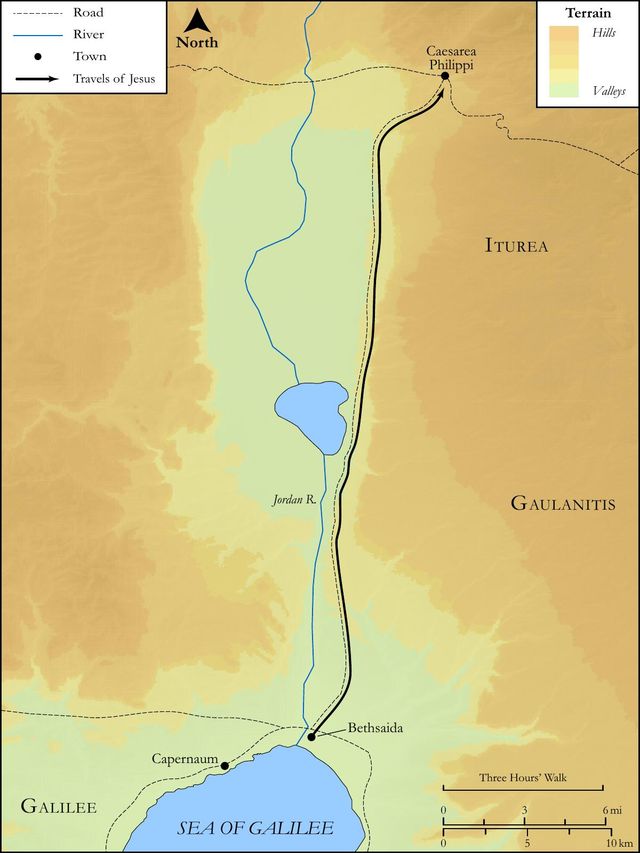
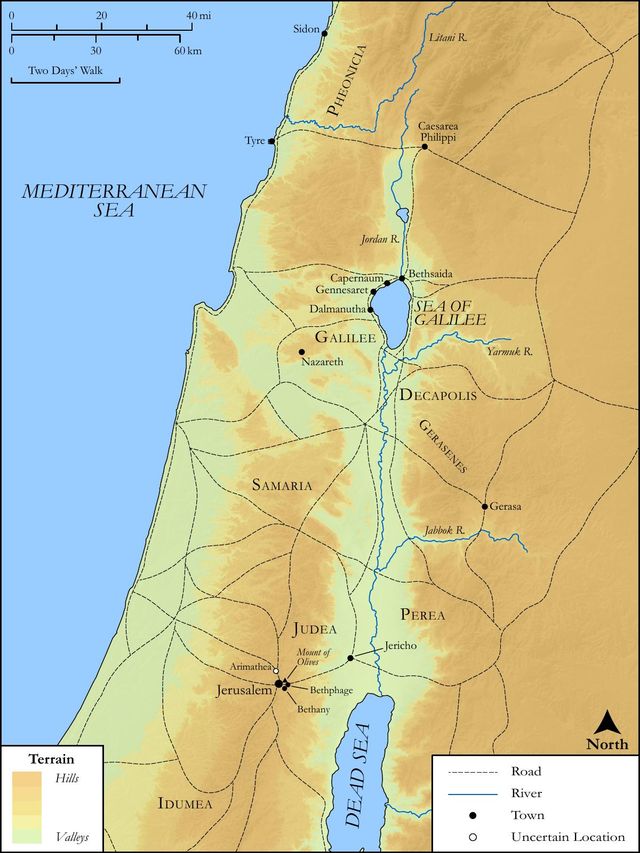
And Jesus and His disciples went out to the village of Caesarea Philippi. This Philip is the brother of Herod, of whom we spoke before, tetrarch of the regions of Ituraea and Trachonitis, who in honor of Tiberius Caesar named Caesarea Philippi, which is now called Paneas, and it is in the province of Phoenicia; imitating Herod his father, who in honor of Augustus Caesar named Caesarea, which was previously called Tower of Straton, and built Libyad beyond the Jordan in the name of his daughter. This place is Caesarea Philippi, where the Jordan arises at the roots of Lebanon, and it has two sources, one named Jor, and the other Dan, which mixed together create the name Jordan.
(in Marc. 2, 35) Philip was that brother of Herod, of whom we spoke above, who in honour of Tiberius Cæsar called that town, which is now called Paneas, Cæsarea Philippi. It goes on, And by the way he asked his disciples, saying unto them, Whom do men say that I am?
(ubi sup.) Wherefore He first asks what is the opinion of men, in order to try the faith of the disciples, lest their confession should appear to be founded on the common opinion. It goes on, And they answered, saying, Some say John the Baptist, some Elias, and others, One of the prophets.
(ubi sup. Chrys. ubi sup.) This, however, he speaks with the feelings of a man who loves and desires; as if he said, This cannot be, neither can mine ears receive that the Son of God is to be slain.
After taking His disciples afar from the Jews, He then asks them concerning Himself, that they might speak the truth without fear of the Jews; wherefore it is said, And Jesus entered, and his disciples, into the towns of Cæsarea Philippi.
For many thought that John had risen from the dead, as even Herod believed, and that he had performed miracles after his resurrection. After however having enquired into the opinion of others, He asks them what was the belief of their own minds on this point; wherefore it continues, And he saith unto them, But whom say ye that I am?
He confesses indeed that He is the Christ announced by the Prophets; but the Evangelist Mark passes over what the Lord answered to his confession, and how He blessed him, lest by this way of relating it, he should seem to be favouring his master Peter; Matthew plainly goes through the whole of it.
For He wished in the mean time to hide His glory, lest many should be offended because of Him, and so earn a worse punishment.
But after the Lord had accepted the confession of the disciples, who called Him the true God, He then reveals to them the mystery of the Cross. Wherefore it goes on, And he began to teach them that the Son of man must suffer many things, and be rejected of the elders and of the chief priests, and the scribes, and be killed, and after three days rise again; and he spake that saying openly, that is, concerning His future passion. But His disciples did not understand the order of the truth, neither could they comprehend His resurrection, but thought it better that He should not suffer.
For the Lord, wishing to show that His Passion was to take place on account of the salvation of men, and that Satan alone was unwilling that Christ should suffer, and the race of man be saved, called Peter Satan, because he savoured the things that were of Satan, and, from unwillingness that Christ should suffer, became His adversary; for Satan is interpreted 'the adversary.'
He says that Peter savours the things which be of men, in that he in some way savoured carnal affections, for Peter wished that Christ should spare Himself and not be crucified.
Continue studying Mark 8:27 across the web’s major study libraries — every link below opens this exact verse, chapter, or book on the destination site.
Read & Compare
 BibleGatewayThis verse in more than 200 translations and 70 languages.
 Bible.comThe YouVersion reader — hundreds of translations, reading plans, and highlights.
 ESV.orgCrossway's official English Standard Version reader.
 NET BibleThe NET translation with 60,000+ translators' notes on every rendering decision.
 STEP BibleTyndale House's free study tool — original text, vocabulary, and scholarly resources.
 BibliaLogos Bible Software's free web reader.
 USCCBThe New American Bible (Revised Edition) with the U.S. bishops' study notes.
Commentaries
 BibleHub CommentariesDozens of classic commentaries on this verse, gathered on one page.
 StudyLightMore than 100 commentary sets — the largest collection on the web.
 BibleRefPlain-English commentary on what this verse means, verse by verse.
 Enduring WordDavid Guzik's free commentary on this chapter, widely used by Bible teachers.
 Bible Study ToolsVerse commentary alongside Greek and Hebrew study aids.
Original Language & Research
- BibleHub InterlinearThe verse word by word — original language, transliteration, and English.
- BibleHub LexiconEvery word's original-language definition and Strong's entry.
 Blue Letter BibleDeep-study tools — Strong's numbers, concordance, and word studies.
 CNTR CollationThe earliest Greek manuscripts of this verse, collated letter by letter.
Sermons, Hymns & Audio


TrulyRandomVerse is not affiliated with these sites and doesn’t control their content. They’re linked because they’re genuinely useful.
Summary
Mark 8:27 initiates a pivotal moment in Jesus' ministry, representing a significant turning point in the Gospel of Mark. As Jesus leads his disciples away from the familiar Jewish territories into the distinctly pagan region of Caesarea Philippi, he poses a profound question about his identity, first inquiring about public perception and then preparing to challenge his disciples to articulate their own understanding of who he truly is. This encounter sets the stage for Peter's confession and Jesus' subsequent teaching on his impending suffering, death, and resurrection.
Context
ShowHideLiterary Context
This verse marks a crucial transition in Mark's narrative, moving from Jesus' public ministry and miraculous deeds (e.g., the feeding of the four thousand in Mark 8:1-10 and the healing of the blind man at Bethsaida in Mark 8:22-26) to a more focused, private instruction of his disciples concerning his true identity and the nature of his Messiahship. It immediately precedes Peter's confession of Jesus as the Christ (Mark 8:29) and Jesus' first explicit prediction of his suffering, death, and resurrection (Mark 8:31). This strategic placement underscores the shift from demonstrating power to revealing purpose, demanding a deeper understanding from those who follow him.
Historical & Cultural Context
Caesarea Philippi, located at the foot of Mount Hermon, far north of Galilee, was a region steeped in paganism and Roman imperial worship. Originally known as Paneas (after the Greek god Pan, whose shrine was prominent there), it was renamed Caesarea Philippi by Philip the Tetrarch in honor of Emperor Augustus Caesar and himself. This area boasted a magnificent temple dedicated to Caesar, making it a powerful symbol of worldly power and idolatry. By choosing this remote, gentile-dominated location, Jesus deliberately removes his disciples from the immediate pressures of Jewish expectations concerning the Messiah and the scrutiny of the Jerusalem religious authorities. This setting provides a stark backdrop against which the question of Jesus' divine identity would resonate with even greater force, contrasting the claims of Caesar with the true King.
Key Themes
ShowHideMark 8:27 contributes significantly to several overarching themes in the Gospel of Mark. Firstly, it highlights the Central Question of Jesus' Identity, moving beyond popular misconceptions to demand a personal, revelatory understanding of who he is. Secondly, it underscores the theme of Discipleship and Understanding, revealing the disciples' initial struggle to grasp the full implications of Jesus' Messiahship, particularly his suffering servant role, which contrasts sharply with prevailing messianic expectations (as seen in Mark 8:32-33). Thirdly, the setting in Caesarea Philippi emphasizes the Clash of Kingdoms, pitting the worldly authority and idolatry represented by Roman rule against the spiritual authority and true kingship of Jesus, foreshadowing his universal reign that transcends earthly powers, a theme woven throughout the Gospels, for example, in the encounter with Pilate in John 18:36.
Exposition and Analysis
ShowHideKey Word Analysis
ShowHideThis verb, derived from epi (upon) and erōtáō (to ask), implies a direct, pointed inquiry, often with the expectation of a specific answer or for the purpose of eliciting information. It suggests a deliberate and significant questioning, not a casual conversation. Jesus is not merely curious; he is initiating a crucial pedagogical moment to prompt a confession from his disciples.
While a common verb for "to say," in this context, it emphasizes the act of verbal declaration or articulation. Jesus is asking his disciples to voice what others are saying, and then, by implication, what they themselves believe. This highlights the importance of verbalizing one's understanding of his identity.
This is the present infinitive of the verb "to be" (eimi). Its presence in the question "Whom do men say that I am?" is profoundly significant. It directly probes Jesus' very essence and existence. The question is not about what Jesus does, but fundamentally about who he is—his nature, his being, his identity. This echoes the divine "I AM" statements found throughout scripture, subtly hinting at his divine nature even in the context of human perception.
Verse Breakdown
ShowHide"And Jesus went out, and his disciples, into the towns of Caesarea Philippi:"
This opening clause establishes the setting, emphasizing a deliberate journey away from the more familiar Jewish regions. The choice of Caesarea Philippi, a Gentile-dominated area known for its pagan worship and imperial cult, is highly symbolic, setting the stage for a revelation about Jesus' identity that transcends narrow Jewish expectations and challenges worldly power structures.
"and by the way he asked his disciples,"
This phrase indicates that the conversation took place during their journey, suggesting an opportune moment for private instruction away from the crowds. The act of "asking" is central, indicating Jesus' intentional pedagogy. He is not lecturing but engaging them in a dialogue, prompting them to reflect.
"saying unto them, "Whom do men say that I am?""
This is the pivotal question. Jesus first probes the disciples about popular opinion, demonstrating his awareness of public discourse surrounding him. This initial question serves as a warm-up, allowing the disciples to articulate common perceptions before Jesus narrows the focus to their personal conviction in the subsequent verses. The question about "men" (plural) highlights the widespread speculation about his identity.
Literary Devices
ShowHideMark 8:27 employs several significant literary devices. The Setting in Caesarea Philippi functions as powerful Symbolism. This pagan stronghold, dedicated to Caesar and Pan, stands in stark Contrast to the true identity of Jesus, the Messiah and Son of God. The question "Whom do men say that I am?" is a Rhetorical Question in the sense that Jesus already knows the answer, but he poses it to elicit a response and to guide his disciples toward a deeper truth. It serves as a Catalyst for the profound revelation that follows. The structure of the question, moving from general public opinion to the disciples' personal conviction, is a form of Gradual Revelation, characteristic of Mark's narrative where understanding of Jesus' true identity unfolds progressively.
Theological and Thematic Connections
ShowHideMark 8:27 serves as the theological hinge of Mark's Gospel, pivoting from Jesus' public ministry of power and teaching to his private instruction concerning his suffering Messiahship. This verse initiates the crucial dialogue about Christology—the doctrine of Christ's person and work. By asking "Whom do men say that I am?", Jesus directly confronts the various human perceptions and expectations of the Messiah, preparing the way for the divine revelation of his true identity as the Christ, the Son of God, and the Suffering Servant. This moment underscores that true faith requires not just witnessing miracles or hearing teachings, but a personal, Spirit-revealed conviction about who Jesus fundamentally is. It is a foundational question that every believer must answer.
Reflection and Application
ShowHideJesus' question in Mark 8:27 remains profoundly relevant for believers today. It challenges us to move beyond superficial understandings or popular cultural portrayals of Jesus and to engage in a deep, personal reflection on who we believe him to be. In a world full of competing voices and ideologies, it is crucial to anchor our faith not in hearsay or fleeting opinions, but in the revealed truth of Scripture and the conviction of the Holy Spirit. Our answer to this question shapes our worship, our discipleship, and our mission. It calls us to examine whether our understanding of Jesus is merely intellectual assent or a transformative, life-altering belief that compels us to follow him, even when the path leads to suffering and self-denial, as he would soon reveal.
Questions for Reflection
ShowHideFAQ
ShowHideWhy did Jesus ask this question in Caesarea Philippi, a pagan region?
ShowHideJesus' choice of Caesarea Philippi was highly intentional and symbolic. This region, dominated by pagan worship (including a shrine to Pan and a temple dedicated to Caesar), stood in stark contrast to the Jewish expectations of the Messiah. By asking the question "Whom do men say that I am?" in this particular setting, Jesus underscored that his identity and kingdom transcended the narrow confines of Jewish nationalism and worldly imperial power. It provided a secluded environment, away from the crowds and religious authorities in Jerusalem, allowing for a focused and profound discussion with his disciples about his true nature and universal mission, preparing them for the revelation that his Messiahship would involve suffering and not just earthly triumph. The location itself served as a powerful backdrop, highlighting the clash between the claims of Caesar and the true King of kings.
Christ-Centered Fulfillment
ShowHideMark 8:27, with Jesus' pivotal question, finds its Christ-centered fulfillment in the ultimate revelation of Jesus as the promised Messiah and Son of God, whose identity is inextricably linked to his redemptive mission. The question "Whom do men say that I am?" sets the stage for Peter's Spirit-inspired confession in Mark 8:29, which, in turn, immediately precedes Jesus' first prediction of his suffering, death, and resurrection (Mark 8:31). This sequence reveals that the true Christ is not merely a powerful king or prophet, but the Suffering Servant of Isaiah 53, whose ultimate act of love would be to lay down his life for the redemption of humanity. His identity as the "Lamb of God who takes away the sin of the world" (John 1:29) is the answer to the question posed in Caesarea Philippi, culminating in his atoning sacrifice on the cross and his glorious resurrection, which validates his claim to be the Son of God (Romans 1:4). Thus, the question about his identity is fully answered in his work of salvation, establishing him as the unique Lord and Savior, to whom all authority in heaven and on earth has been given (Matthew 28:18).