


Romans 1:4
- τοῦtouwhoG3588T-GSMDefinite article Genitive Singular Masculine
- ὁρισθέντοςhoristhentoshaving been declaredG3724V-APP-GSMVerb Aorist Passive Participle Genitive Singular Masculine
- υἱοῦhuiouSonG5207N-GSMNoun Genitive Singular Masculine
- θεοῦtheouof GodG2316N-GSM-TNoun Genitive Singular Masculine Title
- ἐνeninG1722PREPPreposition
- δυνάμειdunameipowerG1411N-DSFNoun Dative Singular Feminine
- κατὰkataaccording to [the]G2596PREPPreposition
- πνεῦμαpneumaSpiritG4151N-ASNNoun Accusative Singular Neuter
- ἁγιωσύνηςhagiōsunēsof holinessG42N-GSFNoun Genitive Singular Feminine
- ἐξexbyG1537PREPPreposition
- ἀναστάσεωςanastaseōsresurrectionG386N-GSFNoun Genitive Singular Feminine
- νεκρῶνnekrōn[from the] deadG3498A-GPMAdjective Genitive Plural Masculine
- ἸησοῦIēsouJesusG2424N-GSM-PNoun Genitive Singular Masculine Individual
- ΧριστοῦChristouChristG5547N-GSM-TNoun Genitive Singular Masculine Title
- τοῦtoutheG3588T-GSMDefinite article Genitive Singular Masculine
- κυρίουkuriouLordG2962N-GSM-TNoun Genitive Singular Masculine Title
- ἡμῶνhēmōnof usG3165P-1GPPersonal pronoun Genitive 1st Plural
English is a literal word-by-word gloss of the Greek, not the KJV's wording. Why?
This is the original text the KJV's translators worked from — each Greek word with its own literal English meaning in this verse, prepared by scholars at Tyndale House, Cambridge. The KJV translates whole sentences, not word by word, so its wording differs: one Greek word can become several English words, and the KJV may choose “charity” where the gloss reads “love”. Both are faithful — they answer different questions. For the KJV's own rendering, switch to the KJV text.
Details
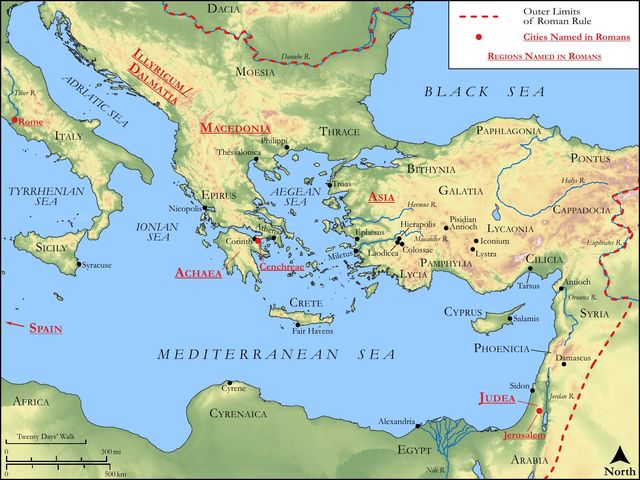
See on the biblical-era map

Study this verse
Public-domain commentary
Matthew Henry
From his Commentary on the Whole Bible. Henry comments on passages, not single verses — this entry covers Romans 1:1–7. His three-level outline is real structure in the source text, so it is rendered as structure.
In this paragraph we have,
I.The person who writes the epistle described (Rom 1:1):
Paul, a servant of Jesus Christ; this is his title of honour, which he glories in, not as the Jewish teachers, Rabbi, Rabbi; but a servant, a more immediate attendant, a steward in the house. Called to be an apostle. Some think he alludes to his old name Saul, which signifies one called for, or enquired after: Christ sought him to make an apostle of him, Act 9:15. He here builds his authority upon his call; he did not run without sending, as the false apostles did; klētos apostolos - called an apostle, as if this were the name he would be called by, though he acknowledged himself not meet to be called so, Co1 15:9. Separated to the gospel of God. The Pharisees had their name from separation, because they separated themselves to the study of the law, and might be called aphōrismenoi eis ton nomon; such a one Paul had formerly been; but now he had changed his studies, was aphōrismenos eis to Euangelion, a gospel Pharisee, separated by the counsel of God (Gal 1:15), separated from his mother's womb, by an immediate direction of the Spirit, and a regular ordination according to that direction (Act 13:2, Act 13:3), by a dedication of himself to this work. He was an entire devotee to the gospel of God, the gospel which has God for its author, the origin and extraction of it divine and heavenly.
II.Having mentioned the gospel of God, he digresses, to give us an encomium of it.
1.The antiquity of it. It was promised before (Rom 1:2); it was no novel upstart doctrine, but of ancient standing in the promises and prophecies of the old Testament, which did all unanimously point at the gospel, the morning-beams that ushered in the sun of righteousness; this not by word of mouth only, but in the scriptures.
2.The subject-matter of it: it is concerning Christ, Rom 1:3, Rom 1:4. The prophets and apostles all bear witness to him; he is the true treasure hid in the field of the scriptures. Observe, When Paul mentions Christ, how he heaps up his names and titles, his Son Jesus Christ our Lord, as one that took a pleasure in speaking of him; and, having mentioned him, he cannot go on in his discourse without some expression of love and honour, as here, where in one person he shows us his two distinct natures.
(1.)His human nature: Made of the seed of David (Rom 1:3), that is, born of the virgin Mary, who was of the house of David (Luk 1:27), as was Joseph his supposed father, Luk 2:4. David is here mentioned, because of the special promises made to him concerning the Messiah, especially his kingly office; Sa2 7:12; Psa 132:11, compared with Luk 1:32, Luk 1:33.
(2.)His divine nature: Declared to be the Son of God (Rom 1:4), the Son of God by eternal generation, or, as it is here explained, according to the Spirit of holiness. According to the flesh, that is, his human nature, he was of the seed of David; but, according to the Spirit of holiness, that is, the divine nature (as he is said to be quickened by the Spirit, Pe1 3:18, compared with Co2 13:4), he is the Son of God. The great proof or demonstration of this is his resurrection from the dead, which proved it effectually and undeniably. The sign of the prophet Jonas, Christ's resurrection, was intended for the last conviction, Mat 12:39, Mat 12:40. Those that would not be convinced by that would be convinced by nothing. So that we have here a summary of the gospel doctrine concerning Christ's two natures in one person.
3.The fruit of it (Rom 1:5); By whom, that is, by Christ manifested and made known in the gospel, we (Paul and the rest of the ministers) have received grace and apostleship, that is, the favour to be made apostles, Eph 3:8. The apostles were made a spectacle to the world, led a life of toil, and trouble, and hazard, were killed all the day long, and yet Paul reckons the apostleship a favour: we may justly reckon it a great favour to be employed in any work or service for God, whatever difficulties or dangers we may meet with in it. This apostleship was received for obedience to the faith, that is, to bring people to that obedience; as Christ, so his ministers, received that they might give. Paul's was for this obedience among all nations, for he was the apostle of the Gentiles, Rom 11:13. Observe the description here given of the Christian profession: it is obedience to the faith. It does not consist in a notional knowledge or a naked assent, much less does it consist in perverse disputings, but in obedience. This obedience to the faith answers the law of faith, mentioned Rom 3:27. The act of faith is the obedience of the understanding to God revealing, and the product of that is the obedience of the will to God commanding. To anticipate the ill use which might be made of the doctrine of justification by faith without the works of the law, which he was to explain in the following epistle, he here speaks of Christianity as an obedience. Christ has a yoke. "Among whom are you, Rom 1:6. You Romans in this stand upon the same level with other Gentile nations of less fame and wealth; you are all one in Christ." The gospel salvation is a common salvation, Jde 1:3. No respect of persons with God. The called of Jesus Christ; all those, and those only, are brought to an obedience of the faith that are effectually called of Jesus Christ.
III.The persons to whom it is written (Rom 1:7):
To all that are in Rome, beloved of God, called to be saints; that is, to all the professing Christians that were in Rome, whether Jews or Gentiles originally, whether high or low, bond or free, learned or unlearned. Rich and poor meet together in Christ Jesus. Here is,
1.The privilege of Christians: They are beloved of God, they are members of that body which is beloved, which is God's Hephzibah, in which his delight is. We speak of God's love by his bounty and beneficence, and so he hath a common love to all mankind and a peculiar love for true believers; and between these there is a love he hath for all the body of visible Christians.
2.The duty of Christians; and that is to be holy, for hereunto are they called, called to be saints, called to salvation through sanctification. Saints, and only saints, are beloved of God with a special and peculiar love. Klētois hagiois - called saints, saints in profession; it were well if all that are called saints were saints indeed. Those that are called saints should labour to answer to the name; otherwise, though it is an honour and a privilege, yet it will be of little avail at the great day to have been called saints, if we be not really so.
IV.The apostolical benediction (Rom 1:7):
Grace to you and peace. This is one of the tokens in every epistle; and it hath not only the affection of a good wish, but the authority of a blessing. The priests under the law were to bless the people, and so are gospel ministers, in the name of the Lord. In this usual benediction observe,
1.The favours desired: Grace and peace. The Old Testament salutation was, Peace be to you; but now grace is prefixed - grace, that is, the favour of God towards us or the work of God in us; both are previously requisite to true peace. All gospel blessings are included in these two: grace and peace. Peace, that is all good; peace with God, peace in your own consciences, peace with all that are about you; all these founded in grace.
2.The fountain of those favours, from God our Father, and the Lord Jesus Christ. All good comes,
(1.)From God as a Father; he hath put himself into that relation to engage and encourage our desires and expectations; we are taught, when we come for grace and peace, to call him our Father.
(2.)From the Lord Jesus Christ, as Mediator, and the great feoffee in trust for the conveying and securing of these benefits. We have them from his fulness, peace from the fulness of his merit, grace from the fulness of his Spirit.
Historical interpretation
Ten Centuries of Reception
12 surviving comments on this verse. Each one is dated, so this reads as a timeline rather than a list.
Select a marker to jump to its quote. Markers stagger vertically where authors wrote within a few decades of each other.
Let no one think that we are reading more into this text than the meaning itself permits. For although in Latin translations one normally finds the word predestined here, the true reading is designated and not predestined. For designated applies to someone who already exists, whereas predestined is only applicable to someone who does not yet exist, like those of whom the apostle said: “For those whom he foreknew he also predestined.” … Those who do not yet exist may be foreknown and predestined, but he who is and who always exists is not predestined but designated. These things are said by us concerning those who speak blasphemously about the only begotten Son of God and ignoring the difference between designated and predestined think that Christ is to be numbered among those who were predestined before they existed. But he was never predestined to be the Son, because he always was and is the Son, just as the Father has always been the Father.… The apostle makes an essential distinction when he says that “from the seed of David according to the flesh” Christ was made, but as “the Son of God in power according to the Spirit of holiness” he is designated.And when he says “Son of God” it is not without reason that he adds “in power,” indicating by this that in substance he is the Son according to the Spirit of holiness. For Christ is called “the power of God and the wisdom of God.” … But we want to know what to make of the soul of Jesus, if what is born of the seed of David is according to the flesh and what is designated in power is according to the Spirit of holiness the Son of God and in the substance of God. The soul, however, is not mentioned either with the flesh, with the Spirit of holiness or with the substance of God’s power, although the Savior himself speaks of it elsewhere: “My soul is very sorrowful, even unto death” and: “Now is my soul troubled.” Here he means the soul which he laid aside of his own free will, which went down to hell and of which it is said: “Thou dost not leave my soul in hell.” It is certain that this soul was not born of the seed of David, for he says that what was born of the seed of David was according to the flesh.
The soul cannot be included with the things which are according to the flesh, nor in that which is designated Son of God in power according to the Spirit of holiness. I think that the apostle is here following his usual custom, knowing that the soul is always midway between the spirit and the flesh. Either it joins itself to the flesh and is made one with the flesh or it associates itself with the spirit and is made one with the spirit. From this it may be concluded that when the soul is united with the flesh, men become carnal, and that when it is united with the spirit, men become spiritual. For this reason, Paul does not mention the soul independently but only as flesh or spirit. For he knows that the soul must necessarily attach itself to one or other of these, as it does in those to whom he says: “But you are in the flesh and not in the spirit,” and: “Whoever joins himself to a harlot is one body with her,” calling the harlot here “flesh” or “body,” but “whoever joins himself to the Lord is one spirit with him.”80
Some people come to us raising the most serious problems as to how Christ can be descended from the seed of David when it is clear that he was not born from Joseph, in whom the line of David descends from one generation to the other. Unpleasant as it is to have to argue according to the literal sense of the text, some of our people answer by saying that Mary was already engaged to Joseph and that before they came together, she was found with child by the Holy Spirit. According to the law, she was therefore already united to Joseph’s tribe and family. … Whether you think this line of argument is valid is up to you, dear reader, to decide!
In our opinion, these things must be understood according to the spiritual or allegorical sense, according to which there is no reason why Joseph should not be called the father of Christ, even though he was not his father. For in the generations recorded by Matthew it is stated that Jehoshaphat begat Joram and Joram begat Uzziah, but in 2 Kings it is said that Jehoshaphat begat Ahaziah and Ahaziah begat Joash and Joash begat Amaziah, and Amaziah begat Azariah, who was also called Uzziah. … Matthew therefore left three generations out! The explanation for this is surely not to be sought on the historical level but in conjunction with the spiritual understanding.… It is therefore enough for us to say, in answer to our opponents, that just as Jesus is called the son of Joseph even though he did not descend from him, and Uzziah is called the son of Joram even though Joram was not his father, so can we also reckon that Christ was born of the seed of David according to the flesh. What we accept as reason and proof in the case of Joram and Joseph must, we think, be allowed to stand in the case of David as well.
How it is that he who is said to have been made from the seed of David according to the flesh should be the Son of God by his resurrection from the dead is not hard to understand for anyone who has read that it is written: “For it was fitting that he, for whom and by whom all things exist, in bringing many sons to glory, should make the pioneer of their salvation perfect through suffering.” Now the end of Christ’s sufferings is the resurrection, and after the resurrection “he will never die again; death no longer has dominion over him.” And again: “Even though we once regarded Christ from a human point of view, we regard him thus no longer.” Thus everything which is in Christ is now the Son of God.
How this all relates to him who is designated Son of God in power is hard for us to understand unless we accept that, because of the indissoluble union of the Word and the flesh, everything which pertains to the flesh may be attributed to the Word also, and everything which pertains to the Word may be attributed to the flesh also. For we often find Jesus referred to in either nature as both Christ and Lord.
When Paul speaks about the Son of God he is pointing out that God is Father, and by adding the Spirit of holiness he indicates the mystery of the Trinity. For he who was incarnate, who obscured what he really was, was then predestined according to the Spirit of holiness to be manifested in power as the Son of God by rising from the dead, as it is written in Psalm 84: “Truth is risen from the earth.” For every ambiguity and hesitation was made firm and sure by his resurrection, just as the centurion, when he saw the wonders, confessed that the man placed on the cross was the Son of God. … Note that Paul did not say “because of the resurrection of Jesus Christ” but “because of his resurrection from the dead,” because the resurrection of Christ led to the general resurrection. For this power and victory in Christ appears to be all the greater, in that a dead man could do the same things as he did when he was alive. By this fact he appeared to dissolve death, in order to redeem us. Thus Paul calls him our Lord.
"And declared to be the Son of God with power, according to the Spirit of Holiness, by the resurrection from the dead, even Jesus Christ."
What is said has been made obscure by the close-folding of the words, and so it is necessary to divide it. What then is it, which he says? We preach, says he, Him Who was made of David. But this is plain. Whence then is it plain, that this incarnate "Person" was also the Son of God? First, it is so from the prophets; wherefore he says, "Which He had promised afore by the Prophets in the Holy Scriptures." And this way of demonstration is no weak one. And next also from the very way of His Generation: which also he sets forth by saying, "of the seed of David according to the flesh": for He broke the rule of nature. Thirdly, from the miracles which He did, yielding a demonstration of much power, for "in power" means this. Fourthly, from the Spirit which He gave to them that believe upon Him, and through which He made them all holy, wherefore he saith, "according to the Spirit of holiness." For it was of God only to grant such gifts. Fifthly, from the Resurrection; for He first and He alone raised Himself: and this Himself too said to be above all a miracle sufficient to stop the mouths even of them that behaved shamelessly. For, "Destroy this Temple," He says, "and in three days I will raise it up"; and, "When ye have lifted" Me "up from the earth, then shall ye know that I am He"; and again, This "generation seeketh after a sign; and there shall no sign be given unto it, but the sign of Jonas." What then is the being "declared?" being shown, being manifested, being judged, being confessed, by the feeling and suffrage of all; by Prophets, by the marvelous Birth after the Flesh, by the power which was in the miracles, by the Spirit, through which He gave sanctification, by the Resurrection, whereby He put an end to the tyranny of death.
Christ was predestined as to the spirit of sanctification, so that because of his incorruptibility he might rise again before anyone else and open the way of resurrection for the children of God.… The nature of the resurrection (not of all who rise from the dead but of those who belong to Christ) is prefigured by Christ.
With respect to this predestination Christ was glorified before the foundation of the world, so that as a result of his resurrection from the dead he might have glory at the Father’s right hand, where he now sits. Thus, when he saw that his predestined glorification had come, in order that what had already been done by predestination might now also take place in fact, he prayed: “Father, glorify thou me in thy own presence with the glory which I had with thee before the world was made.”
Jesus was predestined, so that he who was to be the Son of David according to the flesh should nonetheless be in power the Son of God, according to the Spirit of sanctification, for he was born of the Holy Spirit and the Virgin Mary. This is that unique act, performed in an ineffable manner, the assumption of a man by the Word of God, so that he might truly and properly be called at once the Son of God and the Son of Man—the Son of Man because of the man who was assumed, the Son of God because of the only begotten God who assumed him.
Christ is the son of David in weakness according to the flesh but Son of God in power according to the Spirit of sanctification.… Weakness relates to David but life eternal to the power of God.
Paul had to oppose the unbelief of those who accept our Lord Jesus Christ only according to the man whom he put on but do not understand his divinity, which sets him apart from every other creature.
As Christ was predestined to be the Son of God in power, so we too have been predestined to be sons of God, not however in power but by grace, having been made worthy of such a calling and having received it only by the will of God the Father. There is a big difference here between Emmanuel and us. For even if he was born of the seed of David according to the flesh, and so we can say that the Son of God was one of us in his humanity, still, in power and in truth he is the natural Son, and it is through him that we are made sons as well.… We stand in the same relation to him as images do to their original.
Before his crucifixion and death the Lord Jesus Christ did not appear to be God either to the Jews or even to the disciples. For they were offended by human things, as when they saw him eating and drinking and sleeping and urinating, and not even his miracles made them change their minds. So, for instance, when they saw the miracle which he performed with the sea, they said: “Who is this, that even the sea and the winds obey him?” … But after he rose from the dead and ascended into heaven, and the Holy Spirit came, and after miracles of every kind which they performed by calling on his adorable name, all those who believed recognized that he was God and the only begotten Son of God.
By his miracles and resurrection and by the descent of the Holy Spirit, it was made plain and certain to the world that Christ was the Son of God.
42. Having commended Christ’s origin [n. 28], he now commends his power; and mentions three things. First, his predestination, when he says, who was predestined; secondly, his dignity or power, when he says [n. 49] Son of God in power; thirdly, the sign or effect, when he says [n. 58] according to the spirit of sanctification. 43. In regard to the first it should be noted that the word "predestination" is taken from "destination," for something is said to be predestined as though destined beforehand. But destination is taken in two senses: in one sense, to destine is to send, for those who are sent to achieve some purpose are said to be destined, in accord with 1Mac 1(:14), "Some of the people destined, and they went to the king."12 In another sense to destine is to determine, as in 2Mac 6(:20): "Eleazar destined not to do any unlawful things." But this second meaning seems to be derived from the first. For as a courier, who is sent, is directed to something, so whatever we determine we direct to some end. According to this, therefore, to predestine is nothing more than to determine beforehand in the heart what is to be done in regard to some thing. 44. Now someone can determine about a future thing or action. In one way, as to its make-up, as a builder determines how he should build a house; in another way, as to 28 13 On Christian Doctrine, book 1, chapter 4. the use or governance of the thing, as when someone determines how to use his horse. It is to this second pre-determination and not the first that predestination pertains. 45. For what one uses is referred to its end, because, as Augustine says in the book On Christian Doctrine, "To use is to refer something to an end to be enjoyed."13 When, however, a thing is made, it is not by that very fact directed to something else. Hence, the pre-determination of a thing’s make-up cannot properly be called predestination. Therefore, to deny predestination is the same as to deny the eternal divine pre-determination about things to be done in time. But because all natural things pertain to the make-up of the thing itself, for they are either the principles of which things are made or what follows from such principles, it follows that natural things do not properly fall under predestination; for example, it is not proper to say that man is predestined to have hands. What is left is that predestination is properly said only of things that are above nature, to which things the rational creature is ordained. 46. But God alone is above the nature of the rational creature, who is united to him by grace: in one way, as regards God’s own act, as when foreknowledge of the future, which belongs to God alone, is communicated to a man by the grace of prophecy. Of this sort are all the graces called graces freely given [gratia gratis data]. In another way, as regards God himself, to whom the rational creature is united in the common manner through the effect of love: "He who abides in love abides in God and God in him" (1 Jn 4:16). This is done through sanctifying grace [gratia gratum facientem], which is the grace of adoption. In another way, which is particular to Christ, it is done through a union in personal being [esse personali]; and this is called the grace of union. 29 14 Due to a copyist’s error, the Latin text of Rev 5:12 has divinitatem instead of divitias, which would be the proper rendering of the Greek text. Therefore, just as a man’s union with God through grace of adoption falls under predestination, so also the union with God in person though the grace of union falls under predestination. And as regards this he says, who was predestinated son of God. 47. But to prevent this from being referred to the sonship of adoption, he adds, in power. As if to say: He was predestinated to be such a Son as to have equal, indeed the same, power as God the Father, because, as it is said in Revelation 5(:12), "Worthy is the Lamb who was slain to receive power and divinity";14 in fact Christ himself is the power of God: "Christ, the power of God and the wisdom of God" (1 Cor 1:24). Hence, "whatever the Father does the Son does likewise" (Jn 5:19). In regard to the graces freely given [gratia gratis data], one is not said to be predestined in the strict sense, because such graces are not directly ordained to direct to his ultimate end the one who receives them, but to direct others by them, as it is stated in 1 Cor 12(:7), "To each is given the manifestation of the Spirit unto profit." 48. Now it is obvious that anything which exists of itself is the measure and rule of things which exist in virtue of something else and through participation. Hence, the predestination of Christ, who was predestinated to be the Son of God by nature, is the measure and rule of our life and therefore of our predestination, because we are predestined to adoptive sonship, which is a participation and image of natural sonship: "Those whom he foreknew he also predestined to be conformed to the image of his Son" (Rom 8:29). Therefore, just as the man Christ was not predestined to be the natural Son of God because of any antecedent merits, but solely from grace, so we are predestined to be 30 adopted sons of God solely from grace and not from our merits: "Do not say in you heart, after the Lord your God has thrust them out before you, ‘It is because of my righteousness that the Lord has brought me in to possess this land’" (Dt 9:4). It is clear, therefore, what the goal of that predestination is, namely, that one be son of God in power. 49. But we must still inquire who it is that has been predestined to this. For since predestination implies antecedence, it seems that the one predestined to be the son of God in power was not always the son of God in power; for predestination does not seem to be concerned with what always has been, since that involves nothing antecedent. Hence if we suppose, according to Nestorius, that the person of the Son of man were other than the person of the Son of God, there would be no problem, because we could say that the created person of the son of man did not exist eternally but began in time to be the son of God in power. The same would apply if one were to say the hypostasis or supposit of the Son of God and of the Son of Man were distinct. But this is alien to the faith, as has been said [n. 34ff]. Therefore, since not only the person but also the hypostasis and suppositum of the Son of God and of the Son of man are the same, so that it cannot be truly and properly said that the son of man was made the Son of God, lest any created suppositum be implied of whom "Son of God" would be newly predicated, for an equal reason it does not seem possible to say that the son of man was predestined to be the son of God, because "the son of man" presupposes the eternal suppositum, who was always the Son of God. Hence, the antecedence which predestination involves has no place. 31 50. For this reason Origen says that the text should not read "who was predestinated" but "who was destined" to be the son of God in power so that no antecedence is indicated. If this accepted, the sense is plain, because Christ was destined, i.e., sent into the world by God the Father as the true Son of God in divine power. But because all the Latin texts generally have, who was predestined, others have explained this according to the custom of Scripture whereby something is considered to be made when it is made known, as the Lord after the resurrection says: "All authority in heaven and on earth has been given to me" (Mt 28:18), because it was after the resurrection that he made known that such power had been given to him from eternity. But if this is correct, the word "predestinated" is not taken in the proper sense, because predestination concerns matters pertaining to grace; whereas no grace was given to Christ by the fact that his divine power was made known, but rather to us. Hence, it is even stated in a Gloss that according to this sense "predestinated" is used in the wider sense of "foreknown," so that the sense would be: Christ was predestinated, i.e., foreknown, from eternity to be revealed in time as the Son of God in power. 51. Therefore, others, relating predestination to the union itself, did not attribute it to the person but to the nature, so that the sense would be: Who was predestinated son of God in power, i.e., whose nature was predestinated to be united to him who is the Son of God in power. But even this explanation is improper and extorted. For since predestination implies an ordering to an end, predestination affects that to which it belongs to be ordered to an end by its own activity. But it is not the nature but the person that acts for an end. 32 Therefore, if the word "predestined" be taken in the strict sense, predestination must be attributed to the very person of Christ. But because the person of Christ subsists in two natures, the human and the divine, something can be said of him with respect to either nature. For just as something can be said of a man regarding his body, for example, to be touched or wounded, and something regarding his soul, for example, to understand and to will, so, too, something can be said of Christ both as to his divine nature, as when he says: "I and the Father are one" (Jn 10:30), and as to his human nature, as when we say that he was crucified and died. It is in this way that He is said to be predestinated according to His human nature. For although the person of Christ has always been the Son of God, nevertheless it was not always a fact that, while existing in a human nature, he was the Son of God; rather, this was due to an ineffable grace. 52. There is another consideration concerning the participle made, which designates a real act, and the participle predestinated, which designates an act of the soul. For the soul, through its intellect and reason, can distinguish things that are joined in reality. For one can think of a white wall and speak separately about the fact that it is a wall and separately about the fact that it is white. So, too, in predestination. For predestination can be attributed to the person of Christ inasmuch as he subsists in a human nature, even though it is not attributed to him as subsisting in the divine nature. This is why the Apostle first presents the Son of God as being incarnated and then attributes predestination to him, to let it be understood that he was predestined according as he was made from the seed of David according to the flesh. Thus from the Son of God he descends to the flesh and from the flesh, by way of predestination, he ascends to the Son of God, in order to show that neither did the glory of the Godhead prevent the 33 weakness of the flesh nor did the weakness of the flesh diminish the majesty of the Godhead. 53. In the Gloss it is asked, first, whether Christ is the Son of God according as he is man. It seems so, because here is Christ, who was predestined to be [the Son of God]; but he was predestined to be [the Son of God] according as he is a man. Therefore, as a man he is the Son of God. However, I answer that if the "as" denotes the unity of the person, it is true that as man he is the Son of God, because the person of God and man is one. But if it designates the condition of the nature or its cause, it is false. For it is not from the human nature that he is Son of God. In the argument there is a fallacy of composition and division, because the "as" can modify the participle "predestined," and taken this way it is true that as man he is predestined; or it can modify that being the Son of God to which the predestination is ordained, and taken this way it is false. For he was not predestined that as man he be Son of God; and this is the sense of the words assumed by the argument. 54. The second question [in the Gloss] is whether Christ as man is a person. I answer that if the "as" is referred to the very supposit of the man, it must be admitted that this supposit is a divine person. But if it designates the condition of the nature or the cause, taken this way Christ as man is not a person, because the human nature does not cause a new personhood in Christ. For it is joined to a nobler person into whose personhood it passes. 34 55. Likewise, an objection is made against a statement in the Gloss, namely, that the one who assumed and what he assumed are one person. But what the Son of God assumed is a human nature. Therefore, the human nature is a person. I answer that such expressions must be explained so that the meaning is this: he who assumed and the nature he assumed are united in one person. 56. The fourth question is whether this is true: "A man was assumed by the Word." It would seem so according to Ps (65:4): "Blessed is he whom thou dist choose and assume." I answer that since a man implies a supposit, in this case an eternal one, it cannot properly be said that a man was assumed by the Word; for a same thing is not assumed by itself. Hence, wherever the expression "man was assumed" is found, it is taken as the human nature. 57. The fifth question is whether this is true: "This man has always existed." The answer is that it is true, because a man supposes a supposit, in this case an eternal one. Hence it is stated in Heb (13:8): "Jesus Christ is the same yesterday and today and forever." However, the statement is not true if man is taken precisely as man. For it is not true that that man, as man, always has existed, but as He is Son of God. So, the matters concerning the preordainment and power of the Son of God are clear. 58. But a third matter remains, namely concerning the sign, which is touched upon when he says, according to the Spirit of holiness. 35 It is the custom of divine power to sanctify men by conferring the Holy Spirit: "I am the Lord who sanctify you" (Lev 20:8). He alone can give the Holy Spirit: "Thus says God, the Lord who created the heavens, who gives breath to the people upon it and the Spirit to those who walk in it" (Is 42:5). Therefore, it is clear that Christ has divine power, because He gives the Holy Spirit: "When the Counselor comes whom I shall send" (Jn 15:26). Furthermore, it is by His power that we are sanctified: "You were sanctified, you were justified, in the name of the Lord Jesus Christ and in the Spirit of our God" (1 Cor 6:11). He says, therefore: that Christ is the Son of God in power appears according to the Spirit of holiness, i.e., inasmuch as He gives the sanctifying Spirit. This sanctification began with the resurrection from the dead of Jesus Christ our Lord: "For as yet the Spirit had not been given, because Jesus was not yet glorified" (Jn 7:39). However, this does not mean that no one had received the sanctifying Spirit before Christ’s resurrection, but that from the time He arose, a more copious and general Spirit of sanctification began to be given. 59. It can also mean that two signs of the divine power in Christ are designated here. First, indeed, from the fact that he says, according to the Spirit of holiness, whether it be understood according to the sanctifying Spirit, as has been explained, or in view of the fact that He was conceived in the Virgin’s womb by the Holy Spirit - which, of course, is a sign of the divine power in Him according to the words of Lk (1:25): "The Holy Spirit will come upon you" and further on (1:35): Therefore, the child to be born will be called holy, the Son of God." 36 The second sign of the divine power is the raising of the dead: "As the Father raises the dead and gives life, so also the Son" (Jn 5:21). The sense, therefore, is this: that Christ is the Son of God in power is evident from His resurrection from the dead, i.e., from the fact that He made the dead rise with Him: "many bodies of the saints who had fallen asleep were raised" (Mt 27:52) and will finally make all rise: "All who are in the tombs will hear his voice and come forth" (Jn 5:28). Or it can be understood of a spiritual resurrection of the dead, i.e., from sin: "Awake, O sleeper, and arise from the dead" (Eph 5:14). Those who are raised by Him are called Christ’s dead because they are raised by him just as those under a doctor’s care are called his sick. But these two signs can be referred to two previous clauses in this way, who was made to him according to the flesh from the seed of David: and this according to the Spirit of Holiness, from Whom His flesh was conceived. Who was predestined Son of God in power, and this is apparent in the resurrection of the dead. But the first explanation is better.
Continue studying Romans 1:4 across the web’s major study libraries — every link below opens this exact verse, chapter, or book on the destination site.
Read & Compare
 BibleGatewayThis verse in more than 200 translations and 70 languages.
 Bible.comThe YouVersion reader — hundreds of translations, reading plans, and highlights.
 ESV.orgCrossway's official English Standard Version reader.
 NET BibleThe NET translation with 60,000+ translators' notes on every rendering decision.
 STEP BibleTyndale House's free study tool — original text, vocabulary, and scholarly resources.
 BibliaLogos Bible Software's free web reader.
 USCCBThe New American Bible (Revised Edition) with the U.S. bishops' study notes.
Commentaries
 BibleHub CommentariesDozens of classic commentaries on this verse, gathered on one page.
 StudyLightMore than 100 commentary sets — the largest collection on the web.
 BibleRefPlain-English commentary on what this verse means, verse by verse.
 Enduring WordDavid Guzik's free commentary on this chapter, widely used by Bible teachers.
 Bible Study ToolsVerse commentary alongside Greek and Hebrew study aids.
Original Language & Research
- BibleHub InterlinearThe verse word by word — original language, transliteration, and English.
- BibleHub LexiconEvery word's original-language definition and Strong's entry.
 Blue Letter BibleDeep-study tools — Strong's numbers, concordance, and word studies.
 CNTR CollationThe earliest Greek manuscripts of this verse, collated letter by letter.
Sermons, Hymns & Audio


TrulyRandomVerse is not affiliated with these sites and doesn’t control their content. They’re linked because they’re genuinely useful.
Summary
Romans 1:4 presents a profound theological declaration concerning the identity of Jesus Christ, asserting His divine Sonship with undeniable power. Following the assertion of His human lineage through David in the preceding verse, this verse pivots to emphasize His divine nature, definitively "declared" or "appointed" as the Son of God through the mighty act of His resurrection from the dead, operating according to the Spirit of holiness. It serves as a foundational statement for Paul's gospel, highlighting the dual nature of Christ—fully human and fully divine—with the resurrection as the ultimate validation of His deity.
Context
ShowHideLiterary Context
Romans 1:4 stands as the climactic statement in Paul's opening salutation and theological thesis (Romans 1:1-7), specifically elaborating on the "gospel of God" (Romans 1:1). It directly follows Romans 1:3, which states that Jesus was "made of the seed of David according to the flesh." Verse 4 provides the crucial divine counterpoint to this human lineage, presenting Jesus' identity "according to the spirit of holiness" and validating His Sonship through the resurrection. This intentional juxtaposition of "flesh" (humanity) and "spirit of holiness" (divinity) is central to Paul's Christology, establishing from the outset that the Jesus he preaches is both truly human and truly divine, with His divine status powerfully confirmed by God Himself. This foundational declaration sets the stage for the entire letter, which will systematically unpack the implications of this gospel for humanity's sin, God's righteousness, and the path to salvation.
Historical & Cultural Context
Paul is writing to a diverse church in Rome, comprising both Jewish and Gentile believers. For Jewish believers, the concept of a Messiah from the "seed of David" (Romans 1:3) was deeply rooted in Old Testament prophecy (e.g., 2 Samuel 7:12-16). However, the idea of a resurrected Messiah who is also "Son of God with power" would challenge traditional expectations and require theological unpacking. For the Greco-Roman world, the notion of resurrection from the dead was largely foreign and often met with skepticism or ridicule (as seen in Acts 17:32). Therefore, Paul's emphasis on the resurrection as the powerful declaration of Jesus' divine Sonship was a radical and counter-cultural claim, asserting a unique divine intervention that transcended both Jewish messianic expectations and pagan philosophical frameworks. The "power" (Greek: dynamis) would have resonated with a world that understood divine power through miraculous acts, but here it is uniquely tied to victory over death.
Key Themes
ShowHideThis verse contributes significantly to several major themes in Romans and Pauline theology. Firstly, it underscores the Divine Sonship of Jesus Christ, establishing His unique relationship with God the Father and His inherent divine essence. This title signifies not merely an adopted status but an ontological reality, distinguishing Him as God's unique Son. Secondly, the verse highlights the Centrality and Power of the Resurrection. The resurrection is presented not just as an event, but as the definitive, powerful act by which God declared Jesus' divine identity. It is the ultimate vindication of Jesus' claims and the demonstration of His victory over sin and death, forming the very core of the gospel message (see 1 Corinthians 15:3-4). Thirdly, the phrase "according to the spirit of holiness" introduces the theme of the Holy Spirit's Role in Christ's Identity and Work. This contrasts with the "flesh" in Romans 1:3, pointing to the spiritual, divine realm from which Jesus' power and identity are derived, and hinting at the Spirit's active participation in the resurrection and in the life of believers, a theme extensively developed throughout Romans 8.
Exposition and Analysis
ShowHideKey Word Analysis
ShowHideMeaning "to mark out or bound," "to appoint," "decree," or "specify." This word implies more than a mere announcement; it signifies a definitive, authoritative designation or proof. Jesus was not simply called the Son of God, but was powerfully designated or proven to be the Son of God by a divine act. It's a formal, decisive act of God establishing Christ's identity and status.
Referring to "force (literally or figuratively)," "miraculous power," or "might." Here, dýnamis emphasizes the potent, effective, and supernatural nature of God's act in declaring Jesus' Sonship. It suggests an overwhelming, undeniable demonstration of divine might, specifically manifested through the resurrection. This power is intrinsic to Jesus' divine nature and is the means by which His Sonship is definitively established.
Meaning "sacredness" or "the quality of being holy." This word, combined with "spirit" (G4151, pneûma), refers to the divine, holy nature of the Spirit, whether understood as the Holy Spirit, or Christ's own divine Spirit. It stands in direct contrast to "flesh" (G4561, sarx) in Romans 1:3, highlighting the spiritual and divine realm from which Jesus' power and identity are derived, as opposed to earthly lineage. It denotes the inherent sacredness and purity that characterize God's Spirit and, by extension, Christ's divine nature.
Verse Breakdown
ShowHide"And declared [to be] the Son of God with power"
This clause asserts the definitive establishment of Jesus' divine identity. The verb "declared" (horízō) signifies a formal, authoritative designation by God. Jesus' status as "the Son of God" is not merely a title but an ontological reality, signifying His unique, divine relationship with the Father. This declaration is made "with power" (en dýnamei), emphasizing the mighty, undeniable, and supernatural nature of the act by which this truth is revealed and confirmed. This power is the hallmark of God's work.
"according to the spirit of holiness"
This phrase clarifies the sphere or nature by which Jesus' divine Sonship is declared. It stands in direct contrast to "according to the flesh" in Romans 1:3. While "flesh" refers to His human lineage and earthly existence, "spirit of holiness" refers to His divine nature, His spiritual essence, or the Holy Spirit's agency. It points to the divine realm, characterized by inherent holiness and spiritual power, as the source and context of His divine declaration.
"by the resurrection from the dead"
This final phrase specifies the concrete, historical event through which Jesus' divine Sonship was powerfully declared. The resurrection is presented as the ultimate, undeniable proof of His identity. It is the decisive act of God that vindicated Jesus' claims, demonstrated His victory over death and sin, and confirmed His status as the divine Son of God. This event is the cornerstone of Christian faith, providing the historical and theological foundation for the gospel.
Literary Devices
ShowHideRomans 1:4 employs several potent literary devices to convey its profound theological message. Central to its impact is Contrast, specifically with the preceding verse. While Romans 1:3 speaks of Jesus "according to the flesh" (his human lineage), verse 4 presents Him "according to the spirit of holiness" (his divine nature), highlighting the two aspects of Christ's person. This antithetical parallelism emphasizes the completeness of His identity as both fully human and fully divine. The phrase "declared... with power" functions as a powerful Affirmation or Proclamation, underscoring the authoritative and undeniable nature of Jesus' divine Sonship. The use of "power" (dýnamis) serves as Emphasis, drawing attention to the supernatural might involved in this declaration, particularly as it culminates in the resurrection. This strategic use of language ensures that the reader grasps the full weight of Jesus' divine authority and the foundational role of His resurrection in establishing His identity.
Theological and Thematic Connections
ShowHideRomans 1:4 is a cornerstone of Christian Christology, establishing the dual nature of Christ—His true humanity and His true divinity—with the resurrection serving as the decisive divine attestation of His Sonship. This declaration is not merely about a title, but about His very being and authority. It underscores that Jesus is not just a prophet or a king, but God's unique Son, sharing in the divine essence, whose identity is fully revealed through His triumph over death. This truth forms the bedrock of the gospel message, affirming that the one who died for our sins is indeed the Lord of life, capable of delivering salvation and new life. The "spirit of holiness" points to the active role of the Holy Spirit in Christ's resurrection and, by extension, in the life of believers, connecting Christ's victory to the indwelling power available to those who believe.
Reflection and Application
ShowHideRomans 1:4 invites us to reflect deeply on the profound identity of Jesus Christ and the unshakable foundation of our faith. If Jesus was truly "declared to be the Son of God with power... by the resurrection from the dead," then His claims, His teachings, and His sacrifice bear the full weight of divine authority. This truth provides immense assurance for believers: our salvation is not based on a mere human teacher or a historical figure, but on the resurrected, divine Son of God who has conquered sin and death. It calls us to live with confident hope, knowing that the same power that raised Christ from the dead is at work within us, enabling us to overcome sin and live a new life. This verse also compels us to share this powerful truth, for the resurrection is the ultimate proof that the gospel is not a myth but a historical reality with eternal implications.
Questions for Reflection
ShowHideFAQ
ShowHideWhat is the significance of "declared [to be] the Son of God with power"?
ShowHideThis phrase, using the Greek word horízō, means Jesus was definitively and authoritatively designated or appointed as the Son of God. It's not merely a title He claimed, but a status powerfully affirmed by God Himself. The "power" (Greek: dýnamis) refers to the mighty, supernatural act by which this declaration was made, specifically through His resurrection. It signifies that Jesus' divine Sonship is an undeniable, divinely validated reality, not just a theological concept. This powerful declaration underscores His unique relationship with the Father and His inherent deity, setting Him apart as the one through whom salvation is accomplished.
What does "according to the spirit of holiness" mean in this verse?
ShowHideThis phrase contrasts with "according to the flesh" in Romans 1:3. While "flesh" refers to Jesus' human lineage and earthly existence, "spirit of holiness" points to His divine nature or the Holy Spirit's agency. It signifies that Jesus' divine Sonship was declared not by human means or earthly lineage, but by His spiritual, divine essence, or by the work of the Holy Spirit. It highlights the divine, holy realm from which His power and identity originate, emphasizing the spiritual reality of His Sonship as opposed to merely a human one. It suggests the inherent holiness and divine power that characterize His being.
Why is the resurrection so crucial to Jesus being "declared" the Son of God?
ShowHideThe resurrection is the ultimate, undeniable proof and the climactic event that validates Jesus' divine Sonship. In a world where death was the final victor, Jesus' resurrection demonstrated His absolute authority over death and sin, proving that He was indeed who He claimed to be—God's unique Son. It was God's powerful seal of approval on Jesus' life, ministry, and sacrificial death. Without the resurrection, the claims of Jesus would lack divine corroboration, and the Christian faith would be in vain, as Paul argues in 1 Corinthians 15:14. The resurrection transformed His disciples' despair into bold proclamation and remains the historical bedrock of Christian belief.
Christ-Centered Fulfillment
ShowHideRomans 1:4 stands as a pivotal declaration of Christ's identity, revealing the profound truth that the Jesus who walked among us, born of David's line, was definitively "declared to be the Son of God with power" through His resurrection. This verse points directly to the core of Christ's redemptive work. His resurrection is not merely an event but the ultimate vindication of His divine claims and the powerful demonstration of His victory over sin and death, essential for our salvation (as seen in Romans 4:25). The "spirit of holiness" through which this declaration occurs foreshadows the indwelling of the Holy Spirit in believers, connecting Christ's triumph to the new life available to us (echoed in Romans 8:11). Thus, Romans 1:4 proclaims Jesus as the divine Lord, whose resurrection secures our hope, assures our justification, and empowers our transformation, making Him the very center of God's redemptive plan and the object of our faith and worship, for He is indeed "Lord of all" (Acts 10:36).