


Romans 1:7
Bible text: King James Version (1769 Blayney text) · Public domain
Bible text: King James Version with Strong's numbers · Public domain
Bible text: Berean Standard Bible · Public domain
Bible text: American Standard Version (1901) · Public domain
Bible text: World English Bible, Messianic edition · Public domain
Bible text: Geneva Bible (1599) · Public domain
Bible text: Young's Literal Translation · Public domain
- πᾶσινpasinTo allG3956A-DPMAdjective Dative Plural Masculine
- τοῖςtoisthoseG3588T-DPMDefinite article Dative Plural Masculine
- οὖσινousinbeingG1510V-PAP-DPMVerb Present Active Participle Dative Plural Masculine
- ἐνeninG1722PREPPreposition
- ῬώμῃRhōmēRomeG4516N-DSF-LNoun Dative Singular Feminine Location
- ἀγαπητοῖςagapētoisbelovedG27A-DPMAdjective Dative Plural Masculine
- θεοῦtheouof GodG2316N-GSM-TNoun Genitive Singular Masculine Title
- κλητοῖςklētoisto [those] calledG2822A-DPMAdjective Dative Plural Masculine
- ἁγίοις·hagioissaintsG40A-DPMAdjective Dative Plural Masculine
- χάριςcharisGraceG5485N-NSFNoun Nominative Singular Feminine
- ὑμῖνhuminto youG4771P-2DPPersonal pronoun Dative 2nd Plural
- καὶkaiandG2532CONJConjunction
- εἰρήνηeirēnēpeaceG1515N-NSFNoun Nominative Singular Feminine
- ἀπὸapofromG575PREPPreposition
- θεοῦtheouGodG2316N-GSM-TNoun Genitive Singular Masculine Title
- πατρὸςpatros[the] FatherG3962N-GSM-TNoun Genitive Singular Masculine Title
- ἡμῶνhēmōnof usG3165P-1GPPersonal pronoun Genitive 1st Plural
- καὶkaiandG2532CONJConjunction
- κυρίουkuriou[the] LordG2962N-GSM-TNoun Genitive Singular Masculine Title
- ἸησοῦIēsouJesusG2424N-GSM-PNoun Genitive Singular Masculine Individual
- ΧριστοῦChristouChristG5547N-GSM-TNoun Genitive Singular Masculine Title
English is a literal word-by-word gloss of the Greek, not the KJV's wording. Why?
This is the original text the KJV's translators worked from — each Greek word with its own literal English meaning in this verse, prepared by scholars at Tyndale House, Cambridge. The KJV translates whole sentences, not word by word, so its wording differs: one Greek word can become several English words, and the KJV may choose “charity” where the gloss reads “love”. Both are faithful — they answer different questions. For the KJV's own rendering, switch to the KJV text.
Details
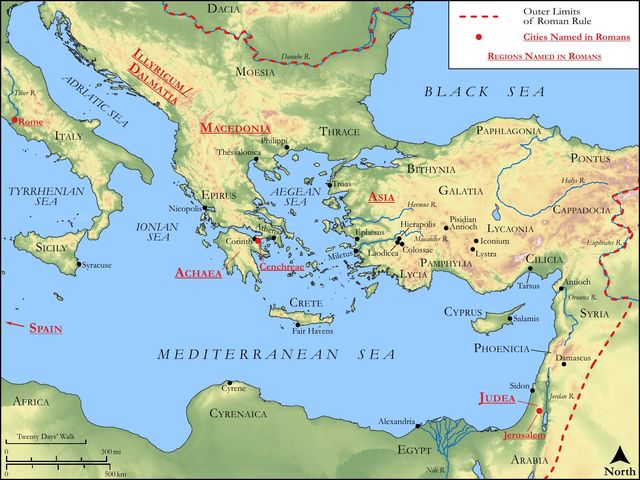
See on the biblical-era maps

Study this verse
Public-domain commentary
Matthew Henry
From his Commentary on the Whole Bible. Henry comments on passages, not single verses — this entry covers Romans 1:1–7. His three-level outline is real structure in the source text, so it is rendered as structure.
In this paragraph we have,
I.The person who writes the epistle described (Rom 1:1):
Paul, a servant of Jesus Christ; this is his title of honour, which he glories in, not as the Jewish teachers, Rabbi, Rabbi; but a servant, a more immediate attendant, a steward in the house. Called to be an apostle. Some think he alludes to his old name Saul, which signifies one called for, or enquired after: Christ sought him to make an apostle of him, Act 9:15. He here builds his authority upon his call; he did not run without sending, as the false apostles did; klētos apostolos - called an apostle, as if this were the name he would be called by, though he acknowledged himself not meet to be called so, Co1 15:9. Separated to the gospel of God. The Pharisees had their name from separation, because they separated themselves to the study of the law, and might be called aphōrismenoi eis ton nomon; such a one Paul had formerly been; but now he had changed his studies, was aphōrismenos eis to Euangelion, a gospel Pharisee, separated by the counsel of God (Gal 1:15), separated from his mother's womb, by an immediate direction of the Spirit, and a regular ordination according to that direction (Act 13:2, Act 13:3), by a dedication of himself to this work. He was an entire devotee to the gospel of God, the gospel which has God for its author, the origin and extraction of it divine and heavenly.
II.Having mentioned the gospel of God, he digresses, to give us an encomium of it.
1.The antiquity of it. It was promised before (Rom 1:2); it was no novel upstart doctrine, but of ancient standing in the promises and prophecies of the old Testament, which did all unanimously point at the gospel, the morning-beams that ushered in the sun of righteousness; this not by word of mouth only, but in the scriptures.
2.The subject-matter of it: it is concerning Christ, Rom 1:3, Rom 1:4. The prophets and apostles all bear witness to him; he is the true treasure hid in the field of the scriptures. Observe, When Paul mentions Christ, how he heaps up his names and titles, his Son Jesus Christ our Lord, as one that took a pleasure in speaking of him; and, having mentioned him, he cannot go on in his discourse without some expression of love and honour, as here, where in one person he shows us his two distinct natures.
(1.)His human nature: Made of the seed of David (Rom 1:3), that is, born of the virgin Mary, who was of the house of David (Luk 1:27), as was Joseph his supposed father, Luk 2:4. David is here mentioned, because of the special promises made to him concerning the Messiah, especially his kingly office; Sa2 7:12; Psa 132:11, compared with Luk 1:32, Luk 1:33.
(2.)His divine nature: Declared to be the Son of God (Rom 1:4), the Son of God by eternal generation, or, as it is here explained, according to the Spirit of holiness. According to the flesh, that is, his human nature, he was of the seed of David; but, according to the Spirit of holiness, that is, the divine nature (as he is said to be quickened by the Spirit, Pe1 3:18, compared with Co2 13:4), he is the Son of God. The great proof or demonstration of this is his resurrection from the dead, which proved it effectually and undeniably. The sign of the prophet Jonas, Christ's resurrection, was intended for the last conviction, Mat 12:39, Mat 12:40. Those that would not be convinced by that would be convinced by nothing. So that we have here a summary of the gospel doctrine concerning Christ's two natures in one person.
3.The fruit of it (Rom 1:5); By whom, that is, by Christ manifested and made known in the gospel, we (Paul and the rest of the ministers) have received grace and apostleship, that is, the favour to be made apostles, Eph 3:8. The apostles were made a spectacle to the world, led a life of toil, and trouble, and hazard, were killed all the day long, and yet Paul reckons the apostleship a favour: we may justly reckon it a great favour to be employed in any work or service for God, whatever difficulties or dangers we may meet with in it. This apostleship was received for obedience to the faith, that is, to bring people to that obedience; as Christ, so his ministers, received that they might give. Paul's was for this obedience among all nations, for he was the apostle of the Gentiles, Rom 11:13. Observe the description here given of the Christian profession: it is obedience to the faith. It does not consist in a notional knowledge or a naked assent, much less does it consist in perverse disputings, but in obedience. This obedience to the faith answers the law of faith, mentioned Rom 3:27. The act of faith is the obedience of the understanding to God revealing, and the product of that is the obedience of the will to God commanding. To anticipate the ill use which might be made of the doctrine of justification by faith without the works of the law, which he was to explain in the following epistle, he here speaks of Christianity as an obedience. Christ has a yoke. "Among whom are you, Rom 1:6. You Romans in this stand upon the same level with other Gentile nations of less fame and wealth; you are all one in Christ." The gospel salvation is a common salvation, Jde 1:3. No respect of persons with God. The called of Jesus Christ; all those, and those only, are brought to an obedience of the faith that are effectually called of Jesus Christ.
III.The persons to whom it is written (Rom 1:7):
To all that are in Rome, beloved of God, called to be saints; that is, to all the professing Christians that were in Rome, whether Jews or Gentiles originally, whether high or low, bond or free, learned or unlearned. Rich and poor meet together in Christ Jesus. Here is,
1.The privilege of Christians: They are beloved of God, they are members of that body which is beloved, which is God's Hephzibah, in which his delight is. We speak of God's love by his bounty and beneficence, and so he hath a common love to all mankind and a peculiar love for true believers; and between these there is a love he hath for all the body of visible Christians.
2.The duty of Christians; and that is to be holy, for hereunto are they called, called to be saints, called to salvation through sanctification. Saints, and only saints, are beloved of God with a special and peculiar love. Klētois hagiois - called saints, saints in profession; it were well if all that are called saints were saints indeed. Those that are called saints should labour to answer to the name; otherwise, though it is an honour and a privilege, yet it will be of little avail at the great day to have been called saints, if we be not really so.
IV.The apostolical benediction (Rom 1:7):
Grace to you and peace. This is one of the tokens in every epistle; and it hath not only the affection of a good wish, but the authority of a blessing. The priests under the law were to bless the people, and so are gospel ministers, in the name of the Lord. In this usual benediction observe,
1.The favours desired: Grace and peace. The Old Testament salutation was, Peace be to you; but now grace is prefixed - grace, that is, the favour of God towards us or the work of God in us; both are previously requisite to true peace. All gospel blessings are included in these two: grace and peace. Peace, that is all good; peace with God, peace in your own consciences, peace with all that are about you; all these founded in grace.
2.The fountain of those favours, from God our Father, and the Lord Jesus Christ. All good comes,
(1.)From God as a Father; he hath put himself into that relation to engage and encourage our desires and expectations; we are taught, when we come for grace and peace, to call him our Father.
(2.)From the Lord Jesus Christ, as Mediator, and the great feoffee in trust for the conveying and securing of these benefits. We have them from his fulness, peace from the fulness of his merit, grace from the fulness of his Spirit.
Historical interpretation
Three Centuries of Reception
11 surviving comments on this verse. Each one is dated, so this reads as a timeline rather than a list.
Select a marker to jump to its quote. Markers stagger vertically where authors wrote within a few decades of each other.
I will therefore not speak of gods at all, nor of lords, but I shall follow the apostle; so that if the Father and the Son, are alike to be invoked, I shall call the Father "God," and invoke Jesus Christ as "Lord." But when Christ alone (is mentioned), I shall be able to call Him "God," as the same apostle says: "Of whom is Christ, who is over all, God blessed for ever."
The blessing of peace and grace, which the apostle Paul gives to all God’s beloved to whom he is writing, is, I think, analogous to the blessing of Noah on Shem and Japheth, which was fulfilled in the Spirit toward all those who were blessed in the same way. It is comparable to the blessing with which Abraham was blessed by Melchizedek and Jacob by his father Isaac, and the twelve patriarchs who were blessed by their father Israel; or the blessing of Moses, with which he blessed the twelve tribes of Israel. I do not think that the blessing of the apostle’s, by which he blessed the churches of Christ, is inferior to any of these.… The apostle writes in the Spirit of God and blesses in the Spirit. Therefore it is through the same Spirit that those who are blessed by the apostle receive their blessings, as long as those on whom the blessing comes are found to be worthy of it. Otherwise it will happen as it is written: “And if a son of peace is there, your peace shall rest upon him; but if not, it shall return to you.” What is written about peace will also be the case with grace, because Paul aligns grace with peace.
“To all God’s beloved in Rome, who are called to be saints.” Although Paul is writing to the Romans, nevertheless he indicates that he is writing to those who are in the love of God. Who are these, if not those who believe rightly concerning the Son of God? These are the ones who are holy and who are said to have been called. For someone who understands incorrectly is not said to have been called, just as those who act according to the law have not rightly understood Christ and have done injury to God the Father, by doubting whether there is full salvation in Christ. Therefore they are not holy, nor are they said to have been called.“Grace to you and peace from God our Father and the Lord Jesus Christ.” Paul says that grace and peace are with those who believe rightly. It is grace by which sinners have been cleansed and peace by which former enemies have been reconciled to the Creator, as the Lord says: “Whatever house you enter and they receive you, say: Peace be to this house.” And so as to teach that without Christ there is no peace or hope, Paul added that grace and peace are not only from God the Father but also from the Lord Jesus Christ. He says that God is our Father because of our origin, since all things are from him, and that Christ is Lord, because we have been redeemed by his blood and made children of God.
You see, then, that we are told that the grace of the Father and the Son is one, and the peace of the Father and the Son is one, but this grace and peace is the fruit of the Spirit, as the Apostle taught us himself, saying: "But the fruit of the Spirit is love, joy, peace, patience."
"To all that be in Rome, beloved of God, called to be saints: grace to you and peace from God our Father, and the Lord Jesus Christ."
See how continually he puts the word "called," saying, "called to be an Apostle; among whom ye also are called; to all that be in Rome, called:" and this he does not out of superfluity of words, but out of a wish to remind them of the benefit. For since among them which believed, it was likely that there would be some of the consuls and rulers as well as poor and common men, casting aside the inequality of ranks, he writes to them all under one appellation. But if in things which are more needful and which are spiritual, all things are set forth as common both to slaves and to free, for instance, the love from God, the calling, the Gospel, the adoption, the grace, the peace, the sanctification, all things else, how could it be other than the uttermost folly, whom God had joined together, and made to be of equal honor in the greater things, those to divide on account of things on earth? on this ground, I presume, from the very outstart, this blessed Apostle, after casting out this mischievous disease, conducts them to the mother of blessings, humble-mindedness. This made servants better, since they learnt that they should take no harm from their servitude, while they had the true freedom; this would incline masters to be gentle, as being instructed that they have no advantage in being free, unless the goods of faith have the first place given them. And that you may learn that he was not doing this to work confusion, by dashing all things, but still knew the best distinction, he wrote not simply to all that were in Rome, but with a definition added, "beloved of God." For this is the best discrimination, and shows whence the sanctification was. Whence then was the sanctification? from Love. For after saying, "beloved," then he proceeds, "called to be saints," showing that it is from this that the fount of all blessings is. But saints he calls all the faithful. "Grace unto you and peace."
Oh address, that bringeth countless blessings to us! This also Christ bade the Apostles to use as their first word when entering into houses. Wherefore it is from this that Paul also in all places takes his beginning, from grace and peace; for it was no small war which Christ put an end to, but indeed one varying and of every kind and of a long season; and this not from our labors, but through His grace. Since then love presented us with grace, and grace with peace, having set them down in the due order of an address, he prays over them that they may abide perpetual and unmoved, so that no other war may again be blown into flame, and beseeches Him that gave, to keep these things firmly settled, saying as follows, "Grace be unto you and peace from God our Father, and the Lord Jesus Christ." See in this passage, the "from" is common to the Son and the Father, and this is equivalent to "of whom." For he did not say, Grace be unto you and peace from God the Father, "through" our Lord Jesus Christ; but, "from God the Father, and the Lord Jesus Christ." Strange! how mighty is the love of God! we which were enemies and disgraced, have all at once become saints and sons. For when he calls Him Father, he shows them to be sons; and when he says sons, he has unveiled the whole treasure of blessings.
Let us then keep showing a conversation worthy of the gift, and hold on in peace and holiness. For other dignities are but for a time, and are brought to an end along with this life present, and may be bought with money (whence one might say they are not dignities at all but names of dignities only, having their strength in the investiture of fine array and the servility of attendants), but this as having been given of God, the gift of sanctification and adoption, is not broken through even by death, but even here maketh men conspicuous, and also departs with us upon our journey to the life to come.
Paul is called to be an apostle to all believers, whom God loves impartially, without showing any preference for Jew or Greek. They are saints because of God’s calling, not because of their own holiness. Paul’s greeting is designed to recall God’s benefits and to pray that they may remain perfect in us, because our sins have been freely forgiven.… Paul also insists that Jews and Gentiles live in peace, since both of them have received the same grace.
Paul does not say “to the saints” lightly—for “many are called but few are chosen” and not all have remained in their calling—but so that he would not be throwing holy things to dogs. … According to the heretics, if Christ is the Lord and God is our Father, then the Father will be a servant of Christ, for as the son is, so is the father. But it is not like that at all. Paul said that God is our Father, in order to show his grace, and that Christ is Lord, in order that the Romans should not become proud and think that because they too were sons of God they could despise the glory of the Son or raise themselves up beyond what was natural. Paul called God “the Father” because he judges no one, but the Son he called “Lord,” because he is the judge. He calls God “the Father” so as to point out his guardianship over us. He calls the Son “Lord” so that we might understand that we are called sons by the goodness of God but that Jesus is the true God by nature and our Lord.
Paul says to all because with Christ everyone is equal. When he says: “to those beloved of God, called to be holy,” he cuts out unbelievers. The forgiveness of sins and the gift of sonship may be what he means by “grace,” and the defeat of the invisible enemies, from whom Christ has delivered us, may be what he means by “peace,” as well as the refusal of the body to rebel against the reasonings of the soul and godly agreement with one another.
Instead of saying “greetings,” Paul says “Grace to you and peace.” Grace then is from God the Father and the Lord Jesus Christ, by which our sins, which had turned us from God, are forgiven; and from them also is this peace, whereby we are reconciled to God. Since through grace hostilities dissolve once sins are remitted, now we may cling in peace to him from whom our sins alone had torn us.… But when these sins have been forgiven through faith in our Lord Jesus Christ, we shall have peace with no separation between us and God.
Here again Paul has emphasized God’s grace rather than the saints’ merit, for he does not say “to those loving God” but rather “to God’s beloved.”
First Paul prays that the Romans might receive the grace of God, by which all believers enjoy salvation. Then he asks for peace, by which God gives to all the restoration of virtue. For the one who accepts the gospel way of life has peace with God. The one who serves him is amenable to everyone.
Continue studying Romans 1:7 across the web’s major study libraries — every link below opens this exact verse, chapter, or book on the destination site.
Read & Compare
 BibleGatewayThis verse in more than 200 translations and 70 languages.
 Bible.comThe YouVersion reader — hundreds of translations, reading plans, and highlights.
 ESV.orgCrossway's official English Standard Version reader.
 NET BibleThe NET translation with 60,000+ translators' notes on every rendering decision.
 STEP BibleTyndale House's free study tool — original text, vocabulary, and scholarly resources.
 BibliaLogos Bible Software's free web reader.
 USCCBThe New American Bible (Revised Edition) with the U.S. bishops' study notes.
Commentaries
 BibleHub CommentariesDozens of classic commentaries on this verse, gathered on one page.
 StudyLightMore than 100 commentary sets — the largest collection on the web.
 BibleRefPlain-English commentary on what this verse means, verse by verse.
 Enduring WordDavid Guzik's free commentary on this chapter, widely used by Bible teachers.
 Bible Study ToolsVerse commentary alongside Greek and Hebrew study aids.
Original Language & Research
- BibleHub InterlinearThe verse word by word — original language, transliteration, and English.
- BibleHub LexiconEvery word's original-language definition and Strong's entry.
 Blue Letter BibleDeep-study tools — Strong's numbers, concordance, and word studies.
 CNTR CollationThe earliest Greek manuscripts of this verse, collated letter by letter.
Sermons, Hymns & Audio


TrulyRandomVerse is not affiliated with these sites and doesn’t control their content. They’re linked because they’re genuinely useful.
Summary
Romans 1:7 serves as a foundational apostolic greeting within Paul's letter, establishing the identity of the Roman believers as those "beloved of God" and "called to be saints." It then extends a profound dual blessing of "grace and peace," unequivocally sourced from "God our Father, and the Lord Jesus Christ," thereby setting the theological tone for the entire epistle by emphasizing divine initiative, unmerited favor, and holistic well-being as the bedrock of Christian existence.
Context
ShowHideLiterary Context
Romans 1:7 concludes the opening salutation of Paul's magnum opus, following his self-identification as a "servant of Jesus Christ, called to be an apostle" in Romans 1:1 and his declaration of the gospel's power in Romans 1:2-6. This verse transitions from Paul's personal introduction and apostolic commission to directly addressing the recipients, establishing a relational foundation rooted in divine love and calling before delving into the profound theological arguments that comprise the rest of the letter. It is a standard, yet deeply theological, epistolary opening that immediately defines the audience's identity in Christ and the source of all spiritual blessings.
Historical & Cultural Context
The letter is addressed "to all that be in Rome," a diverse congregation likely composed of both Jewish and Gentile believers, whose origins may have been in the Jewish community before expanding to include Gentiles. Rome, as the capital of the Roman Empire, was a melting pot of cultures, religions, and philosophical ideas. Paul, though not having founded this church, seeks to establish a relationship and provide robust theological instruction. The greeting "Grace to you and peace" is a brilliant synthesis of Greek and Hebrew salutations: "Grace" (Greek: charis) was a common secular greeting, here imbued with divine meaning as God's unmerited favor; "Peace" (Hebrew: shalom) was a traditional Jewish greeting, encompassing not merely the absence of conflict but holistic well-being, prosperity, and harmony. This blend reflects the dual cultural heritage of the early church and the universal scope of the gospel.
Key Themes
ShowHideRomans 1:7 introduces several pivotal themes that resonate throughout the entire book. Firstly, it highlights the identity of believers as "beloved of God" and "called to be saints," emphasizing that their standing is not based on human merit but on divine election and affection, a theme further explored in Romans 8:28-39. Secondly, it underscores the divine initiative in salvation, as believers are "called" by God, a concept central to Paul's theology of grace and predestination, as seen in Romans 9. Thirdly, the verse establishes the source of all spiritual blessings as the triune God – "God our Father, and the Lord Jesus Christ" – affirming the co-equality and shared divine nature of the Father and the Son, a theological truth foundational to Paul's Christology and the doctrine of salvation by grace through faith in Christ, as elaborated in Romans 3:21-26.
Exposition and Analysis
ShowHideKey Word Analysis
ShowHideFrom the verb meaning "to love," this term signifies being "dearly loved" or "well-beloved." In Romans 1:7, it describes the profound, active affection of God for the believers in Rome. This is not a passive state but an active declaration of God's deep, unmerited love, which is the very foundation of their identity and calling. It emphasizes God's initiative in establishing a relationship with humanity.
Derived from a root meaning "to invite," this word denotes being "invited" or "appointed." In a theological context, as used here, it signifies a divine summons or election. Believers are not merely self-proclaimed saints but are those whom God has specifically called into a relationship with Himself and set apart for His purposes. This calling is foundational to their status as "saints" and underscores the divine origin of their faith and spiritual standing.
Meaning "sacred," "holy," or "consecrated," this term refers to those who are "set apart" by God for His exclusive use and purposes. It does not primarily denote moral perfection (though it implies a call to it) but rather a positional holiness—a status granted by God through Christ. The Roman believers are "saints" because God has sanctified them and designated them as His own, making them holy ones in His sight.
Verse Breakdown
ShowHide"To all that be in Rome"
This phrase identifies the immediate recipients of Paul's letter—the Christian community residing in the imperial capital. It underscores the universal scope of the gospel, reaching even the heart of the Roman Empire, and acknowledges the collective identity of believers within that specific geographical and cultural context.
"beloved of God"
This powerful declaration defines the fundamental identity of the Roman believers. It asserts that their existence and standing before God are rooted in His active, unconditional love (agape). This love is not earned but freely given, forming the bedrock of their spiritual security and worth.
"called [to be] saints"
This further clarifies their identity, emphasizing that their status as "holy ones" (saints) is not self-achieved but divinely initiated. They are "called" by God, indicating a sovereign act of election and separation for His purposes. This calling establishes their positional holiness and their unique relationship with God.
"Grace to you and peace"
This is Paul's profound apostolic blessing. "Grace" (charis) signifies God's unmerited favor and benevolent disposition towards humanity, the source of all spiritual blessings. "Peace" (eirēnē, corresponding to Hebrew shalom) encompasses holistic well-being, harmony, and reconciliation—with God, with others, and within oneself. These two blessings are inextricably linked, with grace being the means by which true peace is attained.
"from God our Father, and the Lord Jesus Christ"
This final clause explicitly states the divine origin of both grace and peace. It highlights the Trinitarian nature of these blessings, flowing directly from God the Father and His Son, the Lord Jesus Christ. This underscores the co-equality and shared divine authority of the Father and the Son as the ultimate source of salvation and spiritual flourishing for believers.
Literary Devices
ShowHideRomans 1:7 masterfully employs several literary devices. The most prominent is the Apostolic Greeting Formula, a common epistolary convention of that day, which Paul transforms into a theological statement. By combining the Greek charis ("grace") with the Hebrew shalom ("peace"), he creates a powerful Syntactic Blend that bridges cultural divides and imbues common greetings with profound spiritual meaning, signifying God's unmerited favor leading to holistic well-being. The phrase "beloved of God, called to be saints" utilizes Apposition to define the recipients' identity through two complementary, divinely-bestowed attributes. This Double Designation emphasizes both God's affection and His sovereign purpose in their lives. Furthermore, the explicit naming of "God our Father, and the Lord Jesus Christ" as the source of grace and peace serves as a powerful Doxological Affirmation, attributing divine authority and shared agency to both persons of the Godhead in the work of salvation.
Theological and Thematic Connections
ShowHideRomans 1:7 is a microcosm of Pauline theology, concisely articulating the core tenets of Christian identity and the source of divine blessing. It reveals that our standing before God is not based on human effort or merit, but entirely on His sovereign initiative and boundless love. To be "beloved of God" is to be the object of His active, electing affection, a love that precedes and enables our response. To be "called to be saints" signifies a divine summons that sets us apart for a holy purpose, transforming our identity from mere individuals into members of God's consecrated people. The twin blessings of "grace and peace" are not abstract concepts but tangible realities flowing from the very being of God the Father and the redemptive work of the Lord Jesus Christ. Grace is the unmerited favor that opens the door to salvation and empowers Christian living, while peace is the holistic well-being and reconciliation that results from being in right relationship with God through Christ. This verse thus lays the groundwork for the entire epistle's exposition on justification by faith, sanctification, and the glorious implications of God's saving plan.
Reflection and Application
ShowHideRomans 1:7 offers profound truths for personal reflection and daily application. First, it anchors our identity in God's unconditional love: we are "beloved of God." This truth liberates us from the need to earn God's favor or prove our worth, reminding us that our value is inherent in His affection, not our performance. Second, our identity as "called to be saints" means we are set apart by God for a sacred purpose. This calls us to live lives consistent with our new status, pursuing holiness not out of obligation, but as a response to His gracious calling. Finally, the twin blessings of "grace and peace" are not merely theological concepts but practical resources for navigating life. God's grace empowers us to overcome sin and live righteously, while His peace provides inner tranquility and reconciliation in a chaotic world. To truly grasp that these blessings flow directly from "God our Father, and the Lord Jesus Christ" is to find an inexhaustible wellspring of strength, comfort, and purpose, fostering a deep sense of security and belonging in the divine family.
Questions for Reflection
ShowHideFAQ
ShowHideWhat does it mean to be "beloved of God"?
ShowHideTo be "beloved of God" means to be the object of God's deep, active, and unconditional love. It signifies that God has chosen you, delights in you, and has set His affection upon you, not because of anything you have done or can do, but solely because of His own nature and gracious will. This love is the foundation of your identity and security in Christ, as seen in passages like Romans 5:8, where Paul emphasizes God's demonstration of love while we were still sinners.
Why are believers "called to be saints," and what does "saint" mean in this context?
ShowHideBelievers are "called to be saints" because their status as holy ones is a result of God's divine initiative and calling, not their own achievement. The Greek word for "saints" (hagioi) literally means "holy ones" or "set apart ones." In the New Testament, it primarily refers to all believers who have been set apart by God through Christ for His purposes and consecrated to Him. It's a positional holiness granted by God, which then leads to a practical call to live a life of increasing moral holiness, as encouraged in 1 Peter 1:15-16.
Why does Paul often use the greeting "Grace and peace"?
ShowHidePaul's greeting "Grace and peace" is a theological synthesis of common Greek and Hebrew salutations. "Grace" (charis) refers to God's unmerited favor, His benevolent disposition, and the divine enablement that is the source of all spiritual blessings. "Peace" (eirēnē, corresponding to the Hebrew shalom) signifies holistic well-being, harmony, and reconciliation, especially with God. By combining these, Paul conveys that true, comprehensive well-being (peace) is a direct result of God's unmerited favor (grace) bestowed through Christ. This powerful pairing underscores the core of the gospel message: that peace with God and all its benefits are freely given by His grace, as further explained in Romans 5:1.
Christ-Centered Fulfillment
ShowHideRomans 1:7 finds its ultimate fulfillment and deepest meaning in Jesus Christ. It is through Christ that we are truly "beloved of God," for He is the perfect embodiment of God's love, the one in whom the Father's affection rests (e.g., Matthew 3:17). Our "calling to be saints" is actualized in Christ, as we are sanctified and set apart by His atoning work and indwelling Spirit (e.g., 1 Corinthians 1:30). The "grace" extended to us is the very grace that came "through Jesus Christ" (John 1:17), His life, death, and resurrection being the supreme demonstration of God's unmerited favor. And the "peace" we receive is not merely an absence of conflict but the profound reconciliation with God achieved by Christ's sacrifice on the cross, making Him "our peace" (Ephesians 2:14). Thus, every element of this foundational greeting points to Jesus as the mediator, the means, and the very substance of God's love, calling, grace, and peace for humanity.