


Romans 1:8
Bible text: King James Version (1769 Blayney text) · Public domain
Bible text: King James Version with Strong's numbers · Public domain
Bible text: Berean Standard Bible · Public domain
Bible text: American Standard Version (1901) · Public domain
Bible text: World English Bible, Messianic edition · Public domain
Bible text: Geneva Bible (1599) · Public domain
Bible text: Young's Literal Translation · Public domain
- ΠρῶτονPrōtonFirstG4413A-ASNAdjective Accusative Singular Neuter
- μὲνmenindeedG3303PRTParticle or Disjunctive
- εὐχαριστῶeucharistōI thankG2168V-PAI-1SVerb Present Active Indicative 1st Singular
- τῷtōtheG3588T-DSMDefinite article Dative Singular Masculine
- θεῷtheōGodG2316N-DSM-TNoun Dative Singular Masculine Title
- μουmouof mineG3165P-1GSPersonal pronoun Genitive 1st Singular
- διὰdiathroughG1223PREPPreposition
- ἸησοῦIēsouJesusG2424N-GSM-PNoun Genitive Singular Masculine Individual
- ΧριστοῦChristouChristG5547N-GSM-TNoun Genitive Singular Masculine Title
- περὶperiforG4012PREPPreposition
- πάντωνpantōnallG3956A-GPMAdjective Genitive Plural Masculine
- ὑμῶνhumōnof youG4771P-2GPPersonal pronoun Genitive 2nd Plural
- ὅτιhotibecauseG3754CONJConjunction
- ἡhētheG3588T-NSFDefinite article Nominative Singular Feminine
- πίστιςpistisfaithG4102N-NSFNoun Nominative Singular Feminine
- ὑμῶνhumōnof youG4771P-2GPPersonal pronoun Genitive 2nd Plural
- καταγγέλλεταιkatangelletaiis being proclaimedG2605V-PPI-3SVerb Present Passive Indicative 3rd Singular
- ἐνeninG1722PREPPreposition
- ὅλῳholōallG3650A-DSMAdjective Dative Singular Masculine
- τῷtōtheG3588T-DSMDefinite article Dative Singular Masculine
- κόσμῳ·kosmōworldG2889N-DSMNoun Dative Singular Masculine
English is a literal word-by-word gloss of the Greek, not the KJV's wording. Why?
This is the original text the KJV's translators worked from — each Greek word with its own literal English meaning in this verse, prepared by scholars at Tyndale House, Cambridge. The KJV translates whole sentences, not word by word, so its wording differs: one Greek word can become several English words, and the KJV may choose “charity” where the gloss reads “love”. Both are faithful — they answer different questions. For the KJV's own rendering, switch to the KJV text.
Details
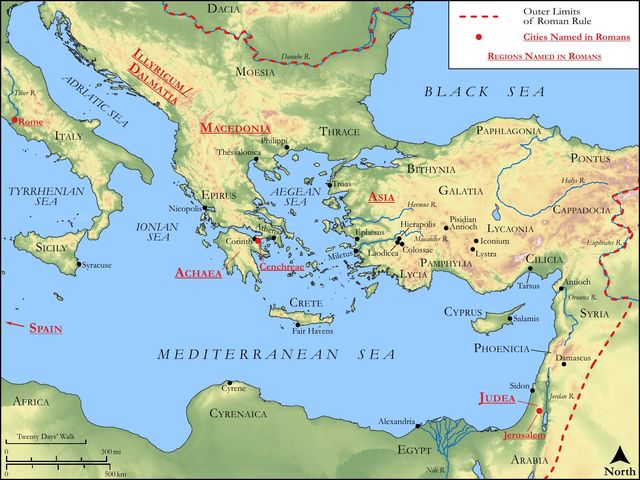
See on the biblical-era maps

Study this verse
Public-domain commentary
Matthew Henry
From his Commentary on the Whole Bible. Henry comments on passages, not single verses — this entry covers Romans 1:8–15. His three-level outline is real structure in the source text, so it is rendered as structure.
We may here observe,
I.His thanksgivings for them (Rom 1:8):
First, I thank my God. It is good to begin every thing with blessing God, to make that the alpha and omega of every song, in every thing to give thanks. - My God. He speaks this with delight and triumph. In all our thanksgivings, it is good for us to eye God as our God; this makes every mercy sweet, when we can say of God, "He is mine in covenant." - Through Jesus Christ. All our duties and performances are pleasing to God only through Jesus Christ, praises as well as prayers. - For you all. We must express our love to our friends, not only by praying for them, but by praising God for them. God must have the glory of all the comfort we have in our friends; for every creature is that to us, and no more, which God makes it to be. Many of these Romans Paul had no personal acquaintance with, and yet he could heartily rejoice in their gifts and graces. When some of the Roman Christians met him (Act 28:15), he thanked God for them, and took courage; but here his true catholic love extends itself further, and he thanks God for them all; not only for those among them that were his helpers in Christ, and that bestowed much labour upon him (of whom he speaks Rom 16:3, Rom 16:6), but for them all. - That your faith is spoken of. Paul travelled up and down from place to place, and, wherever he came, he heard great commendations of the Christians at Rome, which he mentions, not to make them proud, but to quicken them to answer the general character people gave of them, and the general expectation people had from them. The greater reputation a man hath for religion, the more careful he should be to preserve it, because a little folly spoils him that is in reputation, Ecc 10:1. - Throughout the whole world, that is, the Roman empire, into which the Roman Christians, upon Claudius's edict to banish all the Jews from Rome, were scattered abroad, but had now returned, and, it seems, left a very good report behind them, wherever they had been, in all the churches. There was this good effect of their sufferings: if they had not been persecuted, they had not been famous. This was indeed a good name, a name for good things with God and good people. As the elders of old, so these Romans, obtained a good report through faith, Heb 11:2. It is a desirable thing to be famous for faith. The faith of the Roman Christians came to be thus talked of, not only because it was excelling in itself, but because it was eminent and observable in its circumstances. Rome was a city upon a hill, every one took notice of what was done there. Thus those who have many eyes upon them have need to walk circumspectly, for what they do, good or bad, will be spoken of. The church of Rome was then a flourishing church; but since that time how is the gold become dim! How is the most fine gold changed! Rome is not what it was. She was then espoused a chaste virgin to Christ, and excelled in beauty; but she has since degenerated, dealt treacherously, and embraced the bosom of a stranger; so that (as that good old book, the Practice of Piety, makes appear in no less than twenty-six instances) even the epistle to the Romans is now an epistle against the Romans; little reason has she therefore to boast of her former credit.
II.His prayer for them, Rom 1:9.
Though a famous flourishing church, yet they had need to be prayed for; they had not yet attained. Paul mentions this as an instance of his love to them. One of the greatest kindnesses we can do our friends, and sometimes the only kindness that is in the power of our hands, is, by prayer to recommend them to the loving-kindness of God. From Paul's example here we may learn,
1.Constancy in prayer: Always without ceasing. He did himself observe the same rules he gave to others, Eph 6:18; Th1 5:17. Not that Paul did nothing else but pray, but he kept up stated times for the solemn performance of that duty, and those very frequent, and observed without fail.
2.Charity in prayer: I make mention of you. Though he had not particular acquaintance with them, nor interest in them, yet he prayed for them; not only for all saints in general, but he made express mention of them. It is not unfit sometimes to be express in our prayers for particular churches and places; not to inform God, but to affect ourselves. We are likely to have the most comfort in those friends that we pray most for. Concerning this he makes a solemn appeal to the searcher of hearts: For God is my witness. It was in a weighty matter, and in a thing known only to God and his own heart, that he used this asseveration. It is very comfortable to be able to call God to witness to our sincerity and constancy in the discharge of a duty. God is particularly a witness to our secret prayers, the matter of them, the manner of the performance; then our Father sees in secret, Mat 6:6. God, whom I serve with my spirit. Those that serve God with their spirits may, with a humble confidence, appeal to him; hypocrites who rest in bodily exercise cannot. His particular prayer, among many other petitions he put up for them, was that he might have an opportunity of paying them a visit (Rom 1:10): Making request, if by any means, etc. Whatever comfort we desire to find in any creature, we must have recourse to God for it by prayer; for our times are in his hand, and all our ways at his disposal. The expressions here used intimate that he was very desirous of such an opportunity: if by any means; that he had long and often been disappointed: now at length; and yet that he submitted it to the divine Providence: a prosperous journey by the will of God. As in our purposes, so in our desires, we must still remember to insert this, if the Lord will, Jam 4:15. Our journeys are prosperous or otherwise according to the will of God, comfortable or not as he pleases.
III.His great desire to see them, with the reasons of it, Rom 1:11-15.
He had heard so much of them that he had a great desire to be better acquainted with them. Fruitful Christians are as much the joy as barren professors are the grief of faithful ministers. Accordingly, he often purposed to come, but was let hitherto (Rom 1:13), for man purposeth, but God disposeth. He was hindered by other business that took him off, by his care of other churches, whose affairs were pressing; and Paul was for doing that first, not which was most pleasant (then he would have gone to Rome), but which was most needful - a good example to ministers, who must not consult their own inclinations so much as the necessity of their people's souls. Paul desired to visit these Romans,
1.That they might be edified (Rom 1:11): That I may impart unto you. He received, that he might communicate. Never were full breasts so desirous to be drawn out to the sucking infant as Paul's head and heart were to be imparting spiritual gifts, that is, preaching to them. A good sermon is a good gift, so much the better for being a spiritual gift. - To the end you may be established. Having commended their flourishing he here expresses his desire of their establishment, that as they grew upward in the branches they might grow downward in the root. The best saints, while they are in such a shaking world as this, have need to be more and more established; and spiritual gifts are of special use for our establishment.
2.That he might be comforted, Rom 1:12. What he heard of their flourishing in grace was so much a joy to him that it must needs be much more so to behold it. Paul could take comfort in the fruit of the labours of other ministers. - By the mutual faith both of you and me, that is, our mutual faithfulness and fidelity. It is very comfortable when there is a mutual confidence between minister and people, they confiding in him as a faithful minister, and he in them as a faithful people. Or, the mutual work of faith, which is love; they rejoiced in the expressions of one another's love, or communicating their faith one to another. It is very refreshing to Christians to compare notes about their spiritual concerns; thus are they sharpened, as iron sharpens iron. - That I might have some fruit, Rom 1:13. Their edification would be his advantage, it would be fruit abounding to a good account. Paul minded his work, as one that believed the more good he did the greater would his reward be.
3.That he might discharge his trust as the apostle of the Gentiles (Rom 1:14): I am a debtor.
(1.)His receivings made him a debtor; for they were talents he was entrusted with to trade for his Master's honour. We should think of this when we covet great things, that all our receivings put us in debt; we are but stewards of our Lord's goods.
(2.)His office made him a debtor. He was a debtor as he was an apostle; he was called and sent to work, and had engaged to mind it. Paul had improved his talent, and laboured in his work, and done as much good as ever any man did, and yet, in reflection upon it, he still writes himself debtor; for, when we have done all, we are but unprofitable servants. - Debtor to the Greeks, and to the barbarians, that is, as the following words explain it, to the wise and to the unwise. The Greeks fancied themselves to have the monopoly of wisdom, and looked upon all the rest of the world as barbarians, comparatively so; not cultivated with learning and arts as they were. Now Paul was a debtor to both, looked upon himself as obliged to do all the good he could both to the one and to the other. Accordingly, we find him paying his debt, both in his preaching and in his writing, doing good both to Greeks and barbarians, and suiting his discourse to the capacity of each. You may observe a difference between his sermon at Lystra among the plain Lycaonians (Act 14:15, etc.) and his sermon at Athens among the polite philosophers, Act 17:22, etc. He delivered both as debtor to each, giving to each their portion. Though a plain preacher, yet, as debtor to the wise, he speaks wisdom among those that are perfect, Co1 2:6. For these reasons he was ready, if he had an opportunity, to preach the gospel at Rome, Rom 1:15. Though a public place, though a perilous place, where Christianity met with a great deal of opposition, yet Paul was ready to run the risk at Rome, if called to it: I am ready - prothumon. It denotes a great readiness of mind, and that he was very forward to it. What he did was not for filthy lucre, but of a ready mind. It is an excellent thing to be ready to meet every opportunity of doing or getting good.
Historical interpretation
Eleven Centuries of Reception
11 surviving comments on this verse. Each one is dated, so this reads as a timeline rather than a list.
Select a marker to jump to its quote. Markers stagger vertically where authors wrote within a few decades of each other.
" Paul, in like manner, everywhere speaks of "God the Father, and our Lord Jesus Christ." When writing to the Romans, he gives thanks to God through our Lord Jesus Christ. To the Galatians he declares himself to be "an apostle not of men, neither by man, but through Jesus Christ and God the Father.
Sometimes the apostle writes in the way he does to the Romans, giving thanks for everyone, but sometimes he just gives thanks without adding “for all of you.” If you notice this you will realize that in the places where he gives thanks for everyone, he does not draw attention to any grave faults or sins in them. But where he criticizes people or reproves them, he does not add to his thanksgiving that he gives thanks for them all—see, e.g., 1 Corinthians or Colossians. In Galatians he does not even give thanks at all, because he is surprised that they have so quickly abandoned the gospel that called them and chosen another one instead.2Paul thus begins his letter with thanksgiving. To give thanks to God is to offer him a sacrifice of praise, and therefore he adds “through Jesus Christ,” as through a high priest. Anyone who wants to offer a sacrifice to God ought to know that he should offer it through the hands of a priest. But note also this important addition: “(to) my God.” This can only be the voice of the saints, whose God he is, as he is the God of Abraham, Isaac and Jacob. No one can say that the Lord God is his if his god is his stomach, or if his god is greed, or if his god is the glory of this life and the pomp of this world or the power of things which are perishing. For whatever anyone worships more than other things, that is his god.
But let us see what it is that the apostle gives thanks for. “Because,” he says, “your faith is proclaimed in all the world.” “In all the world,” simply understood, means that in many parts of the world, that is of this earth, the faith and religion of those at Rome is preached. But if, as in some passages, the universe is meant here, consisting of heaven and earth and everything in them, it may be understood to mean that the powers, of whom it is said that “they rejoice over one sinner who repents,” rejoice much more over the conversion and the faith of the Romans when the angels who ascend and descend to the Son of Man proclaim it to them. For these powers are amazed at the conversion of the Gentiles and that the sound of the apostles of Christ Jesus has gone out into all the world. Finally, they rejoice even at the sufferings of those in this world, as the apostle says: “We have become a spectacle to the world, to angels and to men.”
The verse may also be understood as meaning that this faith which the Romans have is the same faith as, and none other than, that which is proclaimed and believed in all the world and which is preached not only on earth but in heaven as well. For by his blood Jesus reconciled not only those things which are on earth but also those things which are in heaven, and in his name not only earthly powers but also heavenly and infernal ones bow the knee. This is what is meant by preaching the faith in the whole world, through which the entire earth may be subjected to God.
It may be noticed that there is no “second” which corresponds to “first,” but we have already explained that Paul’s phrases are not always complete. On the other hand, it may be that “first” is picked up by “I want you to know brethren” [in verse 13].
For what is there either in peace so suitable, or in a war of persecution so necessary, as to maintain the due severity of the divine rigour? Which he who resists, will of necessity wander in the unsteady course of affairs, and will be tossed hither and thither by the various and uncertain storms of things; and the helm of counsel being, as it were, wrenched from his hands he will drive the ship of the Church's safety among the rocks; so that it would appear that the Church's safety can be no otherwise secured, than by repelling any who set themselves against it as adverse waves, and by maintaining the ever-guarded rule of discipline itself as if it were the rudder of safety in the tempest. Nor is it now but lately that this counsel has been considered by us, nor have these sudden appliances against the wicked but recently occurred to us; but this is read of among us as the ancient severity, the ancient faith, the ancient discipline, since the apostle would not have published such praise concerning us, when he said "that your faith is spoken of throughout the whole world" unless already from thence that vigour had borrowed the roots of faith from those times; from which praise and glory it is a very great crime to have become degenerate. For it is less disgrace never to have attained to the heraldry of praise, than to have fallen from the height of praise; it is a smaller crime not to have been honoured with a good testimony, than to have lost the honour of good testimonies; it is less discredit to have lain without the announcement of virtues, ignoble without praise, than, disinherited of the faith, to have lost our proper praises. For those things which are proclaimed to the glory of any one, unless they are maintained by anxious and careful pains, swell up into the odium of the greatest crime.
We have not just recently adopted this particular course of action, nor have these measures against the ungodly suddenly crossed our mind. For with us, the strictness is ancient, the faith is ancient. The apostle would not have praised us so highly by stating: “Your faith is spoken of throughout the whole world,” if this strictness of ours had not already been rooted in the faith of those times.
After finishing his introduction, before all else Paul bears witness to his joy, as the apostle to the Gentiles, that although the Romans ruled the world, they had submitted to the Christian faith, which seemed lowly and stupid to the wise of this world. There were many things about the Romans which he could rejoice in. They were mindful of discipline and eager to do good works, more interested in doing right than in talking about it, which is not far from God’s religion. Nevertheless, he says that most of all he rejoices in this, that word of their faith was circulating everywhere. For it seemed to be a wonderful thing, that the lords of the Gentiles should bow before a promise made to the Jews. Even if they did not believe correctly, nevertheless he was pleased that they had begun to worship one God in the name of Christ, and knew that they could advance further. For this reason he reveals his love for them, when he rejoices at their good start and encourages them to go on. He therefore says that he is giving thanks to God, even though they have not yet received everything, because God is the source of all things. The entire dispensation of our salvation is from God, indeed, but through Christ, not through the law or any prophet. Hence he says that he is giving thanks to God but through Christ, because the report of their faith was an encouragement to many to attribute this very thing to the providence of God through Christ. For either the others who believed rejoiced, having been strengthened by seeing their rulers and brothers established in the faith, or at least those who did not believe could easily have believed by following their example. For the lesser quickly does what he sees being done by the greater.
An exordium worthy of this blessed spirit, and able to teach all men to offer unto God the firstlings of their good deeds and words, and to render thanks not only for their own, but also for others' well-doings: which also maketh the soul pure from envy and grudging, and draweth God in a greater measure towards the loving spirit of them that so render thanks. Wherefore also elsewhere he says, "Blessed be God and the Father of our Lord Jesus Christ, Who hath blessed us with all spiritual blessing." (Eph. i. 3.) And it is fitting that we render thanks not only when rich, but also when poor, not when in health only, but also when sick, not when we thrive only, but also when we have to bear the reverse. For when our affairs are borne onward with a fair wind, to be thankful is not matter of wonder. But when no small tempests be upon us, and the vessel veers about and is in jeopardy, then is the great time for displaying patience and goodness of heart. For this cause Job also gained a crown from hence, and the shameless mouth of the devil did he stop, and show clearly that not even when he saw good days was it through his wealth that he was thankful, but through his much love toward God. And see too what things he is thankful for: not for things earthly and perishing, as power and authority and glory (for these things are of no account), but for real blessings, faith and boldness of speech. And with how much feeling he gives thanks: for he saith not "to God," but "to my God," which also the Prophets do, so making that which is common to all their own. And what is there wonderful in the Prophets doing so? For God himself plainly does it continually to His servants, calling Himself the God of Abraham and Isaac and Jacob, as peculiarly theirs. "That your faith is spoken of throughout the whole world." What then, had the whole world heard of the faith of the Romans? Yes, the whole, according to him. And it is not a thing unlikely. For the city was not one of no note, but as being upon a sort of eminence it was on every account conspicuous. But consider, I pray, the power of the preaching, how in a short time by means of publicans and fishermen it took hold upon the very head of all cities, and Syrians became the teachers and guides of Romans. He attests then two excellencies in them, both that they believed, and that they believed with boldness, and that so great as that the fame of them reached into all the world. "For your faith," he says "is spoken of throughout the whole world. Your faith," not your verbal disputations, nor your questionings, nor your syllogisms. And yet there were there many hindrances to the teaching. For having recently acquired the empire of the world they were elated, and lived in riches and luxury, and fishermen brought the preaching there, and they Jews and of the Jews, a nation hated and had in abomination among all men; and they were bidden to worship the Crucified, Who was brought up in Judea. And with the doctrine the teachers proclaimed also an austere life to men who were practised in softness, and were agitated about things present. And they that proclaimed it were poor and common men, of no family, and born of men of no family. But none of these things hindered the course of the word. So great was the power of the Crucified as to carry the word round everywhere. "For it is spoken of," he says, "in all the world." He says not, it is manifested, but, is spoken of, as if all men had them in their mouths.
God is the God of all by nature but of some only by their own choice and response.… Paul calls God his in this second sense. He thanks God for them all, not just for the Jews, and praises them prudently, in order to encourage them to improve. Perhaps he did this because the whole world stood amazed that the idolatrous Romans had been converted … but probably he was just praising a faith which was now evident.
It seems that Paul begins by giving thanks in his other epistles too, thereby teaching by word and deed those to whom the letter is written that one ought to begin by thanking God, not only for one’s own but also for others. But here this salutation has a special importance, because after the teaching of Peter, anyonewho wanted to teach them the doctrines of godliness had to show that he accepted Peter’s teaching and was not trying to introduce them to anything which went against that. Therefore his praise of the Romans was no accident. Often in his letters he used the salutation as a way of preparing those who would be better disposed toward him as a result of such praise, for the reading of what had been written.“Through Jesus Christ” had to be added here, not to qualify Christ’s ministry, as it seemed to some of the heretics, but because he is the cause of our thanks. Hence the apostle says that he thanks God for them all and that Christ is the cause of his thanksgiving.
Paul was not saying this in order to flatter them; he was simply telling the truth. For it could not be that what was happening at Rome should not be known all over the world. After all, it was the capital of the empire.
Paul does not say “through Jesus Christ” as if he were some kind of intermediary, but in the context of giving thanks to God, says that we do this because of the Lord Christ. This amazing dispensation which has saved our race through him has taken us captive, along with the rest, by the faith we have in him.Paul does his utmost to win the Romans over, in case they may be thinking that he has something against them, or that following the tradition of Peter he might be coming to order them about, and if indeed they are vexed for this sort of reason, they might refuse to read his letter and miss out on the blessing it would bring. Therefore, starting with thanksgiving and faith, he praised them for keeping it pure and firm, as they all did together, and then with the word proclaimed spoke more personally in praise of the city, and by adding “in all the world” he praised them greatly and exalted them before going on to talk about meeting them in person.
74. After the greeting [n. 15], the Apostle begins the message, wherein First he shows his affection for his readers, in order to render them benevolent hearers; secondly, he instructs them in the truth about the power of Christ’s grace, there [v. 16b; n. 97] at For it is the power of God. He shows his affection for them in three ways: first, by giving thanks for their blessings; secondly, by the prayer he directs to God on their behalf, there [v. 9; n. 78] at For God is my witness; thirdly, by his desire to visit them, there [v. 10; n. 85] at Always in my prayers. 75. In regard to the first, three things should be noted [n. 76, 77]. First, the order in which he gives thanks, when he says, first, I thank my God. For it is necessary that in all affairs, we begin by giving thanks: "Give thanks in all circumstances" (1 Th 5:18); indeed, a person is not worthy to receive a blessing, if he does not express thanks for past blessings: "The hope of an ungrateful man will melt like wintry frost" (Wis 16:29) and "to the place where the streams flow, there they return" (Ec 1:7), because to the source whence blessings come they return, namely, by giving thanks, to flow again by repeated blessings. But we need God’s blessing in all we seek or do; consequently, before all else thanks should be given. 76. Secondly, he designates three persons, one of whom is the person to whom thanksgiving is made when he says, my God, to whom thanks are due for all our 44 blessings, because they flow from Him: "Every good endowment and every perfect gift is from above" (Jas 1:17). And although He is God of all through creation and governance, he is particularly the God of the just for three reasons: first, on account of the special care he shows them: ‘The eyes of the Lord are toward the righteous" (Ps 34:15) and again: "The Lord is my light" (Ps 27:1); on account of their special worship; "This is my God and I will praise him" (Ex 15:2); thirdly, because he is their reward: "I am your reward exceedingly great" (Gen 15:1). The second person is the mediator, whom he mentions when he says, through Jesus Christ. For thanks should be returned to God in the same order in which graces come to us, namely, through Jesus Christ: "Through him we have access to this grace in which we stand" (Rom 5:2). The third is the person of those for whom he gives thanks, for all of you, because he regarded their graces as his on account of the bond of love. As if to say: "I have no greater grace than to hear that my children walk in the truth" (3 Jn 1:4). He purposely says, for all, because he desires to please them all: "Just as I try to please all men in everything I do" (1 Cor 10:33) and wishes the salvation of all: "I wish that all were as I myself am (1 Cor 7:7). 77. Thirdly, he indicates the point about which he is grateful, because your faith is proclaimed in all the world. He gives thanks for their faith, because it is the foundation of all spiritual blessings: "Faith is the substance of things hoped for" (Heb 11:1). But the reason he commends the Romans on their faith is that they embrace it with ease and continued in it firmly. Hence, even today very many signs of faith are seen 45 by those who visit the holy places, as Jerome says On the Epistle to the Galatians. However, their faith was not yet perfect, because some of them had been reached by false apostles, who taught that the rites of the Law must be joined to the Gospel. But he rejoices and gives thanks for their faith not only on their account but on account of the benefits accruing therefrom, namely, because, being the rulers of the world, their example would lead other nations to accept the faith; for, as a Gloss says, the lesser are quick to do what they see doe by the greater. On this account prelates are advised to be good examples to the flock (1 Pt 5:3). 78. Then when he says, God is my witness, he shows his affection for them from the prayer he offers for them. And because the business of prayer is carried on in secret in God’s presence: "When you pray, go into you room and shut the door and pray to your Father in secret" (Mt 6:6), he calls on God to testify that he prays for them. First therefore he calls on the witness; secondly he shows on what point he calls the witness [v. 9b; n. 83]. 79. He calls on the witness when he says, God is my witness, under whose witness all things are done: "I am judge and witness" (Jer 29:23). Then, to show that he is not mistaken in calling on the just witness, he mentions how is joined to Him. First, in regard to service when he says, whom I serve, namely, with the worship of latria: "The Lord your God shall you adore and him alone shall you serve" (Dt 6:13). Secondly, in regard to the way he served when he says, with my spirit. As if to say: Not only in outward bodily service, but especially within, according to the spirit: "God is spirit, and those who worship him must worship in spirit and truth" (Jn 46 4:24). Or in spirit, i.e., in spiritual observances, not in carnal, as the Jews: "We are the true circumcision who worship God in spirit" (Phil 3:3). Thirdly, in regard to the office in which he serves, namely, in the gospel of his Son: "Set apart for the gospel" (Rom 1:1). It is the gospel of the Son in three ways: first, because it is about Him: "I bring you good news of a great joy" (Lk 2:10). Secondly, because it was preached by Him as a special duty: "I must preach the good news of the kingdom of God to the other cities also, for I was sent for this purpose" (Lk 4:43). Thirdly, because it was enjoined by Him: "Preach the gospel to every creature" (Mk 16:15). 80. But since, as Augustine says, it is the same to say "God is my witness" and "I swear by God" the Apostle seems to be acting against the Lord’s command: "I say to you, Do not swear at all" (Mt 5:34); "Above all, my brethren, do not swear" (Jas 5:12). However, as Augustine also says, the meaning of Sacred Scripture is gathered from the actions of the saints. For it is the same Spirit Who inspired the sacred Scriptures: "Men moved by the Holy Spirit spike from God" (2 Pt 1:21) and Who moves holy men to act: "All who are led by the Spirit are sons of God" (Rom 8:14). Consequently, if Paul is found to swear, it shows that the Lord’s word and that of the apostle James are not to be understood as indicating that an oath is absolutely unlawful, but that men should strive as far as possible not to use oaths as though they were something good and desirable of their very nature. And this on account of the danger involved in frequent swearing, namely, the possibility of perjury due to a slip of the tongue. Si (23:9) says, "Do not accustom your mouth to oaths for many are tripped by them." Also because it seems contrary to the reverence we owe God for one to call 47 God as witness without necessity. For this reason the Apostle never made an oath except in writing, when a man speaks with greater deliberation and caution. 81. Yet an oath is sometimes necessary to lend credence to a speaker, which in turn often benefits the hearer. Consequently, the Apostle makes an oath for the benefit of his hearer, for whom it was beneficial to believe, as thought hot seeking what was useful to himself but to the majority, namely, their salvation. Hence, the Lord’s statement that "anything more than this," i.e., than simple word, "comes from evil" (Mt 5:37) does not imply that it comes from evil in the one who swears, but in the one who demands the oath: it comes not from the evil of sin, except in the case where a person judges that the one from whom he demands the oath will sear falsely - in which case it is a serious sin, as Augustine says. Rather, it implies that it comes from the evil of punishment, i.e., our ignorance of whether something said to us is true. 82. It should be noted that there are two ways of making an oath: one is by a simple statement, as when it is said, "by God" or "God is my witness." This is the form the Apostle uses here. The other is by an imprecation, namely, when a person calls on God’s witness in the form of some punishment to be inflicted on the speaker if he is lying: "if I have requited evil with evil…, let my enemy pursue me…" (Ps 7:3-5). The Apostle also uses this form, as in 2 Cor (1:23): "I call God to witness against my life." 83. Then he mentions the matter concerning which he calls God to witness when he says, that I mention [remember] you always in my prayers without ceasing, i.e., because in his prayers he always prayed for them on account of the general benefits that 48 arose from their conversion: "Far be it from me that I should sin against the Lord by ceasing to pray for you" (1 Sam 12:23). The statement, I remember, can be understood in two ways: in one way according to the sense of Ps 137 (v.6): "Let my tongue cleave to the roof of my mouth, if I do not remember you"; in another way, I remember you, i.e., I pray to God, Who receives the prayers of the humble. Therefore, when the saints pray for certain people, they are somehow presented to His gaze, just as their other actions are. Hence, the woman said to Elijah: "You have come to bring my sin to remembrance" (1 Kg 17:18), as though whatever is done against the just is in the memory and eyes of God. 84. That he claims to pray without ceasing is in agreement with what he tells the Thessalonians: "Pray constantly" (1 Th 5:7) and with Lk (18:1) that "they ought always to pray and not lose heart." This can be understood in three ways: in one way, as to the very act of praying, and then one is praying always or without ceasing, if he prays at the appointed times and hours: "peter and John were going up to the temple at the hour of prayer, the ninth hour" (Ac 3:1). In another way, as to purpose of prayer which is that our mind rise up to God; and so a man prays as long as he directs his entire life to God: "Whether you eat or drink, or whatever you do, do all to the glory of God" (1 Cor 10:31). Thirdly, as to the cause; for when a person so acts that others pray for him, he seems to be praying, as in the case of those who give alms to the poor who pray for them: "Store up almsgiving in the heart of the poor: and it shall obtain help for you against all evil" (Si 29:12). Therefore, I thank my God for you, because I regard your blessings as my own. This is obvious from the fact that I pray for you as I do for myself. 49 85. Then when he says, asking that somehow … I may succeed in coming to you, he proves his affection by his desire to visit them. First, he mentions the desire; secondly, his intention of acting on this desire, there [v. 13; n. 89] at And I would not have you ignorant. In regard to the first he does two things: first, he mentions a sign of this desire; secondly, the cause of his desire, there [v. 11; n. 87] at For I long. 86. The sign of the desire is the prayer he said for them, which implies such a desire. That the desire itself was intense is shown when he says, asking [entreating], for something very important which is beyond my merits: "The poor use entreaties, but the rich answer roughly" (Pr 18:23); for something intensely desired seems great to the one desiring. Secondly, it is an anxious desire, for he says, somehow [by any means]. For if a person anxiously desires something, he seeks to get it by any means, easy or difficult: "What then? Only that in every way, whether in pretense or in truth, Christ is proclaimed; and in that I rejoice. Yes, and I shall rejoice" (Phil 1:18-19). Thirdly, the desire was of long standing, for he says, that I may now at last, i.e., after long desiring it. For the just are concerned not for a short time but continually: "A friend loves at all times" (Pr 17:17). Fourthly, the desire was correct, because it was in keeping with God’s will. Hence he adds, that by God’s will I may at last succeed in coming to you, i.e., in keeping 50 with His will, in terms of which I judge success: "not as I will, but as thou wilt" (Mt 26:39). 87. Then when he says, For I long to see you, he mentions the causes of the desire, and there are two [n. 88]. First, the welfare of those he would visit; hence, I long to see you: "I yearn for you all with the affection of Christ Jesus" (Phil 1:8), not for a trifling reason as in worldly friendship, but that I may impart to you some spiritual gift, not as its author but as its minister: "One should regard us as stewards of the mysteries of God" (1 Cor 4:2); and this to strengthen you in the faith you have received: "When you have been converted, strengthen your brethren" (Lk 22:32). Now a minister imparts grace in a number of ways, one of which is by the administration of the sacraments of grace: "As each has received a gift, administer it to one another as good dispensers of God’s grace" (1 Pt 4:10) and by exhorting in sermons: "Let no evil talk come out of your mouth, but only such as is good for edifying…, that it may impart grace to those who hear" (Eph 4:29). 88. The second cause is the mutual consolation found in friendly communication. Hence he continues, that we may be mutually encouraged, i.e., me by seeing you and imparting a grace, and all of us by each other’s faith, both yours and mine. For it is a source of mutual consolation to be one in the faith: "But God who comforts the downcast comforted us by the coming of Titus: not only by his coming but also by the comfort with which he was comforted in you." (2 Cor 6:6). 89. Then when he says, I would not have you ignorant, he mentions his intention to fulfill his plan lest it appear to be a vain desire. 51 First, he mentions his plan; secondly, its cause, there [v. 13b; n. 92] at that I might have some fruit; thirdly, his eagerness, there [v. 15; n. 95] at So, as much as in me. In regard to the first he does two things: first, he mentions his plan; secondly, the obstacle, there [v. 13b; n. 91] at and have been hindered. 90. He says, therefore, first: Not only do I desire to see you, but I have decided to fulfill this desire, and I want you to know, brethren, that I have often intended to come to you to prove my love "not only in word or speech but in deed and in truth" (1 Jn 3:18). 91. Secondly, he touches on the obstacle preventing him from having fulfilled that intention, saying, but thus far I have been prevented either by the devil, who endeavors to prevent the preaching from which man’s salvation results: "the north wind drives away rain" (Pr 25:23), i.e., the doctrines of the preachers; or perhaps by God, according to Whose nod the journeys and words of preachers are arranged: "The clouds," i.e., preachers, "scatter his lightning. They turn round and round by his guidance to accomplish all that he commands them" (Jb 37: 11-12). Hence in Ac (16:6) it is recorded: "They went through the region of Phrygia and Galatia, having been forbidden by the Holy Spirit to speak the word in Asia"; and again: "They attempted to go into Bithynia, but the Spirit of Jesus did not allow them." But the Apostle wants them to know both these things for their own benefit, so that seeing his affection, they might receive his words with more reverence, and recognizing their own conduct as the obstacle hitherto preventing his visit, they might 52 amend their lives. Ro the words of Is (5:6) express a punishment for sin: "I will command the clouds to rain no rain upon it." 92. Then he gives two reasons for his intention. The first is utility; hence he says, in order that I may reap some harvest among you as well as among the rest of the Gentiles, to whom I have preached. This can be taken in two ways: in one way as though her were saying: that I may reap some harvest among you by my preaching: "You should go and bear fruit" (Jn 15:16). In another way as though from their conversion a harvest would grow for him: "He who reaps, receives wages and gathers fruit for eternal life" (Jn 4:36). 93. The other reason is the responsibility of his office: "Woe to me, if I do not preach the gospel" (1 Cor 9:16). And because he had undertaken the general apostolate of the Gentiles, he asserts that he under obligation to all: "Although I am free from all men, I have made myself a slave to all" (1 Cor 9:19). 94. And for this reason he sets out two diversities. One is along the lines of the diversity of nations, when he says, to Greeks and to barbarians. A person is called a barbarian, either because he is cut off from some people in one way or another in the sense of 1 Cor (13:11): "If I do not know the meaning of the language, I shall be a barbarian to the speaker and the speaker to me"; or because he is cut off from the human race, inasmuch as he is not ruled by reason. Hence, they are properly called barbarians who are not directed by reason. This is implied in 2 Macc (15:2): "Do not act so fiercely and barbarously," i.e., inhumanly. 53 Now because the Greeks were the first to establish laws, he calls all the Gentiles ruled by human laws Greeks. He makes no mention of the Jews who were ruled by divine laws, because he was not appointed apostle to the Jews but to the Gentiles: "We to the Gentiles and they to the circumcised" (Gal 2:9). 95. Both reasons account for his readiness of will, so that he says, I am eager, i.e., as far as I am concerned, I am prepared, unless prevented, to preach the Gospel even to you in Rome: "Then all the people departed from the presence of Moses. And they came everyone whose heart stirred him" (Ex 35:20). 96. He rejects the obstacle to eagerness, namely, shame, on account of which many fail to do what they would otherwise do readily; hence he says, I am not ashamed of the gospel, which, indeed, seemed to be an occasion of shame for some in the presence of unbelievers, as he states in 1 Cor (1:23); "We preach Christ crucified, a stumbling block to the Jews and folly to the Gentiles." But there is really no reason for shame, because he continues (v. 24): "but to those who are called, both Jews and Greeks [?] Hence it is said: "Whoever is ashamed of me and of my words, of him the Son of man will be ashamed" (Lk 9:26). That is why the baptized are anointed with the chrism in the form of a cross on the forehead, where shame has its seat, namely, lest they be ashamed of the gospel.
Continue studying Romans 1:8 across the web’s major study libraries — every link below opens this exact verse, chapter, or book on the destination site.
Read & Compare
 BibleGatewayThis verse in more than 200 translations and 70 languages.
 Bible.comThe YouVersion reader — hundreds of translations, reading plans, and highlights.
 ESV.orgCrossway's official English Standard Version reader.
 NET BibleThe NET translation with 60,000+ translators' notes on every rendering decision.
 STEP BibleTyndale House's free study tool — original text, vocabulary, and scholarly resources.
 BibliaLogos Bible Software's free web reader.
 USCCBThe New American Bible (Revised Edition) with the U.S. bishops' study notes.
Commentaries
 BibleHub CommentariesDozens of classic commentaries on this verse, gathered on one page.
 StudyLightMore than 100 commentary sets — the largest collection on the web.
 BibleRefPlain-English commentary on what this verse means, verse by verse.
 Enduring WordDavid Guzik's free commentary on this chapter, widely used by Bible teachers.
 Bible Study ToolsVerse commentary alongside Greek and Hebrew study aids.
Original Language & Research
- BibleHub InterlinearThe verse word by word — original language, transliteration, and English.
- BibleHub LexiconEvery word's original-language definition and Strong's entry.
 Blue Letter BibleDeep-study tools — Strong's numbers, concordance, and word studies.
 CNTR CollationThe earliest Greek manuscripts of this verse, collated letter by letter.
Sermons, Hymns & Audio


TrulyRandomVerse is not affiliated with these sites and doesn’t control their content. They’re linked because they’re genuinely useful.
Summary
Paul opens his foundational letter to the Roman believers by expressing profound gratitude to God, channeled specifically through Jesus Christ, for the remarkable and widely recognized faith of their community. This thanksgiving highlights the spiritual vitality of the church in Rome, whose steadfast belief and commitment to Christ had become a celebrated testimony spoken of across the known world.
Context
ShowHideLiterary Context
Romans 1:8 serves as the initial expression of Paul's thanksgiving, immediately following his formal salutation and self-introduction (Romans 1:1-7). After establishing his apostolic authority and the divine origin of the Gospel he preaches, Paul pivots to affirm his deep connection with the Roman Christians. This verse sets a positive and relational tone before he delves into the weighty theological arguments concerning sin, righteousness, and salvation. It also subtly prepares the readers for Paul's earnest desire to visit them and impart spiritual gifts, as he expresses later in Romans 1:11-12. This opening thanksgiving is a common Pauline epistolary feature, often found at the beginning of his letters, demonstrating his pastoral heart and shared joy in the spiritual progress of the churches.
Historical & Cultural Context
The city of Rome was the powerful capital of the vast Roman Empire, a melting pot of diverse cultures, religions, and philosophical schools. The Christian community in Rome was likely a mix of Jewish and Gentile believers, established not by Paul himself, but perhaps by converts from Pentecost (Acts 2:10) or early missionaries. The fact that their faith was "spoken of throughout the whole world" (likely referring to the Roman Empire or the widespread network of early Christian communities) is significant. It suggests that despite potential internal tensions or external pressures, the Roman church exhibited a vibrant and visible commitment to Christ that was widely acknowledged. This reputation would have been particularly impactful given Rome's central position, making it a hub for news and influence across the empire.
Key Themes
ShowHideThis verse contributes to several overarching themes within Romans and Paul's broader theology. It underscores the theme of Thanksgiving, modeling a posture of gratitude to God for the spiritual state of others, a practice Paul frequently encourages (e.g., Philippians 4:6). It highlights the Power and Reach of the Gospel, demonstrating how the message of Christ transforms lives and creates communities whose faith becomes a public testimony. The phrase "through Jesus Christ" emphasizes the Mediatorial Role of Christ, through whom all blessings and access to God are granted. Finally, the widespread reputation of their faith points to the Communal Nature of Faith and its potential for global impact, foreshadowing the universal scope of the Gospel's message that Paul will elaborate on throughout the epistle, particularly in chapters like Romans 10.
Exposition and Analysis
ShowHideKey Word Analysis
ShowHideFrom the root meaning "to be grateful," this verb signifies expressing gratitude. Paul's act of thanksgiving is not merely polite convention but a genuine, Spirit-prompted acknowledgment of God's work in the Roman believers. It implies a deep appreciation for the spiritual vitality and faithfulness evident in their lives.
This crucial term encompasses more than just intellectual assent; it denotes persuasion, credence, and moral conviction. In a religious context, it signifies reliance upon Christ for salvation and consistency in that profession. The Roman believers' "faith" was a living, active trust in God through Christ, manifesting in their lives and becoming widely known.
Meaning "to proclaim," "promulgate," or "declare widely," this verb indicates that the Roman Christians' faith was not a private matter but was openly reported and discussed. It suggests an active dissemination of information about their spiritual state, testifying to its remarkable nature and impact.
Verse Breakdown
ShowHide"First, I thank my God"
Paul begins with a declaration of priority and personal devotion. "First" (G4412, prōton) indicates that this thanksgiving is his initial and primary sentiment. His gratitude is directed specifically to "my God" (G2316, theós, G3450, moû), emphasizing a personal relationship with the divine source of all blessings, rather than a generic deity.
"through Jesus Christ"
This crucial phrase (G1223, diá, G2424, Iēsoûs, G5547, Christós) identifies the indispensable channel through which Paul's thanksgiving, and indeed all access to God, is made possible. It underscores Christ's mediatorial role, signifying that genuine spiritual blessings and appropriate responses to God are only accomplished by means of His person and work.
"for you all"
Paul's gratitude is comprehensive, encompassing every believer in the Roman community (G5228, hypér, G5216, hymōn, G3956, pâs). This inclusive address fosters a sense of unity and shared spiritual identity, reinforcing his pastoral care for the entire body of believers.
"that your faith is spoken of"
The specific reason for Paul's thanksgiving is the widely acknowledged spiritual reputation of the Roman church. Their "faith" (G4102, pístis) – their trust, belief, and faithfulness in Christ – was not hidden but had become a subject of public report and proclamation (G2605, katangéllō).
"throughout the whole world"
This phrase (G1722, en, G3650, hólos, G2889, kósmos) emphasizes the extensive reach of the Roman church's reputation. While likely a hyperbole referring to the vast Roman Empire or the known Christian network of the time, it powerfully conveys the significant impact and visibility of their faith, testifying to the transformative power of the Gospel.
Literary Devices
ShowHidePaul employs several literary devices in this opening verse. The phrase "throughout the whole world" is a clear example of Hyperbole, a deliberate exaggeration used to emphasize the widespread renown of the Roman Christians' faith. While their faith was not literally known to every person on the planet, the expression powerfully conveys its significant and far-reaching impact within the known Roman Empire or the broader Christian community. This verse also exemplifies Apostolic Thanksgiving, a common feature in Paul's epistles where he begins by expressing gratitude for his readers, thereby establishing a positive rapport and affirming their spiritual standing before addressing more challenging topics. Furthermore, the precise phrasing "First, I thank my God through Jesus Christ" demonstrates Emphasis, highlighting the priority of gratitude and the centrality of Christ in all spiritual matters, setting a foundational theological principle for the entire letter.
Theological and Thematic Connections
ShowHideRomans 1:8 profoundly illustrates the interconnectedness of divine grace, human response, and communal testimony. Paul's thanksgiving to God, channeled through Christ, underscores the theological truth that all spiritual blessings and the very existence of faith are gifts from God, mediated by His Son. The widespread reputation of the Roman believers' faith serves as a powerful testament to the transformative power of the Gospel, demonstrating that genuine faith is not merely an internal conviction but a dynamic force that shapes lives and communities, becoming a visible witness to the world. This verse thus connects to the broader theme of the global reach of God's redemptive plan and the church's role as a light to the nations.
Reflection and Application
ShowHidePaul's opening words in Romans 1:8 offer a profound model for contemporary believers and churches. His immediate posture of thanksgiving reminds us of the importance of regularly acknowledging and celebrating God's work in the lives of fellow Christians. It challenges us to look beyond our own spiritual journeys and cultivate a spirit of gratitude for the faith, growth, and witness of the wider body of Christ. Furthermore, the fact that the Roman church's faith was "spoken of throughout the whole world" serves as a powerful encouragement and a call to intentional living. It highlights that our collective faith, when genuine and vibrant, has the potential for far-reaching influence, becoming a public testimony that brings glory to God. This prompts us to consider how our individual and communal expressions of faith are perceived by those outside the church, and whether they genuinely reflect the transformative power of the Gospel.
Questions for Reflection
ShowHideFAQ
ShowHideWhat does "First" mean in this verse?
ShowHideThe word "First" (G4412, prōton) indicates that Paul's expression of thanksgiving is his initial and primary sentiment as he begins his letter. It signifies the priority and importance he places on giving thanks to God for the Roman believers' faith, setting a positive and grateful tone before he delves into the deeper theological exposition that follows in the rest of Romans. It's not merely a chronological marker but an emphasis on the foundational nature of his gratitude.
Was the Roman church's faith literally known "throughout the whole world"?
ShowHideThe phrase "throughout the whole world" (G3650, hólos, G2889, kósmos) is best understood as a hyperbole, a common literary device used to emphasize a point. It's highly unlikely that every single person on the planet was aware of the Roman church's faith. Instead, it most likely refers to the extensive reach within the known Roman Empire or the widespread network of early Christian communities. Rome, as the capital, was a central hub for news and travel, so the reputation of its Christian community would naturally spread far and wide among those connected to the nascent Christian movement. This emphasizes the significant impact and visibility of their faith, demonstrating the powerful influence of the Gospel even in its early stages, as seen in other places where the gospel "spread rapidly" (e.g., Acts 19:20).
Christ-Centered Fulfillment
ShowHideRomans 1:8, while a personal expression of thanksgiving, finds its ultimate fulfillment and meaning in Christ. Paul's gratitude is not merely for the Roman believers' faith in general, but specifically for their faith in Jesus Christ. He explicitly states that his thanks are offered "through Jesus Christ," underscoring Christ's indispensable mediatorial role as the one through whom all blessings flow from God and through whom all acceptable worship and gratitude ascend to God. The very faith that is "spoken of throughout the whole world" is faith in the person and work of Christ—His life, death, and resurrection—which is the core message of the Gospel (1 Corinthians 15:3-4). The widespread reputation of their faith is a testament to the power of Christ's transforming work, fulfilling His commission for His followers to be His witnesses "to the ends of the earth" (Acts 1:8). Thus, this verse points to Christ as the object, channel, and ultimate purpose of saving faith, whose global reign and redemptive work are increasingly manifested through the faithful witness of His church (Philippians 2:9-11).