


1 Thessalonians 1:8
Bible text: King James Version (1769 Blayney text) · Public domain
Bible text: King James Version with Strong's numbers · Public domain
Bible text: Berean Standard Bible · Public domain
Bible text: American Standard Version (1901) · Public domain
Bible text: World English Bible, Messianic edition · Public domain
Bible text: Geneva Bible (1599) · Public domain
Bible text: Young's Literal Translation · Public domain
- ἀφ᾽aph᾽FromG575PREPPreposition
- ὑμῶνhumōnyouG4771P-2GPPersonal pronoun Genitive 2nd Plural
- γὰρgarforG1063CONJConjunction
- ἐξήχηταιexēchētaihas sounded forthG1837V-RPI-3SVerb Perfect Passive Indicative 3rd Singular
- ὁhotheG3588T-NSMDefinite article Nominative Singular Masculine
- λόγοςlogoswordG3056N-NSMNoun Nominative Singular Masculine
- τοῦtouof theG3588T-GSMDefinite article Genitive Singular Masculine
- κυρίουkuriouLordG2962N-GSM-TNoun Genitive Singular Masculine Title
- οὐounotG3756PRT-NNegative Particle Negative
- μόνονmonononlyG3441A-ASNAdjective Accusative Singular Neuter
- ἐνeninG1722PREPPreposition
- τῇtēa<the>G3588T-DSFDefinite article Dative Singular Feminine
- ΜακεδονίᾳMakedoniaMacedoniaG3109N-DSF-LNoun Dative Singular Feminine Location
- καὶkaiandG2532CONJConjunction
- ἈχαΐᾳAchaiaAchaiaG882N-DSF-LNoun Dative Singular Feminine Location
- ἀλλ᾽all᾽butG235CONJConjunction
- καὶkaialsoG2532CONJConjunction
- ἐνeninG1722PREPPreposition
- παντὶpantieveryG3956A-DSMAdjective Dative Singular Masculine
- τόπῳtopōplaceG5117N-DSMNoun Dative Singular Masculine
- ἡhētheG3588T-NSFDefinite article Nominative Singular Feminine
- πίστιςpistisfaithG4102N-NSFNoun Nominative Singular Feminine
- ὑμῶνhumōnof youG4771P-2GPPersonal pronoun Genitive 2nd Plural
- ἡhē<the>G3588T-NSFDefinite article Nominative Singular Feminine
- πρὸςprostowardG4314PREPPreposition
- τὸνton<the>G3588T-ASMDefinite article Accusative Singular Masculine
- θεὸνtheonGodG2316N-ASM-TNoun Accusative Singular Masculine Title
- ἐξελήλυθενexelēluthenhas gone abroadG1831V-2RAI-3SVerb 2nd Perfect Active Indicative 3rd Singular
- ὥστεhōsteso as forG5620CONJConjunction
- μὴmēnotG3361PRT-NNegative Particle Negative
- χρείανchreianneedG5532N-ASFNoun Accusative Singular Feminine
- ἔχεινecheinto haveG2192V-PANVerb Present Active Infinitive
- ἡμᾶςhēmasusG3165P-1APPersonal pronoun Accusative 1st Plural
- λαλεῖνlaleinto sayG2980V-PANVerb Present Active Infinitive
- τιtianythingG5100X-ASNIndefinite pronoun Accusative Singular Neuter
English is a literal word-by-word gloss of the Greek, not the KJV's wording. Why?
This is the original text the KJV's translators worked from — each Greek word with its own literal English meaning in this verse, prepared by scholars at Tyndale House, Cambridge. The KJV translates whole sentences, not word by word, so its wording differs: one Greek word can become several English words, and the KJV may choose “charity” where the gloss reads “love”. Both are faithful — they answer different questions. For the KJV's own rendering, switch to the KJV text.
Details
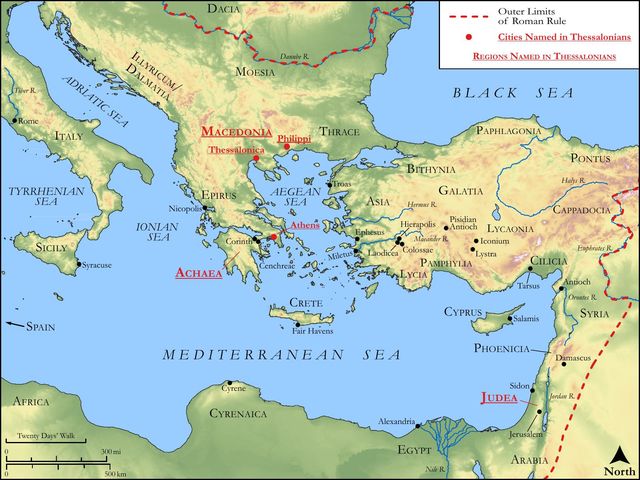
See on the biblical-era maps

Study this verse
Public-domain commentary
Matthew Henry
From his Commentary on the Whole Bible. Henry comments on passages, not single verses — this entry covers 1 Thessalonians 1:6–10. His four-level outline is real structure in the source text, so it is rendered as structure.
In these words we have the evidence of the apostle's success among the Thessalonians, which was notorious and famous in several places. For,
I.They were careful in their holy conversation to imitate the good examples of the apostles and ministers of Christ, Th1 1:6.
As the apostle took care to demean himself well, not only for his own credit's sake, but for the benefit of others, by a conversation suitable to his doctrine, that he might not pull down with one hand what he built up with the other, so the Thessalonians, who observed what manner of men they were among them, how their preaching and living were all of a piece, showed a conscientious care to be followers of them, or to imitate their good example. Herein they became also followers of the Lord, who is the perfect example we must strive to imitate; and we should be followers of others no further than they are followers of Christ, Co1 11:1. The Thessalonians acted thus, notwithstanding their affliction, that much affliction which the apostles and themselves also were exposed to. They were willing to share in the sufferings that attended the embracing and professing of Christianity. They entertained the gospel, notwithstanding the troubles and hardships which attended the preachers and professors of it too. Perhaps this made the word more precious, being dear - bought; and the examples of the apostles shone very bright under their afflictions; so that the Thessalonians embraced the word cheerfully, and followed the example of the suffering apostles joyfully, with joy in the Holy Ghost - such solid and spiritual and lasting joy as the Holy Ghost is the author of, who, when our afflictions abound, makes our consolations much more to abound.
II.Their zeal prevailed to such a degree that they were themselves examples to all about them, Th1 1:7, Th1 1:8. Observe here,
1.Their example was very effectual to make good impressions upon many others. They were tupoi - stamps, or instruments to make impression with. They had themselves received good impressions from the preaching and conversation of the apostles, and they made good impressions, and their conversation had an influence upon others. Note, Christians should be so good as by their example to influence others.
2.It was very extensive, and reached beyond the confines of Thessalonica, even to the believers of all Macedonia, and further, in Achaia; the Philippians, and others who received the gospel before the Thessalonians, were edified by their example. Note, Some who were last hired into the vineyard may sometimes outstrip those who come in before them, and become examples to them.
3.It was very famous. The word of the Lord, or its wonderful effects upon the Thessalonians, sounded, or was famous and well known, in the regions round about that city, and in every place; not strictly every where, but here and there, up and down in the world: so that, from the good success of the gospel among them, many others were encouraged to entertain it, and to be willing, when called, to suffer for it. Their faith was spread abroad.
(1.)The readiness of their faith was famed abroad. These Thessalonians embraced the gospel as soon as it was preached to them; so that every body took notice what manner of entering in among them the apostles had, that there were no such delays as at Philippi, where it was a great while before much good was done.
(2.)The effects of their faith were famous.
[1.]They quitted their idolatry; they turned from their idols, and abandoned all the false worship they had been educated in.
[2.]They gave themselves up to God, to the living and true God, and devoted themselves to his service.
[3.]They set themselves to wait for the Son of God from heaven, Th1 1:10. And this is one of the peculiarities of our holy religion, to wait for Christ's second coming, as those who believe he will come and hope he will come to our joy. The believers under the Old Testament waited for the coming of the Messiah, and believers now wait for his second coming; he is yet to come. And there is good reason to believe he will come, because God has raised him from the dead, which is full assurance unto all men that he will come to judgment, Act 17:31. And there is good reason to hope and wait for his coming, because he has delivered us from the wrath to come. He came to purchase salvation, and will, when he comes again, bring salvation with him, full and final deliverance from sin, and death, and hell, from that wrath which is yet to come upon unbelievers, and which, when it has once come, will be yet to come, because it is everlasting fire prepared for the devil and his angels, Mat 25:41.
Historical interpretation
Nine Centuries of Reception
2 surviving comments on this verse. Each one is dated, so this reads as a timeline rather than a list.
Select a marker to jump to its quote. Markers stagger vertically where authors wrote within a few decades of each other.
"For from you hath sounded forth the word of the Lord, not only in Macedonia and Achaia, but also in every place your faith to God-ward is gone forth."
As a sweet-smelling ointment keeps not its fragrance shut up in itself, but diffuses it afar, and scenting the air with its perfume, so conveys it also to the senses of the neighbors; so too illustrious and admirable men do not shut up their virtue within themselves, but by their good report benefit many, and render them better. Ye have filled, therefore, all your neighbors with instruction, and the world with wonder. For this is meant by the expression, "in every place." And he has not said, your faith is noised abroad, but "has sounded out"; as every place near is filled with the sound of a loud trumpet, so the report of your manfulness is loud, and sounding even like that, is sufficient to fill the world, and to fall with equal sound upon all that are round about. For great actions are more loudly celebrated there, where they have taken place; afar off indeed they are celebrated, but not so much.
But in your case it was not so, but the sound of good report was spread abroad in every part of the earth. And this has also arisen from their vehemence. For as if he were speaking of something living, he introduces the word "gone forth"; so vehement and energetic was their faith. "So that we need not to speak anything," says he, "for they themselves report concerning us what entering in we had unto you." They do not wait to hear from us, but those who were not present, and have not seen, anticipate those who were present, and have seen your good deeds. So manifest were they everywhere made by report. We shall not therefore need, by relating your actions, to bring them to equal zeal. For the things which they ought to have heard from us, these they themselves talk of, anticipating us. And yet in the case of such there is frequently envy, but the exceeding greatness of the thing conquered even this, and they are the heralds of your conflicts. And though left behind, not even so are they silenced, but they are beforehand with us. And being such, it is not possible for them to disbelieve our report.
For from you, the Word of the Lord was spread
Because of them the word of God has spread, so many who were previously silent from fear were made bold by their example, and preached openly and in many places.
not only in Macedonia and in Achaia
who are their neighboring locations
Continue studying 1 Thessalonians 1:8 across the web’s major study libraries — every link below opens this exact verse, chapter, or book on the destination site.
Read & Compare
 BibleGatewayThis verse in more than 200 translations and 70 languages.
 Bible.comThe YouVersion reader — hundreds of translations, reading plans, and highlights.
 ESV.orgCrossway's official English Standard Version reader.
 NET BibleThe NET translation with 60,000+ translators' notes on every rendering decision.
 STEP BibleTyndale House's free study tool — original text, vocabulary, and scholarly resources.
 BibliaLogos Bible Software's free web reader.
 USCCBThe New American Bible (Revised Edition) with the U.S. bishops' study notes.
Commentaries
 BibleHub CommentariesDozens of classic commentaries on this verse, gathered on one page.
 StudyLightMore than 100 commentary sets — the largest collection on the web.
 BibleRefPlain-English commentary on what this verse means, verse by verse.
 Enduring WordDavid Guzik's free commentary on this chapter, widely used by Bible teachers.
 Bible Study ToolsVerse commentary alongside Greek and Hebrew study aids.
Original Language & Research
- BibleHub InterlinearThe verse word by word — original language, transliteration, and English.
- BibleHub LexiconEvery word's original-language definition and Strong's entry.
 Blue Letter BibleDeep-study tools — Strong's numbers, concordance, and word studies.
 CNTR CollationThe earliest Greek manuscripts of this verse, collated letter by letter.
Sermons, Hymns & Audio


TrulyRandomVerse is not affiliated with these sites and doesn’t control their content. They’re linked because they’re genuinely useful.
Summary
First Thessalonians 1:8 powerfully commends the Thessalonian believers, highlighting how the transformative "word of the Lord" resonated from them, and their genuine, God-directed faith became widely known throughout Macedonia, Achaia, and beyond. So pervasive was their spiritual influence that Paul and his companions found it unnecessary to further announce the Gospel in those regions, as the Thessalonians' own lives and testimony had already effectively proclaimed it.
Context
ShowHideLiterary Context
This verse is part of Paul's opening thanksgiving in his first letter to the Thessalonians. Following a warm greeting (1 Thessalonians 1:1), Paul immediately expresses profound gratitude for their faith, love, and hope (1 Thessalonians 1:3). He affirms their election by God, noting that the Gospel came to them not merely in word but with power and the Holy Spirit (1 Thessalonians 1:4-5). The Thessalonians, in turn, became imitators of Paul and the Lord, receiving the word amidst much affliction with joy (1 Thessalonians 1:6). This verse (1 Thessalonians 1:8) then serves as the culmination of Paul's commendation, explaining how their example became so potent, leading directly into the observation that they had become a model to all believers in Macedonia and Achaia (1 Thessalonians 1:7). The subsequent verse (1 Thessalonians 1:9) further elaborates on their conversion, specifically their turning from idols to serve the living and true God, reinforcing the depth of their transformation that fueled their widespread witness.
Historical & Cultural Context
The church in Thessalonica was established by Paul during his second missionary journey, as recorded in Acts 17:1-9. It was a relatively new congregation, likely founded only a few months before Paul wrote this letter from Corinth. Thessalonica was a significant Roman city, the capital of the Roman province of Macedonia, located on the major trade route known as the Via Egnatia. This strategic location, coupled with its bustling port, made it an ideal hub for the rapid dissemination of ideas and news. The believers in Thessalonica faced immediate and intense opposition from hostile Jews and some Gentiles, forcing Paul to leave prematurely. Despite this persecution, their conversion was genuine and their commitment steadfast, a testament to the Holy Spirit's work. Their "faith to God-ward" would have been particularly striking in a city steeped in Roman imperial cults and various pagan deities, where allegiance to Christ often meant social and economic ostracism.
Key Themes
ShowHideThis verse powerfully illustrates several core themes found throughout 1 Thessalonians and the broader New Testament. It underscores the power of the Gospel to transform lives and spread dynamically, as the "word of the Lord" did not merely arrive in Thessalonica but "sounded out" from them. It highlights the theme of effective Christian witness, demonstrating that new believers, even amidst persecution, can become active agents in the propagation of the faith, their lives and words echoing the message they received. The widespread recognition of their "faith to God-ward" speaks to the authenticity and reputation of genuine faith, emphasizing that true conversion is visible and impactful, serving as a model for others, as mentioned in 1 Thessalonians 1:7. Furthermore, it showcases the rapid expansion of the early church, demonstrating how the fervent commitment of local congregations facilitated the swift spread of Christianity across geographical regions, a pattern also seen in the growth described in Acts 19:20.
Exposition and Analysis
ShowHideKey Word Analysis
ShowHideThis middle voice verb literally means "to echo forth" or "resound." It conveys the image of a sound emanating from a source and spreading widely, like a trumpet blast or a reverberating echo. In this context, it emphasizes the powerful, far-reaching, and undeniable impact of the Thessalonians' witness. Their reception of the Gospel was not a quiet, private affair but a public, audible declaration that reverberated throughout the region.
"lógos" here refers specifically to "the word of the Lord," meaning the Gospel message, the divine communication of salvation through Jesus Christ. It encompasses not just spoken words but the entire message, doctrine, and truth of God's revelation. The fact that this "lógos" sounded out from them indicates that they had fully embraced and embodied its truth, becoming its living conduits.
"pístis" signifies persuasion, credence, or moral conviction. It denotes a deep, active reliance upon God for salvation and a steadfast trust in His truthfulness. The phrase "your faith to God-ward" (πρὸς τὸν θεόν) clarifies that this was not merely intellectual assent but a genuine, active trust and loyalty directed specifically towards God, profoundly shaping their lives and becoming evident to others.
Verse Breakdown
ShowHide"For from you sounded out the word of the Lord"
This opening clause establishes the source and nature of the message. The "word of the Lord" (the Gospel) did not merely arrive in Thessalonica, but it actively "sounded out" or "echoed forth" from the Thessalonian believers themselves. This highlights their active role as conduits and proclaimers of the message, not just passive recipients.
"not only in Macedonia and Achaia, but also in every place your faith to God-ward is spread abroad"
This expands on the geographical reach and the content of their witness. The impact was not confined to their immediate Roman provinces (Macedonia and Achaia, which comprised most of Greece) but extended "in every place." What was spread abroad was not just the "word of the Lord" but specifically "your faith to God-ward." This emphasizes that their living out of the Gospel—their genuine, God-directed faith—was the primary vehicle for the message's propagation. Their transformed lives were the most compelling sermon.
"so that we need not to speak any thing"
This concluding phrase underscores the completeness and effectiveness of the Thessalonians' witness. Paul, Silas, and Timothy, as the original evangelists, found that their customary role of introducing the Gospel was rendered superfluous in many areas because the Thessalonians' reputation and testimony had already preceded them. Their faith was so widely known and impactful that it had already prepared the ground for the Gospel, making further initial proclamation by Paul's team unnecessary.
Literary Devices
ShowHideThe verse employs several impactful literary devices. Hyperbole is evident in the phrase "in every place," which, while not literally meaning every single place on earth, signifies a widespread and remarkable reach beyond their immediate region, emphasizing the extraordinary nature of their witness. The verb "sounded out" (ἐξηχέω) functions as a powerful metaphor, likening the spread of the Gospel and their faith to a resounding echo or a trumpet blast, conveying the idea of a loud, clear, and far-reaching proclamation. This also implies a sense of synecdoche, where "the word of the Lord" and "your faith" represent the entire Christian message and the transformed lives of the believers. The verse's structure, moving from the specific regions of Macedonia and Achaia to "every place," uses climax to build upon the increasing scope of their influence, culminating in the astonishing observation that Paul's team no longer needed to speak.
Theological and Thematic Connections
ShowHideThis verse profoundly illustrates the organic and powerful nature of early Christian missions, driven not just by apostolic preaching but by the vibrant, lived reality of new converts. The Thessalonians' faith, directed "to God-ward," became a public testimony that transcended geographical boundaries. This demonstrates that genuine conversion naturally overflows into a compelling witness, where the transformed lives of believers become the most effective proclamation of the Gospel. Their example underscores the principle that the authenticity of faith is its most potent evangelistic tool, preparing hearts and minds for the message of Christ even before missionaries arrive.
Reflection and Application
ShowHideThe Thessalonians offer a powerful challenge and encouragement for believers today. Their story reminds us that the effectiveness of our witness is not solely dependent on eloquent speech or formal ministry, but profoundly on the authenticity and visible impact of our "faith to God-ward." When our lives genuinely reflect the transformative power of the Gospel—when our love for God and others, our endurance in suffering, and our hope in Christ are evident—it creates a powerful resonance that "sounds out" into our communities and beyond. We are called not just to receive the word but to embody it so fully that it becomes a living testimony, preparing the way for others to encounter Christ. This requires a deep, active reliance on God that shapes every aspect of our existence, making our faith a compelling, undeniable force in a world desperately searching for truth and hope.
Questions for Reflection
ShowHideFAQ
ShowHideWhat does Paul mean by "we need not to speak any thing"?
ShowHidePaul's statement "so that we need not to speak any thing" does not imply that the Gospel message was entirely unnecessary in those regions, nor that Paul ceased his evangelistic efforts. Instead, it signifies that the Thessalonians' profound conversion and vibrant witness had already effectively preceded Paul and his team. Their genuine "faith to God-ward" (faith directed towards God) and the way they lived out the Gospel had become so widely known and impactful that it served as a powerful, living testimony. In essence, the Thessalonians had already done the initial work of introducing the reality and power of the Gospel through their lives, making it unnecessary for Paul to begin from scratch or to explain who these new believers were or what they believed. Their reputation had already paved the way, creating a fertile ground for further teaching and discipleship. This highlights the power of a transformed community as a missionary force, as also seen in the early church's growth in Acts 2:47.
Christ-Centered Fulfillment
ShowHideThe resounding witness of the Thessalonian believers, where their faith "sounded out" and "spread abroad," beautifully foreshadows and participates in the ultimate, universal proclamation of the Gospel centered on Christ. Their effective testimony, which made it unnecessary for Paul to speak, points to the profound truth that the Gospel's power resides not in human eloquence alone, but in the transformative work of Christ Himself, echoed through His people. Just as the Thessalonians became living epistles, so too are all believers called to embody the message of the Lamb of God who takes away the sin of the world. This echoes the Great Commission given by Christ, where His disciples are sent out to make disciples of all nations, empowered by His presence (Matthew 28:18-20). The Thessalonians' faith, directed "to God-ward," was a faith in God through Christ, the one mediator (1 Timothy 2:5). Their witness was a participation in Christ's ongoing work of drawing all people to Himself (John 12:32), demonstrating that the Spirit-empowered lives of His followers are integral to the global spread of His kingdom, fulfilling the prophecy that the earth would be filled with the knowledge of the glory of the Lord as the waters cover the sea (Habakkuk 2:14).