


1 Thessalonians 1:7
Bible text: King James Version (1769 Blayney text) · Public domain
Bible text: Berean Standard Bible · Public domain
Bible text: American Standard Version (1901) · Public domain
Bible text: World English Bible, Messianic edition · Public domain
Bible text: Geneva Bible (1599) · Public domain
Bible text: Young's Literal Translation · Public domain
- ὥστεhōsteso as forG5620CONJConjunction
- γενέσθαιgenesthaito becameG1096V-2ADNVerb 2nd Aorist Middle Deponent Infinitive
- ὑμᾶςhumasyouG4771P-2APPersonal pronoun Accusative 2nd Plural
- τύπονtuponan exampleG5179N-ASMNoun Accusative Singular Masculine
- πᾶσινpasinto allG3956A-DPMAdjective Dative Plural Masculine
- τοῖςtoistheG3588T-DPMDefinite article Dative Plural Masculine
- πιστεύουσινpisteuousinbelieving [ones]G4100V-PAP-DPMVerb Present Active Participle Dative Plural Masculine
- ἐνeninG1722PREPPreposition
- τῇtēa<the>G3588T-DSFDefinite article Dative Singular Feminine
- ΜακεδονίᾳMakedoniaMacedoniaG3109N-DSF-LNoun Dative Singular Feminine Location
- καὶkaiandG2532CONJConjunction
- τῇtēa<the>G3588T-DSFDefinite article Dative Singular Feminine
- ἈχαΐᾳAchaiaAchaiaG882N-DSF-LNoun Dative Singular Feminine Location
English is a literal word-by-word gloss of the Greek, not the KJV's wording. Why?
This is the original text the KJV's translators worked from — each Greek word with its own literal English meaning in this verse, prepared by scholars at Tyndale House, Cambridge. The KJV translates whole sentences, not word by word, so its wording differs: one Greek word can become several English words, and the KJV may choose “charity” where the gloss reads “love”. Both are faithful — they answer different questions. For the KJV's own rendering, switch to the KJV text.
Details
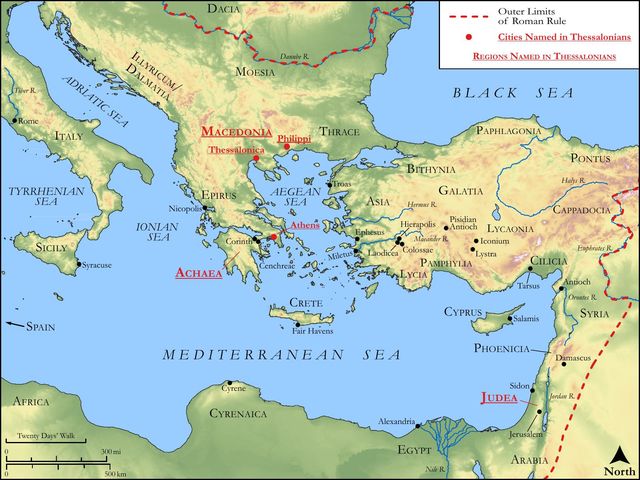
See on the biblical-era maps

Study this verse
Public-domain commentary
Matthew Henry
From his Commentary on the Whole Bible. Henry comments on passages, not single verses — this entry covers 1 Thessalonians 1:6–10. His four-level outline is real structure in the source text, so it is rendered as structure.
In these words we have the evidence of the apostle's success among the Thessalonians, which was notorious and famous in several places. For,
I.They were careful in their holy conversation to imitate the good examples of the apostles and ministers of Christ, Th1 1:6.
As the apostle took care to demean himself well, not only for his own credit's sake, but for the benefit of others, by a conversation suitable to his doctrine, that he might not pull down with one hand what he built up with the other, so the Thessalonians, who observed what manner of men they were among them, how their preaching and living were all of a piece, showed a conscientious care to be followers of them, or to imitate their good example. Herein they became also followers of the Lord, who is the perfect example we must strive to imitate; and we should be followers of others no further than they are followers of Christ, Co1 11:1. The Thessalonians acted thus, notwithstanding their affliction, that much affliction which the apostles and themselves also were exposed to. They were willing to share in the sufferings that attended the embracing and professing of Christianity. They entertained the gospel, notwithstanding the troubles and hardships which attended the preachers and professors of it too. Perhaps this made the word more precious, being dear - bought; and the examples of the apostles shone very bright under their afflictions; so that the Thessalonians embraced the word cheerfully, and followed the example of the suffering apostles joyfully, with joy in the Holy Ghost - such solid and spiritual and lasting joy as the Holy Ghost is the author of, who, when our afflictions abound, makes our consolations much more to abound.
II.Their zeal prevailed to such a degree that they were themselves examples to all about them, Th1 1:7, Th1 1:8. Observe here,
1.Their example was very effectual to make good impressions upon many others. They were tupoi - stamps, or instruments to make impression with. They had themselves received good impressions from the preaching and conversation of the apostles, and they made good impressions, and their conversation had an influence upon others. Note, Christians should be so good as by their example to influence others.
2.It was very extensive, and reached beyond the confines of Thessalonica, even to the believers of all Macedonia, and further, in Achaia; the Philippians, and others who received the gospel before the Thessalonians, were edified by their example. Note, Some who were last hired into the vineyard may sometimes outstrip those who come in before them, and become examples to them.
3.It was very famous. The word of the Lord, or its wonderful effects upon the Thessalonians, sounded, or was famous and well known, in the regions round about that city, and in every place; not strictly every where, but here and there, up and down in the world: so that, from the good success of the gospel among them, many others were encouraged to entertain it, and to be willing, when called, to suffer for it. Their faith was spread abroad.
(1.)The readiness of their faith was famed abroad. These Thessalonians embraced the gospel as soon as it was preached to them; so that every body took notice what manner of entering in among them the apostles had, that there were no such delays as at Philippi, where it was a great while before much good was done.
(2.)The effects of their faith were famous.
[1.]They quitted their idolatry; they turned from their idols, and abandoned all the false worship they had been educated in.
[2.]They gave themselves up to God, to the living and true God, and devoted themselves to his service.
[3.]They set themselves to wait for the Son of God from heaven, Th1 1:10. And this is one of the peculiarities of our holy religion, to wait for Christ's second coming, as those who believe he will come and hope he will come to our joy. The believers under the Old Testament waited for the coming of the Messiah, and believers now wait for his second coming; he is yet to come. And there is good reason to believe he will come, because God has raised him from the dead, which is full assurance unto all men that he will come to judgment, Act 17:31. And there is good reason to hope and wait for his coming, because he has delivered us from the wrath to come. He came to purchase salvation, and will, when he comes again, bring salvation with him, full and final deliverance from sin, and death, and hell, from that wrath which is yet to come upon unbelievers, and which, when it has once come, will be yet to come, because it is everlasting fire prepared for the devil and his angels, Mat 25:41.
Historical interpretation
Nine Centuries of Reception
2 surviving comments on this verse. Each one is dated, so this reads as a timeline rather than a list.
Select a marker to jump to its quote. Markers stagger vertically where authors wrote within a few decades of each other.
"So that ye became ensamples to all that believe in Macedonia and Achaia."
And yet it was later that he went to them. But ye so shone, he says, that ye became teachers of those who received (the word) before you. And this is like the Apostle. For he did not say, so that ye became ensamples in regard to believing, but ye became an ensample to those who already believed; how one ought to believe in God, ye taught, who from the very beginning entered into your conflict. "And in Achaia," he says; that is, in Greece. Do you see how great a thing is zeal? that it does not require time, nor delay, nor procrastination, but it is sufficient only to venture one's self, and all is fulfilled. Thus then though coming in later to the Preaching, they became teachers of those who were before them.
Let no one therefore despair, even though he has lost much time, and has done nothing. It is possible for him even in a little while to do so much, as he never has done in all his former time. For if he who before did not believe, shone so much at the beginning, how much more those who have already believed! Let no one, again, upon this consideration be remiss, because he perceives that it is possible in a short time to recover everything. For the future is uncertain, and the Day of the Lord is a thief, setting upon us suddenly when we are sleeping. But if we do not sleep, it will not set upon us as a thief, nor carry us off unprepared. For if we watch and be sober, it will not set upon us as a thief, but as a royal messenger, summoning us to the good things prepared for us. But if we sleep, it comes upon us as a thief. Let no one therefore sleep, nor be inactive in virtue, for that is sleep. Do you not know how, when we sleep, our goods are not in safety, how easy they are to be plotted against? But when we are awake, there needs not so much guarding. When we sleep, even with much guarding we often perish. There are doors, and bolts, and guards, and outer guards, and the thief has come upon us.
So have you become a pattern for all who believe
that is, they were models of excellence.
in Macedonia and in Achaia
Those are provinces of Greece.
Continue studying 1 Thessalonians 1:7 across the web’s major study libraries — every link below opens this exact verse, chapter, or book on the destination site.
Read & Compare
 BibleGatewayThis verse in more than 200 translations and 70 languages.
 Bible.comThe YouVersion reader — hundreds of translations, reading plans, and highlights.
 ESV.orgCrossway's official English Standard Version reader.
 NET BibleThe NET translation with 60,000+ translators' notes on every rendering decision.
 STEP BibleTyndale House's free study tool — original text, vocabulary, and scholarly resources.
 BibliaLogos Bible Software's free web reader.
 USCCBThe New American Bible (Revised Edition) with the U.S. bishops' study notes.
Commentaries
 BibleHub CommentariesDozens of classic commentaries on this verse, gathered on one page.
 StudyLightMore than 100 commentary sets — the largest collection on the web.
 BibleRefPlain-English commentary on what this verse means, verse by verse.
 Enduring WordDavid Guzik's free commentary on this chapter, widely used by Bible teachers.
 Bible Study ToolsVerse commentary alongside Greek and Hebrew study aids.
Original Language & Research
- BibleHub InterlinearThe verse word by word — original language, transliteration, and English.
- BibleHub LexiconEvery word's original-language definition and Strong's entry.
 Blue Letter BibleDeep-study tools — Strong's numbers, concordance, and word studies.
 CNTR CollationThe earliest Greek manuscripts of this verse, collated letter by letter.
Sermons, Hymns & Audio


TrulyRandomVerse is not affiliated with these sites and doesn’t control their content. They’re linked because they’re genuinely useful.
Summary
First Thessalonians 1:7 powerfully commends the believers in Thessalonica, highlighting how their genuine faith and steadfast commitment to the gospel, even amidst severe persecution, transformed them into exemplary models. Their vibrant spiritual lives and impactful witness served as a living blueprint for all other believers across the Roman provinces of Macedonia and Achaia, demonstrating the profound and far-reaching influence of a church truly transformed by the Holy Spirit.
Context
ShowHideLiterary Context
This verse is part of Paul's effusive opening commendation (1 Thessalonians 1:2-10) to the church in Thessalonica, an integral component of his earliest preserved epistle. Following his customary thanksgiving and prayer, Paul immediately shifts to praising the Thessalonians for their "work of faith, and labour of love, and patience of hope" (1 Thessalonians 1:3). Verse 6 establishes that they became "followers of us, and of the Lord," having received the word "in much affliction, with joy of the Holy Ghost." Verse 7 then builds directly upon this, asserting that their imitation of Paul and the Lord, coupled with their Spirit-filled endurance, made them a visible and influential pattern for others. The subsequent verses (1 Thessalonians 1:8-10) further elaborate on how their faith "sounded out" and their conversion from idols to serve the living God became widely known, reinforcing the idea of their exemplary status.
Historical & Cultural Context
Paul, Silas, and Timothy established the Thessalonian church during Paul's second missionary journey, as detailed in Acts 17:1-9. Thessalonica was a bustling, strategic port city and the capital of the Roman province of Macedonia, situated on the Via Egnatia, a major east-west trade route. This location contributed significantly to the rapid spread of the gospel from Thessalonica. The believers faced immediate and intense persecution from hostile Jews and city officials, forcing Paul and his companions to depart prematurely. Despite this brief initial ministry, the Thessalonians' conversion was remarkably deep and authentic, characterized by a radical turning from idolatry to God (1 Thessalonians 1:9). Their steadfastness under duress, in a culture where loyalty to traditional gods and the emperor was paramount, made their faith particularly striking and credible to observers.
Key Themes
ShowHideThe Thessalonians' experience encapsulates several vital themes within Paul's theology and the broader New Testament. Their transformation highlights Exemplary Christian Living, demonstrating that genuine faith is not merely intellectual assent but a dynamic, visible lifestyle that serves as a practical blueprint for others. This echoes the call for believers to be "light" in the world, as seen in Matthew 5:16. Furthermore, the widespread recognition of their faith underscores the Widespread Influence of the Gospel, showing how even a relatively new and small community can have far-reaching impact across geographical and cultural boundaries, fulfilling the Great Commission's global scope. Finally, their profound and rapid conversion, coupled with their endurance in affliction, powerfully attests to the Transformative Power of the Gospel. As Paul articulates in 1 Thessalonians 1:5, the gospel came to them "not in word only, but also in power, and in the Holy Ghost, and in much assurance," resulting in lives that became undeniable proof of God's saving grace.
Exposition and Analysis
ShowHideKey Word Analysis
ShowHideThis term signifies a "die (as struck)," "stamp," "scar," or "impression." By analogy, it refers to a "shape," "statue," "style," "resemblance," or, most relevant here, a "sampler" or "type." It denotes a "model for imitation" or an "instance for warning." In 1 Thessalonians 1:7, týpos conveys that the Thessalonians were not merely good examples, but they were the very standard, pattern, or blueprint that others could look to and emulate. Their lives provided a concrete, tangible demonstration of what it meant to live out the Christian faith, making them a living template for believers in other regions.
This verb means "to cause to be," "to become," "to come into being," or "to happen." Its use here emphasizes the dynamic process by which the Thessalonians became ensamples. It's not just that they were examples in a static sense, but their lives actively developed into a pattern. This implies a transformation and ongoing demonstration, rather than a mere state of being.
Pâs means "all," "every," or "the whole," indicating universality. Pisteúō means "to have faith (in, upon, or with respect to, a person or thing)," or "to credit," and by implication, "to entrust (especially one's spiritual well-being to Christ)." The phrase "all that believe" thus encompasses the entire community of Christians, emphasizing that the Thessalonians' exemplary status extended to every single believer within the specified regions, irrespective of their local church or background.
Verse Breakdown
ShowHide"So that ye were ensamples"
This clause highlights the direct consequence of the Thessalonians' faith, love, in and hope, as described in the preceding verses. Their reception of the gospel "in much affliction, with joy of the Holy Ghost" (1 Thessalonians 1:6) led to their lives becoming a living pattern or model. The term "ensamples" (Greek týpos) indicates that their conduct, perseverance, and spiritual vitality provided a tangible, imitable standard for others. It was not merely a passive observation but an active demonstration of authentic Christian living.
"to all that believe in Macedonia and Achaia"
This specifies the widespread reach and impact of the Thessalonians' witness. Macedonia and Achaia were the two major Roman provinces encompassing much of Greece, where numerous Christian communities were emerging. "All that believe" underscores the universal nature of their influence, indicating that their reputation and the pattern of their faith had permeated the entire Christian network in these regions. This demonstrates the remarkable ripple effect of a faithful church, even one recently established and facing significant opposition.
Literary Devices
ShowHideThe verse employs several effective literary devices. Metonymy is present in the use of "Macedonia and Achaia" to represent the Christian communities within those geographical regions, rather than the regions themselves. This efficiently communicates the broad scope of the Thessalonians' influence. The central device is Metaphor, as the Thessalonians are described as "ensamples" or "patterns" (týpos). This metaphor portrays their lives as a mold or blueprint, suggesting that their conduct provided a concrete, replicable standard for others to follow. There is also an element of Hyperbole or strong emphasis, as the claim that they were ensamples "to all that believe" across two entire provinces suggests an extraordinary and widely recognized reputation, underscoring the profound impact of their genuine faith.
Theological and Thematic Connections
ShowHideThe Thessalonians' role as "ensamples" underscores a profound theological truth: the church, as the body of Christ, is called to embody and display the transforming power of the gospel to the world and to fellow believers. Their lives served as a visible apologetic for the truth of Christianity, demonstrating that genuine conversion leads to a radical reorientation of life, marked by faith, love, and hope, even in the face of adversity. This exemplary living is not born of human effort alone but is the fruit of the Holy Spirit's work within believers, enabling them to live in a manner worthy of their calling. The widespread impact of their witness highlights the interconnectedness of the early Christian communities and the vital role of mutual encouragement and emulation within the broader body of Christ, where the faithfulness of one local church can strengthen and inspire many others.
Reflection and Application
ShowHideThe example of the Thessalonian believers serves as a powerful and enduring challenge for every Christian and every local church today. It compels us to consider the tangible reality of our faith: are our lives, individually and corporately, truly serving as a clear pattern for others to follow? Do our actions, our perseverance in trials, and our love for one another genuinely reflect the transformative power of the gospel? This verse reminds us that our witness extends far beyond our immediate circles, potentially inspiring and encouraging believers in distant communities, even those we may never meet. We are called to live with intentionality, knowing that our authenticity and steadfastness can have a ripple effect, strengthening the faith of others and bringing glory to God. Let us strive to live lives that are not merely good, but exemplary, becoming living letters of Christ, known and read by all.
Questions for Reflection
ShowHideFAQ
ShowHideWhy were the Thessalonians so quickly recognized as "ensamples" despite being a relatively new church?
ShowHideThe rapid recognition of the Thessalonians as "ensamples" stemmed from several factors. Firstly, their conversion was remarkably genuine and radical, involving a decisive turning from idolatry to serve the living and true God (1 Thessalonians 1:9). This profound transformation was evident in their lives. Secondly, they received the gospel "in much affliction, with joy of the Holy Ghost" (1 Thessalonians 1:6), demonstrating an extraordinary perseverance and spiritual vitality that was highly visible and compelling. Their steadfastness under persecution, coupled with their active "work of faith, and labour of love, and patience of hope" (1 Thessalonians 1:3), made their faith undeniable. Finally, Thessalonica's strategic location on the Via Egnatia, a major Roman road, facilitated the swift spread of news about their faith throughout the region, as Paul notes that their "faith to God-ward is spread abroad" (1 Thessalonians 1:8).
Christ-Centered Fulfillment
ShowHideWhile the Thessalonians served as a powerful human "ensample" for other believers, their exemplary lives ultimately find their true fulfillment and source in Jesus Christ. They became patterns for others because they first became "followers of us, and of the Lord" (1 Thessalonians 1:6), meaning they imitated Christ Himself, who is the ultimate and perfect pattern for humanity. Christ is the "image of the invisible God" (Colossians 1:15), the one who perfectly embodied God's will and character. The Thessalonians' turning from idols to serve the living God and wait for His Son from heaven (1 Thessalonians 1:9-10) is a direct response to Christ's redemptive work. Their ability to endure affliction with joy was empowered by the Holy Spirit, whom Christ sent (John 14:26), and their hope was anchored in His resurrection and promised return (1 Thessalonians 4:14-17). Thus, the Thessalonians' lives were not merely good examples in themselves, but they were a living testament to the transforming power of Christ, reflecting His glory and inviting others to follow the pattern of faith that originates in Him. As believers, we are called to "put on the Lord Jesus Christ" (Romans 13:14), becoming living epistles known and read by all, with Christ Himself as the divine archetype we strive to embody.