


2 Corinthians 11:9
- καὶkaiAndG2532CONJConjunction
- παρὼνparōnbeing presentG3918V-PAP-NSMVerb Present Active Participle Nominative Singular Masculine
- πρὸςproswithG4314PREPPreposition
- ὑμᾶςhumasyouG4771P-2APPersonal pronoun Accusative 2nd Plural
- καὶkaiandG2532CONJConjunction
- ὑστερηθεὶςhusterētheishaving been in needG5302V-APP-NSMVerb Aorist Passive Participle Nominative Singular Masculine
- οὐounotG3756PRT-NNegative Particle Negative
- κατενάρκησαkatenarkēsaI did burdenG2655V-AAI-1SVerb Aorist Active Indicative 1st Singular
- οὐθενός·outhenosno [one]G3762A-GSMAdjective Genitive Singular Masculine
- τὸto<the>G3588T-ASNDefinite article Accusative Singular Neuter
- γὰρgarforG1063CONJConjunction
- ὑστέρημάhusterēmathe needG5303N-ASNNoun Accusative Singular Neuter
- μουmouof mineG3165P-1GSPersonal pronoun Genitive 1st Singular
- προσανεπλήρωσανprosaneplērōsancompletely filled upG4322V-AAI-3PVerb Aorist Active Indicative 3rd Plural
- οἱhoitheG3588T-NPMDefinite article Nominative Plural Masculine
- ἀδελφοὶadelphoibrothersG80N-NPMNoun Nominative Plural Masculine
- ἐλθόντεςelthonteshaving comeG2064V-2AAP-NPMVerb 2nd Aorist Active Participle Nominative Plural Masculine
- ἀπὸapofromG575PREPPreposition
- ΜακεδονίαςMakedoniasMacedoniaG3109N-GSF-LNoun Genitive Singular Feminine Location
- καὶkaiandG2532CONJConjunction
- ἐνeninG1722PREPPreposition
- παντὶpantieverythingG3956A-DSNAdjective Dative Singular Neuter
- ἀβαρῆabarēunburdensomeG4A-ASMAdjective Accusative Singular Masculine
- ἐμαυτὸνemautonmyselfG1473F-1ASMReflexive pronoun Accusative 1st Singular Masculine
- ὑμῖνhuminto youG4771P-2DPPersonal pronoun Dative 2nd Plural
- ἐτήρησαetērēsaI keptG5083V-AAI-1SVerb Aorist Active Indicative 1st Singular
- καὶkaiandG2532CONJConjunction
- τηρήσωtērēsōwill keepG5083V-FAI-1SVerb Future Active Indicative 1st Singular
English is a literal word-by-word gloss of the Greek, not the KJV's wording. Why?
This is the original text the KJV's translators worked from — each Greek word with its own literal English meaning in this verse, prepared by scholars at Tyndale House, Cambridge. The KJV translates whole sentences, not word by word, so its wording differs: one Greek word can become several English words, and the KJV may choose “charity” where the gloss reads “love”. Both are faithful — they answer different questions. For the KJV's own rendering, switch to the KJV text.
Details
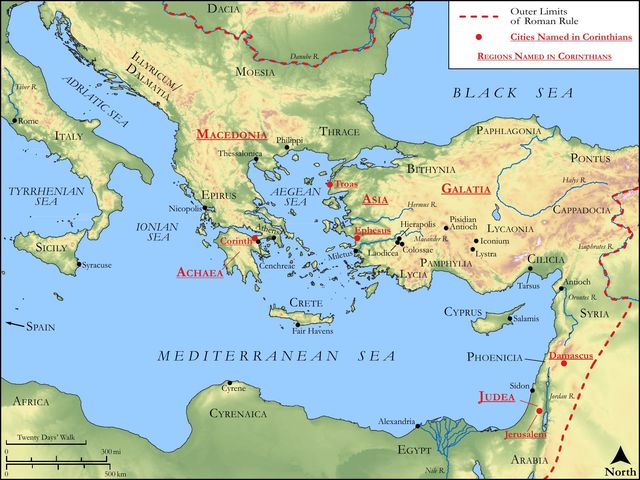
See on the biblical-era map

Study this verse
Public-domain commentary
Matthew Henry
From his Commentary on the Whole Bible. Henry comments on passages, not single verses — this entry covers 2 Corinthians 11:5–15. His two-level outline is real structure in the source text, so it is rendered as structure.
After the foregoing preface to what he was about to say, the apostle in these verses mentions,
I.His equality with the other apostles - that he was not a whit behind the very chief of the apostles, Co2 11:5.
This he expresses very modestly: I suppose so. He might have spoken very positively. The apostleship, as an office, was equal in all the apostles; but the apostles, like other Christians, differed one from another. These stars differed one from another in glory, and Paul was indeed of the first magnitude; yet he speaks modestly of himself, and humbly owns his personal infirmity, that he was rude in speech, had not such a graceful delivery as some others might have. Some think that he was a man of very low stature, and that his voice was proportionably small; others think that he may have had some impediment in his speech, perhaps a stammering tongue. However, he was not rude in knowledge; he was not unacquainted with the best rules of oratory and the art of persuasion, much less was he ignorant of the mysteries of the kingdom of heaven, as had been thoroughly manifested among them.
II.His equality with the false apostles in this particular - the preaching of the gospel unto them freely, without wages.
This the apostle largely insists on, and shows that, as they could not but own him to be a minister of Christ, so they ought to acknowledge he had been a good friend to them. For,
1.He had preached the gospel to them freely, Co2 11:7-10. He had proved at large, in his former epistle to them, the lawfulness of ministers' receiving maintenance from the people, and the duty of the people to give them an honourable maintenance; and here he says he himself had taken wages of other churches (Co2 11:8), so that he had a right to have asked and received from them: yet he waived his right, and chose rather to abase himself, by working with his hands in the trade of tent-making to maintain himself, than be burdensome to them, that they might be exalted, or encouraged to receive the gospel, which they had so cheaply; yea, he chose rather to be supplied from Macedonia than to be chargeable unto them.
2.He informs them of the reason of this his conduct among them. It was not because he did not love them (Co2 11:11), or was unwilling to receive tokens of their love (for love and friendship are manifested by mutual giving and receiving), but it was to avoid offence, that he might cut off occasion from those that desired occasion. He would not give occasion for any to accuse him of worldly designs in preaching the gospel, or that he intended to make a trade of it, to enrich himself; and that others who opposed him at Corinth might not in this respect gain an advantage against him: that wherein they gloried, as to this matter, they might be found even as he, Co2 11:12. It is not improbable to suppose that the chief of the false teachers at Corinth, or some among them, were rich, and taught (or deceived) the people freely, and might accuse the apostle or his fellow-labourers as mercenary men, who received hire or wages, and therefore the apostle kept to his resolution not to be chargeable to any of the Corinthians.
III.The false apostles are charged as deceitful workers (Co2 11:13), and that upon this account, because they would transform themselves into the likeness of the apostles of Christ, and, though they were the ministers of Satan, would seem to be the ministers of righteousness. They would be as industrious and as generous in promoting error as the apostles were in preaching truth; they would endeavour as much to undermine the kingdom of Christ as the apostles did to establish it. There were counterfeit prophets under the Old Testament, who wore the garb and learned the language of the prophets of the Lord. So there were counterfeit apostles under the New Testament, who seemed in many respects like the true apostles of Christ. And no marvel (says the apostle); hypocrisy is a thing not to be much wondered at in this world, especially when we consider the great influence Satan has upon the minds of many, who rules in the hearts of the children of disobedience. As he can turn himself into any shape, and put on almost any form, and look sometimes like an angel of light, in order to promote his kingdom of darkness, so he will teach his ministers and instruments to do the same. But it follows, Their end is according to their works (Co2 11:15); the end will discover them to be deceitful workers, and their work will end in ruin and destruction.
Historical interpretation
Historical reception
3 surviving comments on this verse. Each one is dated, so this reads as a timeline rather than a list.
Select a marker to jump to its quote. Markers stagger vertically where authors wrote within a few decades of each other.
Paul accepted contributions from the Macedonians because they corrected their faults. But he refused anything from the Corinthians because they were less ready to correct theirs.
"And when I was present with you, and was in want, I was not a burden on any man." For he did not say, "ye did not give to me," but, "I did not take," for as yet he spares them. But nevertheless even in the subduedness of his language he covertly strikes them again, for the word, "present," is exceedingly emphatic, and so is "in want." For that they might not say, "what matter then, if you had [enough]?" he added, "and was in want." "I was not a burden" on you. Here again he hits them gently, as making such contributions reluctantly, as feeling them a burden. Then comes the reason also, full of accusation and fraught with jealousy. Wherefore also he introduced it, not in the way of a leading point, but as informing them whence and by whom he was supported, so as to stimulate them again, in an unsuspicious way, as to the point of alms-giving; "For the measure of my want," he says, "the brethren which came from Macedonia supplied." Seest thou how he provokes them again, by bringing forward those that had ministered to him? For inspiring them first with a desire of knowing who these could be, when he said, "I robbed other churches;" he then mentions them also by name; which would incite them also unto almsgiving. For he thus persuades those who had been beaten [by them] in the matter of supporting the Apostle, not to be also beaten in the succor they gave to the poor. And he says this also in his Epistle to the Macedonians themselves, "For in my necessities ye sent unto me once and again, even in the beginning of the Gospel;" which point also was a very great commendation of them, that from the very beginning they shone forth. But observe how everywhere he mentions his "necessity," and no where a superfluity.
Now therefore by saying "present," and in "want" he showed that he ought to have been supported by the Corinthians; and by the words, "they supplied the measure of my want," he shows that he did not so much as ask. And he assigns a reason which was not the real one. What then is this? That he had received from others; "for," says he, "the measure of my want those that came supplied." "For this reason," he says, "I was not a burden; not because I had no confidence in you." And yet it is for this latter reason that he so acts, and he shows it in what follows; but does not say it plainly, but throws it into the shade, leaving it to the conscience of his hearers. And he gives proof of it covertly in what follows, by saying, "And in every thing I kept myself from being burdensome, and so will I keep myself." "For think not," says he, "that I say these things that I may receive." Now the words "so will I keep myself," are severer, if he has not even yet confidence in them; but once for all had given up the idea of receiving aught from them. He shows, moreover, that they even considered this to be a burden; wherefore he said, "I have kept myself from being burdensome, and so will I keep myself."
This is the greatest condemnation of the Corinthians imaginable. For while he was benefiting them, Paul was being funded by others elsewhere.
Continue studying 2 Corinthians 11:9 across the web’s major study libraries — every link below opens this exact verse, chapter, or book on the destination site.
Read & Compare
 BibleGatewayThis verse in more than 200 translations and 70 languages.
 Bible.comThe YouVersion reader — hundreds of translations, reading plans, and highlights.
 ESV.orgCrossway's official English Standard Version reader.
 NET BibleThe NET translation with 60,000+ translators' notes on every rendering decision.
 STEP BibleTyndale House's free study tool — original text, vocabulary, and scholarly resources.
 BibliaLogos Bible Software's free web reader.
 USCCBThe New American Bible (Revised Edition) with the U.S. bishops' study notes.
Commentaries
 BibleHub CommentariesDozens of classic commentaries on this verse, gathered on one page.
 StudyLightMore than 100 commentary sets — the largest collection on the web.
 BibleRefPlain-English commentary on what this verse means, verse by verse.
 Enduring WordDavid Guzik's free commentary on this chapter, widely used by Bible teachers.
 Bible Study ToolsVerse commentary alongside Greek and Hebrew study aids.
Original Language & Research
- BibleHub InterlinearThe verse word by word — original language, transliteration, and English.
- BibleHub LexiconEvery word's original-language definition and Strong's entry.
 Blue Letter BibleDeep-study tools — Strong's numbers, concordance, and word studies.
 CNTR CollationThe earliest Greek manuscripts of this verse, collated letter by letter.
Sermons, Hymns & Audio


TrulyRandomVerse is not affiliated with these sites and doesn’t control their content. They’re linked because they’re genuinely useful.
Summary
In 2 Corinthians 11:9, the Apostle Paul vigorously defends his apostolic integrity and selfless ministry to the Corinthian church. He recounts his deliberate choice to avoid being a financial burden upon them during his time in Corinth, even when he experienced material need. This need, he clarifies, was fully met by the generous financial support provided by the believers who traveled from the churches in Macedonia, thereby enabling him to maintain his independence and ensure the gospel's unhindered proclamation without any suspicion of mercenary motives.
Context
ShowHideLiterary Context
This verse is situated within Paul's "fool's speech" (2 Corinthians 10-13), a section where he reluctantly boasts about his sufferings, weaknesses, and genuine apostolic credentials in stark contrast to the "super-apostles" who had infiltrated the Corinthian church. These false apostles likely boasted of their eloquence, spiritual power, and perhaps their ability to command financial support, implicitly or explicitly criticizing Paul for not doing the same. Paul's refusal to be financially dependent on the Corinthians, reiterated here, serves as a crucial point of distinction, demonstrating his authentic commitment to the gospel over personal gain. It builds upon earlier arguments in 1 Corinthians 9, where he asserts his right to receive support but explains his choice to forgo it for the sake of the gospel, and specifically in 2 Corinthians 11:7-8, where he states he "robbed other churches" by accepting their support to serve the Corinthians freely.
Historical & Cultural Context
In the Greco-Roman world, it was common for philosophers, rhetoricians, and religious teachers to charge fees for their instruction. This practice often led to accusations of greed or charlatanism, particularly if the teacher seemed to prioritize personal gain over the integrity of their message. Paul's stance was radical; by refusing to take money from the Corinthians, he defied prevailing norms and sought to remove any potential accusation that he was a mercenary. The Macedonian churches, particularly Philippi, were known for their exceptional generosity and consistent support of Paul's ministry, as evidenced in Philippians 4:15-16. This act of inter-church support highlights the early Christian community's interconnectedness and shared mission, where some churches sacrificially supported apostles to preach in other regions.
Key Themes
ShowHidePaul's financial independence underscores several key themes in 2 Corinthians and his broader theology. First, it emphasizes Apostolic Integrity and Self-Sacrifice, demonstrating that genuine ministry prioritizes the gospel's advancement over personal comfort or gain. Paul's willingness to suffer want and rely on external support rather than burden the Corinthians showcases his commitment to serving them without reproach (2 Corinthians 12:14). Second, it highlights the Generosity and Partnership in the Gospel among early Christian communities, where churches like those in Macedonia actively participated in the spread of the gospel by supporting its heralds (Philippians 1:5). Third, Paul's actions were a strategic effort to Remove Stumbling Blocks to the gospel, ensuring that no accusation of financial exploitation could deter the Corinthians from embracing the truth (1 Corinthians 9:12). His consistent practice aimed to silence critics and validate the sincerity of his message.
Exposition and Analysis
ShowHideKey Word Analysis
ShowHideMeaning "to grow utterly torpid, i.e. (by implication) slothful (figuratively, expensive)." Paul uses this term to emphatically state that he did not become a financial burden or an oppressive expense to the Corinthians. The word carries a sense of numbing or weighing down, implying that his financial needs would have been a heavy, perhaps paralyzing, burden on the church if he had demanded support from them. His refusal to be "chargeable" highlights his deliberate effort to avoid placing any financial strain on the Corinthian believers.
Meaning "to fill up further, i.e. furnish fully." This compound verb indicates that the Macedonian brethren not only met Paul's needs but did so completely and abundantly, filling up what was lacking. It suggests a generous and comprehensive provision, ensuring that Paul's material wants were fully satisfied, enabling him to continue his ministry without distraction or dependency on the Corinthians.
Meaning "to guard (from loss or injury, properly, by keeping the eye upon; and thus differing from φυλάσσω, which is properly to prevent escaping; and from κουστωδία, which implies a fortress or full military lines of apparatus), i.e. to note (a prophecy; figuratively, to fulfil a command); by implication, to detain (in custody; figuratively, to maintain); by extension, to withhold (for personal ends; figuratively, to keep unmarried)." Paul uses this word to emphasize his active, intentional, and consistent effort to maintain his financial independence from the Corinthians. It implies a vigilant watchfulness and a deliberate guarding of his conduct to ensure he remained "not burdensome" (G4, abarḗs). This was not a passive state but an active, disciplined choice.
Verse Breakdown
ShowHide"And when I was present with you, and wanted, I was chargeable to no man:"
Paul begins by recalling his time ministering in Corinth. He acknowledges that he experienced "want" or need (G5302, hysteréō), indicating that his decision to not be a burden was not due to an absence of need but a deliberate choice despite it. The emphatic declaration "I was chargeable to no man" (G3762, oudeís) underscores his consistent practice of financial independence from the Corinthian church members.
"for that which was lacking to me the brethren which came from Macedonia supplied:"
This clause provides the reason (G1063, gár) for his ability to remain independent. His needs were met by a specific group: "the brethren which came from Macedonia" (G80, adelphós, G2064, érchomai, G3109, Makedonía). This highlights the inter-church support system, where churches in Macedonia (e.g., Philippi and Thessalonica) generously provided for Paul's needs, freeing him from dependency on the Corinthians. The word "supplied" (G4322, prosanaplēróō) indicates a full and complete provision.
"and in all [things] I have kept myself from being burdensome unto you, and [so] will I keep [myself]."
Paul broadens his statement, asserting that this practice of avoiding being "burdensome" (G4, abarḗs) was not an isolated incident but a consistent principle applied "in all things" (G3956, pâs, G1722, en). He emphasizes his active role in maintaining this standard ("I have kept myself," G5083, tēréō, G1683, emautoû) and declares his unwavering commitment to continue this practice in the future ("and so will I keep myself"). This serves as a powerful defense against any accusations of greed or exploitation, contrasting sharply with the likely practices of his opponents.
Literary Devices
ShowHidePaul's defense in 2 Corinthians 11:9 employs several potent literary devices. Central to his argument is Antithesis, where he contrasts his own selfless, non-burdensome ministry with the implied mercenary practices of the false apostles. By explicitly stating that he was "chargeable to no man" and that others "supplied" his needs, he highlights the purity of his motives against those who might have sought financial gain. This verse is also a crucial part of Paul's Apostolic Apologia, a sustained defense of his legitimate apostleship. He uses his financial integrity as a concrete example of his genuine commitment to the Corinthians and the gospel, a tangible proof of his spiritual authenticity. Furthermore, Paul uses Repetition and Emphasis by stating both his past and future commitment ("I have kept myself... and so will I keep myself"), underscoring the consistent and unwavering nature of his principle. His life serves as an Exemplum, a living illustration of the principles he preaches, demonstrating that true ministry is characterized by sacrifice and a focus on the spiritual well-being of the flock rather than personal enrichment.
Theological and Thematic Connections
ShowHidePaul's insistence on financial independence from the Corinthians, enabled by the generosity of the Macedonian churches, carries profound theological implications for the nature of ministry and Christian community. It underscores the principle that the proclamation of the gospel should be free from any suspicion of self-interest, ensuring its integrity and removing potential stumbling blocks for those who hear it. While ministers have a biblical right to be supported by those they serve, Paul's example demonstrates that there are times when foregoing that right, out of love and strategic wisdom, can be a more powerful witness to the gospel's purity and the minister's genuine motives. This also highlights the interconnectedness of the body of Christ, where believers in one region sacrificially support the work of God in another, fostering a spirit of partnership and shared mission that transcends local boundaries.
Reflection and Application
ShowHidePaul's example in 2 Corinthians 11:9 offers a powerful and challenging model for all believers, particularly those in ministry. It calls us to examine our motives, ensuring that our service to God and others is driven by selfless love and a desire for the gospel's advancement, rather than personal gain or comfort. While legitimate support for ministry is biblical, Paul's willingness to sacrifice his right to support for the sake of the gospel's integrity reminds us that flexibility and a servant's heart are paramount. For congregations, this verse highlights the privilege and responsibility of supporting those who minister the Word, enabling them to serve effectively without being a burden. It also encourages a broader vision of partnership, recognizing that our resources can bless ministries beyond our immediate community, fostering unity and expanding the reach of the gospel worldwide. Ultimately, it challenges us to prioritize the unhindered proclamation of Christ above all else, making choices that remove obstacles and commend the truth to a watching world.
Questions for Reflection
ShowHideFAQ
ShowHideWhy was Paul so insistent on not being a financial burden to the Corinthians?
ShowHidePaul's insistence on not being a financial burden to the Corinthian church, even when in need, stemmed from several strategic and theological reasons. Firstly, he wanted to remove any potential accusation that his ministry was motivated by greed or that he was exploiting the Corinthians for personal gain, a common charge against itinerant teachers of his day. This was crucial for preserving the integrity and credibility of the gospel message (2 Corinthians 11:7). Secondly, by serving them freely, he aimed to distinguish himself sharply from the "super-apostles" who were likely charging for their services and undermining Paul's authority. His self-sacrifice served as a powerful contrast, demonstrating the purity of his motives. Finally, his goal was to ensure that nothing would hinder the spread of the gospel (1 Corinthians 9:12), and he believed that accepting support from the Corinthians might create a barrier or cause them to question his sincerity.
Christ-Centered Fulfillment
ShowHidePaul's self-sacrificial ministry, particularly his refusal to be a financial burden on the Corinthians, finds its ultimate fulfillment and perfect example in the person and work of Jesus Christ. Just as Paul "emptied himself" of his right to support for the sake of the gospel, Christ supremely "emptied himself, by taking the form of a servant" (Philippians 2:7), laying aside His divine prerogatives to become incarnate and serve humanity. Jesus, though "rich, yet for your sakes he became poor, that ye through his poverty might be rich" (2 Corinthians 8:9), freely giving His life as a ransom for many without demanding anything in return. Paul's commitment to removing "stumbling blocks" and ensuring the unhindered proclamation of the gospel mirrors Christ's own mission to clear the path to God, breaking down the "middle wall of partition" (Ephesians 2:14) through His atoning sacrifice. Thus, Paul's financial independence was not merely a pragmatic choice but a living out of the gospel's core message: a selfless, costly love that gives all for the sake of others, perfectly exemplified by the Lamb of God who takes away the sin of the world (John 1:29).