


Galatians 6:14
Bible text: King James Version (1769 Blayney text) · Public domain
Bible text: King James Version with Strong's numbers · Public domain
Bible text: Berean Standard Bible · Public domain
Bible text: American Standard Version (1901) · Public domain
Bible text: World English Bible, Messianic edition · Public domain
Bible text: Geneva Bible (1599) · Public domain
Bible text: Young's Literal Translation · Public domain
- ἐμοὶemoiFor me myselfG1473P-1DSPersonal pronoun Dative 1st Singular
- δὲdehoweverG1161CONJConjunction
- μὴmēneverG3361PRT-NNegative Particle Negative
- γένοιτοgenoitowould it beG1096V-2ADO-3SVerb 2nd Aorist Middle Deponent Optative 3rd Singular
- καυχᾶσθαιkauchasthaito boastG2744V-PNNVerb Present Middle Or Passive Deponent Infinitive
- εἰeionlyG1487CONDConjunction
- μὴmēexceptG3361PRT-NNegative Particle Negative
- ἐνeninG1722PREPPreposition
- τῷtōtheG3588T-DSMDefinite article Dative Singular Masculine
- σταυρῷstaurōcrossG4716N-DSMNoun Dative Singular Masculine
- τοῦtouof theG3588T-GSMDefinite article Genitive Singular Masculine
- κυρίουkuriouLordG2962N-GSM-TNoun Genitive Singular Masculine Title
- ἡμῶνhēmōnof usG3165P-1GPPersonal pronoun Genitive 1st Plural
- ἸησοῦIēsouJesusG2424N-GSM-PNoun Genitive Singular Masculine Individual
- ΧριστοῦChristouChristG5547N-GSM-TNoun Genitive Singular Masculine Title
- δι᾽di᾽throughG1223PREPPreposition
- οὗhouwhichG3739R-GSMRelative pronoun Genitive Singular Masculine
- ἐμοὶemoito me myselfG1473P-1DSPersonal pronoun Dative 1st Singular
- κόσμοςkosmos[the] worldG2889N-NSMNoun Nominative Singular Masculine
- ἐσταύρωταιestaurōtaihas been crucifiedG4717V-RPI-3SVerb Perfect Passive Indicative 3rd Singular
- κἀγὼkagōand I myselfG2532P-1NS + G2532=CONJ
- τῷtō<the>G3588T-DSMDefinite article Dative Singular Masculine
- κόσμῳkosmōto [the] worldG2889N-DSMNoun Dative Singular Masculine
English is a literal word-by-word gloss of the Greek, not the KJV's wording. Why?
This is the original text the KJV's translators worked from — each Greek word with its own literal English meaning in this verse, prepared by scholars at Tyndale House, Cambridge. The KJV translates whole sentences, not word by word, so its wording differs: one Greek word can become several English words, and the KJV may choose “charity” where the gloss reads “love”. Both are faithful — they answer different questions. For the KJV's own rendering, switch to the KJV text.
Details
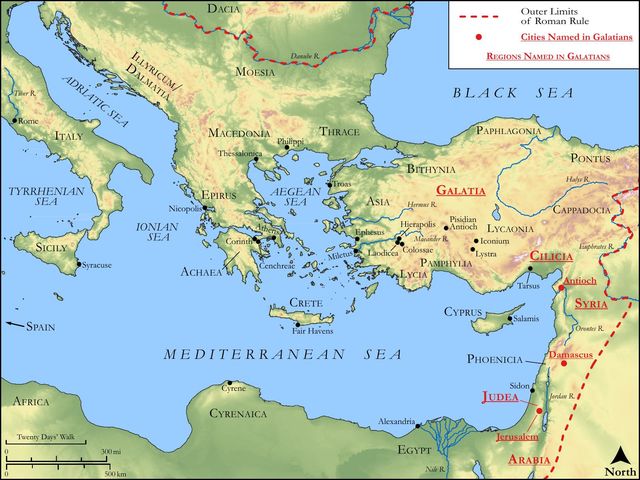
See on the biblical-era maps

Study this verse
Public-domain commentary
Matthew Henry
From his Commentary on the Whole Bible. Henry comments on passages, not single verses — this entry covers Galatians 6:11–18. His three-level outline is real structure in the source text, so it is rendered as structure.
The apostle, having at large established the doctrine of the gospel, and endeavoured to persuade these Christians to a behaviour agreeable to it, seems as if he intended here to have put an end to the epistle, especially when he had acquainted them that, as a particular mark of his respect for them, he had written this large letter with his own hand, and had not made use of another as his amanuensis, and only subscribed his name to it, as he was wont to do in his other epistles: but such is his affection to them such his concern to recover them from the bad impressions made upon them by their false teachers, that he cannot break off till he has once again given them the true character of those teachers, and an account of his own contrary temper and behaviour, that by comparing these together they might the more easily see how little reason they had to depart from the doctrine he had taught them and to comply with theirs.
I.He gives them the true character of those teachers who were industrious to seduce them, in several particulars. As,
1.They were men who desired to make a fair show in the flesh, Gal 6:12. They were very zealous for the externals of religion, forward to observe, and to oblige others to observe, the rites of the ceremonial law, though at the same time they had little or no regard to real piety; for, as the apostle says of them in the following verse, neither do they themselves keep the law. Proud, vain, and carnal hearts desire nothing more than to make a fair show in the flesh, and they can easily be content with so much religion as will help them to keep up such a fair show; but frequently those have least of the substance of religion who are most solicitous to make a show of it.
2.They were men who were afraid of suffering, for they constrained the Gentile Christians to be circumcised, only lest they should suffer persecution for the cross of Christ. It was not so much out of a regard to the law as to themselves; they were willing to sleep in a whole skin, and to save their worldly cargo, and cared not though they made shipwreck of faith and a good conscience. That which they chiefly aimed at was to please the Jews, and to keep up their reputation among them, and so to prevent the trouble that Paul, and other faithful professors of the doctrine of Christ, lay open to. And,
3.Another part of their character was that they were men of a party spirit, and who had no further zeal for the law than as it subserved their carnal and selfish designs; for they desired to have these Christians circumcised, that they might glory in their flesh (Gal 6:13), that they might say they had gained them over to their side, and made proselytes of them, of which they carried the mark in their flesh. And thus, while they pretended to promote religion, they were the greatest enemies of it; for nothing has been more destructive to the interest of religion than men-siding and party-making.
II.He acquaints us, on the other hand, with his own temper and behaviour, or makes profession of his own faith, hope, and joy; particularly,
1.That his principle glory was in the cross of Christ: God forbid, says he, that I should glory, save in the cross of our Lord Jesus Christ, Gal 6:14. By the cross of Christ is here meant his sufferings and death on the cross, or the doctrine of salvation by a crucified Redeemer. This was what the Jews stumbled at and the Greeks accounted foolishness; and the judaizing teachers themselves, though they had embraced Christianity, yet were so far ashamed of it that in compliance with the Jews, and to avoid persecution from them, they were for mixing the observance of the law of Moses with faith in Christ, as necessary to salvation. But Paul had a very different opinion of it; he was so far from being offended at the cross of Christ, or ashamed of it, or afraid to own it, that he gloried in it; yea, he desired to glory in nothing else, and rejected the thought of setting up anything in competition with it, as the object of his esteem, with the utmost abhorrence; God forbid, etc. This was the ground of all his hope as a Christian: this was the doctrine which, as an apostle, he was resolved to preach; and, whatever trials his firm adherence to it might bring upon him, he was ready, not only to submit to them, but to rejoice in them. Note, The cross of Christ is a good Christian's chief glory, and there is the greatest reason why we should glory in it, for to it we owe all our joys and hopes.
2.That he was dead to the world. By Christ, or by the cross of Christ, the world was crucified to him, and he to the world; he had experienced the power and virtue of it in weaning him from the world, and this was one great reason of his glorying in it. The false teachers were men of a worldly temper, their chief concern was about their secular interests, and therefore they accommodated their religion thereunto. But Paul was a man of another spirit; as the world had no kindness for him, so neither had he any great regard to it; he had got above both the smiles and the frowns of it, and had become as indifferent to it as one who is dying out of it. This is a temper of mind that all Christians should be labouring after; and the best way to attain it is to converse much with the cross of Christ. The higher esteem we have of him the meaner opinion shall we have of the world, and the more we contemplate the sufferings our dear Redeemer met with from the world the less likely shall we be to be in love with it.
3.That he did not lay the stress of his religion on one side or the other of the contesting interests, but on sound Christianity, Gal 6:15. There was at that time an unhappy division among Christians; circumcision and uncircumcision had become names by which they were distinguished from each other; for (Gal 2:9, Gal 2:12) the Jewish Christians are called the circumcision, and those of the circumcision. The false teachers were very zealous for circumcision; yea, to such a degree as to represent it as necessary to salvation, and therefore they did all they could to constrain the Gentile Christians to submit to it. In this they had carried the matter much further than others did; for, though the apostles connived at the use of it among the Jewish converts, yet they were by no means for imposing it upon the Gentiles. But what they laid so great a stress upon Paul made very little account of. It was indeed of great importance to the interest of Christianity that circumcision should not be imposed on the Gentile converts, and therefore this he had set himself with the utmost vigour to oppose; but as for mere circumcision or uncircumcision, whether those who embraced the Christian religion had been Jews or Gentiles, and whether they were for or against continuing the use of circumcision, so that they did not place their religion in it - this was comparatively a matter of little moment with him; for he very well knew that in Jesus Christ, that is, in his account, or under the Christian dispensation, neither circumcision availed any thing nor uncircumcision, as to men's acceptance with God, but a new creature. Here he instructs us both wherein real religion does not and wherein it does consist. It does not consist in circumcision or uncircumcision, in our being in this or the other denomination of Christians; but it consists in our being new creatures; not in having a new name, or putting on a new face, but in our being renewed in the spirit of our minds and having Christ formed in us: this is of the greatest account with God, and so it was with the apostle. If we compare this text with some others, we may more fully see what it is that renders us most acceptable to God, and about which we should therefore be chiefly concerned. Here we are told that it is a new creature, and in Gal 5:6 that it is faith which worketh by love, and in Co1 7:19 that it is the keeping of the commandments of God, from all which it appears that it is a change of mind and heart, whereby we are disposed and enabled to believe in the Lord Jesus and to live a life of devotedness to God; and that where this inward, vital, practical religion is wanting, no outward professions, nor particular names, will ever stand us in any stead, or be sufficient to recommend us to him. Were Christians duly concerned to experience this in themselves, and to promote it in others, if it did not make them lay aside their distinguishing names, yet it would at least take them off from laying so great a stress upon them as they too often do. Note, Christians should take care to lay the stress of their religion where God has laid it, namely, on those things which are available to our acceptance with him; so we see the apostle did, and it is our wisdom and interest herein to follow his example. The apostle having shown what was of chief consideration in religion, and what he laid the greatest stress upon, namely, not a mere empty name or profession, but a sound and saving change, in Gal 6:16 he pronounces a blessing upon all those who walk according to this rule: And as many as walk according to this rule peace be upon them, and mercy upon the Israel of God. The rule which he here speaks of may signify more generally the whole word of God, which is the complete and perfect rule of faith and life, or that doctrine of the gospel, or way of justification and salvation, which he had laid down in this epistle, namely, by faith in Christ without the works of the law; or it may be considered as more immediately referring to the new creature, of which he had just before been speaking. The blessings which he desires for those who walk according to this rule, or which he gives them the hope and prospect of (for the words may be taken either as a prayer or a promise), are peace and mercy - peace with God and conscience, and all the comforts of this life as far as they are needful for them, and mercy, or an interest in the free love and favour of God in Christ, which are the spring and fountain of all other blessings. A foundation is laid for these in that gracious change which is wrought in them; and while they behave themselves as new creatures, and govern their lives and hopes by the rule of the gospel, they may most assuredly depend upon them. These, he declares, shall be the portion of all the Israel of God, by whom he means all sincere Christians, whether Jews or Gentiles, all who are Israelites indeed, who, though they may not be the natural, yet are become the spiritual seed of Abraham; these, being heirs of his faith, are also heirs together with him of the same promise, and consequently entitled to the peace and mercy here spoken of. The Jews and judaizing teachers were for confining these blessings to such as were circumcised and kept the law of Moses; but, on the contrary, the apostle declares that they belong to all who walk according to the rule of the gospel, or of the new creature, even to all the Israel of God, intimating that those only are the true Israel of God who walk according to this rule, and not that of circumcision, which they insisted so much upon, and therefore that this was the true way to obtain peace and mercy. Note,
(1.)Real Christians are such as walk by rule; not a rule of their own devising, but that which God himself has prescribed to them.
(2.)Even those who walk according to this rule do yet stand in need of the mercy of God. But,
(3.)All who sincerely endeavour to walk according to this rule may be assured that peace and mercy will be upon them: this is the best way to have peace with God, ourselves, and others; and hereupon, as we may be sure of the favour of God now, so we may be sure that we shall find mercy with him hereafter.
4.That he had cheerfully suffered persecution for the sake of Christ and Christianity, Gal 6:17. As the cross of Christ, or the doctrine of salvation by a crucified Redeemer, was what he chiefly gloried in, so he had been willing to run all hazards rather than he would betray this truth, or suffer it to be corrupted. The false teachers were afraid of persecution, and this was the great reason why they were zealous for circumcision, as we see, Gal 6:12. But this was the least of Paul's concern; he was not moved at any of the afflictions he met with, nor did he count his life dear to him, so that he might finish his course with joy, and the ministry which he had received of the Lord Jesus, to testify the gospel of the grace of God, Act 20:24. He had already suffered much in the cause of Christ, for he bore in his body the marks of the Lord Jesus, the scars of those wounds which he had sustained from persecuting enemies, for his steady adherence to him, and that doctrine of the gospel which he had received from him. As from this it appeared that he was firmly persuaded of the truth and importance of it, and that he was far from being a favourer of circumcision, as they had falsely reported him to be, so hereupon, with a becoming warmth and vehemence, suitable to his authority as an apostle and to the deep concern of mind he was under, he insists upon it that no man should henceforth trouble him, namely by opposing his doctrine or authority, or by any such calumnies and reproaches as had been cast upon him; for as, both from what he had said and what he had suffered, they appeared to be highly unjust and injurious, so also those were very unreasonable who either raised or received them. Note, (1.) It may justly be presumed that men are fully persuaded of those truths in the defence of which they are willing to suffer. And (2.) It is very unjust to charge those things upon others which are contrary not only to their profession, but their sufferings too.
III.The apostle, having now finished what he intended to write for the conviction and recovery of the churches of Galatia, concludes the epistle with his apostolical benediction, Gal 6:18. He calls them his brethren, wherein he shows his great humility, and the tender affection he had for them, notwithstanding the ill treatment he had met with from them; and takes his leave of them with this very serious and affectionate prayer, that the grace of our Lord Jesus Christ may be with their spirit. This was a usual farewell wish of the apostle's, as we see, Rom 16:20, Rom 16:24, and Co1 16:23. And herein he prays that they might enjoy the favour of Christ, both in its special effects and its sensible evidences, that they might receive from him all that grace which was needful to guide them in their way, to strengthen them in their work, to establish them in their Christian course, and to encourage and comfort them under all the trials of life and the prospect of death itself. This is fitly called the grace of our Lord Jesus Christ, as he is both the sole purchaser and the appointed dispenser of it; and though these churches had done enough to forfeit it, by suffering themselves to be drawn into an opinion and practice highly dishonourable to Christ, as well as dangerous to them, yet, out of his great concern for them, and knowing of what importance it was to them, he earnestly desires it on their behalf; yea, that it might be with their spirit, that they might continually experience the influences of it upon their souls, disposing and enabling them to act with sincerity and uprightness in religion. We need desire no more to make us happy than the grace of our Lord Jesus Christ. This the apostle begs for these Christians, and therein shows us what we are chiefly concerned to obtain; and, both for their and our encouragement to hope for it, he adds his Amen.
Historical interpretation
Three Centuries of Reception
12 surviving comments on this verse. Each one is dated, so this reads as a timeline rather than a list.
Select a marker to jump to its quote. Markers stagger vertically where authors wrote within a few decades of each other.
Mindful of him, do ye by all means know that Jesus the Lord was truly born of Mary, being made of a woman; and was as truly crucified. For, says he, "God forbid that I should glory, save in the cross of the Lord Jesus." And He really suffered, and died, and rose again. For says [Paul], "If Christ should become passible, and should be the first to rise again from the dead." And again, "In that He died, He died unto sin once: but in that He liveth, He liveth unto God." Otherwise, what advantage would there be in [becoming subject to] bonds, if Christ has not died? what advantage in patience? what advantage in [enduring] stripes? And why such facts as the following: Peter was crucified; Paul and James were slain with the sword; John was banished to Patmos; Stephen was stoned to death by the Jews who killed the Lord? But, [in truth, ] none of these sufferings were in vain; for the Lord was really crucified by the ungodly.
And again: "God forbid that I should glory in anything
The severance, therefore, of the soul from the body, made a life-long study, produces in the philosopher gnostic alacrity, so that he is easily able to bear natural death, which is the dissolution of the chains which bind the soul to the body. "For the world is crucified to me, and I to the world," the [apostle] says; "and now I live, though in the flesh, as having my conversation in heaven."
Moreover, "the world is crucified unto me," who am a servant of the Creator-"the world," (I say, ) but not the God who made the world-"and I unto the world," not unto the God who made the world.
Paul proclaims in a loud and lofty voice, "But God forbid that I should glory, save in the cross of our Lord Jesus Christ, by whom the world is crucified unto me, and I unto the world." And yet a virgin in the Church glories concerning her fleshly appearance and the beauty of her body! Paul adds, and says, "For they that are Christ's have crucified their flesh, with its faults and lusts." And she who professes to have renounced the lusts and vices of the flesh, is found in the midst of those very things which she has renounced! Virgin, thou art taken, thou art exposed, thou boastest one thing and affectest another. You sprinkle yourself with the stains of carnal concupiscence, although you are a candidate of purity and modesty. "Cry," says the Lord to Isaiah, "All flesh is grass, and all the glory of it as the flower of the grass: the grass withereth, and the flower fadeth; but the word of the Lord endureth for ever." It is becoming for no Christian, and especially it is not becoming for a virgin, to regard any glory and honour of the flesh, but only to desire the word of God, to embrace benefits which shall endure for ever. Or, if she must glory in the flesh, then assuredly let her glory when she is tortured in confession of the name; when a woman is found to be stronger than the tortures; when she suffers fire, or the cross, or the sword, or the wild beasts, that she may be crowned. These are the precious jewels of the flesh, these are the better ornaments of the body.
That he who has attained to trust, having put off the former man, ought to regard only celestial and spiritual things, and to give no heed to the world which he has already renounced. In Isaiah: "Seek ye the Lord; and when ye have found Him, call upon Him. But when He hath come near unto you, let the wicked forsake his ways, and the unrighteous man his thoughts: and let him be turned unto the Lord, and he shall obtain mercy, because He will plentifully pardon your sins." Of this same thing in Solomon: "I have seen all the works which are done under the sun; and, lo, all are vanity." Of this same thing in Exodus: "But thus shall ye eat it; your loins girt, and your shoes on your feet, and your staves in your hands: and ye shall eat it in haste, for it is the Lord's passover." Of this same thing in the Gospel according to Matthew: "Take no thought, saying, What shall we eat? or, What shall we drink? or, Wherewith shall we be clothed? for these things the nations seek after. But your Father knoweth that ye have need of all these things. Seek first the kingdom of God, and His righteousness; and all these things shall be added unto you." Likewise in the same place: "Think not for the morrow, for the morrow shall take thought for itself. Sufficient unto the day is its own evil." Likewise in the same place: "No one looking back, and putting his hands to the plough, is fit for the kingdom of God." Also in the same place: "Behold the fowls of the heaven: for they sow not, nor reap, nor gather into barns; and your heavenly Father feedeth them. Are not ye of more value than they? " Concerning this same thing, according to Luke: "Let your loins be girded, and your lamps burning; and ye like unto men that wait for their lord, when he cometh from the wedding; that, when he cometh and knocketh, they may open to him. Blessed are those servants, whom their lord, when he cometh, shall find watching." Of this same thing in Matthew: "The foxes have holes, and the birds of the heaven have nests; but the Son of man hath not where He may lay His head." Also in the same place: "Whoso forsaketh not all that he hath, cannot be my disciple." Of this same thing in the first to the Corinthians: "Ye are not your own, for ye are bought with a great price. Glorify and bear God in your body." Also in the same place: "The time is limited. It remaineth, therefore, that both they who have wives be as though they have them not, and they who lament as they that lament not, and they that rejoice as they that rejoice not, and they who buy as they that buy not, and they who possess as they who possess not, and they who use this world as they that use it not; for the fashion of this world passeth away." Also in the same place: "The first man is of the clay of the earth, the second man from heaven. As he is of the clay, such also are they who are of the clay; and as is the heavenly, such also are the heavenly. Even as we have borne the image of him who is of the clay, let us bear His image also who is from heaven." Of this same matter to the Philippians: "All seek their own, and not those things which are Christ's; whose end is destruction, whose god is their belly, and their glory is to their confusion, who mind earthly things. For our conversation is in heaven, whence also we expect the Saviour, our Lord Jesus Christ, who shall transform the body of our humiliation conformed to the body of His glory." Of this very matter to Galatians: "But be it far from me to boast, except in the cross of our Lord Jesus Christ, by whom the world is crucified unto me, and I unto the world." Concerning this same thing to Timothy: "No man that warreth for God bindeth himself with worldly annoyances, that he may please Him to whom he hath approved himself. But and if a man should contend, he will not be crowned unless he fight lawfully." Of this same thing to the Colossians: "If ye be dead with Christ froth I the elements of the world, why still, as if living in the world, do ye follow vain things? " Also concerning this same thing: "If ye have risen together with Christ, seek those things which are above, where Christ is sitting on the right hand of God. Give heed to the things that are above, not to those things which are on the earth; for ye are dead, and your life is hidden with Christ in God. But when Christ your life shall appear, then shall ye also appear with Him in glory." Of this same thing to the Ephesians: Put off the old man of the former conversation, who is corrupted, according to the lusts of deceit. But be ye renewed in the spirit of your mind, and put on the new man, him who according to God is ordained in righteousness, and holiness, and truth." Of this same thing in the Epistle of Peter: "As strangers and pilgrims, abstain from fleshly lusts, which war against the soul; but having a good conversation among the Gentiles, that while they detract from you as if from evildoers, yet, beholding your good works, they may magnify God." Of this same thing in the Epistle of John: "He who saith he abideth in Christ, ought himself also to walk even as He walked." Also in the same place: "Love not the world, neither the things that are in the world. If any man loveth the world, the love of the Father is not in him. Because everything which is in the world is lust of the flesh, and lust of the eyes, and the ambition of this world, which is not of the Father, but of the lust of this world. And the world shall pass away with its lust. But he that doeth the will of God abideth for ever, even as God abideth for ever." Also in the first Epistle of Paul to the Corinthians: "Purge out the old leaven, that ye may be a new dough, as ye are unleavened. For also Christ our passover is sacrificed. Therefore let us celebrate the feast, not in the old leaven, nor in the leaven of malice and wickedness, but in the unleavened bread of sincerity and truth."
And to return to the praise of martyrdom, there is a word of the blessed Paul, who says; "Know ye not that they who run in a race strive many, but one receiveth the prize? But do ye so run, that all of you may obtain." Moreover also elsewhere, that be may exhort us to martyrdom, he has called us fellow-heirs with Christ; nay, that he might omit nothing, he says, "If ye are dead with Christ, why, as if living in the world, do ye make distinctions? " Because, dearest brethren, we who bear the rewards of resurrection, who seek for the day of judgment, who, in fine, are trusting that we shall reign with Christ, ought to be dead to the world. For you can neither desire martyrdom till you have first hated the world, nor attain to God's reward unless you have loved Christ. And he who loves Christ does not love the world. For Christ was given up by the world, even as the world also was given up by Christ; as it is written, "The world is crucified unto me, and I unto the world." The world has been an object of affection to none whom the Lord has not previously condemned; nor could he enjoy eternal salvation who has gloried in the life of the world. That is the very voice of Christ, who says: "He that loveth his life in this world, shall lose it in the world to come; but he that hateth his life in this world, shall find it in the world to come." Moreover, also, the Apostle Paul says: "Be ye imitators of me, as I also am of Christ." And the same elsewhere says: "I wish that all of you, if it were possible, should be imitators of me."
But they say that the gods do this, not through fear, but through hatred; as though it were possible for any one to hate another, unless it be him who injures, or has the power of injuring. Yea, truly, it would be consistent with their majesty to visit those whom they hated with immediate punishment, rather than to flee from them. But since they can neither approach those in whom they shall see the heavenly mark, nor injure those whom the immortal sign as an impregnable wall protects, they harass them by men, and persecute them by the hands of others: and if they acknowledge the existence of these demons, we have overcome; for this must necessarily be the true religion, which both understands the nature of demons, and understands their subtlety, and compels them, vanquished and subdued, to yield to itself.
When Paul writes that the cross is glory, he means obviously “the cross of our Lord Jesus Christ.” When in that mystery his body hung from the cross and in it crushed the power of this world, the whole world was crucified through him. In the cross he identified with every person in the world. In doing so, he made everything that he suffered universal, that is, he caused all flesh to be crucified in his death. Therefore I too am fixed to the cross and to the world. I means the one who was living carnally, whose thoughts were of the flesh. Such a one is now “nailed to the world,” that is, the worldly things in him are subjected to death.
Such is a soul winged with heavenly love. For if those who cherish the foul earthly passion which men call love, think nothing either glorious or precious, but those things alone which tend to gratify their lust, they think both glorious and honorable, and their mistress is everything to them; much more do those, who have been taken captive by this heavenly love, think nothing of the cost. Would that I could bring forward examples of all this from among ourselves: but since we are at a loss for such, we must needs betake ourselves to this same Paul. Observe him then, how he felt towards the whole world. "The world is crucified unto me," he says, "and I unto the world": I am dead to the world, and the world is dead to me.
"But far be it from me to glory, save in the cross of our Lord Jesus Christ."
Truly this symbol is thought despicable; but it is so in the world's reckoning, and among men; in Heaven and among the faithful it is the highest glory. Poverty too is despicable, but it is our boast; and to be cheaply thought of by the public is a matter of laughter to them, but we are elated by it. So too is the Cross our boast. He does not say, "I boast not," nor, "I will not boast," but, "Far be it from me that I should," as if he abominated it as absurd, and invoked the aid of God in order to his success therein. And what is the boast of the Cross? That Christ for my sake took on Him the form of a slave, and bore His sufferings for me the slave, the enemy, the unfeeling one; yea He so loved me as to give Himself up to a curse for me. What can be comparable to this! If servants who only receive praise from their masters, to whom they are akin by nature, are elated thereby, how must we not boast when the Master who is very God is not ashamed of the Cross which was endured for us. Let us then not be ashamed of His unspeakable tenderness; He was not ashamed of being crucified for thy sake, and wilt thou be ashamed to confess His infinite solicitude? It is as if a prisoner who had not been ashamed of his King, should, after that King had come to the prison and himself loosed the chains, become ashamed of him on that account. Yet this would be the height of madness, for this very fact would be an especial ground for boasting.
"Through which the world hath been crucified unto me, and I unto the world."
What he here calls the world is not the heaven nor the earth, but the affairs of life, the praise of men, retinues, glory, wealth, and all such things as have a show of splendor. To me these things are dead. Such an one it behooves a Christian to be, and always to use this language. Nor was he content with the former putting to death, but added another, saying, "and I unto the world," thus implying a double putting to death, and saying, They are dead to me, and I to them, neither can they captivate and overcome me, for they are dead once for all, nor can I desire them, for I too am dead to them. Nothing can be more blessed than this putting to death, for it is the foundation of the blessed life.
(Verse 14.) But far be it from me to boast except in the cross of our Lord Jesus Christ, by which the world has been crucified to me, and I to the world. For neither circumcision counts for anything, nor uncircumcision, but a new creation. And as for all who walk by this rule, peace and mercy be upon them, and upon the Israel of God. But that world is crucified to the just one, of whom the Savior says: I have conquered the world (John 16:33). And: Do not love the world. And: You have not received the spirit of the world. To whom the world is crucified, to him the world is also dead: and now the end of the world has come to him, and he is worthy of the new heaven and the new earth, and the new Testament, he sings a new song, and receives a new name written in a book, which no one knows except the one who receives it. It is asked how now Paul says: But God forbid that I should glory, save in the cross of our Lord Jesus Christ, by whom the world is crucified unto me, and I unto the world. (Galatians 6:14). And in another place concerning others: That in this boasting I may not be put to shame. (2 Corinthians 9:4). And again: But he said to me: My grace is sufficient for thee; for power is made perfect in weakness. (2 Corinthians 12:9). And in another place: But though I should have a mind to glory, I shall not be foolish; for I will say the truth. But I forbear, lest any man should think of me above that which he seeth in me or any thing he heareth from me. (2 Corinthians 12:6). And so on, such as are written in this manner. But it must be known that all that boasting related to the cross, let the glory be to the cross: and whatever worthy is accomplished in virtues, let it be done because of the Lord's passion.
Continue studying Galatians 6:14 across the web’s major study libraries — every link below opens this exact verse, chapter, or book on the destination site.
Read & Compare
 BibleGatewayThis verse in more than 200 translations and 70 languages.
 Bible.comThe YouVersion reader — hundreds of translations, reading plans, and highlights.
 ESV.orgCrossway's official English Standard Version reader.
 NET BibleThe NET translation with 60,000+ translators' notes on every rendering decision.
 STEP BibleTyndale House's free study tool — original text, vocabulary, and scholarly resources.
 BibliaLogos Bible Software's free web reader.
 USCCBThe New American Bible (Revised Edition) with the U.S. bishops' study notes.
Commentaries
 BibleHub CommentariesDozens of classic commentaries on this verse, gathered on one page.
 StudyLightMore than 100 commentary sets — the largest collection on the web.
 BibleRefPlain-English commentary on what this verse means, verse by verse.
 Enduring WordDavid Guzik's free commentary on this chapter, widely used by Bible teachers.
 Bible Study ToolsVerse commentary alongside Greek and Hebrew study aids.
Original Language & Research
- BibleHub InterlinearThe verse word by word — original language, transliteration, and English.
- BibleHub LexiconEvery word's original-language definition and Strong's entry.
 Blue Letter BibleDeep-study tools — Strong's numbers, concordance, and word studies.
 CNTR CollationThe earliest Greek manuscripts of this verse, collated letter by letter.
Sermons, Hymns & Audio


TrulyRandomVerse is not affiliated with these sites and doesn’t control their content. They’re linked because they’re genuinely useful.
Summary
This verse stands as a climactic declaration from the Apostle Paul, encapsulating the central message of his Epistle to the Galatians and sharply contrasting his singular devotion with the self-serving motives of the false teachers. It profoundly asserts that the cross of our Lord Jesus Christ is the exclusive and ultimate object of a believer's glory, confidence, and allegiance, simultaneously signifying a radical and irreversible break from the world's values and systems.
Context
ShowHideLiterary Context
Galatians 6:14 serves as a powerful concluding statement within Paul's impassioned defense of the Gospel of grace. Throughout the letter, Paul has vehemently countered the "Judaizers," false teachers who insisted that Gentile converts needed to observe Mosaic Law, particularly circumcision, to be truly saved and righteous before God. This verse follows Paul's direct confrontation of these teachers' motives in Galatians 6:12-13, where he exposes their desire to avoid persecution for the cross and to boast in the flesh (i.e., in the circumcision of their converts). Paul's declaration in verse 14 thus stands in stark contrast to their legalistic and self-serving agenda, asserting his sole allegiance and glory in the atoning work of Christ on the cross, which he has championed since the opening chapters of the epistle (e.g., Galatians 1:6-9).
Historical & Cultural Context
The churches in Galatia, likely located in the Roman province of Galatia (modern-day Turkey), comprised a mix of Jewish and Gentile believers. The controversy addressed in this epistle arose from the infiltration of "Judaizers," Jewish Christians who insisted that Gentile converts must be circumcised and adhere to the Mosaic Law to be fully part of God's covenant people. This teaching directly challenged the core of Paul's gospel, which proclaimed salvation through faith in Christ alone, apart from works of the law (see Galatians 2:16). For the Judaizers, boasting in circumcision was a way to maintain their Jewish identity and avoid social stigma or persecution from their Jewish compatriots, as the cross was a scandal to Jews (1 Corinthians 1:23). Paul's declaration of glorying only in the cross was a radical counter-cultural statement, as crucifixion was a shameful, brutal form of execution reserved for criminals and slaves, signifying utter disgrace in both Roman and Jewish societies (Deuteronomy 21:23).
Key Themes
ShowHideThis pivotal verse encapsulates several major theological themes central to Paul's entire letter and indeed, his theology. Firstly, it powerfully asserts The Supremacy of the Cross, elevating Christ's crucifixion from an instrument of shame to the singular object of Christian glory. For Paul, the cross represents not merely a historical event but the definitive act of God's redemptive love, offering atonement for sin, reconciliation with God, and victory over spiritual powers (as seen in Colossians 2:14-15). Secondly, the verse highlights the theme of Radical Transformation and New Identity, expressed through the reciprocal crucifixion of "the world unto me, and I unto the world." This signifies a complete break from the world's values, systems, and pursuit of human approval, and an embrace of a new life defined by Christ (a theme echoed in Galatians 2:20). Finally, it underscores the theme of Boasting in Christ Alone, directly contrasting with the Judaizers' self-righteous boasting in human effort (circumcision) and emphasizing that true spiritual pride belongs only in God's saving work through Christ, echoing Paul's earlier declaration in Galatians 3:3).
Exposition and Analysis
ShowHideKey Word Analysis
ShowHideThis verb means "to boast, exult, or take pride in." Paul uses it to highlight the object of his ultimate confidence and source of honor. In contrast to those who boast in human achievements or external markers like circumcision, Paul directs all his boasting towards the cross of Christ, signifying a radical reorientation of values and allegiance.
Originally referring to an upright stake or pole used for capital punishment, this term here figuratively denotes the instrument of Christ's death and, by implication, His atoning sacrifice. For Paul, the cross is not merely a symbol of suffering but the locus of God's redemptive power, where sin was defeated and reconciliation achieved. It represents the very heart of the Gospel.
This verb means "to impale on the cross" and, figuratively, "to extinguish (subdue) passion or selfishness." Used in the perfect passive tense ("is crucified"), it indicates a completed action with lasting results. In this context, it signifies a decisive, once-for-all spiritual break from the world's influence and values, as well as the world's loss of power over the believer.
Verse Breakdown
ShowHide"But God forbid that I should glory"
Paul begins with a powerful and emphatic rejection, expressed by the Greek idiom mē genoito (from mḗ G3361 and gínomai G1096), meaning "May it never be!" or "Absolutely not!" This strong negation underscores his absolute refusal to boast in anything other than what he is about to state. It sets a stark contrast with the self-serving boasting of the Judaizers and highlights his complete reorientation of values.
"save in the cross of our Lord Jesus Christ"
This clause reveals the singular object of Paul's boast and confidence. The "cross" (Greek, staurós G4716) refers not just to the wooden instrument but to the entire event of Christ's atoning death—His sacrifice for sin, His victory over evil, and the foundation of God's grace. For Paul, this event is the ultimate display of divine power and love, the sole source of salvation, righteousness, and true glory, utterly eclipsing any human achievement or religious ritual.
"by whom the world is crucified unto me"
The phrase "by whom" (Greek, diá ho G1223 G3739) indicates the agency or means through which this spiritual reality occurs—namely, through Christ and His cross. "The world" (Greek, kósmos G2889) here refers not to the physical creation but to the fallen, unredeemed system of human values, ambitions, and spiritual opposition to God. To say the world "is crucified unto me" (Greek, stauróō G4717 in the perfect passive) means that the world's power, allurements, and judgments have been definitively rendered powerless and dead in Paul's life. Its influence is decisively broken, as if it were executed and lifeless.
"and I unto the world"
This reciprocal statement completes the profound spiritual separation. Just as the world has lost its power over Paul, Paul himself is spiritually dead to the world's expectations, standards, and approval. His identity, priorities, and allegiance are no longer shaped by worldly desires or societal pressures. This signifies a radical, irreversible break, where his former self, aligned with worldly values, has been put to death through his identification with Christ's crucifixion, resulting in a new life in Christ.
Literary Devices
ShowHidePaul employs several potent literary devices in this verse to convey his profound theological conviction. The most striking is Metaphor, particularly in the phrases "the cross of our Lord Jesus Christ" and "the world is crucified unto me, and I unto the world." The "cross" itself is a powerful metaphor for Christ's atoning work, His suffering, and His triumph over sin and death. The reciprocal "crucifixion" of Paul to the world and the world to Paul is a vivid and forceful metaphor for a complete, decisive break and spiritual death to the old way of life and its values. This is further intensified by Personification, where "the world" is treated as an entity capable of being "crucified," emphasizing its active opposition to God and its subsequent defeat in the believer's life. The opening phrase, "God forbid" (mē genoito), is a strong Idiom or Exclamation, conveying Paul's absolute and vehement rejection of any alternative source of glory. Finally, the verse exhibits a powerful Antithesis or Contrast, setting Paul's singular glorying in the cross against the implicit boasting in human achievements or legalistic practices of the Judaizers, thereby highlighting the radical difference between the Gospel of grace and a gospel of works.
Theological and Thematic Connections
ShowHideGalatians 6:14 encapsulates the very heart of Pauline theology: the centrality and all-sufficiency of the cross of Christ. Theologically, it asserts that true glory and salvation are found exclusively in Christ's finished work, not in human effort, religious ritual, or worldly status. This radical reorientation of allegiance signifies a profound spiritual transformation, where the believer dies to the dominion of sin and the world's values, and lives for Christ. This "crucifixion to the world" is not a gradual process but a definitive break, a spiritual death that mirrors Christ's physical death, resulting in a new creation. It underscores the complete inadequacy of the law for salvation and the absolute supremacy of grace, challenging any system that would add human merit to God's perfect provision in Christ. The cross, once a symbol of shame, becomes the ultimate symbol of divine love, power, and redemption, the sole ground for Christian boasting and the catalyst for a life fully devoted to God.
Reflection and Application
ShowHidePaul's declaration in Galatians 6:14 serves as a profound call to introspection and a radical re-evaluation of our own lives. In a world that constantly beckons us to find significance in wealth, status, achievements, or even religious performance, Paul redirects our gaze entirely to the cross of Jesus Christ. This verse challenges us to examine what we truly "glory" in. Is our confidence placed in our own abilities, our moral uprightness, our social standing, or even our spiritual disciplines? Or is our boast solely in the scandalous yet glorious work of Christ on the cross? Embracing this truth means a decisive break from the world's allurements and its system of values. It calls us to live as those who have died to self-promotion, worldly approval, and the pursuit of fleeting earthly treasures, recognizing that our true identity, purpose, and hope are found only in our union with Christ crucified. This radical detachment empowers us to live with freedom from worldly pressures and a singular focus on glorifying God through our lives, embodying the transformative power of the cross.
Questions for Reflection
ShowHideFAQ
ShowHideWhat does Paul mean by "God forbid that I should glory"?
ShowHidePaul uses a strong Greek idiom, mē genoito (G3361 G1096), which translates to "May it never be!" or "Absolutely not!" It's an emphatic rejection of the idea that he would boast in anything other than the cross of Christ. This phrase highlights Paul's passionate conviction and serves as a sharp contrast to the false teachers who boasted in external religious practices like circumcision (as seen in Galatians 6:12-13).
What is "the world" that is crucified to Paul, and Paul to the world?
ShowHideIn this context, "the world" (Greek, kósmos G2889) refers not to the physical planet or humanity in general, but to the fallen, unredeemed system of human values, ambitions, and spiritual opposition to God. It encompasses worldly wisdom, pride, self-righteousness, and the pursuit of human approval or material gain. When Paul says "the world is crucified unto me," he means that this system has lost its power, appeal, and influence over him; it is dead to him. Conversely, "and I unto the world" means Paul himself is dead to the world's expectations, judgments, and allurements. His identity and allegiance are no longer defined by worldly standards but by his union with Christ, a concept further explored in Romans 6:1-11.
Why is the cross the only thing Paul would glory in?
ShowHideFor Paul, the cross represents the complete and perfect work of Jesus Christ in securing salvation. It is where sin was atoned for, where God's justice and love met, and where victory over sin, death, and the powers of darkness was achieved. Unlike human achievements or adherence to the Law, which can lead to self-righteousness and boasting in the flesh, the cross leaves no room for human pride. It is an act of sheer grace, demonstrating God's unmerited favor. To glory in the cross is to glory in God's power and wisdom, not human weakness (see 1 Corinthians 1:18-25). It is the sole foundation for true righteousness and eternal hope.
Christ-Centered Fulfillment
ShowHideGalatians 6:14 finds its ultimate Christ-centered fulfillment in the very person and work of Jesus Christ, making His cross the singular focal point of all redemptive history. The cross is not merely a historical event but the divine act by which God reconciled the world to Himself (2 Corinthians 5:19). In Christ, the curse of the law was broken, as He became a curse for us, being hung on a tree (Galatians 3:13). His crucifixion is the means by which believers are united with Him in His death, burying their old sinful nature and rising to newness of life (Romans 6:4). Therefore, Paul's boast in the cross is a boast in Christ's complete and sufficient sacrifice, which utterly nullifies any human attempt at self-justification or glory. The "world" that is crucified to Paul is the very system of sin and death that Christ conquered on the cross, demonstrating His triumph over all principalities and powers (Colossians 2:15). Thus, to glory in the cross is to glory in Christ's victory, His perfect righteousness imputed to us, and the new creation life that flows from His resurrection, making Him the Alpha and Omega of our salvation and the sole object of our worship and devotion (Revelation 1:8).