


Romans 1:16
Bible text: King James Version (1769 Blayney text) · Public domain
Bible text: King James Version with Strong's numbers · Public domain
Bible text: Berean Standard Bible · Public domain
Bible text: American Standard Version (1901) · Public domain
Bible text: World English Bible, Messianic edition · Public domain
Bible text: Geneva Bible (1599) · Public domain
Bible text: Young's Literal Translation · Public domain
- οὐouNotG3756PRT-NNegative Particle Negative
- γὰρgarforG1063CONJConjunction
- ἐπαισχύνομαιepaischunomaiI am ashamed ofG1870V-PNI-1SVerb Present Middle Or Passive Deponent Indicative 1st Singular
- τὸtotheG3588T-ASNDefinite article Accusative Singular Neuter
- εὐαγγέλιονeuangeliongospelG2098N-ASNNoun Accusative Singular Neuter
- τοῦtouof theG3588T-GSMDefinite article Genitive Singular Masculine
- χριστοῦ·christouChristG5547N-GSM-TNoun Genitive Singular Masculine Title
- δύναμιςdunamis[the] powerG1411N-NSFNoun Nominative Singular Feminine
- γὰρgarforG1063CONJConjunction
- θεοῦtheouof GodG2316N-GSM-TNoun Genitive Singular Masculine Title
- ἐστινestinit isG1510V-PAI-3SVerb Present Active Indicative 3rd Singular
- εἰςeisuntoG1519PREPPreposition
- σωτηρίανsōtēriansalvationG4991N-ASFNoun Accusative Singular Feminine
- παντὶpantito everyoneG3956A-DSMAdjective Dative Singular Masculine
- τῷtōwhoG3588T-DSMDefinite article Dative Singular Masculine
- πιστεύοντιpisteuontiis believing —G4100V-PAP-DSMVerb Present Active Participle Dative Singular Masculine
- ἸουδαίῳIoudaiōto JewG2453N-DSM-PGNoun Dative Singular Masculine Individual Gentilic
- τεtebothG5037CONJConjunction
- πρῶτονprōtonfirstG4413A-ASNAdjective Accusative Singular Neuter
- καὶkaiandG2532CONJConjunction
- ἝλληνιHellēnito GreekG1672N-DSM-LGNoun Dative Singular Masculine Location Gentilic
English is a literal word-by-word gloss of the Greek, not the KJV's wording. Why?
This is the original text the KJV's translators worked from — each Greek word with its own literal English meaning in this verse, prepared by scholars at Tyndale House, Cambridge. The KJV translates whole sentences, not word by word, so its wording differs: one Greek word can become several English words, and the KJV may choose “charity” where the gloss reads “love”. Both are faithful — they answer different questions. For the KJV's own rendering, switch to the KJV text.
Details
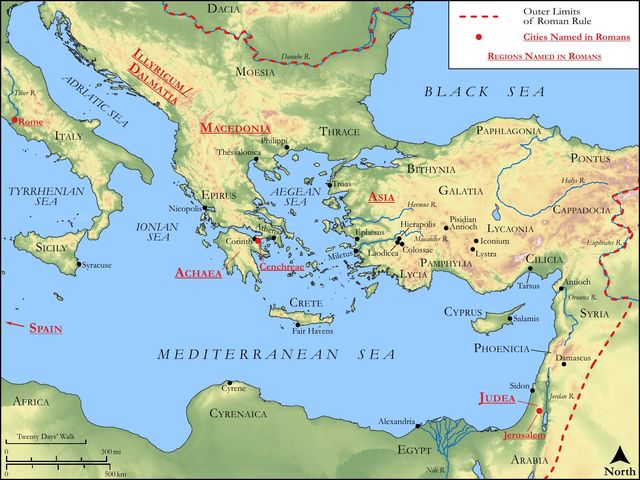
See on the biblical-era maps

Study this verse
Public-domain commentary
Matthew Henry
From his Commentary on the Whole Bible. Henry comments on passages, not single verses — this entry covers Romans 1:16–18. His three-level outline is real structure in the source text, so it is rendered as structure.
Paul here enters upon a large discourse of justification, in the latter part of this chapter laying down his thesis, and, in order to the proof of it, describing the deplorable condition of the Gentile world. His transition is very handsome, and like an orator: he was ready to preach the gospel at Rome, though a place where the gospel was run down by those that called themselves the wits; for, saith he, I am not ashamed of it, Rom 1:16. There is a great deal in the gospel which such a man as Paul might be tempted to be ashamed of, especially that he whose gospel it is was a man hanged upon a tree, that the doctrine of it was plain, had little in it to set it off among scholars, the professors of it were mean and despised, and every where spoken against; yet Paul was not ashamed to own it. I reckon him a Christian indeed that is neither ashamed of the gospel nor a shame to it. The reason of this bold profession, taken from the nature and excellency of the gospel, introduces his dissertation.
I.The proposition, Rom 1:16, Rom 1:17. The excellency of the gospel lies in this, that it reveals to us,
1.The salvation of believers as the end: It is the power of God unto salvation. Paul is not ashamed of the gospel, how mean and contemptible soever it may appear to a carnal eye; for the power of God works by it the salvation of all that believe; it shows us the way of salvation (Act 16:17), and is the great charter by which salvation is conveyed and made over to us. But,
(1.)It is through the power of God; without that power the gospel is but a dead letter; the revelation of the gospel is the revelation of the arm of the Lord (Isa 53:1), as power went along with the word of Christ to heal diseases.
(2.)It is to those, and those only, that believe. Believing interests us in the gospel salvation; to others it is hidden. The medicine prepared will not cure the patient if it be not taken. - To the Jew first. The lost sheep of the house of Israel had the first offer made them, both by Christ and his apostles. You first (Act 3:26), but upon their refusal the apostles turned to the Gentiles, Act 13:46. Jews and Gentiles now stand upon the same level, both equally miserable without a Saviour, and both equally welcome to the Saviour, Col 3:11. Such doctrine as this was surprising to the Jews, who had hitherto been the peculiar people, and had looked with scorn upon the Gentile world; but the long-expected Messiah proves a light to enlighten the Gentiles, as well as the glory of his people Israel.
2.The justification of believers as the way (Rom 1:17): For therein, that is, in this gospel, which Paul so much triumphs in, is the righteousness of God revealed. Our misery and ruin being the product and consequent of our iniquity, that which will show us the way of salvation must needs show us the way of justification, and this the gospel does. The gospel makes known a righteousness. While God is a just and holy God, and we are guilty sinners, it is necessary we should have a righteousness wherein to appear before him; and, blessed be God, there is such a righteousness brought in by Messiah the prince (Dan 9:24) and revealed in the gospel; a righteousness, that is, a gracious method of reconciliation and acceptance, notwithstanding the guilt of our sins. This evangelical righteousness,
(1.)Is called the righteousness of God; it is of God's appointing, of God's approving and accepting. It is so called to cut off all pretensions to a righteousness resulting from the merit of our own works. It is the righteousness of Christ, who is God, resulting from a satisfaction of infinite value.
(2.)It is said to be from faith to faith, from the faithfulness of God revealing to the faith of man receiving (so some); from the faith of dependence upon God, and dealing with him immediately, as Adam before the fall, to the faith of dependence upon a Mediator, and so dealing with God (so others); from the first faith, by which we are put into a justified state, to after faith, by which we live, and are continued in that state: and the faith that justifies us is no less than our taking Christ for our Saviour, and becoming true Christians, according to the tenour of the baptismal covenant; from faith engrafting us into Christ, to faith deriving virtue from him as our root: both implied in the next words, The just shall live by faith. Just by faith, there is faith justifying us; live by faith, there is faith maintaining us; and so there is a righteousness from faith to faith. Faith is all in all, both in the beginning and progress of a Christian life. It is not from faith to works, as if faith put us into a justified state, and then works preserved and maintained us in it, but it is all along from faith to faith, as Co2 3:18, from glory to glory; it is increasing, continuing, persevering faith, faith pressing forward, and getting ground of unbelief. To show that this is no novel upstart doctrine, he quotes for it that famous scripture in the Old Testament, so often mentioned in the New (Hab 2:4): The just shall live by faith. Being justified by faith he shall live by it both the life of grace and of glory. The prophet there had placed himself upon the watch-tower, expecting some extraordinary discoveries (Rom 1:1), and the discovery was of the certainty of the appearance of the promised Messiah in the fulness of time, not withstanding seeming delays. This is there called the vision, by way of eminence, as elsewhere the promise; and while that time is coming, as well as when it has come, the just shall live by faith. Thus is the evangelical righteousness from faith to faith - from Old Testament faith in a Christ to come to New Testament faith in a Christ already come.
II.The proof of this proposition, that both Jews and Gentiles stand in need of a righteousness wherein to appear before God, and that neither the one nor the other have nay of their own to plead. Justification must be either by faith or works. It cannot be by works, which he proves at large by describing the works both of Jews and Gentiles; and therefore he concludes it must be by faith, Rom 3:20, Rom 3:28. The apostle, like a skilful surgeon, before he applies the plaster, searches the wound - endeavours first to convince of guilt and wrath, and then to show the way of salvation. This makes the gospel the more welcome. We must first see the righteousness of God condemning, and then the righteousness of God justifying will appear worthy of all acceptation. In general (Rom 1:18), the wrath of God is revealed. The light of nature and the light of the law reveal the wrath of God from sin to sin. It is well for us that the gospel reveals the justifying righteousness of God from faith to faith. The antithesis is observable. Here is,
1.The sinfulness of man described; he reduceth it to two heads, ungodliness and unrighteousness; ungodliness against the laws of the first table, unrighteousness against those of the second.
2.The cause of that sinfulness, and that is, holding the truth in unrighteousness. Some communes notitae, some ideas they had of the being of God, and of the difference of good and evil; but they held them in unrighteousness, that is, they knew and professed them in a consistency with their wicked courses. They held the truth as a captive or prisoner, that it should not influence them, as otherwise it would. An unrighteous wicked heart is the dungeon in which many a good truth is detained and buried. Holding fast the form of sound words in faith and love is the root of all religion (Ti2 1:13), but holding it fast in unrighteousness is the root of all sin.
3.The displeasure of God against it: The wrath of God is revealed from heaven; not only in the written word, which is given by inspiration of God (the Gentiles had not that), but in the providences of God, his judgments executed upon sinners, which do not spring out of the dust, or fall out by chance, nor are they to be ascribed to second causes, but they are a revelation from heaven. Or wrath from heaven is revealed; it is not the wrath of a man like ourselves, but wrath from heaven, therefore the more terrible and the more unavoidable.
Historical interpretation
Eleven Centuries of Reception
8 surviving comments on this verse. Each one is dated, so this reads as a timeline rather than a list.
Select a marker to jump to its quote. Markers stagger vertically where authors wrote within a few decades of each other.
And so in the passage where he says: "I am not ashamed of the gospel (of Christ): for it is the power of god unto salvation to every one that beheveth; to the Jew first, and also to the Greek; for therein is the righteousness of God revealed from faith to faith," he undoubtedly ascribes both the gospel and salvation to Him whom (in accordance with our heretic's own distinction) I have called the just God, not the good one.
Many attacks were made on the gospel when it was first preached, but Paul learned patience from the prophets who said: “Fear not the reproach of men, and be not dismayed at their revilings.” He knew that he should preach the gospel, “not in plausible words of human wisdom but in the power of the Spirit.” Therefore, defining what the gospel is, he proclaims: “It is the power of God for salvation to everyone who has faith, to the Jew first and also to the Greek.” When he says the power of God for salvation he implies that there is another power of God which is not for salvation but for damnation. It may be that it is because of these different powers that right and left are distinguished in God, so that the power for salvation would be identified with the right, and the power by which he condemns would be identified with the left.
Paul says that even if, in the very largest of cities, the preacher of the cross of Christ will be mocked by the ignorant, he is not to be ashamed. For if the Son of God bore the shame of the cross on our behalf, how could it not be out of place for us to be ashamed at the Lord’s suffering for us?
For power backed up the teaching of the apostles, so that if what they preached seemed incredible, signs and wonders performed by the apostles were a testimony that they should not be ashamed of what was said to them, because there was so much power in it. For there is no doubt that words must give way before power. Insofar as the Romans’ preaching was not backed up by signs, it was without the power of God. Paul is not ashamed of the gospel of God, but the implication is that some whom he is addressing may be ashamed of it. Perhaps what had been handed on to them had come into disrepute, because it had never been confirmed by any testimony and hence had become loosened from apostolic teaching. It is the power of God which calls persons to faith and which gives salvation to all who believe, because it remits sins and justifies, so that one who has been marked with the mystery of the cross cannot be bound by the second death. For the preaching of the cross of Christ is a sign that death has been expelled, as the apostle John says: “The reason the Son of God appeared was to destroy the works of the devil.” Thus no believer is bound by death, since he has a sign that death has been conquered.“To the Jew first and also to the Greek.” This means to him who is of the race of Abraham and to him who is from the Gentiles. By Greek Paul means Gentile, and by Jew he means a descendant of Abraham. For these began to be called Jews only in the time of Judas Maccabaeus, who in a time of destruction resisted the sacrileges of the Gentiles and by trusting in God rallied the nation and defended his people. He was of the sons of Aaron. Therefore, although Paul puts the Jews first because of their ancestors, nevertheless he says that they must also accept the gift of the gospel in the same way as the Gentiles.
"What sayest thou, O, Paul? When it were fitting to say, that I boast, and am proud, and luxuriate in it; thou sayest not this, but what is less than this, that thou art "not ashamed," which is not what we usually say of things very glorious. What then is this which he says, and why does he thus speak? while yet he exults over it more than over heaven. At least, in writing to the Galatians, he said, "God forbid that I should glory, save in the Cross of our Lord Jesus Christ." (Gal. vi. 14.) How then comes he here to say, not that I even glory, but that "I am not ashamed?" The Romans were most anxiously eager about the things of the world, owing to their riches, their empire, their victories; and their kings they reckoned to be equal to the gods, and so they even called them. And for this cause too, they worshipped them with temples and with altars and with sacrifices. Since then they were thus puffed up, but Paul was going to preach Jesus, who was thought to be the carpenter's son, who was brought up in Judea, and that in the house of a mean woman, who had no body guards, who was not encircled in wealth, but even died as a culprit with robbers, and endured many other inglorious things; and it was likely that they were concealing themselves as not as yet knowing any of the unspeakable and great things: for this reason he says, "I am not ashamed," having still to teach them not to be ashamed. For he knew that if they succeeded in this, they would speedily go on and come to glorying also: and do you then, if you hear any one saying, Dost thou worship the Crucified? be not ashamed, and do not look down, but luxuriate in it, be bright-faced at it, and with the eyes of a free man, and with uplifted look, take up your confession; and if he say again, Dost thou worship the Crucified? say in reply to him, Yes! and not the adulterer, not the insulter of his father, not the murderer of his children (for such be all the gods they have), but Him who by the Cross stopped the mouths of devils, and did away with their countless juggleries. For the Cross is for our sakes, being the work of unspeakable Love towards man, the sign of His great concern for us. And in addition to what has been said, since they were puffed up with great pomposity of speech and with their cloak of external wisdom, I, he means to say, bidding an entire farewell to these reasonings, come to preach the Cross, and am not ashamed because of it: "for it is the power of God to salvation." For since there is a power of God to chastisement also (for when He chastised the Egyptians, He said, "This is My great power,") (Joel ii. 25) and a power to destruction, (for, "fear Him," He says, "that is able to destroy both body and soul in hell"), (Matt. x. 28) for this cause he says, it is not these that I come to bring, the powers of chastisement and punishment, but those of salvation. What then? Did not the Gospel tell of these things also, namely, the account of hell, and that of the outer darkness, and of the venomous worm? And yet we know of these from no other source than the Gospel. In what sense then does he say, "the power of God unto salvation?" Attend only to what follows. "To every one that believeth; to the Jew first, and also to the Greek."
For it is not to all absolutely, but to them that receive it. For though thou be a Grecian (i.e. Heathen), and even one that has run into every kind of vice, though a Scythian, though a barbarian, though a very brute, and full of all irrationality, and burdened with the weights of endless sins, no sooner hast thou received the word concerning the Cross, and been baptized, than thou hast blotted out all these; and why says he here, "to the Jew first, and also to the Greek?" What meaneth this difference? and yet he has often said, "Neither circumcision is anything, nor uncircumcision" (1 Cor. vii. 19. see Gal. v. 6 and vi. 15); how then doth he here discriminate, setting the Jew before the Greek? Now why is this? seeing that by being first he does not therefore receive any more of the grace (for the same gift is bestowed both on this person and that,) but the "first" is an honor in order of time only. For he has no such advantage as that of receiving greater righteousness, but is only honored in respect of his receiving it first. Since in the case of those that are enlightened (you that are initiated know what is meant,) all run to the baptism, yet not all at the same hour, but one first and another second. Yet the first doth not receive more than the second, nor he than the person after him, but all enjoy the same gifts. The "first" then here is an honor in word, not a superiority in grace. Then after saying, "unto salvation," he enhances the gift further, by showing that it stayeth not at the present point, but proceedeth farther.
This is subtly intended to censure the pagans who, although they do not hesitate to believe that their god Jupiter turned himself into irrational animals and inanimate gold all for the sake of his monstrous lust, think that we Christians should be ashamed to believe that our Lord was crucified in the flesh he assumed, in order to save his image.… At the same time Paul is also bearing in mind those heretics who think that the crucifixion is something unworthy of God, not realizing that nothing is more fitting for the Creator than to care for the salvation of his creatures, particularly as he could not suffer any loss to his own nature, which is not subject to corruption. There is no power greater than the one which overcame death and restored to man the life he had lost, even if this seems like weakness to an unbeliever.
Those who objected to the Christian gospel ridiculed it, mocking it because of its absurdity. For there is nothing more ridiculous than the word of someone who preaches that the Son of God was born and brought up by Jews, who rejects neither the cross nor death, who says moreover not only that Christ rose from the dead but that he ascended to heaven as Lord of all, that he will raise everyone else from the dead, and other things the apostles preached. The pagans mocked these things and ridiculed them, thinking that they would make the apostles shut up. Therefore St. Paul, feeling obliged to reply to this opinion of the apostles, began his teaching thus: “I am not ashamed of the gospel.”
97. After eliciting the good will of the Roman believers, to whom he was writing, by showing his affection for them [n. 74], the Apostle now begins to instruct them in matters pertinent to the teachings of the Gospel for which he had been set apart. First he shows them the power of the gospel grace; secondly, he urges them to perform the works of this grace, at chapter 12, there [n. 953] at I beseech you. In regard to the first he does to things: first, he sets forth what he intends; secondly, he explains it, there [v. 18; n. 109] at For the wrath of God. In regard to the first he does three things: first, he sets forth the power of the gospel grace; secondly, he explains, there [v. 17; n. 102] at For the justice; thirdly, he supports his explanation, there [17b; n. 104] at As it is written. 55 98. He says, therefore: I am not ashamed of the Gospel, because, although "the word of the cross is folly to those who are perishing, to us who are being saved it is the power of God" (1 Cor :18). For it is the power of God. This can be understood in two ways. In one way, that the power of God is manifested in the Gospel: "He has shown the people the power of his works" (Ps 111:6); in another way, that the Gospel itself contains in itself God’s power, in the sense of Ps 68 (v. 33): "He will give to his voice a voice of power." 99. In regard to this power three things can be considered. First, to what it extends. This is answered when he says, for salvation: "Receive with meekness the implanted word, which is able to save your soul" (James 1:21). This happens in three ways: first, insofar as sins are forgiven by the word of the Gospel: "You are made clean by the word I have spoken to you" (Jn 15:3). Secondly, insofar as a man obtains sanctifying grace through the Gospel: "Sanctify them in the truth; your word is truth" (Jn 17:17). Thirdly, insofar as it leads to eternal life: "You have the words of eternal life" (John 6:68). 100. The second consideration is how the Gospel confers salvation, namely, through faith, which is indicated when he says, to everyone who believes. This happens in three ways. First, through preaching: "Preach the gospel to every creature. He who believes and is baptized will be saved" (Mk 16:15). Secondly, by confessing the faith: with the mouth confession is made unto salvation (Rom 10:10). Thirdly, by the Scripture; hence even the written words of the Gospel have a saving power, as Barnabas cured the sick by placing the Gospel upon them. 56 15 In Quodlibet 12, Q. 9, A. 2 corp., Thomas mentions that St. Cecilia carried a bit of the text of the gospel next to her heart, but he points out that she did not add other words or characters to the text. This would have indicated a superstitious belief in magic phrases or signs. Nonetheless, one must beware the superstitions of characters, because this is superstitious.15 Hence in Ezekiel 9:6, those were saved who had written on their foreheads a Tau, which is the sign of the cross. 101. The third thing to be considered is the people for whom the Gospel works salvation, namely, both the Jews and the Gentiles. For God is God not of the Jews only, but also of the Gentiles, as he says below in 3(:19); hence he adds to the Jews first and also to the Greeks. By Greek is meant all the Gentiles, because the Gentiles’ wisdom arose from the Greeks. But since he says below (10:12) There is no distinction between Jew and Greek, why does he say here that the Jew is first? The answer is that there is no distinction as far as the goal of salvation to be obtained is concerned, for both obtain an equal reward, just as in the vineyard the early and the late workers received one coin in Matt 20(:10). But in the order of salvation the Jews are first, because the promises were made to them, as is said below in chapter 3(:2), whereas the Gentiles were included in their grace like a branch grafted into a cultivated olive tree, as is said in chapter 11(:24). Also, our savior was born from the Jews: "Salvation is from the Jews" (Jn 4:22). 102. Then he explains how the Gospel works unto salvation when he says, For the justice of God is revealed in it from faith unto faith. This can be understood in two ways. 57 In one way it can refer to the justice by which God is just: "The Lord is just and has loved justice" (Ps 11:7). Taken this way, the sense is that the justice of God, by which he is just in keeping his promises, is revealed in it [in eo], namely, in the man who believes the Gospel, because he believes that God has fulfilled what he promised about sending the Christ. And this is from faith, namely, [the faithfulness] of God who promised: "The Lord is faithful in all his words (Ps 145:13); to faith, namely of the man who believes. Or it can refer to the justice of God by which God makes men just. For the justice of men is that by which men presume to make themselves just by their own efforts: Not knowing the justice of God and seeking to establish their own justice, they did not submit to the justice of God (Rom 10:3). This justice [of God] is revealed in the gospel inasmuch as men are justified by faith in the gospel in every age. Hence he adds, from faith to faith, i.e., proceeding from faith in the Old Testament to faith in the New, because in both cases men are made just and are saved by faith in Christ, since they believed in his coming with the same faith as we believe that he has come. Therefore, it is stated in 2Cor 4(:13), "We have the same type of faith as he had who wrote, ‘I believed, and so I spoke’." 103. Or it can mean from the faith of the preachers to the faith of the hearers: "How are they to believe in him of whom they have never heard?" (Rom 10:14) Or from faith in one article to faith in another, because justification requires belief in all the articles: "Blessed is he who reads and hears the words of this prophecy" (Rev 1:3). 58 It can be taken as from present faith into future faith, i.e., into the full vision of God, which is called faith by reason of the certainty and solidity of the knowledge, [while] this [present faith is called faith] by reason of the knowledge of the Gospel: "For now we see in a mirror dimly, but then face to face" (1Cor 13:12). 104. He supports this explanation when he adds, As it is written: My just man lives by faith (Hab 2:4). This follows the Septuagint text, for in our text, which follows the Hebrew truth, it says "The just man lives by his faith." It says My just man, i.e. justified by me and reputed just before me, as is said below in chapter 4(:2), But if Abraham was justified by works of the Law, he has glory, but not before God. For what do the Scriptures say? "Abraham believed God, and it was reputed to him unto justice." Hence it adds, lives by faith, i.e. by the life of grace: "The life I now live in the flesh I live by faith in the Son of God" (Gal 2:20). 105. Four things must be considered here concerning faith [n. 106-108]. First, what faith is. For it involves willed assent, with certitude, to that which is not seen: because, as Augustine says, no one believes unless he is willing. According to this definition a believer differs from a doubter, who assents to neither side; he also differs from one holding an opinion, who assents to one side not with certitude but with fear concerning the other side; he differs also from one who knows scientifically, who through certitude assents by the necessity of reason. Accordingly, faith is midway between scientific knowledge and opinion. 106. The second consideration is whether faith is a virtue. Clearly it is not, if faith is taken for that which is believed, as in the statement: "This is the Catholic faith, 59 that we venerate one God in Trinity." But if it is taken for the habit by which we believe, then sometimes it is a virtue and sometimes not. For a virtue is a principle of a perfect act. But an act depending on two principles cannot be perfect, if either of the principles lacks its perfection, just as riding cannot be perfect, if the horse does not run well or the rider does not know how to guide the horse. Now the act of faith, which is to believe, depends on the intellect and on the will moving the intellect to assent. Hence, the act of faith will be perfect, if the will is perfected by the habit of charity and the intellect by the habit of faith, but not if the habit of charity is lacking. Consequently, faith formed by charity is a virtue; but not unformed faith. 107. The third point to be considered is that the same numerical habit of faith which was not formed by charity becomes a virtue with the advent of charity, because, since charity is outside the essence of faith, the substance of faith is not changed by the coming or going of charity. 108. Fourthly, we must consider that just as the body lives its natural life through the soul, so the soul lives the life of grace through God. First of all, God dwells in the soul through faith: "That Christ may dwell in your hearts through faith" (Eph 3:17); but this indwelling is not perfect, unless faith is formed by charity, which by the bond of perfection unites us to God, as Col 3(:14) says. Consequently, the phrase, lives by faith, must be understood of formed faith. 109. Then when he says, the wrath of God is revealed, he proves what he had said, namely, that the power of the gospel’s grace exists for all men unto salvation. First, he shows that it is necessary for salvation; 60 secondly, that it is efficacious or sufficient, at chapter 5, there [n. 381] at Being justified therefore by faith. In regard to the first he does two things. First, he shows that the power of gospel grace was necessary for the Gentiles’ salvation, because the wisdom in which they trusted could not save them; secondly, he shows that it was necessary for the Jews, because circumcision, the Law and other things in which they trusted, did not bring them salvation. Chapter 2, there [n. 169] at Therefore you have no excuse. In regard to the first he does two things. First, he states his intention; secondly, he manifests it, there [v. 19; n. 113] at Because what is known about God. 110. And he sets forth three things. First, punishment, when he says: Rightly do I say that the justice of God is revealed in it, for in it the wrath of God is revealed, i.e., God’s vengeance, which is called wrath in comparison to angry men who seek vengeance exteriorly; although God takes vengeance with a tranquil spirit: "You, our Lord, judge with tranquility" (Wis 12:18). Of this anger of God, John says: "He that does not believe the Son shall not see life, but the wrath of God rests upon him" (John 3:36). This is stated, because some philosophers said that punishments for sin are not from God, contrary to what is said in Psalm 94(:19), "He that chastises the nations, does he not chastise us?" 61 That is why he adds, from heaven, because they believed that God’s providence was so occupied with the heavens that it did not extend to earthly affairs: "He walks among the poles of the clouds, nor does he consider us" (Job 22:14). But as it says in Ps 102(:19), "From heaven the Lord looked at the earth." Or he is said to prove their iniquity from heaven, because they should have recognized the power of the Creator above all from the greatness of the heavens: "The heavens will reveal his iniquity" (Job 20:27). Or from heaven he will come to judge: "Jesus will come in the same way as you saw him go into heaven" (Acts 1:11). 111. Secondly, he mentions the sin for which the punishment is inflicted. First, the sin against God, when he says: against all ungodliness. For just as godliness refers to worship paid to God, as to the highest parent, so ungodliness is a sin against divine worship: "The wickedness of the wicked shall be upon himself" (Ezek 18:20). Secondly, he sets forth the sin committed against man, when he says: and injustice. For justice is that through which men come together and engage one another reasonably: "Your justice will help a son of man" (Jb 35:8). 112. Thirdly, he sets out the knowledge they had of him, when he says: of men who suppress the truth of God, i.e., true knowledge of God, by their wickedness. For true knowledge of God, by its very nature, leads men to good, but it is bound, as though held captive, by a love of wickedness through which, as Ps 11(:1) says, "truths have vanished from among the sons of men." 62 113. Then when he says: For what can be known about God, he manifests what he has said, but in reverse order. For he first admits that wise men among the Gentiles knew the truth about God; secondly, he shows that there was ungodliness and injustice among them, there [v.20b; n. 123] at So that they are without excuse; thirdly, that they have incurred God’s wrath, there [v. 32; n. 166] at Who, knowing the justice of God. In regard to the first he does three things. First, he shows what they knew about God; secondly, from whom they obtained this knowledge, there [v.19b; n. 116] at For God has made it clear; thirdly, how they obtained it, there [v.20; n. 117] at For the invisible things. 114. First, therefore, he says: Rightly do I say that they have suppressed the truth about God. For they did possess some true knowledge of God, because what is known about God, i.e., what can be known about God by men through reason, is manifest in them, i.e., is manifest to them from something in them, i.e. from an inner light. Therefore, it should be noted that some things about God are entirely unknown to man in this life, namely, what God is. Hence Paul found in Athens an altar inscribed "To the unknown God" (Acts 17:23). The reason for this is that man’s knowledge begins with things connatural to him, namely, sensible creatures, which are not proportioned representing the divine essence. 63 16 De Divinis Nominibus chapter 7, lecture 4. 115. But man is capable of knowing God from such creatures in three ways, as Denis says in The Divine Names.16 He knows him, first of all, through causality. For since these creatures are subject to change and decay, it is necessary to trace them back to some unchangeable and unfailing principle. In this way, it can be known that God exists. Secondly, he can be known by the way of excellence. For all things are not traced back to the first principle as to a proper and univocal cause, as when man produces man, but to a common and exceeding cause. From this it is known that God is above all things. Thirdly, he can be known by the way of negation. For if [God ]is a cause exceeding [his effects], nothing in creatures can belong to him, just as a heavenly body is not properly called heavy or light or hot or cold. And in this way, we say that God is unchangeable and infinite; and we use other negative expressions to describe him. Men had such knowledge through the light of reason bestowed on them: "Many say, ‘O, that we might see some good!’ Lift up the light of your countenance upon us, O Lord" (Ps 4:6). 116. Then when he says God has manifested it to them, he shows by what author such knowledge was manifested to them and says that it was God: "He teaches us more than the beasts of the earth" (Jb 35:11). Here it should be noted that one man manifests something to another by unfolding his own thought by means of such external signs as vocal sounds or writing. But God manifests something to man in two ways: first, by endowing him with an inner light through which he knows: "Send out your light and you truth" (Ps 43:3); secondly, by 64 proposing external signs of his wisdom, namely, sensible creatures: "He poured her out," namely, wisdom, "over all his works" (Sir 1:9). Thus God manifested it to them either from within by endowing them with a light or from without by presenting visible creatures, in which, as in a book, the knowledge of God may be read. 117. Then when he says, For the invisible things of him from the creation of the world, he shows the manner in which they received such knowledge. Here the first points to be considered are the things they have known about God. He mentions three. First, the invisible things of him, through which one understands God’s essence, which, as was said [n. 114], cannot be seen by us: "No one has ever seen God" (Jn 1:18), i.e., in his essence, no one living in this mortal life: "To the king of ages, immortal, invisible" (1 Tim 1:17). He says, invisible things, using the plural, because God’s essence is not known to us in regard to what it is, i.e., as it is in itself one. That is the way it will be known in heaven: "On that day the Lord will be one and his name one" (Zech 14:9). But it is now manifested to us through certain likenesses found in creatures, which participate in manifold ways that which is one in God. Accordingly, our intellect considers the one divine essence under the aspects of goodness, wisdom, power and so on, all of which are one in God. Therefore he calls these the invisible things of God, because the one reality in God which corresponds to these names or notions is not seen by us: "So that what is seen was made out of things which do not appear" (Heb 11:3). 65 Another thing known about God is his power, in virtue of which all things proceed from him as from a principle: "Great is the Lord and abundant in power" (Ps 147:5). This power the philosophers knew to be eternal; hence it is called his eternal power. The third thing known is what he calls divinity, namely, they knew God as the ultimate end unto which all things tend. For the divine good is called the common good in which all things participate; on this account he says, divinity, which signifies participation, rather than "deity," which signifies God’s essence: "For in him the whole fullness of divinity dwells bodily" (Col 2:9). These three things are referred to the above-mentioned three ways of knowing. For the invisible things of God are known by the method of negation; the eternal power by the method of causality; the divinity by way of excellence. 118. Secondly, one must consider the medium through which they knew those things. This is designated when he says, by the things that are made. For just as an art is shown by an artist’s works, so God’s wisdom is shown by his creatures: "From the greatness and beauty of created things comes a corresponding perception of their creator" (Wis 13:5). 119. Thirdly he shows how God is known through them when he says, clearly seen, being understood. For it is by the intellect that God is known, not by the senses or imagination, which do not extend beyond bodily things: "But God is spirit" (John 4:24); "Behold my servant understands [intelligit]" (Is 52:13). 66 17 Gregory the Great, Expositio in librum Iob, book 8. 120. Fourthly, he designates the things from which God is known by this medium when he says, from the creature of the world. In one way, this can be understood as referring to man: "Preach the gospel to every creature" (Mark 16:15), either on account of the excellence of man, who in the order of nature is less than the angels’ but greater than lower creatures: "Yet you have made him less than the angels; you have put all things under his feet, all sheep and oxen" (Ps 8:5), or because he has something in common with every creature. For he has existence in common with stones, life in common with trees, sense in common with animals, and intelligence in common with angels, as Gregory says.17 In another way it can be understood of all creation. For no creature by its own natural power can see God’s essence in itself. Hence it is said even of the Seraphim, "with two wings they covered their head" (Is 6:2). But just as man understands God through visible creatures, so an angel understands God by understanding its own essence. 121. Or, creature of the world can be taken to mean not created things but the creation of things, as though it were said: from the creation of the world. In this case, one interpretation would be that the invisible things of God are understood by means of things made since the creation of the world and not only since the time of grace. Another interpretation would be that from the creation of the world men began to know God through the things that were made: "All men have looked on it" (Jb 36:25). 122. But a gloss says that by the invisible things of God is meant the person of the Father: "Whom no man has ever seen or can see" (1 Tim 6:16); by the eternal power the person of the Son: "Christ the power of God" (1 Cor 1:24); by divinity the person of the Holy Spirit, to whom goodness is appropriated. Not that philosophers under the lead of 67 reason could arrive by means of created things to a knowledge of the persons, so as to know what are proper to each, which do not signify any causal connection with creatures; but [this is said] by way of appropriation. Yet they are said to have failed in the third sign, i.e., in the Holy Spirit, because they did not mention anything corresponding to the Holy Spirit, as they did for the Father, namely the very first principle, and for the Son, namely the first mind created, which they called the Father’s understanding [paternum intellectum], as Macrobius says in his book on The Dream of Scipio.
Continue studying Romans 1:16 across the web’s major study libraries — every link below opens this exact verse, chapter, or book on the destination site.
Read & Compare
 BibleGatewayThis verse in more than 200 translations and 70 languages.
 Bible.comThe YouVersion reader — hundreds of translations, reading plans, and highlights.
 ESV.orgCrossway's official English Standard Version reader.
 NET BibleThe NET translation with 60,000+ translators' notes on every rendering decision.
 STEP BibleTyndale House's free study tool — original text, vocabulary, and scholarly resources.
 BibliaLogos Bible Software's free web reader.
 USCCBThe New American Bible (Revised Edition) with the U.S. bishops' study notes.
Commentaries
 BibleHub CommentariesDozens of classic commentaries on this verse, gathered on one page.
 StudyLightMore than 100 commentary sets — the largest collection on the web.
 BibleRefPlain-English commentary on what this verse means, verse by verse.
 Enduring WordDavid Guzik's free commentary on this chapter, widely used by Bible teachers.
 Bible Study ToolsVerse commentary alongside Greek and Hebrew study aids.
Original Language & Research
- BibleHub InterlinearThe verse word by word — original language, transliteration, and English.
- BibleHub LexiconEvery word's original-language definition and Strong's entry.
 Blue Letter BibleDeep-study tools — Strong's numbers, concordance, and word studies.
 CNTR CollationThe earliest Greek manuscripts of this verse, collated letter by letter.
Sermons, Hymns & Audio


TrulyRandomVerse is not affiliated with these sites and doesn’t control their content. They’re linked because they’re genuinely useful.
Summary
Romans 1:16 serves as a foundational declaration of the Apostle Paul's unwavering confidence in the gospel. He proclaims that he is not ashamed of this message, for it is nothing less than the dynamic power of God, actively bringing about salvation. This divine power is made effective for everyone who believes, demonstrating its universal reach by extending first to the Jew, and then equally to the Greek, thereby establishing the gospel's transformative efficacy and inclusive scope.
Context
ShowHideLiterary Context
Romans 1:16 stands as a pivotal thesis statement within Paul's letter to the Roman church. Following his extensive salutation and personal introduction (Romans 1:1-7), and his expression of longing to visit and minister in Rome (Romans 1:8-15), this verse succinctly encapsulates the core message he intends to unpack throughout the epistle. It immediately precedes and sets the stage for the profound theological exposition on God's righteousness revealed through the gospel, which is introduced in Romans 1:17 and then systematically developed through the universal indictment of humanity's sin (beginning in Romans 1:18) and the subsequent revelation of salvation by faith. The verse thus functions as a thematic gateway, signaling the central arguments concerning justification, sanctification, and God's sovereign plan for both Jew and Gentile.
Historical & Cultural Context
Paul wrote to believers in Rome, the heart of the Roman Empire, a city characterized by its diverse population of Jews, Greeks (representing the broader Gentile world), and Romans. In this cosmopolitan environment, the message of a crucified Messiah was often perceived as scandalous to Jews, who sought a conquering king, and foolishness to Greeks, who valued philosophical wisdom and strength. To declare oneself "not ashamed" of such a message was a bold counter-cultural statement, defying the prevailing societal pressures and intellectual disdain. Furthermore, the tension between Jewish and Gentile believers within the early church in Rome was a significant factor, as evidenced by later discussions in the letter regarding dietary laws and observance of days (e.g., Romans 14). Paul's assertion that the gospel is for "the Jew first, and also to the Greek" addresses this dynamic, affirming God's historical priority for Israel while simultaneously emphasizing the gospel's universal accessibility and unifying power for all who believe, regardless of ethnic or cultural background.
Key Themes
ShowHideThis verse introduces several foundational themes central to the book of Romans and Pauline theology. First, it highlights the righteousness of God, which is revealed through the gospel (as further elaborated in Romans 1:17). This righteousness is not merely an attribute of God but His saving activity, making sinners right with Him. Second, the theme of salvation by faith is explicitly stated, emphasizing that the gospel's power is effective "to every one that believeth." This concept is a cornerstone of Paul's theology, contrasting with salvation by works of the law (e.g., Romans 3:28). Third, the universality of the gospel is powerfully articulated by its reach to "the Jew first, and also to the Greek," underscoring that God's plan of salvation extends beyond ethnic boundaries to encompass all humanity. Finally, the power of God is presented as the inherent dynamic force of the gospel itself, demonstrating that salvation is not a human achievement but a divine work, capable of transforming lives and reconciling people to God.
Exposition and Analysis
ShowHideKey Word Analysis
ShowHideDerived from epi (upon) and aischynomai (to feel shame), this word means "to feel shame for something" or "to be put to shame." Paul's declaration, "I am not ashamed," is a strong negation, indicating a defiant confidence in the face of potential ridicule, social ostracism, or intellectual scorn that the message of a crucified Messiah might evoke in Roman or Jewish society. It implies a courageous embrace and bold proclamation of the gospel, regardless of external pressures or personal cost.
This term literally means "good message" or "glad tidings." In the New Testament, it refers specifically to the good news concerning God's saving activity through Jesus Christ—His life, death, resurrection, and ascension—which brings about reconciliation between God and humanity. It is not merely information but a divine announcement of God's redemptive work, demanding a response of faith. Paul consistently uses this term to denote the core message of salvation that he preaches.
This word signifies inherent strength, ability, or miraculous power. It is the root of the English word "dynamite," though it refers more broadly to dynamic, active force rather than explosive destruction. Here, dynamis describes the intrinsic, effective, and transformative nature of the gospel. It is not just a message about power, but the very power of God at work, actively accomplishing salvation in those who believe. This emphasizes that salvation is not achieved by human effort or wisdom, but by God's own mighty intervention through the gospel.
Verse Breakdown
ShowHide"For I am not ashamed of the gospel of Christ:"
Paul begins with a strong personal affirmation, using "for" (Greek, gar) to introduce the reason for his eagerness to preach in Rome (Romans 1:15). His declaration of being "not ashamed" directly confronts the cultural and religious objections to the gospel—a crucified Messiah was a scandal to Jews and foolishness to Gentiles. By stating his lack of shame, Paul asserts his full confidence and bold allegiance to the message of Jesus Christ, recognizing its divine origin and ultimate truth, despite its counter-cultural nature.
"for it is the power of God unto salvation"
This clause provides the profound theological justification for Paul's unashamed stance. The gospel is not merely a human philosophy, a set of moral guidelines, or an historical account; it is the active, dynamic "power of God." This power is directed "unto salvation," meaning it is the effective means by which God rescues humanity from sin, death, and judgment, bringing them into a right relationship with Himself. It highlights that salvation is a divine work, not a human achievement.
"to every one that believeth;"
This phrase specifies the condition for receiving this divine power unto salvation: faith. The gospel's power is not indiscriminately applied but is activated and received by those who "believe"—who trust in, rely on, and commit themselves to the message of Christ. This emphasizes the personal and volitional response required from individuals to partake in God's saving work, making faith the essential conduit for salvation.
"to the Jew first, and also to the Greek."
This final clause clarifies the universal scope of the gospel, while also acknowledging a historical and theological priority. "The Jew first" recognizes God's covenant relationship with Israel and the fact that the gospel was initially proclaimed to the Jewish people. "And also to the Greek" (representing all non-Jews or Gentiles) underscores that the gospel's saving power extends equally to all humanity, breaking down ethnic and cultural barriers. It signifies that God's plan of salvation through Christ is inclusive, embracing all who believe, regardless of their background.
Literary Devices
ShowHideRomans 1:16 masterfully employs several literary devices to convey its powerful message. The opening phrase, "For I am not ashamed," functions as a strong Assertion and a declaration of Paul's personal conviction, setting a tone of bold confidence. This assertion immediately establishes a Contrast with the world's potential contempt for the gospel, highlighting Paul's unwavering commitment. The statement "it is the power of God" utilizes Metonymy, where the gospel, which is a message, is equated with the divine power it embodies and conveys. This emphasizes that the gospel is not just words but an active, efficacious force. Furthermore, the entire verse serves as a Thesis Statement for the entire book of Romans, succinctly summarizing its core themes of God's righteousness, salvation by faith, and the gospel's universal reach to both Jew and Gentile. The structure of the verse, moving from Paul's personal stance to the gospel's divine nature and then its universal application, demonstrates a clear and logical progression, characteristic of Paul's rhetorical style.
Theological and Thematic Connections
ShowHideRomans 1:16 is a theological cornerstone, linking the gospel's divine power to its universal availability through faith. It encapsulates the core of God's redemptive plan, revealing His righteousness not as a condemning standard but as His active power to save. This verse connects deeply with the Old Testament promise of a Messiah who would bring salvation, expanding that promise to include all nations, not just Israel. It underscores that salvation is entirely a work of God, initiated by His power, received by human faith, and offered indiscriminately to all humanity. The gospel is thus presented as the ultimate revelation of God's character—His love, justice, and mercy—culminating in the provision of a means for humanity to be reconciled to Him.
Reflection and Application
ShowHidePaul's declaration in Romans 1:16 challenges believers today to examine their own posture toward the gospel. In a world that often dismisses, ridicules, or seeks to silence the Christian message, are we truly "not ashamed" of the gospel of Christ? This verse calls us to a courageous confidence, reminding us that the power of the gospel does not reside in our eloquence, intellectual arguments, or social acceptance, but in God Himself. Our task is simply to proclaim it, trusting in its inherent divine efficacy to bring salvation. Furthermore, the emphasis on "every one that believeth" reinforces the fundamental truth that salvation is a gift received by faith, not earned by works or merit, prompting us to rest in God's grace. Finally, the gospel's universal scope—"to the Jew first, and also to the Greek"—compels us to embrace a global vision for evangelism and missions, recognizing that God desires all people from every background to hear and respond to this life-transforming message. It reminds us that our churches should be welcoming communities where all are invited to experience God's saving power.
Questions for Reflection
ShowHideFAQ
ShowHideWhy was Paul "not ashamed" of the gospel, and what does that imply for believers today?
ShowHidePaul's declaration of being "not ashamed" (Greek, epaischýnomai) was a bold counter-cultural statement. In the Roman world, the message of a crucified Jewish Messiah was often seen as foolishness or a scandal. To the Jews, a crucified Messiah was a stumbling block, as they expected a conquering king, not one who died a shameful death. Paul, a highly educated Jew and Roman citizen, could have easily found the gospel embarrassing or socially disadvantageous. However, his lack of shame stemmed from his profound conviction that the gospel was not a human invention but the very "power of God" for salvation. For believers today, this implies a call to courageous confidence in the gospel, even when it is unpopular, misunderstood, or ridiculed. It means prioritizing God's truth over societal approval and understanding that the gospel's power comes from God, not from human acceptance or intellectual validation. We are to boldly proclaim and live out the truth of the gospel, just as Paul did, knowing that its efficacy is divine.
What does it mean that the gospel is the "power of God unto salvation"?
ShowHideThe Greek word for "power" here is dýnamis, which denotes inherent strength, ability, or dynamic force. When Paul states that the gospel is the "power of God unto salvation," he means that the gospel is not merely a set of facts, a moral code, or a philosophical system. Instead, it is the active, effective, and transformative means by which God Himself works to bring about salvation. It is the divine energy that convicts of sin, grants repentance, brings spiritual life, justifies the ungodly, and transforms lives. This power is directed "unto salvation" (Greek, eis sōtēría), indicating its purpose and goal: to rescue humanity from sin, death, and God's wrath, and to establish them in a right, reconciled relationship with God. It emphasizes that salvation is entirely a work of God, accomplished through the gospel, and not through human effort or merit.
What is the significance of "to the Jew first, and also to the Greek"?
ShowHideThis phrase highlights both God's historical redemptive plan and the universal scope of the gospel. "To the Jew first" acknowledges God's covenant relationship with Israel, through whom the Messiah came, and the fact that the gospel was initially proclaimed to the Jewish people (e.g., Acts 3:26). Jesus Himself ministered primarily to Israel, and the early church began in Jerusalem with Jewish believers. However, "and also to the Greek" (representing all Gentiles or non-Jews) emphatically declares that the gospel's saving power is equally available to all humanity, without distinction. This breaks down ethnic and cultural barriers, affirming that God's plan of salvation through Christ is inclusive, extending to every person who believes, regardless of their background (as seen in Romans 10:12-13). It underscores the unity of all believers in Christ and the global mission of the church.
Christ-Centered Fulfillment
ShowHideRomans 1:16 finds its ultimate and profound fulfillment in Jesus Christ. The "gospel of Christ" is inherently Christ-centered, for He is both its subject and its object. Jesus Himself embodies the "power of God unto salvation," as He is God incarnate, whose life, atoning death, and glorious resurrection are the very means by which God's saving power is unleashed upon humanity. As 1 Corinthians 1:24 declares, Christ is "the power of God and the wisdom of God." Through His obedient life, He fulfilled the Law; through His sacrificial death on the cross, He bore the penalty for sin, becoming the propitiation for our transgressions (as seen in Romans 3:25); and through His resurrection, He conquered death, securing eternal life for all who believe. The "salvation" spoken of is salvation in Christ, achieved by Christ, and received through faith in Christ. Furthermore, Christ Himself is the one who breaks down the dividing wall between Jew and Gentile, making "one new humanity" out of the two (as articulated in Ephesians 2:14-16). Thus, Romans 1:16 is a powerful testament to the person and work of Jesus, who is the divine power, the saving grace, and the unifying head for all who believe, whether Jew or Greek.