


Romans 1:1
- ΠαῦλοςPaulosPaulG3972N-NSM-PNoun Nominative Singular Masculine Individual
- δοῦλοςdoulosa servantG1401N-NSMNoun Nominative Singular Masculine
- ΧριστοῦChristouof ChristG5547N-GSM-TNoun Genitive Singular Masculine Title
- ἸησοῦIēsouJesusG2424N-GSM-PNoun Genitive Singular Masculine Individual
- κλητὸςklētosa calledG2822A-NSMAdjective Nominative Singular Masculine
- ἀπόστολοςapostolosapostleG652N-NSMNoun Nominative Singular Masculine
- ἀφωρισμένοςaphōrismenosset apartG873V-RPP-NSMVerb Perfect Passive Participle Nominative Singular Masculine
- εἰςeisforG1519PREPPreposition
- εὐαγγέλιονeuangelion[the] gospelG2098N-ASNNoun Accusative Singular Neuter
- θεοῦtheouof GodG2316N-GSM-TNoun Genitive Singular Masculine Title
English is a literal word-by-word gloss of the Greek, not the KJV's wording. Why?
This is the original text the KJV's translators worked from — each Greek word with its own literal English meaning in this verse, prepared by scholars at Tyndale House, Cambridge. The KJV translates whole sentences, not word by word, so its wording differs: one Greek word can become several English words, and the KJV may choose “charity” where the gloss reads “love”. Both are faithful — they answer different questions. For the KJV's own rendering, switch to the KJV text.
Details
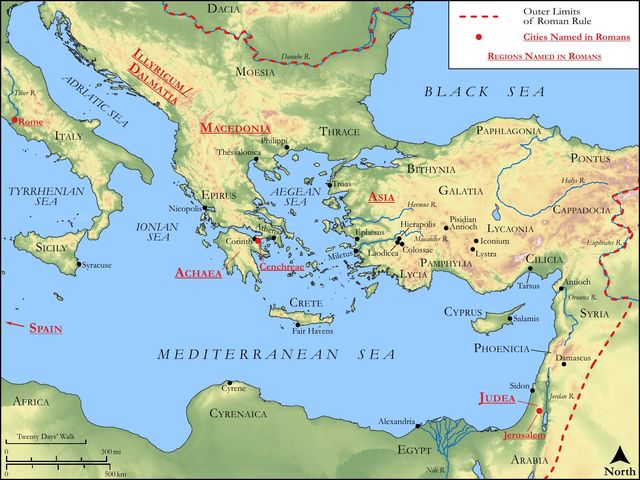
See on the biblical-era map

Study this verse
Public-domain commentary
Matthew Henry
From his Commentary on the Whole Bible. Henry comments on passages, not single verses — this entry covers Romans 1:1–7. His three-level outline is real structure in the source text, so it is rendered as structure.
In this paragraph we have,
I.The person who writes the epistle described (Rom 1:1):
Paul, a servant of Jesus Christ; this is his title of honour, which he glories in, not as the Jewish teachers, Rabbi, Rabbi; but a servant, a more immediate attendant, a steward in the house. Called to be an apostle. Some think he alludes to his old name Saul, which signifies one called for, or enquired after: Christ sought him to make an apostle of him, Act 9:15. He here builds his authority upon his call; he did not run without sending, as the false apostles did; klētos apostolos - called an apostle, as if this were the name he would be called by, though he acknowledged himself not meet to be called so, Co1 15:9. Separated to the gospel of God. The Pharisees had their name from separation, because they separated themselves to the study of the law, and might be called aphōrismenoi eis ton nomon; such a one Paul had formerly been; but now he had changed his studies, was aphōrismenos eis to Euangelion, a gospel Pharisee, separated by the counsel of God (Gal 1:15), separated from his mother's womb, by an immediate direction of the Spirit, and a regular ordination according to that direction (Act 13:2, Act 13:3), by a dedication of himself to this work. He was an entire devotee to the gospel of God, the gospel which has God for its author, the origin and extraction of it divine and heavenly.
II.Having mentioned the gospel of God, he digresses, to give us an encomium of it.
1.The antiquity of it. It was promised before (Rom 1:2); it was no novel upstart doctrine, but of ancient standing in the promises and prophecies of the old Testament, which did all unanimously point at the gospel, the morning-beams that ushered in the sun of righteousness; this not by word of mouth only, but in the scriptures.
2.The subject-matter of it: it is concerning Christ, Rom 1:3, Rom 1:4. The prophets and apostles all bear witness to him; he is the true treasure hid in the field of the scriptures. Observe, When Paul mentions Christ, how he heaps up his names and titles, his Son Jesus Christ our Lord, as one that took a pleasure in speaking of him; and, having mentioned him, he cannot go on in his discourse without some expression of love and honour, as here, where in one person he shows us his two distinct natures.
(1.)His human nature: Made of the seed of David (Rom 1:3), that is, born of the virgin Mary, who was of the house of David (Luk 1:27), as was Joseph his supposed father, Luk 2:4. David is here mentioned, because of the special promises made to him concerning the Messiah, especially his kingly office; Sa2 7:12; Psa 132:11, compared with Luk 1:32, Luk 1:33.
(2.)His divine nature: Declared to be the Son of God (Rom 1:4), the Son of God by eternal generation, or, as it is here explained, according to the Spirit of holiness. According to the flesh, that is, his human nature, he was of the seed of David; but, according to the Spirit of holiness, that is, the divine nature (as he is said to be quickened by the Spirit, Pe1 3:18, compared with Co2 13:4), he is the Son of God. The great proof or demonstration of this is his resurrection from the dead, which proved it effectually and undeniably. The sign of the prophet Jonas, Christ's resurrection, was intended for the last conviction, Mat 12:39, Mat 12:40. Those that would not be convinced by that would be convinced by nothing. So that we have here a summary of the gospel doctrine concerning Christ's two natures in one person.
3.The fruit of it (Rom 1:5); By whom, that is, by Christ manifested and made known in the gospel, we (Paul and the rest of the ministers) have received grace and apostleship, that is, the favour to be made apostles, Eph 3:8. The apostles were made a spectacle to the world, led a life of toil, and trouble, and hazard, were killed all the day long, and yet Paul reckons the apostleship a favour: we may justly reckon it a great favour to be employed in any work or service for God, whatever difficulties or dangers we may meet with in it. This apostleship was received for obedience to the faith, that is, to bring people to that obedience; as Christ, so his ministers, received that they might give. Paul's was for this obedience among all nations, for he was the apostle of the Gentiles, Rom 11:13. Observe the description here given of the Christian profession: it is obedience to the faith. It does not consist in a notional knowledge or a naked assent, much less does it consist in perverse disputings, but in obedience. This obedience to the faith answers the law of faith, mentioned Rom 3:27. The act of faith is the obedience of the understanding to God revealing, and the product of that is the obedience of the will to God commanding. To anticipate the ill use which might be made of the doctrine of justification by faith without the works of the law, which he was to explain in the following epistle, he here speaks of Christianity as an obedience. Christ has a yoke. "Among whom are you, Rom 1:6. You Romans in this stand upon the same level with other Gentile nations of less fame and wealth; you are all one in Christ." The gospel salvation is a common salvation, Jde 1:3. No respect of persons with God. The called of Jesus Christ; all those, and those only, are brought to an obedience of the faith that are effectually called of Jesus Christ.
III.The persons to whom it is written (Rom 1:7):
To all that are in Rome, beloved of God, called to be saints; that is, to all the professing Christians that were in Rome, whether Jews or Gentiles originally, whether high or low, bond or free, learned or unlearned. Rich and poor meet together in Christ Jesus. Here is,
1.The privilege of Christians: They are beloved of God, they are members of that body which is beloved, which is God's Hephzibah, in which his delight is. We speak of God's love by his bounty and beneficence, and so he hath a common love to all mankind and a peculiar love for true believers; and between these there is a love he hath for all the body of visible Christians.
2.The duty of Christians; and that is to be holy, for hereunto are they called, called to be saints, called to salvation through sanctification. Saints, and only saints, are beloved of God with a special and peculiar love. Klētois hagiois - called saints, saints in profession; it were well if all that are called saints were saints indeed. Those that are called saints should labour to answer to the name; otherwise, though it is an honour and a privilege, yet it will be of little avail at the great day to have been called saints, if we be not really so.
IV.The apostolical benediction (Rom 1:7):
Grace to you and peace. This is one of the tokens in every epistle; and it hath not only the affection of a good wish, but the authority of a blessing. The priests under the law were to bless the people, and so are gospel ministers, in the name of the Lord. In this usual benediction observe,
1.The favours desired: Grace and peace. The Old Testament salutation was, Peace be to you; but now grace is prefixed - grace, that is, the favour of God towards us or the work of God in us; both are previously requisite to true peace. All gospel blessings are included in these two: grace and peace. Peace, that is all good; peace with God, peace in your own consciences, peace with all that are about you; all these founded in grace.
2.The fountain of those favours, from God our Father, and the Lord Jesus Christ. All good comes,
(1.)From God as a Father; he hath put himself into that relation to engage and encourage our desires and expectations; we are taught, when we come for grace and peace, to call him our Father.
(2.)From the Lord Jesus Christ, as Mediator, and the great feoffee in trust for the conveying and securing of these benefits. We have them from his fulness, peace from the fulness of his merit, grace from the fulness of his Spirit.
Historical interpretation
Eleven Centuries of Reception
16 surviving comments on this verse. Each one is dated, so this reads as a timeline rather than a list.
Select a marker to jump to its quote. Markers stagger vertically where authors wrote within a few decades of each other.
Paul, when writing to the Romans, has explained this very point: "Paul, an apostle of Jesus Christ, predestinated unto the Gospel of God, which He had promised by His prophets in the holy Scriptures, concerning His Son, who was made to Him of the seed of David according to the flesh, who was predestinated the Son of God with power through the Spirit of holiness, by the resurrection from the dead of our Lord Jesus Christ."
Come, now, if he had not "wholly saddened" so many persons in the first Epistle; if he had "rebuked" none, had "terrified" none; if he had "smitten" the incestuous man alone; if, for his cause, he had sent none into panic, had struck (no) "inflated" one with consternation,-would it not be better for you to suspect, and more believing for you to argue, that rather some one far different had been in the same predicament at that time among the Corinthians; so that, rebuked, and terrified, and already wounded with mourning, he therefore-the moderate nature of his fault permitting it-subsequently received pardon, than that you should interpret that (pardon as granted) to an incestuous fornicator? For this you had been bound to read, even if not in an Epistle, yet impressed upon the very character of the apostle, by (his) modesty more clearly than by the instrumentality of a pen: not to steep, to wit, Paul, the "apostle of Christ," the "teacher of the nations in faith and verity," the "vessel of election," the founder of Churches, the censor of discipline, (in the guilt of) levity so great as that he should either have condemned rashly one whom he was presently to absolve, or else rashly absolved one whom he had not rashly condemned, albeit on the ground of that fornication which is the result of simple immodesty, not to say on the ground of incestuous nuptials and impious voluptuousness and parricidal lust,-(lust) which he had refused to compare even with (the lusts of) the nations, for fear it should be set down to the account of custom; (lust) on which he would sit in judgment though absent, for fear the culprit should "gain the time; " (lust) which he had condemned after calling to his aid even "the Lord's power," for fear the sentence should seem human.
The first question which occurs to us concerns the name Paul itself. Why is he, who in Acts was called Saul, now called Paul? In Holy Scripture we find that among the ancients, many names were altered, e.g., Abram was renamed Abraham, Sarai became Sarah, and Jacob became Israel. In the Gospels too, Simon was changed to Peter, and the sons of Zebedee became known as sons of thunder. But these things occurred by divine command, and we read nothing of the sort in the case of Paul. Because of this, some people have imagined that the apostle took the name of Paul, the proconsul of Cyprus, whom he converted to the Christian faith, in the same way that rulers are in the habit of adding the names of conquered peoples to their titles, e.g., Parthicus would indicate someone who conquered the Parthians, Gothicus a victor over the Goths, and so on. In the same way the apostle would have called himself Paul to indicate that he had conquered the proconsul Paul.We cannot exclude this reason completely, but given that no such custom can be found in Holy Scripture, we ought rather to seek a solution from the examples which we do have. And indeed we find in the Scriptures that some people have two or even three different names, e.g., Solomon is also called Jedidiah, Zedekiah is also called Mattaniah, Uzziah is also called Azariah, and there are many others in the books of Judges, Samuel and Kings who have double names. But even the Gospels do not abandon this custom, e.g., Matthew was called Levi … and Thaddeus sometimes appears as Lebbaeus. Obviously the Gospel writers did not get the names of the apostles wrong, but given that it was the custom of the Hebrews to have two or three names, they gave different names to one and the same man. It seems to us that it is in accordance with this custom that Paul appears to have a second name, and that as long as he was ministering to his own people he was called Saul, which was probably the name his parents gave him, but that when he was writing laws and commandments for the Greeks and other Gentiles, he was called Paul. Scripture makes it clear when it says: “Saul, who is also called Paul,” that the name Paul was not then being given to him for the first time but was already habitual.
But why does Paul call himself a slave, when elsewhere he says: “For you did not receive the spirit of slavery to fall back into fear, but you have received the Spirit of sonship, by which we cry Abba! Father!” … We may understand this as an expression of humility … and that would not be wrong. Nor is the reality of Paul’s freedom compromised by this in any way. As he himself says: “Though I am free from all men, I have made myself a slave to all.” … For he serves Christ not in the spirit of slavery but in the spirit of adoption, for Christ’s service is more noble than any freedom.
“Called” is the name given to everyone who believes in Christ and is therefore a general term, although it is applied to each one according to what God has foreseen and chosen in him. He may be called to be an apostle or a prophet or a teacher; as free from a wife or as bound in marriage, and this is determined by the diversity of grace given to everyone, as it is written: “Many are called but few are chosen.”
In Paul’s case, he was not called to be an apostle in the general sense, but he was also chosen according to the foreknowledge of God to be “set apart for the gospel of God,” as he says elsewhere: “God set me apart before I was born and called me through his grace.” Heretics wrongly claim that he was set apart from his mother’s womb on account of the goodness of his nature, just as from the opposite side of the fence we read in the Psalms of those “sinners who were separated from the womb” because of their evil nature.
But we say that Paul was chosen neither by accident nor because of some natural difference, but he himself attributed the causes of his election to him who knows everything before it happens.… For God foresaw that Paul would labor more abundantly than anyone else in the gospel … and for that reason Jesus set him apart in his mother’s womb for the gospel. Had he been chosen by fate, as the heretics maintain, or by some inherently better nature, he would not have been afraid of being condemned if he failed to preach the gospel.
God’s foreknowledge, by which those who will labor and succeed are known, comes first, and his predestination follows afterwards, so that foreknowledge cannot be regarded as the cause of predestination. With men, merits are weighed according to past actions, but with God they are weighed according to future behavior, and anyone who thinks that God cannot see our future just as easily as he can see our past is an unbeliever.
Some people argue quite pointlessly as to whether the participle called is meant to modify servant or apostle. It applies to both, since everyone is called, and called equally, both to faith and grace and to election and the apostolic order.
Paul was set apart and dedicated to evangelism, like the offerings which the law says were set apart for God and for the priests.
Saul changed his name to Paul, and the change was permanent. Because Saul means restlessness or trial, when he came to faith in Christ he called himself Paul, i.e., rest, because our faith is peace. For whereas previously he had inflicted trials on the servants of God because of his desire to fulfill the law, later he himself endured trials on account of the hope which before he had denied because of his love of Judaism.In calling himself a “servant of Jesus Christ,” Paul shows that he has been delivered from the law, and he puts both names, Jesus and Christ, in order to signify the person of God and man, for in both he is Lord, as Peter the apostle testifies, saying: “He is the Lord of all.” And because he is Lord, he is also God, as David says: “For the Lord himself is God.” The heretics deny this. Marcion, it seems, denied Christ and his body out of hatred for the law, although he confessed Jesus. The Jews and Photinus denied that Jesus was God out of their zeal for the law. For whenever Scripture says either “Jesus” or “Christ,” it sometimes means the person of God and sometimes the person of the man, e.g.: “there is one Lord Jesus Christ, through whom are all things.”
“Called to be an apostle.” Because Paul acknowledged the Lord and confessed him he became the perfect servant and shows that he was promoted, saying that he was called to be an apostle, i.e., a messenger sent by the Lord to do his work. By this he shows that he had merit with God because he served Christ and not the law.
“Set apart for the gospel of God.” The gospel of God is good news, by which sinners are called to forgiveness. For since as a Pharisee the apostle held a teaching post among the Jews, he now says that he has been set apart from the preaching of Judaism for the gospel of God, so that abandoning the law, he might preach Christ who justifies those who believe in him, which the law could not do. This does not go against the law but affirms it, since the law itself says that this will happen in the future, in the words of Isaiah the prophet: “There will come from Zion one who will break and remove the captivity of Jacob, and this will be a testimony of me, when I shall take away their sins.”
Moses having written five books, has nowhere put his own name to them, neither have they who after him put together the history of events after him, no nor yet has Matthew, nor John, nor Mark, nor Luke; but the blessed Paul everywhere in his Epistles sets his own name. Now why was this? Because they were writing to people, who were present, and it had been superfluous to show themselves when they were present. But this man sent his writings from afar and in the form of a letter, for which cause also the addition of the name was necessary. But if in the Epistle to the Hebrews he does not do the same, this too is after his own wise judgment. For since they felt prejudiced against him, lest on hearing the name at the outstart, they should stop up all admission to his discourse, he subtly won their attention by concealing the name.
"Paul, a servant of Jesus Christ." Why did God change his name, and call him Paul who was Saul? It was, that he might not even in this respect come short of the Apostles, but that that preëminence which the chief of the Disciples had, he might also acquire; and have whereon to ground a closer union with them. And he calls himself, the servant of Christ, yet not merely this; for there be many sorts of servitude. One owing to the Creation, according to which it says, "for all are Thy servants"; and according to which it says, "Nebuchadnezzar, My servant", for the work is the servant of Him which made it. Another kind is that from the faith, of which it saith, "But God be thanked that ye were the servants of sin, but ye have obeyed from a pure heart that form of doctrine which was delivered unto you: being then made free from sin, ye became the servants of righteousness." Another is that from civil subjection, after which it saith, "Moses my servant is dead"; and indeed all the Jews were servants, but Moses in a special way as shining most brightly in the community. Since then, in all the forms of the marvellous servitude, Paul was a servant, this he puts in the room of the greatest title of dignity, saying, "a servant of Jesus Christ." And the Names appertaining to the dispensation he sets forth, going on upwards from the lowest. For with the Name Jesus, did the Angel come from Heaven when He was conceived of the Virgin, and Christ He is called from being anointed, which also itself belonged to the flesh. And with what oil, it may be asked, was He anointed? It was not with oil that He was anointed, but with the Spirit. And Scripture has instances of calling such "Christs": inasmuch as the Spirit is the chief point in the unction, and that for which the oil is used. And where does it call those "Christs" who are not anointed with oil? "Touch not," it says, "Mine anointed, and do My prophets no harm", but at that time the institution of anointing with oil did not yet even exist.
"Called an Apostle." He styles himself "called" in all his Epistles, so showing his own candor, and that it was not of his own seeking that he found, but that when called he came near and obeyed. And the faithful, he styles, "called to be saints," but while they had been called so far as to be believers, he had besides a different thing committed to his hands, namely, the Apostleship, a thing full of countless blessings, and at once greater than and comprehensive of, all the gifts.
And what more need one say of it, than that whatsoever Christ was doing when present, this he committed to their hands when He departed. Which also Paul cries aloud, speaking thereof and magnifying the dignity of the Apostles' office; "We are ambassadors for Christ, as though God did beseech by us;" i. e. in Christ's stead. "Separated to the Gospel of God." For as in a house, each one is set apart for divers works; thus also in the Church, there be divers distributions of ministrations. And herein he seems to me to hint, that he was not appointed by lot only, but that of old and from the first he was ordained to this office; which also Jeremy saith, that God spake concerning himself, "Before thou camest forth out of the womb, I sanctified thee, I ordained thee a prophet unto the nations." For in that he was writing to a vainglorious city, and one every way puffed up, he therefore uses every mode of showing that his election was of God. For he Himself called him, and Himself separated him. And he does this, that he may make the Epistle deserve credit, and meet an easy reception. "To the Gospel of God." Not Matthew then alone is an Evangelist, nor Mark, as neither was this man alone an Apostle, but they also; even if he be said preëminently to be this, and they that. And he calleth it the Gospel, not for those good things only which have been brought to pass, but also for those which are to come. And how comes he to say, that the Gospel "of God" is preached by himself? for he says, "separated to the Gospel of God"-for the Father was manifest, even before the Gospels. Yet even if He were manifest, it was to the Jews only, and not even to all of these as were fitting. For neither did they know Him to be a Father, and many things did they conceive unworthily of Him. Wherefore also Christ saith, "The true worshippers" shall come, and that "the Father seeketh such to worship Him." But it was afterwards that He Himself with the Son was unveiled to the whole world, which Christ also spake of beforehand, and said, "that they might know Thee the only true God, and Jesus Christ Whom Thou has sent." But he calls it the "Gospel" of God, to cheer the hearer at the outstart. For he came not with tidings to make the countenance sad, as did the prophets with their accusations, and charges, and reproofs, but with glad tidings, even the "Gospel of God;" countless treasures of abiding and unchangeable blessings.
Do we wonder why he writes Paul, given that he was called Saul before? Doubtless he did this following the habit of the saints. When they advanced in virtue they were addressed with a different name, so that they might be new people even in name, e.g., Abraham, Sarah and Cephas. … Paul earned the office of an apostle by faithful and matchless service. He was set apart in Acts 13:2. Gospel … means “good news”, i.e., of Christ’s birth, suffering, resurrection and ascension into heaven.
Paul here preaches the divinity of Christ to a world which was ignorant of it. Many people saw the Lord, and others believed in him without seeing, but Paul was called from heaven: “Saul, Saul, why do you persecute me?” He was more highly favored than the other apostles, for the Lord called Peter and James and John and made them his disciples; he did not immediately make or call them apostles. But he made Paul an apostle as soon as he called him. Thus the gospel is preached according to the plan of God.
All things are servants of Christ, and he is Lord of all. Therefore Paul calls himself a servant first of all, thereby encouraging the rest to do likewise. He also recalls the unique lordship of the Son but not in such a way as to deny the lordship of the Father, which is confessed by everybody. In saying that he was set apart, he showed that he was not only called but also chosen from among many as useful for the preaching of the gospel.
By these two words, called and set apart, Paul distinguishes between the church, which is acceptable to God, and the synagogue, whose glory has faded away. The church (i.e., ecclesia) is so called because it “calls forth”: the synagogue, because it “gathers together.”
Civil governors and military commanders put their titles at the beginning of their letters in order to boast and show off. But St. Paul says that he was born out of due time, that he is the chief of sinners and that he is unworthy of his apostleship. Nevertheless, when writing his letters, he starts with the words imposed on him by grace, for the benefit of those who receive them. For when the recipients realized the importance of the person who was writing to them, they would read the letter with greater earnestness and attention.
This man is to me a chosen vessel to carry my name before the Gentiles and kings and the sons of Israel (Ac 9:15). 1. In sacred Scripture men are compared to vessels from four viewpoints: their construction, contents, use and fruit. From the viewpoint of construction, vessels depend on the good pleasure of their maker: "he reworked it into another vessel as it seemed good to him" (Jer 18:4). In the same way men’s construction1 depends on God’s good pleasure: "He fashioned us and not we ourselves" (Ps 100:3 Vul 99:3); hence Is (45:9) asks: "Does the clay say to him who fashions it, ‘What are you making?’": In the same vein St Paul asks: "Will what is molded say to its molder, ‘ Why have you made me thus?’" (Rom 9:20). Hence, it is the Creator’s will that determines the variety of construction among his vessels: "In a great house there are not only vessels of gold and silver, but also of wood and earthenware" (2 Tim 2:20). In the above words, blessed Paul is described as a vessel. What sort of vessel he was is described in Sirach (50:9): "As a vessel of solid gold adorned with all kinds of precious stones." He was a golden vessel on account of his brilliant wisdom; what is said in Genesis (2:12) can be understood as speaking of this: "The gold of that land is the best," because, as is said in Proverbs (3:15), "it is more precious than all riches." Whence even blessed Peter bears witness to him: "So also our beloved brother Paul wrote to you according to the wisdom given him" (2 Pt 3:15). 1 Latin constitutio can refer both to the "construction" of a vessel and to the "character" of a man. 6 2 Reading propinavit for propinabit. 3 This does not exactly match the phrasing of the Vulgate or of the Hebrew. He was solid on account of the virtue of love, of which the Song of Songs (8:6) says, "Love is strong as death." Hence Paul himself writes: "I am sure that neither death, nor life, nor angels, nor height, nor depth, nor any other creature will be able to separate us from the love of God" (Rom 8:38ff). Furthermore, he was adorned with all manner of precious stones, i.e., with all the virtues, concerning which it says in 1 Cor (3:12): "Now if any man builds on the foundation with gold, silver, precious stones …, each man’s work will become manifest." Hence, he says: "Our boast is this, the testimony of our conscience that we have conducted ourselves in the world with simplicity of heart and godly sincerity, not by earthly wisdom but by the grace of God" (2 Cor 1:12). 2. The nature of this vessel is thus indicated by the sort of things it poured out;2 for Paul taught the mysteries of the most lofty divinity, which requires wisdom: "Among the mature we do speak wisdom" (1Cor 2:6). He extolled love in the loftiest terms in 1 Corinthians 13. He taught men about the different virtues: "Put on then, as God’s chosen ones, holy and beloved, compassion, kindness, meekness … patience" (Col 3:12). 3. In the second place it is customary for vessels to be filled with some sort of liquid, as is clear in 1King (4:3), "They gave him vessels and she filled them."3 Now it is by reason of what is poured into them that vessels are classified: for some are wine vessels, some oil vessels, and so on. In the same way, God fills men with diverse graces, as though with diverse liquids: "To one is given through the Spirit the utterance of wisdom and to another the utterance of knowledge according to the same Spirit" (1 Cor 12:8). 7 But the vessel about which we are now speaking was filled with a precious liquid, the name of Christ, of which it is said: "Your name is oil poured out" (Song 1:3). Hence, our text says to carry my name, for he seems to have been thoroughly filled with this name, in accord with Revelation 3(:12), "I will write my name upon him." For he possessed this name in the knowledge of his intellect: "For I decided to know nothing among you except Christ" (1 Cor 2:2). He also possessed this name in the love of his affections: "Who will separate us from the love of Christ?" (Rom 8:35); "If any one does not love our Lord Jesus Christ, let him be accursed" (1 Cor 16:21). Finally, he possessed it in his whole way of life; Hence he said, "It is no longer I who love, but Christ who lives in me" (Gal 2:20). 4. In the third place, with regard to use, one should consider that all vessels are set aside for a definite use, but some for a more honorable and some for a baser use: "Has not the potter power to make from the same lump one vessel for beauty and another for dishonor?" (Rom 9:21). So, too, according to God’s decree, men are set aside for different uses: "All men are from the ground and from the earth, whence also Adam was created. In the fullness of his knowledge the Lord distinguished them and appointed their different uses; some of them he blessed and exalted, but some of them he cursed and brought low" (Sir 33:11-12). This vessel, however, was set apart for noble use, for it is a vessel such as carries the divine name; for [the text] says to carry my name. It was, indeed, necessary for this name to be carried, because it was far from men: "Behold the name of the Lord comes from afar" (Is 30:27). 8 It is far from us on account of sin: "Salvation is far from the wicked" (Ps 119:155). It is also far from us on account of the darkness of our understanding; hence it was said of some that "they beheld it from afar" (Heb 11:13) and "I see him, but not now; I behold him, but not nigh" (Num 24:17). Consequently, just as the angels bestow God’s light on us as being far from God, so the apostles brought us the gospel teaching from Christ; and just as in the Old Testament after the law of Moses the prophets were read to instruct the people in the teachings of the law—"Remember the law of my servant, Moses" (Mal 4:4)—so also, in the New Testament, after the gospels are read the teachings of the apostles, who handed down to the faithful the words they had heard from the Lord: "For I received from the Lord what I also delivered to you" (1 Cor 11:23). 5. The blessed Paul carried Christ’s name, first of all, in his body by imitating his life and sufferings: "I bear on my body the marks of Jesus" (Gal 6:17). 6. Secondly, in his speech, for he names Christ very frequently in his epistles: "Out of the abundance of the heart the mouth speaks" (Mt 12:34). Hence, he can be signified by the dove of which it is said that it returned to the ark bearing an olive branch in its mouth (Gen 8:11). For since the olive signifies mercy, it is fittingly taken to stand for Christ’s name, which also signifies mercy: "You shall call his name Jesus, for he will save his people from their sins" (Mt 1:21). This olive branch bearing leaves was brought to the ark, i.e., to the church, when he explained its power and meaning in many ways, disclosing Christ’s grace and mercy. Thus, he says: "I received mercy for this reason that in me, as in the foremost, Jesus Christ might display his perfect patience" (1 Tim 1:16). Hence, just as the most frequently used writings of the Old Testament in the church are the psalms of David, who 9 obtained pardon after his sin, so the most frequently used writings of the New Testament are the epistles of Paul, who obtained mercy, so that by these examples of sinners might be aroused to hope; although another reason for this custom could be that in each of these writings is contained almost the whole teaching of theology. 7. Thirdly, he carried this name not only to those who were present but also to those absent and as yet unborn by handing down the meaning of the Scriptures: "Take a large tablet and write upon it in common characters" (Is 8:1). 8. In this role of carrying God’s name his excellence is shown in regard to three things: first, in regard to the grace of being chosen; hence he is called a chosen vessel: "He chose us in him before the foundation of the world" (Eph 1:4). Secondly, in regard to his dedication, because he sought nothing of his own but what was Christ’s: "For what we preach is not ourselves but Jesus Christ as Lord" (2 Cor 4:5). Hence, it is stated that he is a chosen vessel of mine. Thirdly, in regard to his unique excellence: "I worked harder than any of them" (1 Cor 15:10). Hence, he is a chosen vessel of mine in a more outstanding way than the others. 9. As regards fruit, one should consider that that some men are, so to speak, useless vessels, either on account of sin or of error, in accord with Jer (51:34): "He has made me an empty vessel." But Paul was free of sin or of error; consequently, he was a useful chosen vessel, as he himself testified: "If anyone purifies himself from these things," i.e., from errors and sins, "then he will be a vessel set aside for a noble use, useful to the Lord" (2 Tim 2:21). Hence the usefulness or fruit of this vessel is expressed by the words, before the Gentiles, whose teacher he was: "A teacher of the Gentiles in faith and truth" (1 Tim 2:7), 10 and kings, to whom he preached the faith of Christ, for example, to Agrippa (Ac 16) and even to Nero and his princes. Hence he says: "What has happened to me has really served to advance the gospel, so that it has become known throughout the whole praetorian guard that my imprisonment is for Christ" (Phil 1:12); "Kings shall see and princes shall arise" (Is 49:7). And the sons of Israel, against whom he argued about Christ: "But Saul increased all the more in strength, and confounded the Jews who lived in Damascus by proving that Jesus was the Christ" (Ac 9:22). 10. From the words of our text, therefore, we gather the four causes of this work, i.e. of Paul’s letters, which we have before us. First, the author, in the word, vessel; secondly, the matter, in the words, my name, of which the vessel is full, because this entire teaching is about the teaching of Christ; thirdly, the manner, in the word, carry. For this teaching is conveyed in the manner of letters which were customarily carried by messengers: "So curriers went with letters from the king and his princes" (2 Ch 30:6). Fourthly, the difference [distinctio] of the work in the usefulness mentioned. 11. For he wrote fourteen letters, nine of which instructed the church of the Gentiles; four, the prelates and princes of the church, i.e., kings; and one to the people of Israel, namely, the letter to the Hebrews. For this entire teaching is about Christ’s grace, which can be considered in three ways: In one way, as it is in the Head, namely, Christ, and in this regard it is explained in the letter to the Hebrews. 11 In another way, as it is found in the chief members of the Mystical Body, and this is explained in the letters to the prelates. In a third way, as it is found in the Mystical Body itself, that is, the Church, and this is explained in the letters sent to the Gentiles. These last letters are distinguished from one another according to the three ways the grace of Christ can be considered: in one way, as it is in itself, and thus it is set out in the letter to the Romans; in another way, as it exists in the Sacraments of the Church, which is explained in the two letters to the Corinthians—in the first of these the nature of the Sacraments is treated; in the second, the dignity of the minister—and in the letter to the Galatians, in which superfluous sacraments are rejected against certain men who wanted to join the old sacraments to the new ones. In a third way, Christ’s grace is considered in regard to the unity it produces in the Church. Hence, the Apostle deals first with the establishment of ecclesial unity in the letter to the Ephesians; secondly, with its consolidation and progress in the letter to the Philippians; thirdly, of its defense against certain errors in the letter to the Colossians; against existing persecutions in the first letter to the Thessalonians and against persecutions to come, especially in the time of anti-Christ, in the second letter to the Thessalonians. He instructs the prelates of the Church, both spiritual and temporal. He instructs the spiritual prelates of the Church about establishing, preserving and governing ecclesial unity in the first letter to Timothy, about resistance against persecutors in the second, and about defense against heretics in the letter to Titus. He instructs temporal lords in the letter to Philemon. 12 4 See Eusebius’ Historia Ecclesiastica, book 3, chapter 1. 5 For the pseudo-Clementine writings, see Wilhelm Schneemelcher, ed., New Testament Apocrypha (trans. R. McL. Wilson; Philadelphia: Westminster, 1965), II: 536-570; for the preaching of Barnabas, see page 538 of the same volume. And thus the division and order of all the epistles is clear. 12. But it appears that the letter to the Romans is not first. For he seems to have written first to the Corinthians, according to the last chapter of Romans (16:1): "I commend to you our sister Phoebe, who is in the ministry of the church at Cenchreae," which is a Corinthian port. But one should say rather that the letter to the Corinthians is first as regards its time of writing. Nonetheless, the letter to the Romans is placed ahead of it, both because of the dignity of the Romans, who ruled the other nations, since in this letter pride is rebuked, which is the source of all sin (Sir 10:14); and because the order of teaching requires that grace should first be considered in itself before being considered as it as found in the Sacraments. 13. Another question concerns the place from which the Apostle wrote this letter. Augustine says that it was written in Athens, Jerome that it was written from Corinth. Both could be right, because he could have begun it in Athens and finished it in Corinth. 14. Finally, there is an objection against what is said in the gloss, that some believers preached to the Romans before Peter did, whereas in the Ecclesiastical History it says that Peter was the first to preach to them.4 However this can be taken to mean that Peter was the first apostle to teach the Romans and the first to reap a great harvest among them. Already Barnabas had preached at Rome, as the Itinerary of Clement states.
15. This letter is divided into two parts, namely, the greeting and the body of the letter [epistularem tractatum], which begins there [n. 74] at "first indeed" and so on (1:8). In the first part three things are done: first, the person sending the greeting is described; secondly, the persons greeted, there [n. 66] at "to all who are in Rome" (1:7a); thirdly, the blessings invoked, there [n. 70] at "Grace to you" and so on (1:7b). 16. The person writing is described by four things [nn. 16, 20, 22, 23]. First, by his name, Paul, concerning which one should consider three things [nn 17-19]. First, its accuracy; for this name, as it is spelled here, cannot be Hebrew because Hebrew does not have the letter P in its alphabet; but it can be Greek and Latin. Still, if it be taken as some letter close to P, it can be Hebrew. 17. Secondly, one should consider its meaning. Considered as Hebrew, it means "wonderful" or "chosen"; taken as Greek, it means "quiet;" taken as Latin it means "small." And these meanings suit him. For he was chosen as regards grace; hence "he is a chosen vessel of mine" (Ac 9:15). He was wonderful in his work: "A marvelous vessel, the work of the Most High" (Si 43:2). He was quiet in contemplation: "When I enter my house, I shall find rest with her" (Wis 8:16). He was small by humility: "I am the least of the apostles: (1 Cor 15:9). 18. Thirdly, one should consider when that name was conferred on the Apostle, since he had formerly been called Saul, as is found in Acts 9. There are three opinions about this. Jerome says that whereas he had formerly been called Saul, later he wished to be called Paul on account of something notable he had done, namely that he converted Sergius Paulus, a proconsul (Act 13), just as Scipio was called Africanus because he had conquered Africa. Others say that this name was conferred on account of the growth in virtue which is signified by this name, as was said. For names are conferred by God on certain men at the very beginning of the lives to indicate the grace they receive at the beginning, as in the case of John the Baptist. In other cases the names of persons are changed to indicate their growth in virtue, as Chrysostom says. This is clear in the cases of Abraham (Gen 17) and Peter (Mt 16). But others have a better explanation, namely, that Paul always went by two names. For it was customary among the Jews, along with their Hebrew name, to take a name from among the people they served; thus, those who served the Greeks took Greek names, as is clear in the cases of Jason and Menelaus (2 Macc 4). 19. Now the name Paul was held in esteem among the Romans from the earliest times; accordingly, he was called Saul among the Hebrews and Paul among the Romans, although he does not seem to have used the latter until he began to preach to the Gentiles. 15 6 See Augustine’s Expositions on the Psalms, at Psalm 73. 7 Salus might also be rendered "salvation." Hence, Acts (13:9) says: "But Saul, who is also called Paul." This third opinion is the one Augustine favors.6 20. Secondly, the writer’s person is described by his station when he says, a servant of Christ. Now the state of servitude seems a lowly one, if it be considered absolutely; this is why it is imposed with a curse as a punishment for sin: "Cursed be Canaan; a slave of slaves shall he be to his brothers" (Gen 9:25). But it is made commendable by reason of what is added, namely, of Jesus Christ. For "Jesus" means Savior: "He will save his people from their sins" (Mt 1:21); "Christ" means anointed: "Therefore God, your God, has anointed you" (Ps 45:7). This indicates Christ’s dignity both in regard to his holiness, since priests were anointed, as is clear from Exodus 29; and in regard to his power, since kings, too, were anointed, as is clear in the cases of David and Solomon; and in regard to his knowledge, since prophets were also anointed, as in the case of Elisha. Furthermore, it is praiseworthy for a person to be subjected to his well-being7 and to the spiritual anointing of grace, because a thing is perfect to the extent that it is subjected to its perfection, as the body to the soul and air to light: "O Lord, I am your servant" (Ps 116:16). 21. This seems to conflict with John 15(:15), "No longer do I call you servants, but friends." But one should say that there are two kinds of servitude: one is the servitude of fear, which does not befit saints: "You did not receive the spirit of slavery to fall back 16 8 Antonomasia is the substitution of a title or epithet for a proper name, as Aquinas illustrates by the example of Rome. into fear, but you have received the spirit of the adoption of sons" (Rom 8:15); the other is that of humility and love, which does befit saints: "Say, ‘We are unworthy servants.’" (Lk 17:10). For since a free man is one who exists for his own sake [causa sui], whereas a servant is one who exists for the sake of another [causa alterius], as moving by reason of another’s moving him; then, if a person acts for the sake of another [causa alterius] as though moved by him, the service is one of fear, which forces a man to act in opposition to his own will. But it he acts for the sake of another [causa alterius] as an end, then it is the servitude of love; because a friend serves and does good to his friend for the friend’s own sake, as the Philosopher says in the ninth book of the Ethics [chapter 4]. 22. Thirdly, the person writing is described by his dignity when it says called to be an apostle. The apostolic dignity is the foremost in the Church, in accord with 1Corinthians 12(:18), "God has appointed in the church, first, apostles." For "apostle" means "sent": "As the Father has sent me, even so I send you" (Jn 20:21), i.e., out of the same love and with the same authority. Moreover, he says, called to be an apostle, to indicate a gift: "One does not take the honor upon himself, but he is called by God as Aaron was" (Heb 5:4); or to emphasize the excellence of apostleship, so that just as Rome is antonomastically8 called the city, so Paul is called the apostle: "I worked harder than any of them" (1 Cor 15:10); or to show his humility, as though to say: I do not dare to call myself an apostle, but men call me that: "I am unfit to be called an apostle" (1 Cor 15:9). 17 23. Fourthly, the person writing is described by his office when it says set apart for the gospel for God. Set apart, I say, from unbelievers by his conversion: "But when he who had set me apart from the womb of my mother," i.e., of the synagogue (Gal 1:15); or set apart from other disciples by his being chosen: "Set apart for me Barnabas and Saul for the work to which I have called them" (Ac 13:2). "Gospel" means good news. For it announces the news of man’s union with God, which is man’s good: "It is good for me to cleave to God" (Ps 73:28). 24. Indeed, a threefold union of man with God is announced in the gospel. The first is by the grace of union: "The Word was made flesh" (Jn 1:14). The second is by the grace of adoption, as implied in Psalm 82(:6) "I say, ‘You are gods, sons of the Most High, all of you.’" The third is by the glory of attainment: "This is eternal life, that they know you" (Jn 17:3); "How beautiful upon the mountains are the feet of him who brings good tidings" (Is 52:7). These good tidings were not from men, but from God: "What I have heard from the Lord of hosts, the God of Israel, I announce to you" (Is 21:10). Hence he says, for the gospel of God. 18
Continue studying Romans 1:1 across the web’s major study libraries — every link below opens this exact verse, chapter, or book on the destination site.
Read & Compare
 BibleGatewayThis verse in more than 200 translations and 70 languages.
 Bible.comThe YouVersion reader — hundreds of translations, reading plans, and highlights.
 ESV.orgCrossway's official English Standard Version reader.
 NET BibleThe NET translation with 60,000+ translators' notes on every rendering decision.
 STEP BibleTyndale House's free study tool — original text, vocabulary, and scholarly resources.
 BibliaLogos Bible Software's free web reader.
 USCCBThe New American Bible (Revised Edition) with the U.S. bishops' study notes.
Commentaries
 BibleHub CommentariesDozens of classic commentaries on this verse, gathered on one page.
 StudyLightMore than 100 commentary sets — the largest collection on the web.
 BibleRefPlain-English commentary on what this verse means, verse by verse.
 Enduring WordDavid Guzik's free commentary on this chapter, widely used by Bible teachers.
 Bible Study ToolsVerse commentary alongside Greek and Hebrew study aids.
Original Language & Research
- BibleHub InterlinearThe verse word by word — original language, transliteration, and English.
- BibleHub LexiconEvery word's original-language definition and Strong's entry.
 Blue Letter BibleDeep-study tools — Strong's numbers, concordance, and word studies.
 CNTR CollationThe earliest Greek manuscripts of this verse, collated letter by letter.
Sermons, Hymns & Audio


TrulyRandomVerse is not affiliated with these sites and doesn’t control their content. They’re linked because they’re genuinely useful.
Summary
Romans 1:1 serves as a profound and foundational declaration of Paul's identity, authority, and life's singular purpose. In this opening statement, Paul introduces himself not by earthly titles but as a devoted bondservant of Jesus Christ, divinely commissioned as an apostle, and uniquely set apart for the proclamation of God's transformative gospel. This verse immediately establishes the theological weight and apostolic authority behind the entire letter, setting the stage for its comprehensive exposition of salvation through faith.
Context
ShowHideLiterary Context
Romans 1:1 functions as the epistolary prescript, immediately following the standard ancient letter format of sender identification. It is not merely a formal greeting but a theological declaration that frames the entire epistle. Paul's detailed self-description and statement of purpose in this opening verse are crucial for establishing his authority with a church he did not found and had not yet visited. This extended introduction (vv. 1-7) serves to validate his message and prepare the recipients for the profound theological arguments that follow, particularly concerning the universal need for salvation and God's righteousness revealed in the gospel.
Historical & Cultural Context
Paul likely wrote this letter from Corinth around 57 AD, at the culmination of his third missionary journey, as he prepared to travel to Jerusalem and then on to Rome and Spain. The Roman church was a diverse community, comprising both Jewish and Gentile believers, and likely faced internal tensions regarding the relationship between the Law and the Gospel, and the place of Israel in God's redemptive plan. Paul's emphasis on his apostolic calling and his being "separated unto the gospel of God" (a phrase reminiscent of prophetic callings like Jeremiah's or Isaiah's) was vital for asserting his direct commission from Christ, thus lending weight to his articulation of the gospel for both segments of the Roman church.
Key Themes
ShowHideThis introductory verse immediately introduces several pivotal themes that permeate the entire letter to the Romans. Paul's self-identification as a "servant of Jesus Christ" (a recurring theme of Christian identity and servanthood) underscores the complete devotion and submission required of those who follow Christ. His calling as an "apostle" highlights the divine initiative and authority behind the proclamation of the gospel, a message not of human origin but of God's own design. Furthermore, being "separated unto the gospel of God" emphasizes the exclusive and holy purpose of Paul's life, echoing the broader biblical theme of God setting apart individuals for His specific purposes. Finally, the phrase "the gospel of God" introduces the central subject of the entire epistle, signaling that the good news originates from and belongs to God Himself, a theme profoundly developed throughout Romans.
Exposition and Analysis
ShowHideKey Word Analysis
ShowHideFrom δέω, meaning "to bind." This term signifies a slave or bondservant, implying complete ownership and absolute devotion. Paul's use of doûlos here is not merely a humble self-description but a profound theological statement: his identity, will, and life are entirely submitted to and defined by Jesus Christ. It speaks of a voluntary, lifelong commitment to his Master's will and purpose, transcending mere employment to denote profound allegiance.
From ἀποστέλλω, meaning "to send forth." An apóstolos is a delegate, an authorized messenger, or a commissioner. For Paul, this title signifies a direct, divine commission from the risen Christ to preach the gospel, particularly to the Gentiles. It implies not only a message but also the authority and power to deliver it, often accompanied by miraculous signs, distinguishing him as a foundational messenger of the new covenant.
From ἀπό ("from") and ὁρίζω ("to set a boundary"). This word means "to set off by boundary," "to limit," or "to appoint." In this context, it denotes a divine act of setting Paul apart for a specific, holy purpose—the proclamation of the gospel. It implies a deliberate, sovereign choice by God that distinguished Paul from others and dedicated his life entirely to this sacred mission.
Verse Breakdown
ShowHide"Paul, a servant of Jesus Christ"
This opening phrase immediately establishes the author's identity. "Paul" is his Roman name, signifying his Gentile mission. The designation "a servant of Jesus Christ" (Greek doûlos) is a powerful declaration of his ultimate allegiance and submission. It is his primary identity, indicating that his entire being and ministry are devoted to Christ, not to any earthly master or ambition. This sets the tone for the letter, rooting its authority in Christ himself.
"called to be an apostle"
This clause clarifies the nature of Paul's servanthood. His apostleship is not self-appointed but a divine summons ("called," Greek klētós). This "calling" is an act of God's sovereign grace, conferring upon him the unique authority and responsibility of an apostle (Greek apóstolos), one "sent forth" by Christ with a specific message and mission. This divine commission is crucial for the Roman church, as it validates the message of a man they had not personally met.
"separated unto the gospel of God"
This final clause defines the specific purpose of Paul's calling and servanthood. The word "separated" (Greek aphorízō) implies a deliberate, divine act of setting him apart for a holy and exclusive task. His entire life and ministry are dedicated to "the gospel of God"—the good news that originates from God, reveals God's righteousness, and accomplishes God's redemptive plan. This highlights that the gospel is not a human invention but God's own saving message, to which Paul's life is wholly consecrated.
Literary Devices
ShowHideRomans 1:1 is rich in Apostolic Salutation, a common feature of ancient letters, but Paul transforms it into a profound theological statement. The verse employs Self-Identification as its primary function, with Paul immediately asserting his authority and mission. The use of "servant" (Greek doûlos) is a powerful example of Metonymy, where the term for a slave represents complete devotion and submission. This also functions as Humility alongside Authority, as Paul, despite his high office, presents himself first as a humble bondservant. The phrase "gospel of God" is a concise Theological Declaration, immediately stating the letter's central theme and ultimate source. The verse's structure, moving from identity to calling to purpose, demonstrates a clear Purpose Statement that guides the reader into the letter's content.
Theological and Thematic Connections
ShowHidePaul's opening declaration in Romans 1:1 is a theological cornerstone, establishing the divine origin and authority of the gospel he is about to expound. His identity as a "servant of Jesus Christ" reflects a profound understanding of Christian discipleship, where true freedom is found in complete devotion to Christ. His "calling" and "separation" underscore the sovereignty of God in initiating and sustaining His redemptive plan through chosen vessels. The "gospel of God" is presented not as a human philosophy but as God's own powerful message of salvation, revealing His righteousness and faithfulness. This sets the stage for the entire book, which meticulously unpacks how this gospel addresses humanity's sin and offers salvation by grace through faith, for both Jew and Gentile.
Reflection and Application
ShowHidePaul's concise yet profound self-introduction in Romans 1:1 offers a powerful framework for understanding our own identity and purpose as believers. He doesn't lead with his impressive resume or Jewish heritage, but with his fundamental relationship to Jesus Christ: a servant, called, and separated. This challenges us to consider what truly defines us. Is our primary identity rooted in our relationship with Christ, or in our worldly achievements, roles, or affiliations? Like Paul, we are all called by God, though our specific vocations may differ from his apostolic one. Every believer is "separated" by God's grace for His purposes, entrusted with the privilege of living out and, in various ways, sharing the "gospel of God." Our lives, therefore, should be fundamentally oriented towards this good news, reflecting its transforming power and pointing others to its divine source. What does it mean for us, in our daily lives, to live as those "separated unto the gospel of God"?
Questions for Reflection
ShowHideFAQ
ShowHideWhy does Paul emphasize being "called to be an apostle" and "separated unto the gospel of God" so early in his letter?
ShowHidePaul's emphasis on his divine calling and separation in Romans 1:1 serves several crucial purposes. First, it establishes his apostolic authority. Unlike the churches he founded, Paul had not personally established the church in Rome. By asserting that he was "called to be an apostle" (a direct commission from the resurrected Christ, as seen in Acts 9:15-16), he validates his right to instruct and teach this significant community. Second, it highlights the divine origin of his message. He is not sharing his own opinions but "the gospel of God," a message entrusted to him by God Himself. This underscores the gospel's inherent truth and power. Third, being "separated unto the gospel" (a concept also found in Galatians 1:15) emphasizes the singular, lifelong dedication of his ministry, assuring the Roman believers that his motives and message are pure and divinely ordained, not self-serving.
Christ-Centered Fulfillment
ShowHideRomans 1:1, while a statement about Paul's identity, profoundly points to Christ in its very structure and terminology. Paul, as a "servant of Jesus Christ," mirrors the ultimate servanthood of Christ Himself, who, though divine, "made himself nothing by taking the very nature of a servant" (Philippians 2:7). Paul's "calling" as an apostle is a direct extension of Christ's own mission to proclaim the good news of the Kingdom, fulfilling the prophetic role of the one "sent" by God (John 3:17). Furthermore, Paul's "separation unto the gospel of God" finds its ultimate fulfillment in Christ, who was uniquely "separated" and consecrated by God the Father to be the very embodiment and content of that gospel (Hebrews 7:26). The "gospel of God" itself is the good news about Christ—His life, death, resurrection, and reign—which is the power of God for salvation to everyone who believes (Romans 1:16). Thus, Paul's identity, calling, and purpose are entirely defined by and directed towards the person and work of Jesus Christ, making this opening verse a Christ-centered declaration of the redemptive plan.