


Luke 2:4
Bible text: King James Version (1769 Blayney text) · Public domain
Bible text: King James Version with Strong's numbers · Public domain
Bible text: Berean Standard Bible · Public domain
Bible text: American Standard Version (1901) · Public domain
Bible text: World English Bible, Messianic edition · Public domain
Bible text: Geneva Bible (1599) · Public domain
Bible text: Young's Literal Translation · Public domain
- ἀνέβηanebēWent upG305V-2AAI-3SVerb 2nd Aorist Active Indicative 3rd Singular
- δὲdethenG1161CONJConjunction
- καὶkaialsoG2532CONJConjunction
- ἸωσὴφIōsēphJosephG2501N-NSM-PNoun Nominative Singular Masculine Individual
- ἀπὸapofromG575PREPPreposition
- τῆςtēs<the>G3588T-GSFDefinite article Genitive Singular Feminine
- ΓαλιλαίαςGalilaiasGalileeG1056N-GSF-LNoun Genitive Singular Feminine Location
- ἐκekout ofG1537PREPPreposition
- πόλεωςpoleōs[the] townG4172N-GSFNoun Genitive Singular Feminine
- ΝαζαρὲθNazarethof NazarethG3478N-GSF-LNoun Genitive Singular Feminine Location
- εἰςeistoG1519PREPPreposition
- τὴνtēn<the>G3588T-ASFDefinite article Accusative Singular Feminine
- ἸουδαίανIoudaianJudeaG2449N-ASF-LNoun Accusative Singular Feminine Location
- εἰςeistoG1519PREPPreposition
- πόλινpolin[the] CityG4172N-ASFNoun Accusative Singular Feminine
- ΔαυὶδDauidof DavidG1138N-GSM-PNoun Genitive Singular Masculine Individual
- ἥτιςhētiswhichG3748R-NSFRelative pronoun Nominative Singular Feminine
- καλεῖταιkaleitaiis calledG2564V-PPI-3SVerb Present Passive Indicative 3rd Singular
- ΒηθλέεμBēthleemBethlehemG965N-NSF-LNoun Nominative Singular Feminine Location
- διὰdiabecause ofG1223PREPPreposition
- τὸto<the>G3588T-ASNDefinite article Accusative Singular Neuter
- εἶναιeinaibeingG1511V-PANVerb Present Active Infinitive
- αὐτὸνautonhimG846P-ASMPersonal pronoun Accusative Singular Masculine
- ἐξexfromG1537PREPPreposition
- οἴκουoikou[the] houseG3624N-GSMNoun Genitive Singular Masculine
- καὶkaiandG2532CONJConjunction
- πατριᾶςpatriasfamilyG3965N-GSFNoun Genitive Singular Feminine
- ΔαυίδDauidof DavidG1138N-GSM-PNoun Genitive Singular Masculine Individual
English is a literal word-by-word gloss of the Greek, not the KJV's wording. Why?
This is the original text the KJV's translators worked from — each Greek word with its own literal English meaning in this verse, prepared by scholars at Tyndale House, Cambridge. The KJV translates whole sentences, not word by word, so its wording differs: one Greek word can become several English words, and the KJV may choose “charity” where the gloss reads “love”. Both are faithful — they answer different questions. For the KJV's own rendering, switch to the KJV text.
Details
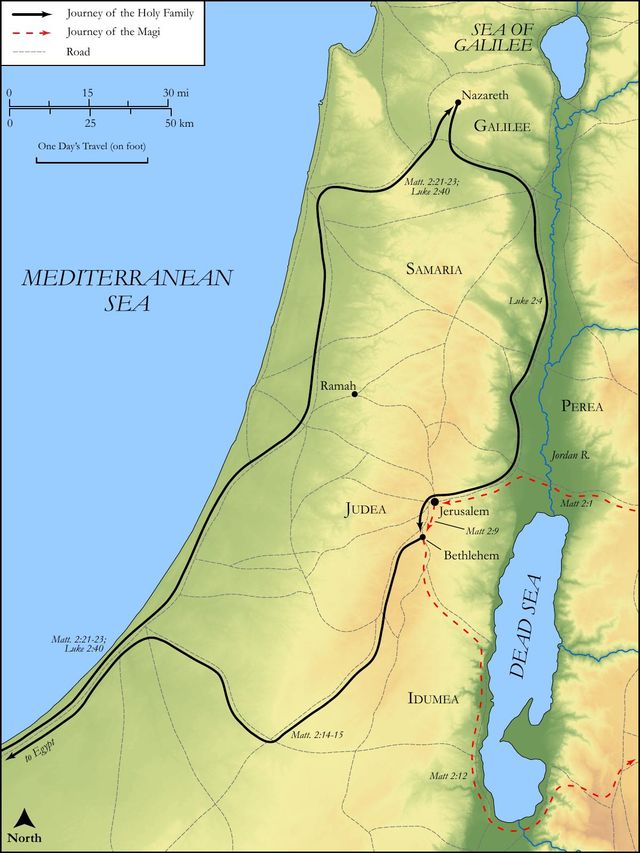
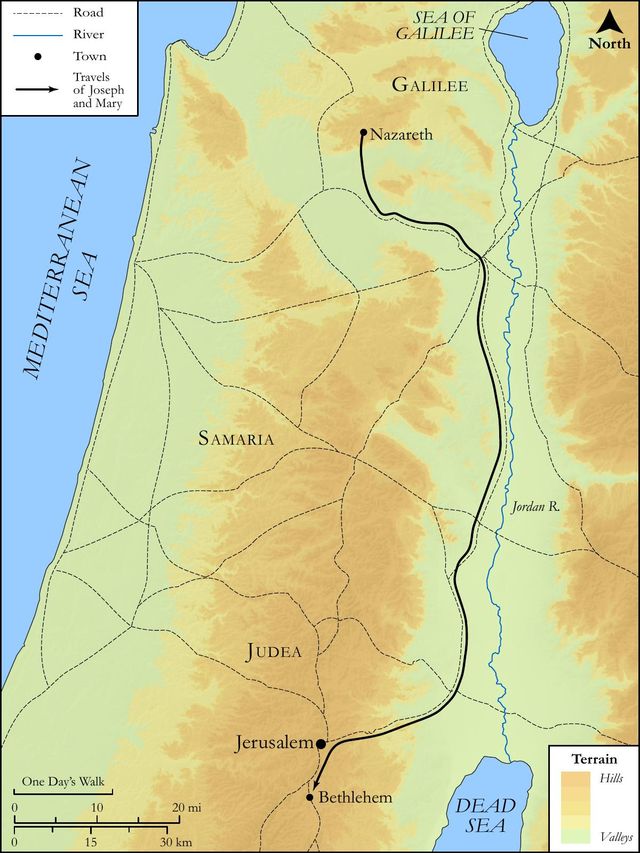
See on the biblical-era maps

Study this verse
Public-domain commentary
Matthew Henry
From his Commentary on the Whole Bible. Henry comments on passages, not single verses — this entry covers Luke 2:1–7. His four-level outline is real structure in the source text, so it is rendered as structure.
The fulness of time was now come, when God would send forth his Son, made of a woman, and made under the law; and it was foretold that he should be born at Bethlehem. Now here we have an account of the time, place, and manner of it.
I.The time when our Lord Jesus was born.
Several things may be gathered out of these verses which intimate to us that it was the proper time.
1.He was born at the time when the fourth monarchy was in its height, just when it was become, more than any of the three before it, a universal monarchy. He was born in the days of Augustus Caesar, when the Roman empire extended itself further than ever before or since, including Parthia one way, and Britain another way; so that it was then called Terraram orbis imperium - The empire of the whole earth; and here that empire is called all the world (Luk 2:1), for there was scarcely any part of the civilized world, but what was dependent on it. Now this was the time when the Messiah was to be born, according to Daniel's prophecy (Dan 2:44): In the days of these kings, the kings of the fourth monarchy, shall the God of heaven set up a kingdom which shall never be destroyed.
2.He was born when Judea was become a province of the empire, and tributary to it; as appears evidently by this, that when all the Roman empire was taxed, the Jews were taxed among the rest. Jerusalem was taken by Pompey the Roman general, about sixty years before this, who granted the government of the church to Hyrcanus, but not the government of the state; by degrees it was more and more reduced, till now at length it was quite subdued; for Judea was ruled by Cyrenius the Roman governor of Syria (Luk 2:2): the Roman writers call him Sulpitius Quirinus. Now just at this juncture, the Messiah was to be born, for so was dying Jacob's prophecy, that Shiloh should come when the sceptre was departed from Judah, and the lawgiver from between his feet, Gen 49:10. This was the first taxing that was made in Judea, the first badge of their servitude; therefore now Shiloh must come, to set up his kingdom.
3.There is another circumstance, as to the time, implied in this general enrolment of all the subjects of the empire, which is, that there was now universal peace in the empire. The temple of Janus was now shut, which it never used to be if any wars were on foot; and now it was fit for the Prince of peace to be born, in whose days swords should be beaten into plough-shares.
II.The place where our Lord Jesus was born is very observable.
He was born at Bethlehem; so it was foretold (Mic 5:2), the scribes so understood it (Mat 2:5, Mat 2:6), so did the common people, Joh 7:42. The name of the place was significant. Bethlehem signifies the house of bread; a proper place for him to be born in who is the Bread of life, the Bread that came down from heaven. But that was not all; Bethlehem was the city of David, where he was born, and therefore there he must be born who was the Son of David. Zion was also called the city of David (Sa2 5:7), yet Christ was not born there; for Bethlehem was that city of David where he was born in meanness, to be a shepherd; and this our Saviour, when he humbled himself, chose for the place of his birth; not Zion, where he ruled in power and prosperity, that was to be a type of the church of Christ, that mount Zion. Now when the virgin Mary was with child, and near her time, Providence so ordered it that, by order from the emperor, all the subjects of the Roman empire were to be taxed; that is, they were to give in their names to the proper officers, and they were to be registered and enrolled, according to their families, which is the proper signification of the word here used; their being taxed was but secondary. It is supposed that they made profession of subjection to the Roman empire, either by some set form of words, or at least by payment of some small tribute, a penny suppose, in token of their allegiance, like a man's atturning tenant. Thus are they vassals upon record, and may thank themselves.
According to this decree, the Jews (who were now nice in distinguishing their tribes and families) provided that in their enrolments particular care should be had to preserve the memory of them. Thus foolishly are they solicitous to save the shadow, when they had lost the substance.
That which Augustus designed was either to gratify his pride in knowing the numbers of his people, and proclaiming it to the world, or he did it in policy, to strengthen his interest, and make his government appear the more formidable; but Providence had another reach in it. All the world shall be at the trouble of being enrolled, only that Joseph and Mary may. This brought them up from Nazareth in Galilee to Bethlehem in Judea, because they were of the stock and lineage of David (Luk 2:4, Luk 2:5); and perhaps, being poor and low, they thought the royalty of their extraction rather than a burden and expense to them than a matter of pride. Because it is difficult to suppose that every Jew (women as well as men) was obliged to repair to the city of which their ancestors were, and there be enrolled, now, at a time when they kept not to the bounds of their tribes, as formerly, it may be offered as a conjecture that this great exactness was used only with the family of David, concerning which, it is probable, the emperor gave particular orders, it having been the royal family, and still talked of as designed to be so, that he might know its number and strength. Divers ends of Providence were served by this.
1.Hereby the virgin Mary was brought, great with child, to Bethlehem, to be delivered there, according to the prediction; whereas she had designed to lie in at Nazareth. See how man purposes and God disposes; and how Providence orders all things for the fulfilling of the scripture, and makes use of the projects men have for serving their own purposes, quite beyond their intention, to serve his.
2.Hereby it appeared that Jesus Christ was of the seed of David; for what brings his mother to Bethlehem now, but because she was of the stock and lineage of David? This was a material thing to be proved, and required such an authentic proof as this. Justin Martyr and Tertullian, two of the earliest advocates for the Christian religion, appeal to these rolls or records of the Roman empire, for the proof of Christ's being born of the house of David.
3.Hereby it appeared that he was made under the law; for he became a subject of the Roman empire as soon as he was born, a servant of rulers, Isa 49:7. Many suppose that, being born during the time of the taxing, he was enrolled as well as his father and mother, that it might appear how he made himself of no reputation, and took upon him the form of a servant. Instead of having kings tributaries to him, when he came into the world he was himself a tributary.
III.The circumstances of his birth, which were very mean, and under all possible marks of contempt.
He was indeed a first-born son; but it was a poor honour to be the first-born of such a poor woman as Mary was, who had no inheritance to which he might be entitled as first-born, but what was in nativity.
1.He was under some abasements in common with other children; he was wrapped in swaddling clothes, as other children are when they are new-born, as if he could be bound, or needed to be kept straight. He that makes darkness a swaddling band for the sea was himself wrapped in swaddling bands, Job 38:9. The everlasting Father became a child of time, and men said to him whose out-goings were of old from everlasting, We know this man, whence he is, Joh 7:27. The Ancient of days became an infant of a span long.
2.He was under some abasements peculiar to himself.
(1.)He was born at an inn. That son of David that was the glory of his father's house had no inheritance that he could command, no not in the city of David, no nor a friend that would accommodate his mother in distress with lodgings to be brought to bed in. Christ was born in an inn, to intimate that he came into the world but to sojourn here for awhile, as in an inn, and to teach us to do likewise. An inn receives all comers, and so does Christ. He hangs out the banner of love for his sign, and whoever comes to him, he will in no wise cast out; only, unlike other inns, he welcomes those that come without money and without price. All is on free cost.
(2.)He was born in a stable; so some think the word signifies which we translate a manger, a place for cattle to stand to be fed in. Because there was no room in the inn, and for want of conveniences, nay for want of necessaries, he was laid in a manger, instead of a cradle. The word which we render swaddling clothes some derive from a word that signifies to rend, or tear, and these infer that he was so far from having a good suit of child-bed linen, that his very swaddles were ragged and torn. His being born in a stable and laid in a manger was an instance,
[1.]Of the poverty of his parents. Had they been rich, room would have been made for them; but, being poor, they must shift as they could.
[2.]Of the corruption and degeneracy of manners in that age; that a woman in reputation for virtue and honour should be used so barbarously. If there had been any common humanity among them, they would not have turned a woman in travail into a stable.
[3.]It was an instance of the humiliation of our Lord Jesus. We were become by sin like an out-cast infant, helpless and forlorn; and such a one Christ was. Thus he would answer the type of Moses, the great prophet and lawgiver of the Old Testament, who was in his infancy cast out in an ark of bulrushes, as Christ in a manger. Christ would hereby put a contempt upon all worldly glory, and teach us to slight it. Since his own received him not, let us not think it strange if they receive us not.
Historical interpretation
Nine Centuries of Reception
12 surviving comments on this verse. Each one is dated, so this reads as a timeline rather than a list.
Select a marker to jump to its quote. Markers stagger vertically where authors wrote within a few decades of each other.
It was the forty second year of the reign of Augustus and twenty-eight years after the oppression of Egypt and the death of Antony and Cleopatra when Jesus was born in Bethlehem according to the prophecies concerning him. Flavius Josephus mentions this census in the time of Quirinius, adding another account about the sect of Galileans that arose at about the same time. Luke, among our writers, mentions this sect in Acts, saying, “After him Judas the Galilean arose in the days of the census and drew some people after him. He also perished, and all who followed him were scattered.”
But in order that men might know that it was an enrolment of righteousness, there came up to it Joseph and Mary, the just man and the virgin. He who was to be guardian of the Word and she who was to bring it forth.
(in diem natal. Christi.) It was the Lord who directed Augustus to give this edict, that he might minister unto the coming of the Only-begotten; for it was this edict that brought Christ's mother into her country as the prophets had foretold, namely, to Bethlehem of Judæa, according to the word, to a city of David, which is called Bethlehem.
A feast day is about to arrive, and it is the most holy and awesome of all feasts. It would be no mistake to call it the chief and mother of all holy days. What feast is that? It is the day of Christ’s birth in the flesh.It is from this day that the feasts of the theophany, the sacred Pasch [Passover], the ascension and Pentecost had their source and foundation. Had Christ not been born in the flesh, he would not have been baptized, which is the theophany or manifestation. Nor would he have been crucified, which is the Pasch. Nor would he have sent down the Spirit, which is Pentecost. Therefore, just as different rivers arise from a single source, these other feasts have their beginnings in the birth of Christ.
He will have it that Mary bore other sons, and he quotes the passage, "And Joseph also went up to the city of David to enroll himself with Mary, who was betrothed to him, being great with child. And it came to pass, while they were there, the days were fulfilled that she should be delivered, and she brought forth her first-born son." From this he endeavours to show that the term first-born is inapplicable except to a person who has brothers, just as he is called only begotten who is the only son of his parents.
Our position is this: Every only begotten son is a first-born son, but not every first-born is an only begotten. By first-born we understand not only one who is succeeded by others, but one who has had no predecessor. [Numbers 18:15] "Everything," says the Lord to Aaron, "that opens the womb of all flesh which they offer unto the Lord, both of man and beast, shall be yours: nevertheless the first born of man shall you surely redeem, and the firstling of unclean beasts shall you redeem." The word of God defines first-born as everything that opens the womb. Otherwise, if the title belongs to such only as have younger brothers, the priests cannot claim the firstlings until their successors have been begotten, lest, perchance, in case there were no subsequent delivery it should prove to be the first-born but not merely the only begotten. [Numbers 18:16] "And those that are to be redeemed of them from a month old shall you redeem, according to your estimation for the money of five shekels, after the shekel of the sanctuary (the same is twenty gerahs). But the firstling of an ox, or the firstling of a sheep, or the firstling of a goat, you shall not redeem; they are holy." The word of God compels me to dedicate to God everything that opens the womb if it be the firstling of clean beasts: if of unclean beasts, I must redeem it, and give the value to the priest. I might reply and say, Why do you tie me down to the short space of a month? Why do you speak of the first-born, when I cannot tell whether there are brothers to follow? Wait until the second is born. I owe nothing to the priest, unless the birth of a second should make the one I previously had the first-born. Will not the very points of the letters cry out against me and convict me of my folly, and declare that first-born is a title of him who opens the womb, and is not to be restricted to him who has brothers? And, then, to take the case of John: we are agreed that he was an only begotten son: I want to know if he was not also a first-born son, and whether he was not absolutely amenable to the law. There can be no doubt in the matter. At all events Scripture thus speaks of the Saviour, "And when the days of her purification according to the law of Moses were fulfilled, they brought him up to Jerusalem, to present him to the Lord (as it is written in the law of the Lord, every male that opens the womb shall be called holy to the Lord) and to offer a sacrifice according to that which is said in the law of the Lord, a pair of turtle-doves, or two young pigeons." If this law relates only to the first-born, and there can be no first-born unless there are successors, no one ought to be bound by the law of the first-born who cannot tell whether there will be successors. But inasmuch as he who has no younger brothers is bound by the law of the first-born, we gather that he is called the first-born who opens the womb and who has been preceded by none, not he whose birth is followed by that of a younger brother. Moses writes in Exodus, [Exodus 12:29] "And it came to pass at midnight, that the Lord smote all the first-born in the land of Egypt, from the first-born of Pharaoh that sat on his throne unto the first-born of the captive that was in the dungeon: And all the first-born of cattle." Tell me, were they who then perished by the destroyer, only your first-born, or, something more, did they include the only begotten? If only they who have brothers are called first-born, the only begotten were saved from death. And if it be the fact that the only begotten were slain, it was contrary to the sentence pronounced, for the only begotten to die as well as the first-born. You must either release the only begotten from the penalty, and in that case you become ridiculous: or, if you allow that they were slain, we gain our point, though we have not to thank you for it, that only begotten sons also are called first-born.
He is also fittingly born in Bethlehem: for Bethlehem is interpreted as "house of bread." For he himself is the one who says: I am the living bread who came down from heaven. The place, therefore, in which the Lord is born was previously called "house of bread," because it was surely going to happen that he would appear there through the substance of flesh, who would refresh the minds of the elect with inner satisfaction.
(Hom. 8. in Ev.) But the registering of the whole world when our Lord was about to be born was mystical; for He appeared in the flesh Who should write down the names of His own elect in eternity.
Joseph also went up from Galilee, from the city of Nazareth, to Judah, to the city of David, etc. By divine arrangement, the census registration was decreed in such a way that everyone was ordered to go to their own homeland. Not only for the mystery we spoke of, but also so that the Lord, conceived elsewhere, born elsewhere, could evade the fury of Herod more easily. If He had been born to parents from Bethlehem, a cunning pursuer might have suspected their sudden flight, especially since everyone knew they were of the lineage of David, from whom Christ was to come. David himself bears witness to this with his name, homeland, and office. David, for his name means "hand of the strong" or "beloved." The name is derived both because he courageously struck down the giant and because he was handsome in appearance and had a pleasing face; but in a deeper mystery, prefiguring Him who was to be born of his house and family, who would singularly conquer the prince of this world, beautiful beyond the sons of men (Ps. 44), and He Himself born in Bethlehem and a shepherd of intellectual sheep, that is, the simple souls. We must particularly observe this great and benevolent humility of Him who consented not only to incarnate for us, but also to be born at a time when He would be registered in Caesar's census and thus subject Himself to servitude for our liberation. Peter suggests this to us as a path of His humility (for He did not come to change conditions, but minds): "Be subject," he says, "to every human creature for God's sake, whether to the king as the superior, or to governors as sent by him" (1 Peter 2). His co-apostle Paul also says: "Render therefore to all their dues: tribute to whom tribute is due; custom to whom custom; fear to whom fear; honor to whom honor. Owe no man anything, but to love one another" (Rom. 13).
He chose a time of utmost peace as the time when he would be born because this was the reason for his being born in the world, that he might lead the human race back to the gifts of heavenly peace. And, indeed it is written: “For he is our peace, who has made us both one,” that is, he who as a kind mediator and reconciler has made one house of God of angels and humanity. Jesus was born in a time of peace, so that even by the circumstance of the time he might teach that he was the very one of whom the prophecy sent before him spoke: “His sovereignty will be multiplied, and there will be no end of peace.”
The Son of God, about to be born in the flesh, as by His birth of a virgin He showed that the grace of virginity was most pleasing in His sight, is therefore begotten in the most peaceful time of the world, because He taught men to seek peace, and condescends to visit those who follow it. But there could be no greater sign of peace than for the whole world to be brought together under one taxing, while its ruler Augustus reigned with so great peace for the twelve years, about the time of our Lord's nativity, that war having been quelled throughout the whole world, there seemed to be a literal fulfilment of the Prophet's prediction, They shall beat their swords into ploughshares, &c.
St. Luke points out, that this taxing was either the first of those which comprehended the whole world, for before this very many parts of the earth are often mentioned as having been taxed; or first began at that time when Cyrinus was sent into Syria.
Now the registration of property was so appointed by Divine guidance, that every one was ordered to go into his own country, as it follows, And they all went to be taxed, every one to his own city. Which so came to pass, in order that the Lord, conceived in one place, born in another, might the more easily escape the fury of the crafty Herod. Hence it follows: Now Joseph also went up from Galilee.
And He most perfectly fulfilled what the name Augustus signifies, in that He was both desirous and able to increase (augere) His own.
As at that time in the reign of Augustus and under the governorship of Cyrinus, every one went to his own city to make returns of his property; so now when Christ reigns through His teachers (the governors of the Church) ought we to make returns of righteousness.
Our city and country is the resting-place of the blessed, to which we ought to be travelling with daily increasing virtues. But day by day does Holy Church wait upon her Teacher, and going up from the course of worldly business (which the name of Galilee signifies) to the city of Judah, i. e. the city of confession and praise, make returns of her devotion to the Eternal King. She, after the example of the blessed Virgin Mary, a Virgin has conceived us of the Spirit. Though espoused to another, she is made fruitful by Him; and while visibly joined to the Pontiff who is placed over her, is invisibly filled with the graces of the Spirit. And hence Joseph is well interpreted increased, declaring by his very name, that the earnestness of the master speaking is of no avail, except he receive increasing help from above, that he may be heard.
Because it was fit also that at Christ's coming the worship of many Gods should cease, and one God only be worshipped, one king is described as ruling the world.
(Irenæus cont. Hær. 1. 3. c. 11.) Now he added, a city of David, that he might declare that the promise made by God to David, namely, that from the fruit of his loins there should go before him a king for ever, (2 Sam. 7:12.) was already fulfilled. Whence it follows, Because he was of the house and lineage of David. (Ps. 132:11.) But since Joseph was of the family of David, it pleased the Evangelist to make known also that the Virgin herself was of the same family, because the Divine law enjoined marriages between those of the same line; and therefore it follows, With Mary his espoused wife.
Continue studying Luke 2:4 across the web’s major study libraries — every link below opens this exact verse, chapter, or book on the destination site.
Read & Compare
 BibleGatewayThis verse in more than 200 translations and 70 languages.
 Bible.comThe YouVersion reader — hundreds of translations, reading plans, and highlights.
 ESV.orgCrossway's official English Standard Version reader.
 NET BibleThe NET translation with 60,000+ translators' notes on every rendering decision.
 STEP BibleTyndale House's free study tool — original text, vocabulary, and scholarly resources.
 BibliaLogos Bible Software's free web reader.
 USCCBThe New American Bible (Revised Edition) with the U.S. bishops' study notes.
Commentaries
 BibleHub CommentariesDozens of classic commentaries on this verse, gathered on one page.
 StudyLightMore than 100 commentary sets — the largest collection on the web.
 BibleRefPlain-English commentary on what this verse means, verse by verse.
 Enduring WordDavid Guzik's free commentary on this chapter, widely used by Bible teachers.
 Bible Study ToolsVerse commentary alongside Greek and Hebrew study aids.
Original Language & Research
- BibleHub InterlinearThe verse word by word — original language, transliteration, and English.
- BibleHub LexiconEvery word's original-language definition and Strong's entry.
 Blue Letter BibleDeep-study tools — Strong's numbers, concordance, and word studies.
 CNTR CollationThe earliest Greek manuscripts of this verse, collated letter by letter.
Sermons, Hymns & Audio


TrulyRandomVerse is not affiliated with these sites and doesn’t control their content. They’re linked because they’re genuinely useful.
Summary
Luke 2:4 meticulously details the divinely orchestrated journey of Joseph from Nazareth in Galilee to Bethlehem in Judaea, the ancestral city of David. This seemingly ordinary trip, necessitated by a Roman census, was in fact a pivotal moment in redemptive history, ensuring that Jesus, the promised Messiah, would be born in the precise location foretold by ancient prophets, thereby confirming His Davidic lineage and messianic credentials.
Context
ShowHideLiterary Context
This verse immediately follows the decree issued by Caesar Augustus for a census to be taken throughout the Roman world, as described in Luke 2:1-3. This imperial mandate provides the immediate narrative impetus for Joseph and Mary's journey. Luke's Gospel carefully sets the stage, demonstrating how seemingly secular events are woven into God's sovereign plan. The journey to Bethlehem is not a random occurrence but a necessary precursor to the central event of the chapter: the birth of Jesus, which is detailed in the verses that follow Luke 2:6-7. The emphasis on Joseph's lineage in this verse also connects to the genealogies presented in both Matthew 1 and Luke 3, establishing Jesus' legal claim to the Davidic throne.
Historical & Cultural Context
The Roman census (Latin: census, Greek: apographē) was a comprehensive registration of citizens and their property, primarily for taxation and military conscription purposes. It was a regular feature of Roman administration. Crucially, for this particular census, individuals were often required to return to their ancestral hometowns or places of origin to register. This explains why Joseph, being "of the house and lineage of David," had to travel specifically to Bethlehem, which was known as "the city of David" due to King David's birth there. The journey from Nazareth in Galilee to Bethlehem in Judaea was approximately 70-90 miles, an arduous trek, especially for Mary who was heavily pregnant. The phrase "went up" accurately reflects the geographical reality, as Galilee is in a lower elevation compared to the Judean hills where Bethlehem is situated.
Key Themes
ShowHideLuke 2:4 is rich with significant theological and narrative themes. Firstly, it underscores Divine Orchestration, illustrating how God uses the decrees of a pagan emperor (Caesar Augustus) as an instrument to fulfill His divine purposes, specifically ensuring Jesus' birth in the prophesied location. This highlights God's absolute sovereignty over human affairs and political powers, demonstrating that even seemingly mundane or secular events serve His grand redemptive plan. Secondly, the verse powerfully showcases the Fulfillment of Prophecy. Joseph's Davidic lineage and the necessity of his travel to Bethlehem directly fulfill ancient prophecies, most notably Micah 5:2, which explicitly declared that the ruler of Israel would come from Bethlehem Ephrathah. Finally, the emphasis on Joseph being "of the house and lineage of David" is crucial for establishing Messianic Identity. It underscores Jesus' legal claim to the throne of David through Joseph, aligning with numerous Old Testament prophecies that the Messiah would be a descendant of David (e.g., Isaiah 9:7; Jeremiah 23:5). This Davidic connection is a cornerstone of Jesus' messianic credentials, affirmed throughout the New Testament, from the opening of Matthew 1:1 to Paul's theological statements in Romans 1:3.
Exposition and Analysis
ShowHideKey Word Analysis
ShowHideThis verb (G305) literally means "to go up" or "ascend." In this context, it accurately describes the geographical ascent from the lower region of Galilee to the higher elevation of Judaea and Bethlehem. Beyond the literal, it can also carry a subtle spiritual connotation of moving towards a significant, divinely appointed destination, hinting at the profound importance of this journey.
This term (G3624) refers to a dwelling, a home, but more broadly, it signifies a family unit, a household, or even a lineage. Here, it emphasizes Joseph's direct familial connection to the royal line of David, highlighting that his obligation to register in Bethlehem was not merely a civic duty but a deeply rooted ancestral identity.
Derived from the word for "father," this noun (G3965) denotes paternal descent, a family group, or a tribe. When paired with "house," it strongly reinforces the idea of Joseph's genealogical connection to David. This dual emphasis ("house and lineage") leaves no doubt about the direct and legitimate ancestral link, which was vital for substantiating Jesus' messianic claims.
Verse Breakdown
ShowHide"And Joseph also went up from Galilee, out of the city of Nazareth,"
This clause establishes the starting point of the journey—Nazareth, Joseph's known residence in Galilee. The inclusion of "also" (Greek: kai) implies that Joseph, like others, was complying with the census decree, making his journey seem routine, yet it was anything but.
"into Judaea, unto the city of David, which is called Bethlehem;"
This specifies the destination: Bethlehem, located in Judaea. The parenthetical description "the city of David" is crucial, immediately highlighting its historical and prophetic significance as the birthplace of King David, and by extension, the prophesied birthplace of the Messiah.
"(because he was of the house and lineage of David:)"
This parenthetical explanation provides the divine rationale behind Joseph's specific destination. It clarifies that his travel to Bethlehem was not arbitrary but compelled by his direct ancestral connection to King David, thereby setting the stage for the fulfillment of messianic prophecy concerning the Messiah's birthplace and Davidic heritage.
Literary Devices
ShowHideLuke 2:4 masterfully employs several literary devices to convey its profound theological message. There is a strong sense of Foreshadowing, as the seemingly mundane journey to Bethlehem for a Roman census is revealed to be the divinely appointed means for the Messiah's birth in the prophesied city, setting the stage for the fulfillment of ancient prophecies. The verse also contains a powerful Irony: a pagan emperor's decree, intended for imperial administration, unwittingly becomes the very instrument through which God orchestrates the birth of His Son in the precise location foretold centuries earlier. This highlights God's ultimate control over human history. Furthermore, the repeated emphasis on "the city of David" and the explicit statement that Joseph was "of the house and lineage of David" serves as Emphasis, underscoring the vital Davidic connection of Jesus. This repetition is not redundant but a deliberate literary choice to stress the authenticity of Jesus' messianic claim through His legal lineage.
Theological and Thematic Connections
ShowHideLuke 2:4 is a profound testament to God's meticulous sovereignty and His unwavering commitment to fulfilling His redemptive promises. The journey of Joseph and Mary, while appearing as a simple compliance with a Roman decree, was in fact a divinely orchestrated event, demonstrating that God works through ordinary human circumstances and even secular authorities to bring about His perfect will. This highlights the theme of divine providence, where every detail, no matter how small or seemingly insignificant, is part of God's grand design. The verse powerfully connects the historical reality of the census to the theological truth of messianic prophecy, ensuring that Jesus' birth would align precisely with the ancient declarations regarding His birthplace and lineage. This confirms Jesus' identity as the long-awaited Messiah, the Son of David, and the true King of Israel.
Reflection and Application
ShowHideLuke 2:4 offers a profound spiritual lesson: God's plans are meticulously detailed and often unfold through the most ordinary, even inconvenient, human events. Joseph and Mary's arduous journey was not chosen by them but imposed by an external authority, yet it perfectly served God's redemptive purpose. This reminds us that even when our lives take unexpected turns, or when we face circumstances beyond our control—be they governmental decrees, economic shifts, or personal obligations—God remains sovereign. He is actively working behind the scenes, weaving every thread of our lives into His larger, perfect tapestry. This verse invites us to cultivate a deep trust in God's providence, recognizing that He is always at work, even when His hand is not immediately visible, guiding all things to accomplish His good and perfect will. Our "journeys," whether physical or metaphorical, are never outside His divine oversight.
Questions for Reflection
ShowHideFAQ
ShowHideWhy was it so important for Jesus to be born in Bethlehem?
ShowHideIt was critically important for Jesus to be born in Bethlehem because ancient Old Testament prophecy explicitly foretold that the Messiah would come from this specific town. Micah 5:2 states, "But you, Bethlehem Ephrathah, though you are small among the clans of Judah, out of you will come for me one who will be ruler over Israel, whose origins are from of old, from ancient times." Joseph's lineage from David, who was also born in Bethlehem (known as "the city of David"), necessitated his journey there for the Roman census, thus providentially ensuring the fulfillment of this prophecy. This birth location served as a key identifier, confirming Jesus' messianic credentials to the Jewish people.
How does Joseph's "house and lineage of David" relate to Jesus' messianic claim?
ShowHideThe emphasis on Joseph being "of the house and lineage of David" is crucial for establishing Jesus' legal claim to the Davidic throne and His identity as the Messiah. Old Testament prophecies repeatedly declared that the Messiah would be a descendant of King David (e.g., 2 Samuel 7:12-16; Isaiah 11:1). While Jesus was miraculously conceived by the Holy Spirit and not biologically Joseph's son, Joseph was His legal father. Through Joseph, Jesus inherited the legal right to the Davidic throne, fulfilling the requirement for the Messiah to be of David's royal line. Both Matthew's and Luke's genealogies trace Jesus' lineage through Joseph back to David, solidifying this vital connection (see Matthew 1:1-17 and Luke 3:23-38).
Christ-Centered Fulfillment
ShowHideLuke 2:4, while seemingly a mundane account of travel for a census, is a profound testament to the Christ-centered nature of God's redemptive plan. The journey of Joseph and Mary to Bethlehem, "the city of David," directly fulfills ancient prophecies concerning the Messiah's birthplace, most notably Micah 5:2. This meticulous divine orchestration ensures that Jesus, the promised Savior, is born in the very place designated by God centuries before. Furthermore, the emphasis on Joseph being "of the house and lineage of David" is paramount, establishing Jesus' legal right to the Davidic throne. This lineage confirms Jesus as the long-awaited King, the "Son of David" (as affirmed in Matthew 1:1 and Romans 1:3), who would reign forever. Thus, this verse is not merely historical detail but a foundational declaration of Jesus' identity as the Christ, the anointed King, whose birth in Bethlehem perfectly aligns with God's sovereign plan to bring salvation to humanity through the true heir of David's kingdom. His humble birth in the "city of David" foreshadows His ultimate reign as "Lord of all" (as proclaimed in Acts 10:36).