


Matthew 2:23
- καὶkaiandG2532CONJConjunction
- ἐλθὼνelthōnhaving comeG2064V-2AAP-NSMVerb 2nd Aorist Active Participle Nominative Singular Masculine
- κατῴκησενkatōkēsenhe dweltG2730V-AAI-3SVerb Aorist Active Indicative 3rd Singular
- εἰςeisinG1519PREPPreposition
- πόλινpolina cityG4172N-ASFNoun Accusative Singular Feminine
- λεγομένηνlegomenēnbeing namedG3004V-PPP-ASFVerb Present Passive Participle Accusative Singular Feminine
- ΝαζαρέτNazaretNazarethG3478N-ASF-LNoun Accusative Singular Feminine Location
- ὅπωςhopōsso thatG3704CONJConjunction
- πληρωθῇplērōthēait may be fulfilledG4137V-APS-3SVerb Aorist Passive Subjunctive 3rd Singular
- τὸtothatG3588T-NSNDefinite article Nominative Singular Neuter
- ῥηθὲνrhēthenhaving been spokenG2046V-APP-NSNVerb Aorist Passive Participle Nominative Singular Neuter
- διὰdiathroughG1223PREPPreposition
- τῶνtōntheG3588T-GPMDefinite article Genitive Plural Masculine
- προφητῶνprophētōnprophetsG4396N-GPMNoun Genitive Plural Masculine
- ὅτιhotithatG3754CONJConjunction
- ΝαζωραῖοςNazōraiosA NazareneG3480N-NSM-LGNoun Nominative Singular Masculine Location Gentilic
- κληθήσεταιklēthēsetaiHe will be calledG2564V-FPI-3SVerb Future Passive Indicative 3rd Singular
English is a literal word-by-word gloss of the Greek, not the KJV's wording. Why?
This is the original text the KJV's translators worked from — each Greek word with its own literal English meaning in this verse, prepared by scholars at Tyndale House, Cambridge. The KJV translates whole sentences, not word by word, so its wording differs: one Greek word can become several English words, and the KJV may choose “charity” where the gloss reads “love”. Both are faithful — they answer different questions. For the KJV's own rendering, switch to the KJV text.
Details
See on the biblical-era map

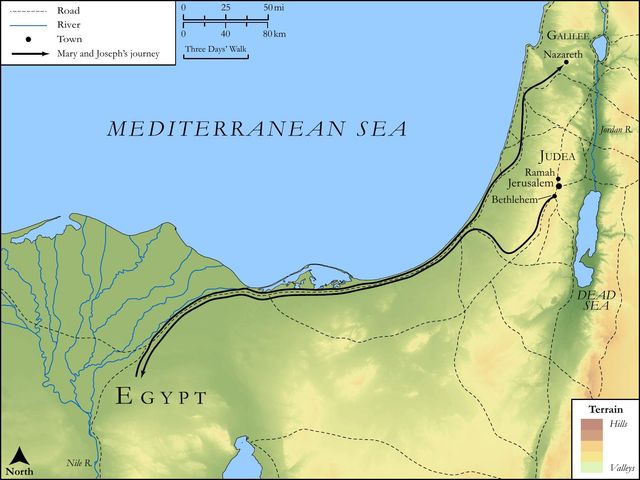
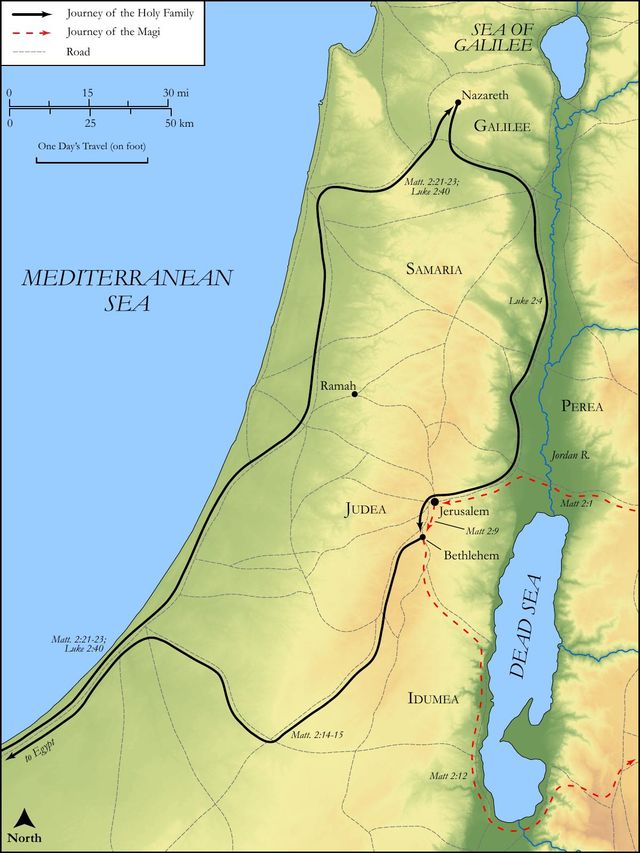
Study this verse
Public-domain commentary
Matthew Henry
From his Commentary on the Whole Bible. Henry comments on passages, not single verses — this entry covers Matthew 2:19–23. His two-level outline is real structure in the source text, so it is rendered as structure.
We have here Christ's return out of Egypt into the land of Israel again. Egypt may serve to sojourn in, or take shelter in, for a while, but not to abide in. Christ was sent to the lost sheep of the house of Israel, and therefore to them he must return. Observe,
I.What it was that made way for his return - the death of Herod, which happened not long after the murder of the infants; some think not above three months. Such quick work did divine vengeance make! Note, Herods must die; proud tyrants, that were the terror of the mighty, and the oppressors of the godly, in the land of the living, their day must come to fall, and down to the pit they must go. Who art thou then, that thou shouldest be afraid of a man that shall die? (Isa 51:12, Isa 51:13) especially considering that at death, not only their envy and hatred are perished (Ecc 9:6), and they cease from troubling (Job 3:17), but they are punished. Of all sins, the guilt of innocent blood fills the measure soonest. It is a dreadful account which Josephus gives of the death of this same Herod (Antiq. 17.146-199), that he was seized with a disease which burned him inwardly with an inexpressible torture; that he was insatiably greedy of meat; had the colic, and gout, and dropsy; such an intolerable stench attended his disease, that none could come near him: and so passionate and impatient was he, that he was a torment to himself, and a terror to all that attended him: his innate cruelty, being thus exasperated, made him more barbarous than ever; having ordered his own son to be put to death, he imprisoned many of the nobility and gentry, and ordered that as soon as he was dead they should be killed; but that execution was prevented. See what kind of men have been the enemies and persecutors of Christ and his followers! Few have opposed Christianity but such as have first divested themselves of humanity, as Nero and Domitian.
II.The orders given from heaven concerning their return, and Joseph's obedience to those orders, Mat 2:19-21.
God had sent Joseph into Egypt, and there he staid till the same that brought him thither ordered him thence. Note, In all our removes, it is good to see our way plain, and God going before us; we should not move either one way or the other without order. These orders were sent him by an angel. Note, Our intercourse with God, if it be kept up on our part, shall be kept up on his, wherever we are. No place can exclude God's gracious visits. Angels come to Joseph in Egypt, to Ezekiel in Babylon, and to John in Patmos. Now,
1.The angel informs him of the death of Herod and his accomplices: They are dead, which sought the young Child's life. They are dead, but the young Child lives. Persecuted saints sometimes live to tread upon the graves of their persecutors. Thus did the church's King weather the storm, and many a one has the church in like manner weathered. They are dead, to wit, Herod and his son Antipater, who, though there were mutual jealousies between them, yet, probably, concurred in seeking the destruction of this new King. If Herod first kill Antipater, and then die himself, the coasts are cleared, and the Lord is known by the judgments which he executes, when one wicked instrument is in the ruin of another.
2.He directs him what to do. He must go and return to the land of Israel; and he did so without delay; not pleading the tolerably good settlement he had in Egypt, or the inconveniences of the journey, especially if, as is supposed, it was in the beginning of winter that Herod died. God's people follow his direction whithersoever he leads them, wherever he lodges them. Did we but look upon the world as our Egypt, the place of our bondage and banishment, and heaven only as our Canaan, our home, our rest, we should as readily arise, and depart thither, when we are called for, as Joseph did out of Egypt.
III.The further direction he had from God, which way to steer, and where to fix in the land of Israel, Mat 2:22, Mat 2:23.
God could have given him these instructions with the former, but God reveals his mind to his people by degrees, to keep them still waiting on him, and expecting to hear further from him. These orders Joseph received in a dream, probably, as those before, by the ministration of an angel. God could have signified his will to Joseph by the Child Jesus, but we do not find that in those removes he either takes notice, or gives notice, of any thing that occurred; surely it was because in all things it behoved him to be made like his brethren; being a Child, he spake as a child, and did as a child, and drew a veil over his infinite knowledge and power; as a child he increased in wisdom.
Now the direction given this holy, royal family, is, 1. That it might not settle in Judea, Mat 2:22. Joseph might think that Jesus, being born in Bethlehem, must be brought up there; yet he is prudently afraid for the young Child, because he hears that Archelaus reigns in Herod's stead, not over all the kingdom as his father did, but only over Judea, the other provinces being put into other hands. See what a succession of enemies there is to fight against Christ and his church! If one drop off, another presently appears, to keep up the old enmity. But for this reason Joseph must not take the young Child into Judea. Note, God will not thrust his children into the mouth of danger, but when it is for his own glory and their trial; for precious in the sight of the Lord are the life and the death of his saints; precious is their blood to him.
2.That it must settle in Galilee, Mat 2:22. There Philip now ruled, who was a mild, quiet, man. Note, The providence of God commonly so orders it, that his people shall not want a quiet retreat from the storm and from the tempest; when one climate becomes hot and scorching, another shall be kept more cool and temperate. Galilee lay far north; Samaria lay between it and Judea; thither they were sent, to Nazareth, a city upon a hill, in the centre of the lot of Zebulun; there the mother of our Lord lived, when she conceived that holy thing; and, probably, Joseph lived there too, Luk 1:26, Luk 1:27. Thither they were sent, and there they were well known, and were among their relations; the most proper place for them to be in. There they continued, and from thence our Saviour was called Jesus of Nazareth, which was to the Jews a stumbling-block, for, Can any good thing come out of Nazareth?
In this is said to be fulfilled what was spoken by the prophets, He shall be called a Nazarene. Which may be looked upon, (1.) As a man of honour and dignity, though primarily it signifies no more than a man of Nazareth; there is an allusion or mystery in speaking it, speaking Christ to be, [1.] The Man, the Branch, spoken of, Isa 11:1. The word there is Netzar, which signifies either a branch, or the city of Nazareth; in being denominated from that city, he is declared to be that Branch. [2.] It speaks him to be the great Nazarite; of whom the legal Nazarites were a type and figure (especially Samson, Jdg 13:5), and Joseph, who is called a Nazarite among his brethren (Gen 49:26), and to whom that which was prescribed concerning the Nazarites, has reference, Num 6:2, etc. Not that Christ was, strictly, a Nazarite, for he drank wine, and touched dead bodies; but he was eminently so, both as he was singularly holy, and as he was by a solemn designation and dedication set apart to the honour of God in the work of our redemption, as Samson was to save Israel. And it is a name we have all reason to rejoice in, and to know him by. Or, (2.) As a name of reproach and contempt. To be called a Nazarene, was to be called a despicable man, a man from whom no good was to be expected, and to whom no respect was to be paid. The devil first fastened this name upon Christ, to render him mean, and prejudice people against him, and it stuck as a nickname to him and his followers. Now this was not particularly foretold by any one prophet, but, in general, it was spoken by the prophets, that he should be despised and rejected of men (Isa 53:2, Isa 53:3), a Worm, and no man (Psa 22:6, Psa 22:7), that he should be an Alien to his brethren Psa 69:7, Psa 69:8. Let no name of reproach for religion's sake seem hard to us, when our Master was himself called a Nazarene.
Historical interpretation
Twelve Centuries of Reception
17 surviving comments on this verse. Each one is dated, so this reads as a timeline rather than a list.
Select a marker to jump to its quote. Markers stagger vertically where authors wrote within a few decades of each other.
Herod had nine wives, by seven of whom he had a numerous issue. By Josida, his first born Antipater—by Mariamine, Alexander and Aristobulus—by Mathuca, a Samaritan woman, Archelaus—by Cleopatra of Jerusalem, Herod, who was afterwards tetrarch, and Philip. The three first were put to death by Herod; and after his death, Archelaus seized the throne by occasion of his father's will, and the question of the succession was carried before Augustus Cæsar. After some delay, he made a distribution of the whole of Herod's dominions in accordance with the Senate's advice. To Archelaus he assigned one half, consisting of Idumæa and Judæa, with the title of tetrarch, and a promise of that of king if he showed himself deserving of it. The rest he divided into two tetrarchates, giving Galilee to Herod the tetrarch, Ituræa and Trachonitis to Philip. Thus Archelaus was after his father's death a duarch, which kind of sovereignty is here called a kingdom.
But the figurative intepretation holds good any way. Joseph represents the Apostles, to whom Christ is entrusted to be borne about. These, as though Hero were dead, that is, his people being destroyed in the Lord’s passion, are commanded to preach the Gospel to the Jews; they are sent to the lost sheep of the house of Israel. But finding the seed of their hereditary unbelief still abiding, they fear and withdraw; admonished by a vision, to wit, seeing the Holy Spirit poured upon the Gentiles, they carry Christ to them.
But the figurative interpretation holds good any way. Joseph represents the Apostles, to whom Christ is entrusted to be borne about. These, as though Herod were dead, that is, his people being destroyed in the Lord's passion, are commanded to preach the Gospel to the Jews; they are sent to the lost sheep of the house of Israel. But finding the seed of their hereditary unbelief still abiding, they fear and withdraw; admonished by a vision, to wit, seeing the Holy Ghost poured upon the Gentiles, they carry Christ to them.
Joseph therefore comes to Nazareth, partly to avoid the danger, partly also delighting to abide in his native place. To give him the more courage, he receives also an oracle from the angel touching this matter. Luke, however, doth not say that he came there by Divine warning, but that when they had fulfilled all the purification, they returned to Nazareth. What then may one say? That Luke is giving an account of the time before the going down to Egypt, when he saith these things. For He would not have brought them down thither before the purification, in order that nothing should be done contrary to the law, but he waited for her to be purified, and to go to Nazareth, and that then they should go down to Egypt. Then, after their return, He bids them go to Nazareth. But before this they were not warned of God to go thither, but yearning after their native place, they did so of their own accord. For since they had gone up for no other cause but on account of the taxing, and had not so much as a place where to stay, when they had fulfilled that for which they had come up, they went down to Nazareth.
And when he had once left the country of His birth, all the occurrences passed out of mind; the rage of persecution had been spent in Bethlehem and its neighbourhood. By choosing Nazareth therefore, Joseph both avoided danger, and returned to his country.
We see here the cause why the angel also, putting them at ease for the future, restores them to their home. And not even this simply, but he adds to it a prophecy, "That it might be fulfilled," saith he, "which was spoken by the prophets, He shall be called a Nazarene."
And what manner of prophet said this? Be not curious, nor overbusy. For many of the prophetic writings have been lost; and this one may see from the history of the Chronicles. For being negligent, and continually falling into ungodliness, some they suffered to perish, others they themselves burnt up and cut to pieces. The latter fact Jeremiah relates; the former, he who composed the fourth book of Kings, saying, that after a long time the book of Deuteronomy was hardly found, buried somewhere and lost. But if, when there was no barbarian there, they so betrayed their books, much more when the barbarians had overrun them. For as to the fact, that the prophet had foretold it, the apostles themselves in many places call Him a Nazarene.
"Was not this then," one may say, "casting a shade over the prophecy touching Bethlehem?" By no means: rather this very fact was sure greatly to stir up men, and to awaken them to the search of what was said of Him. Thus, for example, Nathanael too enters on the inquiry concerning Him, saying, "Can there any good thing come out of Nazareth?" For the place was of little esteem; or rather not that place only, but also the whole district of Galilee. Therefore the Pharisees said, "Search and look, for out of Galilee ariseth no prophet." Nevertheless, He is not ashamed to be named even from thence, signifying that He needs not ought of the things of men; and His disciples also He chose out of Galilee; everywhere cutting off the pretexts of them who are disposed to be remiss, and giving tokens that we have no need of outward things, if we practice virtue. For this cause He doth not choose for Himself so much as a house; for "the Son of Man," saith He, "hath not where to lay His head;" and when Herod is plotting against Him, He fleeth, and at His birth is laid in a manger, and abides in an inn, and takes a mother of low estate; teaching us to think no such thing a disgrace, and from the first outset trampling under foot the haughtiness of man, and bidding us give ourselves up to virtue only.
(Verse 23) And coming, he lived in a city called Nazareth, so that what was spoken by the prophets might be fulfilled, that he would be called a Nazarene. If he had set a fixed example from the Scriptures, he would never have said, what was spoken by the prophets; but simply, what was spoken by the prophet: but now, calling them prophets in the plural, he shows that he did not take words from the Scriptures, but the meaning. Nazarene, interprets as holy. But all Scripture testifies that the Lord would be holy. We can also say in another way, that even in the same words, according to the Hebrew truth, it is written in Isaiah: There shall come forth a rod out of the stem of Jesse, and a Nazarene shall rise out of his roots (Isa. 11:1).
In this it is to be noted that wherever the Evangelist, whether on his own account or in the person of our Lord the Saviour quotes the testimony of the Old Testament he does not follow the authority of the translators of the Septuagint but the Hebrew. Wherefore these two forms exist "Out of Egypt have I called my son," and "for he shall be called a Nazarene."
Had he meant to quote a particular text, he would not have written 'Prophets,' but 'the Prophet.' By thus using the plural he evidently does not take the words of any one passage in Scripture, but the sense of the whole. Nazarene is interpreted 'Holyd,' and that the Lord would be Holy, all Scripture testifies. Otherwise we may explain that it is found in Isaiah (c. 11:1.) rendered to the strict letter of the Hebrew. There shall come a Rod out of the stem of Jesse, and a Nazarene shall grow out of His rootse.
If this could have been found in the Scriptures, he never would have said, “Because it has been spoken by the prophets,” but he would rather have spoken more plainly: “Because it has been spoken by a prophet.” As it is now, in speaking of prophets in general he has shown that he has not taken the specific words but rather the sense from the Scriptures. “Nazarene” is understood as “holy.” Every Scripture attests that the Lord was to be holy. We can also speak in another way of what was written … in Hebrew in Isaiah: “A branch will blossom from the root of Jesse, a Nazarene from his root.”
(De Con. Evan. ii. 10.) Here it may be asked, How then could his parents go up every year of Christ's childhood to Jerusalem, as Luke relates, if fear of Archelaus now prevented them from approaching it? This difficulty is easily solved. At the festival they might escape notice in the crowd, and by returning soon, where in ordinary times they might be afraid to live. So they neither became irreligious by neglecting the festival, nor notorious by dwelling continually in Jerusalem. Or it is open to us to understand Luke when he says, they went up every year, as speaking of a time when they had nothing to fear from Archelaus, who, as Josephus relates, reigned only nine years. There is yet a difficulty in what follows; Being warned in a dream, he turned aside into the parts of Galilee. If Joseph was afraid to go into Judaea because one of Herod's sons, Archelaus, reigned there, how could he go into Galilee, where another of his sons Herod was tetrarch, as Luke tells us? As if the times of which Luke is speaking were times in which there was any longer need to fear for the Child, when even in Judaea things were so changed, that Archelaus no longer ruled there, but Pilate was governor.
(De Con. Evan. ii. 9.) This may perhaps occur to some, that Matthew says His parents went with the Child Jesus to Galilee because they feared Archelaus, when it should seem most probable that they chose Galilee because Nazareth was their own city, as Luke has not forgot to mention. We must understand, that when the Angel in the vision in Egypt said to Joseph, Go into the land of Israel, Joseph understood the command to be that he should go straight into Judaea, that being properly the land of Israel. But finding Archelaus ruling there, he would not court the danger, as the land of Israel might be interpreted to extend to Galilee, which was inhabited by children of Israel. Or we may suppose His parents supposed that Christ should dwell no where but in Jerusalem, where was the temple of the Lord, and would have gone thither had not the fear of Archelaus hindered them. And they had not been commanded from God to dwell positively in Judaea, or Jerusalem, so as that they should have despised the fear of Archelaus, but only in the land of Israel generally, which they might understand of Galilee.
(De Con. Evan. ii. 5.) The whole of this history, from the account of the Magi inclusively, Luke omits. Let it be here noticed once for all, that each of the Evangelists writes as if he were giving a full and complete history, which omits nothing; where he really passes over any thing, he continues his thread of history as if he had told all. Yet by a diligent comparison of their several narratives, we can be at no loss to know where to insert any particular that is mentioned by one and not by the other.
But if “the Nazarene” is interpreted to mean “holy” or, according to some, as “flower,” this is the designation found in many instances. For Daniel calls him “holy” or “of the holy ones.” Likewise we find in Isaiah: “A branch from the stock of Jesse and its flower.” Even the Lord says of himself in the Song of Songs, “I am the bloom of the plain, the lily of the valleys.”
They might have read this in some Prophets who are not in our canon, as Nathan or Esdras. That there was some prophecy to this purport is clear from what Philip says to Nathanael. Him of whom Moses in the Law and the Prophets did write, Jesus of Nazareth. (John 1:15.) Hence the Christians were at first called Nazarenes, at Antioch their name was changed to that of 'Christians.'
Or, we may apply it to the last times of the Jewish Church, when many Jews having turned to the preaching of Enoch and Elijah, the rest filled with the spirit of Antichrist shall fight against the faith. So that part of Judæa where Archelaus rules, signifies the followers of Antichrist; Nazareth of Galilee, whither Christ is conveyed, that part of the nation that shall embrace the faith. Galilee means 'removal;' Nazareth, 'the flower of virtues;' for the Church the more zealously she removes from the earthly to the heavenly, the more she abounds in the flower and fruit of virtues.
How is it that Luke says that after the Lord was born, He completed the forty days, was held in the arms of Simeon, and then went down to Nazareth (Lk. 2:22-40)? But here Matthew says that after the return from Egypt He went to Nazareth? Learn, therefore, that Luke spoke those things on which Matthew was silent. I will give an example: after the birth, He completed the forty days, and then went down to Nazareth. This is what Luke says. Matthew speaks of what took place afterwards, that He fled into Egypt, and then returned from Egypt to Nazareth. They do not contradict each other. One of them, Luke, speaks of the descent from Bethlehem to Nazareth, while the other, Matthew, speaks of the return from Egypt to Nazareth, which took place later.
Which prophet said this? It is not to be found now. For many books have been lost, because of both the carelessness of the Hebrews and the frequent captivities. But perhaps this was an unwritten prophecy among the Jews. "Nazarene" means "sanctified" and as the Christ is holy, it is right that He is called "a Nazarene." For by many prophets the Lord was called "The Holy One of Israel" (Ps. 88:18, Is. 1:4, etc.)
Joseph was not disobedient to the angelic warning, but he arose, and took the young Child and his mother, and came into the land of Israel. The Angel had not fixed the particular place, so that while Joseph hesitates, the Angel returns, and by the often visiting him confirms his obedience.
(ord.) But then we might ask, why was he not afraid to go into Galilee, seeing Archelaus ruled there also? He could be better concealed in Nazareth than in Jerusalem, which was the capital of the kingdom, and where Archelaus was constantly resident.
To this he adds the Prophet's testimony, saying, That it might be fulfilled which was spoken by the Prophets, &c.
Continue studying Matthew 2:23 across the web’s major study libraries — every link below opens this exact verse, chapter, or book on the destination site.
Read & Compare
 BibleGatewayThis verse in more than 200 translations and 70 languages.
 Bible.comThe YouVersion reader — hundreds of translations, reading plans, and highlights.
 ESV.orgCrossway's official English Standard Version reader.
 NET BibleThe NET translation with 60,000+ translators' notes on every rendering decision.
 STEP BibleTyndale House's free study tool — original text, vocabulary, and scholarly resources.
 BibliaLogos Bible Software's free web reader.
 USCCBThe New American Bible (Revised Edition) with the U.S. bishops' study notes.
Commentaries
 BibleHub CommentariesDozens of classic commentaries on this verse, gathered on one page.
 StudyLightMore than 100 commentary sets — the largest collection on the web.
 BibleRefPlain-English commentary on what this verse means, verse by verse.
 Enduring WordDavid Guzik's free commentary on this chapter, widely used by Bible teachers.
 Bible Study ToolsVerse commentary alongside Greek and Hebrew study aids.
Original Language & Research
- BibleHub InterlinearThe verse word by word — original language, transliteration, and English.
- BibleHub LexiconEvery word's original-language definition and Strong's entry.
 Blue Letter BibleDeep-study tools — Strong's numbers, concordance, and word studies.
 CNTR CollationThe earliest Greek manuscripts of this verse, collated letter by letter.
Sermons, Hymns & Audio


TrulyRandomVerse is not affiliated with these sites and doesn’t control their content. They’re linked because they’re genuinely useful.
Summary
Matthew 2:23 concludes the infancy narrative by detailing Joseph's decision, guided by divine warning, to settle his family in Nazareth of Galilee after returning from Egypt. This seemingly ordinary geographical choice is presented by Matthew as a deliberate fulfillment of Old Testament prophecy, asserting Jesus' identity as the promised Messiah who would be known as a "Nazarene," a term carrying connotations of both humble origins and prophetic significance.
Context
ShowHideLiterary Context
This verse serves as the culmination of Matthew's infancy narrative (chapters 1-2), which meticulously traces Jesus' birth, the visit of the Magi, Herod's murderous decree, the flight to Egypt, and the family's eventual return. Following Herod the Great's death, Joseph intended to return to Judea, specifically Bethlehem, where Jesus was born. However, a divine warning in a dream (Matthew's recurring motif of divine guidance, as seen in Matthew 1:20 and Matthew 2:13) redirected him to Galilee, specifically Nazareth. This final relocation sets the stage for Jesus' public ministry, which largely takes place in Galilee, and underscores Matthew's consistent theme of God's sovereign hand guiding every step of the Messiah's life.
Historical & Cultural Context
After Herod the Great's death in 4 BC, his kingdom was divided among his sons. Archelaus, a notoriously cruel and tyrannical ruler, inherited Judea, Samaria, and Idumea (Matthew 2:22). His reign was marked by such brutality that he was eventually deposed by Rome in 6 AD. Joseph's fear of Archelaus was well-founded, making Galilee, ruled by Herod Antipas (a less oppressive, though still problematic, ruler), a safer haven. Nazareth itself was a small, obscure, and generally disrespected village in Lower Galilee, far from the religious and political centers of Jerusalem. It held no particular prominence in Jewish tradition or prophecy, leading to the dismissive question, "Can anything good come out of Nazareth?" (as recorded in John 1:46). This cultural perception of Nazareth is crucial for understanding the prophetic implications Matthew draws.
Key Themes
ShowHideMatthew 2:23 powerfully reinforces several overarching themes in Matthew's Gospel. Firstly, Divine Providence and Prophetic Fulfillment is paramount; Matthew consistently presents Jesus' life as the meticulous fulfillment of Old Testament prophecy, demonstrating His identity as the promised Messiah (e.g., Matthew 1:22-23 and Matthew 2:15). The move to Nazareth, though a practical decision by Joseph, is framed as part of God's overarching, sovereign plan. Secondly, the theme of Humility and Obscurity is highlighted. Jesus' upbringing in Nazareth, a town of no renown, foreshadows His humble earthly ministry and the rejection He would face, aligning with prophecies of the Messiah being despised and rejected (such as Isaiah 53:3). Thirdly, the verse introduces Jesus' Identity as "The Nazarene," a title that would become a significant identifier for Him and later for His followers (e.g., Acts 24:5).
Exposition and Analysis
ShowHideKey Word Analysis
ShowHideThis primary verb signifies movement, "to come or go (in a great variety of applications, literally and figuratively)." In this context, it denotes Joseph's physical journey with Mary and Jesus from Egypt and their subsequent arrival in Nazareth, highlighting the fulfillment of the divine directive to settle there.
Derived from "kata" (down) and "oikeo" (to dwell), this word means "to house permanently, i.e. reside (literally or figuratively)." It emphasizes that Nazareth became the family's settled home, not merely a temporary stop, establishing Jesus' foundational association with this specific town during His formative years.
This term refers to "a Nazoræan, i.e. inhabitant of Nazareth; by extension, a Christian." Its use here is pivotal, as Matthew claims its prophetic fulfillment. While no single Old Testament verse explicitly states "He shall be called a Nazarene," Matthew's plural "prophets" suggests a summation of various prophetic themes related to the Messiah's humble origins and the "Branch" prophecies.
Verse Breakdown
ShowHide"And he came and dwelt in a city called Nazareth:"
This clause describes the specific geographical outcome of Joseph's divinely guided decision. After the perilous return from Egypt and the avoidance of Archelaus's dangerous rule in Judea, Joseph, Mary, and the child Jesus establish their home in Nazareth, a small, unremarkable town in the region of Galilee. This physical relocation is presented as a crucial step in God's unfolding plan for the Messiah.
"that it might be fulfilled which was spoken by the prophets,"
This is Matthew's signature "fulfillment formula," indicating that the events of Jesus' life are not random but are precisely orchestrated by God to align with ancient prophecies. The use of "prophets" in the plural suggests that Matthew is not quoting a single, direct Old Testament verse, but rather summarizing a broader prophetic theme or a collection of prophecies that, when taken together, point to this outcome. It emphasizes God's sovereign control over history and the divine pattern woven into Jesus' earthly journey.
"He shall be called a Nazarene."
This is the specific "prophecy" Matthew cites as being fulfilled. The challenge for interpreters lies in identifying the precise Old Testament source. Scholars often connect "Nazarene" to the Hebrew word netzer (נֵצֶר), meaning "branch" or "shoot," found in messianic prophecies like Isaiah 11:1. Alternatively, given Nazareth's low reputation, "Nazarene" could signify the Messiah's humble, despised status, fulfilling prophecies of the Suffering Servant (e.g., Isaiah 53:3). Thus, Jesus' association with Nazareth encapsulates a complex prophetic truth about His identity and destiny.
Literary Devices
ShowHideMatthew's use of a Fulfillment Formula ("that it might be fulfilled which was spoken by the prophets") is a hallmark of his Gospel, appearing ten times to underscore Jesus' messianic identity and the divine orchestration of His life. This device serves to connect the narrative directly to the Old Testament, presenting Jesus as the culmination of God's promises. There is also significant Symbolism in the choice of Nazareth. As a despised and obscure town, Nazareth symbolizes the humble and often unexpected way in which God's kingdom comes, and the Messiah's willingness to identify with the lowly. This choice also introduces an element of Irony, as the long-awaited Messiah, the King of Israel, grows up in a place from which "nothing good" was expected, subverting conventional expectations of grandeur and power.
Theological and Thematic Connections
ShowHideMatthew 2:23 underscores the profound theological truth of God's sovereignty and meticulous planning. Even the seemingly mundane geographical details of Jesus' early life are revealed to be part of a divine tapestry, fulfilling ancient prophecies. This highlights that God's ways are often counter-intuitive to human expectations; the Messiah, rather than emerging from a place of prominence, is raised in obscurity, embodying humility and identifying with the lowly. This challenges our notions of where and how God chooses to work, demonstrating His ability to use the ordinary and the overlooked for His extraordinary purposes. The "Nazarene" title, therefore, becomes a shorthand for the Messiah's humble beginnings and His connection to the "Branch" of Jesse, signifying both His Davidic lineage and His role as the new shoot of hope.
Reflection and Application
ShowHideMatthew 2:23 offers profound insights into God's character and His method of working in the world. It reveals that God's grandest plans often unfold not in the spotlight of human glory, but in the quiet, unassuming corners of life. Jesus, the promised King, spent His formative years in an obscure village, a "Nazarene" by association, challenging our assumptions about what is valuable or significant in God's eyes. This passage encourages us to embrace humility, recognizing that our perceived insignificance or humble circumstances do not disqualify us from God's purposes. Rather, they can be precisely the context through which God chooses to work powerfully. It calls us to trust in God's sovereign guidance, even when our path seems unexpected or leads through places we might deem unworthy. Our faith is not in the grandeur of our surroundings, but in the faithfulness of a God who can use anything and anyone to bring about His perfect will.
Questions for Reflection
ShowHideFAQ
ShowHideWhat is the "Nazarene" prophecy that Matthew refers to?
ShowHideMatthew 2:23 states that Jesus' dwelling in Nazareth fulfilled what was "spoken by the prophets, He shall be called a Nazarene." This is one of the most debated fulfillment passages in Matthew, as no single Old Testament verse explicitly uses the phrase "He shall be called a Nazarene." Scholars propose several interpretations for Matthew's use of the plural "prophets":
Christ-Centered Fulfillment
ShowHideMatthew 2:23 profoundly contributes to the Christ-centered narrative by establishing Jesus' identity not through earthly grandeur, but through humble origins, directly fulfilling the prophetic trajectory of the Messiah. By being called a "Nazarene," Jesus embodies the paradoxical nature of God's kingdom: the King of kings emerges from a despised town, a "branch" from a seemingly dead root, echoing the prophecies of Isaiah 11:1 and the Suffering Servant of Isaiah 53. This association with Nazareth foreshadows His entire earthly ministry—one characterized by humility, identification with the lowly, and ultimately, rejection by the world, as Nathanael's skepticism in John 1:46 hints. Yet, it is precisely through this path of lowliness, culminating in His sacrificial death and glorious resurrection, that Jesus accomplishes salvation. The title "Nazarene" becomes a signifier of the Messiah who emptied himself, taking the form of a servant (as described in Philippians 2:5-8), ultimately to be exalted as Lord of all. Even after His ascension, His followers would be identified by this very term, "the sect of the Nazarenes," as seen in Acts 24:5, further cementing His identity and the nature of His kingdom.