


Matthew 2:21
Bible text: King James Version (1769 Blayney text) · Public domain
Bible text: Berean Standard Bible · Public domain
Bible text: American Standard Version (1901) · Public domain
Bible text: World English Bible, Messianic edition · Public domain
Bible text: Geneva Bible (1599) · Public domain
Bible text: Young's Literal Translation · Public domain
- ὉHo<the>G3588T-NSMDefinite article Nominative Singular Masculine
- δὲdeAndG1161CONJConjunction
- ἐγερθεὶςegertheishaving arisenG1453V-APP-NSMVerb Aorist Passive Participle Nominative Singular Masculine
- παρέλαβενparelabenhe tookG3880V-2AAI-3SVerb 2nd Aorist Active Indicative 3rd Singular
- τὸtotheG3588T-ASNDefinite article Accusative Singular Neuter
- παιδίονpaidionChildG3813N-ASNNoun Accusative Singular Neuter
- καὶkaiandG2532CONJConjunction
- τὴνtēntheG3588T-ASFDefinite article Accusative Singular Feminine
- μητέραmēteramotherG3384N-ASFNoun Accusative Singular Feminine
- αὐτοῦautouof HimG846P-GSMPersonal pronoun Genitive Singular Masculine
- καὶkaiandG2532CONJConjunction
- εἰσῆλθενeisēlthenenteredG1525V-2AAI-3SVerb 2nd Aorist Active Indicative 3rd Singular
- εἰςeisintoG1519PREPPreposition
- γῆνgēn[the] landG1093N-ASFNoun Accusative Singular Feminine
- ἸσραήλIsraēlof IsraelG2474N-GSM-LNoun Genitive Singular Masculine Location
English is a literal word-by-word gloss of the Greek, not the KJV's wording. Why?
This is the original text the KJV's translators worked from — each Greek word with its own literal English meaning in this verse, prepared by scholars at Tyndale House, Cambridge. The KJV translates whole sentences, not word by word, so its wording differs: one Greek word can become several English words, and the KJV may choose “charity” where the gloss reads “love”. Both are faithful — they answer different questions. For the KJV's own rendering, switch to the KJV text.
Details
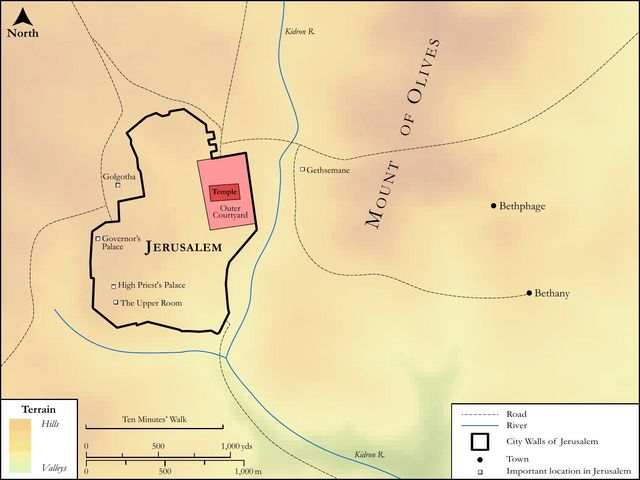
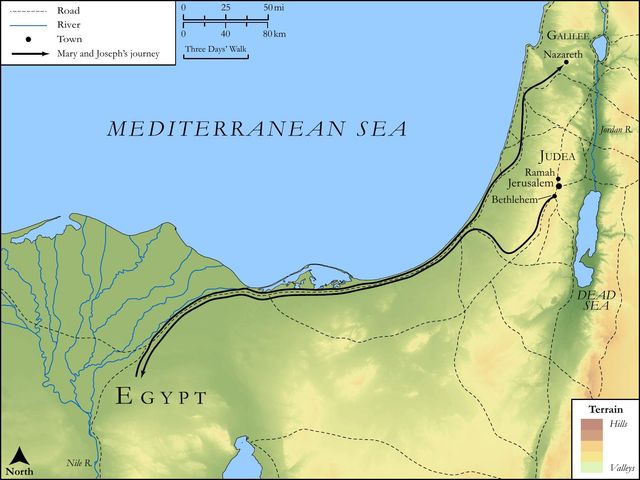
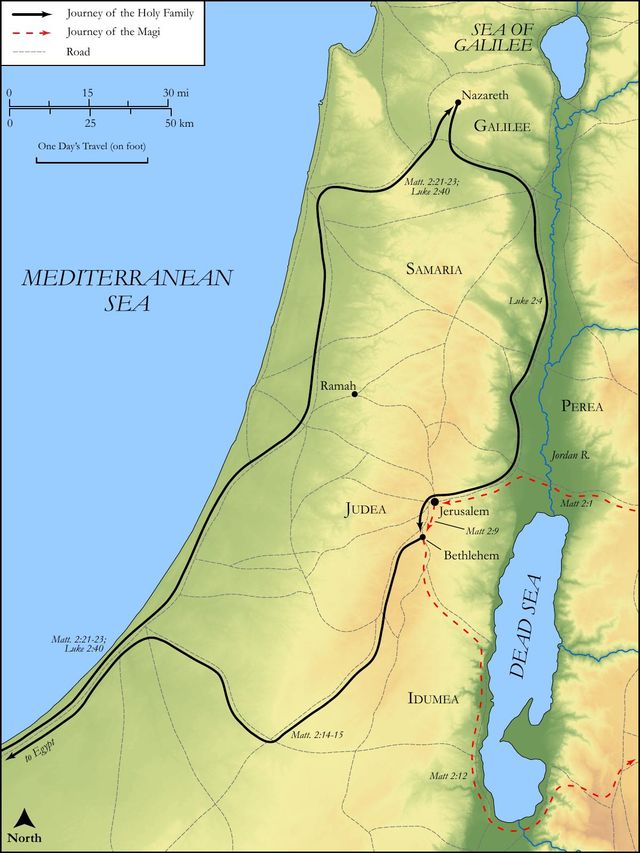
See on the biblical-era maps
Study this verse
Public-domain commentary
Matthew Henry
From his Commentary on the Whole Bible. Henry comments on passages, not single verses — this entry covers Matthew 2:19–23. His two-level outline is real structure in the source text, so it is rendered as structure.
We have here Christ's return out of Egypt into the land of Israel again. Egypt may serve to sojourn in, or take shelter in, for a while, but not to abide in. Christ was sent to the lost sheep of the house of Israel, and therefore to them he must return. Observe,
I.What it was that made way for his return - the death of Herod, which happened not long after the murder of the infants; some think not above three months. Such quick work did divine vengeance make! Note, Herods must die; proud tyrants, that were the terror of the mighty, and the oppressors of the godly, in the land of the living, their day must come to fall, and down to the pit they must go. Who art thou then, that thou shouldest be afraid of a man that shall die? (Isa 51:12, Isa 51:13) especially considering that at death, not only their envy and hatred are perished (Ecc 9:6), and they cease from troubling (Job 3:17), but they are punished. Of all sins, the guilt of innocent blood fills the measure soonest. It is a dreadful account which Josephus gives of the death of this same Herod (Antiq. 17.146-199), that he was seized with a disease which burned him inwardly with an inexpressible torture; that he was insatiably greedy of meat; had the colic, and gout, and dropsy; such an intolerable stench attended his disease, that none could come near him: and so passionate and impatient was he, that he was a torment to himself, and a terror to all that attended him: his innate cruelty, being thus exasperated, made him more barbarous than ever; having ordered his own son to be put to death, he imprisoned many of the nobility and gentry, and ordered that as soon as he was dead they should be killed; but that execution was prevented. See what kind of men have been the enemies and persecutors of Christ and his followers! Few have opposed Christianity but such as have first divested themselves of humanity, as Nero and Domitian.
II.The orders given from heaven concerning their return, and Joseph's obedience to those orders, Mat 2:19-21.
God had sent Joseph into Egypt, and there he staid till the same that brought him thither ordered him thence. Note, In all our removes, it is good to see our way plain, and God going before us; we should not move either one way or the other without order. These orders were sent him by an angel. Note, Our intercourse with God, if it be kept up on our part, shall be kept up on his, wherever we are. No place can exclude God's gracious visits. Angels come to Joseph in Egypt, to Ezekiel in Babylon, and to John in Patmos. Now,
1.The angel informs him of the death of Herod and his accomplices: They are dead, which sought the young Child's life. They are dead, but the young Child lives. Persecuted saints sometimes live to tread upon the graves of their persecutors. Thus did the church's King weather the storm, and many a one has the church in like manner weathered. They are dead, to wit, Herod and his son Antipater, who, though there were mutual jealousies between them, yet, probably, concurred in seeking the destruction of this new King. If Herod first kill Antipater, and then die himself, the coasts are cleared, and the Lord is known by the judgments which he executes, when one wicked instrument is in the ruin of another.
2.He directs him what to do. He must go and return to the land of Israel; and he did so without delay; not pleading the tolerably good settlement he had in Egypt, or the inconveniences of the journey, especially if, as is supposed, it was in the beginning of winter that Herod died. God's people follow his direction whithersoever he leads them, wherever he lodges them. Did we but look upon the world as our Egypt, the place of our bondage and banishment, and heaven only as our Canaan, our home, our rest, we should as readily arise, and depart thither, when we are called for, as Joseph did out of Egypt.
III.The further direction he had from God, which way to steer, and where to fix in the land of Israel, Mat 2:22, Mat 2:23.
God could have given him these instructions with the former, but God reveals his mind to his people by degrees, to keep them still waiting on him, and expecting to hear further from him. These orders Joseph received in a dream, probably, as those before, by the ministration of an angel. God could have signified his will to Joseph by the Child Jesus, but we do not find that in those removes he either takes notice, or gives notice, of any thing that occurred; surely it was because in all things it behoved him to be made like his brethren; being a Child, he spake as a child, and did as a child, and drew a veil over his infinite knowledge and power; as a child he increased in wisdom.
Now the direction given this holy, royal family, is, 1. That it might not settle in Judea, Mat 2:22. Joseph might think that Jesus, being born in Bethlehem, must be brought up there; yet he is prudently afraid for the young Child, because he hears that Archelaus reigns in Herod's stead, not over all the kingdom as his father did, but only over Judea, the other provinces being put into other hands. See what a succession of enemies there is to fight against Christ and his church! If one drop off, another presently appears, to keep up the old enmity. But for this reason Joseph must not take the young Child into Judea. Note, God will not thrust his children into the mouth of danger, but when it is for his own glory and their trial; for precious in the sight of the Lord are the life and the death of his saints; precious is their blood to him.
2.That it must settle in Galilee, Mat 2:22. There Philip now ruled, who was a mild, quiet, man. Note, The providence of God commonly so orders it, that his people shall not want a quiet retreat from the storm and from the tempest; when one climate becomes hot and scorching, another shall be kept more cool and temperate. Galilee lay far north; Samaria lay between it and Judea; thither they were sent, to Nazareth, a city upon a hill, in the centre of the lot of Zebulun; there the mother of our Lord lived, when she conceived that holy thing; and, probably, Joseph lived there too, Luk 1:26, Luk 1:27. Thither they were sent, and there they were well known, and were among their relations; the most proper place for them to be in. There they continued, and from thence our Saviour was called Jesus of Nazareth, which was to the Jews a stumbling-block, for, Can any good thing come out of Nazareth?
In this is said to be fulfilled what was spoken by the prophets, He shall be called a Nazarene. Which may be looked upon, (1.) As a man of honour and dignity, though primarily it signifies no more than a man of Nazareth; there is an allusion or mystery in speaking it, speaking Christ to be, [1.] The Man, the Branch, spoken of, Isa 11:1. The word there is Netzar, which signifies either a branch, or the city of Nazareth; in being denominated from that city, he is declared to be that Branch. [2.] It speaks him to be the great Nazarite; of whom the legal Nazarites were a type and figure (especially Samson, Jdg 13:5), and Joseph, who is called a Nazarite among his brethren (Gen 49:26), and to whom that which was prescribed concerning the Nazarites, has reference, Num 6:2, etc. Not that Christ was, strictly, a Nazarite, for he drank wine, and touched dead bodies; but he was eminently so, both as he was singularly holy, and as he was by a solemn designation and dedication set apart to the honour of God in the work of our redemption, as Samson was to save Israel. And it is a name we have all reason to rejoice in, and to know him by. Or, (2.) As a name of reproach and contempt. To be called a Nazarene, was to be called a despicable man, a man from whom no good was to be expected, and to whom no respect was to be paid. The devil first fastened this name upon Christ, to render him mean, and prejudice people against him, and it stuck as a nickname to him and his followers. Now this was not particularly foretold by any one prophet, but, in general, it was spoken by the prophets, that he should be despised and rejected of men (Isa 53:2, Isa 53:3), a Worm, and no man (Psa 22:6, Psa 22:7), that he should be an Alien to his brethren Psa 69:7, Psa 69:8. Let no name of reproach for religion's sake seem hard to us, when our Master was himself called a Nazarene.
Historical interpretation
Twelve Centuries of Reception
9 surviving comments on this verse. Each one is dated, so this reads as a timeline rather than a list.
Select a marker to jump to its quote. Markers stagger vertically where authors wrote within a few decades of each other.
Herod had nine wives, by seven of whom he had a numerous issue. By Josida, his first born Antipater—by Mariamine, Alexander and Aristobulus—by Mathuca, a Samaritan woman, Archelaus—by Cleopatra of Jerusalem, Herod, who was afterwards tetrarch, and Philip. The three first were put to death by Herod; and after his death, Archelaus seized the throne by occasion of his father's will, and the question of the succession was carried before Augustus Cæsar. After some delay, he made a distribution of the whole of Herod's dominions in accordance with the Senate's advice. To Archelaus he assigned one half, consisting of Idumæa and Judæa, with the title of tetrarch, and a promise of that of king if he showed himself deserving of it. The rest he divided into two tetrarchates, giving Galilee to Herod the tetrarch, Ituræa and Trachonitis to Philip. Thus Archelaus was after his father's death a duarch, which kind of sovereignty is here called a kingdom.
But the figurative interpretation holds good any way. Joseph represents the Apostles, to whom Christ is entrusted to be borne about. These, as though Herod were dead, that is, his people being destroyed in the Lord's passion, are commanded to preach the Gospel to the Jews; they are sent to the lost sheep of the house of Israel. But finding the seed of their hereditary unbelief still abiding, they fear and withdraw; admonished by a vision, to wit, seeing the Holy Ghost poured upon the Gentiles, they carry Christ to them.
Joseph therefore comes to Nazareth, partly to avoid the danger, partly also delighting to abide in his native place. To give him the more courage, he receives also an oracle from the angel touching this matter. Luke, however, doth not say that he came there by Divine warning, but that when they had fulfilled all the purification, they returned to Nazareth. What then may one say? That Luke is giving an account of the time before the going down to Egypt, when he saith these things. For He would not have brought them down thither before the purification, in order that nothing should be done contrary to the law, but he waited for her to be purified, and to go to Nazareth, and that then they should go down to Egypt. Then, after their return, He bids them go to Nazareth. But before this they were not warned of God to go thither, but yearning after their native place, they did so of their own accord. For since they had gone up for no other cause but on account of the taxing, and had not so much as a place where to stay, when they had fulfilled that for which they had come up, they went down to Nazareth.
And when he had once left the country of His birth, all the occurrences passed out of mind; the rage of persecution had been spent in Bethlehem and its neighbourhood. By choosing Nazareth therefore, Joseph both avoided danger, and returned to his country.
(Verse 21.) He rose and took the child and his mother, and came into the land of Israel. He did not say, 'I took my son and my wife,' but the child and his mother, as if a foster father, not a husband.
Had he meant to quote a particular text, he would not have written 'Prophets,' but 'the Prophet.' By thus using the plural he evidently does not take the words of any one passage in Scripture, but the sense of the whole. Nazarene is interpreted 'Holyd,' and that the Lord would be Holy, all Scripture testifies. Otherwise we may explain that it is found in Isaiah (c. 11:1.) rendered to the strict letter of the Hebrew. There shall come a Rod out of the stem of Jesse, and a Nazarene shall grow out of His rootse.
They might have read this in some Prophets who are not in our canon, as Nathan or Esdras. That there was some prophecy to this purport is clear from what Philip says to Nathanael. Him of whom Moses in the Law and the Prophets did write, Jesus of Nazareth. (John 1:15.) Hence the Christians were at first called Nazarenes, at Antioch their name was changed to that of 'Christians.'
Or, we may apply it to the last times of the Jewish Church, when many Jews having turned to the preaching of Enoch and Elijah, the rest filled with the spirit of Antichrist shall fight against the faith. So that part of Judæa where Archelaus rules, signifies the followers of Antichrist; Nazareth of Galilee, whither Christ is conveyed, that part of the nation that shall embrace the faith. Galilee means 'removal;' Nazareth, 'the flower of virtues;' for the Church the more zealously she removes from the earthly to the heavenly, the more she abounds in the flower and fruit of virtues.
Joseph was not disobedient to the angelic warning, but he arose, and took the young Child and his mother, and came into the land of Israel. The Angel had not fixed the particular place, so that while Joseph hesitates, the Angel returns, and by the often visiting him confirms his obedience.
(ord.) But then we might ask, why was he not afraid to go into Galilee, seeing Archelaus ruled there also? He could be better concealed in Nazareth than in Jerusalem, which was the capital of the kingdom, and where Archelaus was constantly resident.
To this he adds the Prophet's testimony, saying, That it might be fulfilled which was spoken by the Prophets, &c.
Continue studying Matthew 2:21 across the web’s major study libraries — every link below opens this exact verse, chapter, or book on the destination site.
Read & Compare
 BibleGatewayThis verse in more than 200 translations and 70 languages.
 Bible.comThe YouVersion reader — hundreds of translations, reading plans, and highlights.
 ESV.orgCrossway's official English Standard Version reader.
 NET BibleThe NET translation with 60,000+ translators' notes on every rendering decision.
 STEP BibleTyndale House's free study tool — original text, vocabulary, and scholarly resources.
 BibliaLogos Bible Software's free web reader.
 USCCBThe New American Bible (Revised Edition) with the U.S. bishops' study notes.
Commentaries
 BibleHub CommentariesDozens of classic commentaries on this verse, gathered on one page.
 StudyLightMore than 100 commentary sets — the largest collection on the web.
 BibleRefPlain-English commentary on what this verse means, verse by verse.
 Enduring WordDavid Guzik's free commentary on this chapter, widely used by Bible teachers.
 Bible Study ToolsVerse commentary alongside Greek and Hebrew study aids.
Original Language & Research
- BibleHub InterlinearThe verse word by word — original language, transliteration, and English.
- BibleHub LexiconEvery word's original-language definition and Strong's entry.
 Blue Letter BibleDeep-study tools — Strong's numbers, concordance, and word studies.
 CNTR CollationThe earliest Greek manuscripts of this verse, collated letter by letter.
Sermons, Hymns & Audio


TrulyRandomVerse is not affiliated with these sites and doesn’t control their content. They’re linked because they’re genuinely useful.
Summary
Matthew 2:21 marks the divinely orchestrated conclusion of the Holy Family's sojourn in Egypt and their guided return to the ancestral land of Israel. This pivotal verse underscores Joseph's unwavering obedience to God's directives, demonstrating the meticulous providence that safeguarded the young Messiah, ensuring He would be brought back to the very soil where His redemptive mission was destined to unfold.
Context
ShowHideLiterary Context
This verse serves as the immediate resolution to the perilous flight into Egypt, which began in Matthew 2:13. Following the Magi's visit and Herod's murderous decree against the infants in Bethlehem (Matthew 2:16), Joseph was divinely warned in a dream to flee. Now, in Matthew 2:19-20, an angel of the Lord appears to Joseph again in a dream, informing him that Herod, who sought the child's life, was dead. This instruction directly reverses the previous command, initiating the family's journey back to their homeland, a return that implicitly fulfills the prophecy cited in Matthew 2:15 regarding Israel being called out of Egypt.
Historical & Cultural Context
The death of Herod the Great, which occurred in 4 BC, was a significant historical event that dramatically altered the political landscape of Judea. Herod was known for his paranoia and cruelty, exemplified by the "Massacre of the Innocents." His demise removed the immediate threat to Jesus' life. For Jews of the time, the "land of Israel" was not merely a geographical location but the promised land, central to their identity, covenant, and Messianic hopes. The return from a foreign land, particularly Egypt, carried deep historical and theological resonance, echoing the Exodus and the various returns from exile throughout Israel's history, reinforcing the idea of divine leading and restoration.
Key Themes
ShowHideThe narrative in Matthew 2 consistently highlights God's Divine Guidance and Protection over His Son. Through a series of angelic dreams given to Joseph, God meticulously orchestrates every step of the Holy Family's journey, from the initial warning to flee to Egypt (Matthew 2:13) to the instruction to return. This demonstrates God's sovereign hand actively preserving the Messiah for His future ministry. Another prominent theme is Joseph's Obedience and Faith. Joseph consistently responds with immediate and unwavering obedience to these divine commands, even when they involve significant disruption and danger. His actions in this verse—"he arose, and took the young child and his mother"—exemplify his selfless dedication and trust in God's plan, mirroring his earlier obedience in Matthew 1:24. Finally, the Return to the Land of Israel is a crucial thematic element, signifying not just a physical relocation but a return to the covenantal homeland, emphasizing Jesus' identity as the true Israel and the inheritor of God's promises.
Exposition and Analysis
ShowHideKey Word Analysis
ShowHideThis verb, G1453, implies a decisive and immediate action, often signifying a rising up from a state of rest, inactivity, or even death. In this context, it highlights Joseph's prompt and resolute response to the divine command, indicating his readiness to obey God's will without hesitation or delay. It suggests a swift and purposeful movement.
The Greek word G3880 means "to receive near," "to associate with oneself," or "to take unto/with." This choice of word emphasizes Joseph's protective and intimate role in taking responsibility for Jesus and Mary. It's not a mere carrying, but an act of receiving them into his care and companionship, underscoring his guardianship.
G1093 refers to "soil," "a region," or "the solid part of the terrene globe." When combined with "Israel" (G2474), it specifically designates the ancestral and covenantal territory promised to Abraham and his descendants. This highlights the theological significance of their destination—not just any land, but the specific geographical and spiritual heartland of God's chosen people, where the Messiah's ministry was destined to unfold.
Verse Breakdown
ShowHide"And he arose"
This phrase emphasizes Joseph's immediate and decisive action in response to the angelic instruction. His promptness highlights his unwavering obedience and trust in God's guidance, demonstrating a readiness to act upon divine revelation without question or delay.
"and took the young child and his mother"
This clause underscores Joseph's primary responsibility and protective role. He is the guardian of both Jesus and Mary, ensuring their safety and well-being. The phrasing highlights the preciousness of "the young child" and the vulnerability of the family, relying solely on divine direction and Joseph's faithful execution of it.
"and came into the land of Israel"
This signifies the successful completion of the journey back from Egypt to the divinely appointed destination. The "land of Israel" is not just a geographical location but the covenantal territory, symbolizing God's faithfulness to His promises and the return of His Son to the very place where His redemptive work would commence.
Literary Devices
ShowHideMatthew's narrative in this passage employs several literary devices. Narrative Repetition is evident in Joseph's consistent pattern of receiving divine instructions through dreams and immediately obeying them (Matthew 1:20-24, Matthew 2:13-14, Matthew 2:19-21). This repetition underscores Joseph's exemplary faith and obedience, presenting him as a model disciple. Furthermore, the return from Egypt functions as Typology, drawing a parallel between Jesus and the nation of Israel. Just as Israel was called "out of Egypt" (Hosea 11:1), so too is Jesus, the true Son of God, called out of Egypt, signifying His identity as the embodiment and fulfillment of Israel's destiny. The entire sequence of events, from flight to return, also serves as Foreshadowing, setting the stage for Jesus' public ministry within the land of Israel, where He would ultimately fulfill His messianic mission.
Theological and Thematic Connections
ShowHideMatthew 2:21 profoundly illustrates God's meticulous providence and sovereign control over history, particularly in safeguarding His Son. The journey from Egypt back to Israel is not merely a geographical relocation but a theological statement about God's faithfulness to His covenant promises and His active involvement in the unfolding of redemptive history. It emphasizes that Jesus' life was divinely protected from its earliest moments, ensuring that He would grow up in the land where He was destined to announce the Kingdom of God, suffer, die, and rise again. This divine oversight reassures believers of God's unwavering commitment to His plans and His people.
Reflection and Application
ShowHideThe narrative of the Holy Family's return from Egypt, driven by divine instruction and executed through Joseph's faithful obedience, offers profound lessons for contemporary believers. It reminds us that our lives, like Jesus', are under the watchful care of a sovereign God who guides our steps, often through unexpected turns and challenging circumstances. Joseph's immediate and unwavering response to God's directives, even when they required significant disruption and relocation, serves as a powerful model for our own walk of faith. We are called to cultivate a spirit of prompt obedience, trusting that God's plan, though sometimes mysterious, is always for our ultimate good and the fulfillment of His purposes. In a world fraught with uncertainty and fear, this passage offers deep reassurance of God's protective presence, encouraging us to lean into His providence rather than succumbing to anxiety.
Questions for Reflection
ShowHideFAQ
ShowHideWhy did Joseph return to the "land of Israel" instead of directly to Bethlehem, where Jesus was born?
ShowHideMatthew 2:21 states Joseph returned to the "land of Israel," which is a broader geographical term for the entire region. The subsequent verses (Matthew 2:22-23) clarify that Joseph received further divine guidance. Upon hearing that Archelaus, Herod's notoriously cruel son, was reigning in Judea (the region including Bethlehem), Joseph was again warned in a dream. This led him to withdraw to the district of Galilee and settle in the town of Nazareth. This decision was not a deviation from God's plan but a further specific instruction to ensure Jesus' safety and to fulfill another prophecy that He would be called a Nazarene. The initial instruction was to return to the general "land of Israel" because the immediate threat (Herod) was gone; the specific destination within that land was refined by subsequent divine guidance.
Christ-Centered Fulfillment
ShowHideMatthew 2:21, though a simple narrative of return, is rich with Christ-centered fulfillment. Jesus' return to the "land of Israel" is not merely a logistical detail but a profound theological statement. He is brought back to the very soil of the covenant, the stage upon which the entire drama of redemption would unfold. This journey echoes the historical exodus of Israel from Egypt, positioning Jesus as the true and ultimate Israel, the one who perfectly embodies and fulfills the nation's calling (Hosea 11:1). His presence in the land signifies the beginning of His public ministry, where He would proclaim the Kingdom of God (Mark 1:14-15), teach with authority (Matthew 7:28-29), perform miracles (John 2:11), and ultimately offer Himself as the perfect sacrifice for the sins of the world in Jerusalem (Luke 24:46-47). His return from a place of refuge to the place of His destiny foreshadows His ultimate victory over sin and death, culminating in His resurrection and ascension, from which He will one day return to that same land to establish His eternal kingdom (Acts 1:11, Revelation 11:15).