


Matthew 2:20
Bible text: King James Version (1769 Blayney text) · Public domain
Bible text: King James Version with Strong's numbers · Public domain
Bible text: Berean Standard Bible · Public domain
Bible text: American Standard Version (1901) · Public domain
Bible text: World English Bible, Messianic edition · Public domain
Bible text: Geneva Bible (1599) · Public domain
Bible text: Young's Literal Translation · Public domain
- λέγων·legōnsayingG3004V-PAP-NSMVerb Present Active Participle Nominative Singular Masculine
- ἐγερθεὶςegertheisHaving arisenG1453V-APP-NSMVerb Aorist Passive Participle Nominative Singular Masculine
- παράλαβεparalabedo takeG3880V-2AAM-2SVerb 2nd Aorist Active Imperative 2nd Singular
- τὸtotheG3588T-ASNDefinite article Accusative Singular Neuter
- παιδίονpaidionChildG3813N-ASNNoun Accusative Singular Neuter
- καὶkaiandG2532CONJConjunction
- τὴνtēntheG3588T-ASFDefinite article Accusative Singular Feminine
- μητέραmēteramotherG3384N-ASFNoun Accusative Singular Feminine
- αὐτοῦautouof HimG846P-GSMPersonal pronoun Genitive Singular Masculine
- καὶkaiandG2532CONJConjunction
- πορεύουporeuoudo goG4198V-PNM-2SVerb Present Middle Or Passive Deponent Imperative 2nd Singular
- εἰςeisintoG1519PREPPreposition
- γῆνgēn[the] landG1093N-ASFNoun Accusative Singular Feminine
- Ἰσραήλ·Israēlof IsraelG2474N-GSM-LNoun Genitive Singular Masculine Location
- τεθνήκασινtethnēkasinthey have diedG2348V-RAI-3PVerb Perfect Active Indicative 3rd Plural
- γὰρgarforG1063CONJConjunction
- οἱhoithoseG3588T-NPMDefinite article Nominative Plural Masculine
- ζητοῦντεςzētountesseekingG2212V-PAP-NPMVerb Present Active Participle Nominative Plural Masculine
- τὴνtēntheG3588T-ASFDefinite article Accusative Singular Feminine
- ψυχὴνpsuchēnlifeG5590N-ASFNoun Accusative Singular Feminine
- τοῦtouof theG3588T-GSNDefinite article Genitive Singular Neuter
- παιδίουpaidiouChildG3813N-GSNNoun Genitive Singular Neuter
English is a literal word-by-word gloss of the Greek, not the KJV's wording. Why?
This is the original text the KJV's translators worked from — each Greek word with its own literal English meaning in this verse, prepared by scholars at Tyndale House, Cambridge. The KJV translates whole sentences, not word by word, so its wording differs: one Greek word can become several English words, and the KJV may choose “charity” where the gloss reads “love”. Both are faithful — they answer different questions. For the KJV's own rendering, switch to the KJV text.
Details
See on the biblical-era maps
Study this verse
Public-domain commentary
Matthew Henry
From his Commentary on the Whole Bible. Henry comments on passages, not single verses — this entry covers Matthew 2:19–23. His two-level outline is real structure in the source text, so it is rendered as structure.
We have here Christ's return out of Egypt into the land of Israel again. Egypt may serve to sojourn in, or take shelter in, for a while, but not to abide in. Christ was sent to the lost sheep of the house of Israel, and therefore to them he must return. Observe,
I.What it was that made way for his return - the death of Herod, which happened not long after the murder of the infants; some think not above three months. Such quick work did divine vengeance make! Note, Herods must die; proud tyrants, that were the terror of the mighty, and the oppressors of the godly, in the land of the living, their day must come to fall, and down to the pit they must go. Who art thou then, that thou shouldest be afraid of a man that shall die? (Isa 51:12, Isa 51:13) especially considering that at death, not only their envy and hatred are perished (Ecc 9:6), and they cease from troubling (Job 3:17), but they are punished. Of all sins, the guilt of innocent blood fills the measure soonest. It is a dreadful account which Josephus gives of the death of this same Herod (Antiq. 17.146-199), that he was seized with a disease which burned him inwardly with an inexpressible torture; that he was insatiably greedy of meat; had the colic, and gout, and dropsy; such an intolerable stench attended his disease, that none could come near him: and so passionate and impatient was he, that he was a torment to himself, and a terror to all that attended him: his innate cruelty, being thus exasperated, made him more barbarous than ever; having ordered his own son to be put to death, he imprisoned many of the nobility and gentry, and ordered that as soon as he was dead they should be killed; but that execution was prevented. See what kind of men have been the enemies and persecutors of Christ and his followers! Few have opposed Christianity but such as have first divested themselves of humanity, as Nero and Domitian.
II.The orders given from heaven concerning their return, and Joseph's obedience to those orders, Mat 2:19-21.
God had sent Joseph into Egypt, and there he staid till the same that brought him thither ordered him thence. Note, In all our removes, it is good to see our way plain, and God going before us; we should not move either one way or the other without order. These orders were sent him by an angel. Note, Our intercourse with God, if it be kept up on our part, shall be kept up on his, wherever we are. No place can exclude God's gracious visits. Angels come to Joseph in Egypt, to Ezekiel in Babylon, and to John in Patmos. Now,
1.The angel informs him of the death of Herod and his accomplices: They are dead, which sought the young Child's life. They are dead, but the young Child lives. Persecuted saints sometimes live to tread upon the graves of their persecutors. Thus did the church's King weather the storm, and many a one has the church in like manner weathered. They are dead, to wit, Herod and his son Antipater, who, though there were mutual jealousies between them, yet, probably, concurred in seeking the destruction of this new King. If Herod first kill Antipater, and then die himself, the coasts are cleared, and the Lord is known by the judgments which he executes, when one wicked instrument is in the ruin of another.
2.He directs him what to do. He must go and return to the land of Israel; and he did so without delay; not pleading the tolerably good settlement he had in Egypt, or the inconveniences of the journey, especially if, as is supposed, it was in the beginning of winter that Herod died. God's people follow his direction whithersoever he leads them, wherever he lodges them. Did we but look upon the world as our Egypt, the place of our bondage and banishment, and heaven only as our Canaan, our home, our rest, we should as readily arise, and depart thither, when we are called for, as Joseph did out of Egypt.
III.The further direction he had from God, which way to steer, and where to fix in the land of Israel, Mat 2:22, Mat 2:23.
God could have given him these instructions with the former, but God reveals his mind to his people by degrees, to keep them still waiting on him, and expecting to hear further from him. These orders Joseph received in a dream, probably, as those before, by the ministration of an angel. God could have signified his will to Joseph by the Child Jesus, but we do not find that in those removes he either takes notice, or gives notice, of any thing that occurred; surely it was because in all things it behoved him to be made like his brethren; being a Child, he spake as a child, and did as a child, and drew a veil over his infinite knowledge and power; as a child he increased in wisdom.
Now the direction given this holy, royal family, is, 1. That it might not settle in Judea, Mat 2:22. Joseph might think that Jesus, being born in Bethlehem, must be brought up there; yet he is prudently afraid for the young Child, because he hears that Archelaus reigns in Herod's stead, not over all the kingdom as his father did, but only over Judea, the other provinces being put into other hands. See what a succession of enemies there is to fight against Christ and his church! If one drop off, another presently appears, to keep up the old enmity. But for this reason Joseph must not take the young Child into Judea. Note, God will not thrust his children into the mouth of danger, but when it is for his own glory and their trial; for precious in the sight of the Lord are the life and the death of his saints; precious is their blood to him.
2.That it must settle in Galilee, Mat 2:22. There Philip now ruled, who was a mild, quiet, man. Note, The providence of God commonly so orders it, that his people shall not want a quiet retreat from the storm and from the tempest; when one climate becomes hot and scorching, another shall be kept more cool and temperate. Galilee lay far north; Samaria lay between it and Judea; thither they were sent, to Nazareth, a city upon a hill, in the centre of the lot of Zebulun; there the mother of our Lord lived, when she conceived that holy thing; and, probably, Joseph lived there too, Luk 1:26, Luk 1:27. Thither they were sent, and there they were well known, and were among their relations; the most proper place for them to be in. There they continued, and from thence our Saviour was called Jesus of Nazareth, which was to the Jews a stumbling-block, for, Can any good thing come out of Nazareth?
In this is said to be fulfilled what was spoken by the prophets, He shall be called a Nazarene. Which may be looked upon, (1.) As a man of honour and dignity, though primarily it signifies no more than a man of Nazareth; there is an allusion or mystery in speaking it, speaking Christ to be, [1.] The Man, the Branch, spoken of, Isa 11:1. The word there is Netzar, which signifies either a branch, or the city of Nazareth; in being denominated from that city, he is declared to be that Branch. [2.] It speaks him to be the great Nazarite; of whom the legal Nazarites were a type and figure (especially Samson, Jdg 13:5), and Joseph, who is called a Nazarite among his brethren (Gen 49:26), and to whom that which was prescribed concerning the Nazarites, has reference, Num 6:2, etc. Not that Christ was, strictly, a Nazarite, for he drank wine, and touched dead bodies; but he was eminently so, both as he was singularly holy, and as he was by a solemn designation and dedication set apart to the honour of God in the work of our redemption, as Samson was to save Israel. And it is a name we have all reason to rejoice in, and to know him by. Or, (2.) As a name of reproach and contempt. To be called a Nazarene, was to be called a despicable man, a man from whom no good was to be expected, and to whom no respect was to be paid. The devil first fastened this name upon Christ, to render him mean, and prejudice people against him, and it stuck as a nickname to him and his followers. Now this was not particularly foretold by any one prophet, but, in general, it was spoken by the prophets, that he should be despised and rejected of men (Isa 53:2, Isa 53:3), a Worm, and no man (Psa 22:6, Psa 22:7), that he should be an Alien to his brethren Psa 69:7, Psa 69:8. Let no name of reproach for religion's sake seem hard to us, when our Master was himself called a Nazarene.
Historical interpretation
Eight Centuries of Reception
10 surviving comments on this verse. Each one is dated, so this reads as a timeline rather than a list.
Select a marker to jump to its quote. Markers stagger vertically where authors wrote within a few decades of each other.
(Eccles. Hist. i. 8.) For the sacrilege which Herod had committed against the Saviour, and his wicked slaughter of the infants of the same age, the Divine vengeance hastened his end; and his body, as Josephus relates, was attacked by a strange disease; so that the prophets declared that they were not human ailments, but visitations of Divine vengeance. Filled with mad fury, he gives command to seize and imprison the heads and nobles out of all parts of Judæa; ordering that as soon as ever he should breathe his last, they should be all put to death, that so Judæa though unwillingly might mourn at his decease. Just before he died he murdered his son Antipater, (besides two boys put to death before, Alexander and Aristobulus.) Such was the end of Herod, noticed in those words of the Evangelist, when Herod was dead, and such the punishment inflicted.
"But when Herod was dead, behold, an angel of the Lord appeareth in a dream to Joseph saying, Arise, and take the young Child and His mother, and go into the land of Israel."
He no more saith "fly," but "go." Seest thou again after the temptation refreshment? then after the refreshment danger again? in that he was freed indeed from his banishment, and came back again to his own country; and beheld the murderer of the children brought to the slaughter; but when he hath set foot on his own country, he finds again a remnant of the former perils, the son of the tyrant living, and being king.
(Verse 20) For those who sought the child's life are dead. From this we understand that not only Herod, but also the priests and scribes at the same time had planned the death of the Lord.
Many here err from ignorance of history, supposing the Herod who mocked our Lord on the day of His passion, and the Herod whose death is here related, were the same. But the Herod who was then made friends with Pilate was son of this Herod and brother to Archelaus; for Archelaus was banished to Lyons in Gaul, and his father Herod made king in his room, as we read in Josephus.
From this we see that not Herod only, but also the Priests and Scribes had sought the Lord's death at that time.
See how Joseph was set for ministering to Mary; when she went into Egypt and returned, who would have fulfilled to her this so needful ministry, had she not been betrothed? For to outward view Mary nourished and Joseph defended the Child; but in truth the Child supported His mother and protected Joseph. Return into the land of Israel; for He went down into Egypt as a physician, not to abide there, but to succour it sick with error. But the reason of the return is given in the words, They are dead, &c.
And that is said to have been done by the counsel of God for their conspiring with Herod against the Lord; as it is said, Herod was troubled, and all Jerusalem with him.
(De Cæl. Hierarch. 4.) See how Jesus Himself, though far above all celestial beings, and coming unchanged to our nature, shunned not that ordinance of humanity which He had taken on Him, but was obedient to the dispositions of His Father made known by Angels. For even by Angels is declared to Joseph the retreat of the Son into Egypt, so ordained of the Father, and His return again to Judæa.
But if they were many who sought his destruction, how came they all to have died in so short a time? As we have related above, all the great men among the Jews were slain at Herod's death.
Or the Evangelist uses a figure of speech, by which the plural is used for the singular. These words, the Child's life, (or soul, i. e. the Apollinarians.) overthrow those heretics who taught that Christ did not take a soul, but had His Divinity in place of a soul.
(Hom. in Nat. Innoc.) This slaughter of the infants for the Lord's sake, the death of Herod soon after, and Joseph's return with the Lord and his mother to the land of Israel, is a figure showing that all the persecutions moved against the Church will be avenged by the death of the persecutor, peace restored to the Church, and the saints who had concealed themselves return to their own places. Or the return of Jesus to the land of Israel on the death of Herod shows, that, at the preaching of Enoch and Elijahc, the Jews, when the fire of modern jealousy shall be extinguished, shall receive the true faith.
Rachel is well set for a type of the Church, as the word signifies 'a sheep' or 'seeing;' (vid. note i, p. 19.) her whole thought being to fix her eye in contemplation of God; and she is the hundredth sheep that the shepherd layeth on his shoulder.
He did not say "flee" but "go," for there was no longer any need for fear.
Where is Apollinarius, who said that the Lord did not have the soul of a man? For here he is reproved.
Continue studying Matthew 2:20 across the web’s major study libraries — every link below opens this exact verse, chapter, or book on the destination site.
Read & Compare
 BibleGatewayThis verse in more than 200 translations and 70 languages.
 Bible.comThe YouVersion reader — hundreds of translations, reading plans, and highlights.
 ESV.orgCrossway's official English Standard Version reader.
 NET BibleThe NET translation with 60,000+ translators' notes on every rendering decision.
 STEP BibleTyndale House's free study tool — original text, vocabulary, and scholarly resources.
 BibliaLogos Bible Software's free web reader.
 USCCBThe New American Bible (Revised Edition) with the U.S. bishops' study notes.
Commentaries
 BibleHub CommentariesDozens of classic commentaries on this verse, gathered on one page.
 StudyLightMore than 100 commentary sets — the largest collection on the web.
 BibleRefPlain-English commentary on what this verse means, verse by verse.
 Enduring WordDavid Guzik's free commentary on this chapter, widely used by Bible teachers.
 Bible Study ToolsVerse commentary alongside Greek and Hebrew study aids.
Original Language & Research
- BibleHub InterlinearThe verse word by word — original language, transliteration, and English.
- BibleHub LexiconEvery word's original-language definition and Strong's entry.
 Blue Letter BibleDeep-study tools — Strong's numbers, concordance, and word studies.
 CNTR CollationThe earliest Greek manuscripts of this verse, collated letter by letter.
Sermons, Hymns & Audio


TrulyRandomVerse is not affiliated with these sites and doesn’t control their content. They’re linked because they’re genuinely useful.
Summary
Matthew 2:20 records the pivotal moment when an angel of the Lord, appearing to Joseph in a dream, instructs him to return to the land of Israel with the young child Jesus and His mother, Mary. This divine directive is given because the immediate threat to Jesus's life, primarily King Herod the Great and his co-conspirators, has passed, signifying God's continued sovereign protection over His Son and the unfolding of His redemptive plan.
Context
ShowHideLiterary Context
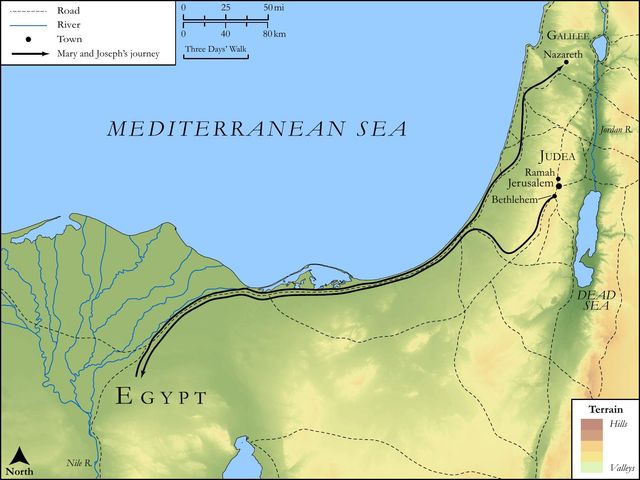
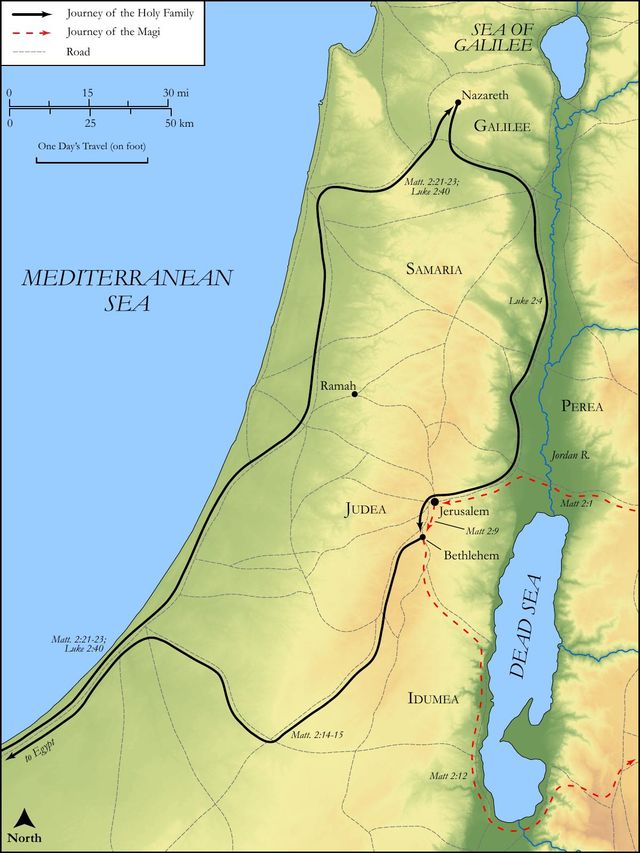
This verse serves as a crucial transition point within the narrative of Jesus's early life in Matthew's Gospel. It immediately follows the account of the Holy Family's flight to Egypt, which was necessitated by King Herod's murderous decree to slaughter all male children two years old and under in Bethlehem and its vicinity (Matthew 2:16). Joseph had previously been warned in a dream to flee to Egypt (Matthew 2:13), fulfilling the prophecy "Out of Egypt have I called my son" (Matthew 2:15). Now, with the threat removed, the angelic command in Matthew 2:20 initiates their return journey, setting the stage for their eventual settlement in Nazareth (Matthew 2:23).
Historical & Cultural Context
The "they are dead which sought the young child's life" primarily refers to King Herod the Great, who died in 4 BC. Herod was a notoriously paranoid and ruthless ruler, known for executing perceived rivals, including members of his own family. His death was a significant event, as it removed the immediate, most potent threat to Jesus. After Herod's death, his kingdom was divided among his three sons: Archelaus received Judea, Samaria, and Idumea; Herod Antipas received Galilee and Perea; and Philip received the northeastern territories. Joseph's subsequent caution about Archelaus (Matthew 2:22) highlights the continued political instability and the family's need for divine guidance even after Herod's demise. The journey from Egypt back to Israel would have been a significant undertaking, requiring careful planning and divine protection.
Key Themes
ShowHideSeveral major themes converge in Matthew 2:20. Divine Protection and Providence is paramount, as God actively intervenes to safeguard His Son from human malice, demonstrating His sovereignty over earthly rulers and events. Obedience to Divine Guidance is a recurring motif in Joseph's character, as he consistently responds with immediate and faithful action to God's instructions given through dreams, illustrating the importance of trusting and acting upon God's clear direction. The phrase "they are dead" underscores the Transience of Evil and its Proponents, reminding readers that while evil may rage for a time, God ultimately ensures its defeat and the advancement of His purposes. Finally, this command to return is integral to the Fulfillment of God's Redemptive Plan, as it brings the Messiah back to the land of Israel, preparing Him for His public ministry and the ultimate work of salvation.
Exposition and Analysis
ShowHideKey Word Analysis
ShowHideThis word signifies a command to "waken" or "rouse," often from sleep, a state of rest, or inactivity. Here, it implies an immediate call to action, urging Joseph to overcome any inertia or fear and promptly embark on the journey. It conveys urgency and divine imperative, signaling a new phase in God's plan for the Holy Family.
This verb, used in the perfect tense (implied by the KJV "are dead"), indicates a completed action with lasting results. It refers to the physical demise of those who sought Jesus's life, primarily King Herod the Great. The perfect tense emphasizes the finality of their threat and the secure environment now available for the family's return.
This word means "to seek," often with an intense purpose. In this context, it carries a negative connotation, implying a malicious plot or scheme against Jesus's life. It highlights the active and deliberate nature of Herod's murderous intent, making the divine intervention and the subsequent death of the persecutors all the more significant.
Verse Breakdown
ShowHide"Saying, Arise, and take the young child and his mother"
This phrase reiterates the angelic communication to Joseph, emphasizing the direct, imperative nature of the command. "Arise" (G1453) conveys urgency, while "take" (G3880) implies assuming responsibility and care for Jesus and Mary, highlighting Joseph's role as their protector and guardian. The "young child" (G3813, paidíon) underscores Jesus's vulnerability and dependence, making God's protective intervention all the more striking.
"and go into the land of Israel"
This specifies the destination, signaling the end of their exile in Egypt. The "land of Israel" (G1093, G2474) is the promised land, the setting for God's covenant people and the place where the Messiah's ministry is destined to unfold. This return is a crucial step in the unfolding of God's redemptive plan.
"for they are dead which sought the young child's life"
This clause provides the divine rationale for the command to return. The conjunction "for" (G1063, gár) introduces the reason. "They are dead" (G2348, thnḗskō) refers primarily to King Herod the Great, whose death removed the immediate and most significant threat to Jesus. The phrase "sought the young child's life" (G2212, G5590) highlights the malicious intent and the grave danger from which Jesus was divinely preserved.
Literary Devices
ShowHideThe verse employs several significant literary devices. Divine Intervention is central, as an angel, God's messenger, directly communicates with Joseph, underscoring God's active involvement in human affairs and His meticulous care for the Messiah. The phrase "they are dead which sought the young child's life" functions as a form of Poetic Justice, illustrating that those who oppose God's purposes ultimately fail and perish, while His plans prevail. There is also an element of Contrast between the mortal, transient power of Herod and the eternal, sovereign power of God. Furthermore, the narrative of the flight to Egypt and subsequent return, prompted by divine dreams, creates a sense of Parallelism with Old Testament narratives, particularly the exodus of Israel from Egypt, subtly foreshadowing Jesus's role as the new Israel and the ultimate deliverer.
Theological and Thematic Connections
ShowHideMatthew 2:20 powerfully articulates God's unwavering commitment to protect His Son and fulfill His redemptive purposes, even in the face of formidable human opposition. It demonstrates that divine providence is not passive but actively intervenes to remove obstacles and guide the path of those called according to His will. The death of Herod, though a historical event, is presented as a direct consequence of God's sovereign oversight, ensuring the safety of the Messiah. This passage underscores the truth that no human power, however great or malicious, can ultimately thwart God's eternal plan, providing a profound assurance of His faithfulness and omnipotence.
Reflection and Application
ShowHideMatthew 2:20 offers profound comfort and challenge for believers today. It reminds us that our lives, especially when we are walking in God's will, are under His sovereign protection. Just as God meticulously orchestrated events to safeguard the young Messiah, He watches over His children, guiding them through dangers and uncertainties. This passage calls us to cultivate a posture of ready obedience, like Joseph, trusting that God's timing is perfect and His instructions, even when delivered in unexpected ways, lead to our ultimate good and the fulfillment of His purposes in our lives. It also serves as a powerful reminder that evil and its proponents, no matter how menacing, are ultimately transient and subject to God's ultimate defeat. We can rest assured that God's plan for His people will prevail, and no earthly power can ultimately thwart His divine will.
Questions for Reflection
ShowHideFAQ
ShowHideWho are "they" who sought the young child's life, and why is their death significant?
ShowHideThe primary individual referred to by "they" (G3588) is King Herod the Great, who had issued a decree to kill all male children in Bethlehem in an attempt to eliminate the prophesied "King of the Jews" (Matthew 2:16). While the plural "they" could include Herod's co-conspirators or his regime, Herod himself was the driving force behind the threat. His death, which occurred historically around 4 BC, was significant because it removed the immediate and most potent danger to Jesus, allowing the Holy Family to safely return to the land of Israel and continue the unfolding of God's redemptive plan without this specific tyrannical threat.
Christ-Centered Fulfillment
ShowHideMatthew 2:20, while detailing a specific event in Jesus's early life, profoundly points to His ultimate identity and mission. The divine protection afforded to the young child Jesus foreshadows His role as the Lamb of God, whose life would ultimately be given, not taken, for the salvation of the world (John 1:29). The removal of Herod, the persecutor, by God's sovereign hand, prefigures Christ's ultimate victory over all the powers of darkness, sin, and death. He is the one who, though "sought" for death by human malice and demonic forces, would ultimately conquer death through His resurrection (Acts 2:24). The return to the "land of Israel" (Matthew 2:20) signifies Jesus's identity as the true Israel, the faithful Son who perfectly fulfills God's covenant promises, ultimately establishing a new covenant through His blood (Luke 22:20). Thus, this verse is not merely a historical account but a testament to God's unwavering commitment to bring His Son, the Messiah, to His appointed destiny, culminating in the redemption of all who believe in Him (Romans 5:8).