


Exodus 4:19
Bible text: King James Version (1769 Blayney text) · Public domain
Bible text: Berean Standard Bible · Public domain
Bible text: American Standard Version (1901) · Public domain
Bible text: World English Bible, Messianic edition · Public domain
Bible text: Geneva Bible (1599) · Public domain
Bible text: Young's Literal Translation · Public domain
- וַיֹּאמֶרvai·Yo·merand he saidH559Conj-w ¦ V-Qal-ConsecImperf-3msVerb Qal Consecutive Imperfect 3rd Singular Masculineוַandיֹּאמֶרhe said
- יְהוָהYah·wehYahwehH3068N-properNoun Proper Title
- אֶל'eltoH413PrepPreposition
- מֹשֶׁהmo·ShehMosesH4872N-proper-mNoun Proper Masculine
- בְּמִדְיָןbe·mid·Yanin MidianH4080Prep-b ¦ N-properNoun Proper LocationבְּinמִדְיָןMidian
- לֵךְlekhgoH1980V-Qal-Imp-2msVerb Qal Imperative 2nd Singular Masculine
- שֻׁבshuvreturnH7725V-Qal-Imp-2msVerb Qal Imperative 2nd Singular Masculine
- מִצְרָיִםmitz·Ra·yimEgyptH4714N-properNoun Proper Location
- כִּיkiforH3588PrtParticle Conditional
- מֵתוּme·tuthey have diedH4191V-Qal-Perf-3cpVerb Qal Perfect 3rd Plural common gender
- כָּלkolallH3605N-mscNoun Singular Masculine Construct
- הָאֲנָשִׁיםha·'a·na·Shimthe menH582Art ¦ N-mpNoun Plural Masculine Absoluteהָtheאֲנָשִׁיםmen
- הַמְבַקְשִׁיםham·vak·Shimwho soughtH1245Art ¦ V-Piel-Prtcpl-mpVerb Piel Participle Plural Masculine Absoluteהַwhoמְבַקְשִׁיםsought
- אֶת'et<obj.>H853DirObjMParticle Object Indicator
- נַפְשֶׁךָnaf·She·khayour lifeH5315N-fsc ¦ 2msNoun Singular Feminine Constructנַפְשֶׁlifeךָyour
English is a literal word-by-word gloss of the Hebrew, not the KJV's wording. Why?
This is the original text the KJV's translators worked from — each Hebrew word with its own literal English meaning in this verse, prepared by scholars at Tyndale House, Cambridge. The KJV translates whole sentences, not word by word, so its wording differs: one Hebrew word can become several English words, and the KJV may choose “the LORD” where the gloss reads “Yahweh”. Both are faithful — they answer different questions. For the KJV's own rendering, switch to the KJV text.
Details
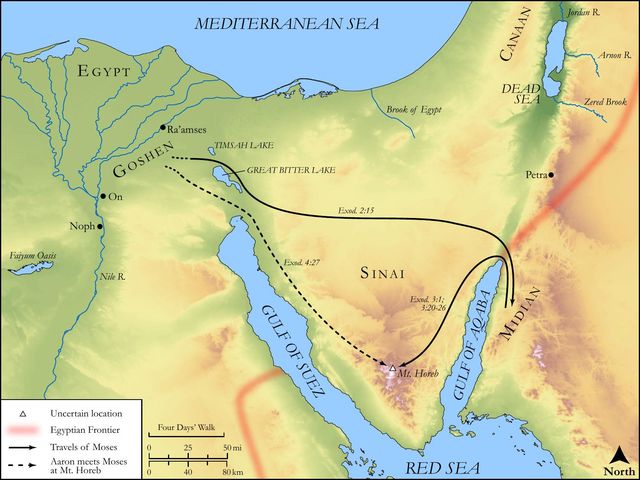
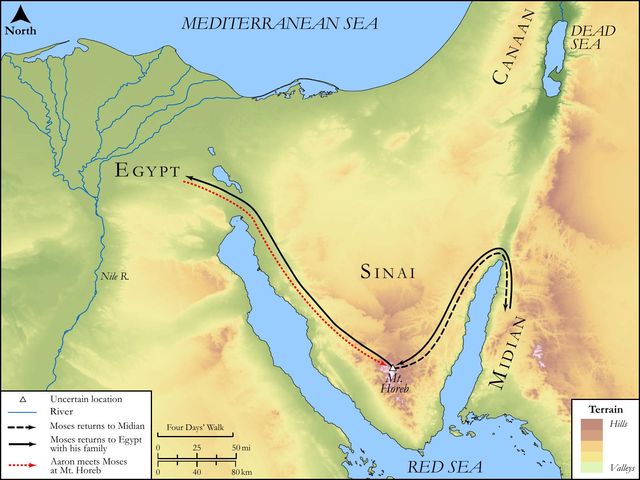
See on the biblical-era maps

Study this verse
Public-domain commentary
Matthew Henry
From his Commentary on the Whole Bible. Henry comments on passages, not single verses — this entry covers Exodus 4:18–23. His three-level outline is real structure in the source text, so it is rendered as structure.
Here, I. Moses obtains leave of his father-in-law to return into Egypt, Exo 4:18. His father-in-law had been kind to him when he was a stranger, and therefore he would not be so uncivil as to leave his family, nor so unjust as to leave his service, without giving him notice. Note, The honour of being admitted into communion with God, and of being employed for him, does not exempt us from the duties of our relations and callings in this world. Moses said nothing to his father-in-law (for aught that appears) of the glorious manifestation of God to him; such favours we are to be thankful for to God, but not to boast of before men.
II.He receives from God further encouragements and directions in his work.
After God had appeared to him in the bush to settle a correspondence, it should seem, he often spoke to him, as there was occasion, with less overwhelming solemnity. And,
1.He assures Moses that the coasts were clear. Whatever new enemies he might make by his undertaking, his old enemies were all dead, all that sought his life, Exo 4:19. Perhaps some secret fear of falling into their hands was at the bottom of Moses's backwardness to go to Egypt, though he was not willing to own it, but pleaded unworthiness, insufficiency, want of elocution, etc. Note, God knows all the temptations his people lie under, and how to arm them against their secret fears, Psa 142:3.
2.He orders him to do the miracles, not only before the elders of Israel, but before Pharaoh, Exo 4:21. There were some alive perhaps in the court of Pharaoh who remembered Moses when he was the son of Pharaoh's daughter, and had many a time called him a fool for deserting the honours of that relation; but he is now sent back to court, clad with greater powers than Pharaoh's daughter could have advanced him to, so that it might appear he was no loser by his choice: this wonder-working rod did more adorn the hand of Moses than the sceptre of Egypt could have done. Note, Those that look with contempt upon worldly honours shall be recompensed with the honour that cometh from God, which is the true honour.
3.That Pharaoh's obstinacy might be no surprise nor discouragement to him, God tells him before that he would harden his heart. Pharaoh had hardened his own heart against the groans and cries of the oppressed Israelites, and shut up the bowels of his compassion from them; and now God, in a way of righteous judgment, hardens his heart against the conviction of the miracles, and the terror of the plagues. Note, Ministers must expect with many to labour in vain: we must not think it strange if we meet with those who will not be wrought upon by the strongest arguments and fairest reasonings; yet our judgment is with the Lord.
4.Words are put into his mouth with which to address Pharaoh, Exo 4:22, Exo 4:23. God had promised him (Exo 4:12), I will teach thee what thou shalt say; and here he does teach him.
(1.)He must deliver his message in the name of the great Jehovah: Thus saith the Lord; this is the first time that preface is used by any man which afterwards is used so frequently by all the prophets: whether Pharaoh will hear, or whether he will forbear, Moses must tell him, Thus saith the Lord.
(2.)He must let Pharaoh know Israel's relation to God, and God's concern for Israel. Is Israel a servant? is he a home-born slave? Jer 2:14. "No, Israel is my son, my firstborn, precious in my sight, honourable, and dear to me, not to be thus insulted and abused." (3.) He must demand a discharge for them: "Let my son go; not only my servant whom thou hast no right to detain, but my son whose liberty and honour I am very jealous for. It is my son, my son that serves me, and therefore must be spared, must be pleaded for," Mal 3:17. (4.) He must threaten Pharaoh with the death of the first-born of Egypt, in case of a refusal: I will slay thy son, even thy firstborn. As men deal with God's people, let them expect to be themselves dealt with; with the froward he will wrestle.
III.Moses addresses himself to this expedition.
When God had assured him (Exo 4:19) that the men were dead who sought his life, immediately it follows (Exo 4:20), he took his wife, and his sons, and set out for Egypt. Note, Though corruption may object much against the services God calls us to, yet grace will get the upper hand, and will be obedient to the heavenly vision.
Continue studying Exodus 4:19 across the web’s major study libraries — every link below opens this exact verse, chapter, or book on the destination site.
Read & Compare
 BibleGatewayThis verse in more than 200 translations and 70 languages.
 Bible.comThe YouVersion reader — hundreds of translations, reading plans, and highlights.
 ESV.orgCrossway's official English Standard Version reader.
 NET BibleThe NET translation with 60,000+ translators' notes on every rendering decision.
 STEP BibleTyndale House's free study tool — original text, vocabulary, and scholarly resources.
 BibliaLogos Bible Software's free web reader.
 USCCBThe New American Bible (Revised Edition) with the U.S. bishops' study notes.
Commentaries
 BibleHub CommentariesDozens of classic commentaries on this verse, gathered on one page.
 StudyLightMore than 100 commentary sets — the largest collection on the web.
 BibleRefPlain-English commentary on what this verse means, verse by verse.
 Enduring WordDavid Guzik's free commentary on this chapter, widely used by Bible teachers.
 Bible Study ToolsVerse commentary alongside Greek and Hebrew study aids.
Original Language & Research
- BibleHub InterlinearThe verse word by word — original language, transliteration, and English.
- BibleHub LexiconEvery word's original-language definition and Strong's entry.
 Blue Letter BibleDeep-study tools — Strong's numbers, concordance, and word studies.
 SefariaThe Hebrew text with Rashi and centuries of Jewish commentary.
Sermons, Hymns & Audio


TrulyRandomVerse is not affiliated with these sites and doesn’t control their content. They’re linked because they’re genuinely useful.
Summary
Exodus 4:19 marks a pivotal moment in Moses' divine commission, as the Lord directly addresses and removes a significant personal obstacle that had kept Moses in exile for forty years. This verse records God's explicit instruction for Moses to return to Egypt, coupled with the crucial assurance that the individuals who had previously sought his life were now dead. This divine declaration not only clears the path for Moses to obey God's call to deliver Israel but also powerfully demonstrates God's sovereign control over circumstances and His meticulous providence in preparing His chosen servant for an monumental task.
Context
ShowHideLiterary Context
This verse immediately follows a lengthy and intense dialogue between God and Moses at the burning bush, detailed in Exodus 3, Exodus 4. Moses had offered a series of objections to God's call to lead Israel out of Egypt, ranging from his perceived inadequacy ("Who am I?") to concerns about the Israelites' belief and his own speaking ability. While not explicitly stated as an objection, the lingering threat of Pharaoh's wrath for the murder of an Egyptian (recounted in Exodus 2:11-15) would have been a profound, unspoken barrier to Moses' return. God's declaration in Exodus 4:19 directly addresses this specific, life-threatening fear, providing the necessary assurance for Moses to finally move forward with his divine assignment. It serves as the definitive word that transitions Moses from hesitant contemplation to active obedience.
Historical & Cultural Context
Forty years prior to this event, Moses had fled Egypt as a fugitive, guilty of murder and facing the death penalty under Pharaoh's law. The "men" who sought his life would have been Pharaoh's officials or agents tasked with apprehending him. In the monarchies of that day, the pursuit of justice (or vengeance) for such a crime, especially against a royal figure, could be relentless and span decades. Moses' flight to Midian, a desert region east of Egypt, provided him refuge but also isolated him from his people. The cultural expectation of justice, combined with the power of the Egyptian state, made a return to Egypt seem suicidal without divine intervention. God's declaration that these specific individuals were "dead" signifies a complete and irreversible removal of the immediate, personal threat, making a return feasible and safe in God's timing.
Key Themes
ShowHideExodus 4:19 profoundly contributes to several overarching themes in Exodus. It underscores Divine Providence and Protection, demonstrating God's active involvement in orchestrating events for His purposes, even to the point of controlling the lifespan of Moses' enemies. It highlights the theme of Overcoming Fear and Obstacles, as God directly addresses Moses' deepest human apprehension, enabling him to move past his past and embrace his future. This verse also reinforces the theme of God's Perfect Timing, illustrating that God prepares His servants and circumstances precisely when the moment is right for His redemptive plan to unfold. Finally, it emphasizes the ultimate Call to Obedience, as all human objections and external threats are systematically removed by God, leaving Moses with no further excuse to delay his divine mission.
Exposition and Analysis
ShowHideThe command in Exodus 4:19 is a direct and unequivocal instruction from the Lord to Moses while he was still residing in Midian. After forty years of shepherding in exile, Moses is told, "Go, return into Egypt." This reiterates the divine mandate given at the burning bush, signaling that the time for hesitation is over and the time for action has arrived. The crucial assurance follows: "for all the men are dead which sought thy life." This statement is the lynchpin of the verse, providing the necessary impetus for Moses to overcome his fear and proceed.
Key Word Analysis
ShowHideThis refers to H3068, "the self-Existent or Eternal; Jehovah, Jewish national name of God." The use of this specific divine name, Yahweh, emphasizes the covenant-keeping, personal God who is actively involved in the affairs of His people and His chosen servant. It underscores the authority and faithfulness behind the command and the assurance given to Moses.
This word (H4191) signifies "to die (literally or figuratively); causatively, to kill." In this context, it is a literal declaration of physical death, confirming that the individuals who posed a direct threat to Moses' life are no longer alive. This complete cessation of the threat is a divine act, demonstrating God's sovereign control over life and death and His meticulous removal of obstacles for His servant.
This phrase combines H1245 ("to search out... by implication, to strive after; ask, beg, beseech, desire, enquire, get, make inquisition, procure, (make) request, require, seek (for)") and H5315 ("properly, a breathing creature, i.e. animal of (abstractly) vitality; used very widely in a literal, accommodated or figurative sense (bodily or mental); any, appetite, beast, body, breath, creature, [idiom] dead(-ly), desire, [idiom] (dis-) contented, [idiom] fish, ghost, [phrase] greedy, he, heart(-y), (hath, [idiom] jeopardy of) life ([idiom] in jeopardy), lust, man, me, mind, mortally, one, own, person, pleasure, (her-, him-, my-, thy-) self, them (your) -selves, [phrase] slay, soul, [phrase] tablet, they, thing, ([idiom] she) will, [idiom] would have it"). Together, "sought thy life" (Hebrew: biqqeshū naphshekha) is a strong idiom denoting an active, murderous intent, indicating that these individuals were relentlessly pursuing Moses to kill him for his crime. It signifies a focused effort to bring him to justice, or rather, to his death.
Verse Breakdown
ShowHide"And the LORD said unto Moses in Midian,"
This opening clause establishes the divine origin of the command and its specific setting. It highlights that this is a direct, personal communication from Yahweh to His chosen servant, emphasizing God's intimate involvement in Moses' life and mission. Midian, Moses' place of refuge and preparation for forty years, is now designated as the point of departure for his new assignment.
"Go, return into Egypt:"
This is a clear, imperative command, echoing God's earlier call to deliver Israel. The dual verbs "Go" and "return" emphasize the decisive end of Moses' long exile and the beginning of his active, public ministry. It signifies a fundamental shift in Moses' life from a shepherd in the wilderness to the appointed leader of God's people, heading back to the very place he fled in fear.
"for all the men are dead which sought thy life."
This is the crucial divine assurance that directly addresses Moses' primary personal fear and removes the most significant obstacle to his obedience. The phrase "sought thy life" refers to the active, murderous pursuit by Pharaoh's agents after Moses killed an Egyptian. God's declaration that these specific individuals are "dead" signifies a complete and irreversible cessation of the threat. This highlights God's sovereign control over life and death, and His meticulous providence in preparing the way for His chosen servant, ensuring that Moses could return without fear of immediate retribution from his past crime.
Literary Devices
ShowHideThe verse primarily employs Divine Speech, as it records a direct utterance from the Lord to Moses, underscoring the authority and certainty of the message. The phrase "sought thy life" is an Idiom (Hebrew: biqqeshū naphshekha), a common expression in biblical Hebrew signifying a murderous intent or active pursuit to kill someone. This idiom powerfully conveys the severity of the threat Moses faced. The statement "for all the men are dead" functions as Divine Assurance and Providence, serving to alleviate Moses' implicit fears and remove a practical barrier to his obedience. It is an act of Divine Intervention that clears the path for God's larger redemptive plan. The entire verse also exhibits Foreshadowing, as God's removal of this specific obstacle for Moses hints at the greater deliverances God will orchestrate for Israel through Moses.
Theological and Thematic Connections
ShowHideExodus 4:19 serves as a profound testament to God's meticulous providence and His unwavering commitment to His redemptive plan. It reveals a God who not only calls His servants but also actively clears the path for their obedience, removing obstacles that might otherwise hinder their mission. This verse showcases God's sovereign control over life and death, demonstrating that He orchestrates circumstances, even the timing of individuals' deaths, to fulfill His divine purposes. It underscores that God's call is always accompanied by His provision, addressing deep-seated fears and enabling His chosen instruments to step out in faith.
Reflection and Application
ShowHideExodus 4:19 offers immense encouragement and a powerful lesson for believers navigating God's call in their own lives. Just as God proactively removed a tangible, life-threatening obstacle for Moses, He continues to work providentially in our lives, often clearing unseen paths or neutralizing hidden dangers that might otherwise prevent us from fulfilling His will. This verse calls us to trust in God's perfect timing and His sovereign care, even when our past fears or present anxieties seem overwhelming. It reminds us that God's commission is always accompanied by His enabling power and provision. When we sense God leading us into a new season or a challenging task, we can step forward with confidence, knowing that He has already accounted for and dealt with the obstacles, whether by removing them or by equipping us to overcome them. Our obedience is not contingent on our ability to see a clear path, but on our faith in the One who has already prepared the way.
Questions for Reflection
ShowHideFAQ
ShowHideWho were "the men" who sought Moses' life?
ShowHideWhile the text does not name them specifically, "the men" refers to those in Pharaoh's court or his agents who were actively seeking to apprehend and execute Moses after he killed an Egyptian (as detailed in Exodus 2:15). These were likely officials, guards, or others directly involved in enforcing Pharaoh's decree. God's declaration means that these specific individuals, who posed a direct and deadly threat to Moses, were no longer alive, thus neutralizing the danger for his return.
Does God always remove obstacles before calling us to a task?
ShowHideNot always in the same manner, but God always provides the necessary means or strength to overcome them. In Moses' case, a specific, life-threatening obstacle was physically removed. In other instances, God may call us to walk through difficulties, promising His presence, strength, and wisdom to navigate them (e.g., Isaiah 43:2 or Philippians 4:13). The key is that God's call is always accompanied by His provision, whether it's the removal of an external obstacle or the empowering of His servant to face it.
Christ-Centered Fulfillment
ShowHideExodus 4:19, where God sovereignly removes a life-threatening obstacle for Moses, powerfully foreshadows the ultimate work of Christ. Moses' deliverance from his enemies allowed him to fulfill his role as a deliverer for Israel, leading them out of physical bondage. In a far greater and redemptive sense, Jesus Christ, through His sacrificial death and glorious resurrection, utterly defeated the ultimate enemies of humanity: sin, death, and the devil. The author of Hebrews declares that Christ shared in our humanity "that through death He might destroy him who had the power of death, that is, the devil, and release those who through fear of death were all their lifetime subject to bondage" (Hebrews 2:14-15). Just as God cleared the path for Moses to lead His people to freedom from Pharaoh, Christ cleared the path for all humanity to enter into a relationship with God, overcoming the greatest spiritual obstacles that sought our eternal lives. His victory ensures that those who are called by God can walk in obedience, confident that the ultimate threat of eternal separation has been neutralized by the cross, allowing us to live in the freedom of His grace (as promised in Romans 8:1-2).