


Exodus 2:23
Bible text: King James Version (1769 Blayney text) · Public domain
Bible text: King James Version with Strong's numbers · Public domain
Bible text: Berean Standard Bible · Public domain
Bible text: American Standard Version (1901) · Public domain
Bible text: World English Bible, Messianic edition · Public domain
Bible text: Geneva Bible (1599) · Public domain
Bible text: Young's Literal Translation · Public domain
- וַיְהִיvay·Hiand it wasH1961Conj-w ¦ V-Qal-ConsecImperf-3msVerb Qal Consecutive Imperfect 3rd Singular Masculineוַandיְהִיit was
- בַיָּמִיםvai·ya·Mimin the daysH3117Prep-b ¦ N-mpNoun Plural Masculine Absoluteבַin theיָּמִיםdays
- הָרַבִּיםha·ra·Bim<the> manyH7227Art ¦ Adj-mpAdjective Plural Masculine Absoluteהָ<the>רַבִּיםmany
- הָהֵםha·Hem<the> thoseH1992Art ¦ Pro-3mpPronoun Personal 3rd Plural Masculineהָ<the>הֵםthose
- וַיָּמָתvai·Ya·motand he diedH4191Conj-w ¦ V-Qal-ConsecImperf-3msVerb Qal Consecutive Imperfect 3rd Singular Masculineוַandיָּמָתhe died
- מֶלֶךְMe·lekh[the] king ofH4428N-mscNoun Singular Masculine Construct
- מִצְרַיִםmitz·Ra·yimEgyptH4714N-properNoun Proper Location
- וַיֵּאָנְחוּvai·ye·'a·ne·Chuand they groanedH584Conj-w ¦ V-Niphal-ConsecImperf-3mpVerb Niphal Consecutive Imperfect 3rd Plural Masculineוַandיֵּאָנְחוּthey groaned
- בְנֵיve·nei[the] people ofH1121N-mpcNoun Plural Masculine Construct
- יִשְׂרָאֵלYis·ra·'ElIsraelH3478N-properNoun Proper Location
- מִןminfromH4480PrepPreposition
- הָעֲבֹדָהha·'a·vo·Dahthe laborH5656Art ¦ N-fsNoun Singular Feminine Absoluteהָtheעֲבֹדָהlabor
- וַיִּזְעָקוּvai·yiz·'A·kuand they cried outH2199Conj-w ¦ V-Qal-ConsecImperf-3mpVerb Qal Consecutive Imperfect 3rd Plural Masculineוַandיִּזְעָקוּthey cried out
- וַתַּעַלva·Ta·'aland it went upH5927Conj-w ¦ V-Qal-ConsecImperf-3fsVerb Qal Consecutive Imperfect 3rd Singular Feminineוַandתַּעַלit went up
- שַׁוְעָתָםshav·'a·Tamtheir cry for helpH7775N-fsc ¦ 3mpNoun Singular Feminine Constructשַׁוְעָתָcry for helpםtheir
- אֶל'eltoH413PrepPreposition
- הָאֱלֹהִיםha·'E·lo·Him<the> GodH430Art ¦ N-mpNoun Plural Masculine Absoluteהָ<the>אֱלֹהִיםGod
- מִןminfromH4480PrepPreposition
- הָעֲבֹדָהha·'a·vo·Dahthe laborH5656Art ¦ N-fsNoun Singular Feminine Absoluteהָtheעֲבֹדָהlabor
English is a literal word-by-word gloss of the Hebrew, not the KJV's wording. Why?
This is the original text the KJV's translators worked from — each Hebrew word with its own literal English meaning in this verse, prepared by scholars at Tyndale House, Cambridge. The KJV translates whole sentences, not word by word, so its wording differs: one Hebrew word can become several English words, and the KJV may choose “the LORD” where the gloss reads “Yahweh”. Both are faithful — they answer different questions. For the KJV's own rendering, switch to the KJV text.
Details
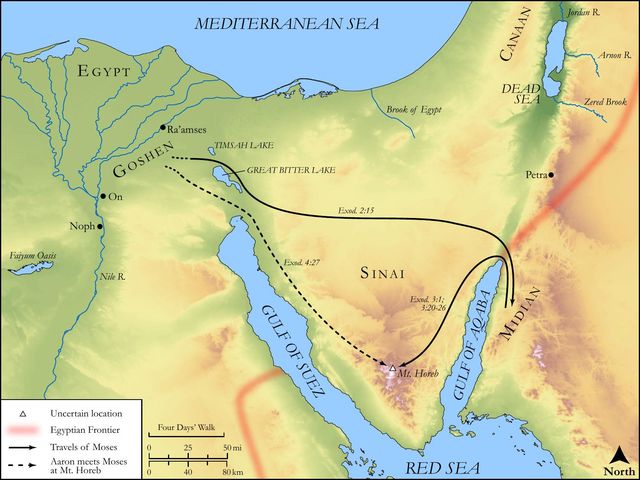
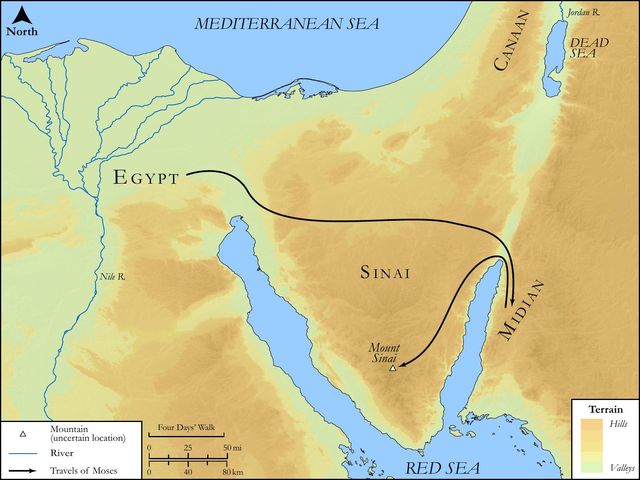
See on the biblical-era maps

Study this verse
Public-domain commentary
Matthew Henry
From his Commentary on the Whole Bible. Henry comments on passages, not single verses — this entry covers Exodus 2:23–25.
Here is, 1. The continuance of the Israelites' bondage in Egypt, Exo 2:23. Probably the murdering of their infants did not continue; this part of their affliction attended only the period immediately connected with the birth of Moses, and served to signalize it. The Egyptians now were content with their increase, finding that Egypt was enriched by their labour; so that they might have them for slaves, they cared not how many they were. On this therefore they were intent, to keep them all at work, and make the best hand they could of their labour. When one Pharaoh died, another rose up in his place that was governed by the same maxims, and was as cruel to Israel as his predecessors. If there was sometimes a little relaxation, yet it presently revived again with as much rigour as ever; and probably, as the more Israel were oppressed the more they multiplied, so the more they multiplied the more they were oppressed. Note, Sometimes God suffers the rod of the wicked to lie very long and very heavily on the lot of the righteous. If Moses, in Midian, at any time began to think how much better his condition might have been had he staid among the courtiers, he must of himself think this also, how much worse it would have been if he had had his lot with brethren: it was a great degradation to him to be keeping sheep in Midian, but better so than making brick in Egypt. The consideration of our brethren's afflictions would help to reconcile us to our own. 2. The preface to their deliverance at last. (1.) They cried, Exo 2:23. Now, at last, they began to think of God under their troubles, and to return to him from the idols they had served, Eze 20:8. Hitherto they had fretted at the instruments of their trouble, but God was not in all their thoughts. Thus hypocrites in heart heap up wrath; they cry not when he binds them, Job 36:13. But before God unbound them he put it into their hearts to cry unto him, as it is explained, Num 20:16. Note, It is a good sign that God is coming towards us with deliverance when he inclines and enables us to cry to him for it. (2.) God heard, Exo 2:24, Exo 2:25. The name of God is here emphatically prefixed to four different expressions of a kind intention towards them. [1.] God heard their groaning; that is, he made it to appear that he took notice of their complaints. The groans of the oppressed cry aloud in the ears of the righteous God, to whom vengeance belongs, especially the groans of God's spiritual Israel; he knows the burdens they groan under and the blessings they groan after, and that the blessed Spirit, by these groanings, makes intercession in them. [2.] God remembered his covenant, which he seemed to have forgotten, but of which he is ever mindful. This God had an eye to, and not to any merit of theirs, in what he did for them. See Lev 26:42. (3.) God looked upon the children of Israel. Moses looked upon them and pitied them (Exo 2:11); but now God looked upon them and helped them. (4.) God had a respect unto them, a favourable respect to them as his own. The frequent repetition of the name of God here intimates that now we are to expect something great, Opus Deo dignum - A work worthy of God. His eyes, which run to and fro through the earth, are now fixed upon Israel, to show himself strong, to show himself a God in their behalf.
Historical interpretation
Historical reception
1 surviving comment on this verse from the historical church.
Finally, the Hebrews who groaned in the labors of Egypt obtained the grace of the righteous. And because they ate bread in sorrow, they were given spiritual food. But the Egyptians, who celebrated such works with exultation, serving a detestable king, did not obtain any forgiveness.
Continue studying Exodus 2:23 across the web’s major study libraries — every link below opens this exact verse, chapter, or book on the destination site.
Read & Compare
 BibleGatewayThis verse in more than 200 translations and 70 languages.
 Bible.comThe YouVersion reader — hundreds of translations, reading plans, and highlights.
 ESV.orgCrossway's official English Standard Version reader.
 NET BibleThe NET translation with 60,000+ translators' notes on every rendering decision.
 STEP BibleTyndale House's free study tool — original text, vocabulary, and scholarly resources.
 BibliaLogos Bible Software's free web reader.
 USCCBThe New American Bible (Revised Edition) with the U.S. bishops' study notes.
Commentaries
 BibleHub CommentariesDozens of classic commentaries on this verse, gathered on one page.
 StudyLightMore than 100 commentary sets — the largest collection on the web.
 BibleRefPlain-English commentary on what this verse means, verse by verse.
 Enduring WordDavid Guzik's free commentary on this chapter, widely used by Bible teachers.
 Bible Study ToolsVerse commentary alongside Greek and Hebrew study aids.
Original Language & Research
- BibleHub InterlinearThe verse word by word — original language, transliteration, and English.
- BibleHub LexiconEvery word's original-language definition and Strong's entry.
 Blue Letter BibleDeep-study tools — Strong's numbers, concordance, and word studies.
 SefariaThe Hebrew text with Rashi and centuries of Jewish commentary.
Sermons, Hymns & Audio


TrulyRandomVerse is not affiliated with these sites and doesn’t control their content. They’re linked because they’re genuinely useful.
Summary
Exodus 2:23 marks a pivotal moment in the narrative of Israel's prolonged oppression, revealing that the death of the reigning Egyptian monarch brought no respite to their suffering. Instead, the relentless burden of their bondage intensified, culminating in desperate sighs and fervent cries that ascended directly to God. This verse powerfully signals the depth of Israel's affliction and, more importantly, God's compassionate attentiveness and impending divine intervention, setting the stage for the miraculous deliverance of the Exodus.
Context
ShowHideLiterary Context
This verse serves as a critical transition point within the book of Exodus. It follows the account of Moses' early life, his flight to Midian after killing an Egyptian, and his establishment of a family there. While Moses is in Midian, the narrative shifts back to the dire situation of the Israelites in Egypt. The death of the Pharaoh who initiated the harsh enslavement and decreed the infanticide of Hebrew male infants is noted, but it is immediately juxtaposed with the continuation of Israel's suffering. This literary move emphasizes that the problem was not merely a single ruler's decree but a deeply entrenched oppression, thereby setting the urgent need for divine, rather than human, intervention. It directly precedes God's remembrance of His covenant and His call to Moses in Exodus 3.
Historical & Cultural Context
The "process of time" mentioned in the verse likely refers to a period of several decades (Moses was 40 when he fled, and 80 when he returned, implying 40 years passed). During this time, the Egyptian empire would have continued its practice of using forced labor for massive building projects, such as cities like Pithom and Raamses (Exodus 1:11). The death of a Pharaoh was a significant event, often leading to a period of instability or a change in policy, but in this case, the pervasive nature of the Israelites' enslavement meant that a new king would simply inherit and continue the existing oppressive policies, especially given the perceived threat of the rapidly multiplying Israelite population (Exodus 1:9-10). The cries of the oppressed were a common feature of life under harsh masters, and Scripture shows them rising to God for justice when human avenues failed, as here, where "their cry came up unto God."
Key Themes
ShowHideExodus 2:23 powerfully contributes to several overarching themes in the book of Exodus and the broader Pentateuch. It highlights the theme of God's Sovereignty and Providence, demonstrating that human political shifts (like the death of a king) are ultimately insufficient to alter God's plans; true deliverance comes only through His direct intervention. It underscores the theme of Divine Compassion and Attentiveness to Suffering, showing that God is not distant but intimately aware of His people's plight, even when they feel abandoned. The verse also introduces the theme of Lament and Prayer as a Catalyst for Divine Action, portraying the Israelites' cries as a direct appeal that reaches God's ears and prompts His response, fulfilling the promises made to Abraham regarding his descendants' affliction and subsequent deliverance (Genesis 15:13-14). This verse sets the stage for the dramatic unfolding of God's redemptive plan for His people.
Exposition and Analysis
ShowHideKey Word Analysis
ShowHideMeaning "a day" or "a space of time defined by an associated term." In the phrase "in process of time," it signifies a significant, undefined period, often implying a long duration. Here, it indicates that many years passed during which Moses was in Midian and the Israelites continued to suffer under Egyptian bondage. This prolonged period emphasizes the endurance of their affliction and the eventual culmination of their suffering that prompted their cry.
A primitive root meaning "to shriek (from anguish or danger)" or "to announce or convene publicly." This word denotes a loud, urgent, and desperate appeal for help, typically directed to a higher authority in times of severe distress or oppression. It is not a passive groan but an active, fervent plea, signifying a breaking point in their suffering where their anguish could no longer be contained silently.
A primitive root meaning "to ascend, intransitively (be high) or actively (mount)." When applied to their cry "coming up unto God," it conveys the powerful imagery of their desperate appeal physically rising from their earthly suffering to the divine throne room. This signifies that their cry was not merely uttered but was heard, received, and acknowledged by the Almighty, indicating God's active attentiveness and readiness to respond.
Verse Breakdown
ShowHide"And it came to pass in process of time, that the king of Egypt died:"
This opening clause establishes a significant temporal marker, signifying a substantial passage of years since the events of the earlier verses. The death of the reigning Pharaoh, while a major political event, is presented as a development that, surprisingly, does not bring the expected relief to the enslaved Israelites. It sets up the ironic contrast between human expectation (a new king might mean new policies) and the continued reality of their suffering.
"and the children of Israel sighed by reason of the bondage,"
This phrase vividly portrays the profound and prolonged suffering of the Israelites. Their "sighs" (Hebrew: ʼânach) denote deep groaning, a visceral expression of pain, distress, and weariness that has reached an unbearable level. It speaks to a deep, internal anguish that has become outwardly manifest, reflecting the cumulative burden of their oppression and the exhaustion of their spirit.
"and they cried,"
The shift from "sighs" to "cries" (Hebrew: zâʻaq) is highly significant. While sighing suggests internal anguish, crying implies an urgent, loud, and desperate appeal for help. This indicates a heightened state of distress, a breaking point where their suffering became so intense that they could no longer bear it silently and were compelled to vocalize their desperate need for intervention.
"and their cry came up unto God by reason of the bondage."
This final clause is the theological climax of the verse. The phrase "came up unto God" signifies that their desperate appeal was not merely a human lament but a prayer that ascended to the divine realm, reaching the ears of the Almighty. The repetition of "by reason of the bondage" emphasizes that their suffering was the direct, persistent cause of their cries, highlighting the intensity and duration of their affliction. Crucially, this phrase indicates God's active attentiveness to the plight of His people, even when they seemed forgotten or abandoned, foreshadowing His imminent response and deliverance.
Literary Devices
ShowHideExodus 2:23 employs several potent literary devices to convey its message. Juxtaposition is evident in the contrast between the death of the powerful Egyptian king and the continued suffering of the Israelites, highlighting that human political change is insufficient to alleviate divinely ordained oppression. The verse also uses Repetition with the phrase "by reason of the bondage," which appears twice, powerfully emphasizing the unrelenting and pervasive nature of their affliction as the direct cause of their anguish and cries. Furthermore, the phrase "their cry came up unto God" employs Anthropomorphism, attributing human-like perception (hearing) and spatial movement (coming up) to God, thereby conveying His active attentiveness and responsiveness to His people's distress in a tangible way. This imagery vividly portrays the efficacy of their desperate pleas.
Theological and Thematic Connections
ShowHideExodus 2:23 is a profound theological statement on God's character and His relationship with His covenant people. It powerfully illustrates that God is not distant or indifferent to the suffering of His creation, particularly His chosen people. Their cries "came up unto God," signifying His active hearing and compassionate awareness of their plight, even when human efforts or changes in leadership fail to bring relief. This verse underscores the efficacy of lament and prayer, presenting the Israelites' "sighs" and "cries" as a direct catalyst for divine action. It highlights the biblical principle that genuine lament and desperate prayer are not merely expressions of pain but potent appeals that reach God's ears and move Him to intervene on behalf of the afflicted, often in alignment with His sovereign timing and covenant faithfulness.
Reflection and Application
ShowHideExodus 2:23 offers profound encouragement for all who endure prolonged suffering, oppression, or seemingly unchangeable circumstances. It reminds us that our deepest pains, our most desperate sighs, and our most fervent prayers do not go unnoticed by the Almighty. Even when human solutions fail, or when the passage of time brings no relief, God remains attentive to the plight of His people. This verse serves as a powerful testament to God's compassion and His readiness to act on behalf of those who are afflicted. It urges believers to bring their burdens to God with fervent prayer, trusting in His divine timing and power to intervene, just as He did for Israel. In our own lives, when we feel trapped by circumstances, whether personal, societal, or spiritual, this passage calls us to cry out to God, assured that our cries ascend to His throne and that He hears, remembers, and will act according to His perfect will and redemptive purposes.
Questions for Reflection
ShowHideFAQ
ShowHideWhy did the death of the king of Egypt not immediately end Israel's bondage?
ShowHideThe oppression of the Israelites was deeply pervasive, not merely the whim of a single monarch. While the king's death was a significant event, the institution of slavery and the policies against the Hebrews were deeply entrenched within the Egyptian state and economy. A new Pharaoh would naturally inherit and likely continue these policies, especially given the perceived economic benefit of their labor and the ongoing fear of the growing Israelite population, as described in Exodus 1:9-10. Therefore, the death of one king did not dismantle the entire oppressive rule, ensuring the continuation of their "bondage."
What is the significance of the Israelites' "sighs" and "cries" coming "up unto God"?
ShowHideThis phrase signifies God's active perception, acknowledgment, and compassionate response to their suffering. It is not merely a poetic expression but indicates that their desperate pleas penetrated the heavens and reached the divine ear. It underscores God's attentiveness and compassion, showing that He is not indifferent to the pain of His people. This divine hearing is the crucial precursor to His intervention, as explicitly stated in Exodus 2:24-25, demonstrating that their lament did not fall on deaf ears but moved God to action.
Does this verse imply that God only acts when people cry out to Him?
ShowHideWhile this verse powerfully highlights the importance of human lament and prayer as a catalyst for divine action, it does not imply that God is inactive until His people cry out. The preceding narrative in Exodus 2 shows God's sovereign plan was already in motion (e.g., preserving Moses from the decree of infanticide). However, the Israelites' cries serve as a crucial moment where human desperation meets divine compassion, demonstrating that God hears and responds to the earnest pleas of His afflicted, often in alignment with His predetermined will and timing. It emphasizes that while God is sovereign, He also invites and responds to the prayers of His people.
Christ-Centered Fulfillment
ShowHideExodus 2:23, with its poignant depiction of Israel's desperate cries under the crushing weight of Egyptian bondage and God's compassionate response, profoundly foreshadows the ultimate deliverance accomplished through Jesus Christ. Just as Israel's physical suffering led to a divine intervention that brought them out of slavery, humanity's spiritual bondage to sin and death elicits a divine response in the person of Christ. Jesus, the Lamb of God who takes away the sin of the world, entered into our suffering, not merely to alleviate symptoms but to break the chains of sin and death definitively. His incarnation demonstrates God's profound empathy, as described in Hebrews 4:15, where He is able to sympathize with our weaknesses. His crucifixion and resurrection represent the ultimate act of God's remembrance of His covenant and His powerful intervention to bring His people out of a far greater captivity, fulfilling the pattern of deliverance initiated in the Exodus narrative. Through Christ, we are liberated from the bondage of corruption and brought into the glorious freedom of the children of God, echoing Israel's journey from slavery to promised land.