


Exodus 2:22
Bible text: King James Version (1769 Blayney text) · Public domain
Bible text: Berean Standard Bible · Public domain
Bible text: American Standard Version (1901) · Public domain
Bible text: World English Bible, Messianic edition · Public domain
Bible text: Geneva Bible (1599) · Public domain
Bible text: Young's Literal Translation · Public domain
- וַתֵּלֶדva·Te·ledand she boreH3205Conj-w ¦ V-Qal-ConsecImperf-3fsVerb Qal Consecutive Imperfect 3rd Singular Feminineוַandתֵּלֶדshe bore
- בֵּןBena sonH1121N-msNoun Singular Masculine Absolute
- וַיִּקְרָאvai·yik·Ra'and he calledH7121Conj-w ¦ V-Qal-ConsecImperf-3msVerb Qal Consecutive Imperfect 3rd Singular Masculineוַandיִּקְרָאhe called
- אֶת'et<obj.>H853DirObjMParticle Object Indicator
- שְׁמוֹshe·Mohis nameH8034N-msc ¦ 3msNoun Singular Masculine Constructשְׁמnameוֹhis
- גֵּרְשֹׁםge·re·ShomGershomH1647N-proper-mNoun Proper Masculine
- כִּיkiforH3588PrtParticle Conditional
- אָמַר'a·Marhe saidH559V-Qal-Perf-3msVerb Qal Perfect 3rd Singular Masculine
- גֵּרgera sojournerH1616N-msNoun Singular Masculine Absolute
- הָיִיתִיha·Yi·tiI have becomeH1961V-Qal-Perf-1csVerb Qal Perfect 1st Singular common gender
- בְּאֶרֶץbe·'E·retzin a landH776Prep-b ¦ N-fsNoun Singular Feminine Absoluteבְּinאֶרֶץa land
- נָכְרִיָּהna·khe·ri·YahforeignH5237Adj-fsAdjective Singular Feminine Absolute
English is a literal word-by-word gloss of the Hebrew, not the KJV's wording. Why?
This is the original text the KJV's translators worked from — each Hebrew word with its own literal English meaning in this verse, prepared by scholars at Tyndale House, Cambridge. The KJV translates whole sentences, not word by word, so its wording differs: one Hebrew word can become several English words, and the KJV may choose “the LORD” where the gloss reads “Yahweh”. Both are faithful — they answer different questions. For the KJV's own rendering, switch to the KJV text.
Details
See on the biblical-era maps

Study this verse
Public-domain commentary
Matthew Henry
From his Commentary on the Whole Bible. Henry comments on passages, not single verses — this entry covers Exodus 2:16–22. His four-level outline is real structure in the source text, so it is rendered as structure.
Moses here gains a settlement in Midian, just as his father Jacob had gained one in Syria, Gen 29:2, etc. And both these instances should encourage us to trust Providence, and to follow it. Events that seem inconsiderable, and purely accidental, afterwards appear to have been designed by the wisdom of God for very good purposes, and of great consequence to his people. A casual transient occurrence has sometimes occasioned the greatest and happiest turns of a man's life. Observe,
I.Concerning the seven daughters of Reuel the priest or prince of Midian.
1.They were humble, and very industrious, according as the employment of the country was: they drew water for their father's flock, Exo 2:16. If their father was a prince, it teaches us that even those who are honourably born, and are of quality and distinction in their country, should yet apply themselves to some useful business, and what their hand finds to do do it with all their might. Idleness can be no one's honour. If their father was a priest, it teaches us that ministers' children should, in a special manner, be examples of humility and industry.
2.They were modest, and would not ask this strange Egyptian to come home with them (though handsome and a great courtier), till their father sent for him. Modesty is the ornament of woman.
II.Concerning Moses.
He was taken for an Egyptian (Exo 2:19); and strangers must be content to be the subjects of mistake; but it is observable,
1.How ready he was to help Reuel's daughters to water their flocks. Though bred in learning and at court, yet he knew how to turn his hand to such an office as this when there was occasion; nor had he learned of the Egyptians to despise shepherds. Note, Those that have had a liberal education yet should not be strangers to servile work, because they know not what necessity Providence may put them in of working for themselves, or what opportunity Providence may give them of being serviceable to others. These young women, it seems, met with some opposition in their employment, more than they and their servants could conquer; the shepherds of some neighbouring prince, as some think, or some idle fellows that called themselves shepherds, drove away their flocks; but Moses, though melancholy and in distress, stood up and helped them, not only to get clear of the shepherds, but, when that was done, to water the flocks. This he did, not only in complaisance to the daughters of Reuel (though that also did very well become him), but because, wherever he was, as occasion offered itself,
(1.)He loved to be doing justice, and appearing in the defence of such as he saw injured, which every man ought to do as far as it is in the power of his hand to do it.
(2.)He loved to be doing good. Wherever the Providence of God casts us we should desire and endeavour to be useful; and, when we cannot do the good we would, we must be ready to do the good we can. And he that is faithful in a little shall be entrusted with more.
2.How well he was paid for his serviceableness. When the young women acquainted their father with the kindnesses they had received from this stranger, he sent to invite him to his house, and made much of him, Exo 2:20. Thus God will recompense the kindnesses which are at any time shown to his children; they shall in no wise lose their reward. Moses soon recommended himself to the esteem and good affection of this prince of Midian, who took him into his house, and, in process of time, married one of his daughters to him (Exo 2:21), by whom he had a son, whom he called Gershom, a stranger there (Exo 2:22), that if ever God should give him a home of his own he might keep in remembrance the land in which he had been a stranger. Now this settlement of Moses in Midian was designed by Providence,
(1.)To shelter him for the present. God will find hiding-places for his people in the day of their distress; nay, he will himself be to them a little sanctuary, and will secure them, either under heaven or in heaven. But,
(2.)It was also designed to prepare him for the great services he was further designed for. His manner of life in Midian, where he kept the flock of his father-in-law (having none of his own to keep), would be of use to him,
[1.]To inure him to hardship and poverty, that he might learn how to want as well as how to abound. Those whom God intends to exalt he first humbles.
[2.]To inure him to contemplation and devotion. Egypt accomplished him as a scholar, a gentleman, a statesman, a soldier, all which accomplishments would be afterwards of use to him; but yet he lacked one thing, in which the court of Egypt could not befriend him. He that was to do all by divine revelation must know, by a long experience, what it was to live a life of communion with God; and in this he would be greatly furthered by the solitude and retirement of a shepherd's life in Midian. By the former he was prepared to rule in Jeshurun, but by the latter he was prepared to converse with God in Mount Horeb, near which mount he had spent much of his time. Those that know what it is to be alone with God in holy exercises are acquainted with better delights than ever Moses tasted in the court of Pharaoh.
Historical interpretation
Historical reception
1 surviving comment on this verse from the historical church.
Gersam: Or Gershom. This name signifies a stranger there: as Eliezer signifies the help of God.
Continue studying Exodus 2:22 across the web’s major study libraries — every link below opens this exact verse, chapter, or book on the destination site.
Read & Compare
 BibleGatewayThis verse in more than 200 translations and 70 languages.
 Bible.comThe YouVersion reader — hundreds of translations, reading plans, and highlights.
 ESV.orgCrossway's official English Standard Version reader.
 NET BibleThe NET translation with 60,000+ translators' notes on every rendering decision.
 STEP BibleTyndale House's free study tool — original text, vocabulary, and scholarly resources.
 BibliaLogos Bible Software's free web reader.
 USCCBThe New American Bible (Revised Edition) with the U.S. bishops' study notes.
Commentaries
 BibleHub CommentariesDozens of classic commentaries on this verse, gathered on one page.
 StudyLightMore than 100 commentary sets — the largest collection on the web.
 BibleRefPlain-English commentary on what this verse means, verse by verse.
 Enduring WordDavid Guzik's free commentary on this chapter, widely used by Bible teachers.
 Bible Study ToolsVerse commentary alongside Greek and Hebrew study aids.
Original Language & Research
- BibleHub InterlinearThe verse word by word — original language, transliteration, and English.
- BibleHub LexiconEvery word's original-language definition and Strong's entry.
 Blue Letter BibleDeep-study tools — Strong's numbers, concordance, and word studies.
 SefariaThe Hebrew text with Rashi and centuries of Jewish commentary.
Sermons, Hymns & Audio


TrulyRandomVerse is not affiliated with these sites and doesn’t control their content. They’re linked because they’re genuinely useful.
Summary
Exodus 2:22 marks a significant moment in Moses' life during his exile in Midian, detailing the birth of his first son, Gershom. Moses' choice of name for his son is deeply personal and revelatory, encapsulating his profound sense of displacement and alienation from his Hebrew heritage and homeland, thereby expressing his identity as a sojourner in a foreign land.
Context
ShowHideLiterary Context
This verse immediately follows Moses' dramatic flight from Egypt, a consequence of his intervention on behalf of a Hebrew slave, which resulted in the killing of an Egyptian taskmaster (Exodus 2:11-14). Having fled Pharaoh's wrath, Moses arrives in Midian, where he encounters Jethro's daughters at a well and defends them from shepherds (Exodus 2:16-17). His subsequent welcome into Jethro's household and marriage to Zipporah (Exodus 2:21) set the stage for the birth of Gershom. This period in Midian, spanning forty years, represents a crucial interlude of preparation and personal transformation for Moses before his divine encounter at the burning bush in Exodus 3.
Historical & Cultural Context
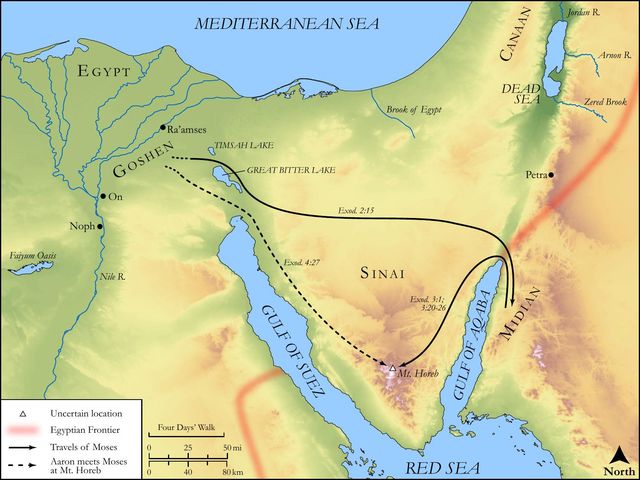
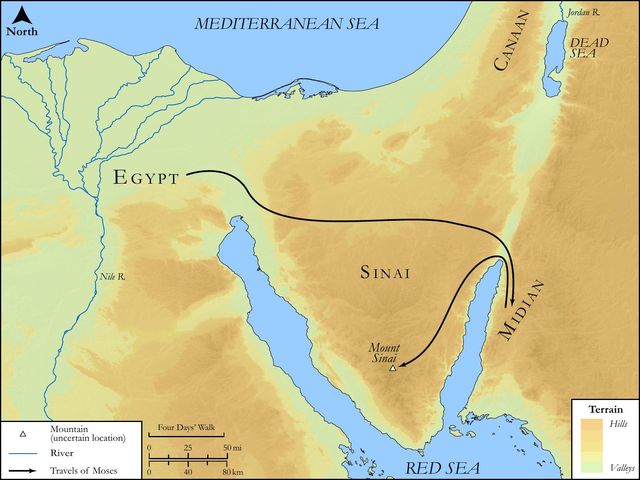
Moses' flight to Midian placed him in a semi-nomadic region east of the Gulf of Aqaba, inhabited by various tribes, including the Kenites, to whom Jethro belonged. Midianites were often depicted as traders and shepherds, and their culture, while distinct from Egyptian and Canaanite societies, shared common Semitic roots. The act of naming a child in Hebrew thought was highly significant, often reflecting the circumstances of birth, the parents' experiences, hopes, or even prophecies for the child's future. Moses' naming of Gershom thus carries profound cultural weight, serving as a public declaration of his internal state and the reality of his exile.
Key Themes
ShowHideExodus 2:22 contributes to several overarching themes within the book of Exodus and the broader Pentateuch. It highlights the theme of exile and sojourning, not only for Moses personally but also foreshadowing the Israelites' future forty-year wanderings in the wilderness as sojourners before entering the Promised Land (Deuteronomy 8:2-5). The verse also underscores divine providence, demonstrating how God uses seemingly obscure periods of hardship and displacement to prepare His chosen instruments for their future roles, as seen in Moses' transformation from an Egyptian prince to a humble shepherd. Furthermore, it reinforces the biblical emphasis on meaningful naming, where names are not mere labels but convey deep theological or personal significance, connecting individual identity to God's unfolding plan, much like the naming of Isaac or Jacob.
Exposition and Analysis
ShowHideExodus 2:22 states, "And she bare [him] a son, and he called his name Gershom: for he said, I have been a stranger in a strange land." This verse, though concise, is profoundly revealing of Moses' internal state and the circumstances of his life during his Midianite exile. It captures a moment of domesticity that is nonetheless permeated by a deep sense of alienation and longing for his true home.
Key Word Analysis
ShowHideThe name of Moses' firstborn son. As explained by Moses himself, the name is a compound reflecting his experience. It combines "gêr" (stranger/sojourner) and "sham" (there), literally meaning "a stranger there." This name serves as a perpetual reminder of Moses' displacement and his identity as an outsider.
Properly, a guest; by implication, a foreigner; alien, sojourner. This word denotes someone residing in a foreign land without full native rights, often dependent on the hospitality of others. Moses' use of this term for himself underscores his profound sense of not belonging, despite finding refuge and family in Midian.
From a root meaning "to be foreign"; strange, in a variety of degrees and applications (foreign, non-relative, adulterous, different, wonderful). In this context, it emphasizes the foreignness of the land itself, reinforcing Moses' feeling of being an alien in an unfamiliar environment.
Verse Breakdown
ShowHide"And she bare [him] a son,"
This phrase simply records the birth of Moses' first child with Zipporah. The act of bearing a son was highly valued in ancient Israelite culture, ensuring the continuation of the family line and heritage.
"and he called his name Gershom:"
This highlights Moses' agency in naming his son, an act that traditionally carried significant meaning. The name chosen by the father often reflected the circumstances of the birth or the father's emotional state or hopes.
"for he said,"
This introduces Moses' direct explanation for the name choice, providing the theological and personal rationale behind "Gershom." It emphasizes the deliberateness and personal significance of the naming.
"I have been a stranger in a strange land."
This powerful declaration is the heart of the verse. It reveals Moses' deep-seated feeling of alienation and displacement. Despite his new family and apparent security, he perceives himself as an outsider, far from his true home and people. This statement encapsulates his identity crisis and longing.
Literary Devices
ShowHideThe primary literary device at play in Exodus 2:22 is Symbolism, specifically through Onomastics (the study of names and their origins). Moses' naming of his son Gershom is not arbitrary; it is a symbolic act that encapsulates his personal experience and internal state. The name "Gershom" itself is a Pun or Wordplay, directly derived from the Hebrew words for "stranger" (ger) and "there" (sham), making the name a living testament to Moses' declaration, "I have been a stranger in a strange land." This creates a powerful Irony in Moses' situation: though he is safe, married, and a father, his chosen name for his son reveals a profound sense of homelessness and disconnection from his birthright and people. The naming acts as a Foreshadowing, subtly hinting at the future journey of the Israelites as sojourners in the wilderness, mirroring Moses' own temporary exile.
Theological and Thematic Connections
ShowHideMoses' personal experience of being "a stranger in a strange land" is a profound theological motif that resonates throughout biblical history. It not only reflects his immediate circumstances but also foreshadows the broader narrative of God's people. The Israelites would soon become sojourners themselves, first in the wilderness, then later through various exiles. This theme extends to the New Testament, where believers are often described as spiritual pilgrims, living in the world but not fully belonging to it, awaiting their true, eternal home. This perspective fosters a sense of detachment from worldly attachments and a longing for the heavenly kingdom.
Reflection and Application
ShowHideMoses' naming of Gershom in Exodus 2:22 offers a deeply relatable perspective for believers navigating their identity and purpose in a world often at odds with their spiritual convictions. Like Moses, who felt like a stranger despite finding a new family, Christians are called to live as "strangers and pilgrims" on earth (1 Peter 2:11), understanding that our true citizenship and ultimate home are in heaven (Philippians 3:20). This perspective cultivates a healthy detachment from worldly pursuits and a longing for the eternal. Furthermore, Moses' personal experience of alienation did not lead to bitterness but profoundly shaped his empathy, later informing the Mosaic Law's repeated commands to show kindness and justice to the sojourner and alien among them (Leviticus 19:34). This challenges us to show the stranger the same kindness the Law required of Israel, remembering that we too were once strangers and sojourners, and recognizing that God often uses our seasons of feeling "out of place" to forge deeper character, empathy, and reliance on Him, preparing us for His greater purposes.
Questions for Reflection
ShowHideFAQ
ShowHideWhy did Moses name his son Gershom?
ShowHideMoses named his son Gershom because the name directly reflects his personal experience and profound sense of displacement. He states, "I have been a stranger in a strange land," and the name Gershom (Hebrew: Ger-shom) literally means "a stranger there" or "a sojourner in that place." It encapsulated his feeling of being an alien, far from his Hebrew people and homeland, and served as a constant reminder of his exile.
What is the significance of Moses' time in Midian before his calling?
ShowHideMoses' forty years in Midian, though seemingly a period of exile and obscurity, was a crucial time of divine preparation. During this period, God stripped away Moses' Egyptian princely identity and pride, teaching him humility, patience, and the skills of a shepherd, which would be essential for leading the vast Israelite nation through the wilderness. It was a time for him to mature spiritually and personally before encountering God at the burning bush and receiving his monumental calling to deliver Israel from bondage (Exodus 3:1-10).
Christ-Centered Fulfillment
ShowHideMoses' experience as a "stranger in a strange land" in Exodus 2:22 finds its ultimate and most profound fulfillment in the person and mission of Jesus Christ. While Moses was a stranger by necessity of exile and personal displacement, Christ willingly became a sojourner, leaving the infinite glory and comfort of heaven to dwell among humanity, a people who often did not recognize or receive Him (John 1:10-11). He declared that "the Son of Man has nowhere to lay his head" (Matthew 8:20), embodying the ultimate sojourner who, though the Creator and Sustainer of all, lived a life of humble itinerancy without a permanent earthly dwelling. Furthermore, Christ's mission was to reconcile alienated humanity to God, transforming us from "strangers and aliens" into fellow citizens with the saints and members of God's household (Ephesians 2:19). Thus, Moses' personal displacement points forward to the divine humility of Christ, who became a stranger for our sake, ultimately leading us, the once-alienated, to our true, eternal home and belonging in God's presence.